Specs are compiled from manufacturer listings and verified buyer reviews and can change over time — please confirm the key details on the product page before buying.
If your squad already knows your voice, the fix is a small box that changes it before the audio ever leaves your controller. A voice changer device sits between your mic and your console or PC, swaps your voice for a robot, a monster, or a child in real time, and lets you trigger meme sounds on top. What most buyers want first is simple: does it actually work on a PS5 or Xbox without a PC, and does the other side hear it clearly. This list answers that, and it separates the boxes that genuinely change your voice from the ones that only claim to.
This guide is built by comparing the manufacturers’ published specifications and the patterns across verified customer reviews, so you get each pick’s real strengths and trade-offs instead of marketing spin.
Some boxes want an XLR microphone and a spare channel; others plug straight into a controller and run off an app. Below you get both kinds, matched to what you actually play on, so the pick you buy is the one that fits your setup rather than the loudest box on the shelf. The crowd favorite here holds 4.0+ stars across 4,500+ ratings, which is why it leads the list.
Top Picks


How To Choose The Best Voice Changer Device
The single decision that matters is where your voice goes next. If it goes into a console party chat, you need a box with a 3.5mm jack that sits between your controller and your headset. If it goes into a PC for streaming, an XLR or USB mixer gives you far more control. Get that one thing right and the effects list matters far less.
Match the connection to your machine, not the marketing
A 3.5mm changer is the console-friendly format, but modern consoles often drop the round headphone jack. That means you may need a USB-C to 3.5mm adapter, and several listings state plainly that the adapter is not included. Check what cables are in the box before you buy — one of the picks here ships USB-C to USB-C, USB-C to Lightning, and a 150cm 3.5mm TRRS cable so you can wire it up from the start.
Count the voices, then count the tuning
Eight modes is the common baseline across this category, and the better boxes add fine-tuning so each voice bends deeper or softer. One premium pick runs 200+ AI voices from a phone app, while a gaming sound board lists six fixed voices. More options help if you stream; for a quick prank with friends, six solid voices beat two hundred you never open.
Look for monitoring and noise control
Real-time monitoring lets you hear your own changed voice as you speak, which is the difference between a convincing bit and a mess. Side-chain does the opposite job on background music: it ducks the song automatically when you talk. Both are worth more day to day than an extra sound effect.
Side-by-Side Comparison
| Model | Best For | Connection | Voices / Effects | Weight | Amazon |
|---|---|---|---|---|---|
| FIFINE Ampligame SC3★ Best Overall | Streamers with an XLR mic | USB and XLR mic input | 6 voice modes, 12 auto tune, 4 sample buttons | 0.5 kg | Amazon |
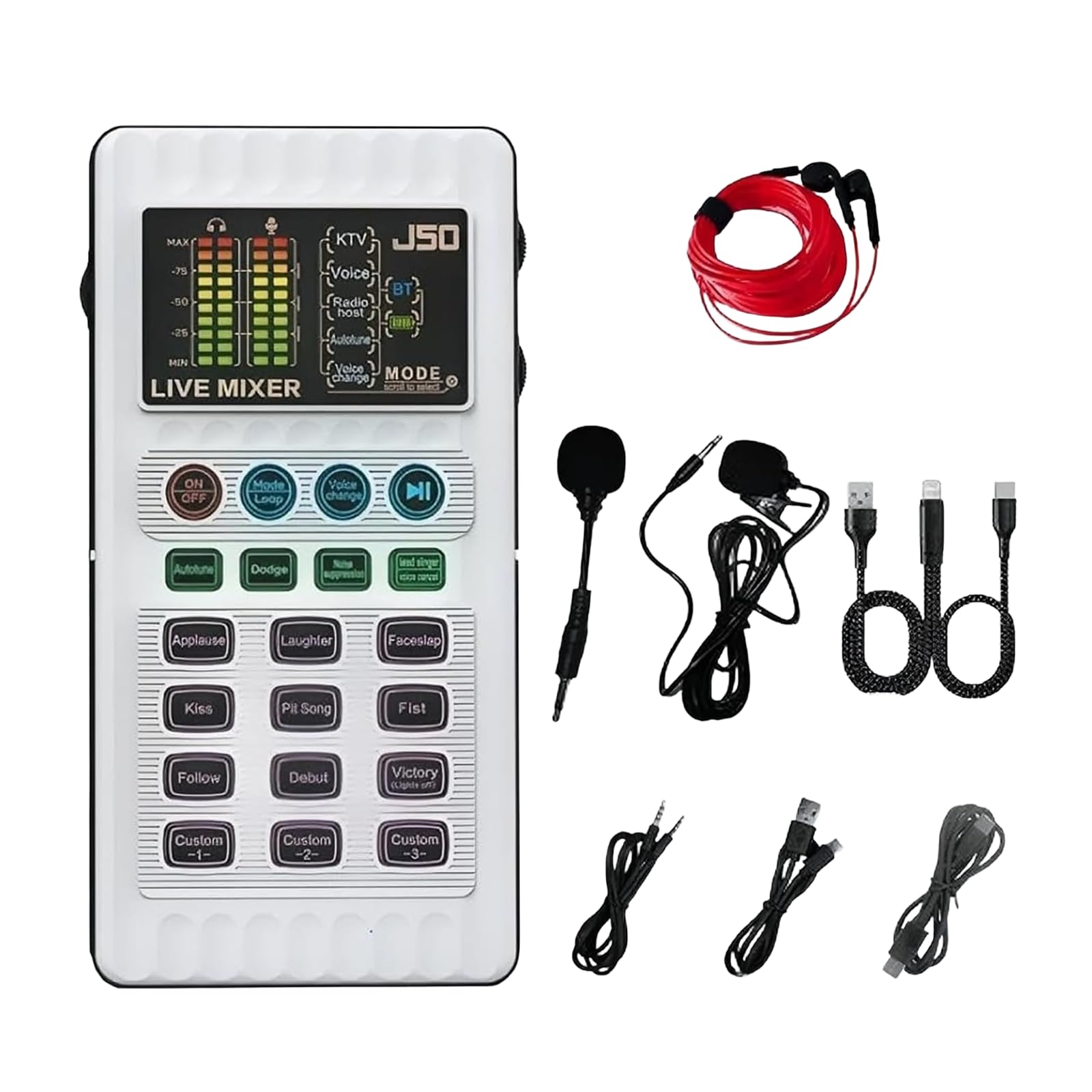
| J50 Portable Live Sound CardBest for Live Streams | On-the-go live streaming | Bluetooth and OTG | 5 voice changers, 12 ambient effects | — | Amazon |
| Glomtheia Gaming Sound BoardTop for PC and PS5 | PC and PS5 with an XLR mic | USB and combo XLR / 1/4″ mic | 6 voice types plus sample recording | 0.53 kg | Amazon |
| Facmogu MC10 Karaoke Mic | TikTok live and karaoke | USB-C | 8 voice modes, 9 sound effects | — | Amazon |
| I9 Portable Voice Changer | Budget pranks and party games | 3.5mm | 8 voice modes, 8 sound effects | — | Amazon |
| AHYGZWZSYC Gaming Voice Changer | Console chat across PS4, PS5 and Xbox | 3.5mm | 4 voice types with 24 variations each | — | Amazon |
| Voicemod Key Lite | Console chat with the biggest voice library | USB-C plus 3.5mm TRRS | 200+ AI voices, 76,000+ community filters | 60 g | Amazon |
| Flylin Handheld Voice Changer | The smallest, lightest a neat extra | 3.5mm plug and play | 16 sound changes, 8 sound effects | 0.04 kg | Amazon |
Detailed Reviews
1. FIFINE Ampligame SC3 Gaming Audio Mixer
Our pick — 4.0+★ from 4,500+ verified ratings; the strongest balance of quality and price.
The desk mixer that hands you a real fader, an XLR mic input, and six voices on tap.
Most voice changers are gadgets you talk into. This is a small mixing desk you build a stream around, and the build is what holds it at the top: 0.5 kg of hardware with a smooth volume slider fader and four independent channels controlling the microphone, line in, headphone, and line out separately. That means you can nudge your voice up and your game audio down with your hand instead of alt-tabbing into software.
The feature that earns it a permanent spot on a desk is the XLR input with built-in 48V phantom power — a supply that lets a studio condenser microphone run without a separate box. If you already own a good XLR mic, this lets you keep it and add voice effects on the way in. Just know the XLR input is for XLR microphones only and will not accept a USB mic.
Six voice-changing modes are here for the fun, plus 12 auto tune settings that bend the pitch of your voice, and four buttons you can record and fire at a press. The front-panel mute and monitor buttons are placed where your fingers actually go, not hidden around the back, so you can cut background noise or hear yourself without fumbling mid-broadcast. What keeps it from being flawless is the audio path itself: some owners get clean sound, others hear breaks in it, so a shielded XLR cable is worth the small extra rather than a thin one.
What you are paying for
- An XLR mic input with 48V phantom power, so a condenser mic plugs straight in
- Four channels with their own volume control, including a mic fader that is genuinely smooth
- Six voice modes, 12 auto tune levels, and four recordable sample buttons
- Mute and monitor on the front, plus flowing RGB that is easy on the eyes
Where it asks more of you
- Not built for USB microphones, so that kind of mic cannot use the XLR input
- XLR cable is not in the box, and cable quality affects the sound you get
- Heavier than a pocket changer at 0.5 kg — this one stays on the desk
Built for: anyone streaming from a PC with an XLR microphone who wants voice effects and hands-on faders in one unit.
Worth knowing: the voice effects are the garnish here, not the main course — the mixing control is what you are really buying.
2. J50 Portable Live Sound Card
A pocket stage for the streamer who records outdoors as often as at the desk.
If your broadcasts happen in a mall, a market stall, or a windy park, the noise problem comes before the voice problem. The J50 answers with a DSP hybrid noise reduction chip — a processor paired with an AI algorithm that pulls down background hiss between you and the mic. Five voice changer effects cover the familiar male, female, and smart voice options, and 12 ambient effects such as applause and laughter sit on physical buttons.
Where this one separates from the desk-bound mixers above is portability and power. A high-capacity polymer lithium battery with a protection circuit lets it stream while plugged in, so a long session does not stall on a dead cell. Bluetooth accompaniment handles your backing track wirelessly, and OTG connection ties it to a phone or PC. It is built for the creator who moves between indoor streaming, outdoor recording, and live commerce without rewiring a studio each time.
One-click switching keeps it friendly: original sound, host, karaoke, electronic music, and voice change each have their own button, along with bass, treble, reverb, and a one-click vocal removal. The honest note is depth of setup — this is a hardware-first box, so anyone expecting an app with hundreds of filters will find the five voices lean. It rewards the buyer who wants to press a button and go live.
Who it clicks with: outdoor and mobile streamers, live sellers, and karaoke hosts who need a battery-backed sound card more than a deep voice library.
The trade-off to weigh: five voice changers is a small menu — a light choice if the voice-swapping trick is your whole reason for buying.
Reach for this if: your stream travels and you want noise control plus effects on battery power.
Look elsewhere if: you want dozens of voices to scroll through rather than five to master.
3. Gaming Sound Board Audio Interface Voice Changer for PC PS5
Six voices, a sample button, and side-chain ducking in a small metal-topped interface.
Picture a Sunday night stream where you want to drop in as a robot, fire a recorded clip, and keep your background music from drowning out your voice. The AR011 does all three. Its voice changer covers Male, Female, Baby, Elder, Robot, and Monster, and an on-the-fly sample feature lets you record and riff clips for your podcast or stream without leaving the desk.
The combo XLR and 1/4-inch microphone connection is the detail that matters most for audio quality, since it takes both condenser and dynamic microphones. Four channels each get their own volume slider and mute button — mic, headphones, line in, and line out — so you can balance the room without software menus. Side-chain is the clever part: it cuts the background music automatically the moment you start speaking.
At 0.53 kg it is a touch heavier than the FIFINE above at 0.5 kg, and both are desk fixtures rather than pocket gadgets. Mic monitoring is included, so you hear your own changed voice in the headphones as you talk. It is a straightforward, no-nonsense interface for a PC or PS5 setup with a real microphone — not a phone accessory, and not the pick for a headset-only console player who never touches an XLR.
What stands out: side-chain plus on-the-fly samples is a combination aimed squarely at live broadcasters who talk over music.
The honest catch: the voice menu stops at six, and the box expects a proper microphone and a desk to sit on.
Best matched to: podcasters and streamers running a condenser or dynamic mic into a PC or PS5.
Less suited to: players who only have a console headset and want a clip-on changer.
4. Online Karaoke Microphone
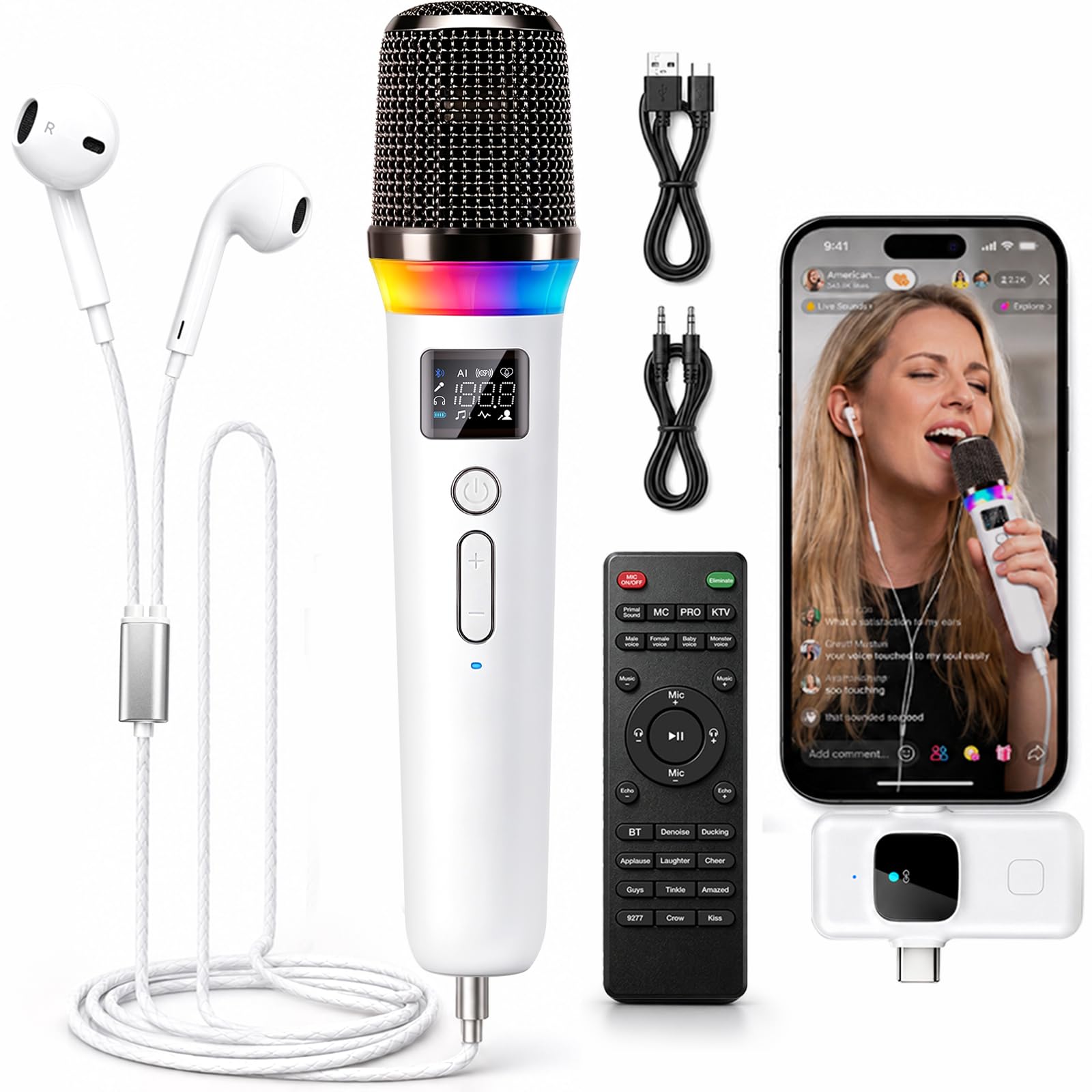
One microphone that already contains the voice changer and the sound card inside it.
This is the pick for the singer who does not want to assemble an audio chain. The MC10 is a handheld microphone with the sound card and voice changer built in, so there is no separate interface to wire up. Eight voice modes cover Original, MC, PRO, KTV, Male, Female, Baby, and Monster, and nine sound effects such as applause, laughter, and cheers fire on demand during a live session.
Hearing yourself is handled properly for karaoke. Plug in headphones and you get real-time monitoring with zero delay — the product’s phrasing for hearing your voice as you sing without a lag between your mouth and your ears. Noise reduction knocks down background distractions like a fan, traffic, or an air conditioner, and a remote control lets you switch modes mid-song instead of reaching for the body of the mic. Dynamic RGB lighting sets the scene for a TikTok live or a family karaoke night.
Connection is USB-C, and it is stated as compatible with iPhone, Android, and PCs, so it suits a phone-first creator. The caveat is the one thing an all-in-one always asks: you get this microphone rather than your own, so anyone with a favored mic is giving something up. As a single-piece starter rig for live singing, though, it removes almost every setup step.
Why it suits beginners: the mic, the effects, and the voice changer arrive as one unit with a remote in hand.
What you give up: flexibility — this is a self-contained microphone, so it replaces your setup rather than adding to it.
For the karaoke and TikTok crowd: it is the simplest path to a voice-changer mic with live effects.
Not for the studio owner: if you already trust your own mic, this all-in-one leaves it out of the chain.
5. I9 Voice Changer

Eight voices, a fine-tune knob, and a hard case for the price of a takeaway.
For a few friends around a screen, this is the low-risk way into voice swapping. Eight distinct modes cover male to female, female to male, normal, Lolita, baby, youth, king, and witch, and a fine-tuning knob lets you bend each voice into variations beyond the eight presets. Eight sound effects — applause, kiss, laughter, cheerful, surprise, fright, crow, and time — each get their own button.
It goes plug and play, so there are no drivers to install before your first prank. LED lights give it a gaming look with a separate switch to kill them when you would rather stay discreet. The listed maximum sample rate is 48 KHz, the same figure quoted on several changers in this class.
The things to plan around are adapters. It works over a 3.5mm interface, iOS devices need a separate adapter cable that is not included, and a PC connection also needs its own adapter. So on a phone you are fine, and on a modern console or a laptop you are buying a small extra cable first. Set that expectation and it delivers exactly what a budget changer should.
The value read: eight voices, eight effects, and a storage case for a beginner-level outlay.
Plan ahead for: the missing adapters — iOS and PC both want a cable the box does not include.
Pick it when: you want to try voice changing with friends without committing to an audio interface.
skip it if: you are wiring a PC or a Lightning-port iPhone and do not want to buy an adapter.
6. Gaming Voice Changers

Four core voices, but 24 variations on each one — the depth is where this one wins.
A changer that gives you four voices sounds thin until you see how they are built. This one disguises your voice as male, female, child, or monster, then uses the Ad1 and Ad2 buttons to cycle 24 variations for each voice, adjusting how deep or soft it lands. That is the most essential trick in the device’s own words, and it means 96 possible sounds from four starting points rather than four flat options.
It is built for real-time play on PS4, PS5, Xbox, Nintendo Switch, and PC across games like Fortnite and PUBG, plus podcasts and phone calls. The signal-to-noise ratio is listed at 100 db — a measure of how much signal you get versus background hiss, so a clean, quiet output. It connects with a 3.5mm jack and ships with a USB cable for charging and PC use, a data cable for PS4 controllers and phones, the changer itself, and a manual.
The adapter warning is the honest part, and it is not small on newer hardware. Apple devices need a Lightning to 3.5mm adapter, newer consoles need a USB-C to 3.5mm headphone jack adapter, and other Type-C devices need an adapter too — none are included. Factor those cables into your setup before you plug in.
The standout feature
- 24 variations per voice type, tuned deeper or softer with the Ad1/Ad2 buttons
- Runs in real time across PS4, PS5, Xbox, Switch, PC, and phones
- 100 db signal-to-noise ratio for a clean output against background hiss
- Ships with a charging and PC cable plus a controller and phone data cable
Budget for these extras
- Apple, newer consoles, and Type-C devices each need an adapter that is not in the box
- Only four base voices to start from, even with the variation range
Best for: console players who want real depth from a handful of voices and do not mind sourcing an adapter.
Second thought: if buying extra cables for your console annoys you, the USB-C pick further down skips that step.
7. Key Lite AI Voice Changer
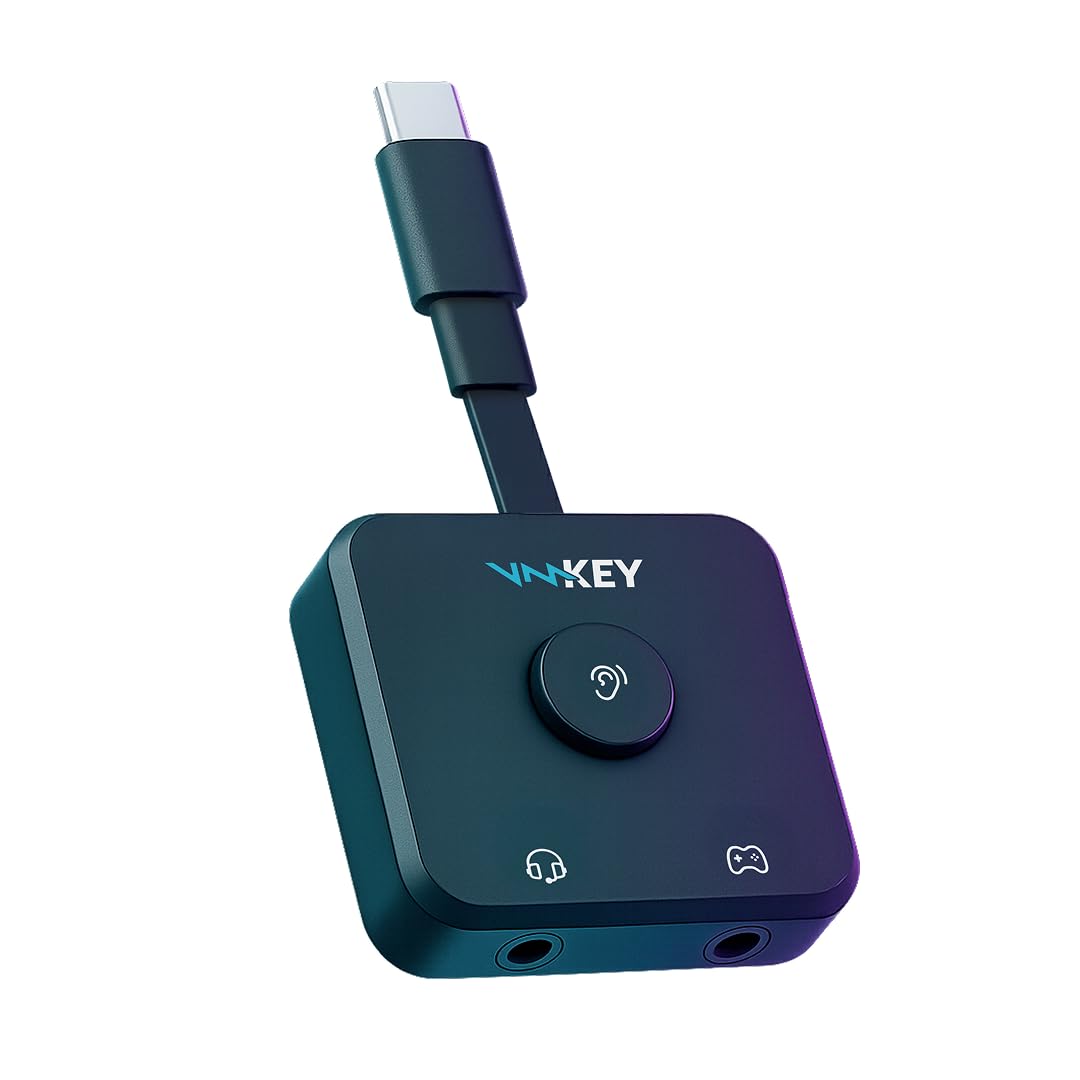
The phone-app route to sounding like anyone — no PC, no drivers, if you wire it right.
Where the hardware boards above cap you at a handful of voices, this one runs off the Voicemod app on an iPhone or Android phone and opens 200+ AI voices plus 76,000+ community voice filters. Your new voice lands straight in PS5, PS4, Xbox Series X/S, Xbox One, Switch 2, and Meta Quest chat, so a squad in Fortnite, Warzone, or GTA Online hears the change while game audio and chat keep playing in your headset.
Setup is a three-step chain with no PC or drivers: plug the VMKey into your controller, connect your phone and a wired headset, then open the app last. The box ships with a USB-C to USB-C cable, a USB-C to Lightning cable for an iPhone, and a 150cm 3.5mm TRRS cable, so the common cases are wired up on arrival. At 60 g it clips into a pocket and vanishes into a bag.
Two things to know before you commit. The full voice and soundboard library requires a Voicemod PRO subscription, so the hardware alone is not the whole purchase. And reliability is the repeated theme in owner feedback — plenty of eager nights turn fun, but the device can stop working within hours of use, and the value and compatibility side carries the same mixed weight. Buy it for the voice variety, not as a wired-in, forget-it box.
The draw: no other pick comes close on sheer voice count, and it needs no computer to run.
Weigh this honestly: the full library sits behind a subscription, and long-session reliability is the recurring complaint.
Suit yourself to it if: console chat variety is the goal and you already expect an app and a subscription in the deal.
Think twice if: you want a box that runs for hours on end without babysitting.
8. Flylin Portable Handheld Microphone Voice Changer

A featherweight little box with 16 voices for the price of a fast-food lunch.
At 0.04 kg it is the lightest thing on this list, next to 0.5 kg for the FIFINE mixer in position one — which is the whole idea. This is a gadget you toss in a jacket pocket and pull out for a laugh, not desk equipment. Sixteen sound changes include man to woman, woman to man, normal, lolita, baby, youth, king, and witch, and a fine-tune button bends each one further. Eight built-in sound effects each have their own button.
It goes plug and play with no drivers to install: connect it to a phone, PS4, Xbox, or PC, and your voice changes. The body is a mix of metal and plastic on a handheld form, with a multicolor finish that reads friendly rather than serious. For online games where nobody knows who you are, it lets you play a role and surprise the squad, which is exactly what this class of small changer is for.
The truth about this tier is cut-through. The small, budget end of voice changers is where quality complaints cluster, and this one draws mixed feedback on whether the sound lives up to the trick. Some find it fun and love the look; others say it does not perform as needed and the audio is poor. Buy it as a cheap novelty for friends, not as your broadcast voice.
The light-and-loud angle: 16 voice changes in a 0.04 kg pocket box with eight sound effects on separate buttons.
Set expectations: the audio here is novelty-grade, and mixed feedback on sound quality is the honest note.
Good fit: pranks with friends, party games, and cheap fun where a perfect voice does not matter.
Poor fit: streamers who care about how their voice sounds to an audience.
Know the Specs
Connection type: 3.5mm, USB, or XLR
A 3.5mm jack is the round headphone-style plug, and it is the console-friendly format that most pocket changers use. It often needs an adapter on newer consoles or Apple phones, and several listings say plainly that the adapter is not included. USB-C is the modern port and usually the cleanest path on a phone or PC. An XLR input is the three-pin microphone connector used by studio mics; it pairs with 48V phantom power to run a condenser microphone, which is the setup a streamer wants.
Voice modes and fine-tuning
Voice modes are the preset characters a changer offers, from male and female to robot, monster, and baby. Fine-tuning is the underrated half: a knob or pair of buttons that adjusts each preset deeper or softer. One pick here stretches four base voices into 24 variations each, while another runs 200+ voices from an app. More presets help a streamer; reliable, clean tuning matters more for a quick prank.
Real-time monitoring and side-chain
Monitoring routes your own voice back into your headphones as you speak, so you hear the change live instead of guessing. Side-chain does the reverse job on background music: it ducks the song automatically when you talk. Both matter more for a broadcast than an extra sound effect, and both separate the hardware mixers on this list from the simple pocket changers.
Sample rate and signal-to-noise ratio
Sample rate, listed around 48 KHz on several changers here, is how often the audio is sampled — a common figure across this class. Signal-to-noise ratio, listed at 100 db on one pick, measures signal against background hiss; a cleaner signal means less hum under your voice. Neither number tells you how fun the voices are, but they tell you how clean the audio path should sound.
Common Questions
Will a 3.5mm voice changer work on a PS5 without an adapter?
Does the other side actually hear the changed voice?
Do I need a subscription for the Voicemod Key Lite?
Can I use a voice changer with a USB microphone?
What does 48V phantom power do on an audio mixer?
How long does the Voicemod Key Lite last per session?
Is a sound card the same as a voice changer?
Can I wear headphones and still hear the changed voice?
What is the difference between a voice changer and a soundboard?
Does a lighter voice changer sound worse?
The Bottom Line
For most buyers, the voice changer device that does the most jobs is the FIFINE Ampligame SC3, because its XLR input, 48V phantom power, four independently controlled channels, and six voice modes cover streaming and pranks in one unit. If battery power and noise reduction for outdoor broadcasts matter more, the J50 Portable Live Sound Card is the one to grab. And for the biggest voice library on console chat with no PC needed, the Voicemod Key Lite is the pick — just expect the app and the subscription alongside it.
How we choose
We do not accept paid placement. Every pick is matched to a real buyer and a real use-case; we do not hands-on test units.
Sources
Specifications: manufacturer listings and product documentation. Review insights: verified customer reviews, as of November 2026. Pricing: not shown on this page (it changes often); check the current price via the retailer link.
As an Amazon Associate, Tactical Gear Guy earns from qualifying purchases. This does not affect which products we feature.