Specs are compiled from manufacturer listings and verified buyer reviews and can change over time — please confirm the key details on the product page before buying.
Buying a vlogging camera with a mic means one thing above all: your voice has to arrive as cleanly as your face does. A camera that shoots gorgeous footage with muddy audio is a camera you will stop using.
This guide is built by comparing the manufacturers’ published specifications and the patterns across verified customer reviews, so you get each pick’s real strengths and trade-offs instead of marketing spin.
Below you’ll find the stabilization, sensor size, mic setup, and battery numbers separated by what they actually change in a real shoot. These are the ten vlogging camera with mic setups that hold up best when you are talking to a lens in the street.
Top Picks


How To Choose The Best Vlogging Camera with Mic
Think about how you actually record. You stand or walk with the camera pointed at yourself and talk. That single habit rules out a lot of cameras and makes three things matter far more than megapixels: audio capture, screen positioning, and how steady the footage looks when you move.
Decide how serious your audio needs to be
A built-in mic is fine when you film indoors and close to the lens. A three-capsule directional mic, like the ones on the Sony compacts here, focuses on the voice in front of it. A true wireless lav setup — a small clip-on transmitter paired to the camera — is what you want the moment you film outdoors, in wind, or at any distance.
Check the input, not just the label. A 3.5mm external mic port lets you plug in a lav or shotgun mic later. Some cameras also pair straight to a wireless transmitter over a proprietary link, which removes a cable and a receiver from your bag entirely.
Match the sensor to your light
You get cleaner footage in everyday light with a 1-inch sensor (a camera chip bigger than a phone’s but smaller than a pro camera’s). It gathers more light than a phone-sized chip, so your clips look less grainy indoors, yet the camera stays small enough to carry. APS-C and full-frame sensors (the two larger chip sizes) do better in dim rooms, but they need bigger lenses and a steadier hand.
Stabilization: mechanical beats digital
Digital stabilization crops your frame to smooth the shake out. A 3-axis mechanical gimbal moves the whole sensor to cancel the wobble instead, so you keep the full width of your shot while walking. For handheld self-filming, that is the difference between usable and unusable footage.
Framing yourself without a helper
A front-facing, flip-out, or rotatable screen is what lets you see your own face while recording. Some of these go further — a detachable screen you set down and use as a remote monitor up to a stated range. That is a real advantage for solo shoots.
Side-by-Side Comparison
| Model | Best For | Sensor / Resolution | Mic Setup | Battery Life | Amazon |
|---|---|---|---|---|---|
| Insta360 Luna Pro★ Best Overall | Solo creators who want cinema-grade footage and a remote screen | 1″ 8K30fps sensor | Wind Guard included, external mic support | 4 hours | Amazon |
| Canon PowerShot V10Best Value | Pocket vlogging with clean built-in stereo audio | 15.2MP 1-inch CMOS | Stereo pair plus third noise-reduction mic; external mic port | 2 hours | Amazon |
| DJI Osmo Pocket 3 Enhanced BundleBest Stabilization | Travel and walking footage that stays steady | 1″ CMOS, 4K/120fps | Stereo recording; pairs to DJI Mic 2/Mic Mini | 4000mAh battery handle included | Amazon |
| Sony ZV-1F | Beginners who want a clean voice without extra gear | 1″ sensor, 20mm lens | Directional 3-capsule mic with wind screen | — | Amazon |
| DJI Osmo Pocket 3 Creator Combo | Interviews and podcasts where audio leads | 1″ CMOS, up to 4K120 | DJI Mic 2 transmitter plus dual wireless lav | Up to 166 minutes | Amazon |
| Sony ZV-E10 | Growing a channel with interchangeable lenses | 24.2MP APS-C Exmor CMOS | Mic input, 4K from 6k oversampling | — | Amazon |
| Sony ZV-1 II | Wide selfies at arm’s length | 1.0-type sensor, 18-50mm zoom | Directional 3-capsule mic with wind screen | — | Amazon |
| Canon EOS R10 Content Creator Kit | All-in-one kit straight from the start | 24.2MP CMOS | Stereo microphone and wind screen included | — | Amazon |
| Nikon Z50II Bundle | Two-lens kit with a condenser mic and tripod grip | 20.9MP DX (APS-C) sensor | Mini condenser microphone UM-MIC100 included | — | Amazon |
| Canon EOS R8 Content Creator Kit | Full-frame video with a bundled stereo mic | 24.2MP full-frame CMOS | Unidirectional stereo microphone included | — | Amazon |
Detailed Reviews
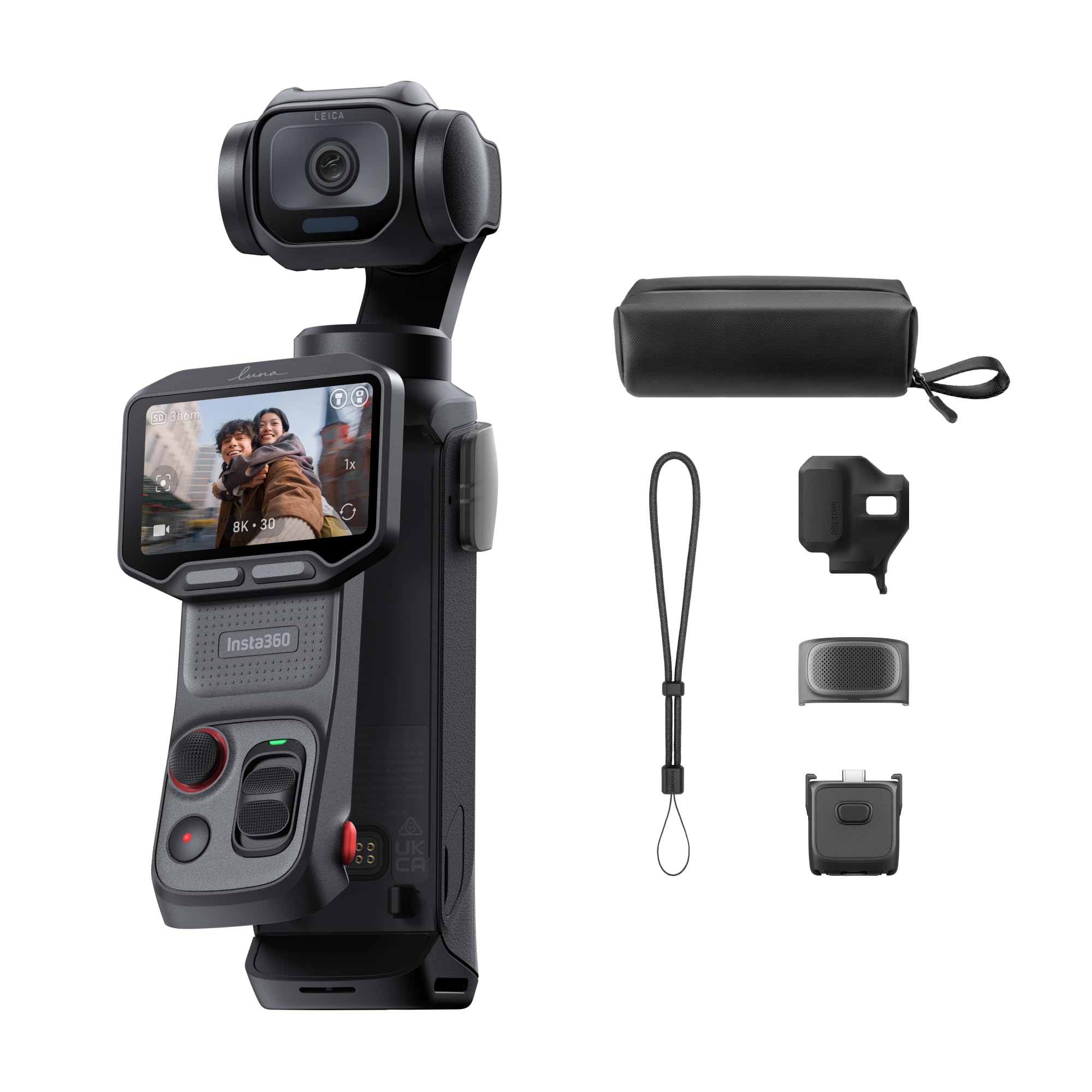
1. Insta360 Luna Pro – 8K Vlogging Camera with Leica Lens
Our pick — 4.5+★ from 200+ verified ratings; the strongest balance of quality and price.
The pocket gimbal that shoots 8K, hands you a remote screen, and keeps talking for four hours.
The headline here is 8K30fps from a 1-inch sensor, and that is not just a spec-sheet flex. A 1-inch sensor is a camera chip noticeably larger than a phone’s, so it pulls in more light and holds detail when the sun drops. Add Dolby Vision and 14 stops of dynamic range — the spread between the darkest and brightest parts of a scene it can hold at once — and your highlights stop blowing out to white streetlights.
Battery is where this pick runs away from the pack. It shoots for up to 4 hours on a charge, and fast charging takes you to 80% in 23 minutes. Compare that to the Canon PowerShot V10’s 2 hours and the gap is obvious for a full day of shooting. The detachable 2-inch OLED touchscreen works as a live preview and remote control up to 20m away, so you can set the camera down and still see your own framing while you talk.
Audio is handled with a wind guard in the box, and the 3-axis mechanical stabilization keeps your walk smooth without cropping the frame. There is a catch, though: 8K files are huge, and this camera takes Micro SD cards — you will want a fast, large one. Owners consistently single out the footage quality as the reason they keep reaching for it, calling the pictures clear and loving that they can look around an image later on their phone.
Leica glass edge
- Shoots 8K30fps on a 1-inch sensor with Dolby Vision and 14 stops of dynamic range
- Up to 4 hours per charge, with fast charging to 80% in 23 minutes
- Detachable 2-inch OLED screen doubles as a remote monitor up to 20m away
- Leica color profiles with QR Color Share for one-tap signature looks
- 3-axis mechanical stabilization plus AI subject tracking
premium price climb
- 8K footage is data-heavy, so you’ll need large, fast Micro SD cards
- 8K footage still needs decent light to hold detail in shadows and highlights
cinematic solo shoot: creators who want 8K footage, a remote screen, and a full day of battery in one pocketable rig.
budget ceiling: if you mainly shoot quick clips for social and never touch color grading, this is more camera than you’ll use.
2. Canon PowerShot V10 Compact Vlogging Camera
A fanny-pack-sized vlogger with three mics built in and a stand that folds both ways.
This is the one that treats audio as a first-class feature. A pair of stereo microphones sit up front, and a third mic in the middle works to pull unwanted background noise out of your recording. For talking straight at the lens indoors or in a quiet room, that is a genuinely clean starting point with nothing extra to buy.
The 15.2-megapixel 1-inch back-illuminated CMOS sensor is a big reason the footage holds up when light gets low. Its 19mm wide-angle lens (a 35mm-equivalent figure) is wide enough to fit you and your surroundings without the stretched, fish-eye look. The retractable front-facing screen is the other vlogging win — you can see yourself while you record, which a plain rear screen simply cannot do.
Where it falls short is stamina. Battery life is listed at 2 hours, and that is a fraction of what the Insta360 Luna Pro delivers, so plan your shoot around a top-up. The built-in stand folds front or back, letting you prop the camera down for hands-free work at a few different angles. Audio also has an escape hatch: an external mic auxiliary port means you can upgrade to a lav when the room gets noisy.
For travel, it slips into a fanny pack, so you actually carry it instead of leaving it at home.
pocket upright frame: clean built-in stereo capture, a third noise-reduction mic, and a 19mm wide lens that frames you and the room together.
fixed lens limits: 2 hours of battery means mid-day shoots want a power bank or a spare chair near an outlet.
Grab it if you film solo at close range: the front screen and multi-mic audio make self-recording simple for first-timers.
quick handheld clips: long recording sessions are your normal — the battery will be your bottleneck, not the sensor.
3. DJI Osmo Pocket 3 Enhanced Vlog Bundle
Walking footage that looks like it was shot on rails, with a 1-inch sensor doing the night shift.
Shake is the silent killer of handheld vlogs, and this camera attacks it at the source. A 3-axis mechanical stabilization moves the sensor assembly to cancel wobble instead of cropping the frame to fake it, so you keep the full width of your shot while hiking, chasing a pet, or gesturing with one hand. The 1-inch CMOS sensor records 4K at 120fps — slow enough to stretch a moment out, sharp enough to hold detail.
The screen is a 2-inch touch display that rotates for both horizontal and vertical shooting, so flipping between a widescreen vlog and a vertical social clip is a twist, not a settings dive. Stereo recording handles the audio, and the camera can pair directly to DJI Mic 2 or Mic Mini transmitters — a wireless link that removes a receiver and a cable from your kit. That direct pairing is the feature the Creator Combo below builds its whole pitch around.
The bundle rounds things out with a 4000mAh battery handle, tripod, carrying case, and screen protector. One honest wrinkle: 9.4 megapixels of effective still resolution is modest for photos, so treat it as a video-first tool. The recurring gripes in owner feedback point at the battery handle and connectivity rather than the footage, so if you rely on wireless pairing, test it before a big shoot.
gimbal smooth footage: a true gimbal inside a pocket-sized body, plus 4K/120fps and a rotating 2-inch screen for horizontal or vertical in a twist.
small sensor tradeoff: it’s built for motion first — stills are secondary, and wireless pairing is the thing to verify before you depend on it.
moving shots: anyone whose vlog involves walking, hiking, or dancing while staying in frame.
low light: you need a stills camera that also happens to do video — this leans hard the other way.
4. Sony ZV-1F Compact Digital Camera 4K Video Black

An ultra-wide lens and a voice-focused mic that make arm’s-length selfies look easy.
Arm’s length is the whole design brief here. The 20mm ultra-wide lens fits you and everything behind you into frame even with your arm fully extended, so you are not backing into traffic to fit your head and shoulders. A 1-inch sensor and an F2 lens work together in low light — the wide F2 aperture is the size of the hole letting light in, and a bigger hole means a brighter, cleaner image after dusk.
Audio is where Sony earns its keep. A directional 3-capsule mic points at the voice in front of it, and a wind screen accessory clips on to cut the buffeting when you film outdoors. Autofocus holds your eye with Eye-AF and subject tracking, so you stay sharp even as you move. The side-articulating touchscreen flips out so you can compose your own selfie shots without guessing.
Battery life is the recurring frustration — this is a camera to pair with a spare, and owners flag it as the weak spot. Value is a split verdict too: some see it as a solid budget-conscious pick, others find it priced steeply for the features. If 4K clarity and a clean voice from the start are what you want, those complaints rarely touch the footage itself.
solo talking heads: you’re new to vlogging and want wide framing plus a voice mic that works without extra gear.
bright sun glare: carry a charged backup — running time is the part owners push back on most.
5. DJI Osmo Pocket 3 Creator Combo
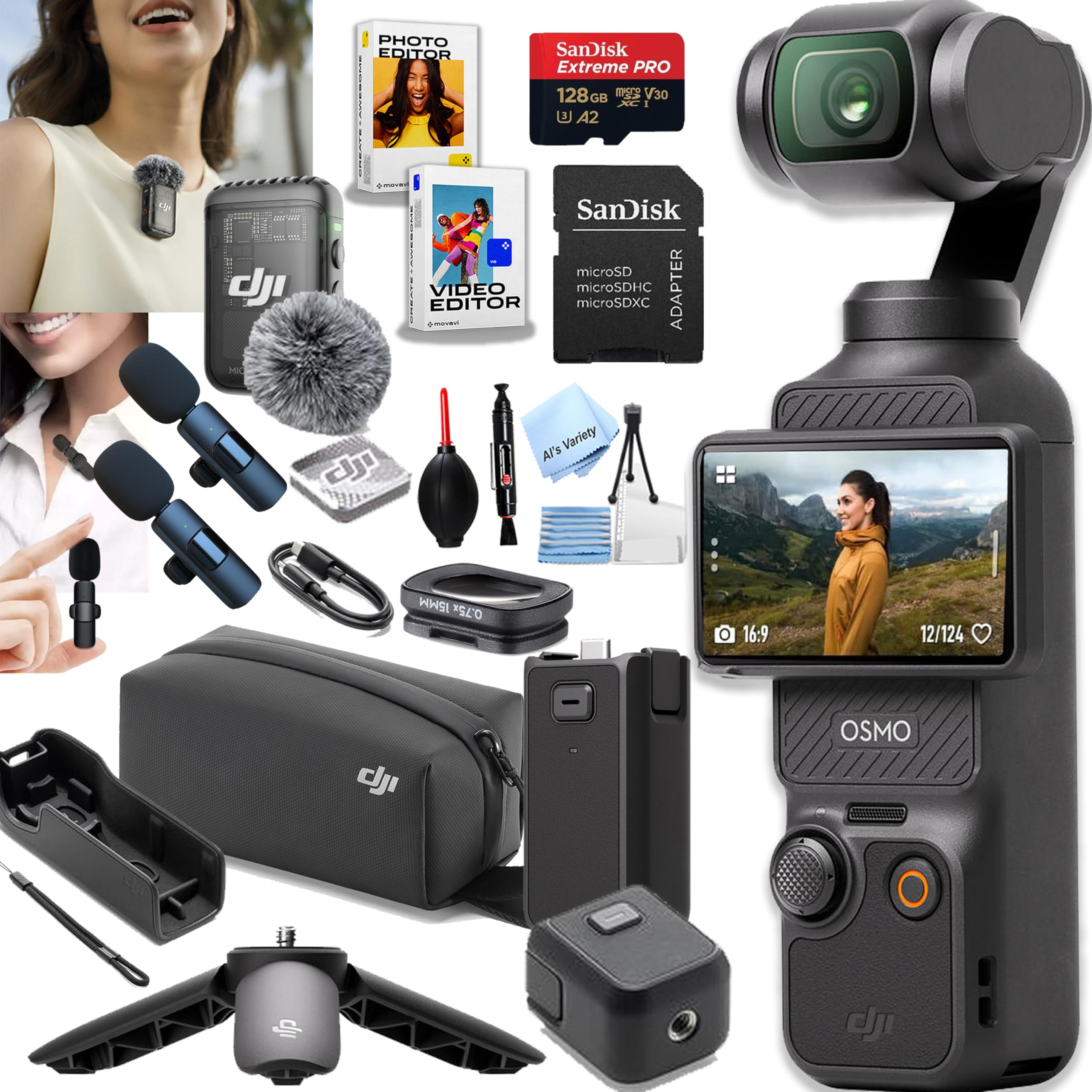
The audio-first version of the Pocket 3 — mic transmitters, memory, and tripod all in one box.
If the standard Osmo Pocket 3 is the camera, this is the whole recording booth. It ships with the camera plus a DJI Mic 2 clip-on transmitter — a small recorder that clips to your collar and captures a built-in mic with 32-bit float recording — along with a dual wireless lavalier set. That 32-bit float mode is the quiet hero for anyone whose takes matter: it records a wider range of loudness without clipping.
Transmission reaches 820 feet, so you can leave the camera and walk away while staying on the mic. The transmitter carries 8GB of internal storage for its own backup recordings, which is a small safety net against a lost take. The wide-angle lens expands your field of view to 108° for more of the scene. Battery handle adds a 950mAh cell that increases operating time by 62%.
The video core is the same story as the Enhanced bundle — 4K up to 120fps on a 1-inch sensor, 3-axis stabilization, and 2-inch rotatable screen. It also includes a 128GB memory card in Class 10 U3 V60 spec, so you can record from the start without shopping for storage. Storage speeds matter here: V60 keeps long 4K clips writing without stalling.
wireless mic bundle
- Bundles a DJI Mic 2 transmitter with 32-bit float recording and 8GB internal storage
- Dual wireless lavalier microphones clipped on the collar free your hands
- 128GB V60 memory card included so you can shoot immediately
- Wide-angle lens expands the field of view to 108°
accessory sprawl
- You have to take the receiver off to hear playback
- It’s a bundle of many pieces — more gear to track, charge, and pack
interview setup: creators who film other people, record podcasts, or want wireless audio without buying it separately.
minimal gear: pure solo shooters who never leave the camera on a tripod — the extra mic gear is weight you won’t use.
6. Sony ZV-E10 APS-C Mirrorless Camera with 16-50mm Lens
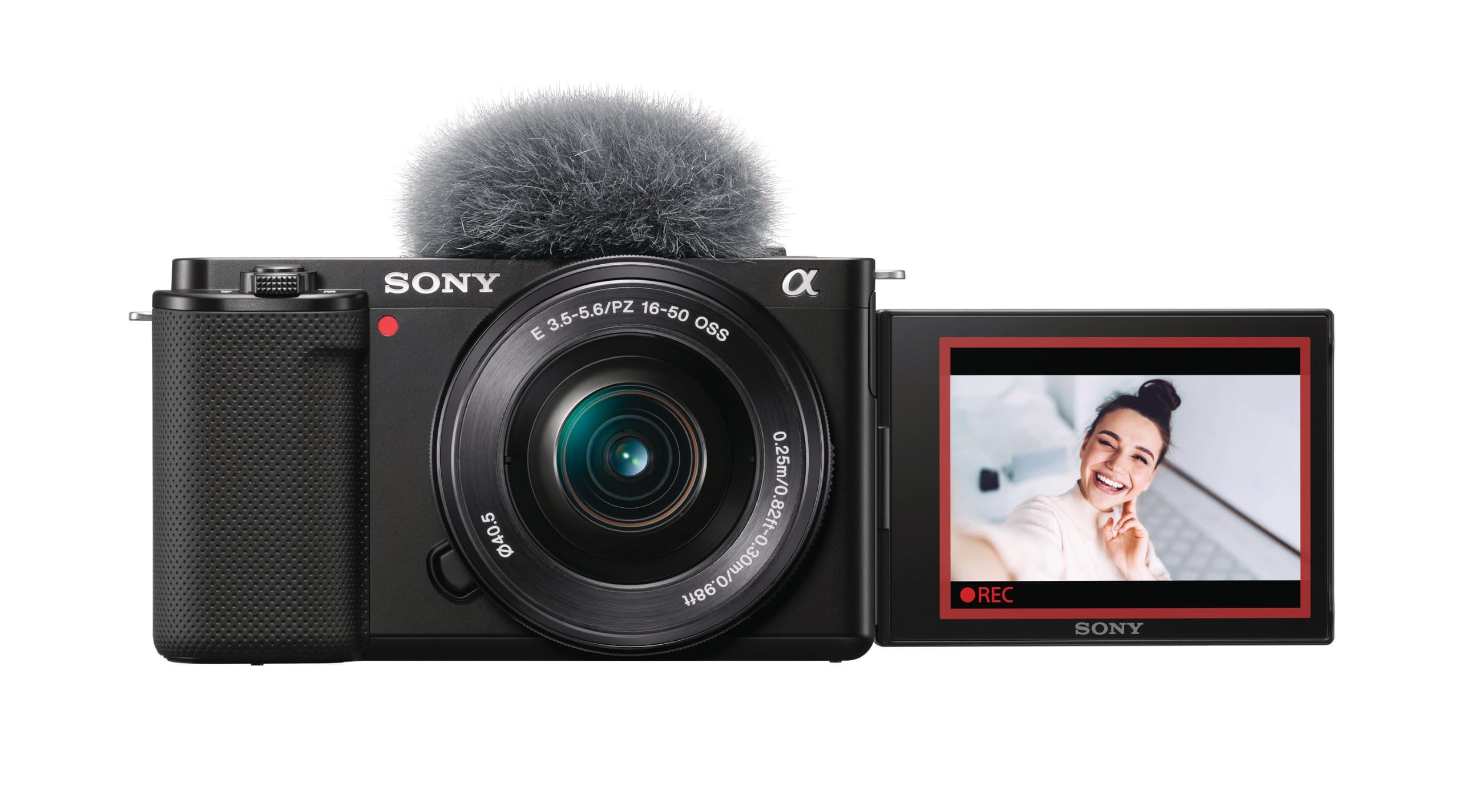
The one that grows with you — swap lenses as your channel does.
A 24.2-megapixel APS-C Exmor CMOS sensor is the foundation here, backed by Sony’s BIONZ X processor. The 4K video is oversampled from 6k with full pixel readout and no pixel binning — a mouthful that simply means the camera builds crisp 4K from more source pixels, so fine detail in hair and fabric survives. It comes with the 16-50mm lens, and because the mount is Sony E, you can upgrade glass later without replacing the body.
The vlogging tools are built in. A Background Defocus button toggles the soft, blurry-background look on and off with one press. A Product Showcase Setting shifts focus from your face to an object you hold up, which is the move every reviewer makes when showing a product. Live streaming runs off a single USB cable with no extra hardware or software.
The camera’s performance wins people over most — it’s a workhorse for YouTube content, and they appreciate how flexible the interchangeable lens system is. The main thing to budget for is glass: the kit lens is a starting point, and a brighter lens for low-light shoots is the natural next purchase.
lens swap growth: 24.2MP APS-C, 4K oversampled from 6k, and a Sony E mount that lets you buy lenses for years.
kit lens softness: it’s a body-and-lens system — plan on buying glass to reach its ceiling.
channel expansion: anyone who wants a camera to grow into, with room to add lenses.
compact carry: you want one sealed unit — this rewards people happy to buy and swap lenses.
7. Sony ZV-1 II Premium Compact Digital Camera 4K Video

An 18mm starting point that swallows the whole room behind you, zoom included.
The number that matters is 18-50mm. Starting at 18mm ultra-wide rather than a tighter prime means you can frame yourself and a background in one shot at arm’s length, then zoom to 50mm when you want to compress the scene. A large 1.0-type sensor does low-light work, and the F1.8 aperture lets in a lot of light when the room dims.
Audio follows the same recipe as the ZV-1F: a directional 3-capsule mic aimed at your voice, paired with a wind screen accessory for outdoor takes. Real-time autofocus tracking and Eye-AF keep your face sharp while you move. The 18mm wide end and the 3-capsule mic are both aimed at one person talking to the lens.
Two honest caveats surface from owners. Battery life is a frequent complaint, with some reporting it lasting only about an hour — keep a spare within reach. And photo and video quality stir mixed reactions, though most agree the wide framing is genuinely suited to selfie shooting. On autofocus and ease of use, opinions are split too, so it rewards a little hands-on time before a big shoot.
Pick this when framing is your problem: the 18-50mm zoom and 1.0-type sensor handle wide selfies and low light together.
run and gun: short battery life and mixed autofocus feedback mean spare power and a test run before you rely on it.
8. Canon EOS R10 Content Creator Kit
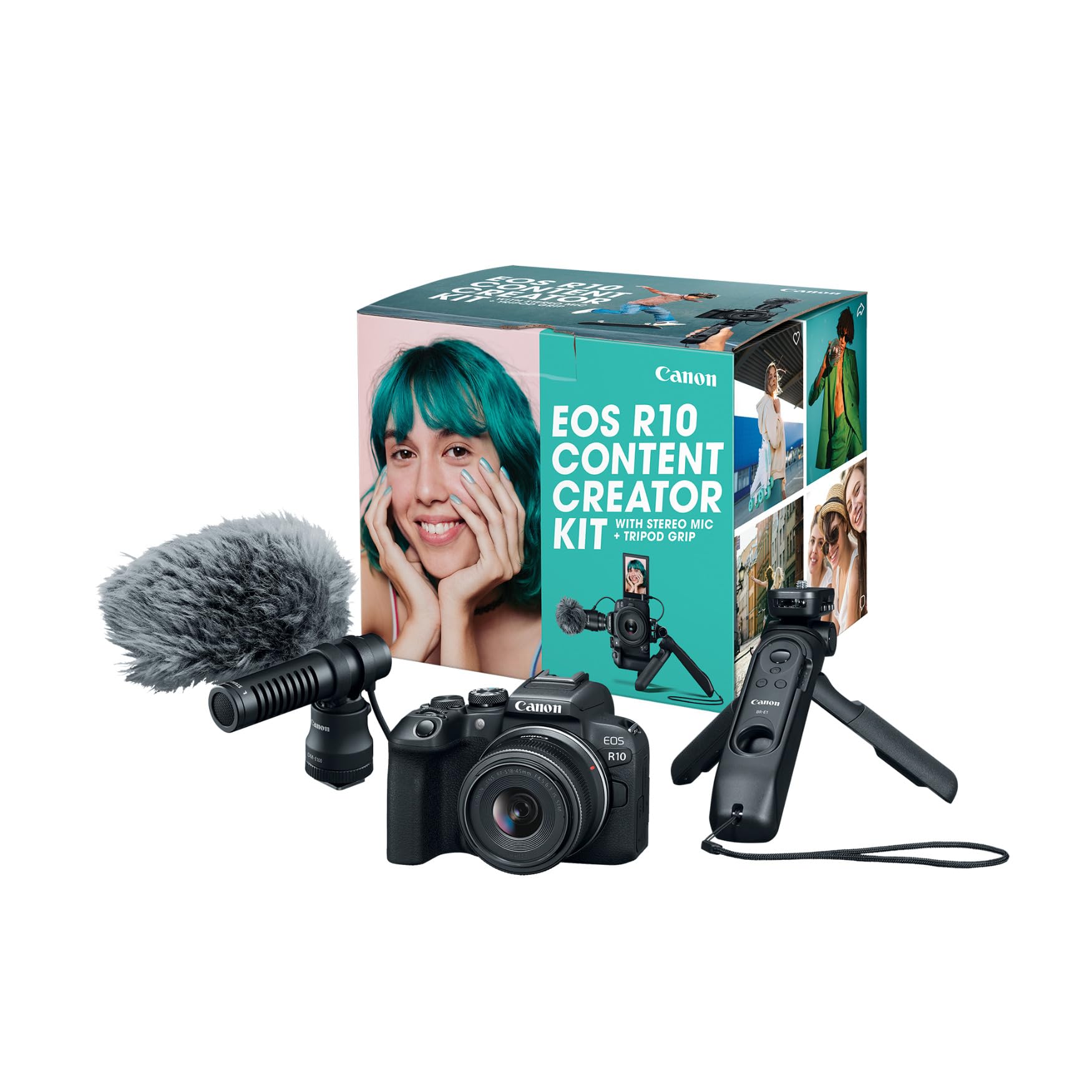
Everything a new channel needs in one box, mic and tripod grip included.
If you would rather not assemble a kit piece by piece, this one arrives complete. You get the R10 body, a stereo microphone with a wind screen, a tripod grip with wireless remote control, and the RF-S18-150mm lens — a single lens that covers wide group shots through to compressed close-ups.
The camera underneath is a 24.2-megapixel CMOS sensor paired with Canon’s DIGIC X processor, and the autofocus is the standout. Dual Pixel CMOS AF uses 651 autofocus points and inherits subject detection for people, animals, and vehicles from Canon’s higher-end bodies, so your subject stays locked while you talk and move. Speed is on the table too — 15 fps with the mechanical shutter and 30fps electronic, so fast action is caught rather than blurred.
There’s a practical video win: the Movie Servo AF system with subject detection and tracking lets you record 4K clips without them stopping after 30 minutes. The RF mount is flexible — it accepts RF-S, RF, EF, and EF-S lenses, so your glass collection can expand. The bundled stereo mic and tripod grip mean no separate audio or support purchase.
one decision buy: the kit bundles the mic, wind screen, and tripod grip so you’re recording the day it lands.
pro glass plans: you already own a mic and grip — you’d be paying for parts you don’t need.
9. Nikon Z50II Mirrorless Camera
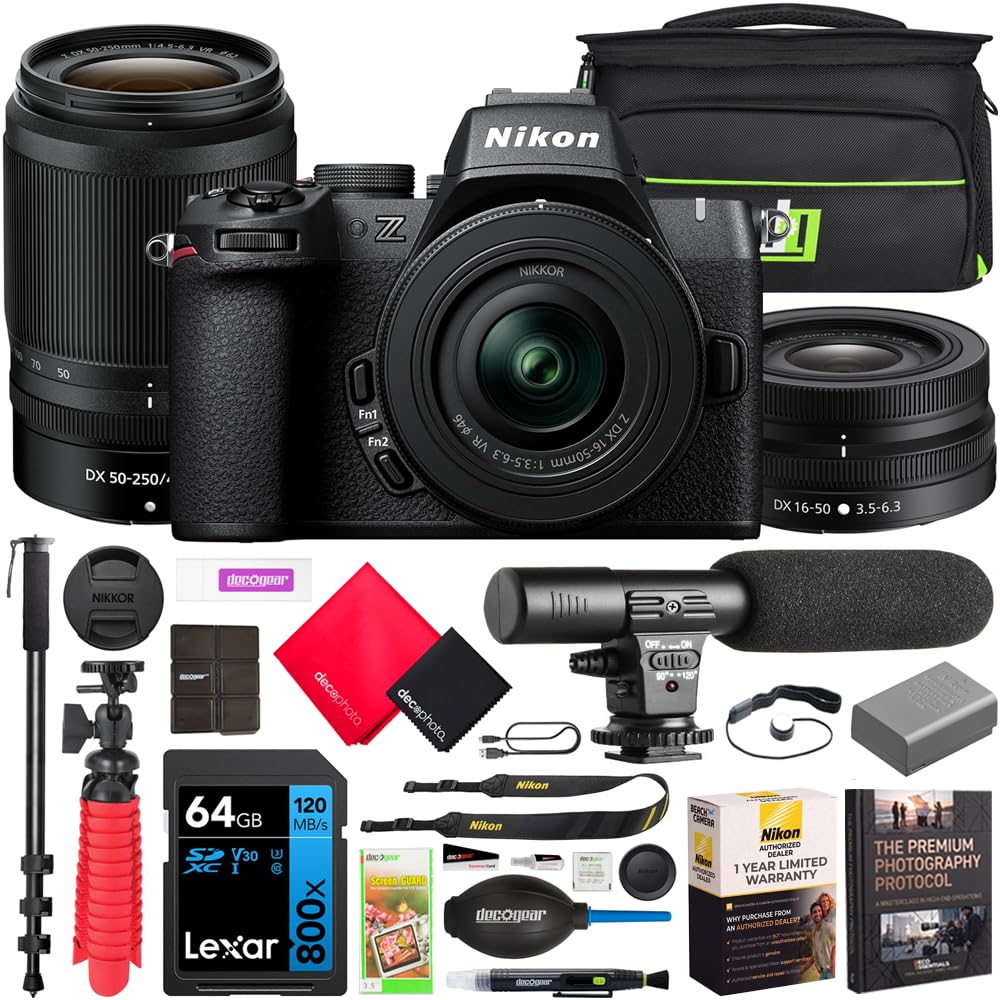
Two lenses, a condenser mic, and a tripod grip — the bundle that leaves nothing off the list.
Two lenses in the box is the draw here — the 16-50mm and the 50-250mm, both with vibration reduction for steadier handheld shots. That covers wide vlog framing and long telephoto reach without buying a second lens later. The 20.9-megapixel DX (APS-C) sensor is the chip behind lifelike colors from dawn to dusk, and it’s sized several times larger than a typical smartphone sensor while staying small enough to fit in a small bag.
For a talking-head channel, the bundle’s mini condenser microphone UM-MIC100 is the audio answer — a dedicated mic rather than relying on an internal one. A 12-inch vlogging tripod that doubles as a handheld grip makes set-and-forget filming easy. On video, it captures 4K UHD at 60p, with in-camera 120p slow motion in Full HD and built-in electronic VR. The autofocus detects and tracks nine distinct subjects, and there are 31 built-in presets to shape your look.
The head-scratcher is bundle reliability. Some buyers report missing items and mixed feelings about how complete the bundle is, so verify the contents against the listing the moment it arrives. The camera itself gets strong marks, so the hardware isn’t the worry — the packing is.
dual lens range
- Two lenses — 16-50mm and 50-250mm, both with vibration reduction
- UM-MIC100 condenser microphone plus a 12-inch tripod/handheld grip
- 20.9MP DX sensor, 4K UHD/60p video, built-in electronic VR
- Nine subject-detection types and 31 built-in presets
- Lexar 64GB memory card and cleaning accessories included
body only quirks
- Bundle contents have drawn missing-item reports, so verify against the listing on arrival
- A two-lens kit means more weight and more pieces to manage on the go
Best if you want range and audio from day one: two lenses plus a dedicated condenser mic covers wide shots, telephoto, and clean voice.
reach and width: you’d rather keep it light and lean — a two-lens bundle is a lot to carry.
10. Canon EOS R8 Content Creator Kit

Full-frame depth of field and a 6K-oversampled 4K image, with the mic in the box.
The full-frame 24.2-megapixel CMOS sensor is the reason this pick sits at the top of the range. A bigger sensor pulls in more light and gives you the shallow, blurred-background look that flatters a talking head. The 4K video is 6K-oversampled and uncropped up to 60fps, with Full HD high-frame-rate recording up to 180fps for slow-motion cutaways.
Audio arrives ready to go: the kit includes a compact unidirectional stereo microphone plus a tripod grip with a wireless remote. Unidirectional means it listens toward what it’s pointed at and rejects what’s behind, which keeps the focus on your voice. Autofocus is aggressive — Dual Pixel CMOS AF II covers up to 100% x 100% of the frame with 1,053 AF zones, using deep learning to detect people, animals, and vehicles, plus aircraft, trains, and horses.
Handling is thoughtfully done with a 0.39-inch 2.36-million-dot OLED electronic viewfinder — a tiny screen you look into, refreshing up to 120 fps — and a 3.0-inch vari-angle touchscreen that flips for framing yourself. It also shoots up to 40 fps with the electronic shutter for stills. The honest edge: it’s a full-frame body, so lenses are larger and pricier, and the kit lens is a starting point rather than the end game.
For the shooter who wants the full-frame look: deep background blur, low-light headroom, a bundled stereo mic, and a flip screen for solo framing.
serious production: you’re chasing portability — full-frame glass adds size and weight to every outing.
Know the Specs
Mic Setup: built-in versus wireless
A built-in mic is the simplest path — the camera captures your voice without extra gear. A three-capsule directional mic focuses on the voice in front of the lens and rejects some of the room around it. Wireless lavalier systems, like the transmitters in the DJI Creator Combo, clip to your collar and beam audio to the camera from a distance, which frees your hands and lets you step back from the body. For interviews or outdoor filming, the wireless path usually sounds cleaner.
Sensor size and low light
A sensor is the chip behind the lens that turns light into a picture. A 1-inch sensor is larger than a phone’s and gathers more light for cleaner evening footage. An APS-C chip (the size inside the Sony ZV-E10 and Nikon Z50II) is larger still, and a full-frame sensor (in the Canon EOS R8) is the biggest of the group. Bigger sensors mean better low-light and more background blur, but they also mean bigger, heavier lenses.
Resolution and frame rate
8K30fps means a picture built from roughly 8,000 pixels across, captured 30 times a second — enormous detail that gives you room to crop and reframe. 4K at 120fps, as on the Osmo Pocket 3, lets you slow action down smoothly. A higher frame rate costs more storage, so match it to the shot: 4K for normal vlogs, higher frame rates for slow-motion moments.
Stabilization and battery
Digital stabilization crops the frame to smooth the shake. A 3-axis mechanical gimbal moves the whole sensor instead, keeping the full width while you walk. Battery life varies widely across this list — from 2 hours to up to 4 hours — and a 4000mAh battery handle can extend operating time on the gimbal cameras. Always keep a spare or a power bank handy for longer shoots.
Common Questions
Do I need a separate microphone if my camera has a built-in one?
What does 32-bit float recording actually do for my audio?
Is a mechanical gimbal better than digital stabilization for handheld vlogging?
How wide does a lens need to be for arm’s-length selfies?
Can these cameras connect to a wireless mic transmitter without an extra receiver?
How long can one of these vlogging cameras run on a charge?
What is oversampled 4K, and does it matter for vlogging?
Do these cameras flip the screen so I can see myself while recording?
Will the bundled kitting actually give me clean audio from the start?
What storage card should I buy for 4K and 8K vlogging?
The Bottom Line
The vlogging camera with mic that earns top billing is the Insta360 Luna Pro. It pairs 8K30fps footage from a 1-inch sensor with up to 4 hours of battery and a detachable screen you can use as a remote monitor — the three things that keep a solo shoot running.
If audio leads your work, the DJI Osmo Pocket 3 Creator Combo puts a DJI Mic 2 transmitter and dual wireless lavs in the box, with 32-bit float recording and 820-foot transmission. For a complete first setup with nothing left to buy, the Canon EOS R10 Content Creator Kit hands you a stereo mic, wind screen, and tripod grip on day one.
And if you want the full-frame look with the shallow background blur that flatters a talking head, the Canon EOS R8 Content Creator Kit oversamples 4K from 6K and throws in a unidirectional stereo mic. Whichever you choose, prioritize audio capture and stabilization — neither can be fixed in editing.
How we choose
We do not accept paid placement. Every pick is matched to a real buyer and a real use-case; we do not hands-on test units.
Sources
Specifications: manufacturer listings and product documentation. Review insights: verified customer reviews, as of November 2026. Pricing: not shown on this page (it changes often); check the current price via the retailer link.
As an Amazon Associate, Tactical Gear Guy earns from qualifying purchases. This does not affect which products we feature.