Specs are compiled from manufacturer listings and verified buyer reviews and can change over time — please confirm the key details on the product page before buying.
Pocket door hardware looks small and cheap on the listing page, yet it can wreck your weekend. Three things decide your buy: is your door already drilled for a 2-1/8″ bore hole (the round hole a latch drops into), do you need a lock or just a pull, and will the finish match the trim you already installed. Get those right and the install is a screwdriver job. Get them wrong and you are chiseling a door that is already hanging. Below are the nine pieces worth your money, sorted by how they behave in a finished wall.
This guide is built by comparing the manufacturers’ published specifications and the patterns across verified customer reviews, so you get each pick’s real strengths and trade-offs instead of marketing spin.
You do not need a specialist to buy a latch — you need to know your backset and your door thickness before you click. This breakdown covers both, along with the finishes that hold up. Here is the straight answer on vintage pocket door hardware for your next sliding-door project.
Top Picks


How To Choose The Best Vintage Pocket Door Hardware
Start with your door, not the hardware. Every pocket door lock on this list assumes a hole has already been cut in the face of the door, and that hole has a fixed size and a fixed position. Measure the bore size and position before you shop and you eliminate most returns.
Measure the backset first
The backset is the distance from the edge of the door to the center of the round hole. You will see 2-3/8″ and 2-3/4″ on this list, and they are not interchangeable — a 2-3/8″ latch will not line up with a door bored for 2-3/4″. Measure from the door edge to the middle of the existing hole with a tape, then buy only the locks that match. If you are drilling fresh, pick the backset that matches the rest of the doors in the house so the hardware looks consistent room to room.
Know your door thickness
Most interior pocket doors sit between 1-3/8″ and 1-1/2″ thick, and a few locks here stretch to 1-3/4″. A lock rated narrower than your door will not clamp down, and the plates will sit loose against the face. Check the range in the listing and match it to a door you have actually measured — hollow-core slabs and solid-core doors are often different thicknesses in the same house.
Privacy lock or plain pull
A privacy lock has a turn button on the inside and a coin-release on the outside, so it suits a bathroom, a bedroom, or a home office. A plain pull is just a handle — cheaper, simpler, and correct for a closet or a hallway door that never needs to latch. A lock you do not need adds a mechanism that can stick; a pull where you wanted privacy means a second purchase.
Finish and material
Vintage finishes fall into two families: oil-rubbed bronze, which is a dark, soft-looking brown-black, and antique brass, which is warmer and slightly yellower. Solid forged brass holds its finish and its shape over years of sliding; zinc and stainless cost less but read differently in the hand. Order a single piece first if the finish has to match existing trim exactly.
Side-by-Side Comparison
| Model | Best For | Backset | Door Thickness | Function | Amazon |
|---|---|---|---|---|---|
| Dynasty Pocket Door Latch★ Best Overall | Bathrooms and bedrooms on a standard bore | 2-3/8″ | Standard 2-1/8″ bore | Locking privacy | Amazon |
| Schlage 990 PullBest for Closets | Closets and passage doors | — | 1-3/8″ to 1-1/2″ | Pull only | Amazon |
| QCAA Solid Brass PullWarmest Finish | Replacing a worn rectangular pull | — | 1-3/8″ to 1-1/2″ | Privacy | Amazon |
| Schlage 991 Privacy Lock | Matching an existing antique brass set | — | 1-3/8″ to 1-1/2″ | Privacy lock | Amazon |
| Senharvest Pull Set | Wardrobes, barn doors, bifolds | — | — | Flush pull plus edge pull | Amazon |
| Baldwin Estate Edge Pull | Thin doors and solid-core slabs | — | Narrow-profile doors | Spring-loaded edge pull | Amazon |
| Stone Harbor 2-3/8″ Round Lock | Bathrooms with a standard bore | 2-3/8″ | 1-3/8″ to 1-3/4″ | Privacy lock | Amazon |
| Stone Harbor 2-3/4″ Round Lock | Doors already bored at 2-3/4″ | 2-3/4″ | 1-3/8″ to 1-3/4″ | Privacy lock | Amazon |
| Emtek Tubular Set | Full replacement on a 2-3/8″ bore | 2-3/8″ | 1-3/8″ to 1-3/4″ | Tubular passage with edge pull | Amazon |
Detailed Reviews
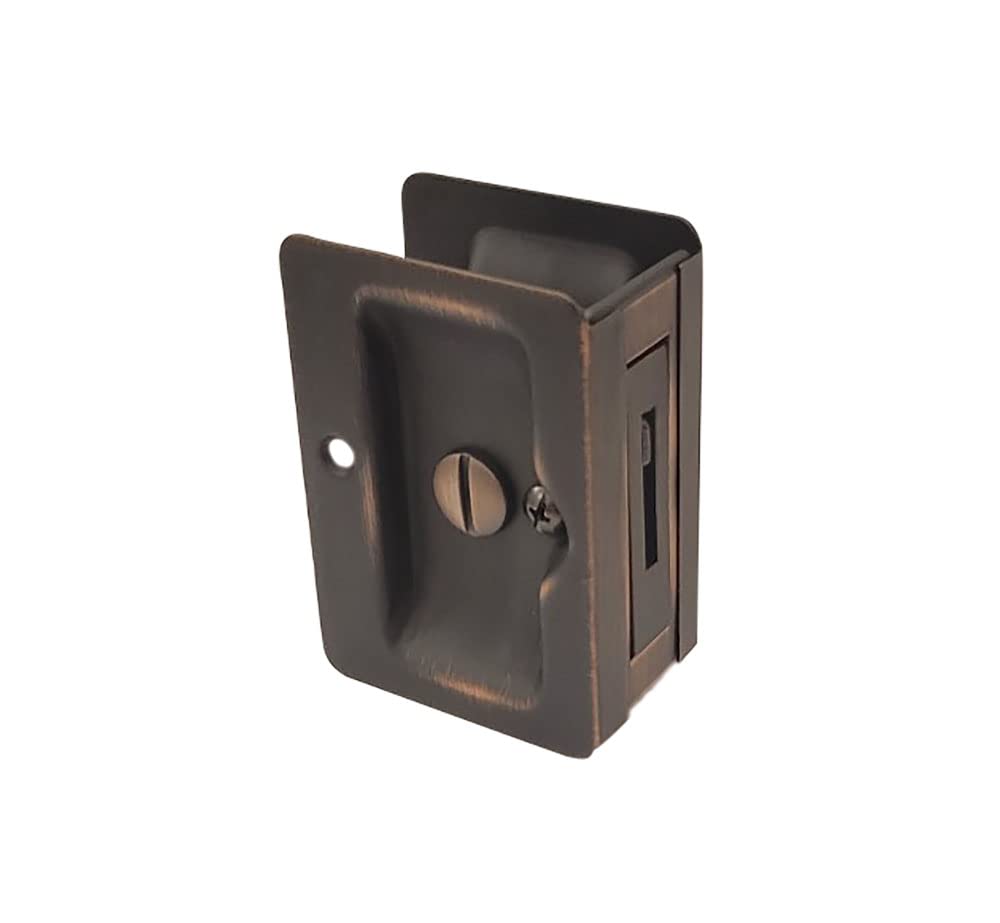
1. Dynasty Pocket Door Latch
Our pick — 4.5+★ from 550+ verified ratings; the strongest balance of quality and price.
The round latch that drops into a standard hole and just works, in a dark bronze that hides fingerprints.
This is the one to buy if your door already has the standard 2-1/8″ bore hole drilled into its face. Dynasty builds the whole mechanism to slide into that hole and fasten with a screwdriver — no chisel, no template, no fuss. It is a privacy latch, which means a turn button on the inside of the room and no key on the outside. For a bathroom or a bedroom off a hallway, that is exactly the right amount of lock.
How it works is what wins people over, and the reviews say so in a specific way: buyers routinely call it better-behaved than the cheaper big-box latch many owners pull out to replace. The aged oil rubbed bronze finish (an 11P finish in the trade) draws the second-biggest share of praise. It does the practical job a vintage finish should — it makes a small piece of hardware look like it belongs on an older door, not bolted on last week.
Installation is where the honest caveat lives. It is a straightforward screw-in job on a correctly drilled door, but the knob itself takes a deliberate turn, and a share of buyers find the mechanism stiff at first. If you have limited hand strength or you want a lock that releases with a fingertip, look at the Stone Harbor round locks below instead. Otherwise, this is the best balance of price, finish, and a mechanism that holds the door closed. It also carries the largest review base of any pick here: 4.5+ stars across 500+ ratings.
What earns its place
- Drops into a standard 2-1/8″ bore hole with nothing but a screwdriver
- Locking privacy function suits bathrooms and bedrooms
- Aged oil rubbed bronze finish matches existing Dynasty trim
- Ambidextrous — works on a left- or right-hand slider
- Round design covers a worn or slightly oversized hole cleanly
Where it asks something of you
- The turn knob needs a deliberate twist — stiff for some hands
- Only fits doors prepped to the standard 2-1/8″ bore
- Bronze finish is the whole story — no other color option in this model
First choice for: any interior pocket door with a standard bore where you want privacy without a key.
Look elsewhere if: your door has no bore hole yet or you want a lock that releases with almost no effort.
2. Schlage 990 Pocket Door Pull
A plain brass pull with no lock to fail — the honest choice for a closet that only needs a handle.
Here is a piece cut from solid brass, pre-assembled, with plates you can flip so it works on a door opening either direction. That reversibility is the quiet luxury: you do not have to know your door’s swing direction at checkout, and you do not have to return it if you guessed wrong. Schlage rates it for doors from 1-3/8″ to 1-1/2″ thick, which covers the great majority of interior pocket doors.
Set it against the Dynasty latch above and the difference is function, not quality. The Dynasty locks; this one only pulls. If the door is a linen closet or a pantry, a latch is a mechanism you paid for and will never use. This one is the opposite deal — nothing to jam, nothing to turn, nothing to think about. At a 1-3/4″ depth and 2-1/4″ height it stays visually small on the door face, which is what you want on a vintage setup where the molding is the star.
The trade-off is the mirror image of its strength. No lock means no privacy, so this belongs nowhere near a bathroom. And because the plates are sized for a specific opening, an older door with a roughly cut slot may show a sliver of daylight at the edge. Fit it to a clean opening and it will look like it came with the house. Order this if you want antique brass and a handle that simply slides.
What it does well: Solid brass construction with reversible plates takes the guesswork out of hand orientation, and the small 2-1/4″ height keeps the profile low on a vintage door face.
The honest catch: Solid brass in an antique finish is the draw here — but the pull-only design means you will need a separate latch if the room ever needs to lock.
Reach for this if: you want a warm antique brass handle on a closet, pantry, or hallway slider and privacy is irrelevant.
Pass on it if: the door closes on a bathroom — there is no locking mechanism here at all.
3. QCAA Pocket Sliding Door Pull
The rectangular brass plate that reads as genuinely old — provided your door’s slot is cut clean.
If your pocket door has a rectangular cutout instead of a round bore (the round hole a latch drops into), this is the shape you want. QCAA machines it from solid brass with a bronze finish that sits warm and brown rather than shiny. It ships with the mounting hardware, the installation instructions, and a reversible body, so left- and right-hand doors both work. It adjusts to door thickness from 1-3/8″ to 1-1/2″.
The quality of the machining is what draws the most approval — the plate feels heavier and better finished than the price tier suggests, and the appearance follows close behind it. On a vintage restoration, a rectangular pull is often the historically correct shape, and this one carries it without looking like stamped metal.
Here is what to know before you buy. The privacy function (a latch that locks from inside) does not suit every opening — some owners find the latch catches and holds a door they wanted to leave free. A few run into fit trouble when the existing slot is not cut to the right size. Neither is a reason to skip the piece; it is a reason to measure your cutout and decide if you want the latch to engage at all. Buy it for a bathroom or bedroom with a clean rectangular prep, and it does the job with a finish that looks decades older than the packaging.
Suits: rectangular-prep pocket doors, particularly restored interiors where the plate shape has to look period-correct.
Think twice if: your cutout is irregular or you want a pull that never latches — this one is built to hold the door shut.
4. Schlage 991 Pocket Door Lock

A lock for the door where everything else is already antique brass and needs to keep matching.
Owners of this one are, almost without exception, replacing an old lock with a new one that looks identical. Schlage’s antique brass here is the color most older homes already have on their hinges and knobs, so the new piece disappears into the existing hardware instead of announcing itself. It is solid brass, pre-assembled for a left-to-right opening, with reversible plates, and it fits doors from 1-3/8″ to 1-1/2″ thick.
The locking is a push button rather than a twist, which is a small but real difference from the Dynasty above — it releases more easily under a thumb. Quality leads what owners say about it, then function, then appearance, and the three line up the way they should: it is a lock that looks right, installs without drama, and holds.
One practical note that saves a confused hour: the strike plate and screws ship tucked inside the lock body, so do not assume they are missing when you open the box. Empty the mechanism before you call anyone. Beyond that, there is not much to complain about here — the main limit is that it only suits doors in the 1-3/8″ to 1-1/2″ range, which excludes thicker custom slabs. For a standard interior door in an older house, it is the cleanest visual match in this group.
Why restoration people pick it: Antique brass finish, push-button locking, and plates you can flip make it a drop-in visual match for existing period hardware.
Before you order: Check the door thickness — 1-3/8″ to 1-1/2″ only. A thick custom slab will not clamp.
Your match: an older home where the existing trim and hinges are already antique brass and this has to blend in.
Not your fit: thick or non-standard doors, or any door prepped at a 2-3/4″ backset.
5. Senharvest Pocket Door Pull Set
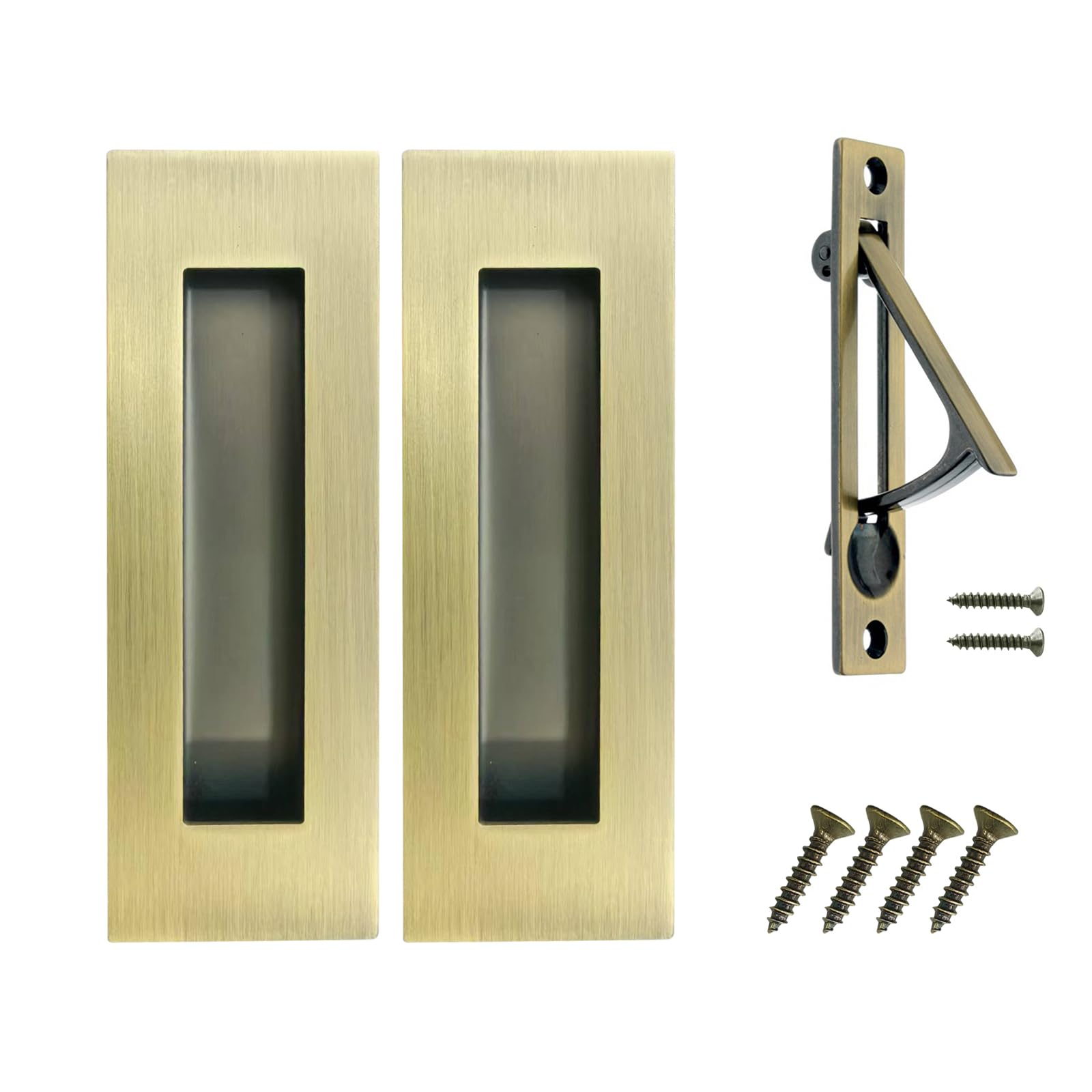
Two pulls in one box for the wardrobe and barn doors a standard latch was never designed for.
A flush pull and an edge pull together, both in antique brass over 304 stainless steel — the grade of stainless that resists rust rather than just slowing it. The recessed finger pull sits flush in its slot and fastens with two screws, so it lies flat against the door face and never snags a sleeve. The edge pull gives your fingers something to grab on the leading edge of a heavy slider.
This set earns its keep through breadth. The listing names kitchen cabinet sliding doors, bifold doors, wardrobe doors, pantry doors, and farmhouse handles as fair game. That is the real point — a 6-inch handle and a flush finger pull (a flat pull set into the door face) cover openings a pocket-door latch cannot address. Machining and finish are what people notice first, and the antique brass reads convincingly warm rather than plated-bright.
Installation is the one thing to weigh. It is an embedded fit — the pull only sits flat if the slot is cut to match, which means a router or a careful chisel, not just a screwdriver. The other cosmetic note is that the edges of the opening arrive crisp, and a sharp edge is not a defect but it will catch a finger if the cut is rough. Twelve minutes with a file fixes that. For the price-per-piece of two pulls, nothing else here covers as many door types.
Two pulls, one box
- Flush finger pull plus edge pull covers both faces of a slider
- 304 stainless steel body resists rust in humid rooms
- Antique brass finish suits farmhouse and vintage interiors
- Two-screw embedded install sits flat against the door
- Works on cabinetry, bifolds, and wardrobe doors as well as pocket doors
What to budget for
- Needs a routed or chiseled slot — not a screwdriver-only job
- Edges arrive sharp and can catch a finger until dressed with a file
Pick this set: when you are outfitting a wardrobe, pantry, or bifold and want two matching pulls in a vintage finish.
Know what you are taking on: the install is embedded, so it needs a clean slot cut — bring a router and a file, not just a drill.
6. Baldwin Estate 0465.102 Edge Pull

A forged brass edge pull for the thin door where every other latch bottoms out.
Baldwin makes this one narrow on purpose. The face measures 3/4″ wide by 3 7/8″ high, so it slips onto a thin pocket door where a full-width plate has nowhere to sit. The lever is spring-loaded and returns flush with the faceplate, meaning it lies flat when not in use rather than leaving a hook to catch on. It is forged from solid brass rather than cast, and Baldwin recommends it for marine use — a good shorthand for how it handles moisture.
Owner feedback lands squarely on build quality and function: it makes a solid-core door noticeably easier to close, and it has the weight and finish of hardware meant to last. Compare the 3 7/8″ height here to the 2-1/4″ height of the Schlage 990 pull above and the difference is aim — the Schlage is compact and discreet, the Baldwin is a substantial grab point for a heavier slab.
What it does not do is lock, and it is not a one-size-fits-all installation. This is an edge pull, not a full pocket-door lock set, so pair it with a latch if the room needs privacy. Fitting it is a job for someone comfortable making a clean mortise in the door’s edge, and that is where the mixed feeling comes from — the piece itself is easy, the cut is not. On a solid-core door in a period home, the result looks like it has always been there.
Built for: solid-core and thin-profile pocket doors where a low-profile, spring-loaded pull is the only thing that fits.
Be ready for: a mortise cut in the door edge — the hardware is easy, the install is not, and it does not lock.
7. Stone Harbor Round Pocket Door Lock 2-3/8″

The privacy lock that lets you out with a coin — smart design for anyone who has ever been stuck.
This is the practical pick for a bathroom pocket door. The turn button locks it from inside, and the outside face has a coin-or-flathead-screwdriver release, so a stuck door never traps anyone. The latch hooks into the included strike plate to hold the door shut, and the whole thing fits a 2-3/8″ backset — the distance from the door edge to the center of the bore hole. Door thickness range is the widest on this list at 1-3/8″ to 1-3/4″, which covers both hollow and solid interior slabs.
The door prep instructions are spelled out clearly: drill a 2-1/8″ diameter bore hole, carve a 2-1/4″ by 1″ depression in the edge with a mortise chisel, then drill a 1″ crossbore through the center. A template is included, and all the mounting hardware comes in the box, so a screwdriver and a drill finish the job on a correctly prepped door.
Where it asks patience is the lock mechanism itself — a share of owners find it stiff to engage, especially on a door that does not hang perfectly square. Making sure the door is aligned before you install handles most of that. The quality and finish carry the rest: unlike the round Dynasty latch above, this one is a statement piece in antique brass, and the price-per-piece buys you the coin-release safety feature as well. Worth the extra if you want a lock that cannot strand you.
Best detail: Coin-or-screwdriver release on the outside face makes it a genuinely safe privacy lock.
Set-up note: Latch engagement wants a square-hanging door. Align the door before installation to avoid a stiff turn.
Go with this: bathroom or bedroom pocket door on a 2-3/8″ bore where safety matters.
Choose a different backset if: your door is bored for 2-3/4″ — this one will not line up.
8. Stone Harbor Round Pocket Door Lock 2-3/4″
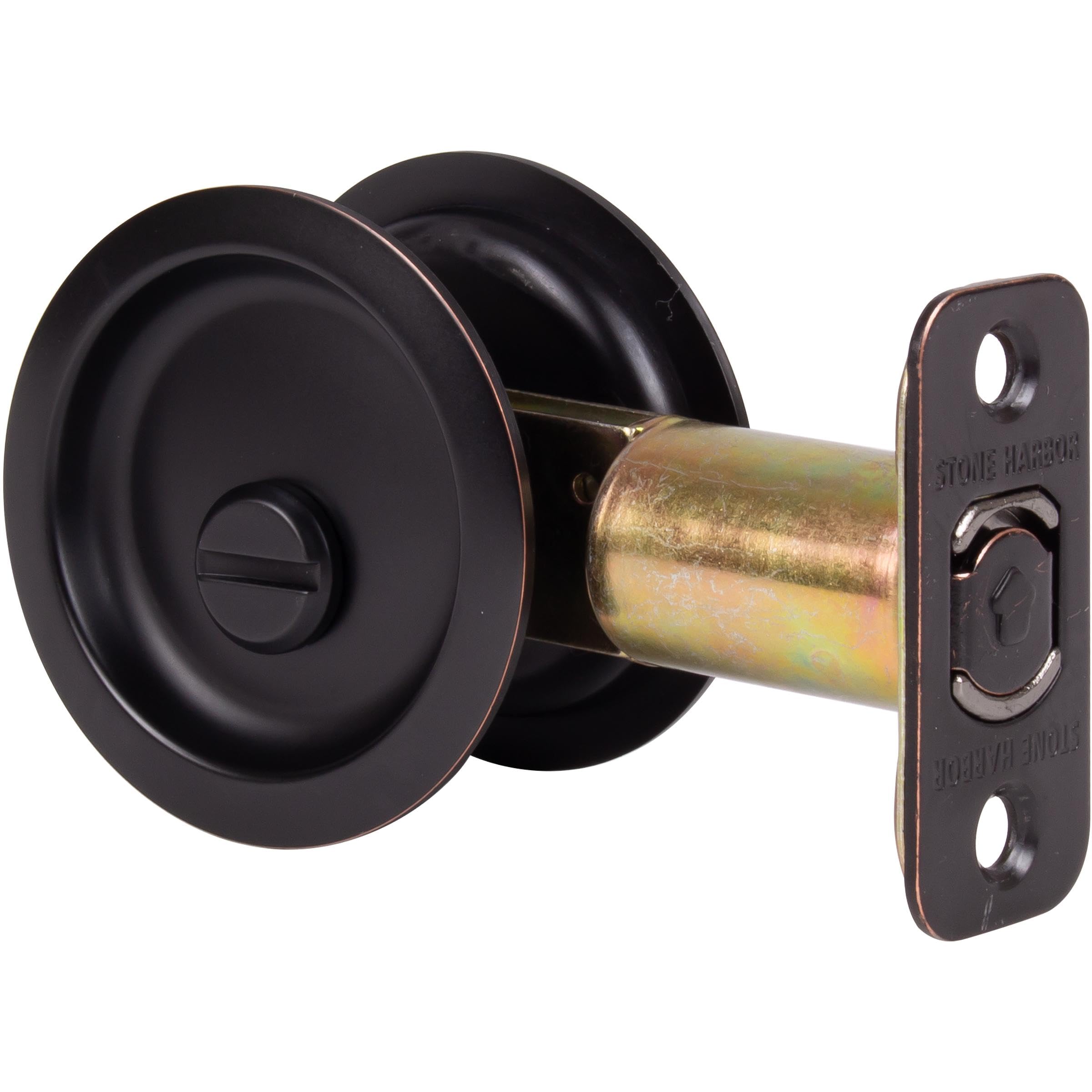
Same lock as above, shifted to 2-3/4″ — the answer for a door with an off-standard bore.
Everything about the mechanism is the same as the 2-3/8″ version — privacy turn button inside, coin release outside, latch and strike plate to hold the door, and a 1-3/8″ to 1-3/4″ door thickness range. The one thing that changes is the backset: 2-3/4″ instead of 2-3/8″. If your door has an existing bore set back further from the edge, this is the one that lines up; the other will not.
What owners like most is the unflashy reliability. Quality is the top thing they praise, then function, and the people who did the install describe it as straightforward. The vintage bronze finish is a hair darker and less yellow than antique brass. It reads as a century of patina rather than a fresh coat of lacquer — appropriate if your trim is dark and your hinges are aged.
On prep, the instructions are specific: mark the bore center 2-3/4″ from the door edge, drill the 2-1/8″ bore (the round latch hole) halfway through each side, chisel a 2-1/4″ by 1″ depression in the edge, then run a 1″ crossbore (a hole drilled straight through the door edge) through it. Use the included template and the door does the rest of the work for you. The limitation is simply that a 2-3/4″ backset (the distance from door edge to hole center) narrows the field of compatible doors — measure, then buy. On a matching door, though, it is one of the cleanest installs in this group.
The right buy when: your door is bored at 2-3/4″ and you want a privacy lock with a coin release.
skip it if: your bore is a standard 2-3/8″ or your door is thinner than 1-3/8″ — the plates will not seat.
9. Emtek Tubular Pocket Door, Round Privacy, French Antique

A complete tubular set from Emtek — the name on the box that carries the highest price and the highest expectations.
This is a full set, not a single piece: a tubular passage lock with a strike plate and a pop-out edge pull, all in French antique finish (US7). It fits 1-3/8″ to 1-3/4″ doors on the standard 2-1/8″ prep with a 2-3/8″ backset only. Emtek’s finish quality is the headline — the French antique reads warm and slightly smoky, and the round plate carries the maker’s stamp cleanly. It is sold as a complete set with screws and strike plate included.
Here is where the value conversation gets honest. The finish and the build are what buyers praise most, and the appearance gets the second-biggest share of positive attention. But the function is mixed — some buyers report it does not work smoothly with their pocket door setup, and a smaller group finds it hard to operate. At the highest price on this list, that is a meaningful risk to weigh.
The Stone Harbor locks above cost roughly a third as much and are described as plain-Jane reliable. The Emtek is the pick for someone who wants brand-name hardware and a specific finish that has to match an Emtek door lever elsewhere in the house. If you are outfitting a bathroom and you care most about function-per-dollar, the Stone Harbor 2-3/8″ lock is the safer call. Buy this one for the name and the finish, not for the price bracket.
The Emtek difference: French antique finish and a complete set — lock, strike plate, and pop-out edge pull in one box.
Worth knowing first: It costs the most of any piece here and carries the lowest rating; the function works for many doors but not all.
Buy if: you want a full Emtek set in French antique and the finish match to other Emtek hardware is the priority.
Consider the Stone Harbor first if: this is a working bathroom door and you would rather have plain reliability than a designer name.
Know the Specs
Backset
The distance from the door edge to the center of the round bore hole, usually 2-3/8″ or 2-3/4″. A lock with the wrong backset will not line up with the existing hole. Measure yours with a tape before you buy — it is the single spec that decides whether the piece drops in or has to go back.
Door Thickness
The clamp range, usually 1-3/8″ to 1-1/2″ for interior doors, with some locks stretching to 1-3/4″. A lock rated narrower than your door will not seat and the plates will sit loose. Hollow-core and solid-core doors in the same house can differ, so measure the actual slab.
Privacy vs Passage
A privacy lock has a turn button inside and a coin or screwdriver release outside, so it suits a bathroom or bedroom. A passage pull has no lock at all — cheaper and simpler, right for a closet. Buy the one that matches how the room is actually used.
Finish and Material
Solid forged brass holds its finish and shape over years of sliding; zinc and stainless cost less but feel different in the hand. Oil-rubbed bronze is dark and soft-looking, antique brass is warmer and slightly yellower, and vintage bronze reads a shade darker still. Match finish to existing trim before committing.
Common Questions
What is a pocket door backset and how do I measure it?
Will a pocket door lock fit if my door has no bore hole yet?
What is the difference between a privacy lock and a passage pull?
Can I install pocket door hardware on a hollow-core door?
How long does solid brass pocket door hardware last?
Why does my pocket door privacy lock stick?
Can a pocket door privacy lock be opened from outside in an emergency?
What finish do I choose if my other hardware is already aged?
Does a pocket door lock need a strike plate?
Can pocket door hardware be used on a barn door or wardrobe?
The Bottom Line
The vintage pocket door hardware winner is the Dynasty Locking Pocket Door Latch. It drops into a standard 2-1/8″ bore hole, locks with a privacy turn button, and backs its 4.5+ star rating with 500+ owner reviews. If you want a plain antique brass pull for a closet door, the Schlage 990 is the cleaner choice. And for a bottom-line privacy lock on a standard bore, the Stone Harbor 2-3/8″ round lock gets you the coin-release safety feature at a mid-range cost.
Whichever you pick, measure the backset and the door thickness before you order. Those two numbers decide everything else, and getting them right turns a weekend project into a five-minute screwdriver job.
How we choose
We do not accept paid placement. Every pick is matched to a real buyer and a real use-case; we do not hands-on test units.
Sources
Specifications: manufacturer listings and product documentation. Review insights: verified customer reviews, as of November 2026. Pricing: not shown on this page (it changes often); check the current price via the retailer link.
As an Amazon Associate, Tactical Gear Guy earns from qualifying purchases. This does not affect which products we feature.