Specs are compiled from manufacturer listings and verified buyer reviews and can change over time — please confirm the key details on the product page before buying.
You want a kitchen that looks like it stepped out of a 1950s catalogue, but you also want a fridge that actually holds cold air and a microwave that heats dinner without drama. The trick with vintage-style appliances is separating the ones built around a real compressor or a real cooking cavity from the ones that are just a pretty shell. This guide sorts the retro radio, the apricot microwave, the cream kettle and the chrome-handled fridges by what they actually do in daily use — and tells you plainly where each one asks you to compromise.
This guide is built by comparing the manufacturers’ published specifications and the patterns across verified customer reviews, so you get each pick’s real strengths and trade-offs instead of marketing spin.
Some retro appliances are decoration that happens to work, and others are real microwaves, fridges and kettles wearing a throwback coat. The difference shows up in cubic-foot capacity, microwave wattage and how a fridge door seals after a year of daily use. Below, every pick is judged on those working parts first — the vintage home appliances that hold up past the novelty phase.
Top Picks


How To Choose The Best Vintage Home Appliances
A retro appliance has two jobs: it has to look right in your room, and it has to do the boring work reliably every day. Buyers who end up happy are the ones who checked cubic feet and wattage before falling for the finish. Here is what to weigh before you commit counter space to a throwback design.
Match the cavity size to how you actually cook and store
Capacity is the number that decides whether a retro microwave or fridge fits your life. A 0.7 cubic foot microwave (the interior cooking box) suits a single person reheating a plate, while a 1.1 cubic foot interior takes a full dinner plate plus a mug. On the fridge side, a 3.5 cubic foot model with a 1.0 cubic foot freezer zone handles drinks, snacks and a couple of ice cream tubs. A 7.5 cubic foot apartment-size fridge is the jump you make when you cook real meals and want a vegetable crisper. Measure your counter and doorway first — a tall retro fridge is deeper and heavier than it looks in the photos.
Read the wattage, not the badge
Microwave wattage is the cooking power, and it directly changes how evenly food heats. A 700-watt unit warms a plate fine but takes longer on dense leftovers, while an 800-watt or 1000-watt oven moves through a frozen dinner faster. More wattage usually means a bigger box too, so a high-power retro oven may not slide under a low cabinet. If your counter is shallow, prioritize the exterior dimensions over the power rating.
Decide whether you can live with manual defrost
Most vintage-style fridges use manual defrost, which means a thin layer of ice builds in the freezer and you clear it out now and then. That is normal for this category and not a fault. If you would rather never think about it, factor that routine into your choice rather than discovering it later. The same logic applies to a pull-handle microwave versus a push-button panel — both work, but one feels more period-correct in daily handling.
Side-by-Side Comparison
| Model | Best For | Capacity | Power / Wattage | Color / Finish | Amazon |
|---|---|---|---|---|---|
| ClearClick Retro AM/FM Radio★ Best Overall | Kitchen counter soundtrack | — | 120V plug | Wood | Amazon |
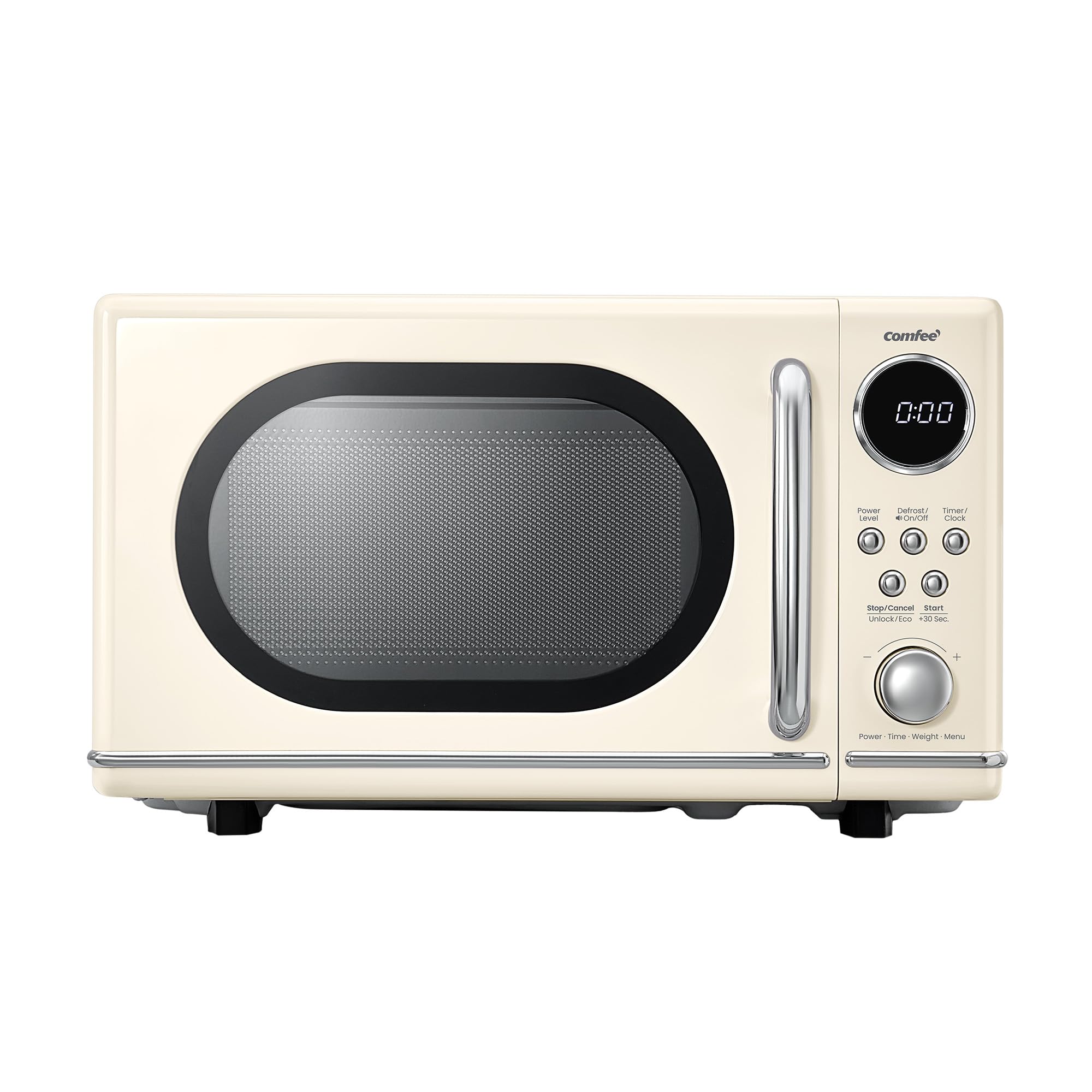
| COMFEE’ Retro MicrowaveSmall-Space Pick | Small kitchens and dorms | 0.7 cubic feet | 700 watts | Apricot | Amazon |
| Nostalgia Retro MicrowaveMost Loved | Family reheating | 0.9 cubic feet | 800 watts | Ivory | Amazon |
| DEMULLER Retro Mini Fridge | Dorms and offices | 3.5 cubic feet | 320 kWh/year | Blue | Amazon |
| SMEG Mini Kettle | Single cups of tea | 3 cups / 0.8L | — | Cream | Amazon |
| Galanz Retro Microwave | Apartments and kitchenettes | 1.1 cubic feet | 1000 watts | Green | Amazon |
| SMEG 4 Slice Toaster | Brunch and families | 4 slices | 1800 watts | Stainless Steel | Amazon |
| BINMIT Retro Mini Fridge | Budget freezer combo | 4.0 cubic feet | 358 kWh/year | Cream | Amazon |
| Commercial Cool Retro Fridge | Small-space storage | 4.5 cubic feet | 368 kWh/year | Red | Amazon |
| Frigidaire Retro Refrigerator | Couples and apartments | 7.5 cubic feet | 40 dB | Green | Amazon |
| Galanz GLR46TRDER Fridge | Big retro statement | 4.6 cubic feet | 325 kWh/year | Red | Amazon |
Detailed Reviews
1. ClearClick Retro AM/FM Radio
Our pick — 4.5+★ from 900+ verified ratings; the strongest balance of quality and price.
A handmade wooden cabinet with real AM/FM tuning and Bluetooth, backed by a five-year warranty.
The ClearClick is the rare retro appliance that earns its place by what is under the shell: a handmade wooden exterior that measures 8 inches long, 6 inches wide and 10.5 inches tall. That is small enough to sit on a kitchen shelf or a nightstand without swallowing the surface. It is a genuine AM/FM radio with a tuning dial and a volume knob, so you turn it like a radio rather than hunting through menus. The Bluetooth side lets you push music from a phone, tablet or computer, and the tuning backlight stays lit even when you are streaming — a small touch that keeps the dial readable in a dim room.
Where it beats a plastic speaker is the finish. The solid wood cabinet gives the sound a denser enclosure than a hollow plastic shell, which is why this radio reads as furniture rather than gadget. The 108 MHz tuning ceiling covers the top of the FM band, so you catch the full dial range. It runs from a standard North American power plug at 120V, which means no adapter hunt, but also that it is not the pick for overseas sockets.
The owner verdict lands squarely on the styling and the streaming. The walnut tone blends into a room rather than shouting, and the Bluetooth pairs without fuss to phones and tablets. As owners put it, the look is what sold them — and it kept working. The backdrop to that praise is honest: the audio is stereo, but this is a compact wooden cabinet, so it fills a kitchen or a study and is not built to carry a party. If you want wall-shaking volume, that is a different purchase.
What the wood buys you
- Handmade wooden enclosure that reads as furniture, not plastic
- Bluetooth plus real AM/FM tuning in one small box
- Backlit dial stays visible in Bluetooth mode too
- Five-year warranty from a US-based small business
Where it asks you to adjust
- Stereo output suits a room, not a crowd
- Runs on 120V power only, so it stays in North America
Made for: anyone who wants a countertop radio that looks inherited rather than bought, and streams from a phone when the mood strikes.
Think twice if: your plug sockets are outside North America — this one is 120V only.
2. COMFEE’ Retro Microwave Oven 0.7 Cu.Ft.
Apricot paint over a 700-watt box that heats a single plate and stays quiet while doing it.
If your kitchen is a countertop and a kettle, this is the microwave that fits the gap without eating the whole surface. The cooking cavity is 0.7 cubic feet, and the body tops out at 17.3 inches wide — noticeably narrower than the SMEG kettle-height radio stance but sized for a counter with a coffee maker already on it. It brings 700 watts of cooking power and 11 adjustable power levels, so you can drop from a full blast on soup to a gentler setting for butter. Six preset menus cover the usual suspects, and there is auto defrost by weight or time for frozen food.
Two features punch above the sticker tier. The mute function silences the button beeps and end-of-cycle chirps — a real difference in a shared flat at 6 a.m. or a late-night snack. Two-stage cooking automatically hands off from one setting to another, so a frozen meal can start on defrost and finish on high in one run.
What wins people over is the look, by a clear margin — the apricot finish draws compliments and the retro face sells the whole kitchen. Functionality lands right behind it, and the controls stay simple enough to read at a glance. The one honest wrinkle is the size: buyers split between calling it ideal and finding it smaller than expected, so measure your biggest dinner plate against a 0.7 cubic foot cavity before you commit. For a dorm, office or apartment reheat station, that trade-off is easy to live with.
The quiet upgrade: a mute setting and a two-stage cook program are rare in this tier, and both change how often you actually reach for the microwave.
Space math: 17.3 inches wide and 0.7 cubic feet of cavity — perfect for a plate, tight for a casserole dish. That is the whole decision.
Right answer if: you have a short counter, cook for one or two, and want the retro face without a huge footprint.
Pass if: you regularly reheat large dishes — a 0.7 cubic foot cavity will frustrate you.
3. Nostalgia Retro Microwave Oven 0.9 cu ft
The ivory crowd favorite with the chrome handle — more power than the COMFEE’ and a bigger cavity.
This is the microwave most people picture when they hear “retro kitchen.” The ivory body carries a chrome door handle and control panel, and a program dial you turn and push to start rather than a flat touchpad. Behind that face sits 800 watts against the COMFEE’ pick’s 700 watts — 100 more watts of cooking power in a 0.9 cubic foot cavity against the COMFEE’ pick’s 0.7 cubic feet. The practical upshot is a bigger interior that takes a dinner plate plus a side, and faster heat on dense leftovers.
The control set is where the family angle shows up. You get 12 pre-programmed cooking settings covering popcorn, pizza, potatoes and vegetables, plus a delay timer and express cooking. A dial-based interface with manual instructions means you learn it once and never think about it again. The LED display lights the digital clock and highlights the active cooking setting, so you are not squinting at a dim panel across a dim kitchen.
The appearance is what this microwave is famous for, and it earns the reputation — the chrome and ivory combination is the reason it turns up in so many kitchens. Performance sits right behind it, and buyers describe it as simple to run with clear instructions. The fair warning is on the long-haul side: durability is the recurring gripe, with owners reporting units that stop working after about four months. That is not every unit, but it is a real pattern worth knowing before you hand over counter space. Treat it as the style-first pick and weigh that against the budget-tier simplicity of the COMFEE’.
The family argument: 0.9 cubic feet and 800 watts beat the 700-watt COMFEE’ on both cavity and power, which is why this one feeds a household rather than a dorm room.
The honest caveat: durability is the one thing that splits owners — some go years, some fail within months. Buy with the style-first expectation and the dial will serve you well.
Take it home if: the chrome-and-ivory look is the reason you are shopping and you want a cavity that fits a real dinner plate.
Look elsewhere if: you want a set-and-forget box and cannot stomach the chance of an early failure.
4. DEMULLER Retro Mini Fridge 100L
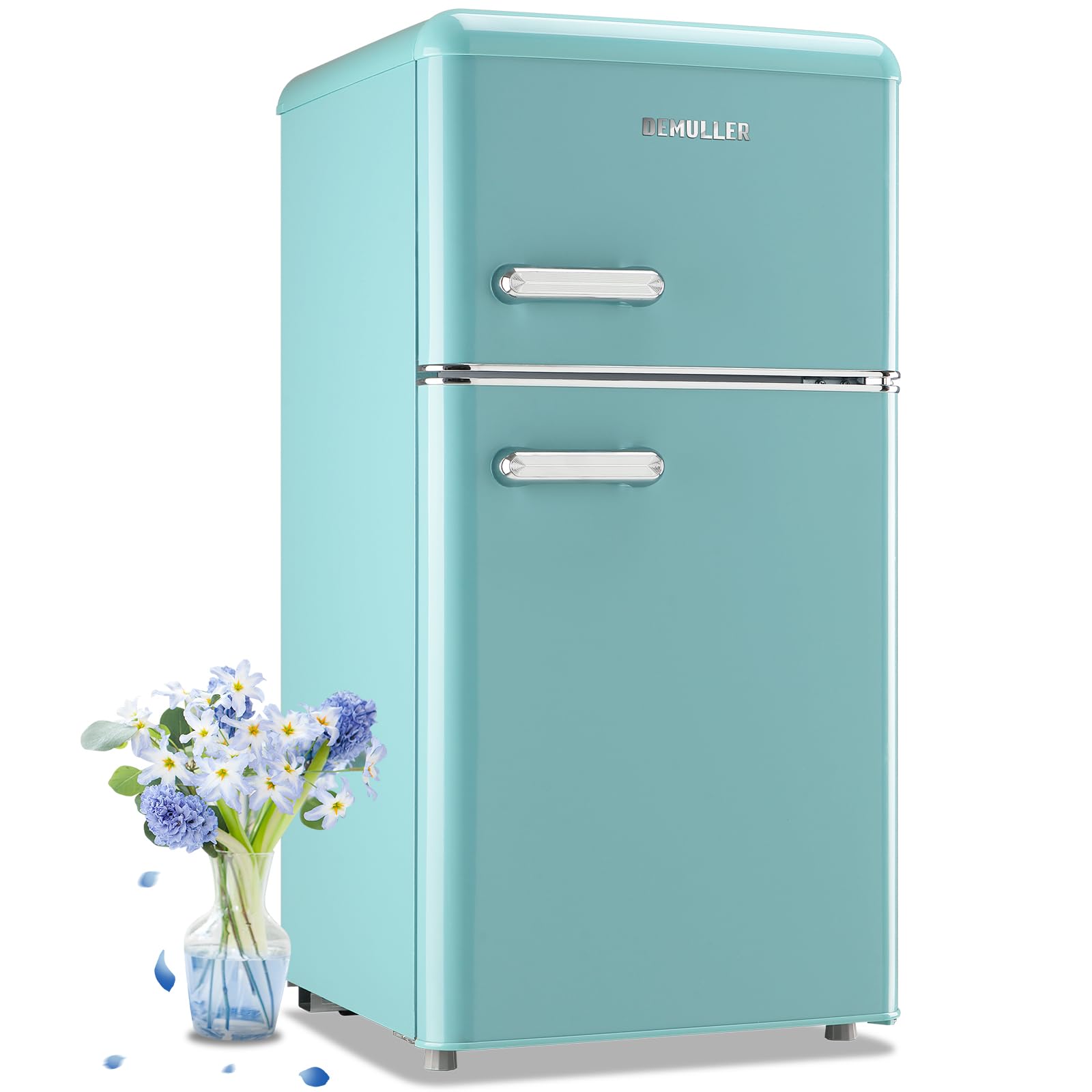
A doorway-safe blue fridge that splits 3.5 cubic feet into real fridge and real freezer halves.
The DEMULLER does the thing most small retro fridges fail at: it gives the freezer its own space. The 3.5 cubic foot body splits into a 1.0 cubic foot freezer zone for ice cream and frozen food and a 2.5 cubic foot fresh zone for everything else. That 1.0 cubic foot top box is what lets you keep a tub of ice cream and a couple of popsicle boxes on hand without fighting the fridge for room. It stands on two wheels with two adjustable feet, so you roll it into place and then level it — a real help in a dorm where the floor is never quite flat.
The temperature dial runs 1 to 7, with 7 as the coldest, and the manual thermostat covers a range from -0.4 to 50°F. That span lets you run it colder in a hot summer and gentler in winter without swapping machines. Two adjustable shelves let you re-shape the fresh zone around a tall bottle or a stack of containers. It uses a compressor (the standard pump that does the actual chilling) and it is rated at 320 kilowatt hours per year.
The surprise here is the noise — this fridge is described as very quiet, which is the thing people notice first when it sits in a bedroom or a small office. The appearance and the functionality follow close behind, and the size lands well for drinks, snacks and frozen treats. Enjoyment is what comes up most: people genuinely like living with it. The trade-off to know is manual defrost — ice builds in the freezer and you clear it out periodically. That is standard for this style of fridge, and it is the price of the retro look.
The layout win
- A true separate 1.0 cubic foot freezer zone
- Wheels plus leveling feet for easy placement
- Quiet operation for bedrooms and offices
- Seven-setting thermostat from -0.4 to 50°F
The routine it adds
- Manual defrost means clearing ice now and then
- 3.5 cubic feet suits one or two people, not a family shop
Built for: the dorm room or office break area where quiet matters and you still want a real freezer box.
Not quite it if: you want frost-free convenience — this one asks you to defrost it yourself.
5. SMEG Retro 3 Cup Electric Kettle

A 2-pound cream kettle that boils enough for one cup and looks good doing it.
The SMEG mini is the kettle for the person who makes a single cup of tea, not a pot for a crowd. It holds 3 cups, or 0.8 liters, which is exactly the amount for one generous mug plus a top-up. At 2 pounds it lifts easily from sink to counter, and its 6 by 8 by 8 inch stance means it tucks beside a toaster without claiming much room. The cream finish matches the SMEG toaster family, so a matching set is genuinely an option here.
The build is where the price tier shows. The interior is stainless steel while the outer body and lid are lightweight plastic — a double-wall arrangement that keeps heat in the water and the outside cooler to the touch than a single-wall kettle. A 360-degree swivel base lets you grab the handle from any angle, and cord storage keeps the cord tidy. The lid has no spring mechanism, so you open it fully by hand, and the removable stainless steel filter makes cleaning and refilling simpler.
Two safety features do quiet, useful work. The kettle shuts off automatically when the water boils, and boil-dry protection stops it from running when there is no water left inside. Owners point to the automatic shut-off as the thing they rely on most, and to the design as the reason they bought it in the first place. The kettle heats water quickly for one or two people, which is the honest limit: 3 cups is a solo or couples kettle, not the one you fill for a tea round with guests.
Designed to look good and boil fast: stainless steel inside, plastic outside, 2 pounds in the hand and a cord wrap underneath — this is a kettle you want on the counter, not in a cupboard.
The honest limit: 3 cups of water per boil is enough for a cup of tea, not a full teapot, so it is a poor fit for hosting.
Reach for this if: you make one or two cups at a time and want a kettle that earns its counter space visually.
Look elsewhere if: you boil water for a family or a teapot — 3 cups runs dry fast.
6. Galanz Retro Microwave 1.1 cu ft

The green 1.1 cubic foot box with 1000 watts — more cooking room than any other microwave here.
When cavity size is your deciding factor, this Galanz wins the shelf: 1.1 cubic feet against the Nostalgia pick’s 0.9 cubic feet and the COMFEE’ pick’s 0.7 cubic feet. That extra room takes a wide dinner plate or a casserole dish without tilting, and the 1000 watts of cooking power moves through dense leftovers faster than the lower-wattage picks here. The pull handle and vintage green cabinet are pure mid-century, and the exterior measures 21.1 inches wide, 16.9 inches deep and 11.2 inches tall — so clear the counter depth before you buy.
The program set covers the everyday jobs. There are 7 auto cooking programs and 10 auto reheat programs, a defrost by weight or time, and a quick-start plus +30-seconds button for when a plate needs a little more heat. A removable 12.4 inch glass turntable rotates a full 360 degrees for even heating and lifts out for cleaning. The interior uses a baked enamel finish that wipes down easily, and the whole unit is built for apartments, kitchenettes and dorms.
Owners go straight to the 1950s look and how simple it is to run. The color gets its own share of praise, with people specifically liking the green. Where it gets tricky is longevity: while plenty call it a great workhorse for the money, others report that it stops cooking mid-cycle and does not last. That is the honest split on a large-capacity budget microwave. If you want maximum cavity for the tier, this delivers; if you want the most dependable box, weigh the lower-wattage picks with stronger reliability records.
The capacity case
- 1.1 cubic feet — the largest cavity in this lineup
- 1000 watts for fast reheating of dense food
- 7 auto cook and 10 auto reheat programs
- Removable 12.4 inch turntable makes cleanup easy
What to weigh
- Durability is the recurring concern — some units quit early
- 21.1 inches wide needs real counter depth
The pick for: anyone who needs to heat a full dinner plate and wants the widest interior available in a retro shell.
Reconsider if: you would rather trade cavity size for a sturdier long-term bet.
7. SMEG 4 Slice Toaster TSF03

Stainless steel, 1800 watts and four wide slots — a toaster built for a full brunch run.
Four slices at once is the headline, and 1800 watts is what makes it fast. The slots measure 1.4 inches wide, wide enough for bagels, Texas toast and thick-cut artisan bread without wedging. Dual independent controls let you run two different browning preferences side by side, which ends the argument over who gets the darker slice. Six browning levels cover everything from lightly warmed bread to a crisp golden finish, and dedicated bagel, defrost and reheat functions handle frozen bread and leftovers on one touch.
At 8 pounds it is a hefty stainless steel box — 13 inches deep, 12 inches wide and 8 inches tall — and that weight is part of why it feels solid on the counter. The toast lifts automatically when done, the knobs are intuitive and the buttons are backlit. Two removable stainless steel crumb trays slide out for cleanup, so the crumb dump is a quick pull rather than a shake over the sink. There is a compatible sandwich rack sold separately if you want grilled toasties from the same machine.
What people praise is the performance and the appearance in near-equal measure — the stainless finish draws the Ferrari comparison, and it does make excellent toast when it behaves. The honest wrinkle is consistency: some buyers report uneven toasting, and reliability gets mixed marks over the long haul. Value is the aspect that draws the most friction, since this is a premium-tier toaster. That does not make it a bad buy; it makes it a buy for people who want the SMEG look and the four-slot speed and will accept that consistency can vary slice to slice.
The brunch math: 4 slices, 1.4 inch slots and 1800 watts — it clears a family breakfast faster than any two-slot toaster can.
The honest catch: toasting consistency is the split point. Some loaves come out perfect, some come out patchy, and you are paying premium-tier money for that risk.
Worth it for: households that toast four slices at once and want a stainless centerpiece that looks like it belongs in a design magazine.
Skip if: even browning on every single slice is non-negotiable — the consistency reports are mixed.
8. BINMIT Retro Mini Fridge 4.0 Cu. Ft

A cream two-door fridge that splits 4.0 cubic feet into 2.8 fresh and 1.2 frozen.
The BINMIT’s appeal is straightforward: a real two-door fridge with 4.0 cubic feet total, split into 2.8 cubic feet of fresh food and a 1.2 cubic foot freezer. That freezer runs down to -0.4°F, cold enough for meat, sausages and ice cream, while the fridge holds between 41°F and 46°F for drinks and produce. It measures 16.7 inches wide, 17.8 inches deep and 34.2 inches tall — narrow enough for a tight corner or a dorm alcove. Two removable glass shelves let you re-shape the interior, and the door has dedicated egg trays.
The running costs and noise level are the quiet selling points. An R600a compressor (the cooling pump used in modern energy-efficient fridges) keeps it compact and efficient, and it is rated at 0.54 to 0.62 kWh of electricity per day. The package includes ice cube trays and an ice spoon, so frozen drinks are ready from day one. Manual defrost applies here, as with most retro fridges — the freezer needs clearing when ice builds up.
Size is what people praise most, and it lines up with the appeal of a compact two-door unit that fits a small space without crowding it. The retro appearance draws its share of compliments too — it reads like a piece of the room rather than an appliance. The honest wrinkle is durability, which is the weakest aspect in the feedback. This is a budget pick with a 3.5+ rating, so go in knowing you are buying compact capacity and retro looks, and treat the long run as the question mark.
Solid value on paper
- 4.0 cubic feet split into 2.8 fresh and 1.2 frozen
- R600a compressor rated at 0.54 to 0.62 kWh per day
- Ice cube trays and spoon included
- Narrow 16.7 inch footprint for tight spaces
Where it bites
- Durability is the lowest-rated aspect in buyer feedback
- Manual defrost means a regular ice-clearing routine
Good fit for: a dorm or small flat where narrow width and a real freezer matter more than long-term pedigree.
Second-guess if: you want a fridge you set up once and forget — durability is the concern here.
9. Commercial Cool Retro Refrigerator 4.5 Cu. Ft.

A red throwback with a 6-can dispenser and tall-bottle storage built into the door.
The Commercial Cool fridge is designed around drinks and small groceries. It holds 4.5 cubic feet total, with 3.17 cubic feet of that in the fresh compartment and a full-width top freezer at 1.35 cubic feet. Two full-width slide-out glass shelves hold the food, and a full-width crisper keeps vegetables and fruit separate. The door is where the party lives: a 6-can dispenser for beer, juice and soda, plus 2-liter tall-bottle storage. It measures 19.3 by 20.3 by 42.9 inches and weighs 61.7 pounds, so it is a serious, tall unit rather than a countertop toy.
The features round out well for a vintage-styled box. A chrome plated door handle, an adjustable thermostat, an interior light and a space-saving flat back design all come standard, plus adjustable leveling legs for uneven floors. It runs on R600a refrigerant, which the manufacturer notes avoids ozone depletion, and the freezer includes an ice cube tray and scraper. Annual energy use is rated at 368 kWh.
The honest read: this is a smaller-review-count product rated 3.5+, so the feedback is thinner than the crowd-favorite picks here. That does not make it a bad fridge — the tall-bottle door storage and 6-can dispenser are genuinely useful features that most retro fridges in this tier skip. What it does mean is that you are buying on spec and features rather than on a deep track record, and the compact 4.5 cubic foot capacity suits one or two people rather than a full grocery run.
The drink-friendly design: 6-can dispenser, 2-liter tall-bottle storage and a 1.35 cubic foot freezer — this is built around how people actually stock a small fridge.
The data caveat: a thinner review base and a 3.5+ rating mean the long-term story is less proven than the top picks. Buy it for the features, not for a legacy.
For you if: drinks storage is your priority and you want a tall retro red fridge with a can dispenser in the door.
Not for you if: you want a proven long-haul track record — the feedback here is thinner than the leaderboard picks.
10. Frigidaire Retro Refrigerator 7.5 cu ft

Seven and a half cubic feet of green retro storage that runs at 40 dB — the quiet workhorse of the lineup.
This is the fridge you buy when a mini fridge is too small and a full kitchen fridge is too much. At 7.5 cubic feet it takes a real grocery run, with three adjustable slide-out glass shelves, a transparent vegetable crisper, and four clear door shelves for smaller items. The top freezer handles 0.5 cubic feet of frozen food. Chrome handles and a matte green finish carry the retro look, and a flush back design lets it sit closer to the wall than a standard-depth fridge would. It runs at 40 dB — about the level of a quiet room — so it fades into a studio apartment.
The practical touches are all here. The glass shelves are spill-proof, containing drips so liquids do not leak down onto the shelves below. The vegetable and fruit crisper bin helps preserve freshness, and the mechanical thermostat is adjustable with accessible controls. Two front leveling legs and two castors at the back let you move it into place and then settle it true. The door bins keep smaller items handy and organized.
What buyers highlight is the vintage look and how well it fits a real home — one customer’s note that it matches the character of a 100-year-old house sums up the appeal. The size is called ideal for one to two people, and the freezer gets a nod for holding several wholesale club boxes. This is the most sensible pick in the article for anyone in an apartment who wants retro charm without a tiny cavity. The one thing to plan for is manual defrost, standard for this style.
The apartment answer: 7.5 cubic feet, three slide-out shelves and a 0.5 cubic foot freezer — it handles a real weekly shop and still fits under a normal counter-top run of cabinetry.
The trade-off: manual defrost applies, and the 0.5 cubic foot freezer is modest if you freeze a lot in bulk.
Buy this one if: you live in an apartment or a small house and need a fridge that holds a real grocery run with retro good looks.
Keep looking if: you need a large freezer — 0.5 cubic feet is a top-up, not a bulk freezer.
11. Galanz GLR46TRDER Retro Refrigerator 4.6 Cu Ft

The glossy red 1950s statement fridge that pairs with the Galanz microwave and toaster oven.
This is the premium-tier entry, and it earns the placement on cavity and finish. The glossy red finish and vintage look are the whole point — the whole Galanz retro family shares a language, so this fridge can sit beside the matching microwave and toaster oven and read as one deliberate kitchen. A high-efficiency compressor cools food quickly with less energy, and the annual rating sits at 325 kWh.
The internals are practical. Slide-out glass shelves separate and organize food, and the door shelves adjust to hold taller items like milk cartons or wine bottles. The mechanical dial runs from cool to cold to coldest, with a fridge compartment range of 32°F to 47°F and a freezer at 0°F and colder. The double door lets the freezer store frozen food or make ice cubes, and the door has a spot for canned beverages. A semi-automatic defrost system is a small step up from the fully manual boxes here.
Buyers describe this fridge as both fantastic and cool-looking, with the 1950s design the thing that stops people in the doorway. It fits small spaces like apartments and office break rooms and works well for single people or couples. The honest sizing note: at 4.6 cubic feet this is a personal fridge, not a household one, so a couple who cooks most meals will want the Frigidaire pick instead. For a statement piece with real cooling behind it, this is the premium answer.
The premium argument
- Glossy retro finish that matches the rest of the Galanz family
- Double-door design with a dedicated freezer zone
- Adjustable door shelves for tall bottles and cartons
- High-efficiency compressor rated at 325 kWh per year
The honest limits
- 4.6 cubic feet suits one or two people, not a family shop
- Semi-automatic defrost still needsattention now and then
The statement buy: a glossy red fridge with a real freezer and a matching appliance family — best for one or two people who want the look to lead.
Think smaller if: you cook for a household — 4.6 cubic feet fills fast for a family.
Know the Specs
Cubic feet (capacity)
Cubic feet is the volume inside a fridge or microwave — it tells you how much food actually fits. A 0.7 cubic foot microwave takes a plate; a 1.1 cubic foot cavity takes a wide dinner plate or a casserole. On the fridge side, 3.5 cubic feet handles drinks and snacks, while 7.5 cubic feet takes a weekly grocery run. Always separate the fresh-food number from the freezer number, since a 4.0 cubic foot fridge may give only 1.2 cubic feet to frozen food. Measure your biggest pot and your counter depth before you buy.
Wattage (cooking power)
Wattage is how much cooking power a microwave or toaster puts out. Higher wattage tends to heat food faster and more evenly, which matters most on dense leftovers and frozen meals. A 700-watt microwave warms a plate fine but takes longer on a thick stew, while 1000 watts moves through it quicker. In toasters, 1800 watts drives fast, even browning across four slices. More wattage often means a bigger body, so balance the power number against the space you actually have.
Defrost type
Defrost is how a freezer sheds the ice that builds up over time. Manual defrost means you clear ice out yourself now and then — normal for vintage-style fridges. Semi-automatic defrost eases that job slightly but still needs occasional attention. Frost-free systems handle it automatically but are rare in retro designs. None of these is a fault; it is a routine you either accept or avoid. If you would rather never think about ice, factor that into your pick rather than discovering it later.
Double-wall insulation
Double-wall insulation means a kettle has an inner stainless steel wall and an outer wall with a gap between them. That gap keeps heat in the water longer and keeps the outside cooler to the touch, which is a safety benefit around kids and a comfort benefit when you grab the handle. A single-wall kettle gets hot on the outside fast. Double-wall kettles also tend to run quieter and lose less heat between boils, so your second cup stays hot longer.
Common Questions
Will a retro mini fridge fit under a standard kitchen counter?
Is a 700-watt retro microwave powerful enough for frozen meals?
Do I have to defrost a vintage-style refrigerator manually?
What is the difference between the SMEG kettle and a standard electric kettle?
Can I use a retro AM/FM radio with Bluetooth for streaming from my phone?
How wide does a retro microwave need to be to fit a dinner plate?
Do retro appliances use more electricity than modern ones?
Is a 4-slice toaster worth it over a 2-slice model?
Can I mix retro appliance colors in one kitchen?
Will a 4.5 to 7.5 cubic foot fridge take a full grocery run?
The Bottom Line
For most people, the vintage home appliances winner is the ClearClick Retro AM/FM Radio because it is the only pick that pairs a handmade wooden cabinet with real AM/FM tuning, Bluetooth streaming, a backlit dial and a five-year warranty — and it holds a 4.5+ rating across 900+ owners. If you need a fridge that takes a real grocery run and runs at 40 dB, the Frigidaire 7.5 cu ft retro refrigerator is the one to reach for. And for the biggest cooking cavity in a retro shell, the Galanz 1.1 cu ft microwave gives you 1000 watts and room for a casserole dish.
The pattern that separates the winners from the rest is simple: the picks that earn their counter space are the ones built around a real compressor or a real cooking cavity, not just a retro shell. Choose the size class that fits your space first, then let the finish decide the model. Sizing first keeps the retro finish from becoming the reason you regret the purchase.
How we choose
We do not accept paid placement. Every pick is matched to a real buyer and a real use-case; we do not hands-on test units.
Sources
Specifications: manufacturer listings and product documentation. Review insights: verified customer reviews, as of November 2026. Pricing: not shown on this page (it changes often); check the current price via the retailer link.
As an Amazon Associate, Tactical Gear Guy earns from qualifying purchases. This does not affect which products we feature.