Specs are compiled from manufacturer listings and verified buyer reviews and can change over time — please confirm the key details on the product page before buying.
You do not need the heaviest machine on the page — you need one whose plate matches the depth of fill you are actually laying down, then the terms that keep it running. A patio base at a few inches of crusher run and a driveway sub-base at deeper lifts want different compactors. The seven machines below split cleanly into electric units you can run indoors, mid-size gas plates for home hardscaping, and heavier Honda- and WEN-powered plates for daily site work. Each entry states what it does, where it stops, and who it actually fits.
This guide is built by comparing the manufacturers’ published specifications and the patterns across verified customer reviews, so you get each pick’s real strengths and trade-offs instead of marketing spin.
The deeper question is not which machine vibrates hardest but which one you can start, steer, and maintain yourself. A plate you can load alone and service without a shop beats a bigger unit that sits idle because it is too awkward to move. That is the filter used throughout this comparison of the vibrating plate compactor market.
Top Picks


How To Choose The Best Vibrating Plate Compactor
Three numbers decide almost everything: how hard the plate slams down (impact force), how big the plate is, and how fast it creeps forward. Get those matched to your job and the rest — fuel type, handle design, warranty — is tuning.
Impact force and depth go together
The plate only reaches as deep as its force allows. A mid-force plate settles shallow lifts of gravel or sand; deeper fills want more force and more machine weight. Putting down thin layers and running more passes is the honest way to reach depth with a lighter plate.
Plate size sets how many passes you make
A wide steel base covers more ground per pass, which saves time on open driveways. A narrower plate slips between walls, posts, and trench edges where a big base simply will not fit. Most homeowners end up wanting coverage; most hardscapers working beside structures want the narrow one.
Electric or gas changes where you can work
An electric unit emits no exhaust, so it can run in a garage, basement, or enclosed patio. A gas plate goes anywhere without a cord and generally delivers more force. If your work is inside or under a roof, that single difference usually decides it.
Side-by-Side Comparison
| Model | Best For | Power Source | Engine / Motor | Plate / Force | Amazon |
|---|---|---|---|---|---|
| Scheppach HP1800S★ Best Overall | Deep lifts and full paving spreads | Gasoline | 6.5 HP | 23,000 N pressure, 30 cm depth | Amazon |
| Evolution HulkBest for Indoors | Indoor and enclosed paving jobs | Electric, 120V | 1.25 A induction motor | 5 m/min travel | Amazon |
| YARDMAX YC0850 | Compact residential jobs | Gasoline | 2.5 hp, 79 cc | 1,850 lb force, 5,900 BPM | Amazon |
| VEVOR 2.8 HP | Home walkways and pavers | Gasoline | 2.8 HP, 78.5 cc | 221 sq in plate, 8 in depth | Amazon |
| Stark USA 6.5HP | Large flat coverage | Gasoline | 6.5 HP, 196 cc | 21″ x 21″ plate, 2,248 lb impact | Amazon |
| WEN 56096 | Site work with wheels built in | Gasoline | 6.5 HP, 196 cc | 3,350 lb force, 5,700 BPM | Amazon |
| Tomahawk TPC90H | Asphalt work with water spray | Gasoline | 5.5 HP Honda GX160 | 22″ x 20″ plate, 12 in depth | Amazon |
Detailed Reviews
1. Scheppach HP1800S Vibrating Plate Compactor
Our pick — 4.5+★ from 100+ verified ratings; the strongest balance of quality and price.
The plate that trades a cord for a tank and reaches the deepest fill on this list.
Reaching down 30 cm — roughly a foot of loose ground — is the spec that opens this one up to real sub-base work, not just surface tidying. A 6.5 HP gasoline engine drives 23,000 N of compaction pressure (the downward push the plate delivers with each hit), which is the number to watch if you are bedding a patio or driveway from scratch rather than skimming a lawn.
Where it leaves the others behind is speed. The automatic feed rate of 25 m/min carries you across a spread fast — the Evolution Hulk moves at 5 m/min — so the gap between an electric plate and this gasoline unit shows up in how many passes a long driveway demands. High-strength steel in the base plate and an uncoated finish keep the sole honest against abrasive aggregate.
The catch is the obvious one: it takes fuel, so it is not the machine for a garage, basement, or any enclosed space where exhaust lingers. It also assumes you can move it. The included travel device is what makes single-person transport possible, and the supplied rubber mat lets you switch over to paving work without a second plate. One 6.5 HP plate with a rubber mat and travel device covers sub-base, paving, and transport on a full patio or driveway build.
What it brings to the job
- 30 cm compaction depth covers deep sub-base lifts in fewer passes
- 25 m/min travel speed moves you across large spreads quickly
- Rubber mat and travel device included for paving and solo transport
- 23,000 N of compaction pressure from a 6.5 HP engine
Where it asks a little more
- Gas only — not for enclosed rooms or indoor work
- Transport relies on the included travel device; plan your route
Reach for it when: you are building a patio, driveway, or path from bare ground and want one plate to see the whole job through.
Look elsewhere for: an indoor pour or a basement-level floor — you need the electric Evolution Hulk for that.
2. Evolution Hulk Electric Plate Compactor
The one plate here that runs indoors without filling the room with exhaust.
First thing worth knowing: no gasoline, no fumes. A 120V~60Hz 1.25A electric induction motor (the type with no brushes to wear out) drives the vibration, which is why this compactor is the pick for a garage, a shed base under a roof, or any space where a gas engine would be unsafe to run. For sand, gravel, crusher run, and block-paving preparation, it does the prep work itself and stays quiet while doing it.
What wins people over with this machine is straightforward function on home-scale jobs — it flattens uneven ground in a home garden setting and suits 1″ to 1.5″ lifts of wet dirt. Paving pads are sold separately to let it work over block paving, and a vibration damper system in the handle takes the sting out of long sessions. The easy-fold hinged handle and roll-bars make it simple to store and to protect in transport.
Compare it directly to the Scheppach and the electric plate travels at 5 m/min versus the gasoline unit’s 25 m/min. That slowness is the trade-off for the cord and the clean air. Some jobs also push past its comfort zone — deeper lifts are where the heavier gasoline plates belong.
Straight read: a low-maintenance electric unit with a thick base plate for centrifugal force, aimed squarely at the homeowner prepping a path, patio bed, or turf base without a fuel can.
Built for the homeowner: anyone compacting crusher run or sand under a roof, or in a yard where the neighbors would rather not hear a small engine.
Not its scene: deep structural lifts — those want the force of a gas plate.
3. YARDMAX YC0850 Plate Compactor
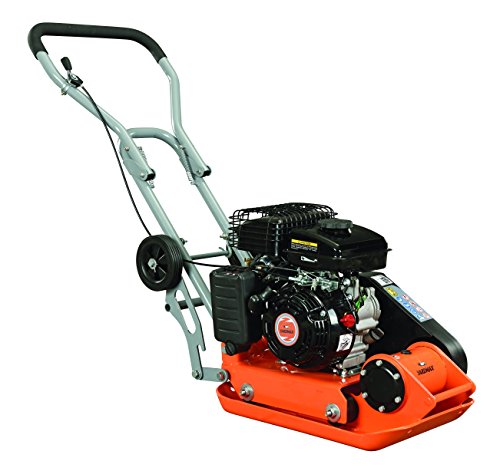
A self-propelled little diesel-free plate built to fit where a big one cannot.
A 79cc engine putting out 2.5 hp works this plate at 5,900 blows per minute with 1,850 lb of compaction force. That is the smallest force number on the list, but the machine’s whole point is its footprint — it gets into small areas, tight corners, and narrow runs where the wide 21-inch plates from Stark or WEN will not turn.
The self-propelled design carries itself across the ground, and fold-up transport wheels are attached permanently, so moving it between jobs does not mean lifting it into a truck bed. The three-point handle uses rubber bushings to soak up vibration — a detail that matters once a job runs long enough for your hands to notice.
The honest note is durability. Parts breaking is the recurring theme in the feedback, so this is a machine that rewards a storage spot under cover and a quick check of fasteners before each season rather than being thrown in a shed. Assembly feedback is mixed as well; set aside a quiet hour to put it together properly. Side by side with the WEN, its 1,850 lb places well below the WEN’s 3,350 lb — smaller force, smaller footprint.
Compact-size logic: if your work is patching driveways and pressing base under a patio that backs onto a fence line, the tight footprint is worth more than raw force. Keep it under cover and check the fasteners each season, and the 1,850 lb plate keeps patching driveways and fence-line patio bases.
Good match for: repair jobs and small pours where maneuvering room, not force, is the limiting factor.
Think twice for: a whole driveway from bare clay — the bigger plates cover that faster.
4. VEVOR Plate Compactor, 2.8 HP 78.5CC
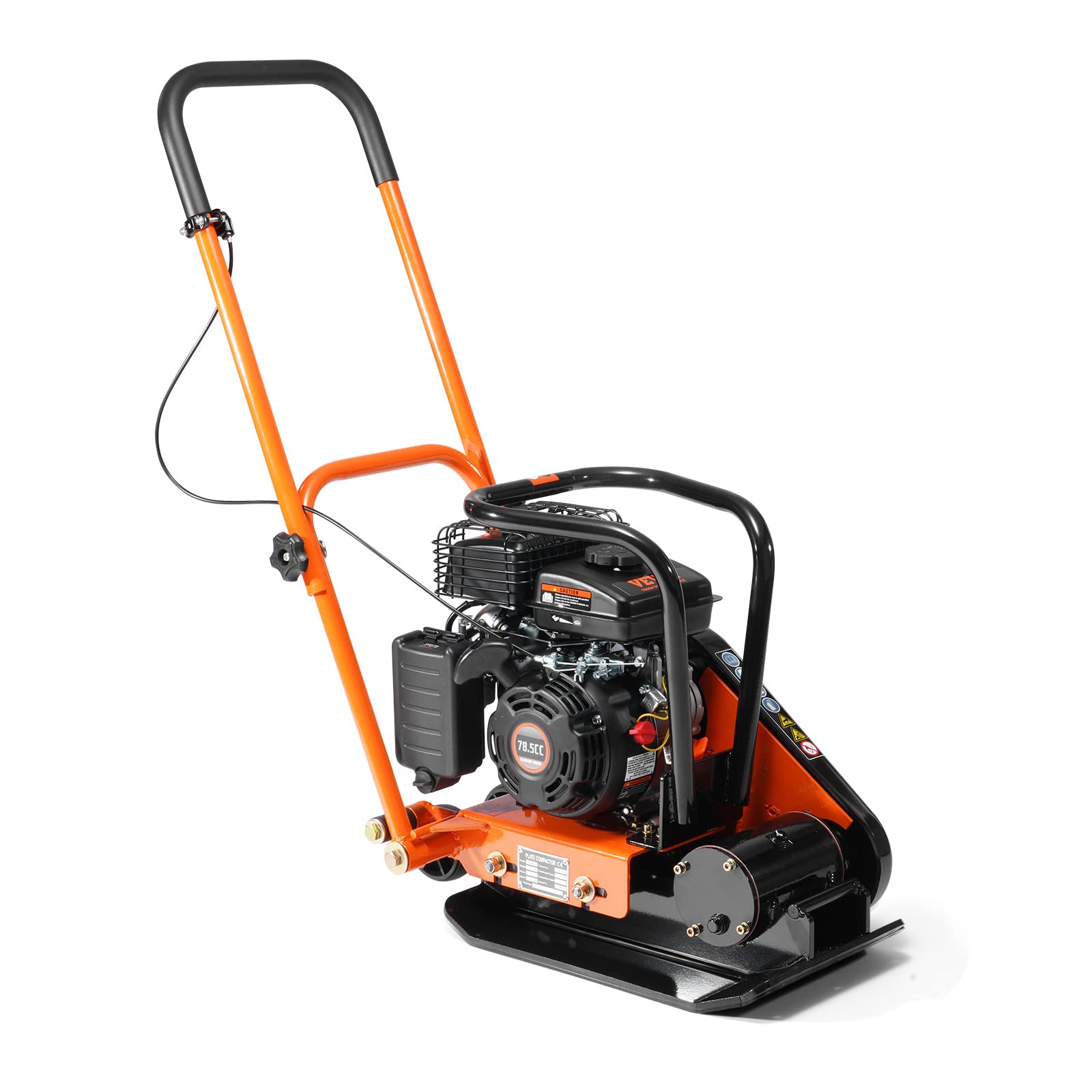
The wide-plate value pick for home walkways and paving stones.
Where this one earns its place is the plate: 221 square inches of 8mm-thick steel, wide enough that it moves more ground per pass than the compact 79cc YARDMAX. The 2.8 HP gas engine drives 5,250 vibrations per minute with an 8-inch maximum compaction depth, and the maker rates it at 5400 sq.ft/hour — a pace that suits a weekend of paving stone work rather than a full site.
The adjustable throttle valve is a genuinely useful detail. You can dial the speed down on soft ground and open it up on firmer material, which is a nicer feel than a machine with one setting. Widened, wear-resistant casters make it maneuverable despite a 114.6 lb weight, and the throttle runs off a linear lever so your hand controls the pace.
Two things to understand before you buy. The machine has a mixed reputation on starting and on durability over the long haul — a careful break-in, fresh fuel, and a sheet over it in storage are worth the twenty minutes. And 8 inches of depth means you compact in lifts; a deep fill goes in shallow layers, which is normal procedure anyway. Against the Scheppach’s 23 kN, this plate’s shallower depth is where the premium unit wins.
The reasons it works
- 221 sq in plate with 8mm steel covers more ground per pass
- Adjustable throttle lets you match speed to surface
- Wear-resistant casters make a 114.6 lb machine easy to steer
- 8-inch compaction depth handles walkway and paving jobs
The honest caveats
- Starting can be temperamental — proper fuel and break-in matter
- Deep structural lifts mean working in layers
The one to grab: for a homeowner laying paving stones, a walkway, or a garden path who wants a wide plate without stepping into premium pricing.
Not the tool for: a crew that needs deep single-lift compaction every day.
5. Stark USA 6.5HP 196cc Plate Compactor
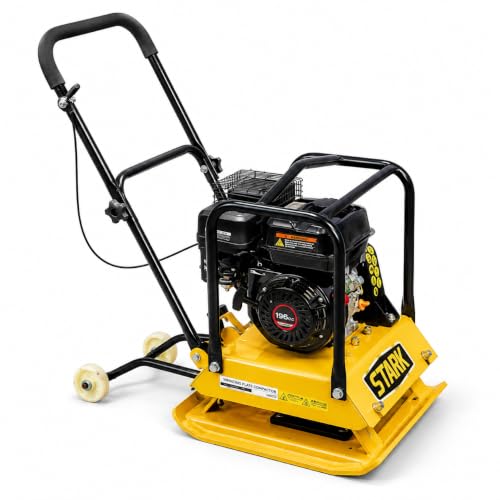
A big plate and a big engine aimed at cutting down your pass count.
Under the frame sits a 6.5 HP, 196cc forced-air-cooled four-stroke engine — the same general class as the WEN’s 196cc, versus the VEVOR’s 78.5 cc. That extra capacity exists to drive a 21″ x 21″ steel plate across driveways, walkways, and patios with fewer passes.
If your job is a broad, open area — a long driveway, a parking pad, a hardscape base — the width does the heavy lifting. It handles the usual materials: soil, gravel, aggregate, sand, asphalt. Heavy-duty steel construction and a rugged plate are meant to take repeated use on construction and landscaping sites, and it is pitched at both contractors and homeowners taking on a renovation.
Understand what you are buying here. The 220 lb weight is the number that decides whether this is a good fit — it is a machine to move with equipment or a second pair of hands, not to carry. Feedback on quality and function is genuinely mixed at this stage, so a seller with a clean returns policy and a careful break-in is sensible. If you want a proven record and a lighter drag, the WEN below is the safer known quantity.
Coverage first: for a broad, open spread the 21-inch plate saves real time. The honest caveat is that its track record is thinner than the higher-rated picks and it wants handling equipment to move.
Fits the job when: you have wide, open ground and a way to move a 220 lb machine from spot to spot.
Skip for: tight patios against a house, or lifting it in and out of a truck by yourself.
6. WEN 6.5HP 196cc Plate Compactor (56096)
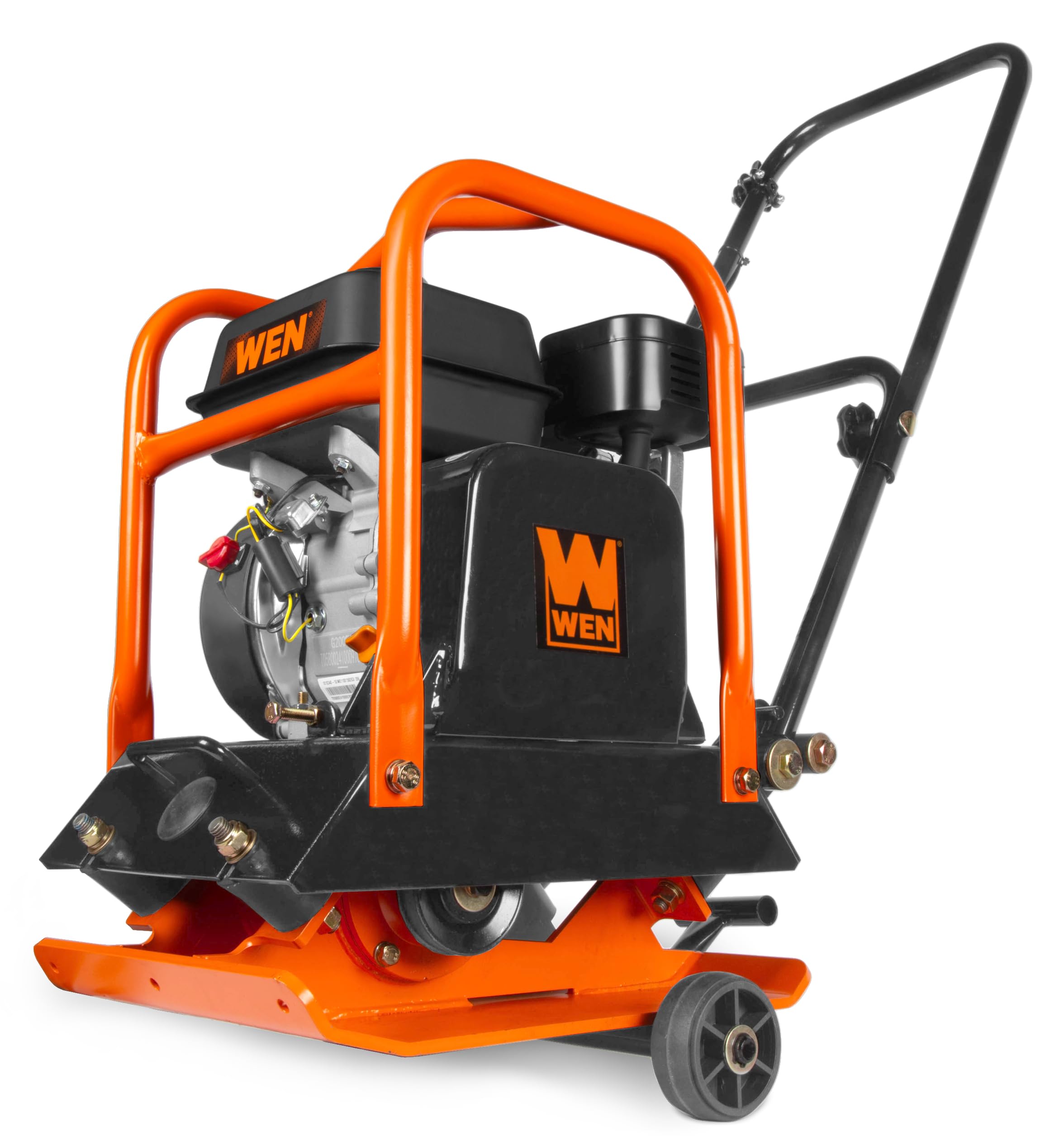
3,350 lb of force, a wheel kit, and the strongest first-pull starting record in this group.
Reviewers repeatedly report first-pull starts, which is why it gets recommended to anyone who dreads troubleshooting a small gas engine. The 196cc engine creates up to 3,350 pounds of force at 5,700 blows per minute — well beyond the YARDMAX’s 1,850 lb and the VEVOR’s 2.8 HP, and it pushes the plate forward at up to 125 feet per minute.
The wheel kit and lifting handles are not extras — they are why this machine gets used. You roll it to the spot and roll it back to the truck instead of dragging it. A low-oil shutdown protects the engine from an expensive mistake, vibration dampers soften the handle, and the powder-coated finish holds up to weather and site grime.
Move it across loose soil and it takes some effort — the mixed reports on mobility are the honest trade-off, and the same goes for working uneven ground. Fold-down-style convenience comes bundled, and the two-year residential warranty (90-day commercial) is the safety net if something goes wrong. Against the Stark, this one holds the higher force figure — 3,350 lb versus 2,248 lb — and a stronger track record.
Why it earns its place
- 3,350 lb of force and 5,700 blows per minute from a 196cc engine
- Wheel kit and lifting handles make hauling it painless
- Low-oil shutdown and vibration dampers protect the machine and your hands
- Two-year residential warranty backs the purchase
Where it pushes back
- Dragging across loose soil takes effort despite the wheels
- Uneven ground slows it down and demands careful steering
The safe pick: for a homeowner or small crew that wants proven force and an easy start with a legitimate warranty behind it.
Pause if: your ground is uneven and you need something that glides rather than needs steering.
7. Tomahawk 5.5 HP Honda Vibratory Plate Compactor
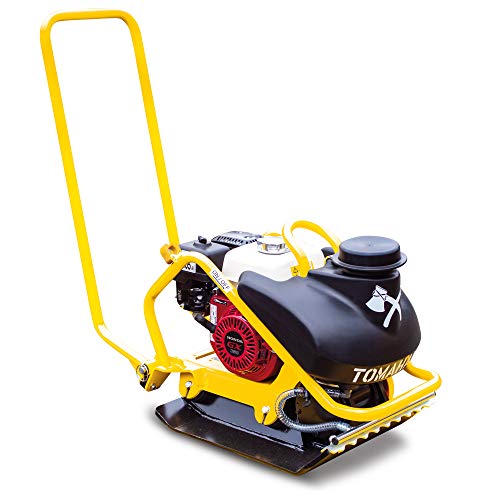
A water-tank plate with a Honda heart, built for asphalt and tight spaces.
Under the hood sits a 5.5 HP Honda GX160 engine — the name that matters if you have ever priced a replacement engine on its own. It compacts over 3,400 lbs per square foot and reaches cohesive and granular soils up to 12 inches deep, which is the deepest single-pass figure in this group and the reason it gets pulled onto serious asphalt and structural jobs.
The 3.5 gallon water tank is the feature that separates it from every gas plate above. You spray as you go to dampen asphalt and keep the plate from sticking, and you can compact asphalt properly without dragging a hose behind you. The 22 in. x 20 in. plate fits around cramped and narrow spaces where the wide 21-inch plates will not reach.
Two things to weigh. At 240 lb it is the heaviest in the group, so moving it is a job for wheels or a second person. And the price puts it in premium territory, which makes sense for the Honda engine and the water-tank capability — but if asphalt is not part of your plan, you are paying for a feature you will not use. For plain patio-base work, the Scheppach is the better-value call.
What you are really buying: the Honda GX160 and the 3.5 gallon tank. One gives you a dependable engine you can trust on a paid job; the other lets you spray while you compact. Both are aimed at asphalt and narrow runs.
Made for: asphalt patching and narrow-space work where a water spray and a Honda engine are worth the premium.
Not worth it for: a one-time patio base — the Scheppach covers that at far less commitment.
Know the Specs
Impact Force (lb) and Compaction Pressure (N)
Impact force is the downward blow the plate delivers each cycle, written in pounds or newtons. It sets how deep and how firmly the plate settles material; a higher force reaches deeper lifts, while a lighter plate reaches depth by working in layers. More force also means more weight to move.
Blows Per Minute (BPM / VPM)
Blows per minute is how many times the plate slams down each minute. A high number means faster coverage on appropriate material, but force still does the actual compacting — a fast plate with low force will not reach the depth a slower, heavier one will.
Plate Size and Travel Speed
Plate size sets how much ground you cover per pass; travel speed (in feet or meters per minute) sets how quickly the plate pulls itself forward. A wide plate on open ground means fewer passes. A narrower plate means you fit into tighter spaces and work slower.
Power Source: Gas vs Electric
Gas delivers more force and no cord limit but emits exhaust, so it belongs outdoors or in a well-ventilated space. An electric induction motor emits no exhaust and runs quieter, which suits indoor and enclosed jobs, at lower force and slower travel.
Compaction Depth
Depth is how far the vibration reaches into the ground, usually given in inches or centimeters. Deeper figures let you compact thicker layers in one pass; shallower ones mean laying fill in several thin lifts and running the plate over each layer.
Water Tank and Paving Accessories
A water tank lets you spray while compacting to dampen asphalt and stop the plate sticking. Rubber paving mats and pads let a plate work over finished pavers instead of just raw soil, which broadens what a single machine can finish.
Common Questions
How deep can a plate compactor compact soil in one pass?
Can I use an electric plate compactor indoors?
What is the difference between impact force in pounds and compaction pressure in newtons?
Do I need a water tank on a plate compactor?
Can a plate compactor be used on paving stones without damaging them?
How heavy is a plate compactor to move on my own?
Is a plate compactor self-propelled?
What kind of fuel does a gasoline plate compactor need?
Will a plate compactor work on wet, muddy soil?
How many passes does it take to compact a driveway base?
The Bottom Line
For most buyers the vibrating plate compactor to beat is the Scheppach HP1800S, because it reaches a 30 cm depth and moves at 25 m/min, so one machine covers a full patio or driveway job. If you need to work inside or under a roof, grab the Evolution Hulk for its no-exhaust electric motor. And for asphalt patching with a water spray, the Tomahawk and its Honda engine are the ones to reach for. Whatever you pick, match the plate’s force and depth rating to your lift thickness, and its power source to where the machine will actually run.
How we choose
We do not accept paid placement. Every pick is matched to a real buyer and a real use-case; we do not hands-on test units.
Sources
Specifications: manufacturer listings and product documentation. Review insights: verified customer reviews, as of July 2026. Pricing: not shown on this page (it changes often); check the current price via the retailer link.
As an Amazon Associate, Tactical Gear Guy earns from qualifying purchases. This does not affect which products we feature.