Specs are compiled from manufacturer listings and verified buyer reviews and can change over time — please confirm the key details on the product page before buying.
You are heating a space the size of a small tent, a shed, a shack or a tiny home, and you have already learned the hard way that most “portable” wood stoves are either too big to move or too thin to survive a season. The eight stoves below are genuinely small — fireboxes in the 450 to 593 cubic inch range, weights from 13.1 to 23.8 pounds — and each one is built to burn wood only, not pellets or gas. Here is which of them is worth carrying, which is worth cooking on, and which will quietly disappoint you in February.
This guide is built by comparing the manufacturers’ published specifications and the patterns across verified customer reviews, so you get each pick’s real strengths and trade-offs instead of marketing spin.
Fit matters more than brand here: a stove that runs too hot in a sealed shelter is as much a problem as one that cannot hold heat overnight. Below you will find the compact stove that suits your shelter, your fuel and your cook pot — the best very small wood burning stoves for tight spaces and cold nights.
Top Picks

How To Choose The Best Very Small Wood Burning Stoves
A small wood stove has a different job from a household one. It needs to heat a shelter that loses warmth through thin fabric or uninsulated walls, it needs to pack down into a truck bed or a backpack, and it needs a chimney short enough to run out through a tent jack. Those three demands push in different directions, which is why the picks below differ so much in shape and weight.
Match the firebox to the shelter, not to the marketing
Firebox volume decides how long the stove burns between refuels and how big a log you can fit. A 450 cubic inch firebox holds a modest load of pre-cut wood and suits a one- or two-person tent. A 593 cubic inch firebox takes larger loads and needs fewer trips out into the cold. Bigger than that and you are buying weight you will carry and heat you may have to damp down.
Steel thickness tells you how long it will live
Tent stove bodies here range from 1mm to 1.6mm stainless, with one model specifying 3mm at the top plate. Thicker steel resists warping when the stove runs hot for hours. The top plate matters most, because that is the part that takes the heat directly and the part that holds your pot.
Chimney diameter decides whether it fits your tent jack
The chimney pipes on these stoves measure either 2.1 inches or 2.76 inches across, so check your tent jack or flashing before you buy. A stove with a 90-degree elbow lets you angle the pipe out sideways under a tarp; a straight run needs a clean vertical exit. A spark arrestor and a rain cap are worth having, because both stop hot debris and weather from coming back down the pipe.
Side-by-Side Comparison
| Model | Best For | Firebox / Body Size | Chimney Setup | Weight | Amazon |
|---|---|---|---|---|---|
| Tent Stove 7.3ft Stainless (KUNGKA)★ Best Overall | All-round tent heating and cooking | 18″L x 11.69″W, 88.3″H assembled with chimney | 6 pipe sections, 2.76 inch, damper and rain cap | 20 pounds | Amazon |
| Ytaoeo Wood Stove, 7 Chimney PipesBest For Packing Flat | Packing down with everything inside | 18.11″D x 9.84″W x 10.63″H | 7 pipes, 2.36 inch, plus 90° elbow | — | Amazon |
| Gonex Hot Tent StoveBest For Long Nights | Long winter nights and grill cooking | 16.9″L x 10″W x 9.5″H firebox | 72.8-inch chimney, 2.76 inch, crescent damper | 23.8 pounds | Amazon |
| YRenZ 1.6mm Triple Air Duct Stove | Cold-weather camping and bushcraft | 1.6mm body, oversized firebox | 7 sections, 2m adjustable height | — | Amazon |
| Change Moore Secondary Burning Stove | Running damp or poor-quality wood | 593 cubic inch firebox, 1.5mm 201 stainless | Built-in chimney connection, brush included | — | Amazon |
| OneTigris Tiger Roar | Heavy long-term basecamp use | 10.6″L x 8.5″W x 17.3″H, 3mm top plate | 7 pipes, 2.1 inch, 2×45° and 2×90° elbows | 10 kg | Amazon |
| Winnerwell Nomad Small | Carrying by hand into a camp | 450 cubic inch firebox, 6″D x 12.6″W x 6″H packed | 5 sections, 2.1 inch, 71-inch assembled | 13.1 pounds | Amazon |
| YRenZ Tent Stove with Oven | Baking and roasting at camp | 19″D x 18″W x 10.6″H, oven plus firebox | Smoke pipe with control valves | 7 kg | Amazon |
Detailed Reviews
1. KUNGKA Tent Stove
Our pick — 4.5+★ from 70+ verified ratings; the strongest balance of quality and price.
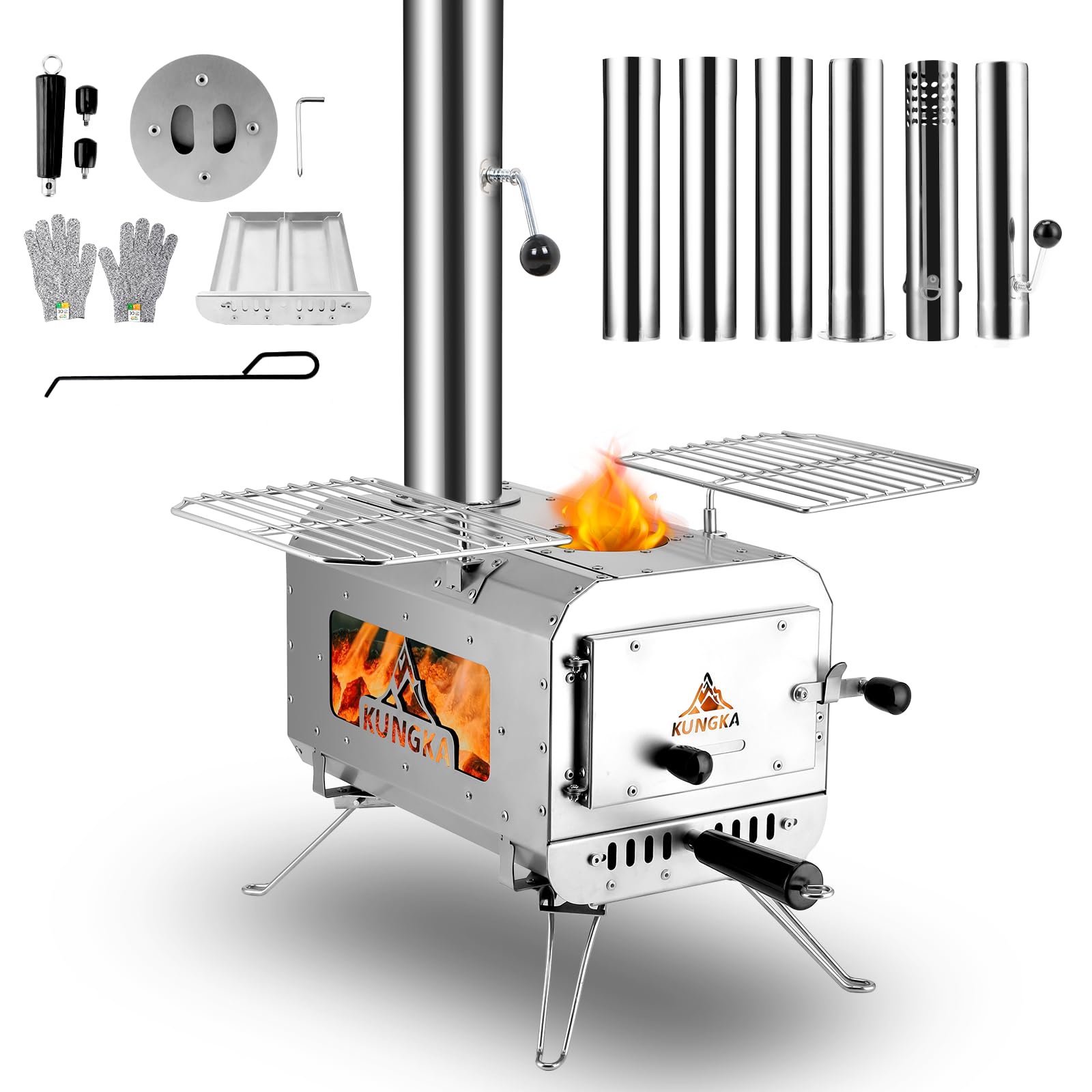
Six chimney sections, two glass windows and a folding shelf — the small stove that behaves like a full camp kitchen.
The number that earns this stove the top slot is the glass: you get a viewing window in the door plus a large window on the side. That means you can watch the fire from a chair without opening the door and dumping heat into the tent. Both panes are described as heat-resistant and flame-retardant, and the maker says the design minimises smoke so the burn lasts longer.
Control is genuinely dual: a damper valve on the chimney and two air inlets on the body let you dial the fire up for a quick boil or choke it down for an overnight smoulder. The rain cap on top means a wet night does not end your fire. Six sections of stainless chimney give you a 7.3-foot total run with the stove standing, and everything — pipes, handles, hook, gloves, two L-shaped wrenches, the ash pan assembly — packs inside the body.
Where it asks for patience is heat output. Some owners find it throws plenty of warmth while others find it runs hotter than they expected for a shelter this size, so plan to run it damped rather than wide open. The side tables unfold into a storage rack, which is handy, but it is also 20 pounds and 18 inches long once assembled, so it is truck-bed cargo rather than backpack cargo. Build quality is what owners praise most, and it shows in the riveted stainless body. This is a recreational stove for tents, teepees, yurts, shacks and tiny homes — the maker is explicit that it is not for residential use.
What earns the top spot
- Two glass windows — door and side — let you watch the burn without opening the door
- Damper valve plus two air inlets give fine control from quick boil to overnight smoulder
- Full kit stows inside the body: 6 pipes, rain cap, spark arrestor, gloves, hook, wrenches
- Foldable legs and unfolding side shelves for a stable base and a place to rest a pot
What to plan around
- Runs hot in a small sealed shelter — you will be damping it down rather than running it wide open
- At 20 pounds it lives in the truck bed, not the backpack
- Not for residential use; it is a shelter and camp stove
Reach for this if: you heat a canvas tent, yurt or shack and want to watch the fire and cook on top of it without fiddling with the door.
Look elsewhere if: you need to carry the stove on your back — the Winnerwell Nomad below is 13.1 pounds and packs into a 12.6-inch footprint.
2. Ytaoeo Wood Stove
The stove that solves its own storage problem — pipes, scraper and grate all live inside the body.
Seven chimney pipes at 2.36 inches in diameter, an extra 90-degree elbow and a spark-resistant pipe section make up the flue kit, and all of it stows inside the stove body along with the ash scraper and fireplace grate. That single design decision is what sells this one: you never hunt for a pipe bag in the dark.
The trick most buyers miss is that the side shelves double as carrying handles. Fold the legs, drop the shelves, and the whole thing is a flat box you carry by the sides. The elbow matters too — it lets you steer the flue sideways under a tarp or through a wall jack instead of forcing a straight vertical run.
Cooking is where it separates from the pack. The stove cover doubles as a BBQ grill, and the L-shaped handle flips out to create an extra grilling surface, so you can boil water on the main plate and grill alongside it. One honest note from the listing: the kettle shown in the photos is not included. The maker also asks you to run it with proper ventilation and a fireproof mat underneath, which you should take seriously in any sealed shelter. Sturdy, well-made construction is the thing owners talk about most here.
The value read: you are getting a full flue kit, an elbow, a grill-capable lid and heat-resistant gloves in one package, and the whole kit nests inside itself so nothing gets left at home.
The honest caveat: the kettle in the product photos is a prop, not part of the box — you supply your own pot or pan.
Suits you when: your vehicle space is tight and you want a stove plus flue that packs into one flat bundle with handles.
Think twice if: you want the widest glass view of the fire — the KUNGKA above gives you a door window and a side window, this one leans on a single large front pane.
3. Gonex Hot Tent Stove
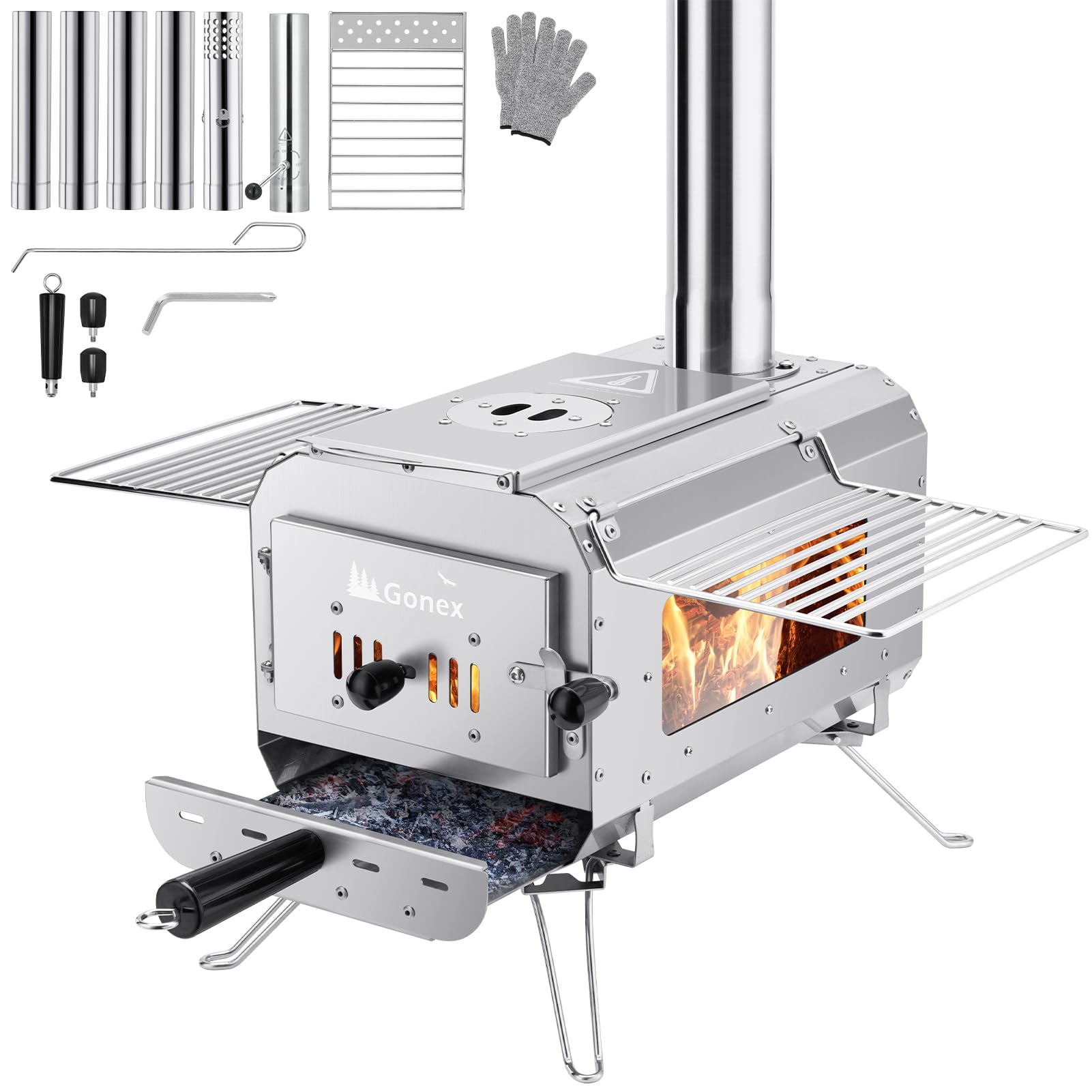
A 16.9-inch firebox built for full-size logs and an ash drawer that slides out without you touching a hot grate.
Anyone who has fed a small stove through a night knows the real cost is not the wood — it is getting up every forty minutes. The Gonex answers that with a 16.9 × 10 × 9.5 inch firebox, and the maker states plainly that it takes most standard pre-cut firewood logs, which is what extends the burn between refuels. The 1mm stainless body is rated to withstand 932°F without warping.
The chimney is the other thoughtful part. It runs 72.8 inches tall with a 2.76-inch diameter for a smooth draw, and the crescent-shaped damper stays partly open even when fully closed to cut smoke backflow down the pipe. A top cap keeps rain and snow out and slows escaping sparks. Inside, the rear anti-clogging structure is meant to stop debris building up so the wood burns fully rather than smouldering.
The catch, and it is a fair one, is that this stove gets hot — the whole body can glow red when you load it heavily, and that is a real warning in a small sealed shelter. The foldable grill widens your cooking area and the wide lid doubles as a BBQ plate, while the small lid is sized for a coffee pot. Ash removal is quick thanks to the pull-out drawer. At 23.8 pounds it is the heaviest pick here, and the comparison is worth stating: that is heavier than most, and it is also 16.9 inches long versus 12.6 inches on the Winnerwell — more room for logs, more room in the truck.
Why it stands out: quality is the word that follows this stove around, and a 16.9-inch firebox that swallows standard pre-cut logs is exactly what a long winter night asks for.
Watch the heat: load it heavy and the stove body itself can run red — keep clearances and ventilation honest.
Pick this one when: you are staying put for several nights and want to feed the stove less often with standard-sized logs.
Skip the extra bulk if: your shelter is a one-person bivvy and you want something you can carry by hand — this is the heaviest stove on the list.
4. YRenZ 1.6mm Stainless Steel Tent Stove
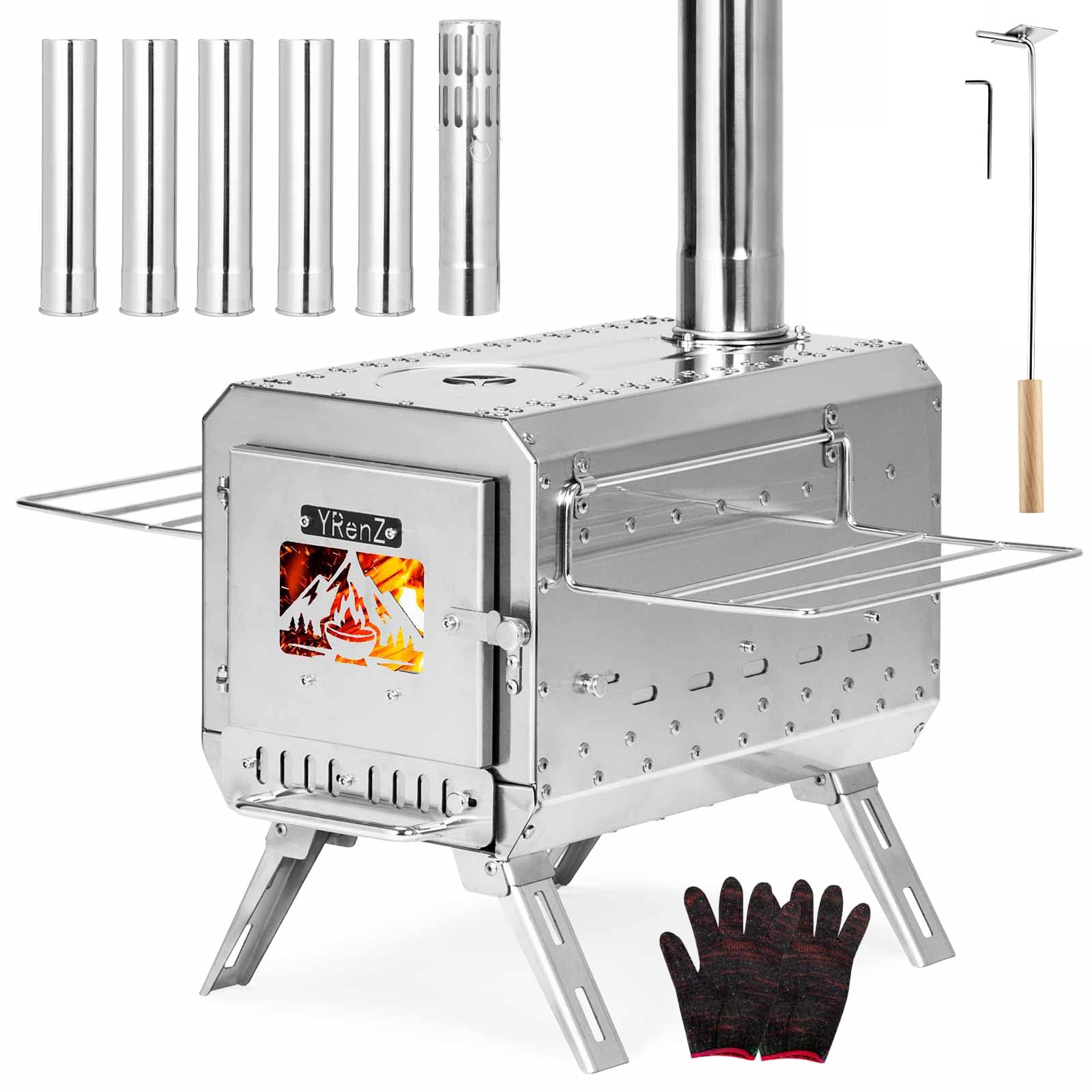
One primary and two adjustable air inlets turn one fire into three streams of air — and a hotter, cleaner burn.
The headline here is the combustion setup: one primary air inlet plus two adjustable secondary inlets, which the maker calls full three-way combustion. In plain terms, air enters above and below the fire, so the gases that usually drift up the pipe unburned get a second chance to ignite. That is why the maker claims a high, stable heat output for cold winter camping rather than a fire that flares and dies.
The body is 1.6mm stainless, versus 1mm on the Gonex above, and part of why it resists deforming — with top reinforcing ribs and a bent bottom edge to hold its shape. A dual-layer heat insulation structure is there to stop the outside overheating and to extend how long the stove lasts. Riveted construction is described as preventing smoke leakage, and the stainless is chosen to avoid odour and paint peeling, which is what happens to painted steel stoves after a season.
Setup flexibility is the practical win: seven splicable chimney sections give you about 2m of height, adjustable to fit most canvas and wall tents. An oversized firebox cuts down on refuelling, and the removable ash drawer empties without a fight. You also get a spark arrestor, fire hook, screwdriver and gloves in the box. There is no customer review history on this listing yet, so weigh it on the published build specs rather than on owner experience.
Where the engineering shows
- Three-way combustion with one primary and two adjustable secondary air inlets
- 1.6mm stainless body with reinforcing ribs and a dual-layer heat insulation structure
- Riveted seams aimed at stopping smoke leakage into the tent
- 2m of adjustable chimney across 7 sections fits most canvas and wall tents
What you give up
- No owner review history yet on this listing, so track record is unproven
- Thicker steel and an oversized firebox mean more to carry than a 13-pound stove
Worth it for: bushcraft and winter camping where you want a hot, stable fire and a chimney tall enough to clear a wall tent.
Hold off if: you want the safety of a large review track record — the OneTigris below has 250+ ratings behind it.
5. Change Moore Hot Tent Wood Stove
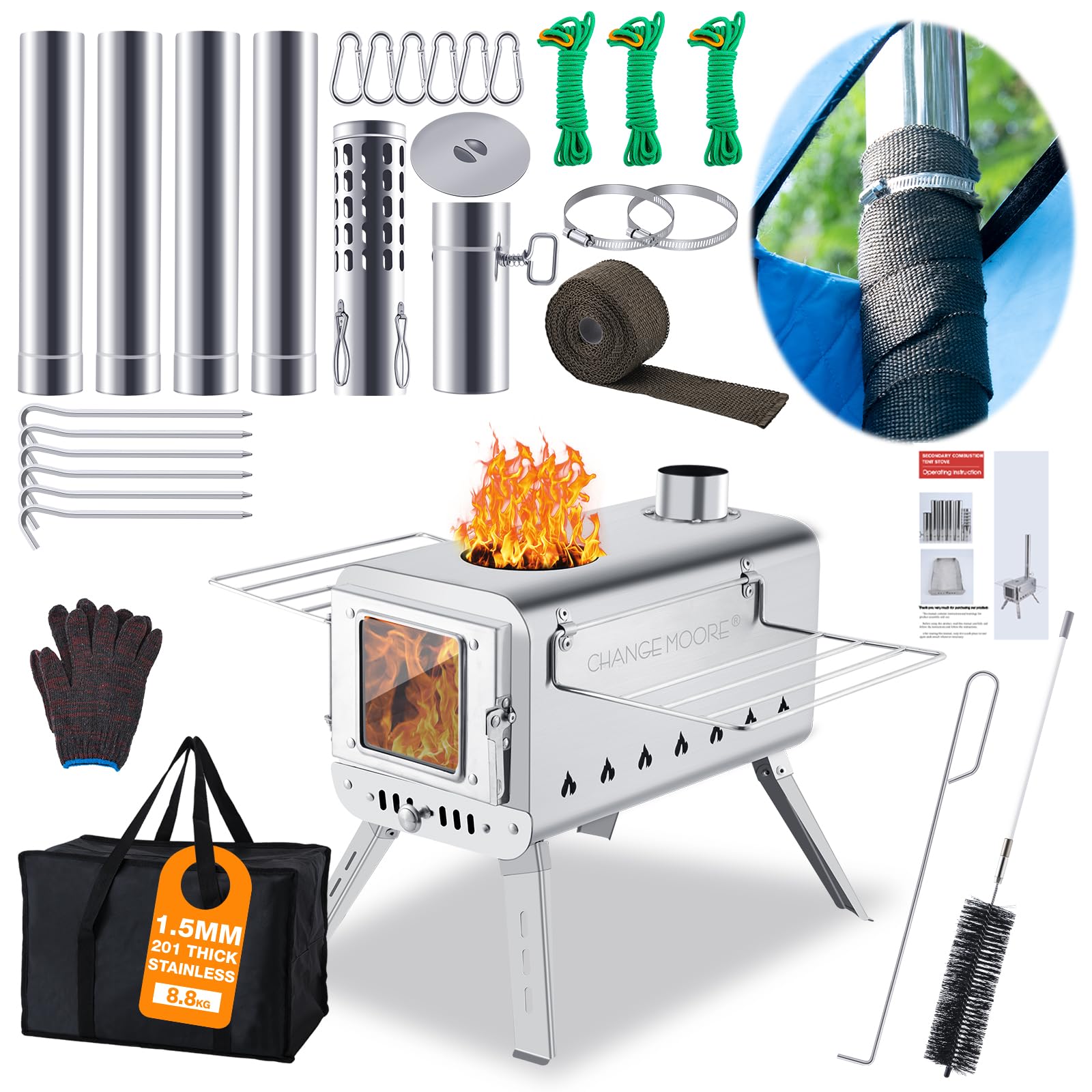
A secondary burn system that chews through damp firewood and leaves barely any smoke behind.
Wet wood is the reality of winter camping — the dry stack runs out, and what is left hisses instead of burning. This stove is designed around that problem. Its secondary burn system is built to raise flame temperatures, burn off tar and carbon monoxide, and keep working on damp or low-quality fuel. Owners consistently point to minimal smoke output, which is the visible proof that the second burn is doing its job.
The interior gives you 593 cubic inches to fill, enough for larger wood loads and an expansive view of the flames through the door. That glass is SCHOTT-branded and rated to 1000°C, so it holds up to a hot burn without clouding. The body is 1.5mm 201 stainless, chosen to hold its shape under sustained heat. A removable burn plate lifts out for cleaning, and a chimney cleaning brush ships in the set to keep airflow steady.
The maker’s own instructions are worth repeating because they prevent trouble: install the chimney before lighting so heat expansion does not jam it, do not cool the stove with water straight after use, and never touch the hot glass. A built-in chimney connection and an included heat-resistant cloth guard against burns, and wind-resistant ropes steady the stove outdoors. The maker rates it for shelters up to 500 square feet. Functionality is what wins people over, with heat retention right behind it.
The clever bit: the ashtray handle doubles as your air intake control, so one motion sets your burn rate and one motion clears the ash.
Read the manual: the chimney goes on before the first match, and no water on a hot stove — those two rules are in the listing for good reason.
Choose this if: your wood supply is never quite dry and you want the smoke and creosote kept to a minimum.
Different priority if: you want to bake at camp — the YRenZ oven stove at the end of this list adds a full oven.
6. OneTigris Tiger Roar Tent Stove
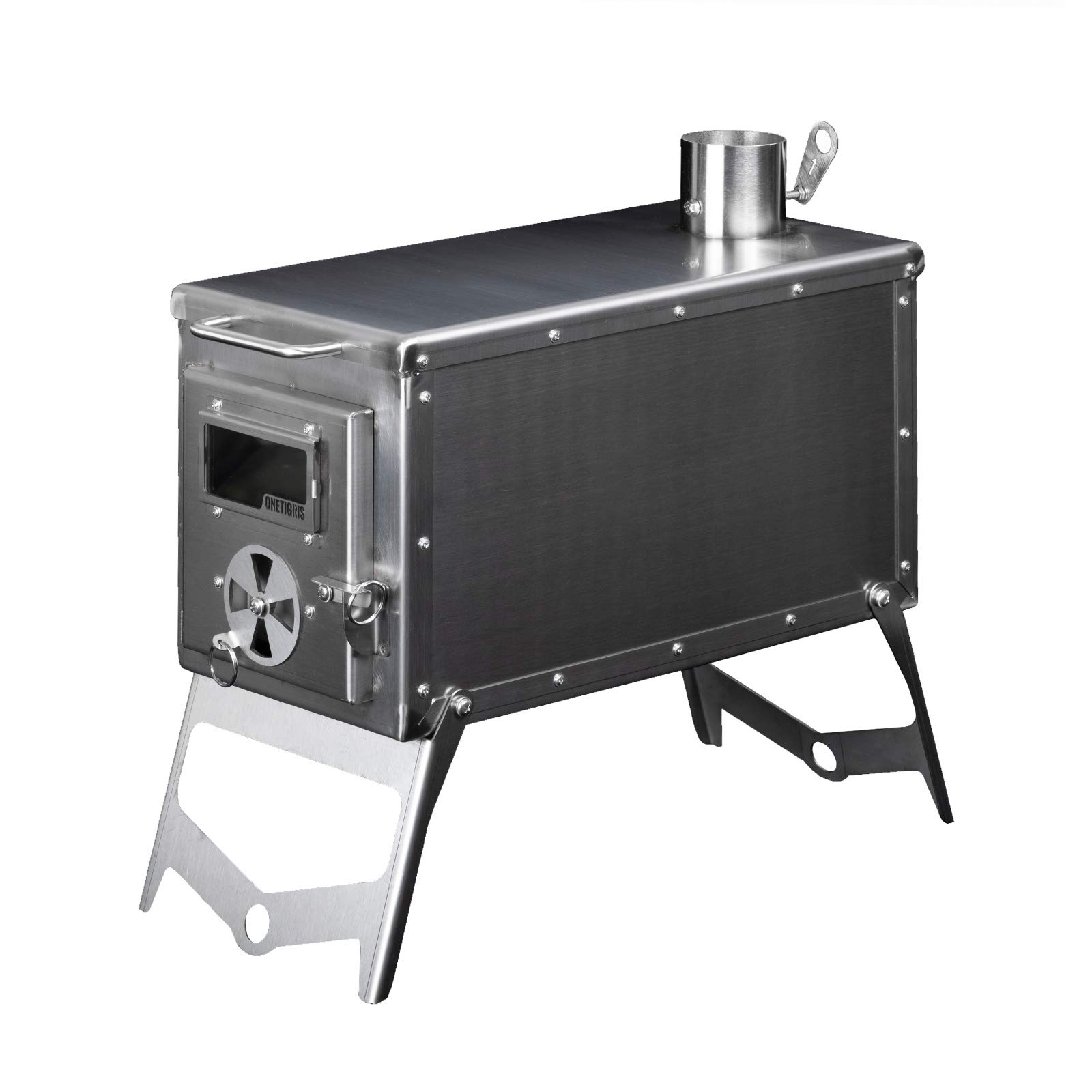
A 3mm-thick top plate and a fire chamber guide flake — the stove built to stop sparks at the source.
The top plate on this one is 3mm thick 304 stainless, versus the 1mm body of the Gonex, and that is deliberate: the top takes the direct flame and your heaviest pot, and it is the part most likely to bow on a cheaper stove. The rest of the body is forged from 304 stainless, while the chimney and elbow pipes use 201 stainless.
Spark control is the engineering story. A guide flake inside the fire chamber slows the gas flow rate and traps sparks, which the maker says means you do not need a spark hunter on top of the pipe. The air intake valve is split so air flows both up and down, controlling flow speed for better fuel use and stopping carbon or sparks from falling out of the inlet and starting a fire. It also blocks smoke from flowing back into the tent. The viewing panel is SCHOTT ROBAX glass-ceramic, rated for short-term blazes up to 760°C and resistant to thermal shock.
The kit is unusually complete: seven pipe sections, two 45-degree elbows and two 90-degree elbows so you can route the flue your own way, plus an ash scraper, leather gloves and a spare glass. Heating performance has carried this stove through genuinely cold nights. The trade-off is real and worth naming plainly: reports on durability vary, with some stoves holding up as heavy-duty stainless and others coming apart after a single use. Treat it as a basecamp stove, assemble the pipes correctly with the small opening down and the big opening up, and keep them clean. It is 10 kg, so it stays where you put it.
Where it holds up
- 3mm 304 stainless top plate resists bowing under a heavy pot
- Split air valve controls airflow up and down and stops smoke backing into the tent
- Guide flake slows gas flow and cuts sparks — no separate spark hunter needed
- 7 pipes plus 2×45° and 2×90° elbows let you route the flue around obstacles
Where the reports split
- Durability is the mixed note — some units hold up as heavy-duty, others have come apart after one use
- 10 kg makes it a basecamp fixture, not a stove you move between camps
The right buy when: you want a substantial fire chamber with proper spark control and you set up camp in one place for the season.
Weigh the risk if: you want the least-doubt purchase — the Winnerwell below has a longer, steadier reliability record.
7. Winnerwell Nomad Small Tent Stove, 450 Cubic Inch Firebox
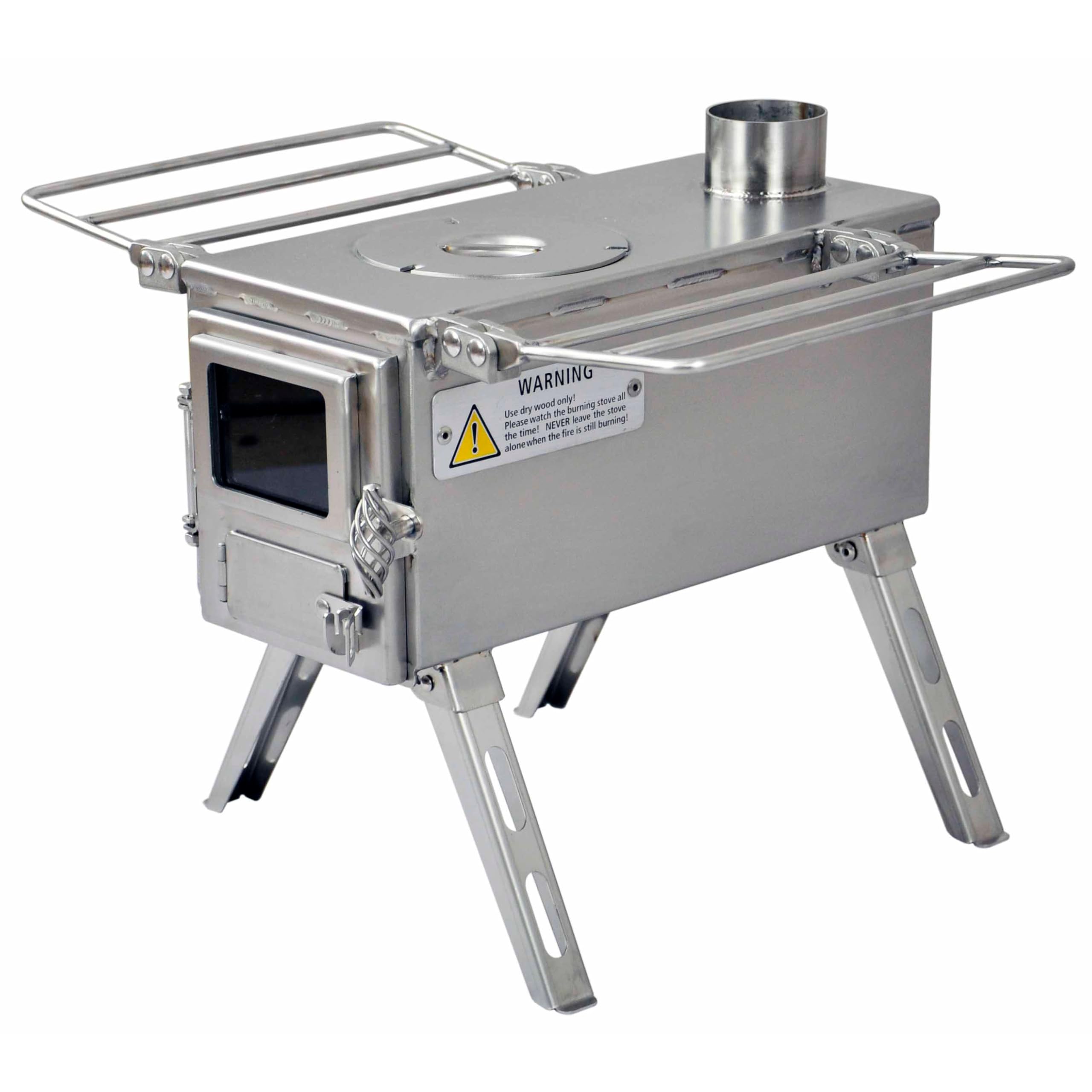
13.1 pounds, folds to a flat 12.6-inch box, and the side shelves become the carry handle.
Packing is the whole point of the Nomad, and the numbers back it up. It folds down to 12.6 inches by 6 inches by 6 inches, with the four nesting legs folding flat underneath and the five chimney pipe sections stowing inside the stove body. The side shelves swing up to form a carry handle. Assembled, it stands 71 inches tall including the chimney, with a 450 cubic inch firebox for the fire itself.
The material is 304 stainless, the same grade the OneTigris uses on its body, picked for corrosion resistance in wet, harsh conditions. The pipe is 2.1 inches in diameter, versus 2.76 inches on the KUNGKA and Gonex, so check your tent jack before you commit. A spark arrestor and ash scraper come in the box, and the door has a viewing window.
Where it gives ground is capacity and heat reserve: 450 cubic inches is the smallest firebox on this list, so you will reload more often in deep cold than you would on the 593 cubic inch Change Moore. That is the honest trade for the weight and footprint. The maker positions it for canvas tents, teepees, yurts, shacks and tiny homes, and states it is not intended for residential use.
The carry math: 13.1 pounds with pipes inside the body and shelves as a handle — you can walk it into a camp in one trip.
The heat math: a 450 cubic inch firebox means more refuelling than the bigger stoves here, so pack wood accordingly.
Made for you if: you hike or pack in and the stove has to come with you rather than follow in the truck.
Look up the list if: you want a longer burn between refuels — the larger fireboxes above trade weight for fewer trips into the cold.
8. YRenZ Tent Stove with Oven
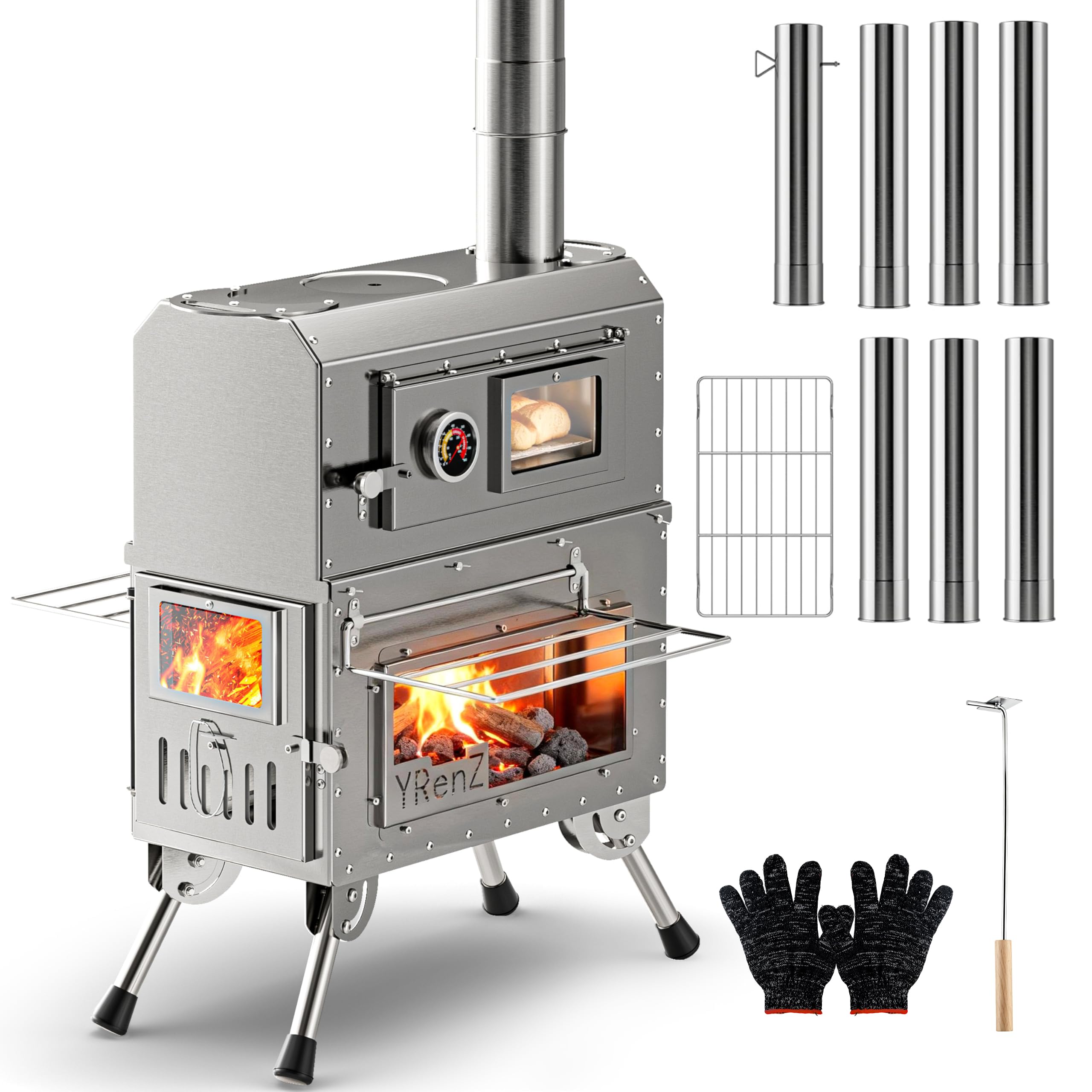
The only pick with an actual oven — bake bread, roast meat, and still heat the tent from one firebox.
Every other stove here gives you a hot plate to boil on. This one gives you a hot plate and an oven, so a camp dinner stops being a choice between rehydrated food and nothing. The unit combines a stove section and an oven section in one body, and multiple secondary air inlets are there to keep the heat even across both chambers.
The build is high-temperature stainless, chosen to hold its shape through prolonged use, with anti-slip feet so the whole thing stays put on uneven ground while you are sliding a pan in and out. A temperature gauge is included in the accessory set, which is the difference between guessing when the oven is ready and knowing. You also get the smoke pipe, control valves, gloves and hooks.
Size is the honest trade-off. At 19 inches deep by 18 inches wide by 10.6 inches tall, this is the widest footprint on the list — it needs a proper flat floor space in the tent, not a corner. It is 7 kg. There is no owner review history yet on this listing, so the case rests on the published spec and the accessory set rather than on a track record. If cooking is the reason you want a stove, though, nothing else here covers the oven function.
The one honest nudge: if a hot meal is the point of your camp, an oven is the feature you cannot add later to a stove that does not have one.
Plan the floor: 19 by 18 inches of level ground inside the shelter before you light it.
Best for you when: hunting camp or a long stay where real cooking — baking and roasting — is as important as warmth.
Not for you if: your tent is tight on floor space or you need something you can lift one-handed.
Know the Specs
Firebox Volume In Cubic Inches
Firebox volume tells you how big a log load the stove accepts and roughly how long it burns between refuels. The stoves here range from 450 cubic inches on the Winnerwell Nomad to 593 cubic inches on the Change Moore. A smaller firebox packs smaller and weighs less; a larger one means fewer trips out into the snow to reload. Match it to how long you sleep and how cold the night gets.
Steel Thickness In Millimetres
Thickness is quoted as 1mm, 1.5mm, 1.6mm and up to a 3mm top plate. The figure refers to the stainless sheet the body is made from. Thicker steel tends to resist warping when the stove runs hot for hours, and the top plate matters most because it takes the direct flame and holds your pot. A dual-layer heat insulation structure is a separate feature that keeps the outside cooler while the inside stays hot.
Chimney Diameter And Height
Pipes here measure 2.1 inches, 2.36 inches or 2.76 inches across. Check your tent jack or flashing against that figure before buying, because a pipe that does not fit means a hole you have to seal by other means. Height matters too: a taller flue draws better and carries smoke clear of the shelter, while a shorter one packs smaller. Elbow sections at 45 or 90 degrees let you route the flue sideways out of a wall or under a tarp.
Secondary Combustion Explained
In a plain stove, gases released by the wood escape up the chimney unburned. Secondary combustion adds air above the fire so those gases ignite too, which raises flame temperature and cuts the smoke and tar that would otherwise coat the flue. In practice it means less smoke in the tent, less creosote to scrape, and a stove that can still burn when the wood is damp. It also tends to be more efficient with fuel over a long night.
Common Questions
Will a small tent stove fit through my tent’s stove jack?
How much firebox do I need to heat a two-person tent overnight?
Is a wood stove safe inside a sealed tent?
What does secondary combustion actually do on a small stove?
Can I cook on a small wood stove, or is it heat only?
How do I stop smoke from blowing back into the tent?
Does thicker stainless steel mean a longer-lasting stove?
Is the Winnerwell Nomad big enough for a wall tent?
How portable are these stoves when packed down?
Do these stoves come with the chimney and accessories included?
The Bottom Line
For most people heating a small tent, yurt or shack, the KUNGKA Tent Stove is the smart pick: two glass windows, a damper and two air inlets for real control, folding legs, and a full kit that stows inside the body. If you want a stove that packs into one flat bundle with its own handles, the Ytaoeo is the one. And when the plan is a proper cooked meal at camp, the YRenZ oven stove is the only pick here that actually bakes.
The clearest reason to buy one of these rather than a bigger stove is the footprint: the Winnerwell Nomad comes in at 13.1 pounds and folds to 12.6 inches, which is a stove you can genuinely carry in. Pick that one when the walk in is the hard part, and pick a larger firebox when staying warm through a long night is the hard part.
How we choose
We do not accept paid placement. Every pick is matched to a real buyer and a real use-case; we do not hands-on test units.
Sources
Specifications: manufacturer listings and product documentation. Review insights: verified customer reviews, as of November 2026. Pricing: not shown on this page (it changes often); check the current price via the retailer link.
As an Amazon Associate, Tactical Gear Guy earns from qualifying purchases. This does not affect which products we feature.