Specs are compiled from manufacturer listings and verified buyer reviews and can change over time — please confirm the key details on the product page before buying.
Buying a front-and-rear camera setup is really about two things: proof of what happened ahead of you, and proof of who hit you from behind. A single front camera leaves half the story on the table, which is why a dual-channel kit — one front unit, one rear unit, recording together — matters so much in a disputed claim. Below you get nine real options, sorted by what each one genuinely does best, with the specs that actually change your day explained in plain words.
This guide is built by comparing the manufacturers’ published specifications and the patterns across verified customer reviews, so you get each pick’s real strengths and trade-offs instead of marketing spin.
You will see which kits record a third cabin channel, which ones need a separate hardwire kit before parking mode works, and where each one cuts a corner. Read to the end and you will know exactly which vehicle front and rear camera belongs on your windshield, and which one you can safely ignore.
Top Picks
How To Choose The Best Vehicle Front and Rear Camera
Most people buy on the resolution number on the box and then get let down by the cable that will not reach their tailgate. Start with the wiring, then the sensor, then the screen.
The rear cable reaches your tailgate or it does not
The rear unit sits by your back window or above the plate, and the cable has to run the length of the cabin. Published cable lengths in this category run from a 6.5M rear cable on the TERUNSOUl up to a 21.3ft rear camera cable on the GKU, and the 70mai A810 Lite ships a rear cam signal cable that buyers openly call short. Measure the run before you buy, especially on an SUV or a minivan, because a cable that falls short means a rear camera that never gets mounted.
Sensor and aperture decide whether a plate is readable at night
A STARVIS sensor is Sony’s low-light image sensor, and the second generation is the one buyers chase — the VIOFO A229 Plus pairs two of them across front and rear. Aperture is the size of the lens opening, written as an f-number; a smaller number lets in more light, so F1.5 beats F1.7 on a dark road. Together they decide whether the plate of the car that clipped you is a white blur or a clean read.
Parking mode is a paid extra, not a default
Nearly every kit here records around the clock only after you add a hardwire kit, which is sold separately on the TERUNSOUl, the 70mai A810 Lite, the GKU, the BOTSLAB and the ROVE. Budget for that part and for an afternoon of fuse-box work, or accept that the camera sleeps when the ignition is off.
Side-by-Side Comparison
| Model | Best For | Front / Rear Resolution | Field Of View | Included Card | Amazon |
|---|---|---|---|---|---|
| TERUNSOUl 3-Channel 4K★ Best Overall | Full cabin coverage | 4K / 1080P | 170 degrees | 128GB | Amazon |
| Coolcrazy 4K DualBudget-Friendly Night Footage | Budget-friendly night footage | 4K / 1080P | 170 degrees | 128GB | Amazon |
| 70mai A810 LiteRemote Monitoring Pick | Remote 4G monitoring | 4K / 1080P | 140 degrees | 64GB | Amazon |
| GKU D600 Pro Max | Discreet two-mount install | 4K / 1080P | 170 degrees | 64GB | Amazon |
| BOTSLAB G300H Plus | Heat resistance | 4K / 1080P | 170 degrees | 64GB | Amazon |
| 70mai T800E 3-Channel | Rideshare drivers | 4K / 1080P | — | 64GB | Amazon |
| VIOFO A229 Plus 3CH | Dual STARVIS 2 night clarity | 1440P / 1080P | 140 degrees | — | Amazon |
| ROVE R2-4K Dual PRO | Top-resolution rear channel | 4K / 2K | 150 degrees | 128GB | Amazon |
| VIOFO A329S | Smooth 60fps front footage | 4K 60fps / 2K | 140 degrees | — | Amazon |
Detailed Reviews
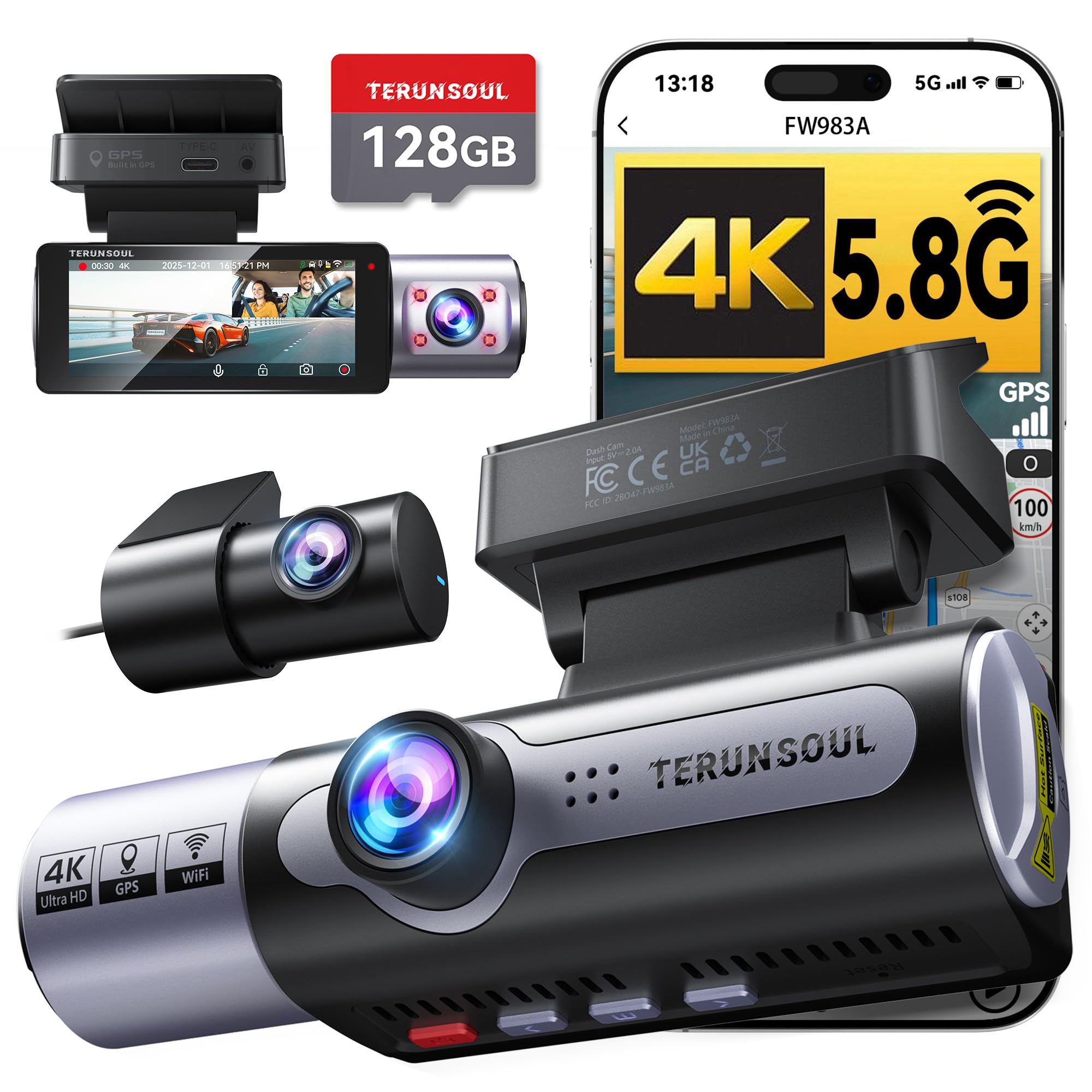
1. TERUNSOUl 4K Dash Cam Front and Rear
Our pick — 4.5+★ from 450+ verified ratings; the strongest balance of quality and price.
Three lenses, one box, and a 128GB card already inside — the closest thing here to a complete kit.
If you drive for a living or carry passengers, the front-and-rear story is only half of it. This unit records three channels at once — 4K up front, 1080P out the back, and 1080P inside the cabin — so a fare dispute and a rear-end bump are captured by the same device. The front lens spans a 170-degree field of view, and the rear and cabin lenses each cover 165 degrees, which is the difference between seeing the lane beside you and seeing only straight ahead.
The 128GB card comes pre-installed, so the camera starts loop recording the moment you plug it in — when the card fills, the oldest open up clip is overwritten. A collision sensor locks the impact footage so it survives that overwrite. The starlight-grade five-layer lens sits behind an F1.6 aperture with HDR, which is the plain-English recipe for a readable plate under streetlights rather than a smear of headlight glare.
Where it lands above the cheaper picks is the GPS work. A high-precision GPS module stamps route, real-time speed, location, compass and timestamp straight into the video file, and you replay that data through a free player for Windows or Mac. That overlay is what turns “he cut me off” into a claim an insurer can check. The built-in 3.16-inch IPS screen lets you review footage at the roadside without reaching for a phone at all.
Where three lenses pay off
- Front, rear and cabin record at once, so nothing inside or behind the car goes unrecorded
- 128GB card ships installed — no extra purchase before first use
- GPS route, speed and timestamp baked into the file, replayable on Windows or Mac
- Dual-band 5.8GHz and 2.4GHz WiFi push clips to the TERUNSOUl app at 20MB/s
What to plan around
- Parking mode needs a separate hardwire kit that is not in the box
- The rear cable is a fixed 6.5M run, so measure a long SUV before mounting
Reach for this if: you want one device covering the road, your bumper and your back seat without buying anything extra to start recording.
Budget the hardwire kit: continuous parking surveillance is a separate part on this kit, so factor that in before you count on overnight coverage.
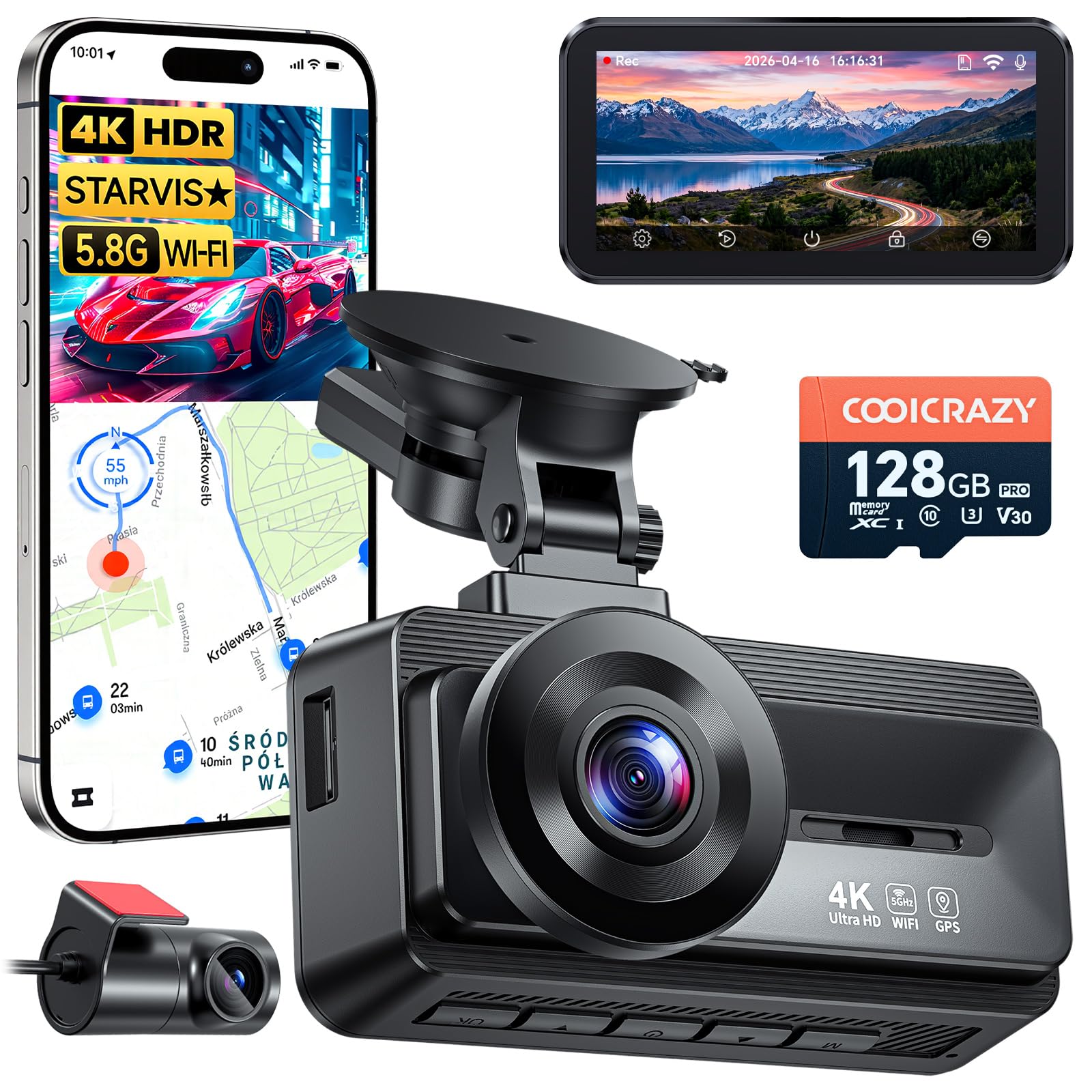
2. Coolcrazy 4K Dash Cam Front and Rear with STARVIS Sensor
The entry-level kit that still brings a night-vision sensor and a 60fps front lens.
Picture the windshield on a rainy night with oncoming headlights washing everything out. That is the exact scenario this camera is built to survive: a STARVIS starlight night-vision sensor paired with a large-aperture WDR setup, which is a processing trick that pulls detail out of both the bright and the dark halves of one frame. Oncoming glare gets cut, tunnel mouths stop turning black, and the plate in front of you stays legible.
The numbers frame the trade-offs cleanly against the 70mai A810 Lite. This one covers a 170-degree front field of view against the 140 degrees on the 70mai, and it includes a 128GB card where the 70mai ships 64GB. The front lens also runs at 60fps, which keeps frames sharp when the relative speed between you and the car ahead climbs on a highway. Where it gives ground is the ceiling on storage: it takes microSD cards up to 256GB, while the 70mai stretches to 512GB.
Loop recording overwrites the oldest files automatically, and a built-in G-sensor locks the clip the instant it senses a collision or hard braking, so the moment you need is preserved. Set-up is genuinely one-click for novices, and a 20.3ft rear camera cable covers most cabin runs. What wins people over is the feature set for the price — a STARVIS sensor, 60fps front recording and a 128GB card in the box. The stickier point is the phone connection: pairing lands easily for some drivers and fights others, so treat app connectivity as the one thing to test in your first week.
The nightly win: STARVIS sensor plus WDR is a serious night-vision pairing at this tier, and 60fps up front keeps moving plates crisp.
Honest follow-up: the 256GB card ceiling caps how many days of footage you can hold before the loop begins overwriting.
Suits the careful spender: a driver who wants genuine night clarity and a card in the box without climbing into premium territory.
Worth knowing going in: app pairing is the weak link, so budget patience for the first connection and you will be fine.
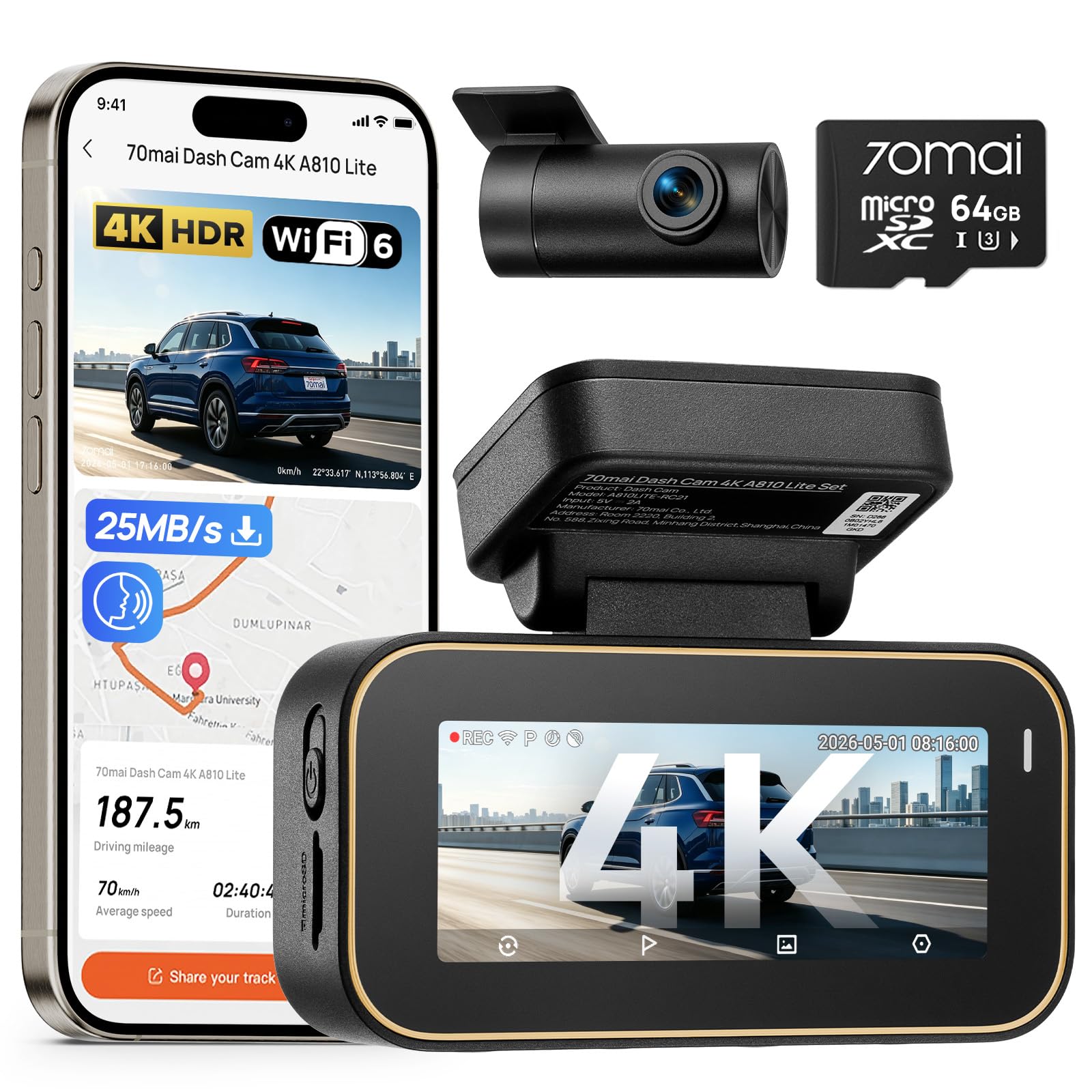
3. 70mai A810 Lite 4K Dash Cam Front and Rear with 4G LTE
Check on a parked car from your desk — this is the kit that puts the camera in your pocket.
The feature nobody else on this list matches is the 4G LTE remote access. With the UP05 4G hardwire kit fitted, you can open live footage of your car while it sits at the airport or on a street miles away, track its location, and get real-time alerts pushed to the app. For long-term parking, a travel-heavy schedule, or a rideshare car parked between shifts, that remote window changes how the camera is used.
Recording itself is 3840x2160P 4K up front and 1080P out back, with an F1.55 aperture and HDR working the night shift to keep headlight glare under control. Wi-Fi 6 moves files at up to 25MB/s, and you can preview, download, share and even update firmware over the air without pulling the card. GPS is three-mode — GPS, GLONASS and BDS satellites together — and it logs speed, route and location for playback.
The design is genuinely tiny: the 0.96-inch deep body slips behind a rearview mirror and out of sight. Where it trails the Coolcrazy is the front field of view — 140 degrees here against 170 degrees there — so the Coolcrazy sees wider across your lanes. The 70mai counters with a 512GB ceiling on card size and a supercapacitor instead of a battery, which is what makes it shrug off a baking summer dash rather than swell like a lithium cell. The recurring gripe is cable length; the main camera cable runs short for some installs, and a few owners hit connectivity snags, so plan the route before you mount anything.
Pick this for the reach: 4G remote viewing is a capability none of the other eight picks here deliver, and it is the reason to choose this one.
Then plan the wire: the compact body hides beautifully, but the short main cable means you should map your cabin run first.
4. GKU 4K Dual Dash Cam Front and Rear with STARVIS 2
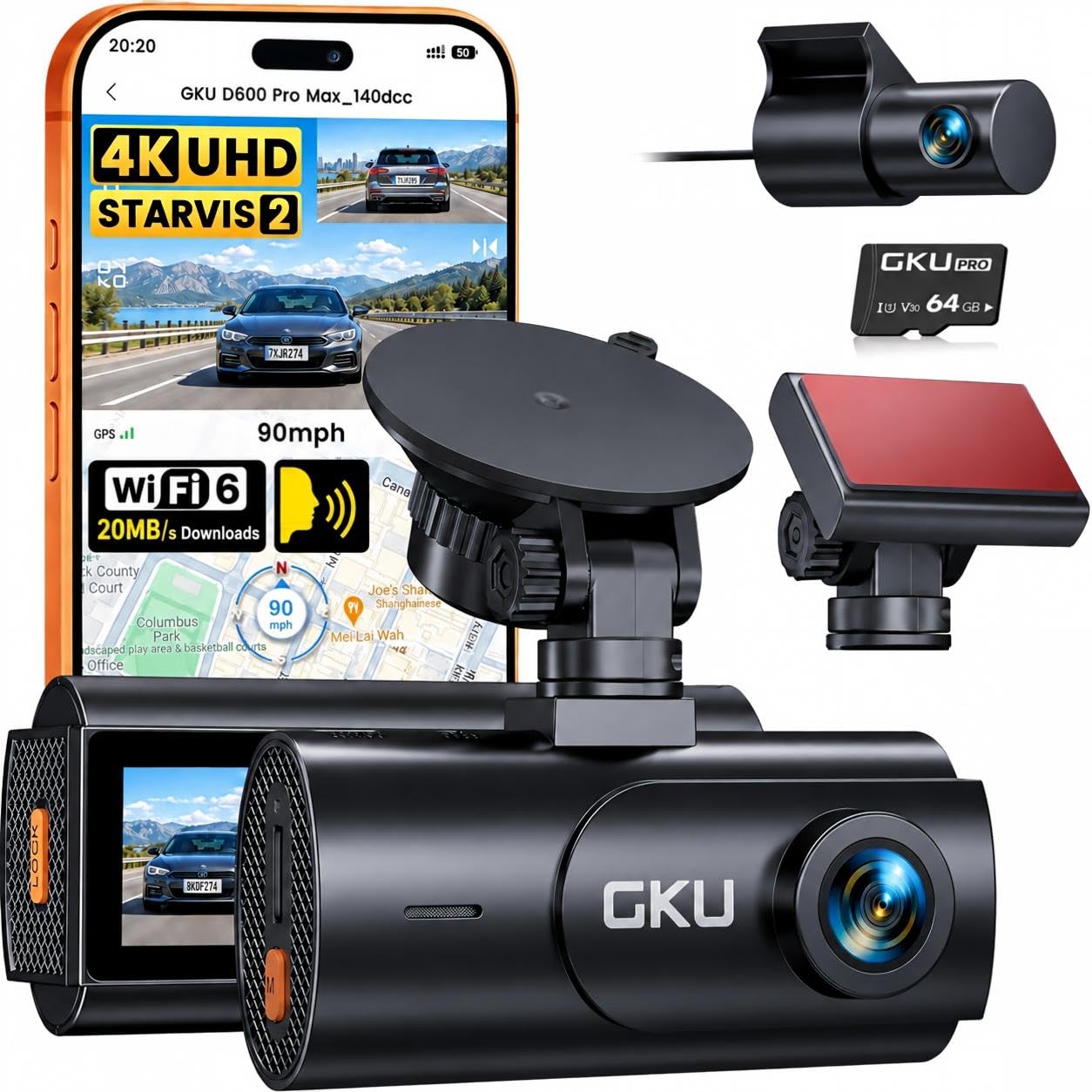
Two ways to mount it, one Sony STARVIS 2 sensor, and a card in the slot on arrival.
Renters and company-car drivers get the most out of this one, because the GKU puts both a suction cup mount and a 3M adhesive mount in the box. Suction for a car you hand back, adhesive for the one you keep. The rear cable is 21.3ft, which is the longest published rear run in this group and the reason it is a comfortable fit for a longer SUV or a truck rather than a snug hatchback.
The front camera records 4K and the rear 1080P, with 170-degree front and 150-degree rear coverage closing the blind spots at both ends. A Sony STARVIS 2 sensor plus WDR handles the nighttime detail, and the unit can run HDR in front-camera-only mode when the rear cam is unhooked. Download speeds up to 20MB/s over 5.8GHz WiFi 6 with a 2.4GHz fallback make pulling a clip to your phone a short wait rather than a chore, and a free 64GB card sits pre-installed in the slot.
Voice control keeps both hands on the wheel for the key recording commands, and a supercapacitor replaces the battery for better heat tolerance and a longer service life in a sun-baked interior. The one rule to respect is the hardwire kit: parking mode needs one, it is sold separately, and it must be the GKU kit — a third-party one can stop the camera powering on altogether. What wins people over is the dual-mount flexibility and the 21.3ft rear cable, and the 12-month warranty extending to 24 months adds a little cushion.
Its real strength: the suction-plus-adhesive mounting choice and the 21.3ft rear cable make it the easiest fit for an awkward vehicle.
The fine print: buy the hardwire kit from GKU itself — the camera’s parking mode will not cooperate with a generic one.
Made for the long-roof driver: an SUV, pickup or van owner who needs the cable to actually reach the tailgate and wants a mount they can remove later.
Just keep the kit matched: the GKU-only hardwire rule is the single thing to get right.
5. BOTSLAB G300H Plus 4K Dual Dash Cam Front and Rear
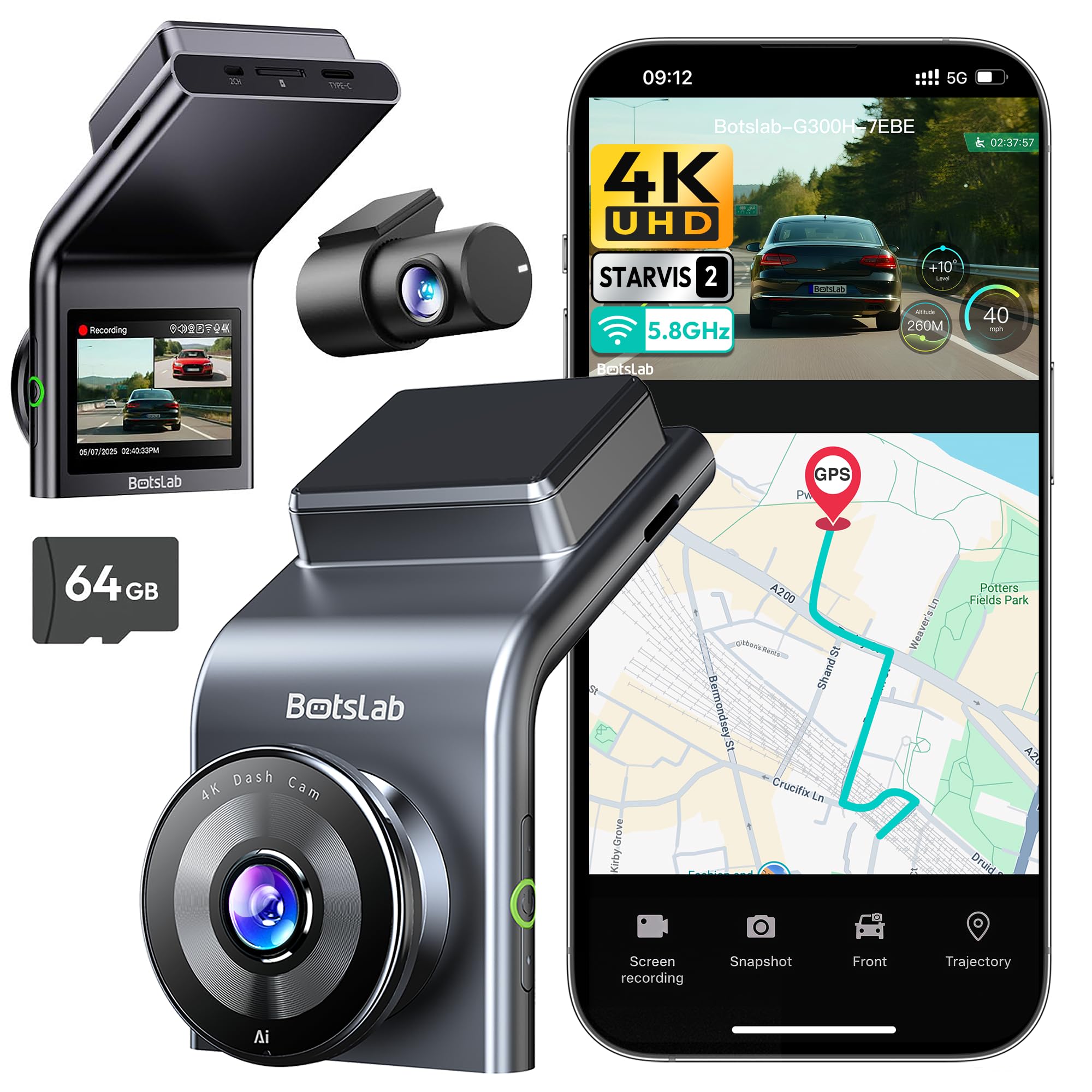
Built for a car that sits in the sun all day and still has to record on the first turn of the key.
Heat kills dash cams that run on lithium batteries, so BOTSLAB went the supercapacitor route — a power component that stores charge without the swelling and lifespan loss a battery suffers in extreme temperatures. The maker rates it from -20℃ to 70℃, which covers a parked car in a summer lot and a cold winter morning both. If your car lives outside, that durability is the whole reason to look here.
The front lens shoots 4K and the rear 1080P, with a 170-degree ultra-wide front view that lets you watch multiple lanes and catch a hazard building at the edge of the frame. STARVIS 2 brings the low-light sensitivity and color accuracy, an F1.5 aperture is the widest on this list, and HDR balances the dark road against oncoming glare so the plate survives the contrast. Voice control handles “take photo” and “video start” without a hand leaving the wheel, and built-in GPS stamps speed, route and location into every file.
A 5.8GHz WiFi radio pushes a 4K clip to your phone for review, which the maker frames against 2.4GHz as dramatically quicker. The included 64GB card keeps loop recording running from the start, and the card slot takes up to 256GB. One practical catch, straight from the manual: this camera and Apple CarPlay cannot hold a phone connection at the same time, because an iPhone runs only one active WiFi link. Choose which one gets the phone while you drive. What wins people over is the supercapacitor and the F1.5 aperture, which keep it recording through a baking summer dash.
Born for the open-air parking spot: a supercapacitor and an F1.5 aperture make it the sensible choice when the car bakes day after day.
iPhone drivers, note this: CarPlay and the camera compete for the same WiFi link, so you cannot run both at once.
6. 70mai T800E 4K Dash Cam Front, Rear and Inside
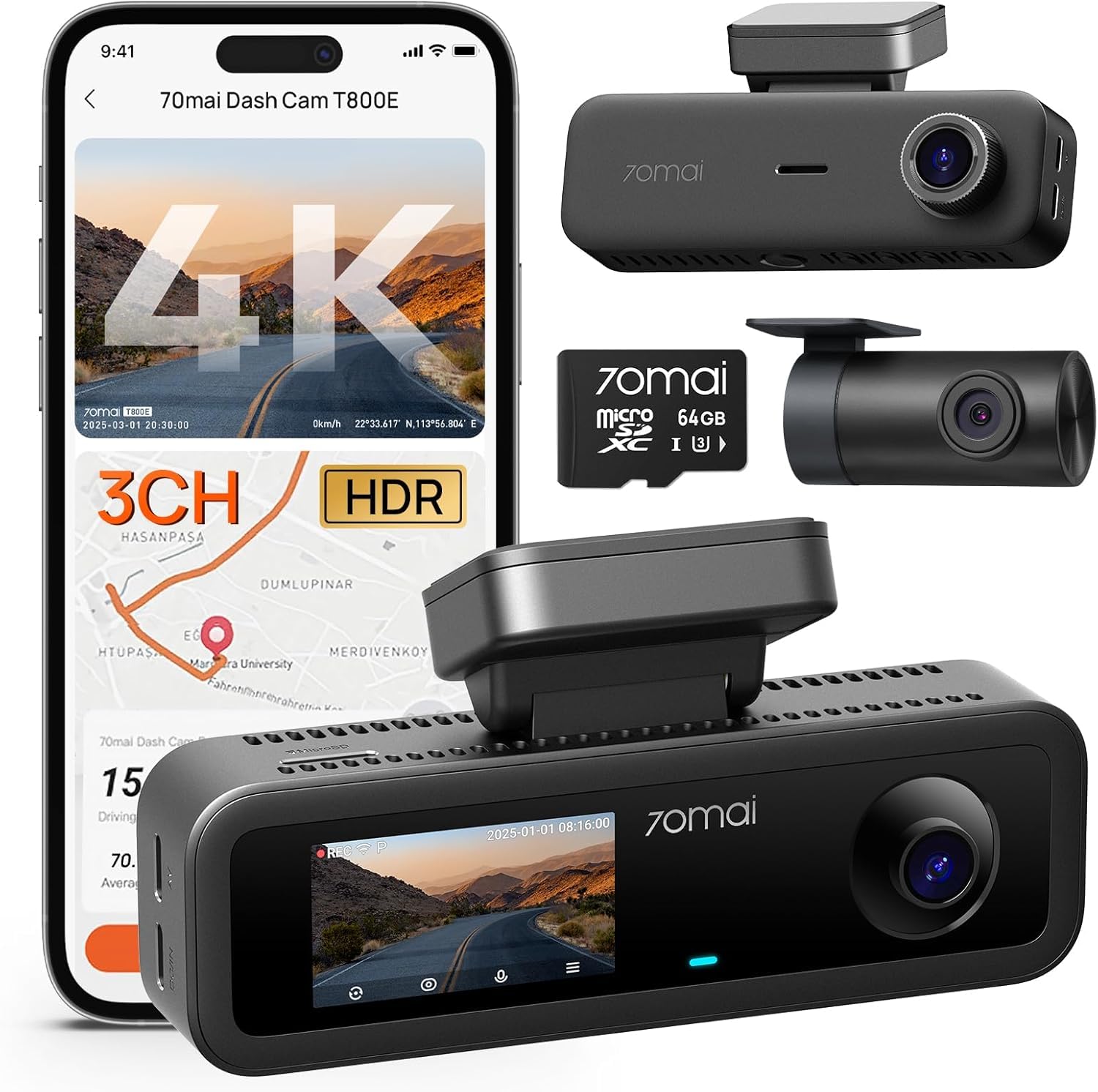
The cabin camera that switches on infrared when the back seat goes dark.
For an Uber or Lyft driver, the interior camera is not a bonus — it is the part that settles a fare dispute. This unit runs three channels at once: 4K up front, 1080P inside, and 1080P out back. The interior lens carries switchable infrared, so you can flip IR on for a black-and-white but legible night view of your passengers, then switch it off when you do not need it. Ultra-wide lenses and an F1.55 aperture do the heavy lifting day and night.
HDR imaging and 3D noise reduction pull detail out of a dark cabin, and the 4K front camera captures plate and road detail clearly. Built-in five-mode GPS logs location, speed and route, and Wi-Fi 6 transfers files through the 70mai app up to five times faster than standard Wi-Fi 4 at speeds up to 10MB/s. Hands-free voice control covers photos, recording and footage locks, so your attention stays on the road. The 64GB card in the box keeps loop recording going, and the slot accepts up to 512GB for longer stretches.
A supercapacitor powers it from 14°F to 140°F, the same battery-free approach that keeps a hot cabin from cooking the electronics. The compact body stays out of your sightline, and set-up is quick enough for a first-timer to finish without help. The honest limit is that 4G is not supported on this model — remote live view is a 70mai A810 Lite feature, not this one. Parking monitoring also asks for the UP06 or UP03 hardwire kit, sold on its own.
Why the cabin cam earns its place
- Infrared switches on for the interior lens so night passengers stay visible
- Three channels record together — road, cabin and rear bumper at once
- Wi-Fi 6 pushes files up to 10MB/s, five times faster than Wi-Fi 4 by the maker’s count
- 64GB card included, and the slot grows to 512GB if you record long shifts
Set your expectations here
- No 4G support, so there is no remote live view from your phone
- Parking surveillance wants the UP06 or UP03 hardwire kit, which is separate
Tailored to the paid driver: rideshare and taxi work where the back seat is where disputes start and the infrared cabin view ends them.
Skip remote hopes: if you were counting on checking the car from your phone, this model does not do 4G.
7. VIOFO A229 Plus 3 Channel Dash Cam, Dual STARVIS 2 Sensors
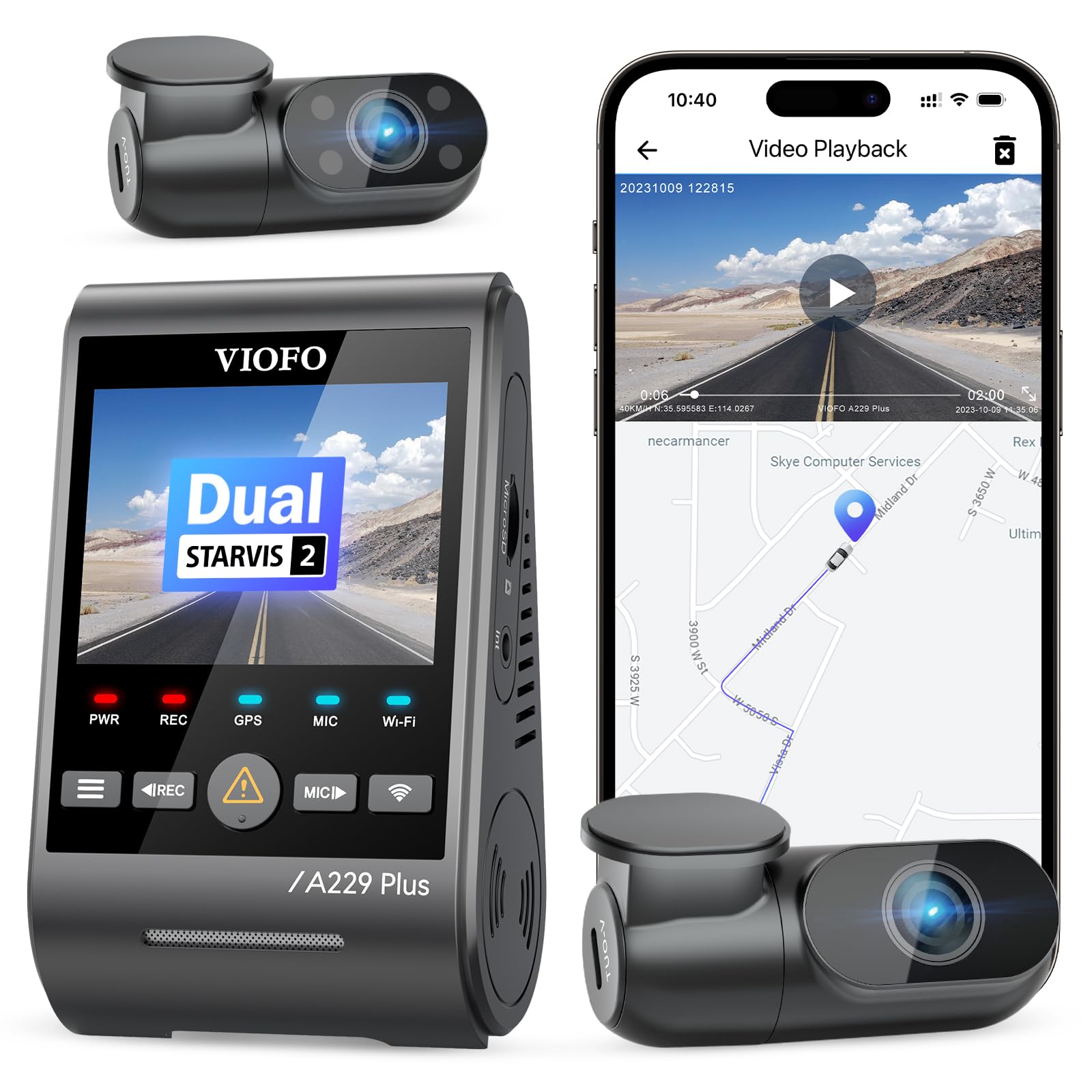
Two Sony STARVIS 2 sensors on one camera is the night-vision move the rest of the list does not make.
This is the first front-and-rear unit in the group to fit two Sony STARVIS 2 IMX675 image sensors, one up front and one out back. The maker puts that generation at 2.5 times the dynamic range and 2.5 times the light sensitivity of the older STARVIS, which in plain terms means less noise and less motion blur when a car crosses your beam at night. Resolution is 2K + 2K + 1080P across front, interior and rear, and HDR runs on all three channels rather than just the front.
The cabin lens adds a detail worth the step up: four infrared LED lights that activate automatically when a built-in IR sensor detects a dark cabin, recording sharp black-and-white detail in complete darkness. Twelve voice commands cover photos, video locks, WiFi and switching between front and rear views, and the unit speaks up about settings changes or memory card errors so a full card does not go unnoticed. GPS is quad-mode across GPS, BEIDOU, GALILEO and GLONASS satellites, tightening location and speed accuracy in playback.
Parking mode comes in three flavors — buffered auto event detection that saves 15 seconds before and 30 seconds after a detected movement, time lapse from 1/2/3/5/10/15fps, and low bitrate for smaller files. What wins people over is the matched STARVIS 2 sensor pair with HDR on all three channels, and the interface upgrade makes setting it up less of a puzzle. The fair caveat is that WiFi stability and the recording reliability get mixed reports; a few owners deal with disconnects, so treat a strong connection as the first thing to settle after install.
The night-night card: dual STARVIS 2 IMX675 sensors with 3-channel HDR put two matched, sensitive eyes on the road.
Call it out: WiFi and recording stability are the mixed notes in this one, so verify a solid link during setup.
For the night-shift driver: someone who does most of their driving after dark and values a matched sensor pair over a wider single-lens angle.
Be ready to troubleshoot: the mixed WiFi reports mean you should expect to tune the connection once, not twice.
8. ROVE R2-4K Dual PRO Dash Cam Front and Rear, 4K + 2K
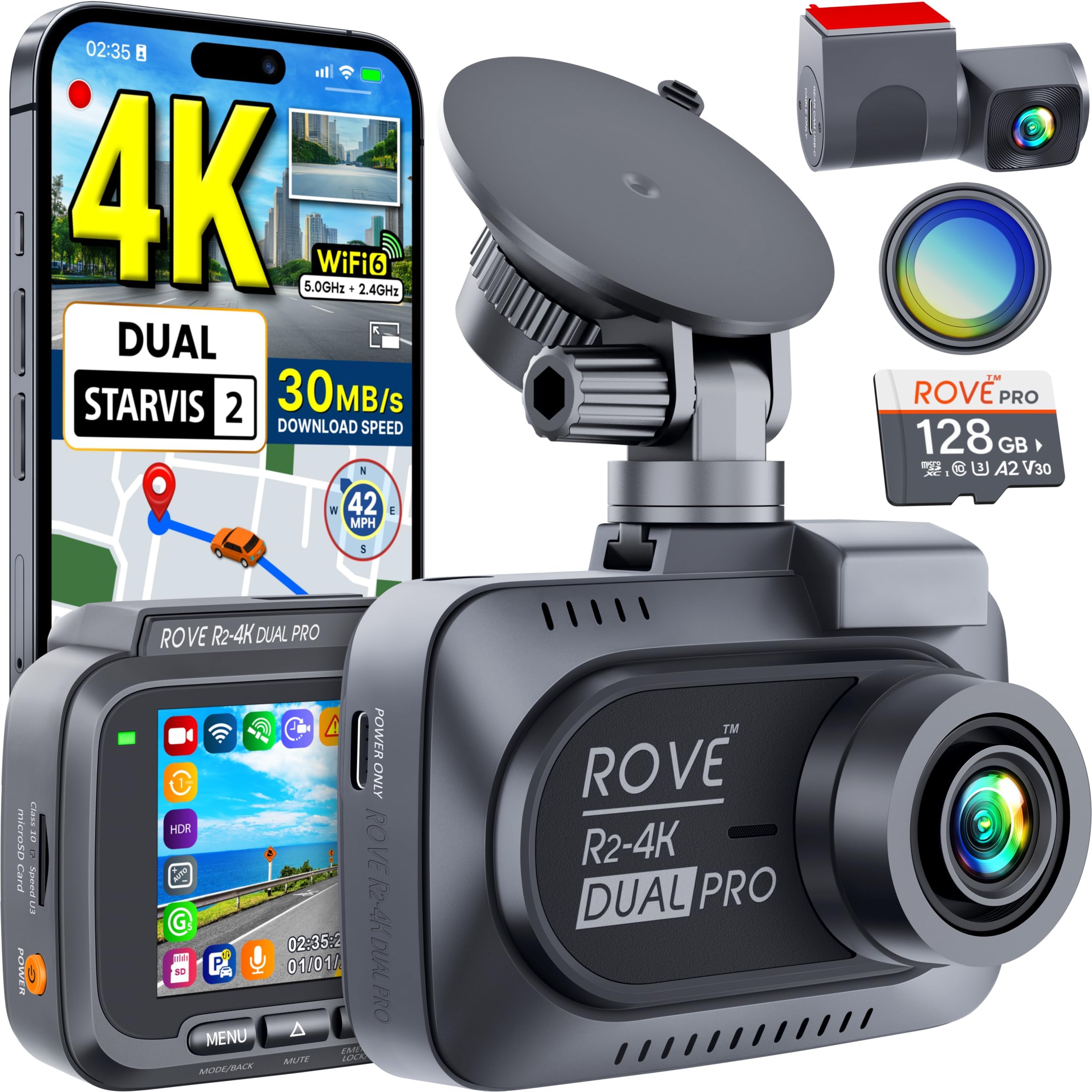
A 2K rear lens — the sharpest rear view on this list, and the reason to pay for it.
Most kits here give the rear a 1080P sensor and call it done. This one runs 3840x2160P 4K at 30fps up front and 2560x1440P 2K at 30fps out back, so the car behind you is captured with the same care as the car ahead. Both ends use Sony STARVIS 2 sensors — an IMX678 at 8 megapixels in front and an IMX675 at 5 megapixels in the rear — backed by HDR imaging and F1.7 front and F1.55 rear apertures. The 150-degree front and 140-degree rear angles cover both directions without the fisheye stretch.
Wi-Fi 6 on both 5GHz and 2.4GHz moves clips at up to 30MB/s, the fastest published transfer rate in the group, which matters when you need a 4K file off the camera in a hurry. Quad-mode GPS across GPS, BEIDOU, GALILEO and GLONASS logs speed and route to the file, and a free player replays the trip with a full overlay. A 128GB ROVE PRO card comes tested for 4K recording without dropped frames, and the slot takes up to 1TB for long trips. A CPL filter ships in the box to cut windshield glare — a physical polarizing lens, not a software trick.
Parking mode offers 1FPS time-lapse, motion detection and collision detection, and a full 1-minute event clip lands in a locked folder with a voice alert the next time you start the car, so you know something happened while you were gone. What wins people over is the 2K rear channel, and the install is straightforward enough that it does not need a professional. The mixed note is reliability — the front and rear cameras run perfectly for most owners, but a few report the front camera stopping. That is the one thing worth watching in the first weeks.
Your pick for the rear: when the car behind you has to be as sharp as the road ahead, this is the only kit on the list with a 2K rear channel.
Keep the receipt handy: the rare front-camera failure makes the return window worth respecting before you commit.
9. VIOFO A329S 4K 60FPS Dash Cam Front and Rear
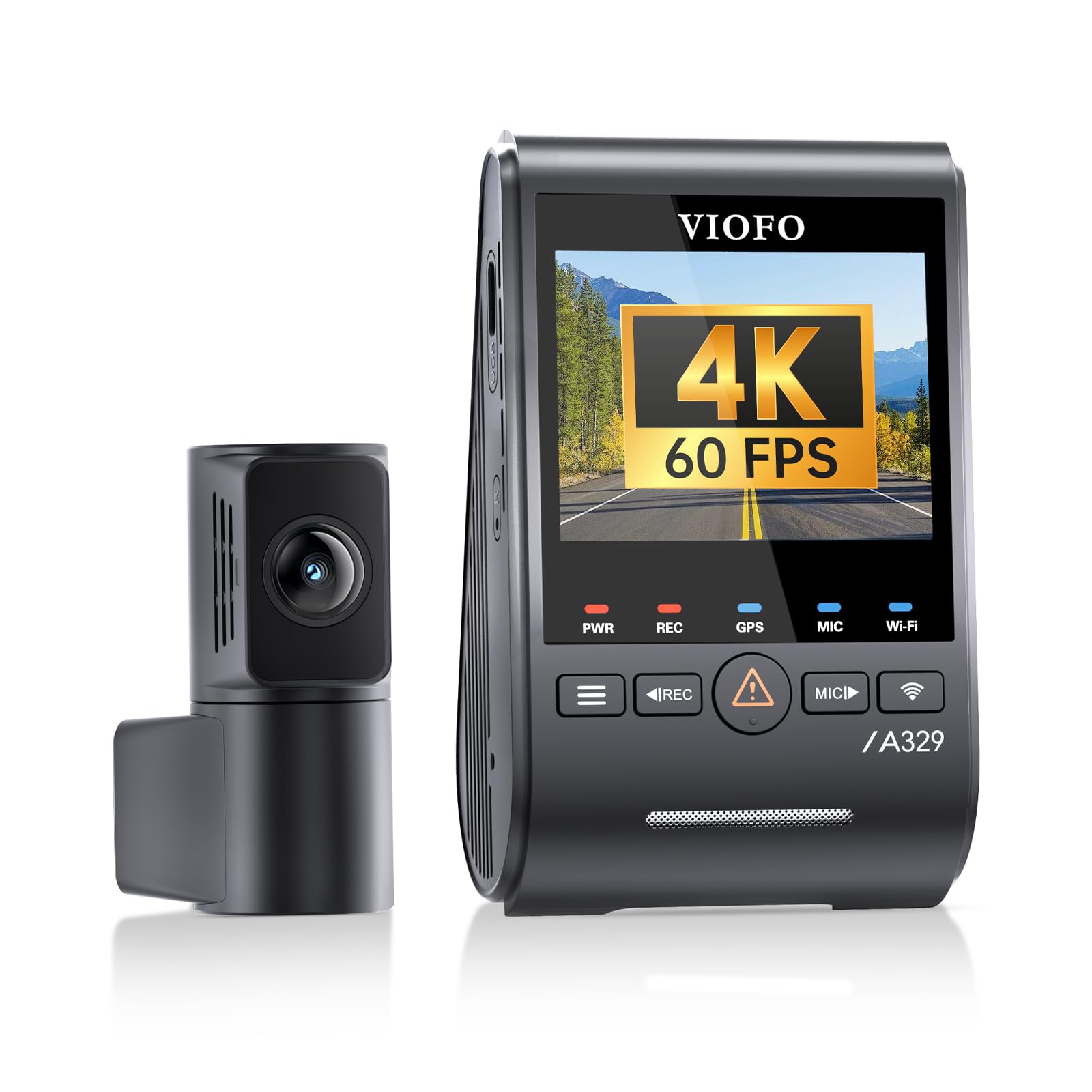
Storage for weeks of driving, and frames so smooth a fast-moving plate stays legible.
If the thought of a road trip where the card overwrites itself makes you uneasy, this is the answer. The A329S records 4K at 60fps up front and 2K out back, and it accepts external SSDs up to 4TB or microSD cards up to 512GB for uninterrupted recording, which the maker frames as over three weeks of driving before anything is overwritten. Neither the SSD nor the microSD card is in the box, so that is a separate buy — but it is the storage ceiling no other kit here touches.
Dual STARVIS 2 sensors do the night work: an IMX678 up front pulls in more pixels for clarity and less noise in low light, while the IMX675 in the rear offers 2.5 times wider dynamic range than a STARVIS pixel of the same size. HDR on all channels balances extreme bright and dark areas so the plate survives a tunnel exit. The 60fps advantage is real but conditional — the maker notes 4K 60fps is not available while HDR is enabled, so you are choosing smoothness or glare-taming, not both at once. That trade-off is the one buyers weigh most, and the extra control is worth the money to some and too costly to others.
Wi-Fi 6 lifts operations roughly three times in the 5GHz band up to 30MB/s, fast enough for a one-minute 4K clip in under ten seconds, which is the difference between pulling evidence now and waiting. The install uses a 2.8mm coaxial rear cable with miniature connectors to hide the run neatly and resist electromagnetic interference from other electronics in the car. Low-power parking mode adds impact detection without draining the battery, using the HK4 or HK6 hardwire kit. The recurring honest note: wiring and reliability get mixed reports, so budget the install carefully and confirm every connection before you trust it.
Where it pulls ahead: 4TB SSD support and 4K at 60fps are both capabilities the A229 Plus cannot offer — this one is built for long trips and moving frames.
The price of that smoothness: HDR and 4K 60fps cannot run together, so pick one lane before you drive.
For the long-haul driver: a road-tripper or contractor who wants weeks of storage and choppy footage never to be the reason a plate went unread.
Weigh the wiring work: the mixed reliability reports mean a careful install is part of the deal here.
Know the Specs
Resolution Split, Front vs Rear
The front lens is where the detail lives, so the front number matters most — but the rear number decides whether the car that hit you is identifiable. A 4K front pairs with a 1080P rear on most kits here, while the ROVE pushes the rear to 2K and the VIOFO A329S matches 4K 60fps front with 2K rear. Read both numbers, not just the headline one.
Supercapacitor vs Battery
A supercapacitor stores power without the swelling and lifespan loss a lithium battery suffers when a cabin bakes in summer. It is why the 70mai A810 Lite, the GKU, the 70mai T800E, the BOTSLAB and the VIOFO A329S all go that route. A battery-free camera tolerates heat and cold better, so a car that lives outside benefits most.
Field Of View and Blind Spots
Field of view is the spread the lens sees, measured in degrees. The Coolcrazy, GKU and BOTSLAB all front 170 degrees, which reaches across the lanes beside you, while the 70mai A810 Lite and both VIOFOs front 140 degrees for a tighter, less distorted frame. A wider angle catches a hazard earlier; a narrower one keeps plates sharper at the edge of the frame.
Parking Mode and Hardwire Kits
Parking mode records while the car sits off and locked, but nearly every kit needs a hardwire kit to power it, and those are sold separately on most picks here. The GKU kit requires the GKU-brand hardwire kit specifically — a third-party one can stop the camera powering on. Budget the part and the install time before you count on overnight coverage.
Common Questions
Will a 1080P rear camera actually read a plate behind me?
Do I need a hardwire kit for parking mode?
How long a rear cable do I need for an SUV?
Is a supercapacitor better than a battery in summer heat?
What is the largest memory card these cameras take?
Can I run both CarPlay and the dash cam on my iPhone?
Does a front and rear camera work in a van or truck?
Will the cabin camera record in total darkness?
What transfer speed should I expect pulling a 4K clip to my phone?
Do I lose 4K 60fps when HDR is on?
The Bottom Line
For the most complete single purchase, the TERUNSOUl 3-Channel 4K is the pick to beat — three lenses, a pre-installed 128GB card and GPS data baked into every file mean it is ready to record before you buy a single extra part. If you drive for a living and the back seat is where trouble starts, the 70mai T800E puts a switchable infrared cabin camera in the same box. And when the car behind you deserves the sharpest possible read, the ROVE R2-4K Dual PRO is the only pick here with a 2K rear lens.
Whichever you choose, factor in the hardwire kit for parking mode and measure your rear cable run before you mount anything. Do those two things and the kit is ready to record the moment you turn the key.
How we choose
We do not accept paid placement. Every pick is matched to a real buyer and a real use-case; we do not hands-on test units.
Sources
Specifications: manufacturer listings and product documentation. Review insights: verified customer reviews, as of November 2026. Pricing: not shown on this page (it changes often); check the current price via the retailer link.
As an Amazon Associate, Tactical Gear Guy earns from qualifying purchases. This does not affect which products we feature.