Specs are compiled from manufacturer listings and verified buyer reviews and can change over time — please confirm the key details on the product page before buying.
If you want one answer: buy the 7-blade Spiralizer first, because it has the longest track record and the strongest body of owner feedback in this whole group. The rest of this list splits into two jobs. Some spiralizers are built to sit on the counter and power through sweet potatoes and raw beets. Others fold flat so they disappear into a drawer in a small kitchen. Knowing which job you actually have is the whole buying decision.
This guide is built by comparing the manufacturers’ published specifications and the patterns across verified customer reviews, so you get each pick’s real strengths and trade-offs instead of marketing spin.
The practical stuff below covers blade counts, how each unit anchors to your counter, what folds, and which vegetables each one actually handles. Every pick is here because it earns its place for a specific kind of cook. Here is the honest read on the veggie noodle spiralizer that will actually get used in your kitchen.
Top Picks


How To Choose The Best Veggie Noodle Spiralizer
Almost every spiralizer on this list turns a zucchini into noodles. The differences that actually matter show up on the second or third vegetable you try — a raw sweet potato, a dense beet, a fat carrot. That is where cheap bodies flex, blades dull, and suction feet let go of the counter mid-crank.
Start with what you plan to spiralize
Soft produce like zucchini, cucumber, and squash is forgiving. Nearly any blade will cut it clean. Hard root vegetables are the real test — a raw sweet potato or a turnip needs a reinforced body and high-carbon steel blades that will not bend under pressure. If zoodles are your whole plan, you have more options. If you want sweet potato noodles and beet ribbons in the rotation, prioritize a sturdy frame and stainless blades over a clever folding trick.
Blade count is not the same as blade range
A 7-blade unit gives you more noodle widths. A 3-blade unit gives you the three cuts most people actually use: a fine spiral, a medium spiral, and a flat slice for ribbons. More blades means more choices and more parts to store and clean. Fewer blades means a simpler drawer and less to lose. Match the count to how often you will vary the cut, not to how impressive the number looks on the box.
How it anchors to your counter
Suction is the difference between an easy dinner and a wrestling match. A weak suction cup on a smooth granite counter will pop loose the moment you hit a firm vegetable. Look for an oversized suction pad with a lever you flip to lock, or a counter-mounted design. This one detail decides whether you reach for the spiralizer midweek or leave it in the cupboard.
Where it lives when you are not using it
Counter space is the quiet dealbreaker. A full countertop model needs a permanent spot. A foldable unit collapses down and goes into a drawer or a cabinet, which matters in apartments, RVs, dorms, and small kitchens. If your counter is already crowded, a fold-down body earns its place by staying out of the way. If you cook veggie noodles several times a week, a countertop model that stays set up may suit you better.
Cleaning and blade storage
Every spiralizer on this list is dishwasher safe in some form, but check whether the blades detach, whether a cleaning brush is included, and where the spare blades live. A built-in blade caddy keeps sharp edges out of a loose drawer. A brush that reaches the corer teeth and blade slots saves you from picking bits of zucchini out by hand.
Side-by-Side Comparison
| Model | Best For | Blades | Anchoring | Weight | Amazon |
|---|---|---|---|---|---|
| Spiralizer 7-Blade★ Best Overall | Hard root vegetables | 7 | Countertop body | 0.9 kg | Amazon |
| Starfrit Pro FoldableFolds Flat | Small drawers | 3 | Suction-grip feet | 1.8 pounds | Amazon |
| GEFU Spirelli 2.0Featherweight Pick | Compact footprint | 1 round blade | Handheld slicer | 0.17 kg | Amazon |
| PL8 Professional | Blade safety | 3 (carousel) | Non-slip base | 1.03 kg | Amazon |
| Brieftons QuickFold | Travel and RVs | 5 | Oversized suction pad | 1.2 pounds | Amazon |
| Brieftons Countertop | Batch meal prep | 5 | Oversized suction pad | 2.1 pounds | Amazon |
| Starfrit Spiral Slicer | Everyday variety | 4 | Suction feet | 1.8 pounds | Amazon |
| Cuisinart CTG-00-SPI4 | Catching the noodles | 3 | Bowl-based body | 1.6 pounds | Amazon |
| Paderno World Cuisine | Counter-mounted work | 3 | Powerful suction base | 1.5 pounds | Amazon |
Detailed Reviews
1. Spiralizer 7-Blade Vegetable Slicer
Our pick — 4.5+★ from 26,500+ verified ratings; the strongest balance of quality and price.
The one built to muscle through a raw sweet potato without flinching.
Seven blades is the headline, but the real reason this unit sits at the top is the body. Spiralizer builds it from ultra-reinforced ABS plastic (a tough molded plastic that resists flexing under load) and pairs it with 420 high-carbon cutlery-grade stainless steel blades. In plain terms, the frame does not bow and the cutting edge does not roll over when you lean into a hard vegetable. The maker claims this third-generation model is 30-35% stronger than others on the market — a manufacturer figure, not an independent test.
What wins people over is the build: the reinforced frame and stiff blades are obvious the moment you handle it. The seven cutting options cover everything from fine angel-hair to wide ribbons, so a single zucchini can become three different dinners across the week. It comes apart for a thorough wash under the tap, which matters because the corer and blade slots are exactly where wet vegetable bits like to hide. Zucchini comes out in clean, even strands with no ragged edges.
The honest caveat: durability is the one area where the experience is not unanimous. This is a sturdy tool for most people, but a small number of units have been reported to fail on the very first use — likely a bad individual piece rather than a design flaw, given how many of these are in daily service. Treat it with reasonable care around the handles and you are getting a spiralizer that should outlast the novelty phase. It is also the heaviest pick here at 0.9 kg, so it wants a permanent counter or drawer spot rather than travel duty.
Where it earns its keep
- 420 high-carbon stainless blades hold an edge against raw beets and sweet potatoes
- Seven blades widen the range from angel-hair to ribbons
- Breaks down for a full clean of the corer and slots
- Reinforced ABS frame resists flex on dense produce
What to keep in mind
- At 0.9 kg it is a counter fixture, not a travel gadget
- A rare unit arrives with a handle that gives way early
- Seven blades means more parts to store and wash
Buy this if: you spiralize often and want one tool that handles soft and hard vegetables without complaint.
Pass if: every inch of drawer space is spoken for — a folding body will serve you better.
2. Starfrit Pro Foldable Spiralizer
A folding spiralizer that claims half the storage space and backs it with suction feet.
If your kitchen is small, the number to care about is not blade count — it is the space this thing gives back. Starfrit says the foldable design lets it take up 50% less room when stored. That is the difference between a spiralizer that lives in a drawer and one that lives in a cupboard you forget about. The three blades cover a slicing blade, a fine spiral, and a medium spiral, which handles zoodles, cucumber ribbons, and most everyday cuts without a drawer full of loose parts.
For grip, it uses suction-grip feet plus a food holder with a pusher guide that keeps the vegetable pinned while you crank. The 10-centimeter blade is on the longer side — for reference, the GEFU Spirelli 2.0 runs a 5-centimeter blade, so this is double the cutting edge. A longer blade means each pass covers more of the vegetable. It is also the same 1.8 pounds as the Starfrit Spiral Slicer, which sits light enough to lift out one-handed.
The trade-off is body size. This is a compact folder, so treat the hardest root vegetables with a bit of patience rather than forcing them through fast. The suction feet want a smooth, clean counter to seal properly. Get those two conditions right — a firm, even crank and a wiped-down surface — and it performs like a much bigger unit that happens to vanish into the drawer afterward.
Best suited to: renters, RV owners, and anyone whose counter is already crowded. The folding trick plus the three-blade range makes it genuinely practical.
Fit note: the compact footprint is the selling point, so dense produce calls for a steadier hand than a full countertop model would need.
Reach for this: when drawer space is the deciding constraint and you want folding without giving up a fine spiral cut.
Look elsewhere: if a raw sweet potato is a weekly staple and you would rather lean into a heavier frame.
3. GEFU Spirelli 2.0
At 0.17 kg, this one travels in a bag and never asks for counter space.
Most spiralizers ask you to commit a chunk of counter to them. The GEFU Spirelli 2.0 asks for almost nothing — it weighs 0.17 kg. For comparison, the PL8 Professional tips the scale at 1.03 kg, so the GEFU is a fraction of that. The trade you make for that portability is a single round stainless blade and a handheld build rather than a countertop frame. You hold it, you crank, noodles drop. There is no suction pad to seal and no body to find a home for.
The round stainless blade cuts a clean spiral through zucchini, cucumbers, and carrots. It ships with an attachable finger guard, which is the safety feature that matters most when the blade is right at your fingertips. The 5-centimeter blade is short compared with a 10-centimeter edge on the Starfrit Pro Foldable, so each vegetable needs a little more patience to work through.
The catch worth knowing before you buy is cleaning. Some owners find it simple to rinse; others hit trouble getting the blade area properly clear. A quick soak and a small brush handle the tight spots. Because it is handheld, firm vegetables need a steady grip rather than the leverage a countertop unit gives you. For soft produce — the zucchini and cucumber crowd — this is a tidy little tool that earns its keep.
The case for it: a genuinely portable spiralizer that handles soft vegetables and stores in a utensil drawer without a second thought.
What to expect: a single blade width, a short 5-centimeter edge, and a blade area that rewards a proper soak over a quick rinse.
Ideal for: small kitchens, campers, and anyone who wants zoodles without dedicating shelf space.
Think twice if: you plan to spiralize dense root vegetables and want the leverage of a frame under your hands.
4. PL8 Professional Spiralizer

No loose blades anywhere — you rotate a carousel to pick the cut.
Most spiralizers hand you a set of blades to swap in and out, which means sharp edges living in a drawer. PL8 solves that with an integrated blade carousel: three cutting options sit inside the unit, and you rotate the carousel to choose thin julienne, thick julienne, or a ribbon cut. Nothing comes out. Nothing gets lost. For anyone who has nicked a finger digging for a blade, that single design choice is worth the price of admission on its own.
The frame is built to stay put, with a non-slip base and an ergonomic handle that gives you leverage. Owners lean on the handles on either side to keep control while cranking, and the unit handles multiple vegetable types in one sitting without complaint. It is dishwasher safe when you are done, so cleanup does not drag on. At 1.03 kg it is the heaviest spiralizer on this list, and its 10.75″L x 7″W x 7.13″H footprint is bigger than the GEFU’s 7″L x 7″W x 7.5″H body — this is a unit that wants a real spot on the counter.
The caveat is simple: this is a countertop fixture, not a drawer gadget. If you spiralize regularly, that permanence is a feature — it is always set up and ready. If you only make zoodles once a month, the size will feel like a lot of real estate for occasional use. The carousel also means you cannot add a fourth blade style later, so make sure the three included cuts match how you cook.
The design win
- Blade carousel keeps all three cutting options internal and safe
- Non-slip base and side handles give steady leverage
- Dishwasher safe after the noodles are made
- Handles multiple vegetable types back to back
The trade-off
- At 1.03 kg it is the heaviest pick here and wants permanent counter space
- Three fixed cuts — no room to add another blade style
Worth it for: households with kids or clumsy hands where loose blades are a real concern.
Skip if: you want a spiralizer that tucks away — this one stays out.
5. Brieftons QuickFold 5-Blade Foldable Spiralizer
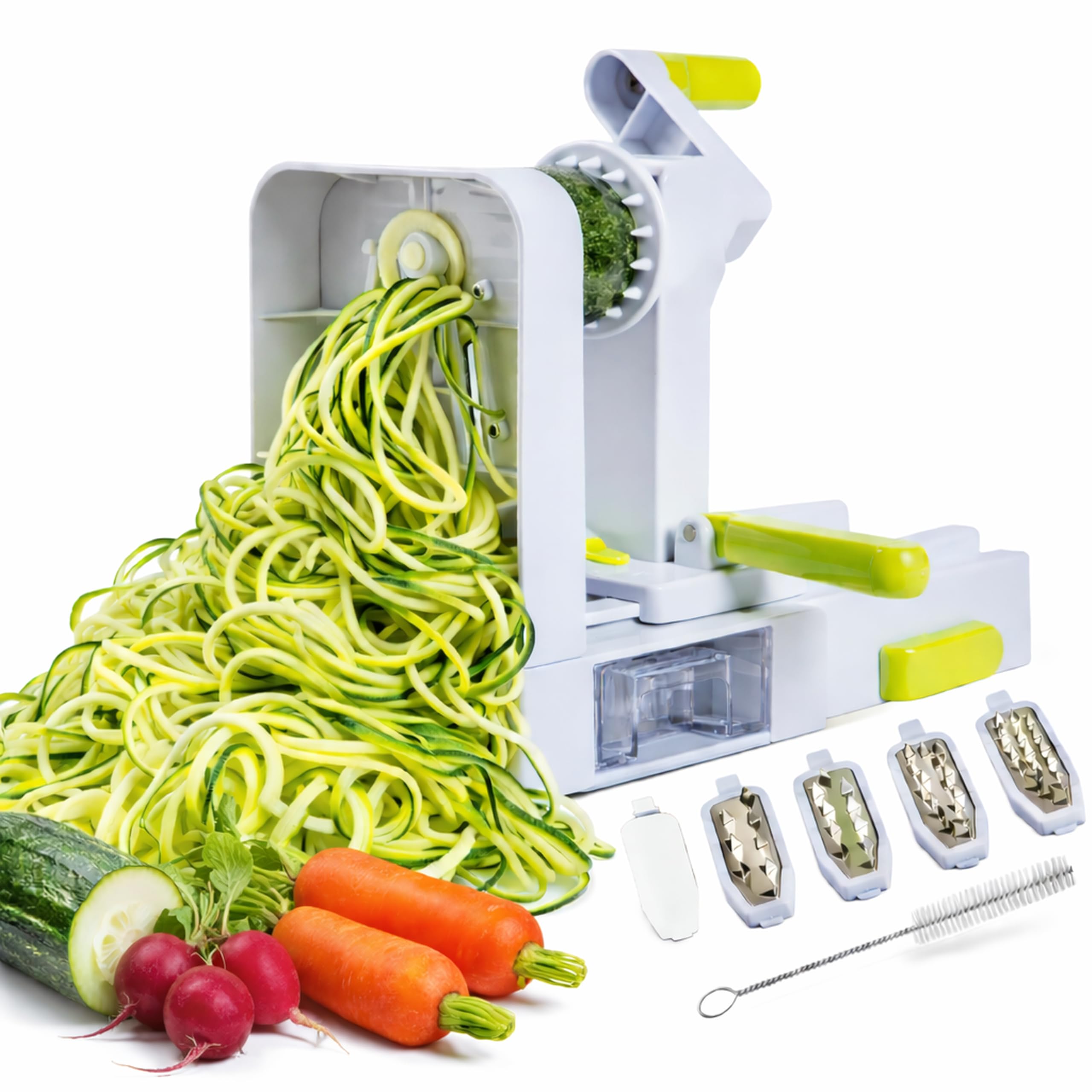
Five noodle sizes in a body that folds down and grips the counter with a lock lever.
The QuickFold is for the cook who wants range without a permanent counter fixture. It folds down in seconds to a body that tucks into a drawer or cupboard, and it does the folding with an oversized suction pad and a Lock/open up lever that bites into smooth, flat surfaces like granite or tile. No electricity, no batteries, no cords — you crank the handle and fresh noodles drop. That is why it suits RVs, dorms, apartments, and small kitchens equally well.
Five Japanese 420-grade stainless steel blades give you four noodle sizes — 2mm angel-hair, 3mm spaghetti, 5mm fettuccine, and 7mm pappardelle — plus a flat slicer for ribbons up to 55mm wide. The blades store in a caddy inside the body, so nothing sharp is loose in a drawer. A reinforced BPA-free ABS body takes on firm produce like potatoes and sweet potatoes, so you are not stuck with only soft vegetables. The unit weighs 1.2 pounds, and for reference the Starfrit Pro Foldable runs 1.8 pounds, so the QuickFold is the lighter of the two folding options. A smaller corer also wastes less of each vegetable, and a cleaning brush is included for the corer teeth and blade slots. It ships with four recipe eBooks holding over 100 recipes.
The honest limit: the discount of a folding body is a lighter frame, so a very dense beet or a rock-hard sweet potato wants a slower, steadier crank rather than brute force. The suction holds best on smooth non-porous counters — textured or tiled surfaces with grout lines give it less to grab. Store the blade caddy where you will remember it, because a loose blade in a junk drawer defeats the whole point.
Most-loved reason: functionality is what people rave about most with this spiralizer — the folding body does not cost you cutting performance on everyday produce.
One real limitation: folding saves space, but a lighter frame asks for patience on the hardest root vegetables.
Pick it for: small kitchens, travel, or anyone who wants five cut sizes and a body that disappears into a drawer.
Choose differently if: you need maximum muscle on raw beets every single week.
6. Brieftons 5-Blade Countertop Vegetable Spiralizer
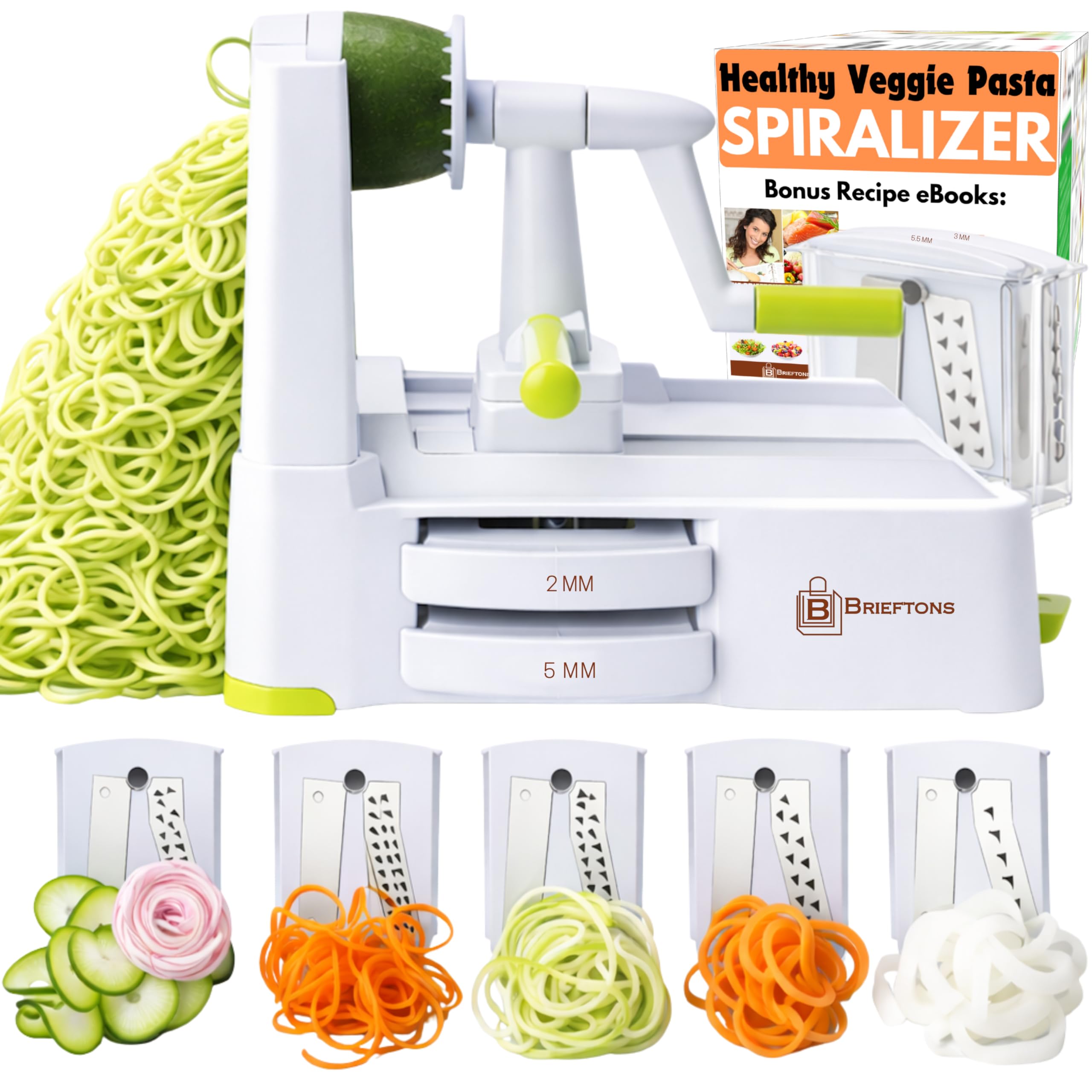
The workhorse that stays put and powers through raw beets without sliding.
If you spiralize in volume, this is the model built for it. Five labeled Japanese 420-grade stainless steel blades give you 2mm angel-hair, 3mm spaghetti, 5mm fettuccine, a 5.5mm pappardelle, and a flat ribbon slicer. Each blade is labeled so you grab the right one without guessing, and the 420-grade steel is chosen for staying sharp and resisting rust through daily use. Soft produce works on any blade; the wider 5mm and 5.5mm blades take on the hardest vegetables like raw beets and butternut squash.
The standout for this one is how firmly it anchors. An oversized suction pad with a lever you turn counter-clockwise locks it to flat, hard, non-porous surfaces like granite, marble, tile, and glass, then releases with a flip of the lever. Brieftons claims the pad can lift an 11-pound marble cutting board — a manufacturer figure, not a lab test we ran. Reviewers repeatedly single out the suction that keeps it locked in place mid-crank. It handles produce at least 1.5 inches wide but does not work on celery, thin carrots, eggplant, cauliflower florets, or spongy produce.
The body is BPA-free white ABS and everything is dishwasher safe on the top rack only — avoid high-heat cycles. Weighing 2.1 pounds and measuring 10.6″L x 4.9″W x 7.9″H, it is heavier than the folding QuickFold at 1.2 pounds, and that extra mass is exactly what keeps it steady mid-crank. It comes with blade storage, a 12-page manual, and four recipe eBooks with over 100 recipes. The caveat: it needs a spot on the counter to stay useful, and it is not a travel tool.
The suction advantage: the oversized pad with a lock lever holds steady on granite, marble, and tile so the body stays put while you work.
Who should pass: anyone limited to celery, thin carrots, or eggplant — those are outside what this model handles.
Built for: meal-prep cooks and families who spiralize several vegetables in one session.
Not for: a kitchen with no spare counter, or a shopper who mostly wants to spiralize celery.
7. Starfrit Spiral Slicer, Green/White

Four cuts, a suction base, and blades that live inside the unit when you are done.
This Starfrit sits in the middle of the line-up as a straightforward everyday spiralizer. Four interchangeable blades cover a slicing blade, a medium spiral, a fine spiral, and an angel-hair blade, so you get everything from thick spirals down to ultra-fine noodles. The blade is a 10-centimeter edge, matched with a triangular stainless blade shape. It ships with the four blades and the slicer body, and the blades store inside the base when not in use — a small thing that keeps the drawer tidy.
Suction feet keep it anchored while you crank, and the built-in storage system means you are not hunting for the right blade mid-recipe. Everything detaches for cleaning, and all parts are dishwasher safe. It handles carrots, cucumbers, zucchinis, potatoes, radishes, apples, pears, and cabbage, which is a wider food list than you might expect from a mid-tier unit. The 1.8 pounds it weighs matches the Starfrit Pro Foldable, so handling is similar — light enough to lift, sturdy enough to stay put under a suction seal.
The honest trade-off: this is a solid everyday cutter rather than a heavy-duty one. It will handle all the usual vegetables, but it is not built to be leaned on like the 0.9 kg Spiralizer at the top of this list. It also wants a smooth counter for the suction feet to bite. If you spiralize a few times a week and want a no-fuss unit with four cuts and cleanable parts, this does the job without fuss.
What you get
- Four blade styles from thick spiral to angel-hair
- Built-in blade storage keeps the drawer tidy
- Suction feet hold it steady while you crank
- All parts detach and are dishwasher safe
The honest limits
- Everyday build rather than heavy-duty for the hardest roots
- Suction needs a smooth, clean counter to seal
Good match for: the everyday cook who wants four cuts, easy cleaning, and blades that store inside the unit.
Better to look on if: you spiralize dense root vegetables daily and want maximum heft behind the blade.
8. Cuisinart CTG-00-SPI4 Food Spiralizer

Spiralize straight into a bowl and skip the counter cleanup entirely.
Most spiralizers drop noodles onto the counter or a cutting board, so you chase them into a bowl afterward. The Cuisinart solves that with a built-in 4-quart bowl catching the noodles as they come off the blade. It gives you three cutting options — thin julienne, thick julienne, and a ribbon slice — and the safe blade-lock design hides the blades away when they are not in use, so nothing sharp is exposed between jobs.
It is dishwasher safe, which keeps cleanup quick, and it weighs 1.6 pounds so it is not a fight to move around the kitchen. The blade-lock design keeps the cutting edges covered between jobs, which suits anyone nervous about loose sharp parts. The three cuts cover the core noodles and ribbons without a drawer full of extra pieces. For zucchini noodles, cucumber spirals, and carrot ribbons, that is enough to get dinner moving.
Here is the thing to weigh before buying: ease of handling splits opinion. Some find it simple to operate; others find it clumsy in the hand. It tends to suit people who want a self-contained unit with a bowl rather than a counter-gripping crank machine. If you value the bowl and the hidden blades, this is a tidy choice. If you want the leverage of a big countertop frame, look to the Brieftons Countertop instead.
Why it stands out: the included 4-quart bowl catches every noodle, so there is no runaway zucchini across the counter.
Know before you buy: handling feel is divided — some find it easy, some find it awkward — so a self-contained bowl unit is the real draw here.
A fit for: anyone who wants noodles landing in a bowl and blades tucked safely away between uses.
Consider another: if leverage and a countertop frame matter more to you than a built-in bowl.
9. Paderno World Cuisine 3-Blade Folding Vegetable Spiralizer Pro

A counter-mounted design built to slice large batches instead of one zucchini at a time.
The Paderno approaches spiralizing like a commercial tool. It mounts to any clean, non-porous surface with a powerful suction base, so the whole unit locks to your counter while you work through a pile of vegetables. The three stainless blades split into a 1/8″ straight blade for ribbons and accordion cuts, plus two julienne blades at 1/8″ and 1/4″ for vegetable strands and zucchini noodles. If you are prepping for a family or a week of meals, that straight-blade flexibility is a real plus.
It is built from heavy-duty BPA-free ABS plastic, folds down with a separate holder for extra blades, and is dishwasher safe on the top shelf. The 1.5 pounds and 10.63″L x 5″W x 4″H footprint make it a compact counter unit that tucks away when not in use. Owners consistently praise how cleanly it spirals zucchini. It takes up minimal space while stored, which helps in a tight kitchen.
The real caveat is the learning curve. Ease of use splits feedback — some cooks find it simple, others say it takes time to figure out — and changing blades is a point of disagreement too. Stability is the other flag: the suction needs a clean, smooth surface to hold securely, and on a poor seal the body can shift. Set it up on a wiped counter, take five minutes with the manual, and it rewards you with serious batch capacity.
The batch advantage: a powerful suction base locks it to the counter so you can work through large quantities of produce in one session.
Set-up matters: the suction needs a clean non-porous surface, and a few cooks find the learning curve and blade changes take practice.
Right choice for: cooks prepping large batches who want a folding, counter-mounted unit with ribbon and julienne options.
Not the easiest start: if you want something you can use perfectly on the first try, the simpler everyday models above ask less of you.
Know the Specs
Blade Count and Blade Width
Blade count tells you how many noodle shapes a spiralizer can produce. The millimeter numbers on the blades are the width of the noodle they make — 2mm is angel-hair, 3mm is spaghetti, 5mm is fettuccine, 7mm is pappardelle. On this list the range runs from a single round blade on the GEFU up to seven blades on the Spiralizer. More blades means more choices and more parts to store. Fewer blades means a simpler drawer. Pick the count that matches how often you actually vary the cut.
Anchoring: Suction vs Counter-Mount
Suction is what keeps a spiralizer from sliding while you crank. An oversized suction pad with a lock lever grips smooth, hard, non-porous surfaces like granite, marble, tile, and glass. A counter-mounted design does the same job with a dedicated mount. Weak suction on a firm vegetable is the most common frustration, so look for a sizeable pad or a lever-lock. Always wipe the counter clean first — grout lines and textured surfaces give suction less to grab.
Foldable vs Countertop Bodies
A foldable body collapses for drawer or cupboard storage, which suits apartments, RVs, dorms, and small kitchens. A countertop body stays set up and gives you a steadier frame for hard root vegetables. The trade is space against sturdiness. If you spiralize several times a week, a countertop model may earn its permanent spot. If counter space is tight, a folding unit that tucks away gets used more often.
Manual Operation and Produce Size
Every spiralizer here is manual — no electricity, no batteries, no cords — so you can spiralize anywhere. The size limit matters too: the Brieftons Countertop handles produce at least 1.5 inches wide and does not work on celery, thin carrots, eggplant, cauliflower florets, or spongy produce. Check the vegetable list before you buy if your weekly rotation leans on a specific food.
Common Questions
What is the difference between 2mm, 3mm, and 5mm spiralizer blades?
Can a veggie noodle spiralizer handle raw sweet potatoes and beets?
Will the suction base hold on my kitchen counter?
Are these spiralizers dishwasher safe?
What vegetables can a spiralizer not cut?
How do I clean the blades without cutting myself?
Is a folding spiralizer as sturdy as a countertop model?
Do spiralizers come with recipes and a manual?
Does a spiralizer work without electricity or batteries?
How much counter space does a countertop spiralizer take up?
The Bottom Line
For most kitchens, the veggie noodle spiralizer winner is the Spiralizer 7-Blade because its reinforced body and high-carbon stainless blades handle sweet potatoes and turnips that crimp cheaper frames. If drawer space is your constraint, grab the Brieftons QuickFold for its five noodle sizes and folding body. And for maximum grip and batch capacity on the counter, the Brieftons 5-Blade Countertop is the one to reach for. The Spiralizer leads on sheer build and a long run of owner trust — a fair reason to make it your first pick.
How we choose
We do not accept paid placement. Every pick is matched to a real buyer and a real use-case; we do not hands-on test units.
Sources
Specifications: manufacturer listings and product documentation. Review insights: verified customer reviews, as of November 2026. Pricing: not shown on this page (it changes often); check the current price via the retailer link.
As an Amazon Associate, Tactical Gear Guy earns from qualifying purchases. This does not affect which products we feature.