Specs are compiled from manufacturer listings and verified buyer reviews and can change over time — please confirm the key details on the product page before buying.
If you are shopping for a bench supply, the question you actually want answered is simple: which one holds its voltage when a real load hits it. The short answer is that the mid-tier units here cover most hobbyists and repair techs, while the lab-grade triple-output box is the only pick that gives you three independent channels at once. This guide ranks nine bench supplies by verified strengths, so you can match the unit to your workload rather than the spec sheet.
This guide is built by comparing the manufacturers’ published specifications and the patterns across verified customer reviews, so you get each pick’s real strengths and trade-offs instead of marketing spin.
A bench supply converts wall power into a dialed DC voltage, so the specs that matter are output range, setting resolution and output ripple. The crowd favorite here is the Kungber 30V 10A, a 4.5+ star unit with 700+ ratings behind it, and this breakdown of the variable dc power supply market shows why precision beats specs on paper.
Top Picks


How To Choose The Best Variable DC Power Supply
A variable DC power supply lets you set a voltage and a current ceiling by hand, then watch both on a display while your circuit runs. First-time buyers tend to chase the biggest voltage and amp number on the label. What actually decides quality is how steady the output holds once a load draws current from it.
Start With The Voltage And Current You Really Need
Most bench work — phone repair, Arduino projects, small motor tests, battery charging — lives well inside 30V. If you work on audio amplifiers, electrolysis tanks or higher-voltage gear, a 0-50V range gives you headroom. Current is the figure that trips people up, so check the honest output rather than the headline number. Some units rated at 10A are documented as good for only a few amps for any length of time, which is why the review pages matter as much as the spec sheet.
Linear Versus Switching: Pick By What You Are Powering
A linear supply uses a heavy transformer and tends to be big, weighty and quiet electrically, with low ripple. A switching supply is compact, but it generates more high-frequency noise on the output. For sensitive analog circuits and audio work, low ripple keeps noise off the rails feeding your test subject. For general repair, charging and DIY jobs, a compact switching unit frees up scarce bench space.
Resolution, Ripple, And The Controls You Touch Every Day
Setting resolution tells you the smallest step you can dial — 0.01V and 0.001A is fine-grained enough for most component testing. Ripple is the residual AC wobble riding on the DC output, and a figure under 20mV keeps precision parts safe from voltage fluctuations. Then there are the controls. An encoder knob lets you step digit by digit instead of nudging a coarse dial and a fine dial back and forth. An output ON/OFF button lets you set voltage with the load disconnected and then switch on, which prevents sparks and protects the circuit.
Side-by-Side Comparison
| Model | Best For | Output Range | Max Power | Weight | Amazon |
|---|---|---|---|---|---|
| Kungber 30V 10A (White)★ Best Overall | All-round bench work | 30V / 10A | 300 W | 2.3 lb | Amazon |
| Jesverty SPS-3010MSmallest Footprint | Small bench, tight space | 0-32V / 0-10A | 320 W | 1.54 kg | Amazon |
| WANPTEK TPS-C3010HRepair Bench Pick | Repeat repair jobs | 0-30V / 0-10A | 300 W | 1.2 kg | Amazon |
| HYELEC HY50-06A | 50V headroom on a budget | 0-50V / 0-6A | 150 W | About 2.7 lb | Amazon |
| FNIRSI DPS-150 | Bag-and-go field testing | 30V / 5A | 150 W | 6.24 oz | Amazon |
| Tekpower TP3005T | Linear low-noise output | 0-30V / 0-5A | — | 12 lb | Amazon |
| KORAD KD3005D | Daily circuit-board work | 30V / 5A | — | 9 lb | Amazon |
| NICE-POWER 30V 20A | High-current loads | 0-30V / 0-20A | 600 W | 3 kg | Amazon |
| Siglent SPD3303X-E | Three channels at once | 32V/3.2A ×2 plus 2.5V/3.3V/5V/3.2A ×1 | 220 W | 17.6 lb | Amazon |
Detailed Reviews
1. Kungber DC Power Supply Variable, 30V 10A
Our pick — 4.5+★ from 750+ verified ratings; the strongest balance of quality and price.
A 300-watt bench box that stops charging the moment your battery is full.
That matters when you are pushing a motor or an electrolysis tank rather than a microcontroller. You set voltage and current on an encoder knob, and the four-digit display shows the live numbers while the unit runs.
What wins people over is the charging logic. The screen tracks charging power in Ah, and the supply cuts off on its own once the battery tops out — so you can leave a pack connected without babysitting it. Press the OCP button and the unit watches for a short circuit or an overcurrent, sounds an alarm, and kills the output before your board cooks. There is also an 18W USB port on the front for topping up a phone while you work.
The trade-off is weight and size, in the honest direction: this is a compact bench unit that still takes up real estate, and the plastic enclosure is not the metal tank some lab supplies are. Its protection suite is thorough though — grounding, leakage, thermal, voltage overload, power overload and short-circuit protection all sit inside, and the fan spins up automatically once the internal temperature passes 122°F/50℃.
What earns it first place
- 300 watts of output — the highest here alongside the WANPTEK
- Automatic charge cutoff stops the supply when the battery is full
- OCP button detects shorts and overcurrent and cuts output
- 18W USB port handles phone charging mid-project
- Fan triggers itself past 122°F/50℃ for thermal protection
Where it gives ground
- Plastic enclosure rather than a metal chassis
- 2.3 lb and 7.59 x 3.35 x 6.1 inches of bench space
- USB port tops out at 18W, so no fast-charge laptop duty
Go with this one if: you want one bench box that handles charging, repair and general DIY without a second purchase.
Step past it if: you need triple isolated channels, which only the Siglent delivers here.
2. Jesverty SPS-3010M Variable DC Power Supply
32 volts and 10 amps squeezed into a box you can slide under a monitor stand.
Here is the direct head-to-head that decides a lot of benches: the Jesverty pushes the ceiling to 0-32V while the WANPTEK below stops at 30V. On current they match at 10A. That extra two volts of headroom is the whole reason this one sits second, and its 320 watts of maximum power edges the 300-watt Kungber above it.
The encoder knob is the daily-use feature. Instead of a coarse dial and a fine dial, you turn one knob and step each digit individually at 0.01V and 0.001A resolution. The output button is the other quiet win — press it to cut power while you rewire, so you never have to unclip the load or kill the mains just to change a setting. Both the USB-A and USB-C ports deliver 20W, which is enough to run an Arduino UNO or a Raspberry Pi off the same supply.
Buyers give the current output mixed marks. Some report it can deliver 32V at 6.6A, while others find it cannot reach 10 amps DC (direct current). One long-run note says it is good for only 2-3ish amps over any length of time. So treat 10A as a peak figure for short tests, not an all-day ceiling.
Bench-space payoff: At 7.1 x 3.35 x 6.1 inches it measures smaller on two of three axes than the WANPTEK’s 8.27 x 5.71 x 3.15 inches, so it tucks into a tight repair corner without crowding your iron.
The fine print: The bundled test leads are a give-away set, and the maker itself recommends heavier leads if you plan to run high current for long stretches.
Reach for this if: your projects need 32V now and then and you want USB-C fast charging built into the box.
Look elsewhere if: your work demands a true sustained 10A draw for hours at a time.
3. WANPTEK TPS-C3010H DC Bench Power Supply
Three memory keys turn a repetitive repair job into two button presses.
If you fix the same board type over and over, the M1/M2/M3 presets on this WANPTEK are the reason to buy it. Save your working voltage and current once, recall them instantly on the next unit, and skip the dial-in ritual entirely. The key lock then freezes the settings so a stray elbow cannot knock your numbers mid-test. At 1.2 kg it is the lightest of the 10A-class boxes here, and its 8.27 x 5.71 x 3.15 inch body lays flat on a bench.
Reliability is the theme that carries this pick — owners keep coming back to how it just works, with clear voltage, wattage and amperage readout that you do not have to squint at. It sits at 0-30V and 0-10A for 300 watts, matching the Kungber’s ceiling. The OCP circuit cuts output on a short and restores it once the fault clears, and the output ON/OFF key keeps sparks away while you wire up.
The catch is the top end. Several reports describe it failing to hold voltage above 19V, and one 24V project saw output sag to 21 volts at only 40 watts. Low-voltage work — 5V, 12V, 19V laptop rails — is its comfort zone. Reach for the HYELEC or the Jesverty if your day regularly runs above 20V. One setup note worth flagging: on a US outlet you must flip the rear 115V/230V input switch to 115V before the first power-on.
Where it shines: Memory presets plus a key lock make it the fastest box here to repeat a known-good setup.
What to plan around: Keep your high-voltage projects on a different supply and this one rewards you on the bench.
Match made for: technicians cycling through the same low-voltage repair procedure all week.
Not the fit for: anyone whose main job floats between 20V and 30V.
4. HYELEC HY50-06A Variable DC Power Supply

Fifty volts on tap for the projects that leave a 30V box behind.
Voltage is the headline and the reason this one exists on the list. The HYELEC dials all the way to 50V, where the WANPTEK above stops at 30V. Amp draw drops to 6A and power lands at 150 watts, so it trades current for range. For electrolysis tanks, plating and anything needing a higher rail, that 50-volt ceiling is the feature you cannot fake on a smaller unit.
Owners lean on it as a daily lab workhorse, with precise adjustments and a fan that runs quietly enough to forget. The output switch earns its keep on shorts — it cuts power the instant things go wrong. Both overvoltage and overcurrent trip points are adjustable to whatever value you want, and the unit carries a documented record of 72 hours of uninterrupted testing at full load. Three memory keys store your common settings, and a 5V 2A USB port powers a phone or tablet while you work.
Two limits to plan around before you buy. The input is 110V only, with no 220V option on this model. And the voltage output draws mixed notes — some find it extremely accurate, others say the real output sits below the setting, so trust your multimeter rather than the display on critical work.
Built for you if: your work needs a 50-volt rail and quiet fan operation matters more than high current.
Cross it off if: you regularly pull more than 6 amps or need dual-voltage input for travel.
5. FNIRSI DPS-150 Variable DC Power Supply

A 150-watt supply that slips into a backpack and runs off a USB-C charger.
Nothing else here travels like this. You feed it from PD, QC or a DC input — there is no power adapter in the box — so a laptop USB-C brick becomes your bench supply in the field. A 2.8-inch IPS color screen flips 90° so you can read it from whichever angle you happen to be working.
The electrical side is respectable for the size: 30V at 5A for 150 watts, ripple under 20mV, and switchable CC/CV mode. That low-ripple figure is the part precision electronics care about, since it keeps voltage fluctuations away from sensitive components. Six groups of output parameters can be preset, and the PC programmable output lets you script a run. Connections cover 4mm banana heads, U-shaped terminals and fine copper wire, so it adapts to whatever your gear uses.
Check the voltage ceiling before you buy. The power output is the most-discussed weak point, and buyers often report a hard stop around 20V. One buyer puts it plainly: “All I know is that I’m limited to 20v.” Some also report units failing within a month. When charging batteries, the maker advises a reverse-current protection module such as a Schottky diode (a component that blocks current from flowing backward). The PD (Power Delivery) input is version 3.0, so it does not support 28V from PD3.1 chargers.
Travel-first design: Bag-friendly weight and a flip display make it the only genuinely portable pick in the lineup.
Honest limit: If your project requires the full 30V or battery charging, plan for a different unit and add the diode if you charge anyway.
Pick it for: field diagnostics and small electronics builds where a full bench box stays home.
Leave it if: you need guaranteed voltage near the top of its range or long unattended runs.
6. Tekpower TP3005T Variable Linear DC Power Supply
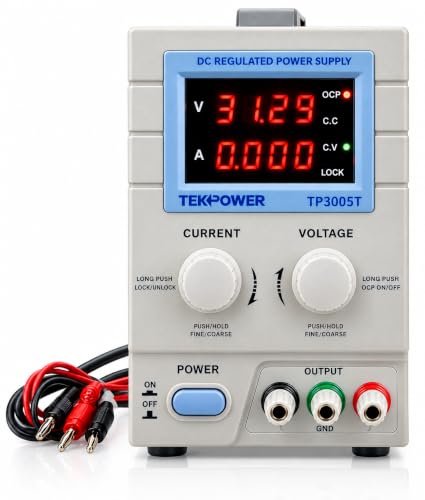
Twelve pounds of metal that will not budge when you tug a test lead.
A linear supply earns its place on the bench through a cleaner output, and the Tekpower is the linear option in this lineup. It runs 0-30V at 0-5A in constant voltage or constant current mode, with a backlit LED display resolving 0.1V and 0.01A. The metal body and 12 pounds of weight are not a downside here — the mass is why it stays put and does not skate across the bench when you pull a lead hard.
Performance is where the owners plant their flag. Readings hold steady across the whole range and track a decent digital multimeter closely, with no spikes when you flick the switch on or off. The thermo-sensor fan kicks in on its own when things warm up, and the backlit readout is crisp enough to read across the room. A 1-year manufacturer’s warranty backs the whole thing.
The controls are the point to think about. This is the older dial layout — separate coarse and fine knobs plus buttons, not the encoder you get on the Kungber or Jesverty — and adjusting volts or current takes more fiddling than one-knob boxes. The fan also draws some mixed notes for noise once it spins up. Neither is a fault, just the price of a linear design at this price tier.
Clean power, simple reality: A linear topology plus a metal chassis gives you steady readings and a bench anchor, which analog and audio work appreciate.
Where it asks for patience: Two dials and a button row mean slower setup, and the fan is audible when it runs.
Suits the tinkerer who: wants a heavy, quiet-output linear supply and does not mind dialing settings by hand.
Worth a pass if: fast, encoder-style setup is a daily need for you.
7. KORAD KD3005D Precision Variable DC Power Supply

A dual-display linear box built for people who leave it powered all day.
Dual 4-digit LED displays let you watch voltage and current at the same time on this KORAD, which is more useful than it sounds when you are chasing a current draw. It handles 30V at 5A, switches automatically between mA and A readout, and carries overload, short-circuit and over-temperature protection. The metal chassis is 9 pounds of steady, and the input switchable 110/220V means it is not tied to one country’s mains.
Power quality is the stand-out here — owners run it for hours at a steady draw with no problems, keep it in daily use, and find the accuracy holds close to a calibrated reference. One long-run report had it at 1.2 amps for hours without a hiccup. Adjustment is fine-grained enough to set a voltage very precisely, which circuit-board work depends on. Automatic CV/CC switching means it shifts modes without you touching a thing.
Two realities to weigh. It is a linear design at 5A, so if you need more than 5 amps of headroom, the NICE-POWER 20A box further down is the tool. And at 14 x 10 x 10 inches it eats more bench space than the compact switching picks. For the daily-driver bench role, though, this is the steady hand.
Dual-readout advantage: Voltage and current both on screen, with auto mA/A switching, so you see the number that matters without toggling.
Trade-off to weigh: Linear at 5A and larger footprint — give it a dedicated corner rather than a shared one.
Best matched to: the regular bench builder who wants accurate voltage and a large, legible display every day.
Look past it if: you need more than 5 amps of sustained current or tight-space placement.
8. NICE-POWER 30V 20A 600W Bench Power Supply
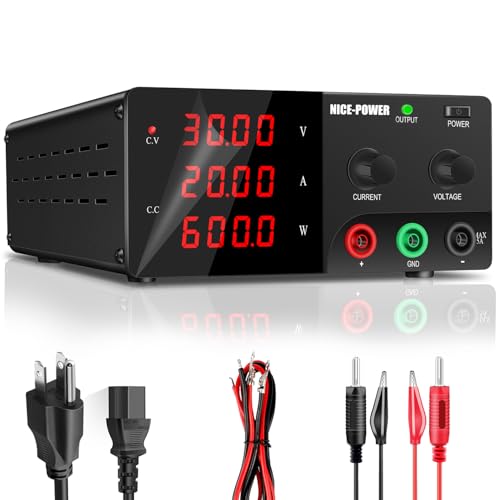
Twenty amps and 600 watts for the jobs that overpower every other box here.
At 600 watts, this unit doubles the power of anything else in this lineup, and its 20A current ceiling is higher than any other pick reaches. That power suits drive motors, electrolysis, plating and heavy testing — jobs that would trip a smaller unit. One design detail matters: the front panel takes output currents up to 5A only. For anything above that, run through the high-current connector on the back panel to reach the full spec without damage.
Settings are easy to dial with the encoder knob — press to select a digit, turn to set it 0-9 — so voltage and current are set rather than nudged. The output ON/OFF key is a real safety feature here: set your numbers with the load isolated so you do not burn out the gear you forgot to unplug. It runs CV or CC automatically, holds full load for long stretches, and the 4-digit backlit display resolves 0.01V and 0.001A. Overvoltage, overcurrent, overheating and termination protection all sit inside, with a fan that starts above 122°F/50℃.
Performance is a real question mark on this one. The output carries a positive read — it will hold constant voltage for a car battery with the engine off, and delivers the required amperage for testing. But the performance notes are mixed, with one unit’s Amp/Watt display quitting after a few months. Fewer owners have weighed in here than on the older boxes, so buy it for the current headroom and keep realistic expectations.
The 20A case: No other pick in this guide goes past 10A, so high-current work is this unit’s whole reason to exist.
Read the setup first: Front-panel output caps at 5A — run heavy loads through the rear terminal as instructed or you risk damage.
The right tool for: motor drives, plating baths and high-draw tests that need well past 10 amps.
Better to choose another if: you only need low-voltage hobby work — the smaller picks are easier to live with.
9. Siglent SPD3303X-E Triple Output Power Supply
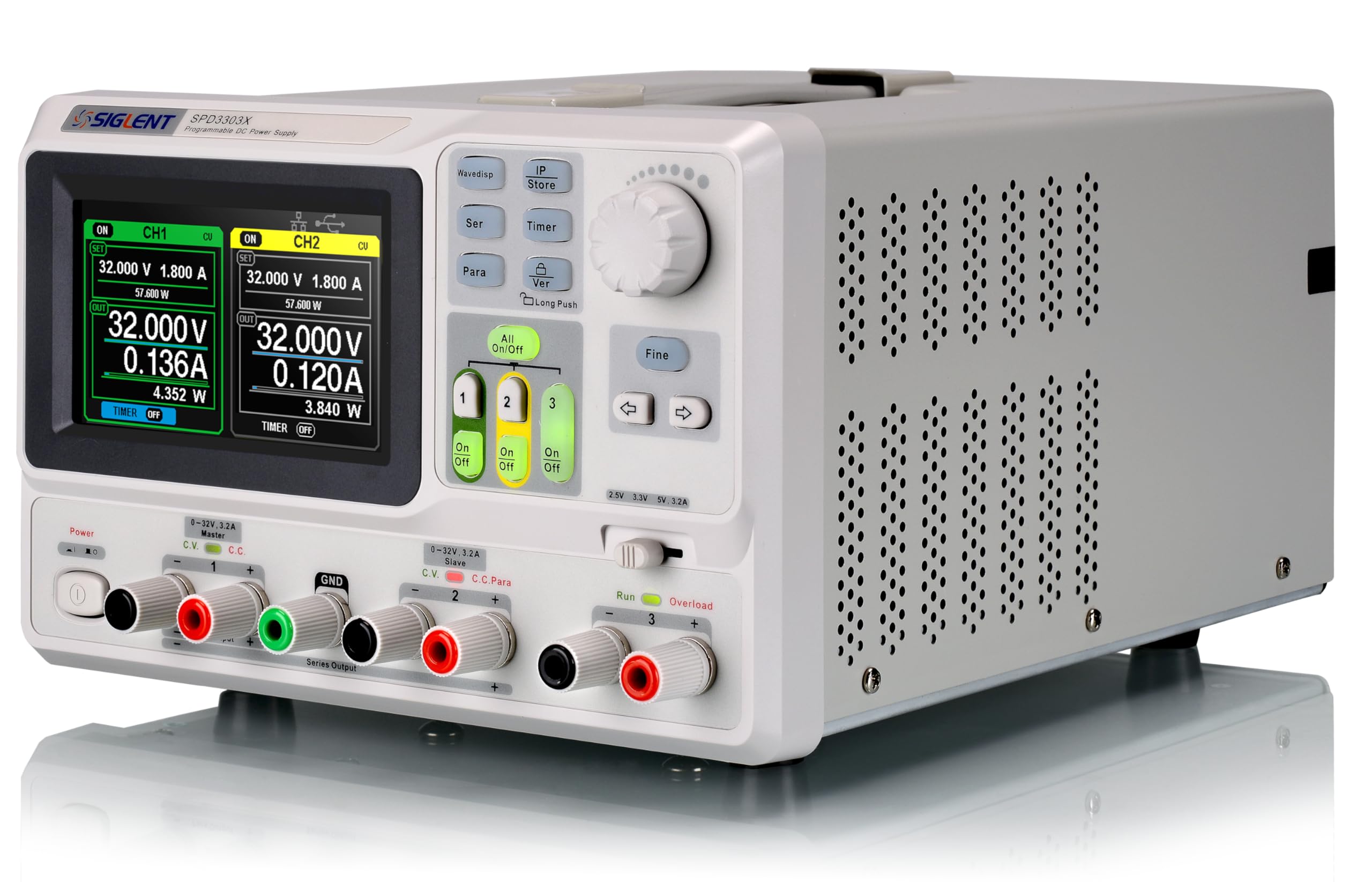
Three isolated channels in one box, so you stop stacking supplies on the bench.
Every other pick here gives you one output. The Siglent gives you three independently controlled and isolated channels — two at 32V/3.2A and one at 2.5V/3.3V/5V/3.2A — for 220 watts total. Run independent, series or parallel modes depending on what the circuit needs, and use the timing output function and trending graphs to watch how the power behaves over a run. When you are powering a project that wants several rails at once, this replaces two or three separate boxes.
The precision is where it earns its keep. Voltage and current readings track a calibrated multimeter closely, the dual-channel programmable design is what owners call out as the reason it is versatile, and the screen is clear enough to read at a glance. It feels well built, and it is backed like lab gear should be. Each channel is isolated, so a fault on one does not drag the others down.
The catch is real and worth stating plainly. Reliability notes are mixed, with a report of the unit rebooting at random after about three months and one pointing out that voltage probes for better current measurement are not included. It also weighs 17.6 pounds and takes up far more room than the compact boxes. This is a serious instrument for a serious bench, not a starter unit.
Three rails, one box: Independent, series and parallel output modes plus timing functions make multi-rail projects straightforward instead of cluttered.
What you are committing to: The size and weight of lab equipment, and the need to add your own probes for precise current measurement.
Reserve it for: engineers and serious hobbyists running multi-rail circuits who want isolated channels in one instrument.
Hold off if: a single output covers your work — the smaller boxes cost less bench space for the same jobs.
Know the Specs
Output Range: Volts And Amps
The voltage figure is the highest rail you can dial; the amp figure is the most current the supply will push. A 30V 10A unit gives 300 watts of ceiling, while a 0-50V 0-6A box gives 150 watts. Higher voltage suits electrolysis and audio; higher current suits motors and heavy loads. Read the honest sustained current in the review pages, not just the label, because some ratings are peak-only.
Resolution And Ripple
Resolution is the smallest step you can set — 0.01V and 0.001A is fine enough for component testing. Ripple is the leftover wobble riding on the output, and a figure under 20mV keeps sensitive parts safe. A linear supply tends to run cleaner here than a compact switching unit, which is why linear boxes stay popular for analog work.
CC And CV Modes
Constant voltage (CV) holds your set voltage while current floats with the load. Constant current (CC) caps the current at your setting once the load pulls past it, which protects a battery or a shorted board. Most units switch between the two automatically, so you set both limits and let the supply decide which applies.
Protection And Controls
Overcurrent (OCP), overvoltage (OVP), over-temperature and short-circuit protection stop the supply from feeding a fault. An output ON/OFF button lets you set values with the load disconnected, which prevents sparks. Encoder knobs and memory presets speed up repeat setups, while a key lock stops a stray hand from changing your numbers mid-test.
Common Questions
What is the difference between a linear and a switching variable DC power supply?
Can a 30V 10A supply really deliver 10 amps continuously?
What does CC and CV mode switching actually do?
Is 30V enough for most electronics repair work?
Why does my supply read one voltage but my multimeter reads another?
Do I need an output ON/OFF button on a bench power supply?
How do I charge a battery safely with a variable DC power supply?
What is ripple and why does a low figure matter?
Is a higher amperage supply always better?
Do these supplies run on 110V or 220V?
The Bottom Line
For most benches, the variable dc power supply that does the most jobs well is the Kungber 30V 10A — 300 watts, an automatic charge cutoff, OCP short protection and an 18W USB port in one box. It is the crowd favorite for a reason: 4.5+ stars across 700+ owners. If you prioritize 32V headroom and USB-C fast charge on a tighter bench, the Jesverty SPS-3010M is the smarter fit. And when your work needs genuinely independent rails in a single instrument, the Siglent SPD3303X-E gives you three isolated, programmable channels no single-output box can match.
How we choose
We do not accept paid placement. Every pick is matched to a real buyer and a real use-case; we do not hands-on test units.
Sources
Specifications: manufacturer listings and product documentation. Review insights: verified customer reviews, as of November 2026. Pricing: not shown on this page (it changes often); check the current price via the retailer link.
As an Amazon Associate, Tactical Gear Guy earns from qualifying purchases. This does not affect which products we feature.