Specs are compiled from manufacturer listings and verified buyer reviews and can change over time — please confirm the key details on the product page before buying.
Fine dust you can’t see settles on your shelves and ends up in your lungs, so the machine you pick has to move enough air to catch it at the tool. That depends on two numbers: how much air the machine moves, and how much of the fine dust it traps. Get the cubic-feet-per-minute (CFM — how much air the machine pulls per minute) rating wrong and your table saw sprays chips across the shop all afternoon. Pick a machine with a slack filter and the really fine dust floats straight back out. Below are eleven real machines — from compact extractors you can carry in one hand to rolling bag collectors that swallow a whole afternoon of planer shavings — so you can match the airflow, capacity, and noise level to the tools you actually run.
This guide is built by comparing the manufacturers’ published specifications and the patterns across verified customer reviews, so you get each pick’s real strengths and trade-offs instead of marketing spin.
You’ll see which machines tie into your power tools automatically, which bags hold the most shavings before a swap, and which ones stay quiet enough to run in a garage below a sleeping house. Below is a plain-English vacuum dust collector guide built around real airflow ratings and real owner experience.
Top Picks


How To Choose The Best Vacuum Dust Collector
Two numbers decide almost everything here: the airflow in CFM and the canister size in gallons. A small handheld sander needs far less air than a planer that throws ribbons the width of a dinner plate, and sizing the machine to your tools is the whole game. Get the airflow right and the dust leaves the cut; get the canister right and you are not swapping bags mid-session.
Match the CFM to the tool, not the shop
Airflow in CFM (cubic feet per minute — how much air the machine pulls past the tool) is the real measure of whether dust gets captured before it scatters. Small extractors in the 130-CFM range pair well with sanders and routers. Big bag collectors that move 660 to 1,300 CFM are built for table saws and planers that produce shavings fast. Buying far more airflow than your tools need wastes money and floor space; buying too little leaves a haze of fine dust over the shelves.
The filter bag micron rating is what protects your lungs
A micron is a millionth of a metre — tiny enough that a single speck of paint overspray might be a hundred microns across. A bag rated at 5 microns lets through fine dust that settles invisibly across the shop overnight. A 1-micron bag catches far more. If you sand drywall, concrete, or paint, step up to a HEPA-rated canister, which traps the finest particles rather than blowing them back into the room.
Canister gallons versus shavings per hour
Bag capacity in gallons is really about how often you stop to empty. A 3.9-gallon canister forces a bag swap on a long sanding session, while a 50-gallon vertical bag collects an entire weekend of planer chips before it needs emptying. Buy the biggest bag your shop floor can spend the space on, and a smaller one if the machine has to wheel into tight corners.
Side-by-Side Comparison
| Model | Best For | Airflow (CFM) | Capacity | Filter / Bag | Amazon |
|---|---|---|---|---|---|
| Festool CT Midi I HEPA★ Best Overall | Carrying between jobsites | 130 CFM | 3.9 gallons | HEPA cartridge | Amazon |
| WEN DC3401Budget Roller | Small-shop roll-around | 660 CFM | 12 gallons | 5-micron bag | Amazon |
| DEWALT 10 Gal StealthsonicQuietest Tank | Wet and dry job-site mess | 5 Peak HP (8 A) | 10 gallons | Cartridge filter | Amazon |
| BUCKTOOL 750 CFM Auto-Start | Auto-start with power tools | 750 CFM | 13 gallons | 2-micron cloth bag | Amazon |
| Fein Turbo I Set | Fine-dust wet and dry cleanup | 151 CFM | 5.8 gallons | HEPA filter | Amazon |
| POWERTEC DC1081 | Central-shop chip collection | 800 CFM | 1-micron bag | 1-micron bag | Amazon |
| WEN DC1300 | Two-tool high-volume shops | 1,300 CFM | 50 gallons | 5-micron bag | Amazon |
| SHOP FOX W1727 | Small-shop saw and band saw pair | 800 CFM | Bag / canister | 2.5-micron bag | Amazon |
| DEWALT DWV010 | Lead and drywall remediation | 150 CFM | 8 gallons | HEPA cartridge | Amazon |
| Bosch VAC090AH | Silica and concrete dust compliance | 150 CFM | 9 gallons | HEPA cartridge | Amazon |
Detailed Reviews
1. Festool 574837 CT Midi I HEPA Bluetooth Dust Extractor
Our pick — 4.5+★ from 500+ verified ratings; the strongest balance of quality and price.
The extractor that turns on the moment you pull the sander’s trigger, no reach for a switch.
The CT Midi I wins its spot with a Bluetooth link that starts the extractor the moment your tool fires up, so you never stop mid-cut to hunt for a switch. Pair it with a Bluetooth battery pack or the remote and it boots itself. At 24.9 pounds with a 3.9-gallon canister, it rides in the van and carries up a flight of stairs like a toolbox — the pick for anyone who moves between jobs or works in a tight shop where a wheeled bag collector would be in the way. Its 130 CFM of suction is aimed at hand tools, not a planer: a router or a finish sander barely notices the load. A touch panel handles manual control, and an onboard hose holder keeps the smooth conical hose tidy between jobs; that conical shape keeps airflow strong without the ridges catching on edges as you drag it. The Sys-Dock with T-Loc lets you clip a sustainer straight on top so everything moves as one stack.
What owners rave about, by a wide margin, is the sheer quality of the build — it feels made to outlast the tools it sits under. Effectiveness with sanders and the ability to pull in the very finest particles come next, and the dust control is real: the HEPA cartridge lives up to the fine-dust job it advertises. It also runs quieter than a shop vac, is compact enough to tuck beside the bench, and the adjustable suction lets you dial back so you are not sucking a sanding pad to the wood. All of that confidence does come at the top of the extractor market, which is the honest trade-off here. If your budget is tight and you are cutting wood rather than drywall, the WEN DC3401 rolls 660 CFM of airflow into a small shop for a fraction of the outlay — different machine for a different job.
For the finish carpenter, the trim installer, or the remodeler chasing fine dust indoors, this is the machine that follows you and cleans itself up. skip it if your real task is shovelling planer shavings off a big shop floor; a bag collector is the tool for that volume.
What wins people over
- Bluetooth auto-start fires the extractor whenever your paired tool runs — no extra reach or switch.
- HEPA cartridge with 130 CFM handles fine sander dust that a shop vac recirculates.
- 24.9 pounds with an onboard hose holder and Sys-Dock make it genuinely portable.
Where it asks for patience
- 3.9-gallon canister means more frequent bag swaps on long sessions than a 15-gallon collector.
- 130 CFM is sized for hand tools, not a planer or drum sander.
Reach for it if: you sand and route on the move and want the dust captured at the tool with zero extra steps.
Pass on it if: your day is dominated by big-chip machines that need hundreds of CFM.
2. WEN DC3401 Dust Collector
A rolling bag collector that moves 660 CFM for table-saw and miter-saw duty without crowding your floor.
If you run a miter saw and a table saw in a garage, this is the entry into real chip collection. A 5.7-amp brushed motor spins a 6-inch impeller to move up to 660 cubic feet of air per minute, so shavings leave the cut instead of settling on the bench. The 4-inch dust port mates with your tools’ standard outlet, which is the size most table saws and miter saws expect. Lockable swivel casters let you pull the machine to the cut and lock it in place, while the onboard carrying handle makes storage easier between sessions. A 12-gallon, 5-micron zippered bag holds a good session’s worth of chips, and the two-year warranty covers the machine.
Buyers report it earns its place behind a miter saw and a table saw, and a 600-plus-CFM rating is enough for CNC router duty too. Set your expectations before the first cut: quality draws a genuinely split reaction — plenty of people find it a clear step up from a shop vac, while others think it sits below the more expensive collectors, which lines up with its place at the low end of bag collectors. Treat it as a chip mover at short hose runs rather than a fine-dust HEPA machine. The 5-micron bag (a micron is one millionth of a meter, so 5 microns catches the bulk of sawdust but not the finest particles) does not filter to the level a HEPA canister will. If you sand finishes or cut drywall, step up to a HEPA extractor instead.
For a hobby shop that wants to stop chasing sawdust with a broom, this is the sensible first bag collector — 660 CFM, a 12-gallon bag, and casters, without going deep into a tool budget. Keep the hose runs short and it pulls chips off the cut instead of leaving them on the bench.
Where it fits: hobby shops with a table saw and a miter saw that need affordable chip collection and a bag that holds a session’s worth.
The honest limit: the 5-micron bag catches chips, not the finest dust — fine sanding or drywall work wants a HEPA-rated machine instead.
Right for: the garage woodworker who needs to pull shavings off a table saw fast and roll the machine out of the way.
Think twice if: your work is dominated by fine sanding dust rather than chips.
3. DEWALT 10 Gal Stealthsonic Shop Vacuum
The rare shop vac you can run beside your ear without flinching — under 65 dB.
Most shop vacs make you wish for ear muffs. This one runs under 65 dB (decibels — the loudness scale), which the maker says is half as loud and built to last longer than the model it replaces. That quiet turns a garage vacuum into something you can use late without waking the house. A 5 Peak HP motor, drawing 8 amps, is aimed at wet and dry messes — dry dust, debris, and any spilled liquid you point it at. A 10-gallon stainless-steel tank means fewer dumps and takes a knock without denting; the 10-foot cord plus 7-foot hose stretch the reach so you are not unplugging to move across the bench. A full accessory kit ships in the box: six disposable dust bags, two extension wands, a floor brush, round brush, car nozzle, utility nozzle, foam filter, and a Clean Connect filter, plus an accessory bag to keep it all together.
Quality is what wins people over most here — the thing feels super strong, and the quiet is the other standout. Cleaning performance covers dust, debris, hay, and feathers without complaint, and owners consider it good value for the job site and garage. The honest caveat: suction draws a split reaction, so on a heavy continuous pull it will not out-suck every big single-tool collector, and the wet-and-dry role is different from a dedicated dust extractor. Treat it as your mess vacuum, not your table-saw collector.
For a workshop or garage that needs a quiet, tough wet-and-dry vac that handles general cleanup, this is the one you leave plugged in.
Why it stands out: under 65 dB turns a job-site tank into a garage-friendly vacuum, with a 10-gallon stainless tank and six bags in the box.
What to know: suction feedback is mixed, so rely on it for cleanup and spills rather than as a chip collector behind a planer.
Grab it if: you want quiet general cleanup and wet-and-dry spills in a garage or on a job site.
Keep looking if: your priority is drawing chips off a running table saw.
4. BUCKTOOL 750 CFM Dust Collector
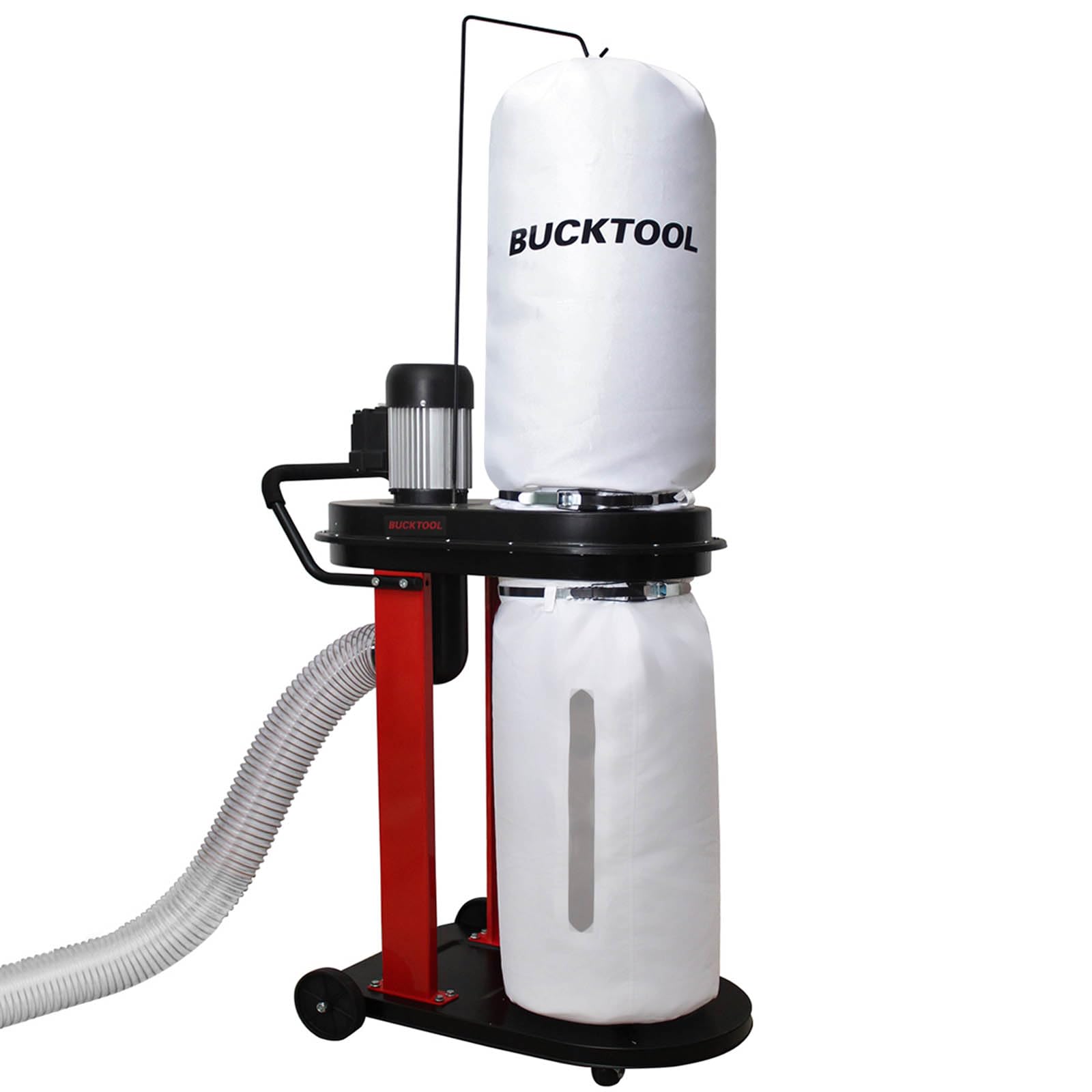
The highest airflow here with an outlet that fires the collector when you start your tool.
This is the machine for someone who wants maximum airflow and does not want to juggle two switches. A 1.2 HP, 120-volt motor turning 3450 RPM moves up to 750 CFM, drawing a full-load 6.5 amps. That makes it a genuine step up on airflow versus the Festool’s 130 CFM, and it beats the DEWALT tank’s 8-amp draw by staying at a leaner 6.5A. The auto-start function gives you a powered outlet on the machine: plug a tool in and the collector spools up and down with it, up to a 7-amp max tool load. Bag changes are handled by a soft PET clamp that will not slice your hand. It runs both as a mobile unit on casters and a stationary one, sized at 16-1/2 x 26-3/8 inches for a compact footprint. The kit includes a 5-foot, 4-inch flex hose, five reducers, plastic and cloth lower bags, and a 2-micron cloth upper collection bag.
Owners ask it to handle a 14-inch planer and a 16-inch horizontal drum sander, and it does. Where it gets sticky is assembly — reactions split, with some finding it simple and others grinding through the instructions. At 56 pounds, plan to keep it on its casters or give it a permanent spot. Keep the hose run short and the 2-micron bag does the chip-catching job well.
If you want the most airflow for the money and an auto-start outlet to drive your tools, this BUCKTOOL is the pick to beat on CFM-per-dollar.
The case for the BUCKTOOL
- 750 CFM — the highest airflow of this lineup for pulling chips off the tool.
- Onboard auto-start outlet syncs the collector with a power tool up to 7 amps.
- 2-micron bag plus soft PET clamp for safer, easier bag changes.
The case against
- Assembly directions split opinion — some find them confusing.
- 56 pounds means it lives on its casters.
Pick this if: you want big airflow and an auto-start outlet without buying a premium extractor.
pass on it if: you assemble flat-pack furniture grudgingly — the build takes some patience.
5. Fein Turbo I Set Wet/Dry Dust Extractor, 5.8-Gallon Capacity
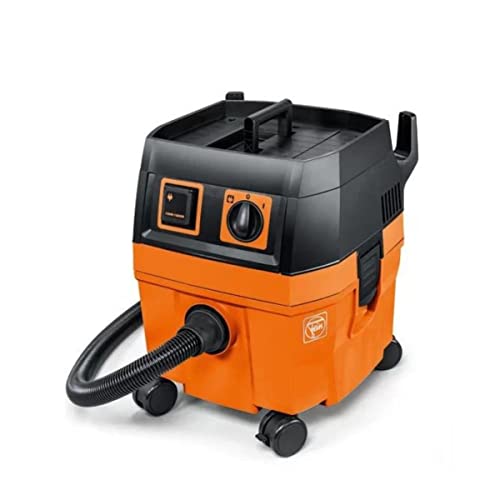
A quiet, HEPA-filtered extractor with the reach to cover a whole room from one outlet.
Fine dust is where the Turbo I shines. A high-performance 1100W turbine produces 151 CFM and 98 inches of water lift — that water-lift figure is the strength of the pull — for wet and dry cleanup on demanding job sites. It runs at just 66 dB, so it fits indoors and beside a workbench without the roar of a shop vac. The reach is the underrated feature: a 19-foot heavy-duty power cord plus a 13-foot vacuum hose let you work across a room without switching outlets. Tool-activated suction via the autostart outlet syncs it to your power tools, and a built-in power-on delay prevents the current spike that can trip a breaker when the vacuum and tool kick on together. Large swivel wheels turn a full 360 degrees so it follows you around tight spaces; an anti-static function with optional accessories helps head off electrostatic buildup.
The build quality is the thing that wins people over, and the low noise is right behind it — you can run this without hearing protection. It pulls fine dust up cleanly and it is small enough to tuck against a wall on its casters. The caveats are honest ones: reliability, durability, and value all draw a split reaction, so a few machines do not live up to the brand’s long-term reputation. The 5.8-gallon capacity is mid-sized, so heavy drywall cutting fills it faster than a big canister. Still, as an indoor fine-dust extractor, few machines are this quiet with this reach.
For interior trim work, sanding, and cleanup that has to stay quiet and grab the fine stuff, the Turbo I is a strong choice.
Where it shines: 151 CFM with 98 inches of water lift, 66 dB running, and 19-foot cord plus 13-foot hose to cover a room from one outlet.
The honest catch: 5.8 gallons fills fast on heavy cutting, and long-term reliability draws a mixed reaction.
Well suited to: indoor sanding and trim work where quiet and fine-dust capture matter most.
Not the pick if: you need a huge bag for volume chip collection.
6. POWERTEC 800 CFM Dust Collector

A 1-micron bag wrapped around 800 CFM — the most thorough chip catcher at this price point.
The 1-micron bag is the headline here. It filters finer than the 5-micron bags on the WEN machines, so more of the dust stays inside the bag and less ends up on your shelves. That fine bag hangs around 800 CFM of suction, delivered by a single-phase 120V/240V, 1-horsepower motor spinning at 3450 RPM. A sturdy base 15-1/4 x 25-1/2 inches rides four casters so you can park it at the saw or hook it into a central run as a stationary unit. Quick-release bag clamps make emptying fast, and the two-height setup lets you move it between a stationary spot and a travelling cleaning job.
Owners say it performs well with a table saw, sander, and router, and the quiet running is a repeated plus. Assembly and install are straightforward, and the value lands well for an 800-CFM 1-micron machine. The one thing that draws a split reaction is suction — some find it plenty, others want more — which again tracks hose length and a choked bag. Keep the run short and the bag clean, and it holds up. The 1-micron bag is the real selling point over cheaper 5-micron collectors: it catches finer dust, so less recirculates.
For a shop running several machines off one collector, this POWERTEC threads an 800-CFM motor and a 1-micron bag through a mobile base with quick-release clamps.
The reason to choose it: a 1-micron bag on 800 CFM of airflow catches dust finer than 5-micron rivals, with quick-release clamps and a four-caster base.
The trade-off: suction draws mixed reactions, so keep the hose run short and empty the bag regularly.
Best matched with: a multi-machine shop that values finer 1-micron dust capture on a mobile base.
Not for: anyone expecting HEPA-grade filtration for drywall or lead work.
7. WEN DC1300 Dust Collector

Two tools, 1,300 CFM, and a 50-gallon bag that swallows an entire weekend of shavings.
When volume is the problem, airflow is the answer. A 14-amp motor drives a 10-inch steel impeller (the spinning fan wheel that moves the air) to 3450 RPM, circulating up to 1,300 cubic feet of air per minute — roughly double the POWERTEC’s 800 CFM and ten times the Festool’s 130 CFM. Dual 4-inch inlets let you attach two tools at once, so two machines can run off one collector. The vertical collection bag holds up to 50 gallons of dust, so you empty it far less often than a 12- or 15-gallon bag, and a mobile base with four swivel casters rolls the whole rig around the shop.
Owners say it cleans messes effectively, moves a lot of air, and has great suction — and it runs quieter than they expect for a machine this size. Assembly is straightforward, and the value lands well for the volume. One detail worth knowing: durability draws a split reaction, so treat it as a tool to mount permanently rather than shove around the job site. The 5-micron bag is a chip catcher, which is exactly what a 50-gallon collector is for.
If you want the most airflow and the biggest bag in one machine, the DC1300 delivers both — two-tool capability, 50 gallons, and 1,300 CFM.
Why volume shops reach for it
- 1,300 CFM from a 14-amp motor and 10-inch steel impeller moves the most air here.
- Dual 4-inch inlets serve two tools at once.
- 50-gallon vertical bag means far fewer empties.
Where it asks for care
- Durability draws a split reaction — treat it as a shop fixture, not a portable job-site machine.
- The 5-micron bag is for chips, not fine finishing dust.
Made for: a high-volume shop running two tools off one collector and emptying a bag rarely.
Not ideal if: you need HEPA filtration or a machine you can carry.
8. SHOP FOX Portable W1727 1 HP Dust Collector

A steady 1 HP, 800 CFM performer that small shops keep for table saws and band saws.
The W1727 is the machine a small shop buys once. A 1 HP, 120V/240V single-phase motor comes prewired for 110V and draws 9 amps, delivering 800 CFM of air suction. Standard bag filtration is rated at 2.5 microns, finer than a 5-micron bag, so it traps more of the finer dust. The portable base measures 15-3/4 x 39-3/4 inches, giving it a footprint a garage can live with, and the whole thing weighs 55 pounds.
Owners mention it performs well for small shops, especially with table saws and band saws, and the easy assembly and quiet operation are recurring highs. One happy account puts the running noise well below expectation. The genuinely mixed signals are worth knowing: dust collection and suction power both draw a split reaction, so it rewards short hose runs and a clean bag rather than long runs into a whole-shop system. It is a chip collector for a small shop, not a HEPA extractor.
For a garage-shop woodworker who runs a table saw and a band saw and wants steady 800 CFM without a permanent central system, this is the tool to keep.
What earns it a spot: 1 HP delivers 800 CFM through a 2.5-micron bag, with easy assembly and quieter-than-expected running for a small shop.
What to watch: dust collection and suction power split opinion — keep hose runs short and the bag clean for the steady performance it is known for.
Fits the buyer who: runs a table saw and band saw in a garage and wants a proven 800-CFM chip collector.
Better to look elsewhere if: you need fine-dust HEPA capture or whole-shop central drawing power.
9. DEWALT DWV010 Dust Extractor
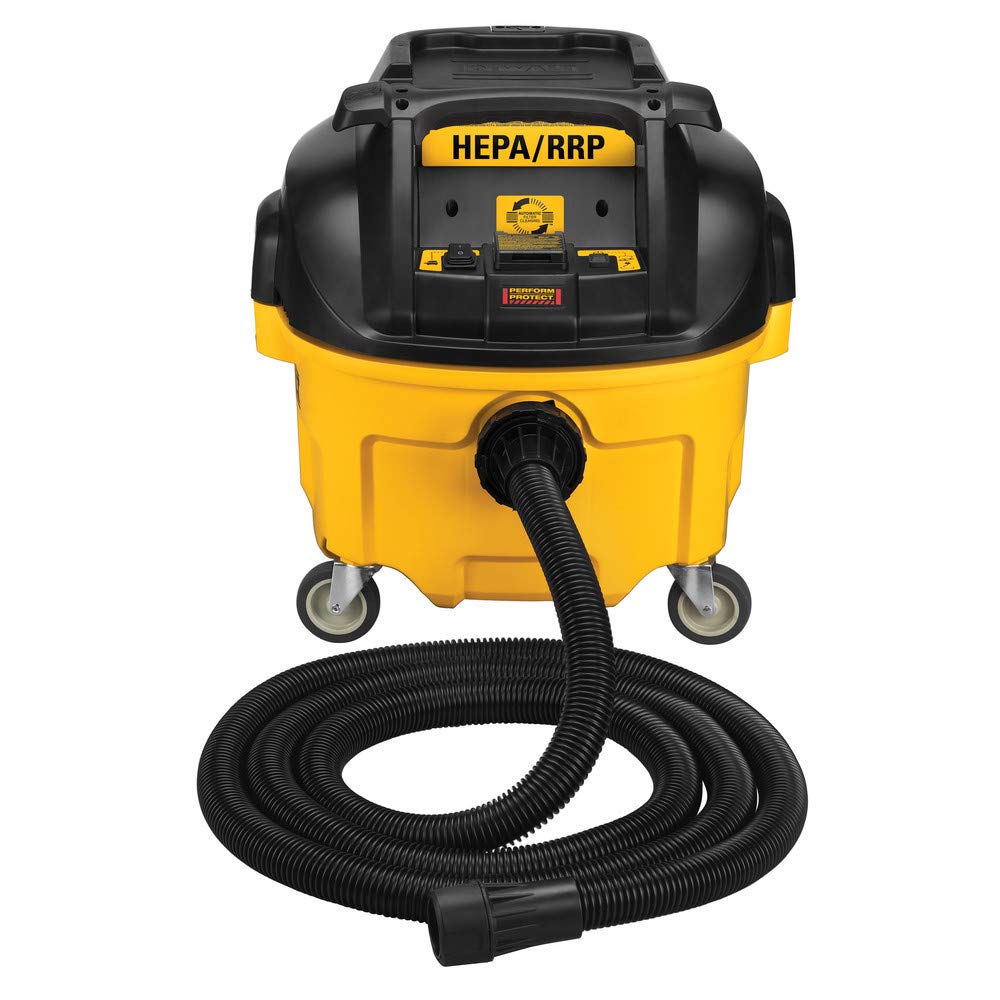
The extractor that keeps its own filter clean while you work, with HEPA filtration to back it up.
If you cut drywall, concrete, or lead paint, the filter is the whole story. The DWV010 pulses its filter every 30 seconds to keep airflow going without you stopping to clean it, feeding a HEPA filter that traps fine dust. A 15-amp motor delivers 150 CFM of airflow, and power-tool actuation lets the tool’s switch run the vacuum. The 8-gallon tank and heavy-duty wheels and casters are built for job-site durability, and a 15-foot anti-static hose with a universal connector swivels for secure tool connections. Meets the EPA Lead Related Renovations, Repair and Painting (RRP) Rule for HEPA vacuums only when DWV9330 filters are used.
Owners find it performs and removes the fine dust that matters — concrete and plaster dust in particular. The self-cleaning feature earns real praise for keeping suction alive on long jobs, and it attaches to DEWALT tools easily. Watch the honest trade-offs: value draws a split reaction, suction power gets mixed feedback, and durability has its doubters. It also wants the DWV9330 filter to hold HEPA compliance, so factor that filter into the routine.
For the remodeler pulling concrete or lead dust and needing HEPA-grade capture with a self-cleaning filter, the DWV010 earns its place.
Why it earns the job: the filter pulses every 30 seconds for continuous operation under 150 CFM of HEPA-filtered airflow, with a 15-foot anti-static hose.
The honest limit: value and durability split opinion, and HEPA compliance depends on using DWV9330 filters.
Right for: drywall and concrete work that needs HEPA capture and a self-cleaning filter.
Less suited to: a woodworker who only needs to pull chips off a saw.
10. Bosch VAC090AH Dust Extractor
HEPA filtration that catches 99.97 percent of particles down to 0.3 microns — for silica-heavy work.
This is the machine for someone who needs HEPA-grade capture on concrete and silica dust. The HEPA filter traps 99.97 percent of particles at 0.3 microns or larger, and the included fleece bag protects the filter and holds dry dust. Automatic filter cleaning pulses every 15 seconds to maintain maximum suction power. A 15-amp-motor delivers a maximum 150 CFM and a sustainable maximum 97 inches of static water lift. Power-tool activation lets your tool’s switch run the vacuum, and the Power Broker dial matches suction to the application — dial it up for a grinder and down for a finish. It meets OSHA Silica Table 1 dust compliance in the Bosch PRO plus GUARD system.
Owners find it performs and contains dust, filling two bags in two hours with concrete dust when pushed, and the automatic filter cleaning earns real praise for keeping suction steady. It is considered well worth the money for what it does. The honest wrinkle is noise — it is louder than the quiet Festool or the DEWALT Stealthsonic, so it is a job-site machine rather than a living-room one. The 9-gallon capacity wants a bag change on heavy cutting days. For silica and concrete dust, though, that filtration is the reason you buy it.
For the contractor cutting concrete or grinding masonry who has to keep the air clean to comply, this is the compliance-ready pick.
What makes it a pro pick
- HEPA filter traps 99.97 percent of particles at 0.3 microns or larger.
- Auto filter cleaning every 15 seconds keeps 150 CFM flowing under load.
- Power Broker dial and tool activation match suction to the job.
Choose this when: silica, concrete, or masonry dust has to be captured to a HEPA standard on site.
Only looked past if: quiet operation outranks compliance filtration for you.
Know the Specs
Airflow (CFM) and why it decides everything
CFM stands for cubic feet per minute — the volume of air the machine pulls past the tool every minute. High CFM keeps chips moving on a table saw or planer; low CFM leaves dust behind at the cut. Big rolling collectors here run from 600 CFM up to 1,300 CFM, while compact extractors like the Festool sit at 130 CFM for hand tools. Match the airflow to your tool: a sander is happy with less, a planer wants more.
Micron rating on the filter bag
A micron is a millionth of a metre, and the rating tells you the smallest particle the bag traps. A 1-micron bag (as on the POWERTEC) holds finer dust than a 5-micron bag (as on the WEN machines), and a 2.5-micron bag (SHOP FOX) sits between. Finer ratings mean less dust recirculating into your shop air. For drywall, concrete, or lead, step up to a HEPA filter, which traps the finest particles rather than blowing them back out.
Water lift and why it signals pull strength
Water lift measures how high the machine can pull a column of water — a rough gauge of suction strength at a sealed end. The Fein lists 98 inches of water lift and the Bosch a sustainable maximum 97 inches. Higher water lift helps when the hose is long or the tool port is narrow, so the pull does not fade at the far end of the run.
Canister gallons and how often you empty
Gallons tell you how much debris the machine holds before you stop to empty it. A 3.9-gallon canister suits a single sanding session, while a 50-gallon vertical bag on the WEN DC1300 collects a weekend’s worth of shavings. Bigger capacity means fewer interruptions, but it also takes more floor space and weight to move.
Common Questions
What is the difference between a dust collector and a shop vac?
How many CFM do I need for a table saw or planer?
Will a 1-micron bag filter better than a 5-micron bag?
Do I need a HEPA extractor for drywall or concrete dust?
What does auto-start or tool activation actually do?
How often will I have to empty the bag?
Can I mount a dust collector on the wall to save floor space?
How loud are these machines in a garage?
What is water lift and does it matter more than CFM?
Can I run two tools off one dust collector at the same time?
The Bottom Line
For most people, the vacuum dust collector that earns first place is the Festool CT Midi I HEPA, because it captures the fine dust you actually breathe with HEPA filtration (a filter standard that traps very fine particles), starts itself over Bluetooth when you pull a tool trigger, and carries at 24.9 pounds — the crowd favorite, holding a 4.5+ rating across 500+ owners. If volume and airflow are your problem, the WEN DC1300 brings 1,300 CFM and a 50-gallon bag to swallow a weekend of shavings. And for the tightest budget and a table-saw-and-miter-saw garage, the WEN DC3401 rolls 660 CFM and a 12-gallon bag into a small shop for a modest outlay. Whichever tier you land in, size the airflow to your biggest tool first and the filtration second — that ordering is what keeps shop air clean enough to actually enjoy working in.
How we choose
We do not accept paid placement. Every pick is matched to a real buyer and a real use-case; we do not hands-on test units.
Sources
Specifications: manufacturer listings and product documentation. Review insights: verified customer reviews, as of November 2026. Pricing: not shown on this page (it changes often); check the current price via the retailer link.
As an Amazon Associate, Tactical Gear Guy earns from qualifying purchases. This does not affect which products we feature.