Specs are compiled from manufacturer listings and verified buyer reviews and can change over time — please confirm the key details on the product page before buying.
Your voice is the product, and the mic is the only thing standing between it and your audience. A mic that picks up keyboard clatter or a headset that makes you sound distant drives viewers off before anyone judges your content. This guide sorts USB microphones and headsets by what actually changes your sound: pickup pattern, sampling rate, monitoring, and how much room noise each one lets in. I’ll name the bundle to grab for each job so you can stop comparing boxes and start recording.
This guide is built by comparing the manufacturers’ published specifications and the patterns across verified customer reviews, so you get each pick’s real strengths and trade-offs instead of marketing spin.
You don’t need an audio interface or a mixing desk to sound broadcast-ready — a single USB bundle covers it. What you need is one box with the mic, stand, headphones, and pop filter that keeps your voice front and center. Below are the bundles worth your desk space, ranked by how they handle real rooms — read on for the usb mic and headset picks that fit your setup and your budget.
Top Picks

How To Choose The Best USB Mic and Headset
Buying a USB microphone is mostly a decision about your room’s noise and reflections, not your talent. A clean, quiet corner lets a modest mic sound great, while a hard-walled kitchen with a humming fridge muddies an expensive one. So the first thing to settle is where you will actually sit and record, and what noise lives there.
Start with the pickup pattern
The pickup pattern is the shape of the space a mic listens to. Cardioid means it hears mostly what sits directly in front of it and turns a deaf ear to the sides and rear. That is why cardioid mics are the default for one person talking into a desk. If you plan to interview a guest across the table, a mic with a bidirectional or stereo mode gives you options a pure cardioid cannot.
Decide if you want a separate mic or a headset
A desktop mic on a stand frees your ears and lets you place the capsule exactly where your voice is loudest. A headset puts the microphone on a boom arm millimeters from your mouth, so you can talk quietly at night without raising your voice. Gamers who need to hear game audio and teammates at the same time tend to prefer the headset route. Podcasters who want a warm, close vocal usually prefer the desktop mic.
Check the monitoring jack
A monitoring jack is a headphone socket on the mic itself that lets you hear your own voice as you speak. Live monitoring is how you catch a plosive before you publish it. Look for a jack that works with the headphones included in the bundle, so you are not shopping for a second pair on day one.
Side-by-Side Comparison
| Model | Best For | Sampling Rate | Pickup Pattern | Headphones Included | Amazon |
|---|---|---|---|---|---|
| MAONO AU-A04H★ Best Overall | Complete desk starter kit | 192kHz/24Bit | Cardioid | Yes | Amazon |
| Dejasound DJM5Quietest Signal | Quiet rooms with an isolation shield | 192kHz/24Bit | Cardioid | Yes | Amazon |
| ZealSound BD9Console Pick | Xbox party chat and streaming | 192kHz/24-bit | Cardioid | No — 3.5mm monitor jack | Amazon |
| TONOR TC777 Pro-IS | Portable podcasting with a shield | — | — | Yes | Amazon |
| Zoom ZUM-2 Pack | First podcast, no fuss | — | Supercardioid | Yes | Amazon |
| Behringer U-PHORIA STUDIO | Home recording with an interface | 192 KHz | Condenser | Yes | Amazon |
| Blue Yeti Bundle | Four-pattern flexibility | 16-Bit/48kHz | Four modes | Yes | Amazon |
| Audio-Technica ATH-M50xSTS-USB | Headset-first streamers | — | Cardioid condenser | Built in | Amazon |
Detailed Reviews
1. MAONO AU-A04H USB Microphone Kit
Our pick — 4.5+★ from 19,500+ verified ratings; the strongest balance of quality and price.
Everything on the desk in one box, and the voice comes out warm.
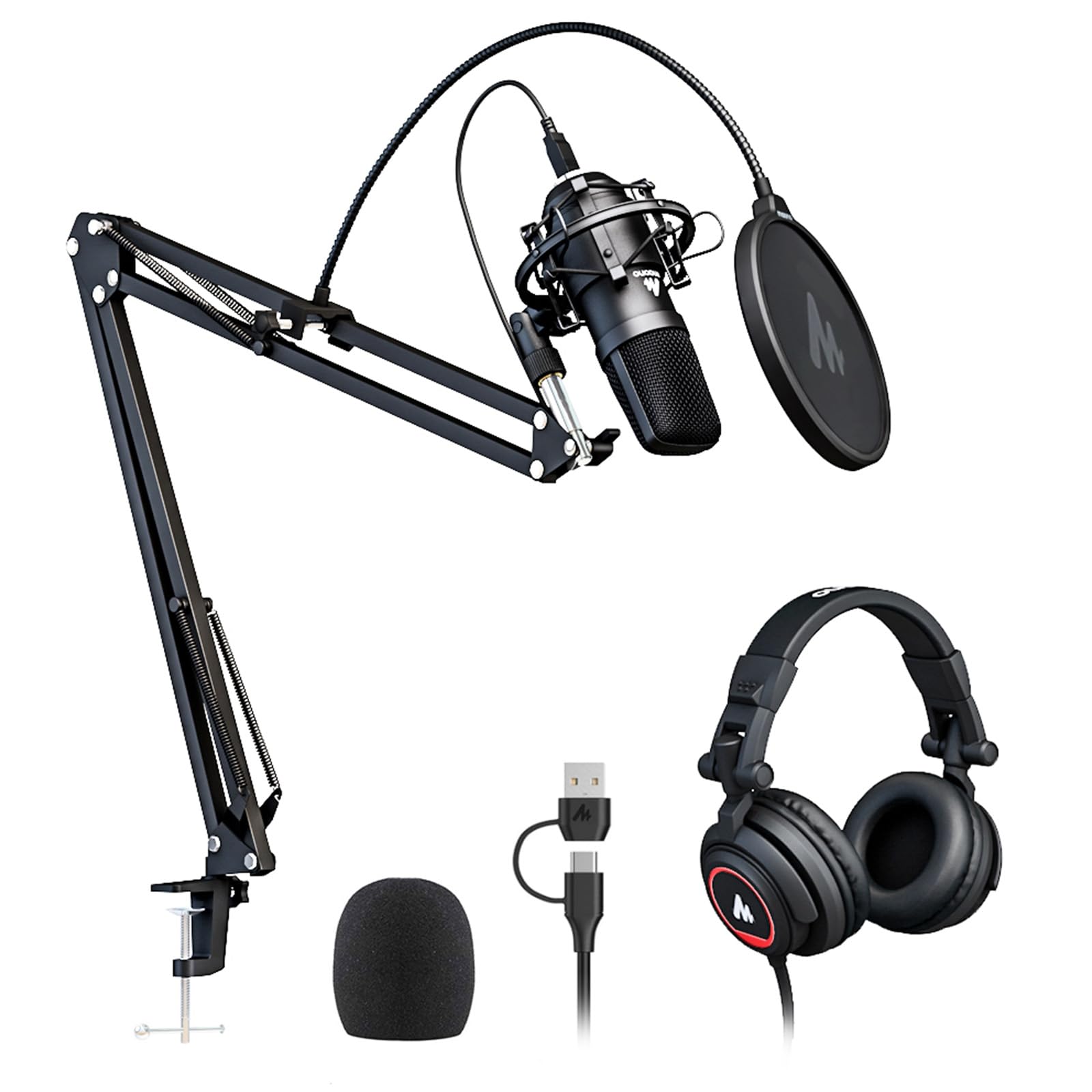
The reason this kit takes the top slot is simple: nothing else on the list hands a beginner a finished recording station. One box carries the USB condenser mic, a wired headphone pair, a boom-style stand, a metal shock mount that floats the mic off the stand, a pop filter, a foam windscreen, a table clamp, and the USB cable. You mount it, plug it into a computer or a PS4/PS5 over USB 2.0, and the operating system recognizes it with no driver software and no external sound card. Buyers report the whole thing takes about 10 minutes to mount.
The audio ceiling is high for the money. The 16mm electret condenser transducer is a small capsule that produces a strong bass response, and the published 192kHz/24Bit sampling rate means the mic captures a very detailed digital copy of your voice. The frequency range runs 30Hz–16kHz, which covers speech, singing, and voice-over cleanly. A magnet ring on the USB cable plus double shielding fights electrical interference — the buzz that sneaks into cheap setups. The noise figure is the honest caveat: 96 db audible noise next to the 20 db of the Dejasound DJM5 kit below means this mic is the louder of the two in a dead-silent room.
What wins people over is the overall package quality — the build and the sound land together, and the value holds up next to bare mics that cost the same. The headphones help here too: soft earmuffs on a circumaural design (cups that sit around the ear, not on it) give decent isolation, and the 90-degree swiveling earcups let you pull one side back for single-ear monitoring. A 9.8ft coil retractable cable gives you room to move. The recurring gripe is durability chatter on the moving parts, so treat the clamp and stand threads gently rather than cranking them down.
What earns the crown
- 192kHz/24Bit sampling and a 30Hz–16kHz range across a 16mm condenser capsule
- Plug-and-play USB 2.0 with double-shielded cable — no drivers, no sound card
- Headphones, shock mount, pop filter, and clamp all in the box
- 90-degree swiveling earcups for one-ear monitoring
Where it asks for care
- 96 db audible noise is the highest figure on this list
- At 1.5 kg the kit is solid — not a throw-it-in-a-backpack rig
Grab this one if: you want one purchase to cover mic, stand, headphones, and filtering for podcasting, gaming, or voice calls.
Look at the DJM5 instead if: your room is quiet enough that the 96 db noise floor would be audible between sentences.
2. Upgraded Studio Recording Microphone
The shield does the work your walls won’t.
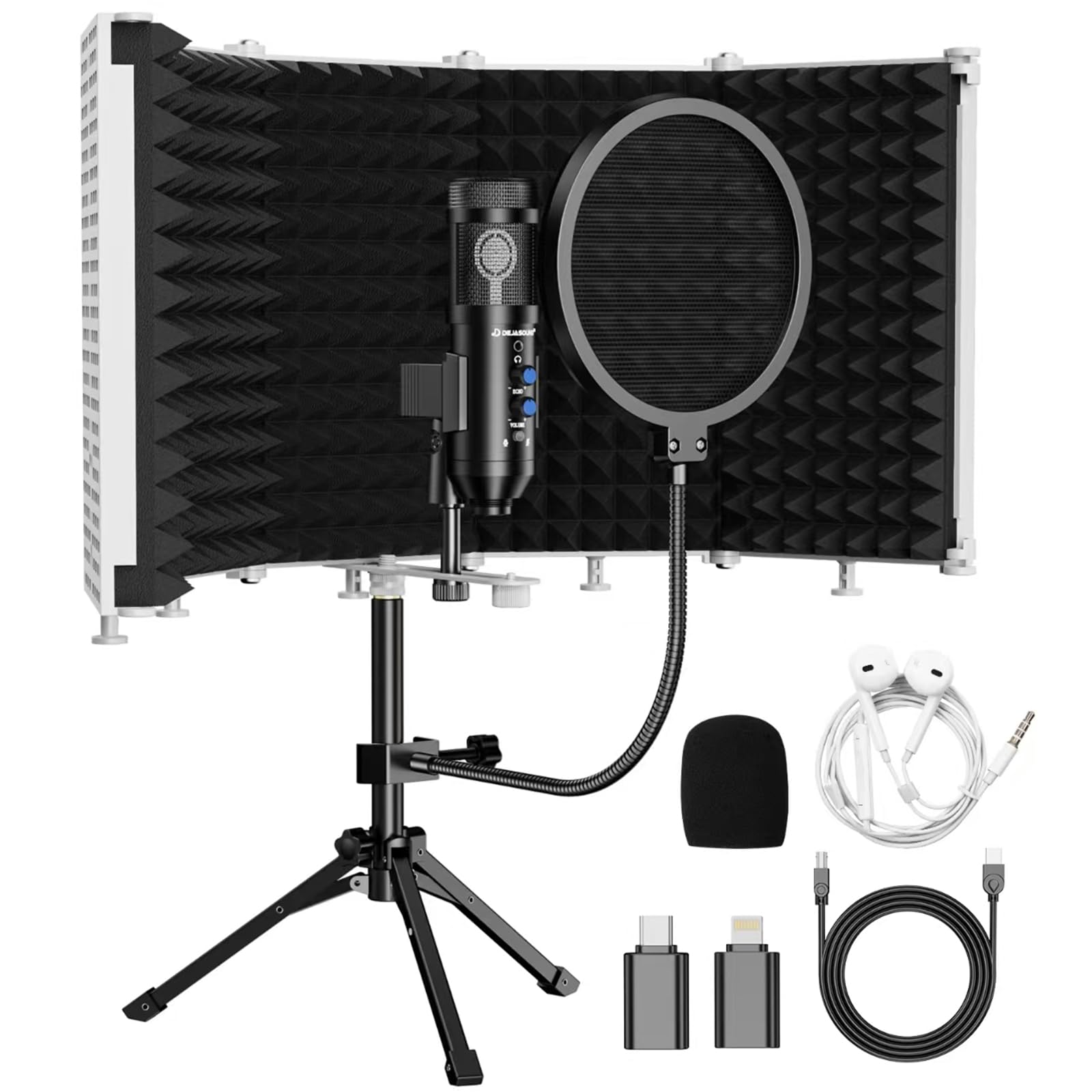
If your desk sits in a bedroom with bare walls and a humming laptop, start here. This Dejasound DJM5 kit posts 20 db of audible noise against the MAONO’s 96 db — a stated 4.8x gap in self-noise that means far less hiss riding under your voice. Around the capsule sits a foldable isolation shield built from 5 high-density sound-absorbing panels in a triple acoustic design, each panel adjustable so you can wrap the mic in acoustic foam and block the room’s reflections before they reach the diaphragm.
The capsule itself is no slouch: a 16mm diaphragm condenser in a cardioid pattern, 192kHz/24Bit sampling, and a 30Hz–16kHz response. Onboard controls cover echo, volume plus and minus, a mute button, and a 3.5mm monitor jack for hearing yourself. The kit throws in a pair of 1.5-meter headphones, a pop filter, a five-door soundproof cover, a mic clip, a tripod stand, a 3-meter power cable, and both Lightning and Type-C adapters so a phone works as a recorder. The shield measures 27.55in x 10.23in, the mic 6.3in x 1.96in, and the whole thing weighs 4.1lbs.
Here is the trade-off: the review pages split down the middle on sound, with warm-sounding results and flat ones both reported, and some find it functions fine while others say it doesn’t deliver as advertised. That makes this a pick for someone who wants the shield and the low noise number and will tune the position themselves. It is also the one bundle that ships in black, rose gold, or white, so it can match a desk without hiding.
Best fit: untreated rooms where reflection and hiss are the real enemy, and buyers who want a shield and pop filter included rather than bought separately.
Set expectations: sound is a coin flip depending on placement, so budget an hour to position the shield and dial the gain before judging it.
Reach for this if: the room echoes and you want acoustic treatment and a mic in one shipment.
Think twice if: you want a guaranteed out-of-the-box vocal tone — the MAONO above is the more predictable result.
3. ZealSound Gaming Microphone
A desktop mic that finally talks to your Xbox controller.
Most USB mics ignore consoles entirely. This ZealSound BD9 is built the other way around — a 3.5mm audio cable runs to an Xbox Series X|S or Xbox One controller for party chat, with no Bluetooth pairing, drivers, splitters, or external sound card in the chain. A USB-C cable handles PC, Mac, laptop, PS4/PS5, tablet, and USB-C iPhone duty. The audio chipset runs 192kHz/24-bit through a cardioid condenser capsule that listens forward and pushes side and rear noise down.
The gaming-specific controls are what earn it a slot. A top-mounted DSP button (digital signal processing — an onboard filter) cleans up background noise with a touch-and-hold, and Original Sound mode preserves a fuller natural tone in a quiet room. A front knob trims mic gain. The touch mute turns the RGB ring solid red so you can see at a glance that you are silenced mid-match. A 3.5mm headphone jack gives real-time monitoring, and the right volume knob toggles mic monitoring in Xbox mode. The 800mAh battery runs up to 12 hours with RGB on or 35 hours with it off, recharges in about 1.5 hours, and supports charging while in use.
The honest wrinkle is compatibility, which is the one thing reviewers spar over most — some report it working great, others not at all. That is not a reason to dismiss it; it means checking your exact console and phone variant before you buy. At 417 g with a weighted desktop base, it stays put on a shelf, and the 110 db sensitivity means it does not need to sit close to your face. Custom RGB with a memory function restores your last setting after a power cycle.
Standout spec: 12 hours of battery life with the RGB running, charged back in roughly 1.5 hours — a rare power figure in a USB microphone.
Worth it for: Xbox players who want desk-mic clarity instead of clamping on a headset.
Not for: buyers who want headphones bundled in — this one ships with a stand and cables but no ear cups.
4. TONOR Studio Recording Microphone
A foldable shield, a tripod, and a mute button you can actually find.
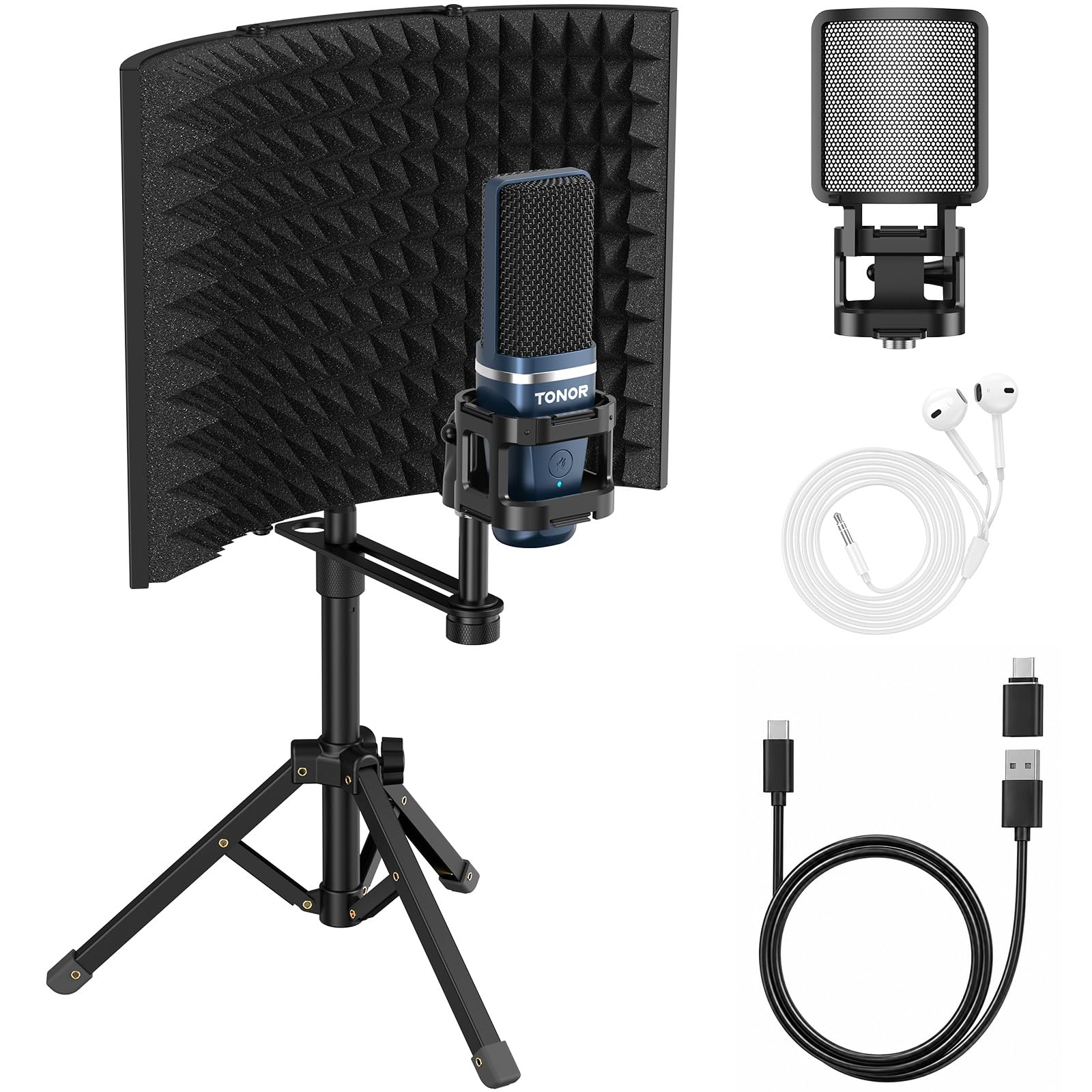
The TC777 Pro-IS pairs a professional condenser mic with a 3-panel isolation shield and a height-adjustable metal tripod. Each panel layers reflection, filtration, and absorption material with high-density acoustic foam, and the whole shield folds flat so it packs down with the rest of your gear. A dual-layer pop filter handles plosives before they hit the capsule, and the frequency range spans 100Hz–16KHz. The bundle covers earphones, a USB cable, a USB-A to Type-C adapter, a shock mount, and the pop filter.
This one is about control at arm’s length. The one-touch mute carries a smart LED indicator so you know your status without opening software. The bottom gain dial trims sensitivity for stream, voiceover, or a work meeting, and a 100Hz–16KHz window keeps the pickup focused on the human voice. Windows, macOS, iOS, Android, PS4, and PS5 all recognize it, and Zoom, Skype, and Discord pick it up without configuration. Mount it on the included metal tripod or screw it onto a boom arm — the arm is sold separately.
Two things to know before you commit. First, TONOR states plainly that it is not compatible with iPhone 14 and earlier, or with Xbox — so check your phone. Second, the sound divides reviewers right down the middle, with some hearing a nice tone and others finding it too quiet, and noise is the most-discussed sticking point. The mic is a 2-pound desk unit that stays where you set it. If you set against noisy reflections with the shield and dial in gain carefully, the setup fits the way it is meant to.
The shield-and-tripod argument
- 3-panel acoustic shield that folds flat for transport
- Dual-layer pop filter, earphones, shock mount, and adapters included
- One-touch mute with LED status and a bottom gain dial
What to weigh first
- No iPhone 14 or earlier support, and no Xbox compatibility
- Sound runs quiet for some users — plan on riding the gain dial
Made for: podcasters and streamers on Windows, Mac, Android, or PS4/PS5 who want a foldable shield in the bundle.
Check first: an older iPhone or an Xbox setup — this mic is documented as not supporting either.
5. Zoom ZUM-2 Podcast Mic Pack with USB Mic, Headphones & Stand

Tighter pickup than the room, and a tripod that folds flat in seconds.
Where the MAONO and TONOR run cardioid capsules, this Zoom pack runs a supercardioid pickup pattern — a narrower ear that focuses harder on your voice and turns away more of the room. For a podcaster sitting close to the mic in a normal living room, that tighter pattern is the spec that does the most audible work. Zoom builds the ZUM-2 as a USB condenser that connects over the included 2-meter USB-C to USB-A cable, with no drivers required on PC or Mac.
The monitoring side is the second half of the bundle. The ZHP-2 closed-back headphones use a 40mm neodymium driver at 68 ohm impedance, with a 3-meter cable long enough to sit back from the desk. Closed-back means the cups seal around your ears so the recording does not bleed into what you hear. A TPS-4 tabletop tripod with metal threads sets up in seconds and folds flat for travel, and a foam windscreen covers the capsule. That is a complete first podcast station in one shipment.
The catch worth knowing is reliability. Some units have been reported to stop working after a day or break within two months — a small share against the positive reports, but real enough to mention. Treat the cable strain and the mic’s power cycle with a little care, and you get a broadcast-flavored vocal from a pack that beginners consistently find easy to start on. It is a first rig that behaves like a first rig, which is exactly what you want before you spend more.
Trusted for: beginner suitability and mic quality — the pattern and the pack make a first episode painless.
Caveat: a small number report early failures, so keep the return window in mind during week one.
This suits: a first-time podcaster who wants a tighter pickup pattern and closed-back monitoring out of one box.
Skip past if: you want the email-the-manufacturer reliability story — the Behringer bundle below is the steadier build.
6. Behringer U-PHORIA STUDIO Bundle

The one box here that routes through an audio interface.
Every other pick on this page is a USB mic that does its own conversion. This Behringer bundle is different: it hands you a USB audio interface, a condenser microphone, and studio headphones as a matched set. The interface tops out at 192 KHz maximum sample rate and carries 2 channels, so you have room to add a second input later. That makes it the pick for someone who wants a small home studio instead of a single desk mic.
The upside of the interface route is that your mic and your headphones are matched to the hardware that feeds them. The bundle is built for digital home recording, podcasting, and music production, and it connects to a laptop over USB. It ships as one item, which keeps the setup simple for a first studio. The build quality is the thing that carries it — the interface feels solid in hand, the kind of heft you want when it lives on a desk and gets plugged and unplugged.
What you give up is the instant-on simplicity of a driver-free USB mic. An interface means a gain staging step, and it is a closed system in the sense that the included mic is the one Behringer matched to it. For buyers who want one box that sounds like a podcast studio and can grow, that is the right trade. For buyers who want to plug in and hit record on a laptop in 30 seconds, the MAONO or the Zoom pack above is the easier path.
Where the money goes: a 192 KHz, 2-channel interface plus a condenser mic and studio headphones, sized for home recording and podcasting.
The trade: more setup steps than a driver-free USB mic, and less flexibility if you already own a mic you love.
Fits best: a home recordist who wants an interface, condenser, and headphones that were designed to work together.
Wrong turn if: you want the shortest possible setup — the Zoom pack takes half the steps.
7. Blue Yeti USB Microphone Bundle (Blackout)

Four pickup patterns under one grille, plus headphones and a filter.
This is the bundle for someone who records more than one thing. The Yeti packs three condenser capsules into one body and lets you switch between four pickup patterns: cardioid for solo speech, bidirectional for a two-person interview across the mic, omnidirectional for a room or a conference table, and stereo for music or ambient capture. No other pick on this list gives you that spread, which is why it holds a spot even against cheaper, higher-resolution mics.
The rest of the specs are modest by comparison but honest. The Yeti records at 16-Bit/48kHz — a lower resolution than the 192kHz/24Bit chipsets in the MAONO and Dejasound kits, though plenty for spoken podcast and stream audio. It is driver-free: plug the USB cable into a computer, calibrate it with the operating system, and record. The bundle adds TX-100 closed-back studio monitor headphones and a pop filter for broadcasting and recording mics, so the monitoring side is covered. It is a side-address microphone, meaning it takes sound from the side of the body rather than the end, which changes how you position it.
The honest split is in the value column. Reviewers divide on whether the bundle is an incredible deal or overpriced, and functionality has its own mixed reports. Consider where that lands you: the Yeti’s strength is the four-pattern flexibility and the metal-bodied build, not the raw sampling rate. If you mostly record one voice at one desk, a cardioid mic with a shield is a cleaner use of money. If your content changes shape week to week, the four patterns earn their place.
Why the flexibility sells
- Four pickup patterns from a three-capsule array
- Driver-free over USB with a metal enclosure
- TX-100 closed-back headphones and pop filter in the bundle
Where it asks for patience
- 16-Bit/48kHz is modest next to the 192kHz/24Bit mic kits
- Value and functionality split opinion — not a slam dunk for every buyer
Pick it when: your recordings change between solo, interview, group, and music sessions and you need one mic to cover all four.
Think twice when: you only ever record one voice — a shield-style cardioid bundle gets you a cleaner result per dollar.
8. Audio-Technica ATH-M50xSTS-USB StreamSet Streaming Headset

Two famous studio pieces married into one cable.
This is the headset answer for anyone who has read down the desk-mic list and thought “I don’t want a stand in my face.” Audio-Technica takes the headphone half of the M50x — 45mm large-aperture drivers with rare-earth magnets and copper-clad aluminum wire voice coils — and bolts on a cardioid condenser microphone based on its 20 Series mics. The boom arm holds the capsule near your mouth so it rejects the room instead of inviting it in.
The drivers deliver the deep, accurate bass the M50x line is known for, across an extended frequency range. That matters for streaming because you need to hear yourself and your game mix clearly without a hollow, thin signature. The microphone half carries studio-grade articulation and intelligibility through a cardioid condenser, and built-in mic monitoring lets you hear your own voice as you talk. It connects over a wired USB connection to computers, laptops, and certain gaming consoles, and the ear cushions ship in the box so you can swap the pads.
The one thing to size properly is comfort, where opinions split — some find the pads comfortable for long sessions, and others find the earcups press. If you have a wider head or wear glasses for hours at a time, give the clamp a chance to loosen before a long stream. The other honest note is that a headset locks your mic to your head position, so you cannot move the capsule. For streamers who want to lean back and talk, the fixed relationship is the feature.
What it nails: 45mm drivers with rare-earth magnets plus a cardioid condenser boom, so your ears and your voice are handled by one cable.
What to size up: earcup comfort is the dividing line — try a session before a marathon stream.
Choose this and you: stream, call, or game for hours and want studio headphone bass with a broadcast-style boom mic.
Choose a desk mic instead if: you need the capsule on a stand you can move — a headset fixes it to your head.
Know the Specs
Sampling rate and bit depth
This is how finely the mic slices your voice into digital pieces per second, and how much detail each slice holds. A high-resolution figure like 192kHz/24Bit captures a very faithful copy of a voice — useful when you plan to edit, compress, and publish. A lower figure like 16-Bit/48kHz still sounds clean for a spoken podcast. When you see kHz and Bit together, the kHz is speed and the Bit is detail.
Pickup pattern
The pattern is the shape of what the mic hears. Cardioid listens mostly in front and rejects the sides and back — the standard for one person at a desk. Supercardioid is a narrower version of the same idea and turns away more room. Bidirectional hears front and back, for an interview across the mic. Omnidirectional hears all around, for a table of people. Stereo captures two sides separately for music or ambience.
Audible noise
This is the hiss the mic makes on its own, with nothing happening in the room. The lower the figure, the quieter the silent gaps between your sentences. A mic in a quiet library should have a low number here; a mic that lives in a noisy house can afford to be a little higher because the room will drown the hiss out anyway.
Monitoring and impedance
A monitoring jack on the mic lets you hear yourself through headphones while you speak, so you catch stumbles and plosives live. Headphone impedance, measured in ohm, describes how hard the headphones are to drive — a 68 ohm pair is common for studio monitoring. In a headset, a driver size like 45mm tells you how much air the speaker pushes, which usually shows up as richer bass.
Common Questions
Will a USB mic work with my Xbox or PlayStation?
Do I need an audio interface to use a USB microphone?
What does cardioid pickup pattern actually do for my voice?
Is 192kHz/24Bit better than 16-Bit/48kHz?
What does an isolation shield do, and do I need one?
How do I hear my own voice while recording?
Does the TONOR TC777 Pro-IS work with an iPhone?
Which of these works from the start with no drivers?
What does supercardioid mean on the Zoom ZUM-2?
Is a headset like the StreamSet better than a desk mic?
The Bottom Line
For most buyers, the usb mic and headset decision depends on the MAONO AU-A04H. It hands you the mic, headphones, stand, shock mount, and pop filter in one order, runs 192kHz/24Bit without a driver, and the build and sound land together. If your room echoes, step to the TONOR TC777 Pro-IS for its foldable 3-panel shield, or the Dejasound DJM5 if you want the lowest self-noise on the page at 20 db. Gamers on Xbox should look at the ZealSound BD9 for its controller cable and 12-hour battery. And for streamers who want studio bass and a boom mic in one cable, the Audio-Technica ATH-M50xSTS-USB is the headset to reach for. One last nudge: the Blue Yeti bundle is the flexible four-pattern choice — but if you only ever record one voice, the MAONO gets you to a clean recording with less to tune.
How we choose
We do not accept paid placement. Every pick is matched to a real buyer and a real use-case; we do not hands-on test units.
Sources
Specifications: manufacturer listings and product documentation. Review insights: verified customer reviews, as of November 2026. Pricing: not shown on this page (it changes often); check the current price via the retailer link.
As an Amazon Associate, Tactical Gear Guy earns from qualifying purchases. This does not affect which products we feature.