Specs are compiled from manufacturer listings and verified buyer reviews and can change over time — please confirm the key details on the product page before buying.
You already know the frustration: something is rattling inside the wall, the drain is blocked somewhere you cannot see, or a spark plug hole is hiding a problem you can only guess at. A USB-C borescope fixes that by turning your own phone into the screen for a tiny camera on a long cable. The trick is picking one whose connector actually matches your phone, whose probe is thin enough for the gap you need to reach, and whose camera is sharp enough to tell a hairline crack from a shadow.
This guide is built by comparing the manufacturers’ published specifications and the patterns across verified customer reviews, so you get each pick’s real strengths and trade-offs instead of marketing spin.
You get nine USB-C inspection cameras here, sorted by what they do well: long-reach drain snakes, slim articulating probes for engine work, and simple plug-in scopes for household checks. You also get the connector and app traps that catch most first-time buyers. Every pick is judged on real specs and owner experience, so you can shortlist the best USB-C borescope for your job.
Top Picks

How To Choose The Best USB-C Borescope
Start with your phone, not the camera. A USB-C borescope only works if your device has a USB-C port and supports OTG (On-The-Go, the feature that lets a phone power and read a plugged-in accessory). Older iPhones with a Lightning port will not work with a USB-C-only scope unless the kit includes a Lightning adapter, and some Android phones have OTG switched off in settings by default.
Match the probe to the gap you need to see into
Probe diameter is the number that decides where a scope can and cannot go. A 6.2mm probe slides into spark plug holes, fuel injector ports and narrow pipework. A 7.9mm or 8mm lens is still slim enough for most drain and wall-cavity work, but it will not fit the tightest engine openings. Measure the smallest hole you plan to inspect before you buy.
Decide between a semi-rigid snake and an articulating tip
A semi-rigid gooseneck holds whatever bend you put in it, so you can steer it around one corner and it stays there. An articulating probe adds a steerable tip that bends left, right, up or down from a control on the handle — that lets you look around a corner you cannot physically push past. Articulation costs more but saves real disassembly time on engine and HVAC work.
Length, lighting and waterproofing
Cable length is a straight trade-off: a 5 ft probe is handy in an engine bay, while a 50 ft cable reaches deep into a sewer run but is far harder to steer. Look for an IP67 rating (fully sealed against dust and able to survive short water immersion) if you plan to inspect drains or damp cavities. Adjustable LEDs matter more than raw LED count, because close-up work blows out highlights when the light cannot be dimmed.
Side-by-Side Comparison
| Model | Best For | Probe / Lens | Cable Length | Resolution | Amazon |
|---|---|---|---|---|---|
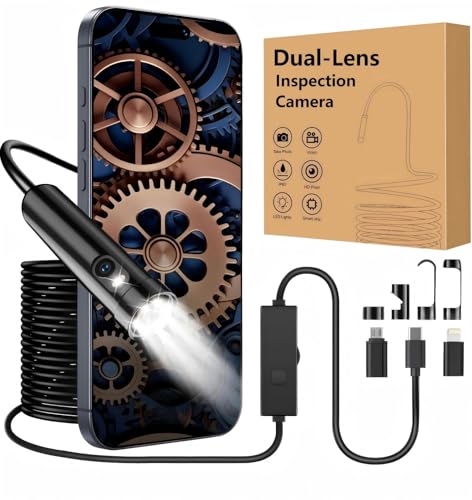
| Dual-Lens Endoscope Inspection Camera (16.4 ft)★ Best Overall | All-round first borescope | Dual lens, 7.9mm-class probe | 16.4 ft | 1920P HD | Amazon |
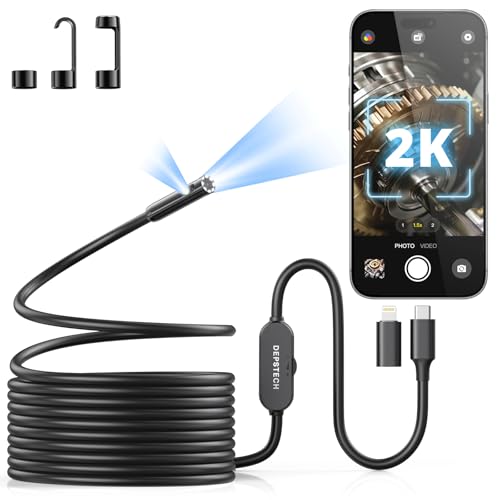
| DEPSTECH NTC55 2K Dual LensSharpest Image | Sharpest phone image | Dual lens, 7.9mm (0.31 in) | 16.5 ft | 2560×1440P | Amazon |
| Teslong 50FT USB-C BorescopeLongest Reach | Long drain runs | Single lens | 50 ft | 720 pixels | Amazon |
| Kinpthy 1920P Dual-Lens (16.4 ft) | Household and auto checks | Dual lens, 7.9mm | 16.4 ft | 1920×1440 | Amazon |
| Klein Tools ET16 | Android-only armored reach | 8 mm | 10 ft | 640×480 | Amazon |
| Vafafinder Articulating 360° | Engine and pipe articulation | 6.2mm, dual-way articulating | 5 ft | 1080P | Amazon |
| Hialemi USB-C Two-Way Articulating | One-hand 220° probing | 6.2mm, 220° two-way | 5.3 ft | 1080P | Amazon |
| MUCAR E021 | PC and scanner work | 5.5mm | 35.43 in | 1280×720 | Amazon |
| Teslong USB-C Two-Way Articulating | Joystick articulation | 8.5mm, 180° articulating | 5 ft | 1 MP | Amazon |
Detailed Reviews
1. Dual-Lens Endoscope Inspection Camera 16.4 ft
Our pick — 4.5+★ from 950+ verified ratings; the strongest balance of quality and price.
Two lenses on one probe, so you stop guessing what is around the bend.
This is the pick that makes the whole category click for a first-time buyer. It shoots 1920P HD video (1920 lines of detail across the frame) from a dual-lens head, so one camera looks straight ahead while the other looks out to the side. In practice, you push the probe down a drain or into an engine bay and see both what is directly ahead and what is off to the side, without dragging the cable back out to reposition it.
The flexible probe bends smoothly and stays where you put it, and the IP67 waterproof rating (sealed against dust and short immersion) covers damp drains, pipes and wall voids. Adjustable LEDs handle the lighting, which matters most when you are nose-to-probe in a dark cavity. You plug into your phone through the free app, and the box includes Type-C, Micro USB and Lightning adapters, so the same scope works across a mixed household of iPhone and Android devices.
The build is the most-praised thing about this scope, and it matters when the probe is jammed into drains and engine blocks. Image quality is the second most-praised trait, with owners calling out the 1920P dual-lens detail that saves them a call-out. The honest catch sits in the probe’s stiffness: the semi-rigid cable is rated mixed on that front, so tight right-angle turns in a long drain run need patience and a drain snake to help it along.
Where It Earns Its Keep
- Dual-lens head gives forward and side views in a single push, so fewer re-insertions
- 1920P HD resolution keeps close-up detail readable on your phone screen
- IP67 probe handles drains, pipes and damp cavities
- Type-C, Micro USB and Lightning adapters cover iPhone and Android in one kit
Where It Asks Patience
- The semi-rigid cable draws mixed feelings — hard corners need working around
- It needs your phone and the app running; there is no standalone screen
Reach for this: if you want one scope for drains, walls and light automotive checks, with adapters that cover both phone camps from the start.
Think twice: if your work is mostly deep sewer runs with tight elbows, where the stiff probe will fight you.
2. DEPSTECH 2K Endoscope Camera NTC55
The resolution leader — a 2560×1440P sensor that out-resolves every other pick here.
If you need to read a fine crack, a stamped part number or carbon buildup rather than just confirm something is down there, this is the scope to start with. Its 2560×1440P lens carries a 3.69 MP effective still resolution, against the 2 MP of the Kinpthy 1920P dual-lens below — a straight jump in how much detail lands on your phone screen. The maker pairs that sensor with Bluart 3.0 processing aimed at keeping grain down in dark cavities.
Two lenses sit on a 7.9mm (0.31 in) head, so you get front and side views and can switch between them in the app for a full look around instead of a single tunnel view. The 16.5 ft semi-rigid cable holds a bend, and an IP67 rating means the probe can go into damp or underwater spots. Lighting comes from 8+1 adjustable LEDs, and the kit ships with a hook, magnet and threaded protective cap for retrieving small dropped parts.
Buyers report it doing real work, with a compressor storage tank inspection standing out as the kind of job this scope handles without draining anything first. The recurring gripe is phone compatibility, the most-discussed weak point for this model. You need Android 9.0+ or iOS 11.0+, OTG switched on, and the DEPSTECHCAM app installed before anything shows on screen — without OTG enabled, the scope simply will not talk to the phone.
What the sensor buys you: the highest pixel count in this lineup at 3.69 MP, so fine surface detail survives the trip to a small screen.
The setup tax: the app-first workflow and the OTG requirement mean you should test the connection at home before you are up a ladder with the probe in a wall.
Pick it for: detail-critical inspection where clarity decides the diagnosis, on a phone you have already confirmed is compatible.
Look elsewhere: if you want zero-configuration plug-and-play or own an older Lightning-port iPhone.
3. Teslong 50FT USB C Borescope Camera
Fifty feet of probe for the jobs where everything else is simply too short.
For a main sewer run or a long duct, reach decides everything, and this cable is the outlier of the group at 15 m / 50 ft — roughly three times the 16.4 ft of the dual-lens dual-purpose scopes higher up this list. That length gets a camera past the trap and deep into pipework where a short scope gives up. Eight high-brightness LEDs with adjustable output light the way, and the IP67 probe (sealed against dust and water) is built for wet, dirty environments.
It is a USB-C-only tool on purpose. It pairs with iPhone 15/16 series, USB-C iPads and Android 8.0+ devices that support OTG (On-The-Go, a phone feature that lets it host a USB device), and Teslong is blunt that older Lightning-port iPhones will not work with it. The semi-rigid cable bends and holds a shape, though the maker is upfront that it is not as stiff as a professional sewer camera — working a drain snake alongside it is the recommended way to get around tight corners.
Owners call it simple to operate and say it does the job of drain cameras costing considerably more. Set your expectations on the picture, though: the still resolution is listed at 720 pixels, which is enough to confirm a blockage or a joint but not to read fine print. Treat it as a reach-first scope rather than a detail-first one and it delivers exactly what it promises.
Why the length matters: 50 ft reaches main-line blockages and long ducts that end well past where a 16.4 ft scope runs out.
The clarity trade-off: 720-pixel stills confirm what and where, but the 1920P and 2560P picks above show far more surface detail.
Best fit: plumbers and homeowners chasing a problem far down a drain run, on a modern USB-C phone.
Not for you: older iPhone owners, or anyone whose priority is reading fine detail rather than reaching distance.
4. Kinpthy Endoscope Camera 16.4 ft Dual-Lens

The dual-lens scope with the deepest pool of happy owners behind it.
This one has clearly been around long enough to prove itself in kitchens, basements and garages. It records 1920×1440 stills and video from a 7.9mm dual-lens probe, so you get both a forward and a side view without pulling the cable to reposition. The 16.4 ft semi-rigid cable unrolls and rolls back up quickly, and an IP67 rating lets the probe work underwater up to 3.28 feet for 1 hour — handy for a flooded drain trap.
Setup is the part owners love: the app walks you through a quick connection to iOS 9.0+ or Android 7+ devices, and the kit arrives with Android, Lightning and Type-C connectors plus magnet, hook, mirror and protective cap. That accessory pack covers the classic jobs — hooking a dropped screw out of a cavity, or using the mirror to peek around a corner.
The friction point is connection consistency. iOS devices tend to render a cleaner picture than some Android models, and the app can be fussy about pairing on certain phones, so test it once at the kitchen table before it goes into a wall.
What Made It Popular
- 1920×1440 resolution on a 7.9mm dual-lens probe for forward and side views
- IP67 probe rated for underwater use up to 3.28 feet for 1 hour
- Full accessory set with magnet, hook, mirror and cap included
- Works across iOS 9.0+ and Android 7+ with the right connector
What To Plan Around
- Android image output can look softer than iOS on some phones
- Pairing is not always instant; set it up before the job starts
Choose it when: you want dual-lens flexibility and a well-stocked accessory kit at a sensible mid-range spot.
Pick another: if you need the sharpest possible sensor or a true articulating tip instead of a fixed dual lens.
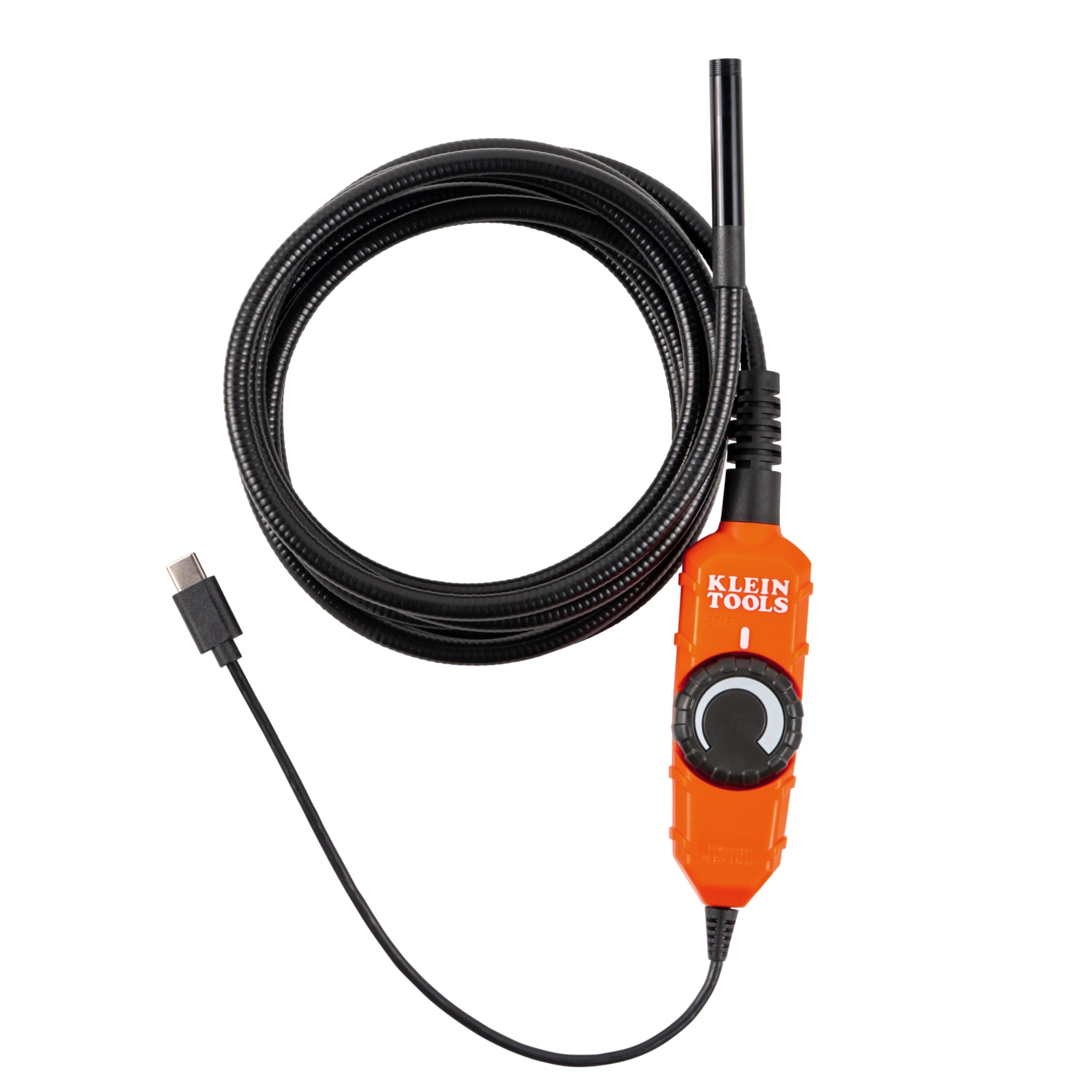
5. Klein Tools ET16 Borescope
Built like a hand tool, not a gadget — armored cable and no battery to charge.
Klein Tools makes hand tools for electricians, and the ET16 shows that DNA. The 10 ft gooseneck is armored rather than soft vinyl, so it survives being pushed into walls, panels and ductwork, and it connects straight to a USB Type-C port with no batteries to worry about. Six white LEDs run through a brightness control, and the whole kit stows in the included carrying case with a hook attachment.
This is strictly an Android tool. It works with devices running OTG version 4.0 or higher over USB Type-C or Micro-USB, using the ET16 Borescope App from Google Play — there is no iPhone support here. The 8 mm camera is IP67 waterproof, which covers wet enclosures and damp cavities, and the resolution sits at 640×480. That is a deliberate trade: enough detail to confirm a condition inside a panel, not enough to read fine markings.
Opinions split on this one, which makes sense given that resolution. It earns its keep with anyone who wants a rugged, battery-free scope for electrical and building inspection, and it feels right in the hand like the rest of the Klein line. The caveat is picture quality — if you need high detail, the 1920P and 2560P dual-lens scopes on this list show noticeably more, so pair the ET16 with realistic expectations.
Made for: electricians and tradespeople on Android who want an armored probe and no charging routine.
Wrong tool: iPhone owners, or anyone buying primarily for close-up image detail.
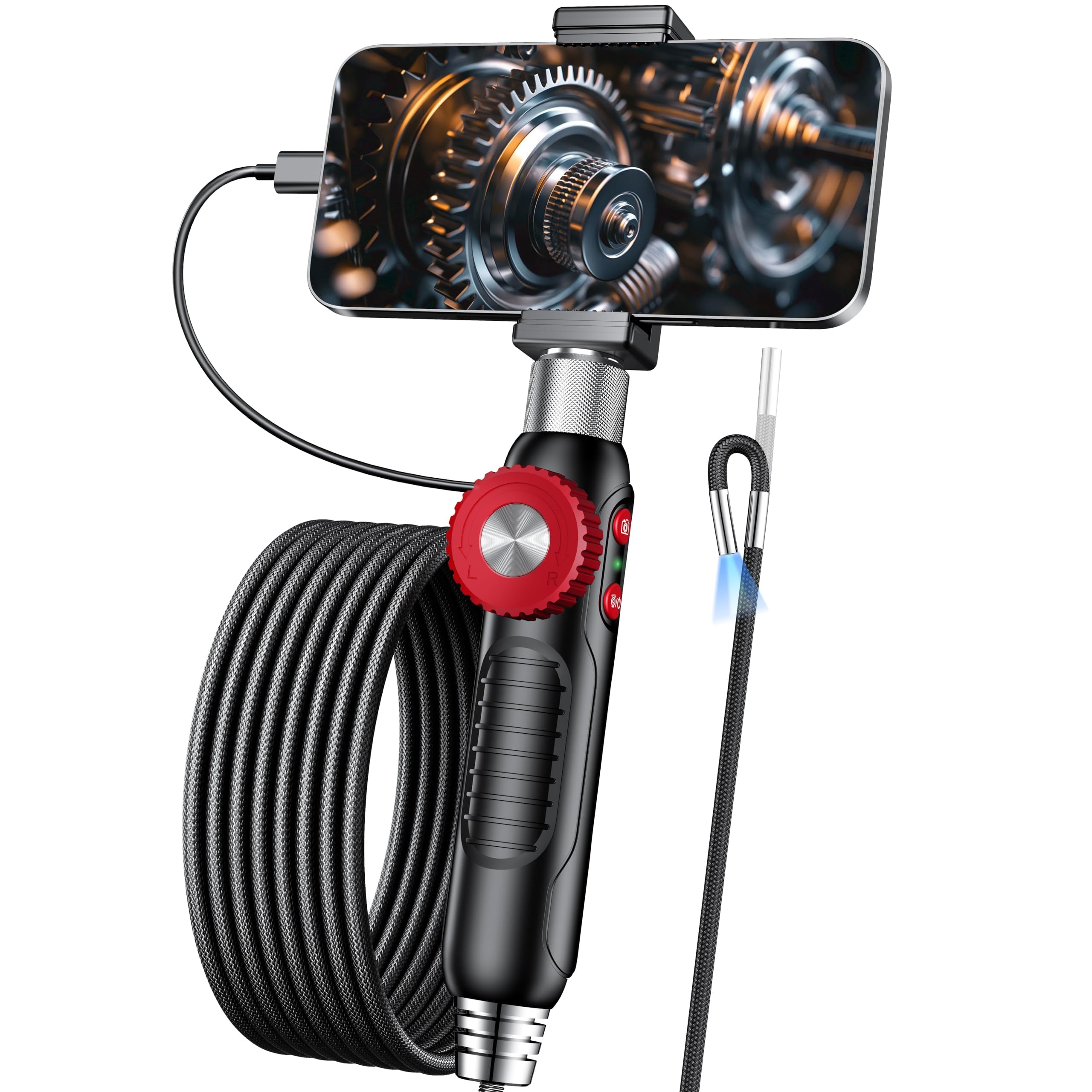
6. Vafafinder Articulating Borescope 360°
A steerable tip on a 6.2mm probe — look around corners without tearing anything apart.
Articulation changes what a borescope can do. This Vafafinder model gives the tip a dual-way bend of up and down 360°, so once the probe is inside a cylinder or a wall void you can aim the camera where you need it without shoving the whole cable to a new angle. The 6.2mm diameter is slim enough for spark plug holes and narrow pipework, and the 5 FT cable holds its shape so you do not need a second hand to keep the probe steady.
The camera records 1080P HD video and stills, and six adjustable LEDs surround the lens to light dark cavities — the dimming control matters in close-range work where full brightness washes out the image. An IP67 rating covers wet and oily environments like engine blocks and drain pipes. Photos and videos save straight to your phone, and the package includes both Lightning and Type-C adapters for iOS and Android.
Reliability is what owners single out most, which matters when a 6.2mm probe is bending inside an engine. Value for money is the second most-cited strength, with buyers calling it a serious tool for the price rather than a toy. The friction is on the phone side: device connection is the most-discussed weak spot, so confirm pairing before you are under a car.
The articulating advantage: 360° up-and-down tip movement on a 6.2mm probe lets you inspect bends and cylinder walls that a fixed gooseneck cannot aim at.
The caveat to respect: the 5 ft cable is short for plumbing runs, and phone connectivity is the part that gives owners the most trouble.
Built for: engine and machinery inspection where you need to aim the lens around an obstruction, not just push toward it.
Go elsewhere: if your priority is long drain runs or a guaranteed instant phone connection.
7. Hialemi USB-C Two-Way Articulating Borescope 5.3 ft
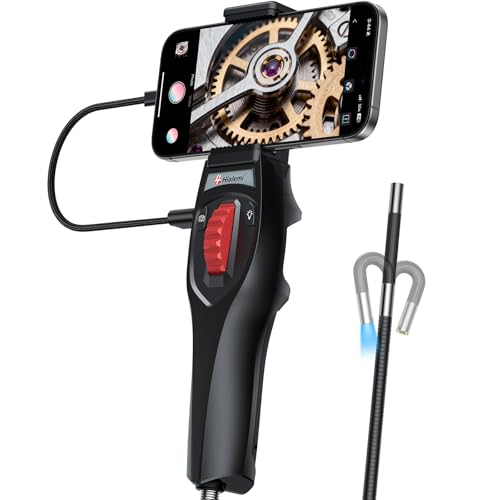
A thumb wheel and dedicated shutter button, so one hand does the work of two.
Where most scopes make you juggle a phone in one hand and a flexing cable in the other, this one puts the controls under your thumb. A smooth wheel drives the 220° bi-directional articulation, two labelled buttons handle the shutter and LED brightness, and your other hand is free to guide the cable. Over a long engine bay session that ergonomic choice is the difference between a steady frame and a shaky one. Its 6.2mm probe slides into spark plug holes and fuel injector ports, with 1080P video and photos landing straight on your phone.
Lighting is a real headline here: three brightness levels with a maximum output of 6800 LUX, which is a serious amount of light for a lens this small. The 5.3FT semi-rigid gooseneck holds a bend, and the probe is IP67 waterproof and oil-resistant for engine and machinery work. There is no battery to charge — you plug into your phone through the included Lightning and Type-C adapters and it runs.
The trade-off to plan around is the cable length. At 5.3 ft it is built for engine compartments and equipment, not for dragging through a long drain run — the 50 ft Teslong earlier in this list is the tool for that job. It also depends entirely on your phone staying connected and powered, so a phone with a weak port or a thick case needs checking before you rely on it in the field.
Controls That Work In Gloves
- Thumb wheel and dedicated shutter button allow true one-handed operation
- 220° two-way articulation reaches angles a fixed probe cannot
- 6800 LUX maximum brightness across three levels
- No battery — plug into iPhone or Android via USB-C or Lightning
What It Will Not Do
- 5.3 ft of cable is short for plumbing and duct runs
- It relies on the phone connection and power staying stable throughout
The right call if: you work inside engines and machinery and want to steer the tip and fire the shutter with one thumb.
Keep looking if: the job is a long sewer line or you want a scope that runs on its own without a phone tethered.
8. MUCAR E021 USB Endoscope Borescope
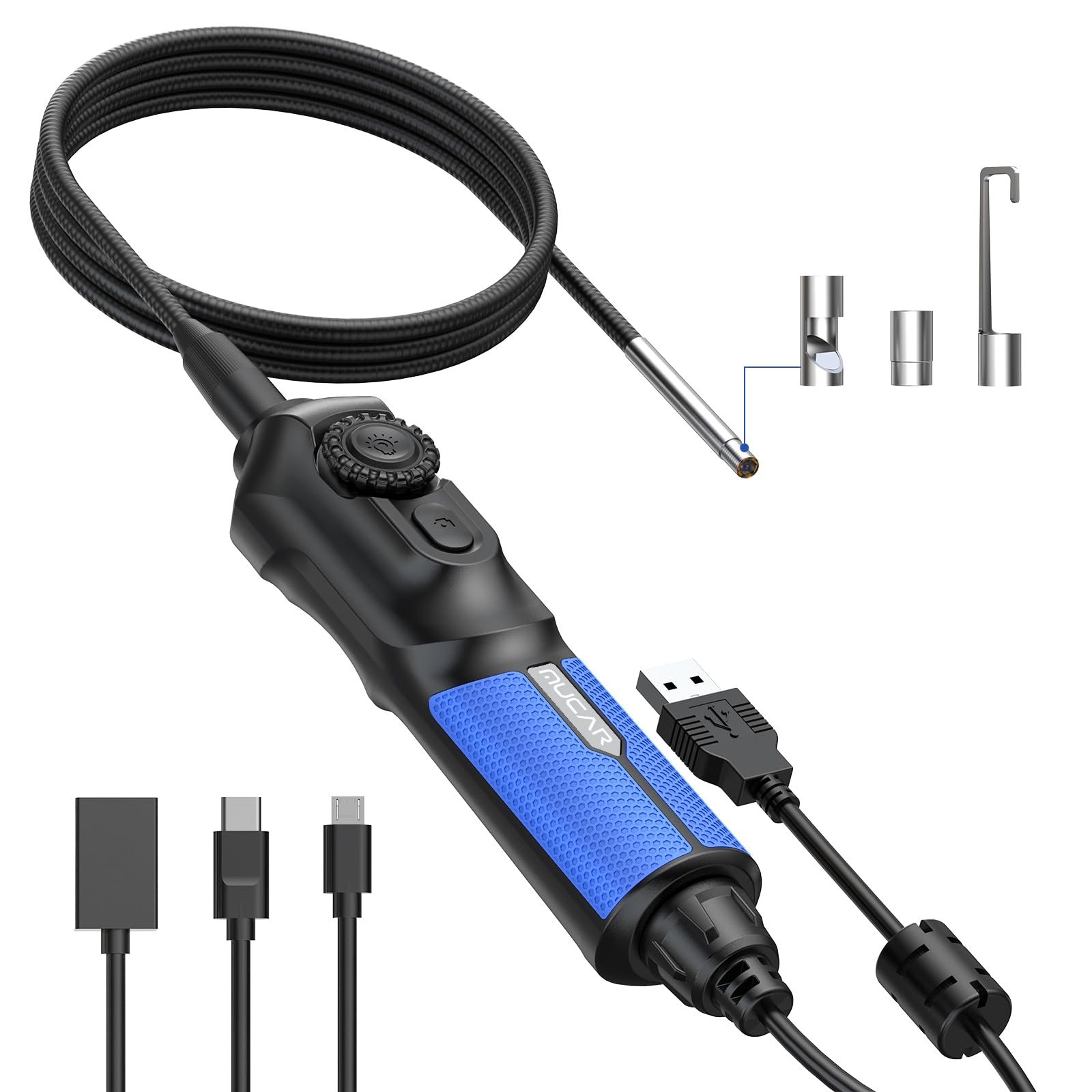
A bench-side scope for laptops and diagnostic scanners rather than phone screens.
Not everyone wants to inspect a cylinder head through a phone. This one plugs into a computer, laptop or any MUCAR diagnostic scanner, which makes it a natural fit for a workshop where the screen is already on the bench. The 5.5mm camera head is the slimmest in this lineup, and a 2MP sensor with six LED lights produces 1280×720 HD visuals in tight, dark spaces.
Its 35.43-inch cable is deliberately short — this is a hand-held inspection tool, not a drain snake, and the included magnetic tip, hook and mirror attachments handle retrieving small objects and peering around hidden corners. The camera head is rated to work up to 3.3 feet underwater, which covers submerged components, drains and crevices. A Type-C cable, Micro USB cable and carrying case come in the box.
For a scanner owner this is close to an accessory rather than a standalone purchase, and that is exactly how to judge it. If you are set up with a PC or a MUCAR unit and want a slim probe to add eyes to it, this does the job with a genuinely narrow head. If you are hoping to run it from your phone in the field, the cable length and PC-first design will leave you short.
The slim-lens case: a 5.5mm head gets into the narrowest openings here, and 1280×720 detail is enough to spot and identify a fault.
The honest limit: a 35.43-inch cable is for bench and component work — do not expect to reach down a pipe with it.
Right for: technicians already running a laptop or MUCAR scanner who want a slim 5.5mm probe in the kit.
Wrong purchase: if you want a long cable for pipe or drain inspection, or a phone-first borescope.
9. Teslong USB-C Two-Way Articulating Borescope
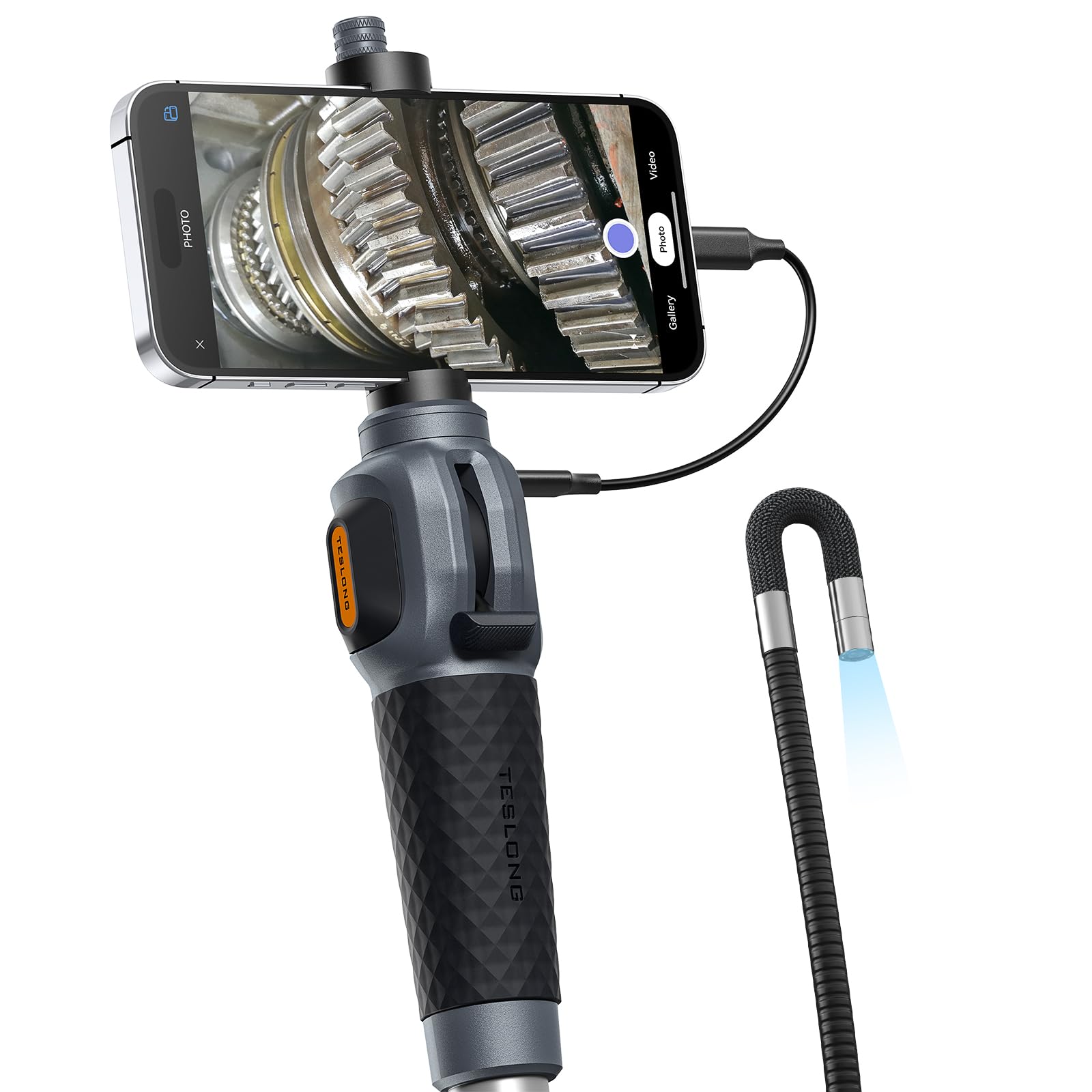
A joystick-driven 180° tip that lets you look behind a wall without opening it.
Teslong’s second entry in this lineup takes a different route to the same goal as the Vafafinder: instead of a wheel, a joystick under your thumb steers a 180° articulating probe around corners, behind walls and inside cylinders. The joystick and photo button sit together, so capturing a shot mid-inspection is a thumb move rather than a screen tap. A built-in phone holder keeps the display steady while you work.
Setup runs through the free SmartEndoscope app, with no account and no subscription, which is a welcome detail if you dislike app permissions creep. It connects to iPhone 15+ or Android over USB-C, and the 8.5mm probe pairs with a 5FT semi-rigid gooseneck that holds its shape for wall cavities, HVAC ducts and plumbing traps. The still resolution is listed at 1 MP, so this is a scope for finding and locating faults rather than reading fine surface detail.
Buyers rate picture and video quality the standout, with the 180° joystick articulation close behind as the third most-praised trait. Build quality is praised too, which matters at this price. Two things to know: the phone holder may need a thick case removed on iPhone Pro Max and Samsung Ultra models, and the USB port is the recurring weak point for staying tight over time.
Steering And Comfort
- Joystick-controlled 180° tip reaches behind walls and around bends
- Integrated phone holder frees a hand during inspection
- No subscription and no account for the SmartEndoscope app
- 5FT semi-rigid gooseneck holds its shape in cavities and ducts
Fit And Longevity Notes
- Thick cases may need removing on larger iPhone and Samsung models to fit the holder
- The USB port is the part to watch for looseness over time
Made for: home and auto inspection where you need to aim a tip around an obstacle and keep a phone mounted and stable.
Consider the alternative: if you want the highest resolution rather than convenience, or need a cable long enough for drains.
Know the Specs
Probe Diameter (mm)
This is the width of the camera head, and it decides which openings a scope can enter. A 5.5mm or 6.2mm head slips into spark plug holes, fuel injector ports and narrow pipework. A 7.9mm or 8mm head is still slim enough for most drains and wall cavities but will not fit the tightest engine openings. Measure the smallest gap you plan to inspect before choosing, because no amount of resolution helps if the head will not go in.
Resolution Labels (1920P, 2560P, 720P)
Resolution tells you how much detail reaches your phone screen. A 2560×1440P sensor captures more surface information than a 1920×1440 one, and both show far more than a 640×480 or 720-pixel sensor. Higher resolution helps when you need to read a crack width or a part marking. Lower resolution is fine when the job is simply confirming that a blockage exists and roughly where it sits.
Articulation vs Semi-Rigid Cable
A semi-rigid cable holds any bend you put into it, so it steers around one corner and stays there. An articulating probe adds a tip that bends from a control on the handle — often 180° or 220°, sometimes described as 360° up-and-down movement. Articulation lets you look around an obstacle you cannot push past. It costs more and adds a moving part, but it can save a full disassembly on engine and HVAC work.
IP67 and LED Lighting
An IP67 rating means the probe is sealed against dust and survives short water immersion, which is the minimum for drain, pipe and damp-cavity work. LED lighting matters just as much: adjustable brightness is more useful than a high LED count, because close-up inspections blow out detail when the light cannot be turned down. Some scopes list a maximum lux figure, which tells you how much light reaches a dark cavity at full power.
Common Questions
Will a USB-C borescope work with my iPhone?
What does OTG mean and why does it matter for a borescope?
What is the difference between a dual-lens and a single-lens borescope?
How long a cable do I need for drain inspection?
Can I use a borescope underwater?
Do articulating borescopes really reach around corners?
Do I need to install an app to use a USB-C borescope?
Why does my borescope image look grainy on Android but clear on iPhone?
What is the best borescope for inspecting an engine cylinder?
Are borescope cameras compatible with PCs and diagnostic scanners?
The Bottom Line
The smartest starting point for most people is the Dual-Lens Endoscope Inspection Camera, because it pairs dual-lens views and a 1920P sensor with an IP67 probe and adapters for both phone camps — and it has the deepest reservoir of satisfied owners in this lineup to back that up. If reading fine detail matters most, the DEPSTECH NTC55 leads on resolution at 2560×1440P with a 3.69 MP sensor that no other pick here matches. For a main sewer run, reach beats everything, and the Teslong 50FT is the only cable here that gets you deep enough to matter. And if you work inside engines, the Hialemi articulating scope puts the 220° tip and shutter under one thumb, which is what makes a long inspection bearable.
Whichever you choose, confirm your phone’s port type and OTG support first — that single check prevents more returns in this category than any spec on the box. If you are unsure where to start, the Best Overall pick covers the widest range of jobs with the least fuss, and it is the one most likely to earn its place in your toolbox rather than a drawer.
How we choose
We do not accept paid placement. Every pick is matched to a real buyer and a real use-case; we do not hands-on test units.
Sources
Specifications: manufacturer listings and product documentation. Review insights: verified customer reviews, as of November 2026. Pricing: not shown on this page (it changes often); check the current price via the retailer link.
As an Amazon Associate, Tactical Gear Guy earns from qualifying purchases. This does not affect which products we feature.