Specs are compiled from manufacturer listings and verified buyer reviews and can change over time — please confirm the key details on the product page before buying.
You land in Sydney, plug your phone charger into the wall, and nothing happens — or worse, the prongs simply don’t go in. Australian outlets take Type I plugs (two angled flat pins in a V shape, plus a straight earth pin), and a standard US flat-pin plug will not fit them. The fix is a small, cheap adapter, but not every adapter is wired the same way. Some give you four US-style outlets, some give you USB-C fast charging, and a few add an extension cord so you can reach the outlet hidden behind the hotel bed. This guide covers the seven picks worth packing, plus the one voltage rule that trips up almost every first-time traveler.
This guide is built by comparing the manufacturers’ published specifications and the patterns across verified customer reviews, so you get each pick’s real strengths and trade-offs instead of marketing spin.
One honest housekeeping note first: these picks use flexible, human-like matching, so not every one is the exact model you typed into the search bar — the nearest same-type adapter that serves the same job is included instead. Below you’ll find the outlet counts, USB wattages, and physical sizes that actually decide which one earns suitcase space. That’s exactly the breakdown you want before you choose a US to Australia Plug Adapter.
Top Picks
How To Choose The Best US to Australia Plug Adapter
The single most important thing to understand before you buy: an adapter changes the shape of your plug, never the voltage coming out of the wall. Australia runs on a higher voltage than the US, so a device that isn’t dual voltage may need a separate voltage converter. Everything else — outlet count, USB ports, cord length — is about convenience.
Check dual voltage before anything else
Look at the label on your charger, hair dryer, or straightener. If it reads a range like 100V-250V or 110V-240V, it handles the higher Australian voltage and only needs the plug shape changed. A single-voltage device — say a 110V-only hair dryer — needs a separate voltage converter, which is a different, heavier product entirely. Every adapter on this list is a shape-changer only.
Count your outlets and USB ports honestly
Between two phones, a tablet, a watch, and a camera, a couple usually travels with four or five things that need charging. A single-outlet adapter forces a rotation; a unit with four US-style outlets plus three or four USB ports lets you plug everything in at the hotel desk and forget it. The USB wattage matters too — a 20W USB-C port tops up a phone quickly, while a shared 15W total across all ports means slower charging if everything is plugged in at once.
Decide if you need a cord
Hotel outlets in Australia and New Zealand are often tucked behind the bed or under a desk. A flat adapter sits right at the wall; an adapter with a short extension cord — anywhere from a couple of feet to four — lets you pull the power to the nightstand. If you’re traveling with a CPAP machine or charging overnight on a cruise, that reach is the difference between a tidy setup and a cable draped across the room.
Side-by-Side Comparison
| Model | Best For | US Outlets | USB Ports | Max Capacity | Amazon |
|---|---|---|---|---|---|
| TESSAN US to Australia Plug Adapter Type I★ Best Overall | All-round travel charging | 4 | 3 (1 USB-C 20W) | — | Amazon |
| LENCENT Australia New Zealand Power Plug AdapterMost Outlets | Charging the most devices at once | 4 | 4 (2 USB-C) | 2500W | Amazon |
| BESTEK New Zealand Power Adapter | High-wattage gear and reach | 3 | 4 (1 USB-C PD 20W) | 3250W | Amazon |
| Australia Power Plug Adapter with 3Ft Extension Cord | Cruise cabins and dorm desks | 3 | 4 (2 USB-C) | 2500W | Amazon |
| meta-ant Australia Travel Adaptor | Long cord plus USB-C charging | 3 | 4 (2 USB-C) | — | Amazon |
| Ceptics Australia, China Travel Adapter | Pocket-sized backup | 2 | USB-C and USB (20W PD-QC) | — | Amazon |
Detailed Reviews
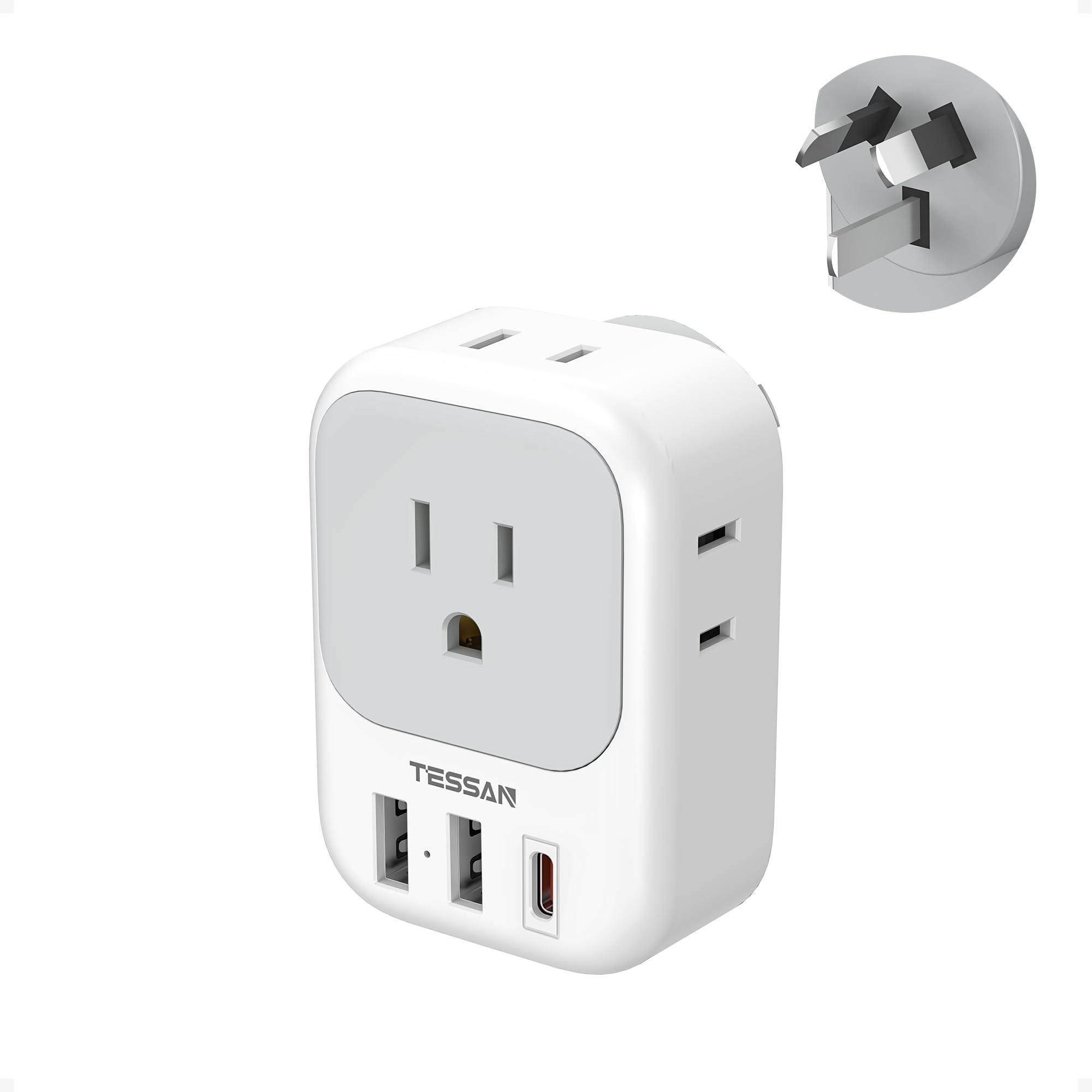
1. TESSAN US to Australia Plug Adapter Type I Travel Adaptor
Our pick — 4.5+★ from 650+ verified ratings; the strongest balance of quality and price.
Four US outlets and three USB ports in one palm-sized block that turns a single Australian wall socket into a full charging hub.
This is the pick to grab if you want one adapter to cover a whole family’s worth of devices. It turns one Type I socket into four American outlets plus three USB ports, so up to seven things can charge at once. The standout is the 20W USB-C port — that’s the fast lane for a modern phone or a tablet. The other two USB-A ports deliver up to 12W each, with total USB output capped at 15W, so when everything is plugged in the charging slows a little to share the load.
Weight is where this adapter genuinely earns its spot in a carry-on. It sits at 3.75oz (about 106 grams), small enough for a jacket pocket, and the compact body means it won’t crowd the rest of your bag. It also has no surge protection and no cord, which makes it a simple item to pack for a cruise — the shape changers that pass ship security are the cordless ones. Buyers report it simply works across every country it lists, from Australia and New Zealand to Argentina, China, Fiji, and Samoa.
The plug design is the honest catch, and not every buyer warms to it. Seating a four-outlet block on a wall socket can feel clumsy in tighter hotel outlets. The block’s footprint may also cover a neighboring socket on a shared panel. None of that stops it working; it’s just a fit consideration if you’re plugging into a crowded power strip. And like every adapter on this list, it only works with 100V-250V dual-voltage devices (devices that accept both US and higher overseas voltages). A single-voltage hair dryer still needs a separate converter.
What makes it the default pick
- Four US outlets plus three USB ports, one of which is a 20W USB-C fast charger
- 3.75oz and pocket-sized, so it costs you almost no luggage space
- No cord and no surge protection, so it’s simple to pack for a cruise
- Covers a long list of Type I countries, not just Australia
Where it asks you to compromise
- Total USB output is capped at 15W, so charging slows when several ports are in use together
- The four-outlet block is bulky enough to crowd tight wall sockets or block a neighbor on a shared panel
- Shape-changing only — single-voltage devices still need a converter
Reach for this if: you want one compact block that charges phones, tablets, and a laptop adapter all from a single Australian outlet — it’s the safest all-round bet on this list.
Think twice if: your priority is raw USB speed for multiple fast-charging devices at once; the shared 15W cap will feel slow.
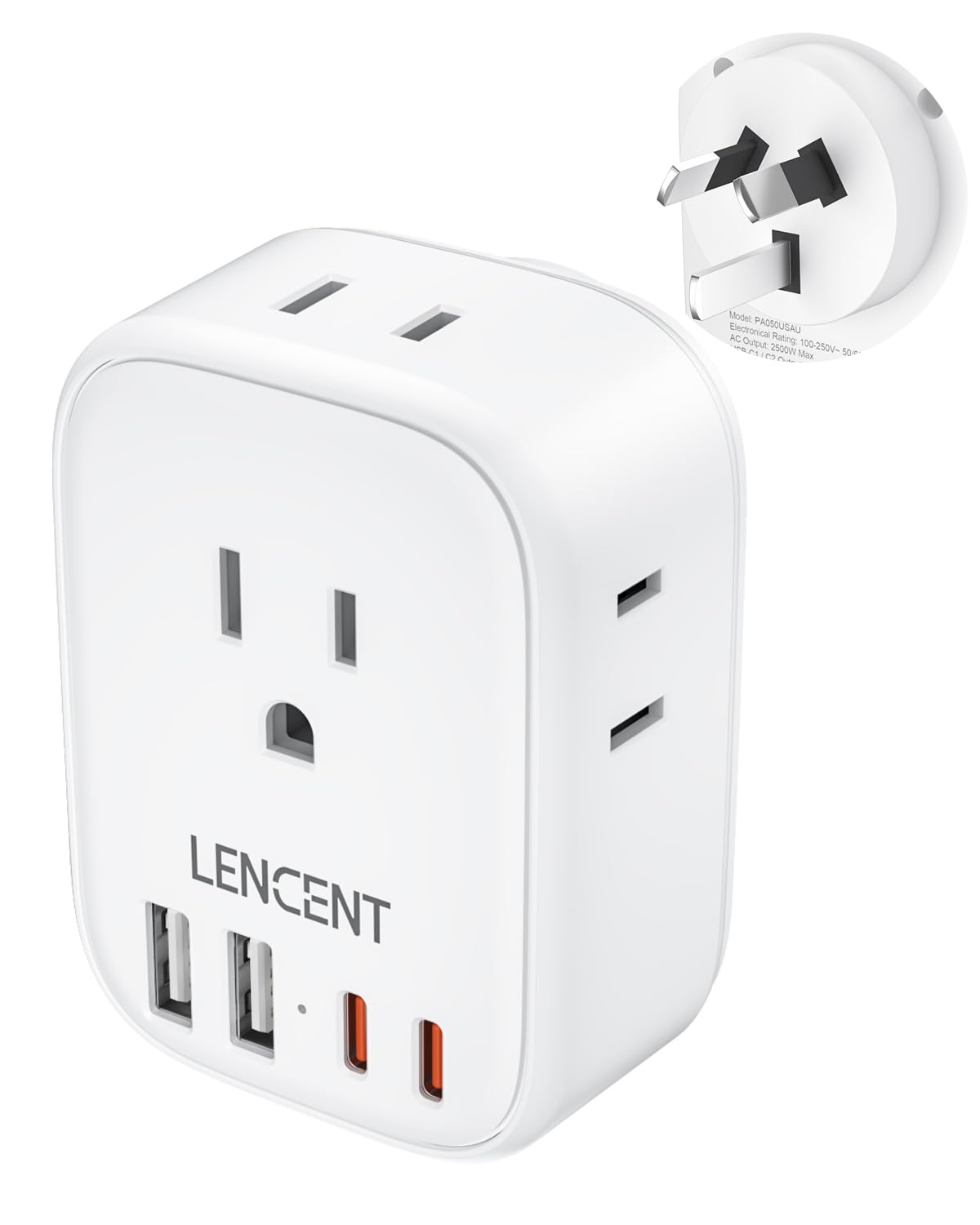
2. LENCENT Australia New Zealand Power Plug Adapter
Eight sockets off one wall plug, arranged on four sides so nothing blocks its neighbor.
If your travel kit reads like a small electronics store — two phones, a tablet, a watch, a power bank — this adapter is built for exactly that. It converts one Type I socket into four American AC outlets and four USB charging ports, and the four-side layout means a chunky laptop brick on one face doesn’t cover the outlet next to it. It handles up to 2500W at 250V and 10A, so mid-wattage gear lives comfortably here. The USB side runs two USB-C and two USB-A ports with a maximum output of 17.5W, which the maker claims is about 50% faster than a standard adapter.
Compare it to the BESTEK below and the trade-off is clear: this one gives you more outlets and more USB-C, while the BESTEK pushes higher wattage through fewer sockets. Both come in around the same weight class. At roughly 3.88oz with a 2.3 x 2.5 x 3.1-inch footprint, it slides into a bag without drama. The grounded plug seats firmly and the built-in protection covers over-current, over-charge, and short-circuit, which is the peace-of-mind you’re paying for on a travel accessory you’ll use in unfamiliar wiring.
The one thing to be clear-eyed about: this is not a voltage converter. It only suits dual-voltage gear in the 100V-250V range, so a single-voltage hair dryer or electric razor rated 110V only still needs a separate converter. For phones, laptops, cameras, and CPAP machines that already support the range, it’s a tidy one-and-done solution — and the four-sided design makes it the easiest pick here for charging eight things at once without a tangle.
The outlet math: four AC outlets and four USB ports, with no outlet blocked by its neighbor — the practical answer for a device-heavy family.
The wattage ceiling: 2500W and 17.5W of USB is plenty for phones and tablets, but it tops out below the BESTEK’s 3250W for power-hungry appliances.
Go this way if: you own a pile of USB-C devices and want the most sockets per square inch — two USB-C ports and four US outlets is the strongest charging spread here.
Look elsewhere if: you need maximum wattage for a high-draw appliance; the lower 2500W ceiling is the reason to skip it.
3. BESTEK New Zealand Power Adapter
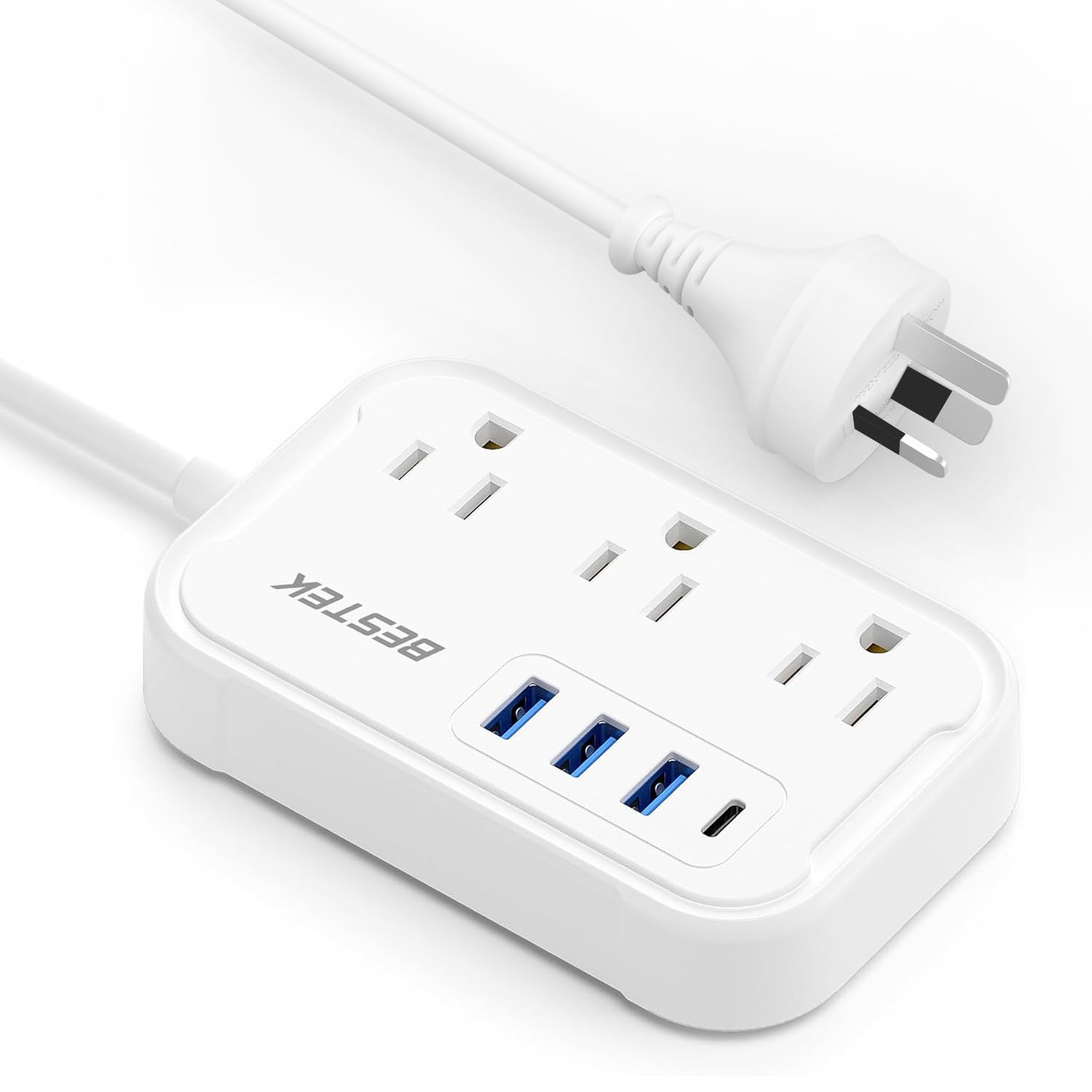
The adapter that reaches the far outlet and still has headroom for the power-hungry stuff.
Most travel adapters top out at 2500W. This BESTEK pushes 3250W at a max of 250V and 13A, which is the highest capacity in this lineup and the one to grab if you want to run a higher-draw appliance overseas without worrying about the ceiling. The 2.6-foot extension cord is the second reason it stands out: Australian hotel outlets are frequently buried behind furniture, and a short cord turns a hidden socket into something you can actually use. Two mounting holes on the back let you hang it on a wall or under a counter if you’re setting up a longer stay.
The seven-in-one layout gives you three AC outlets, three USB-A ports, and one USB-C port with 20W PD fast charging — so phones, tablets, cameras, and a laptop adapter can all share one plug. It’s also the slimmest body here, just 0.9 inches thick, which makes it easy to slide into a bag. Best of all, the 2.6-foot cord and 3250W capacity add reach and wattage without adding bulk.
Here’s the trade-off worth knowing: the BESTEK gives you more power and a cord, but fewer AC outlets — three versus the four you get from the LENCENT. If you’re purely charging USB devices, the extra wattage won’t mean much. If you’re plugging in a fan, a heater, or a coffee machine on an extended stay, the higher capacity is the reason this pick exists. And the same voltage rule applies: dual-voltage gear only, 100V-240V.
Best matched to: longer stays or work setups where you’re plugging in a higher-wattage appliance and need the cord to reach a hidden outlet.
The trade-off: three AC outlets instead of four, plus nearly double the wattage headroom — worth it only if your kit draws real power.
4. Australia Power Plug Adapter 3Ft Extension Cord
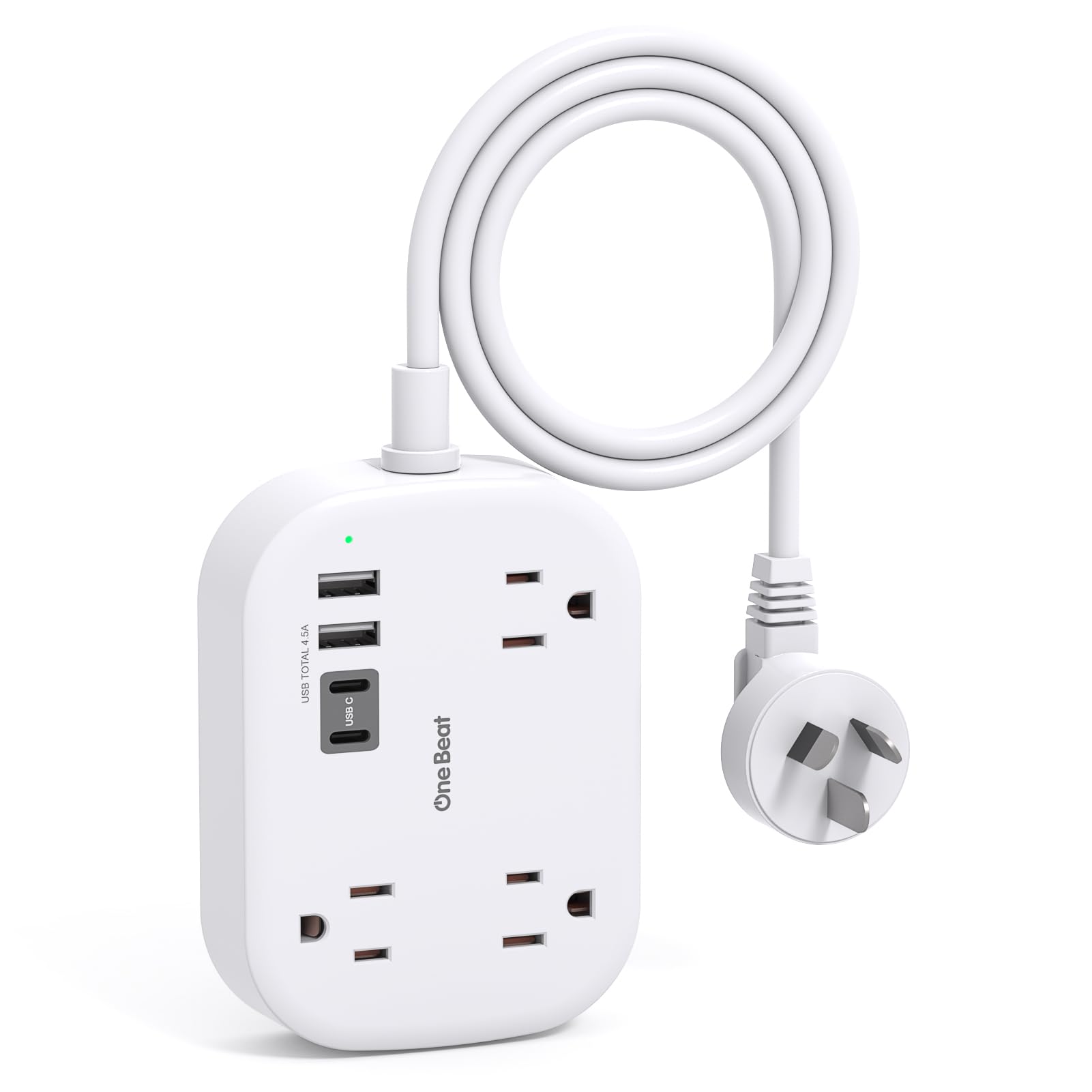
A three-foot cord that turns a hidden hotel socket into a bedside charging station.
Cruise cabins and dorm rooms have a problem in common: the outlet is nowhere near the bed. This adapter answers it with a 3-foot extension cord, so you can pull the power to a nightstand or desk instead of leaving your phone across the room. It turns one Type I outlet into three AC ports plus two USB-A and two USB-C ports — seven devices from a single socket. The AC side handles up to 2500W at 10A, and the portable size packs down nicely for a trip.
The USB side suits modern gear: each USB-C port delivers up to 5V/3A (15W), with all ports sharing a 22.5W total and Smart IC auto-detection to set each device’s charge rate. That’s enough for an iPhone or Galaxy, a pair of AirPods, and a few camera batteries. The body is built from fire-resistant PC (polycarbonate) with safety shutters and overload protection, and it’s deliberately designed without surge protection so it passes cruise-line and hotel policies. A soft blue indicator confirms power is on.
One honest limit worth planning around: the USB-C ports don’t push the higher 14-22V that a big USB-C laptop charger wants, so treat those ports as phone-and-accessory chargers. For laptops, plug your own power brick into one of the three AC outlets instead. As always, dual-voltage devices only — the adapter changes the plug shape, not the voltage.
The case for the cord: a 3-foot reach plus fire-resistant housing and safety shutters makes this the most practical pick for cruise cabins and dorm desks where the outlet sits out of the way.
What to keep in mind: USB-C is capped at 15W per port, so it’s a phone charger, not a laptop charger — you’ll want the AC outlets for anything that draws serious power.
Made for: cruise passengers and dorm dwellers who need to stretch power from a far outlet and want the reassurance of fire-resistant housing.
The catch: its USB-C wattage falls short of a true laptop PD charger (a high-power USB-C charger that can run a laptop). So budget on using the AC outlets for laptops.
5. meta-ant Australia Travel Adaptor

Four feet of reach and two USB-C ports — the pick when the hotel outlet is genuinely out of the way.
Four feet is the longest cord in this lineup, and it changes what’s possible: you can run the adapter from a far wall socket to a desk or bedside table rather than kneeling behind the bed to plug in. The seven-in-one layout gives you three American outlets and four USB ports, two of them USB-C. Charging is smart-detected, with the two USB-C ports delivering up to 5V/3.4A (17W max each), the USB-A ports up to 5V/2.4A (15W max), and everything sharing a 4.2A total — 21W overall.
At 10.64oz with a 4.33 x 3.93 x 1.22-inch body, it’s the heaviest pick here, but that’s the price of a four-foot cord and a polycarbonate shell. What wins people over is charging a mixed bag of devices — phones, a watch, a CPAP machine, and tablets — from one plug. It works across a long list of Type I countries including Australia, New Zealand, Argentina, China, and Fiji. It’s built without surge protection, so it’s simple to pack for a cruise.
Size is the fair gripe: this is a full charging station, not a pocket plug, so if you want something that disappears into a jacket pocket, the LENCENT or TESSAN will suit better. But if your priority is reach plus two fast USB-C ports, the extra weight buys you both. Dual-voltage devices only — 100V-250V.
Right for you if: a long cord and two USB-C ports matter more to you than a compact pocket plug — this is the corded pick to beat for reach.
Think it over if: you’re packing ultra-light; at over ten ounces it’s the heaviest adapter on the list.
6. Ceptics Australia China Travel Adapter
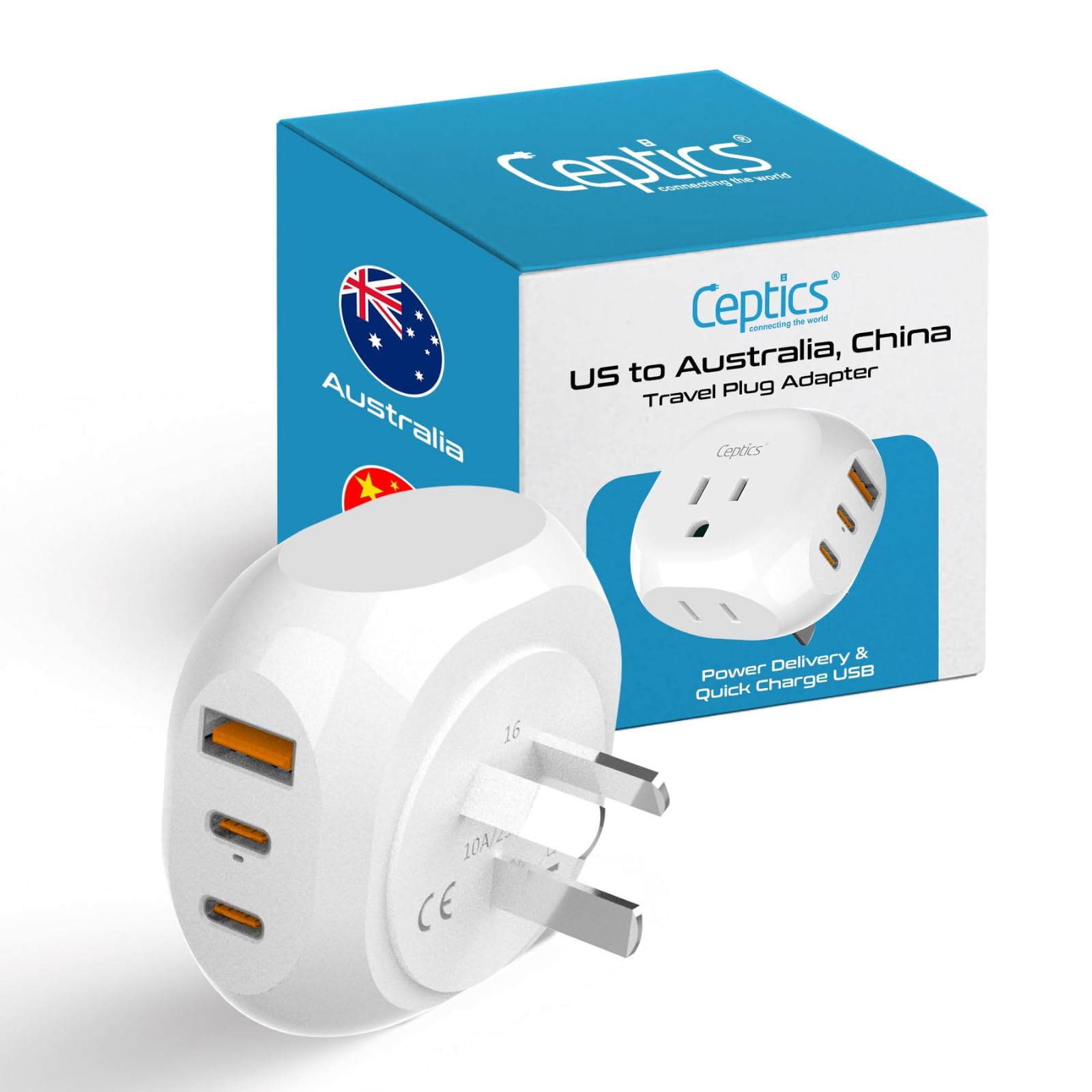
The smallest block here, built for a pocket and backed by a two-year warranty.
Some trips don’t need a charging station — they need a small plug you can forget about in a jacket pocket. This Ceptics fits that brief. It accepts the standard North American 2- and 3-prong flat-pin plug (including polarized) and adds a 20W PD-QC USB-C port plus a USB port, so you can charge a phone or tablet alongside one plugged-in device. The body measures about 2.24 x 2.24 x 2.05 inches, making it the dinkiest pick on this list.
The design is aimed at one dependable job: getting a US plug into a Type I wall in Australia, New Zealand, China, Fiji, and beyond. It doesn’t try to be a full power strip, and that’s the point — fewer parts, less to go wrong. Ceptics positions its adapters as designed in the USA and backs this one with a 24-month warranty, longer than most travel accessories get. The 20W USB-C port is the same fast-charge tier you’d want for a phone.
The honest limitation is capacity: with only two AC outlets and a single USB-C and USB port, this is a one-traveler, two-or-three-device adapter, not a family hub. It also has a mixed record on fit in some outlets, which is the sort of thing that happens with any small plug body — and it’s dual-voltage only. Pick it as a compact backup or a solo traveler’s minimal kit, not as the family’s shared charger.
What it does well
- Smallest footprint here at roughly 2.24 x 2.24 x 2.05 inches
- 20W PD-QC USB-C port plus a USB port for fast phone charging
- Backed by a 24-month Ceptics warranty
- Handles 2- and 3-prong flat-pin US plugs, including polarized
Where it runs short
- Only two AC outlets — not enough for a family’s worth of devices
- Single USB-C and single USB port, so one fast device at a time
- Mixed feedback on outlet fit in some sockets
A fit for: solo travelers who want the smallest possible plug with a fast USB-C port and a long warranty.
skip it if: you’re charging more than two or three devices at once — the outlet count is the limiting factor here.
Know the Specs
Type I and dual voltage
Type I is the plug shape used in Australia, New Zealand, China, and Argentina — two angled flat pins plus an earth pin. An adapter changes your plug’s shape to match that socket; it never changes the voltage. Australia runs on a higher voltage than the US, so your device must be labeled for a wide range, typically 100V-250V or 110V-240V. A dual-voltage device charges fine with just a shape adapter. A single-voltage device (many older hair dryers and clippers are 110V-only) needs a separate voltage converter, which is a different, heavier product.
Wattage, amps, and USB output
Capacity is measured in watts — the total power the adapter can pass through before it becomes a bottleneck. A 2500W adapter at 250V and 10A is plenty for phones, laptops, and most travel gear; a 3250W unit at 13A leaves more headroom for higher-draw appliances. USB output is separate: a single 20W USB-C port charges a phone quickly, but when several ports share a lower total (like 15W or 22.5W), each device slows down. Match the adapter’s total to how many things you’ll plug in at once.
Corded versus cordless
A cordless block sits flush against the wall socket — compact, but limited to the outlet’s location. A corded adapter adds anywhere from about 2.6 to 4 feet of reach, so you can bring power to a nightstand, desk, or the far side of a cruise cabin. Cords cost a little weight and bulk. For cruise cabins and dorm rooms, the reach usually wins.
Cruise compliance
Cruise lines and some hotels restrict power strips, so adapters built without surge protection tend to clear the security check more easily. Surge protection introduces extra circuitry that some ship policies treat as a fire risk. If you’re sailing, look for an adapter that explicitly states it has no surge protection — several picks on this list are built that way on purpose.
Common Questions
Will a US to Australia adapter let me use my hair dryer in Sydney?
What is the difference between a Type I adapter and a voltage converter?
Can I plug a US laptop charger into an Australian outlet with one of these adapters?
Are these adapters allowed on cruise ships?
Do I need a New Zealand adapter too, or does Australia cover both?
How many devices can I charge at once with one adapter?
Will my USB-C laptop charge from these adapters’ USB-C ports?
Is a corded adapter better than a cordless one for a hotel room?
Can I use one of these adapters to charge a CPAP machine while traveling?
Do these adapters protect my devices from power surges?
The Bottom Line
For most travelers, the us to australia plug adapter to grab is the TESSAN Type I adapter, because its four outlets and three USB ports — including a 20W USB-C fast charger — cover a family’s devices in one pocket-sized block. If you’d rather have the maximum outlet count and two USB-C ports, the LENCENT 8-in-1 earns its place. And when the hotel outlet is buried behind the bed, reach for the corded model with the 3-foot extension — the cord is exactly what makes it the practical pick for a cruise cabin or a dorm desk. Whatever you choose, confirm the dual-voltage label on your device first; that one check is what keeps your gear safe in a higher-voltage country.
How we choose
We do not accept paid placement. Every pick is matched to a real buyer and a real use-case; we do not hands-on test units.
Sources
Specifications: manufacturer listings and product documentation. Review insights: verified customer reviews, as of November 2026. Pricing: not shown on this page (it changes often); check the current price via the retailer link.
As an Amazon Associate, Tactical Gear Guy earns from qualifying purchases. This does not affect which products we feature.