Specs are compiled from manufacturer listings and verified buyer reviews and can change over time — please confirm the key details on the product page before buying.
If your folders keep slumping into a heap the moment you let go, the fix is not more shelves — it is the right upright file organizer. The picks below all hold papers vertical, keep every tab visible, and take up a small patch of desk instead of a whole drawer. The choice depends on compartment count and slot width, because a 1-inch gap holds one folder upright while a 2.5-inch gap swallows a thick binder. The Safco Onyx, with its eight 1-inch sections and 6-pound steel frame, is the one to beat for heavy daily filing.
This guide is built by comparing the manufacturers’ published specifications and the patterns across verified customer reviews, so you get each pick’s real strengths and trade-offs instead of marketing spin.
Some organizers are built for a thick stack of folders, while others are meant for slim mail and notebooks, so matching the slot depth to what you actually file matters more than brand. Here are the ones worth putting on your desk, with the trade-offs spelled out plainly so you can skip the guesswork.
Top Picks


How To Choose The Best Upright File Organizer
An upright file organizer has one job — keep folders standing so you can read every tab — and slot width and base weight decide whether it does. The specs below are the ones that decide it.
Start with slot width, not compartment count
Each gap between dividers sets how much paper a slot can hold before it bulges. A tight 1-inch gap hugs a single folder neatly and keeps it from sliding, which suits a steady stream of thin files. Wider gaps of around 2.5 inches swallow a thick binder or a stack of magazines, but a slim folder can flop sideways inside one. Count the compartments after you know your slot width, because eight narrow slots and five wide ones hold very different loads.
Check what sits on the desk — the base matters
Most of these stands are top-heavy once you load them, so the base is what stops a tipping domino of paperwork. Powder-coated steel plate and weighted wood bases stay put; lighter mesh bottoms can slide on a smooth surface. A base with non-slip guards also protects your desk from scratches. On a glass or finished wood desk, those non-slip guards are what keep the base from scratching the surface.
Decide if you need fixed or adjustable dividers
A fixed metal rack is set at the factory and simply works. An adjustable plastic sorter lets you spread the upright boards to almost any width and add base plates to lengthen the run. The catch with adjustable models is that once the boards are snapped in, they can be stiff to move again — great if you set it once, annoying if your filing mix changes weekly.
Think about assembly and finish
Many metal racks arrive flat and need screws; a few come fully assembled. Assembly is usually quick, but screw alignment and tiny screws show up as recurring snags on the cheaper builds. On finish, a powder coat resists chipping better than a bare electroplate, and mesh lets air through so dust does not settle in the slots.
Side-by-Side Comparison
| Model | Best For | Compartments | Footprint (D x W x H) | Material | Amazon |
|---|---|---|---|---|---|
| Safco Onyx Desk Organizer★ Best Overall | Heavy daily filing | 8 tiers (1″ wide) | 10.75″D x 11.75″W x 14″H | Steel mesh | Amazon |
| Simple Trending Desk File SorterBest Value | Large load, tight budget | 9 sections | 13″D x 8″W x 7.5″H | Alloy steel, metal | Amazon |
| gianotter Desktop File OrganizerSmallest Footprint | Slim desk, quick setup | 5 | 2.95″D x 6.49″W x 5.3″H | Carbon steel | Amazon |
| Simmer Stone Gold Desk Organizer | Style-led desk setup | 7 slots (1.2″ gaps) | 8.4″D x 6.3″W x 7.8″H | Metal | Amazon |
| LuluEasy Adjustable Vertical File Sorter | Odd sizes and flexibility | 5 adjustable | 17.7″D x 8″W x 7.3″H | ABS plastic | Amazon |
| Gawerk 7-Section Metal Upright Sorter | Small or crowded desks | 7 | 13.2″D x 8.7″W x 7.32″H | Metal | Amazon |
| Kuntine.B 5-Section Upright Organizer | Binders and classrooms | 5 (listing also cites 7) | 17.7″D x 12″W x 7.5″H | Metal | Amazon |
| MINDEPOT Desk File Organizer | Wide gaps for big files | 7 (2.5″ gaps) | 11.25″D x 12.75″W x 7.5″H | Metal | Amazon |
| Becomrock 5-Section Vertical Organizer | Decor-matched home office | 5 | 8.4″D x 9″W x 8.5″H | Metal, wood | Amazon |
Detailed Reviews
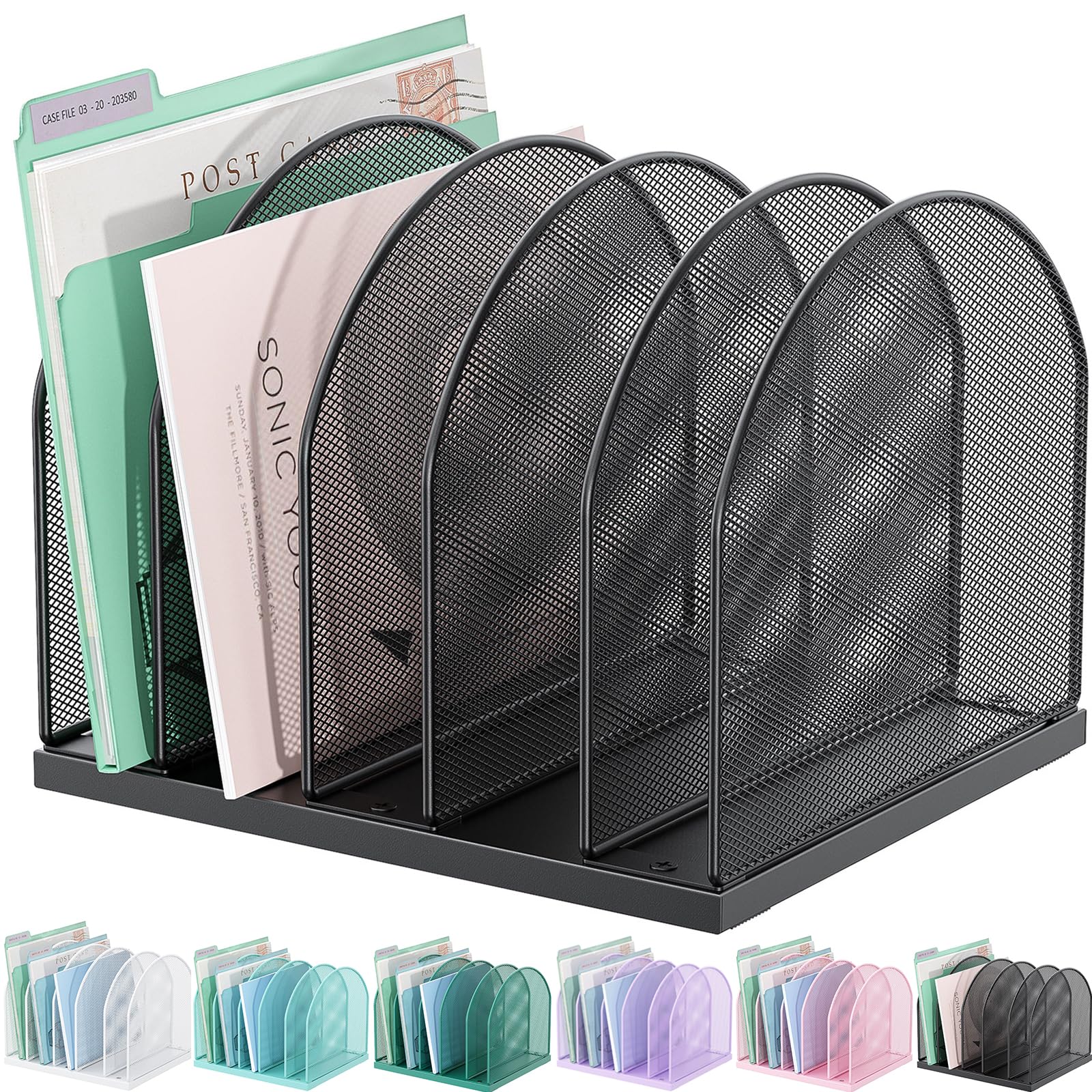
1. Safco Onyx Desk Organizer, 8 Tiered Vertical Compartments
Our pick — 4.5+★ from 450+ verified ratings; the strongest balance of quality and price.
Eight tight one-inch slots and a six-pound steel body — built to take a real office workload.
This is the organizer you buy when the pile on your desk is thick folders, not slim mail. Each of the eight tiers is 1 inch wide, which is narrow enough to hold a single folder upright so the tab stays readable at a glance. The whole rack measures 11.75 inches wide, 10.75 inches deep and 14 inches tall, so it climbs upward instead of sprawling sideways — handy when your usable desk is a small L-corner.
The build is the reason it earns the top spot. Thick commercial-grade steel with a powder coat that resists chipping or scratching, and a mesh design that lets air move through so dust does not settle between the slots. It arrives fully assembled, so there is no screw tray to fight. Everything about it is set for repetitive, heavy daily use in a mailroom, cubicle or classroom.
What wins people over is the sheer solidity — it holds weight without complaint and the racks are spaced just far enough apart to read every folder label. The size is where you want to pay attention: this footprint is substantial compared with a compact sorter, and a few buyers report there are two different capacities in this line. Measure your corner before you order. skip it if you only need a small tray for a handful of envelopes — the gianotter’s five compartments suit that lighter job.
Where the Safco earns its keep
- Eight 1-inch tiers keep thick folders standing and every tab visible.
- Commercial-grade steel and powder coat shrug off daily heavy use.
- Ships fully assembled — nothing to tighten or align.
- Mesh walls cut dust buildup between files.
Before you hit add to cart
- It is the biggest footprint here at 11.75″W x 10.75″D x 14″H — check your desk space.
- The line comes in different capacities, so confirm the section count you want.
Top pick for: anyone filing thick folders every day who wants a rack that will outlast the desk it sits on.
Measure first: the 14-inch height and deep base need a real corner, not a narrow side shelf.
2. Simple Trending Desk File Sorter Organizer, 9 Section
Nine slots of thick metal wire that hold a big paper load without asking much desk room.
You get nine separate slots from ten arched dividers on this rack, and that slot count is the whole pitch. Owners mention loading it with eighteen to twenty file folders, and it holds them without a wobble. At 13 inches deep and 8 inches wide, it takes up far less front-to-back room than the Safco above — about a third of the depth — so it fits on a shallow shelf. The trade-off is height: it sits lower at 7.5 inches tall, so it spreads out sideways rather than climbing.
The material is thick metal wire with a mesh base, rust-proof and built to resist bending. Assembly is quick and the structure sits solid once together, without sliding or tipping. Because the slots are wide and flat, people find a second life for it: laptops and iPads stand in the slots, and it fits nicely on top of a bookcase. The nine-section count is what buyers keep coming back to — more slots than the five-section racks for a similar outlay.
What is honestly mixed is colour choice; the black is basically your only real pick, so if you wanted a bright finish, look elsewhere. Otherwise this is the value story of the list: nine sections, sturdy metal, quick build. The one edit a picky buyer might want is a slightly taller profile for oversized binders.
Load without the wobble: thick wire and a mesh base keep a full twenty-folder stack steady, and the easy assembly means you are filing within minutes.
One colour, one height: the black-only finish is a real limit for a styled office, and at 7.5 inches tall, tall binders may poke above the top of the rack.
Reach for this if: you want the most slots for the least outlay and your files are standard folders.
Look elsewhere if: a colour-matched finish or extra height for tall binders is a must.
3. gianotter Desktop File Organizer with 5 Compartments
Five mesh compartments on a base so small it fits the sliver of desk beside your monitor.
Here is the size story in hard numbers: this organizer measures 2.95 inches deep, 6.49 inches wide and 5.3 inches tall, against the Simple Trending’s 13-inch depth — a 4.4x gap in how much desk it eats. If your only free real estate is the strip next to your keyboard, that difference decides the purchase. The mesh front is see-through, so you can spot the file you want without lifting anything out.
The frame is reinforced alloy steel on a carbon-steel base, with non-slip scratch guards underneath to protect the desk. Five compartments give you classified storage for the everyday paper mess — receipts, a small calculator, a checkbook, upcoming bills. Assembly is quick and the parts are there, screwdriver included. The powder coat and simple look blend with a matching stapler and desk mat rather than shouting for attention.
The trade-off is capacity. Five small compartments are ideal for slim paper and small items; a thick binder stack belongs in a deeper rack. A buyer who wanted a narrow tray for one job found this hit the mark on size and stability, which is the point: it does exactly one job well. If you file a few folders a day rather than a mailroom’s worth of paper, its five mesh compartments are the tidy fit.
Best fit for: a cramped desk that needs a slim, see-through tray for everyday paper and small office bits.
Skip if: your stack is thick binders, because five small compartments will not swallow them the way a full-depth rack will.
4. Simmer Stone Gold Desk Organizer, 7 Slot Inclined
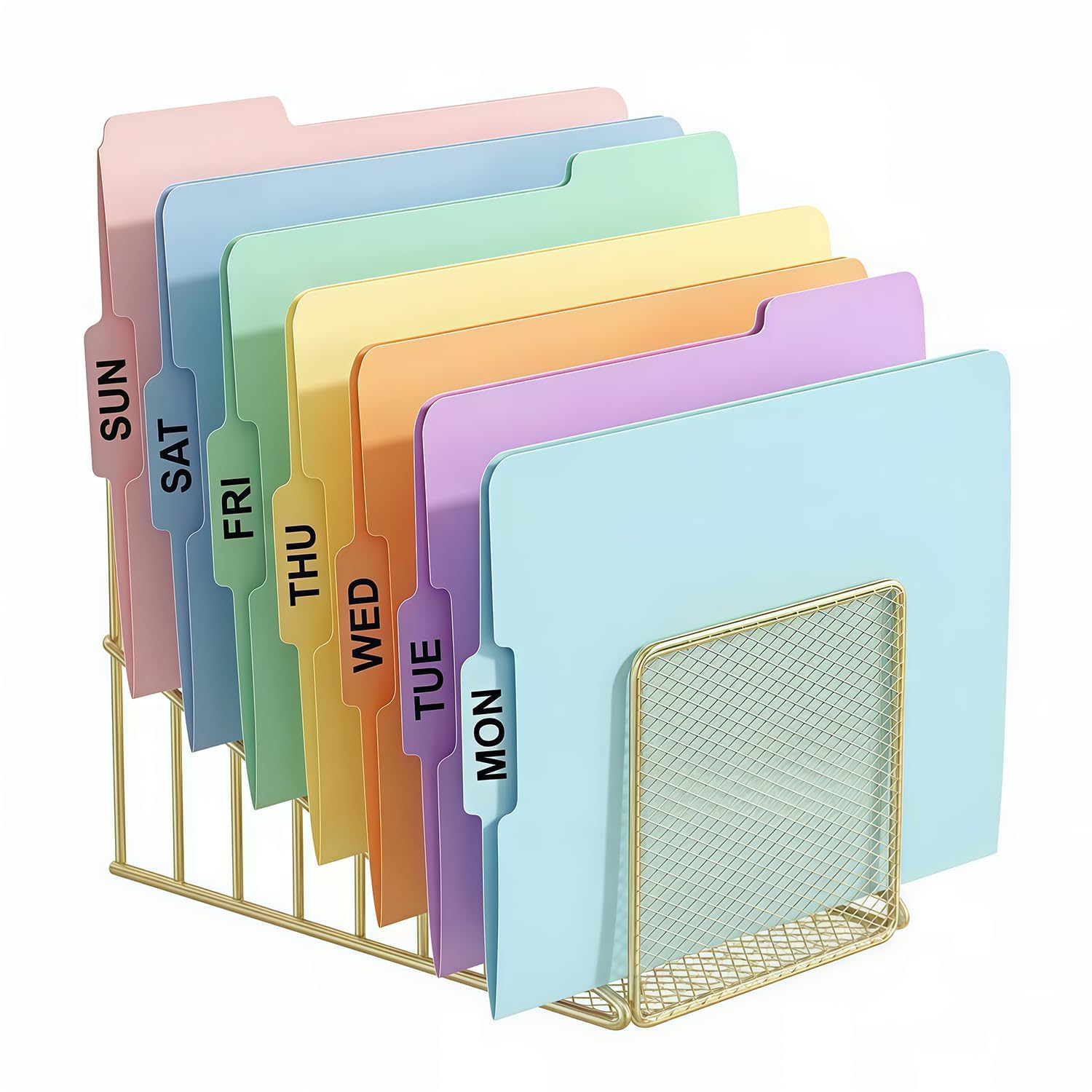
A stepped gold rack that treats your desk as decor while it keeps seven slots of paper on show.
This one walks into the room looking like an accessory, not an office supply. The electroplated gold finish reflects light, and the inclined step design lifts each slot so every folder tab is visible from where you sit. Seven slots sit at 1.2-inch (3cm) gaps, wide enough for notebooks, file folders, magazines and slim binders, and it comes fully assembled. If you are building a gold or rose-gold themed desk, it slots into the look.
What wins people over here is appearances — it earns the most praise of any aspect — with the quality and finish close behind. The mesh front panel holds small envelopes and mail, while the rear wire slots work as a stand for hardcover books, planners and tablets. A 7-slot layout also lends itself to day-labeling your week, Monday through Sunday, if you like categorizing by day.
The catch is size and support. It measures 8.4 inches deep, 6.3 inches wide and 7.8 inches tall, which is compact, and several buyers find it small for heavy folders. The separators are short enough that a thick, weighted folder can flop forward, so this is a rack for slim binders and notebooks, not an archive of dense files. For slim binders and notebooks it looks great doing the job; for dense, heavy folders, step up to the deeper metal racks.
The style case
- Electroplated gold finish turns a desk organizer into decor.
- Inclined 7-slot steps make every tab readable at a glance.
- Fully assembled from the start.
- 1.2-inch gaps fit notebooks, folders and slim binders.
What to weigh up
- At 7.8 inches tall and 6.3 inches wide, it reads small on a big desk.
- Short separators let a heavy folder lean forward.
The style pick: make this your choice when the desk needs to look the part and your files are slim.
Know the limit: dense, heavy folders need a taller separator than this gold rack provides.
5. LuluEasy Adjustable Vertical File Sorter

Plastic base plates you snap and stretch to fit almost any width — the odd-size problem solver.
Most racks are one fixed size; this one grows. The 6-part set includes six base plates and six upright plates for five adjustable filing compartments, and you can add more base plates to make the run as long as your shelf allows. The upright boards slide to whatever width you want, so a lone laptop, a stack of vinyl records or a row of magazines all get their own gap. The build is thick ABS plastic rather than metal mesh, so it will not scuff the surface of what it holds.
Functionality is what people value most here — it simply works — and the snug build snaps together with an ease that had an eight-year-old assembling one on her own. It holds papers and folders without bending or tipping. For anyone with drawers full of mixed sizes and a short reach for standard metal dividers, the minimum gap even grips a laptop or tablet upright.
The honest catch is the adjustability itself. Once a board is snapped into a slot, some owners find the pieces stuck and hard to reposition, so set the spacing once and live with it. In heavier loads a few note it would benefit from a weightier base to keep it from sliding. That is a fit-note for people who plan to rearrange weekly, not a knock on the snapping snugness.
The size-anything angle: extend it, shrink it, grip a laptop or spread a vinyl record — the adjustable boards and addable base plates handle shapes the fixed racks cannot.
Set it and leave it: boards can be stubborn once snapped, so plan your spacing before you commit; a heavier base would help it stay put under a full load.
Go adjustable: pick this when your items vary in size — laptops, vinyl, magazines — or your shelf space is an unusual length.
Best left alone: if you file one uniform stack and want a rack that stays exactly where you set it, a fixed metal design is simpler.
6. Gawerk 7-Section Metal Upright File Sorter
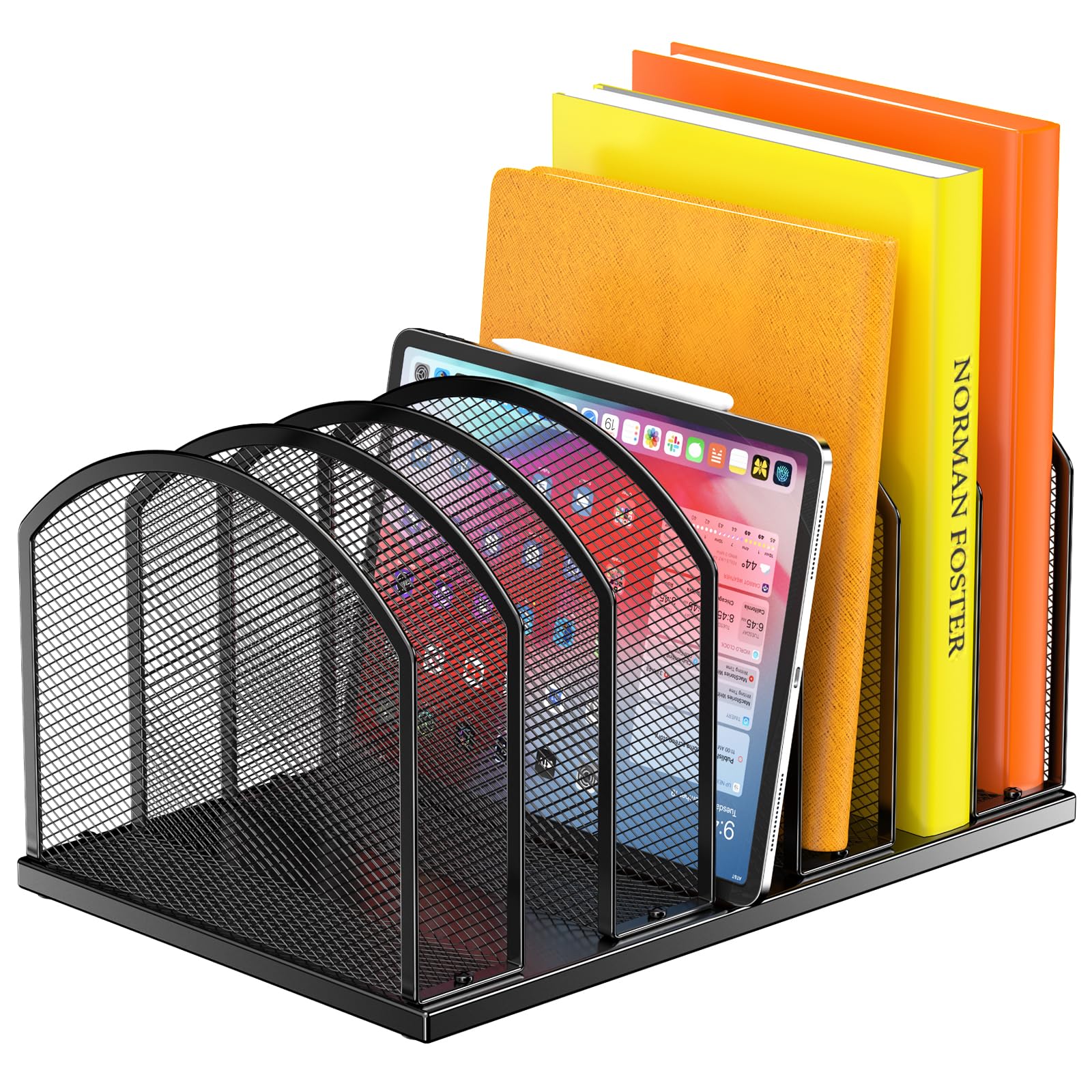
Seven open slots with adjustable shelves, sized to straighten a crowded desk without taking it over.
Seven sections in a rack that measures 13.2 inches deep, 8.7 inches wide and 7.32 inches tall — enough compartments to separate folders by project without a mailroom footprint. The open design lets you pull a document out in one motion, and the adjustable shelves are meant to accommodate different document sizes so you can tune the fit. For a small or crowded workspace, that balance of capacity and compactness is the whole point.
Assembly is the thing buyers rave about — it goes together quickly, and the package even includes a small screwdriver, so you are not hunting for tools. The metal body is sturdy and holds full-size document books and folders as well as shorter items without bending. It organizes envelopes and files, fits well on a small desk, and the build looks tidy once loaded.
A couple of sizing notes worth knowing. Thick manila folders fill the slots fast, so a buyer wishing for slightly more height found the fit snug rather than roomy. It is also worth checking the finish — reviews mention a pink colour variation, so confirm which colour is shipping before you commit to matching a desk. Neither is a deal-stopper for a small desk; both are easy to plan around once you know them.
Matches a small desk: buy this when you want seven clean slots and quick build in a corner that cannot fit a full-size rack.
Check before ordering: tall manila folders sit snug, so measure your folder height and confirm the colour you want.
7. Kuntine.B 5-Section Upright Desk File Organizer
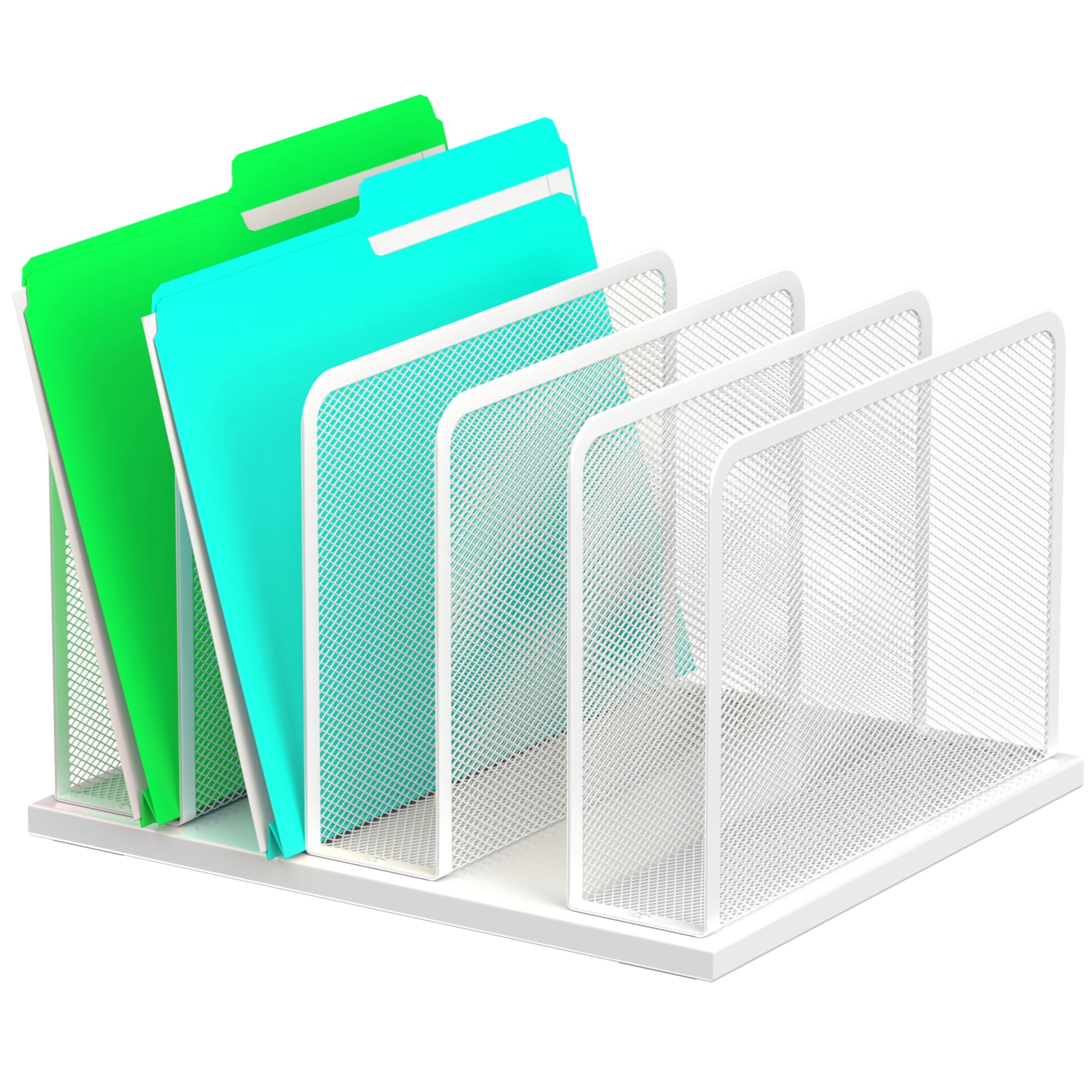
Thick steel panels for holding real binders, not just loose paper — in a clean white finish.
This is a large metal organizer with a solid steel panel base, and its job is holding binders and folders rather than a few loose sheets. It spans 17.7 inches deep and 12 inches wide with a 7.5-inch height, so it takes a meaningful run of desk or shelf and spreads the load across it. Buyers trust it enough to fill it with heavy craft material — small wood and acrylic sheets — and report it stays sturdy.
The construction is heavy-duty steel with an anti-slip touch on the base, and the white finish stands out from the sea of black mesh racks. It organizes binders, folders and paper well, and the solid build looks tidy on a study or classroom shelf. For a home study, dorm or office desk that sees a steady stream of thick files, the steel panels carry the weight.
Assembly is where buyers split. Some call it super easy; others found pieces slightly bent or screws too tiny to grip, and a hammer-stuck-together attempt is not uncommon. Treat it as a careful assembly job rather than a snap-together one, and check the parts on arrival. The listing also notes both 5-section and 7-compartment descriptions, so confirm the compartment count you want. Confirm the compartment count and check the hardware on arrival, and the sturdy white steel earns its place.
Why the steel wins
- Thick steel panel base holds heavy binders and craft sheets steady.
- White finish separates it from black mesh racks.
- A long 17.7″ x 12″ footprint holds a serious filing run.
Assembly is the catch
- Tiny screws and bent parts trip some buyers up — check the box on arrival.
- Listing mixes 5-section and 7-compartment wording, so confirm the count you want.
Steel for heavy files: choose it if you are organizing binders and want a white steel rack that holds real weight.
Be ready to build: budget a patient assembly session and check the hardware as soon as it lands.
8. MINDEPOT Desk File Organizer, 7 Sections

2.5-inch slots — the widest gap on this list, so thick files go in without a jam.
Seven sections each spaced 2.5 inches apart means this rack swallows files, books and mail without everything pinching together. That wide spacing is the differentiator: compared with a 5-section rack it offers two extra sections and more room per slot. It sits on an iron plate base for a stable, sturdy foundation, and the mesh panels are larger than standard, which adds support and resists deforming under load. It measures 11.25 inches deep, 12.75 inches wide and 7.5 inches tall.
Owners describe it as well designed, sturdy, and roomy — a good amount of paper fits each area without the folder pile getting tight. It works equally well on a home office desk, a classroom shelf or a home shelf holding books and documents, and it looks decent once loaded. When the slots are this wide, a thick binder or a full stack sits comfortably instead of bulging.
Assembly is the honest caveat. It is a screw-together build, and the alignment of the holes is where people hit trouble: put all the parts loosely in place before tightening, or the screws will not line up. Some found it easy; others found it finicky. Once it is together, screws not fully seated can poke through the iron plate, so keep the screw heads flush to protect your shelf.
Room for the thick stuff: 2.5-inch gaps and larger mesh panels hold a heavy, varied filing load without pinching it tight.
Patience at assembly: screw alignment is the recurring snag, and any screw that pokes through the base can scratch the shelf — seat every one flush.
Best for wide slots: pick this when binders and bulky files are the norm and you want breathing room between them.
Prep the screwdriver: expect to finesse the screw alignment, and keep the heads flush so they do not mar the shelf.
9. Becomrock 5-Section Vertical File Organizer, Wood Base
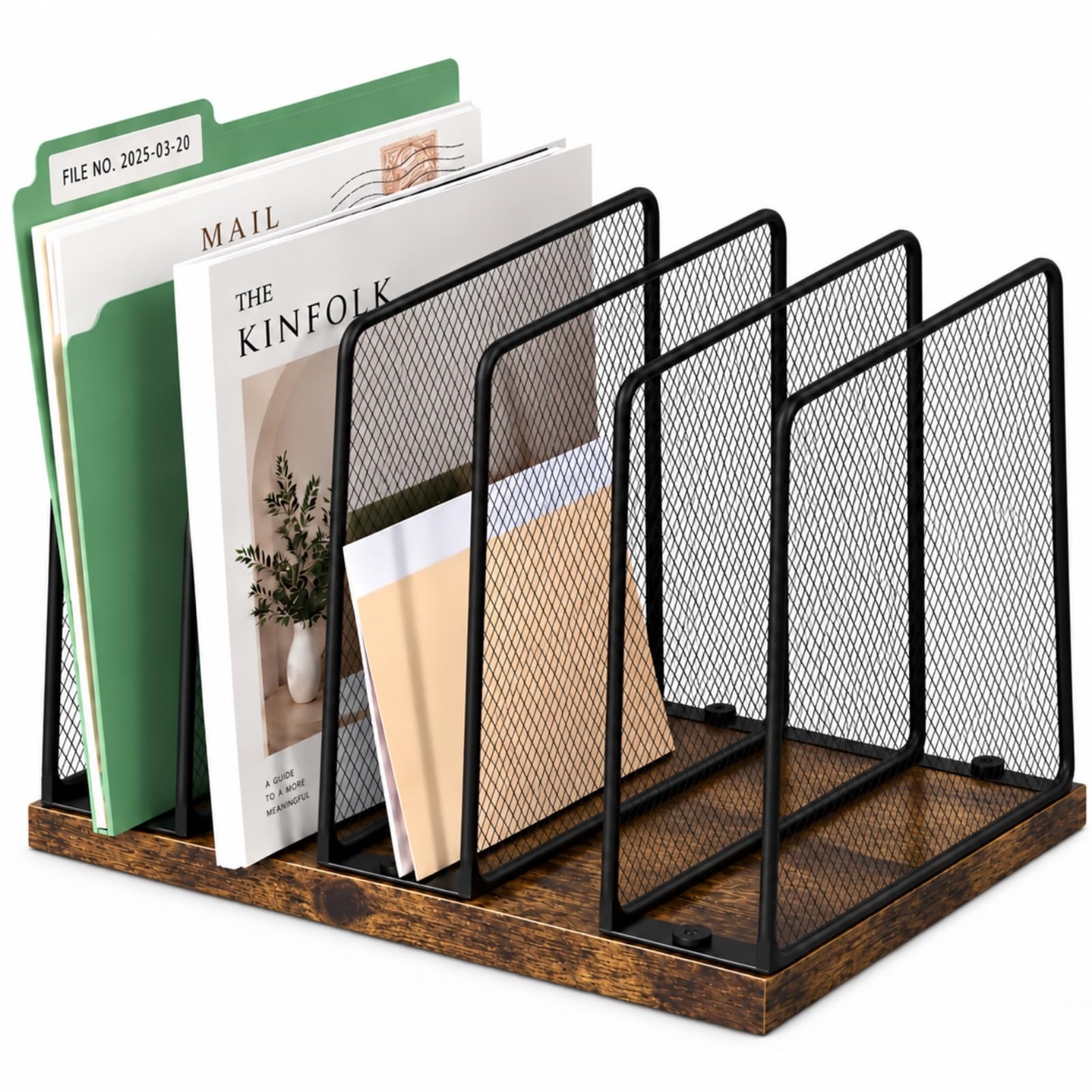
A weighted wood-grain base with black mesh slots, built to stay put and warm up the desk.
Five spacious compartments sit on a weighted wood base (a heavy wooden bottom that anchors the rack) so it stays upright instead of wobbling. Soft non-slip footing under the wood protects your desk surface while the weight holds it steady. It measures 8.4 inches deep, 9 inches wide and 8.5 inches tall — small enough for a home office, dorm or classroom desk, and tall enough to give the slots a little rise so you can grip what is inside.
The look does the heavy lifting for a home setup: matte black mesh paired with rich wood grain, so it reads as a decor piece rather than plain office hardware. Five slots hold magazines, books, vinyl records, mail and even an iPad within reach. Setup is quick with the included hardware and a secure screw-in design, so there is no long weekend build. If your desk carries a warm wood-and-black theme, this fits it.
The trade-off is slim data — this is one of the newer entries in the category, so there is less owner history to lean on than the long-running steel racks. It is also a five-slot rack, so a big archive of thick folders would outgrow it faster than an eight- or nine-section model. For everyday paper, mail and reading material in a styled home office, five slots cover the job with a little room to grow.
Wood-and-mesh match: choose this when your desk decor runs warm and you want five clean slots with a stable, weighted base.
Not for archives: a heavy, growing folder stack will outgrow five slots faster than a deeper multi-tier rack.
Know the Specs
Compartment count and slot width
The number of sections tells you how many piles you can separate; the gap between dividers tells you how much paper each pile can hold. A tighter gap—around 1 inch—hugs a single folder upright so its tab stays readable. A wider gap—up to about 2.5 inches—fits a thick binder or a stack of magazines but can let a slim folder lean. Match the gap to your folders before you count compartments, because eight narrow slots and five wide ones hold very different loads.
Base material and footprint
A weighted base—steel plate, a solid alloy base, or wood—keeps a loaded rack from tipping or sliding on a smooth desk. Non-slip footing protects the surface underneath. Footprint is the depth, width and height of the whole unit, and it is what actually decides whether the rack fits your corner. A compact sorter can be under three inches deep, while a full mailroom rack runs past ten inches of desk depth, so match the box to your free space.
Common Questions
Will thick manila folders fit in an upright file organizer?
How many compartments do I need for a home office?
Do these organizers tip over once they are loaded?
Is metal mesh better than solid panels for a file sorter?
How much desk depth does an upright organizer actually take?
Can I use an upright file organizer for laptops or tablets?
Will I have to assemble the organizer myself?
Does a mesh or metal organizer scratch the desk underneath?
Can I add more compartments to an adjustable plastic sorter?
How do I stop my folders from slumping forward in the slots?
The Bottom Line
For most desks, the upright file organizer that wins is the Safco Onyx Desk Organizer, because its eight 1-inch tiers and commercial-grade steel hold thick folders upright day after day. If you want the most slots for the least outlay, grab the Simple Trending Desk File Sorter with its nine sections and thick metal wire. And if you need the smallest possible footprint for slim paper, the gianotter Desktop File Organizer is the one to reach for, at under three inches of desk depth. The Safco backs that up with 4.5+ stars across 490+ ratings, earned by its six-pound steel body rather than marketing.
How we choose
We do not accept paid placement. Every pick is matched to a real buyer and a real use-case; we do not hands-on test units.
Sources
Specifications: manufacturer listings and product documentation. Review insights: verified customer reviews, as of November 2026. Pricing: not shown on this page (it changes often); check the current price via the retailer link.
As an Amazon Associate, Tactical Gear Guy earns from qualifying purchases. This does not affect which products we feature.