Specs are compiled from manufacturer listings and verified buyer reviews and can change over time — please confirm the key details on the product page before buying.
Rewiring an old car is mostly a labelling problem, not an electrical one. You can read every diagram in the manual, but if the wire in your hand says nothing, you are guessing. A good harness prints the circuit name right onto the insulation, uses GM color codes so the chart in your head still works, and arrives with the fuse block already terminated on one end. That pre-terminated fuse block is why the Painless 10102 takes the top spot here.
This guide is built by comparing the manufacturers’ published specifications and the patterns across verified customer reviews, so you get each pick’s real strengths and trade-offs instead of marketing spin.
Below you will find seven harnesses ranked by circuit count, wire labeling, and how much wiring work each one leaves you. Every pick below is a genuine option for a street rod, a muscle car, or a hot rod build. Choose carefully, because a harness with unmarked wires turns a weekend job into a week of testing each circuit with a meter. Compare these universal wiring harness options on labelling and circuit count before you spend a dollar.
Top Picks

How To Choose The Best Universal Wiring Harness
A universal harness is not built for one model, so every run has to be trimmed and adapted to your car. It is not built for one model, so it has to be adapted. That is why the wiring that arrives printed, color-coded, and partly assembled saves you the most time. The three things that decide whether a kit is a joy or a headache are the circuit count, the labelling on each wire, and how much of the fuse block comes pre-wired.
Circuit count tells you what the kit can power
A circuit is one switched or constant power path — headlights, horn, wipers, fuel pump, and so on. Count the accessories on your build before you buy. A hot rod with a simple dash and basic lights can live on 8 circuits. A car with air conditioning, power windows, an electric fan, and an electric fuel pump needs far more headroom. Buying more circuits than you need leaves room to add accessories later; buying too few forces a second kit.
Wire labelling is the real make-or-break
Every wire in a universal kit has to be identified at both ends. The better harnesses print the circuit name directly on the insulation at regular intervals so you never lose track mid-run. If the print is faint, smeared, or missing entirely, you are left ringing out each wire with a meter. That turns a few hours of work into a full weekend of ringing out wires with a meter.
Pre-terminated fuse blocks and GM color codes
A pre-terminated fuse block arrives with the wires already crimped into the block, so you finish only the loose end. GM color coding means the wire colors follow the General Motors convention, which matches most published hot rod and muscle car diagrams. Combined, those two features cut installation time and reduce the chance of a crossed circuit lighting up the wrong accessory.
Side-by-Side Comparison
| Model | Best For | Circuits | Weight | Wire Labeling | Amazon |
|---|---|---|---|---|---|
| Painless Performance 10102★ Best Overall | Full chassis rewires with a real manual | 21 | 7.54 pounds | Printed every 6 inches, GM codes | Amazon |
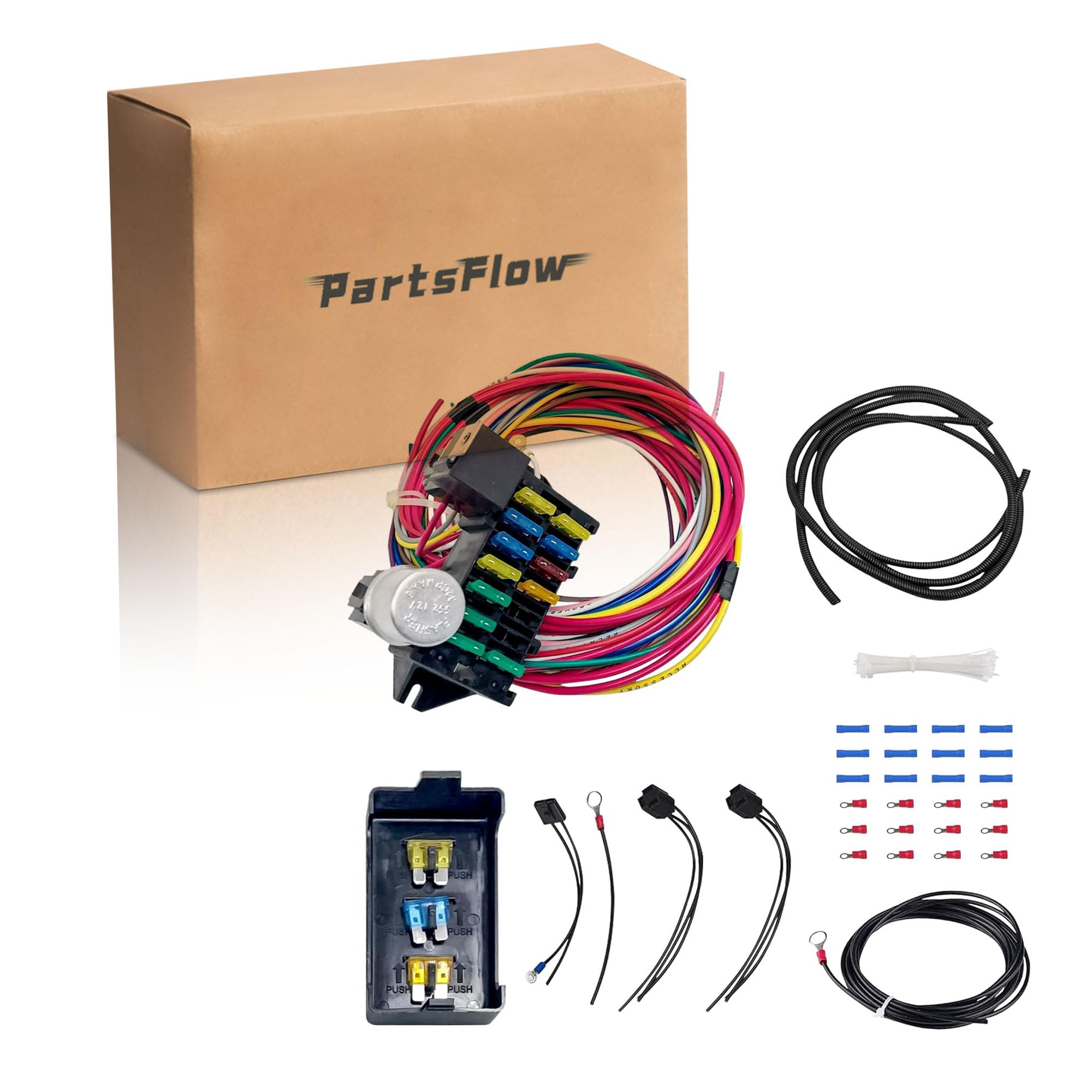
| PartsFlow 12 Circuit HarnessBest Value | Budget street rod builds | 12 | 3 pounds | GM color-coded and labeled | Amazon |
| WMPHE 8 Circuit Harness | Simple builds and small accessory loads | 8 | 1.06 kg | Printed every 6 inches | Amazon |
| WMPHE 14 Circuit Kit | Muscle car rewires with plenty of accessories | 14 | 1.42 kg | Printed every 6 inches | Amazon |
| TADYAO 14 Circuit Harness | Builders who want every connector in the box | 14 | 1.48 kg | Printed, with full accessory set | Amazon |
| VOWAGH 21 Circuit Harness | Long runs in a big car with GM columns | 21 | — | Lightly marked, identified by code | Amazon |
| Auto Parts Prodigy 21 Harness | 21-circuit builds with GM, Ford or Mopar pages | 21 | — | GM color codes, detailed instructions | Amazon |
Detailed Reviews
1. Painless Performance 10102 Chassis Harness
Our pick — 4.5+★ from 200+ verified ratings; the strongest balance of quality and price.
Twenty-one circuits, every wire printed with its name, and a fuse block that arrives half-finished.
If your project car has air conditioning, power windows, an electric fan, and a fuel pump, this is the harness that covers all of them at once. It carries 21 circuits — 21 separate power paths you can assign to different accessories — so you are not juggling a second kit halfway through the build. At 7.54 pounds it is the heaviest reel here, and that weight is the wire: more of it, in longer runs, wrapped around all those circuits.
The thing that wins people over is the labelling. Every wire carries its circuit identification printed along the insulation, and the kit uses GM color codes so the colors match the General Motors convention most hot rod diagrams follow. As buyers report, “everything is labeled every 6 inches, color-coded.” The fuse block is machine-crimped and pre-terminated at the factory, so you terminate only one end and spend the evening on the car rather than on a bench. Quality is the most-praised theme in the feedback, with installation instructions right behind it — the full-color manual is genuinely part of the product here, not a folded sheet of afterthoughts.
The honest catch: this is a universal kit, and universal means you still adapt. No vehicle-specific plugs come in the box, so you will splice into your existing connectors. That is the trade-off you accept for the price advantage over a model-specific harness, and the detailed manual is what makes it manageable. It is also an American-made kit with stateside technical support you can call during the install — a real comfort on your first full rewire.
What earns its keep
- 21 circuits cover a fully loaded dash without a second kit
- Circuit names printed on every wire, GM color codes throughout
- Fuse block arrives machine-crimped and pre-terminated
- Full-color installation manual plus phone support during the build
Where it asks more of you
- No vehicle-specific plugs, so splicing into your existing connectors is on you
- Heaviest reel here at 7.54 pounds, so plan the routing before you start
Reach for this if: you want a full 21-circuit rewire with the labelling doing the hard thinking for you.
Look elsewhere if: your build is simple enough that a smaller, lighter kit would leave less unused wire coiled under the dash.
2. 12 Circuit Wiring Harness
A 3-pound reel that undercuts the top pick on heft by a wide margin.
Compare the two on the scale and the gap is stark: this 12-circuit kit weighs 3 pounds against the Painless at 7.54 pounds. That is a lot less copper and insulation to route, which suits a compact street rod where you are threading wire through a tight dash. It carries 12 circuits covering air conditioning, ignition and battery, gauges, brake switch, flasher, headlights, wipers, hazard, and two accessory feeds — enough for a classic build without the kitchen sink.
The copper core wire is billed as corrosion-resistant with a plastic jacket that stands up to heat and chemicals, and the wires come GM color-coded and labeled so you can follow a standard diagram. The package is a full bumper-to-bumper kit and includes wire loom, a fusible link, and butt connectors, so the small hardware arrives with it. The maker recommends professional installation for best results, and that is a fair caution for anyone who has never traced a live circuit before.
Where it gives ground to the top pick is headroom. Twelve circuits rather than 21 means less spare capacity if you later add power windows or an electric fan. For a straightforward carbureted build with a modest accessory list, that is a fair swap for the lighter reel and the easier routing job.
The weight story: at 3 pounds it is the lightest 12-circuit-class option here, and every gram is wire you do not have to feed through a firewall grommet.
What to weigh: the smaller circuit count is the limit — plan your accessory list before you cut anything to length.
Good fit for: a classic car or street rod with a modest accessory list and a tight dash cavity.
Think twice if: you are planning power seats, power windows, and an electric fan down the line — go for the 21-circuit class instead.
3. 8 Circuit Wiring Harness Universal Wire Harness

Eight circuits for the builder who wants exactly what the car needs and nothing more.
Some builds do not need a loaded dash. This kit carries 8 circuits — brake switch, battery, wipers, hazard lights, signal switch, relay out, gauge, and cluster — which covers the electrical skeleton of a basic hot rod without a great tangle of unused wire. The wires are printed with readable characters every 6 inches, so the identification problem is handled at both ends of every run.
Where it differs most from the 21-circuit top pick is expansion room. Twenty-one circuits versus 8 is a wide gap, and if you have air conditioning, a fuel pump, and power accessories, 8 will come up short. But if you are wiring a bare-bones build, the smaller count means fewer circuits to terminate and less complexity to reason through on a first rewire.
The copper wire and plastic parts are built to standard automotive spec, and the standalone system can be installed anywhere under the dashboard or seat. A comprehensive picture-led manual ships with it, so first-time installers are not left guessing. The one thing to check before you commit is your full accessory list — the manufacturer even asks you to confirm fit before purchase and recommends a professional install.
Why it suits a simple build: 8 clearly labeled circuits and picture-based instructions make it a clean starting harness for a basic hot rod.
Pick this for: a stripped-down build where gauges, lights, wipers, and signals are the whole electrical story.
Pass on it if: your dash carries a heater, air conditioning, or power accessories — the 8-circuit ceiling is too low.
4. 14 Circuit Wiring Harness Kit

Fourteen fused circuits with a printed name every 6 inches down each wire.
Fourteen circuits is a comfortable middle ground. This kit covers the coil, fan, fuel, air conditioning, turn signal, spare, headlights, ignition switch, horn, radio, brakes, wiper, battery, and ACC2 — which is a full muscle car load without the sprawl of 21. It runs 14 fuses and standard 12-volt line voltage, mounted in a fuse block you can locate under the dash or seat.
Here is the fair caution, and it is the most-discussed thing in the feedback: installation draws mixed reviews. Some builders find the setup straightforward, others run into wires that fall short and a wiring diagram they describe as too thin to trust. Completeness is the other mixed theme, with the kit drawing power to the switches rather than the whole chain of accessories. Read that as a fit note rather than a strike — this is the right kit for someone wiring switches and adding connectors, and the wrong one for a builder who expects every terminal to be included.
The high-temperature wire is printed with readable characters every 6 inches, and a picture-based manual ships alongside, so the labelling and documentation are both in place. Bring a meter and a little patience, and the printed wire names give you a real head start on tracing.
Reasons builders reach for it
- 14 fused circuits cover a loaded muscle car dash
- Circuit names printed every 6 inches down the wire
- Can be positioned under the dash or seat
The fair caution
- Installation feedback is mixed — check wire lengths against your run before cutting
- Feeds power to switches, so plan connectors and terminals on top of the kit
- The included diagram can leave you wanting a factory schematic
Fits the builder who: wants 14 labeled, fused circuits and is comfortable supplying extra connectors and a meter.
Not the one for: a first-timer who wants a near-complete kit with every terminal pre-supplied.
5. 14 Circuit Universal Wiring Harness Kit

Comes with spare fuses, a fuse-pulling tweezers, relays, and rolling strips in the box.
Most harnesses hand you wire and a manual and leave the small bits to you. This 14-circuit kit is the exception. Its accessory set includes spare fuses, a tweezers for extracting fuses, relays, a flash relay, terminals, auxiliary connecting wires, pipe sleeves, rolling strips, and spare connectors, so you are not driving to the parts store mid-build for a relay you forgot to buy.
On weight it sits heavier than the 8-circuit WMPHE kit at 1.48 kg against 1.06 kg, which reflects more wire and more hardware in the box. It runs 14 circuits on a copper core with high-quality connectors and insulating materials, and the maker pitches compatibility with Chevy, Ford, Chrysler, and Mopar muscle cars — so a classic street build does not need a model-specific kit. The organized circuit layout is designed to cut installation complexity and keep wiring management tidy.
The reach here is a near-complete kit without hunting down extras. Where it gives a little away is circuit count against the 21-circuit top pick — if your dash is loaded, 14 might come up short. For a build with air conditioning or a fan and a modest accessory list, it is a tidy middle-of-the-road pick.
The bundle is the draw: relays, spare connectors, and a fuse tweezers already in the box mean fewer interruptions mid-install.
Where it stops short: 14 circuits is a real ceiling, so weigh future accessories before you route every wire.
Best when: you want everything for the job in one box and a 14-circuit system covers your build.
Not the pick for: a build with more than 14 accessories — go for a 21-circuit kit.
6. 21 Circuit Wiring Harness Hotrod Kit
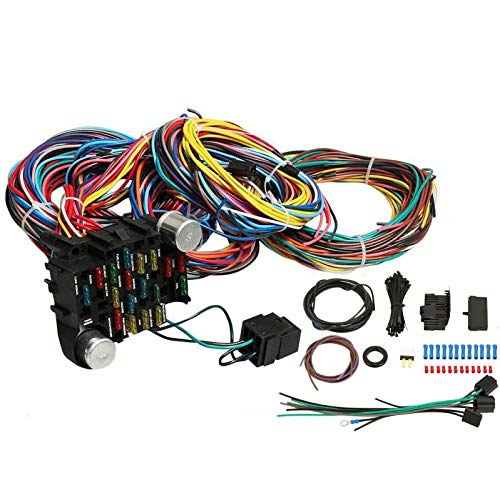
Extra-long wire runs for big cars, with 21 circuits to fill them.
Wiring a long wheelbase or a big-bodied car is where this kit earns its place. It runs extra-long wires with 21 circuits and 17 fuses, so the run from the fuse block to a rear taillight or a door-mounted power window does not leave you splicing in extensions. GM column connectors are included, and the design uses plug-and-play connectors for switched power, constant power, and ground.
The 21 circuits here are more than double the 8-circuit WMPHE kit, and that matters when you are listing wiper, radio, cruise and backup, heater and air, clock, dome, cigarette lighter, courtesy power, power door, power seat, fan power, coil, choke, instrument power, flasher, fuel pump, brake, power window, headlight, radio battery, horn, and more. The corresponding line is found by a font annotation on the fuse box.
The honest limits surface in the small details. Wire labelling is the weakest point — the marking is faint, and some of the numbered labels do not line up neatly with the connector ends, which leaves the included instructions doing too much of the work. An occasional fuse seat arrives a touch loose. Treat this as a kit that rewards a careful install — go over the terminals, check the diagram against your build, and it will serve a long car well.
Why it suits a long build: extra-long wire and 21 circuits give you the reach to route without splicing, plus GM column connectors in the box.
Reach for this if: you are wiring a longer car and want the extra run length together with a full 21-circuit load.
Think twice if: bright, easy-to-read wire markings are top of your list — the print here is on the faint side.
7. 21 circuit wiring harness Standard Color Wire Harness Kit

GXL 125 wire that resists grease, oil, gas, and acid, with 21 circuits to route.
The jacket is the headline. This harness uses GXL 125 high-temperature cross-linked polyethylene wire, jacketed to resist grease, oil, gas, and acid — a real comfort in an engine bay where a fuel line or an oil leak can reach a wire run. It carries 21 circuits, GM color coded for easier installation, covering horn, fan, dome light, hazard, radio, cigarette lighter, door locks, brake, headlights, trunk light, gauges, back up and cruise, wipers, choke, coil, air conditioning, electric fuel pump, power windows, and turn signals.
The kit includes detailed instructions with specific pages for GM, Ford, and Mopar, so the same harness can follow whichever chassis diagram you are working from. Wires run extra long to accommodate big builds. The trade-off sits in the wiring identification — the color coding is there, but the labels on some wires are faint or mislabeled, and the fuse holders have drawn criticism for feeling light. Professional installation is recommended, and that advice earns its keep here.
If you are experienced enough to identify wires by color chart and a meter, this is a capable 21-circuit kit with genuinely tough insulation. If you are new to this and leaning on the printed labels to guide you, look back to the top pick where the circuit names are printed clearly along every wire at regular intervals.
What stands out
- GXL 125 cross-linked polyethylene jacket resists grease, oil, gas, and acid
- 21 circuits with GM color coding across the full circuit list
- Instructions include dedicated GM, Ford, and Mopar pages
- Extra-long wires suit larger builds
What to watch
- Wire markings are on the faint side, so bring a meter and a color chart
- Fuse holders feel light — check them when the block goes in
- Best handled by an experienced installer
Best for: a seasoned builder wiring an engine bay who values tough wire insulation and 21 circuits.
Better elsewhere: if you lean on printed labels and a beginner-friendly manual, the top pick gives you clearer markings.
Know the Specs
Circuits and 12-volt line voltage
A circuit is one power path you can switch on its own — one for headlights, one for the horn, one for the fuel pump. A 12-volt system is the standard electrical voltage on a classic car, so a 12-volt harness matches the battery and charging setup your build already runs. More circuits mean more individual accessories you can power without sharing a feed, which is why a loaded dash calls for more than a simple build.
Wire labeling and GM color codes
Wire labeling means the circuit name or code is printed on the insulation, ideally at regular intervals like every 6 inches, so you can identify both ends of a run. GM color coding means the colors follow the General Motors convention, matching the diagrams most hot rod and muscle car builders already use. Together they let you trace a run by eye, rather than testing each wire with a meter.
Fuse blocks and fuse types
A fuse block is the panel where each circuit’s fuse sits. Pre-terminated means the wires arrive already crimped into the block at the factory, so you finish only the loose end of each run. Modern ATO bladed fuses replace the older glass fuse type, and a set of spare fuses in the box means a blown fuse mid-install does not stop the job.
Wire type and insulation
Copper core wire carries the current, and the jacket around it protects the copper from heat and chemicals. A high-temperature jacket matters most in the engine bay, where the wire runs close to exhaust and hot components. Cross-linked polyethylene jackets like GXL 125 are the type to look for if your runs pass close to fuel, oil, or acid-prone areas.
Common Questions
Will a universal wiring harness fit my classic car without modification?
How many circuits do I actually need for my build?
What does GM color coding mean on a universal harness?
Is a 21-circuit harness better than an 8-circuit harness for a hot rod?
Can I install a universal wiring harness myself or do I need a professional?
What is a pre-terminated fuse block and why does it matter?
Do these kits include connectors, relays, and spare fuses?
Should I use ATO bladed fuses or glass fuses on a rewire?
What wire type should I look for in a wiring harness?
Why do some harnesses show faint or missing wire labels?
The Bottom Line
The winner is the Painless Performance 10102, and the reason is simple: it prints every circuit name on the wire and hands you a fuse block that is already crimped. Twenty-one circuits cover a loaded dash, GM color codes keep it readable against your diagram, and the full-color manual is genuinely part of the product. Want the extra accessory bundle with relays, spare fuses, and a fuse tweezers already in the box? The TADYAO 14 Circuit is the tidy kit for the job. And for a stripped-down build where an 8-circuit harness covers the whole accessory list, the WMPHE 8 Circuit keeps the routing work light and the labeling clear.
How we choose
We do not accept paid placement. Every pick is matched to a real buyer and a real use-case; we do not hands-on test units.
Sources
Specifications: manufacturer listings and product documentation. Review insights: verified customer reviews, as of November 2026. Pricing: not shown on this page (it changes often); check the current price via the retailer link.
As an Amazon Associate, Tactical Gear Guy earns from qualifying purchases. This does not affect which products we feature.