Specs are compiled from manufacturer listings and verified buyer reviews and can change over time — please confirm the key details on the product page before buying.
Most factory car audio sounds flat because the speakers are built to a budget, not to a standard. The fix is rarely a bigger subwoofer or a louder amplifier — it is matching speaker sensitivity, RMS handling, and mounting depth to your vehicle and the volume you actually listen at. This guide covers nine real options, from component speakers and coaxial sets to under-seat subwoofers and full multimedia receivers, so you can match the right upgrade to the sound you actually want.
This guide is built by comparing the manufacturers’ published specifications and the patterns across verified customer reviews, so you get each pick’s real strengths and trade-offs instead of marketing spin.
You will see how power handling, sensitivity, and fitment interact, and which upgrades deliver the most noticeable improvement for the money. Every pick below is judged on RMS power handling, sensitivity, impedance, and fitment — the specs that decide how a speaker performs on a daily commute. The goal is simple: help you choose the right unique car audio upgrade without guessing.
Top Picks


How To Choose Unique Car Audio
The biggest mistake buyers make is chasing peak wattage. A speaker rated at 500W max might only handle 120W continuous (RMS), and that continuous figure is what actually determines how loud and clean it plays before distortion sets in. Match the RMS rating to your amplifier or head unit output, not the peak number on the box.
Sensitivity: The Number That Decides Your Volume
Sensitivity, measured in decibels (dB), tells you how efficiently a speaker converts power into sound. A 94dB speaker will play noticeably louder than an 88dB speaker on the same amplifier. If you are keeping your factory head unit and not adding an amp, prioritize high sensitivity — it means you get more volume without upgrading the power source.
Component vs Coaxial vs Midrange
Component speakers separate the tweeter from the woofer, letting you aim high frequencies at your ears for better staging. Coaxial speakers mount both drivers on one frame, which makes installation simpler but limits tweeter placement. Midrange drivers focus on the vocal range and work best paired with a dedicated tweeter. Choose components if you will mount separate tweeters for aimed staging; choose coaxials if you want a drop-in swap with the tweeter fixed to the woofer frame.
Side-by-Side Comparison
| Model | Best For | Max Power | RMS Power | Driver Size | Amazon |
|---|---|---|---|---|---|
| Pioneer TS-M651PRO★ Best Overall | Serious component staging | 500 W | 120 W | 6.5 in | Amazon |
| DS18 PRO-GM6.4PKTop Performer | Loud midrange and vocals | 480 W | 140 W | 6.5 in | Amazon |
| Seventour 10″ Under-Seat SubCompact Pick | Tight-space bass upgrade | 800 W | 220 W | 10 in | Amazon |
| Pioneer TS-A1681F | Simple 4-way drop-in | 350 W | 80 W | 6.5 in | Amazon |
| JVC KD-SX27BT | Budget Bluetooth head unit | 100 W | — | — | Amazon |
| JBL GTO629 | Factory-fit clarity | 360 W | 60 W | 6.5 in | Amazon |
| Kenwood KMM-BT332U | Alexa and EQ control | 100 W | — | — | Amazon |
| MTX Terminator Dual 12″ | Full bass system | 1200 W | — | 12 in | Amazon |
| Sony XAV-AX3200 | CarPlay/Android Auto screen | — | — | — | Amazon |
Detailed Reviews
1. Pioneer TS-M651PRO 6.5″ Component Car Speakers
Our pick — 4.5+★ from 750+ verified ratings; the strongest balance of quality and price.
The component set that turns a factory stereo into a proper sound stage.
The Pioneer P.R.O. Series TS-M651PRO is the top pick here for one concrete reason: 94dB sensitivity (how efficiently the speaker turns power into volume) paired with 120W continuous power handling. That combination means you get serious output without needing a monster amplifier. The 500W max rating is the peak the driver can survive on transients, not the everyday figure.
What wins people over is the sound quality — it is the most-praised trait by a wide margin in owner feedback, and the pulp cone (a lightweight paper-based material that resists distortion) is a big part of why. The frequency response runs from 50 Hz to 18 kHz, so you get deep lows and clear highs from a single component set. Weight sits at 5.68 pounds for the pair, versus 1.8 pounds for the Pioneer TS-A1681F coaxial set — a difference you will feel when you are holding both boxes, though it does not affect installation once mounted.
The honest catch is fitment. The tweeters are larger than some factory locations expect, and a handful of buyers found they needed adapters or custom mounting. Reliability feedback is mixed too — most report years of trouble-free play, but a few units arrived dead. That is a small slice of the overall picture, and it is worth testing both speakers before you button up the door panel.
What Earns Its Top Spot
- 94dB sensitivity means louder output from a stock head unit
- 120W continuous handling gives headroom before distortion
- Pulp cone keeps the midrange clean and accurate
- 50 Hz to 18 kHz coverage handles the full musical range
Where It Asks More Of You
- Tweeters run large and may need adapters in tight factory locations
- A few units have arrived non-functional, so test before sealing the door
Reach for this if: you want real component staging and have a little patience for tweeter mounting.
Think twice if: your factory tweeter spots are shallow and you want a pure drop-in job.
2. DS18 PRO-GM6.4PK Mid and High Complete Package
A four-piece package built to make vocals cut through road noise.
This DS18 kit bundles two 6.5-inch midrange drivers with two 1-inch aluminum super bullet tweeters and a built-in crossover, so the frequencies get split before they reach your ears. The midrange handles 140W RMS (continuous power) and 480W max at 4 ohms, while each tweeter takes 200W RMS and 300W max. If you want a shouty, forward sound that punches through highway drone, this is the set that does it.
The DS18 runs 140W RMS versus the Pioneer P.R.O.’s 120W, a modest edge in continuous power that matters if you are feeding them from a dedicated amplifier. The aluminum bullet tweeters are the defining feature — they project high frequencies hard and bright, which suits rock, metal, and vocal-heavy tracks but can feel harsh on mellow jazz. Sound quality is what earns the most praise in owner feedback, with “crisp and loud” being the recurring theme.
There is no hidden gotcha with the specs, but the tuning is opinionated. Bright tweeters reward a careful crossover setting and a willingness to dial the treble back on your head unit. The package also assumes you have door locations that can take a 6.5-inch driver, so measure before you buy.
Built for projection: the 1-inch aluminum bullet tweeters are the whole personality of this kit. Aim them toward the listener and they will carry detail over wind and tire noise that softer dome tweeters lose.
The trade-off to know: that same brightness can fatigue your ears on long drives if you do not trim the high end. It rewards tuning, not a set-and-forget install.
Made for: listeners who want loud, forward vocals and do not mind spending ten minutes on EQ.
Not the fit for: anyone chasing a warm, laid-back sound signature.
3. Seventour 10″ 800W Under Seat Car Subwoofer and Amp Package
Deep bass that slides under the seat instead of eating your trunk.
If your cabin has no room for a box, this is the workaround. The Seventour packs a 10-inch driver into a cast-aluminum enclosure that measures just 3.1 inches thick, so it tucks under most seats. The built-in amplifier means you do not need a separate amp — the enclosure, power cable, high-to-low converter, RCA cables, and a wired bass remote all come in the box.
The power figures are 800W peak and 220W RMS at 4 ohms, with a low-pass filter adjustable from 50 Hz to 150 Hz and bass boost of 0 to 12dB at 45 Hz. Those controls let you shape the bass to your cabin rather than accepting whatever the factory tuning gives you. Compared with the DS18 kit’s 140W RMS, the Seventour handles 220W continuous — more headroom for low-end duty.
The blue LED ring is a love-it-or-hate-it detail; some find it a cool touch, others want a way to switch it off. A few buyers also noted the under-seat fit varies by vehicle, so measure your seat clearance first. Sound quality and build quality both draw strong praise overall, which is why it earns a spot here.
Space-saving bass: a 3.1-inch-thick enclosure with a 10-inch driver is the entire argument for this unit. It gives you low end without surrendering cargo room.
Check before you buy: seat clearance varies widely between vehicles, and the glowing LED ring is not for every taste.
Right for: trucks, compact cars, and anyone with a packed trunk who still wants bass.
Skip if: your seats sit low to the floor or you prefer no ambient lighting in the cabin.
4. Pioneer TS-A1681F 6.5″ 4-Way Coaxial Car Speakers

The no-drama swap for a factory speaker that finally sounds alive.
This is the set you buy when you want better sound without cutting holes or running new wires. The 4-way design splits frequencies across four drivers on one frame, and at just 1.8 pounds for the pair it is far lighter than the 5.68-pound Pioneer P.R.O. component set above. Included 6-1/2-inch multi-fit adapters expand which vehicles it drops into.
Power handling sits at 80W continuous and 350W max — the lowest continuous figure among the Pioneer sets here, which is the honest limiter. If you plan to feed them from a big amplifier, the P.R.O. set handles 120W and gives you more room. But for a stock head unit or a modest amp, 80W is plenty, and the 91dB sensitivity means you still get good volume.
The frequency response spans 35 Hz to 29 kHz, which is the widest range on this list and gives you sparkling highs without a separate tweeter. Setup is genuinely simple thanks to the included adapters. Expect a slightly brighter top end than a component set, since the tweeter sits on the same frame as the woofer and cannot be aimed independently.
Why It Is The Easy Choice
- 4-way design delivers balanced sound without extra components
- Included multi-fit adapters widen vehicle compatibility
- 35 Hz to 29 kHz is the broadest range in this lineup
- Lightweight at 1.8 pounds for the pair
Where It Leaves Room
- 80W continuous is the lowest RMS figure among the Pioneer sets here
- Tweeter cannot be aimed separately, so staging stays limited
Go with it when: you want a clean upgrade on stock power with minimal wrenching.
Hold off if: you are planning a high-power amp and want maximum continuous handling.
5. JVC KD-SX27BT Car Stereo

A single-DIN head unit that gives old speakers a second life.
The JVC KD-SX27BT is the entry point to a modern stereo: 50W per channel from a built-in amplifier, Bluetooth for two phones at once, and a 1.5A USB port that charges while you play.
You get strong sound-shaping control here, and the 13-band EQ (13 sliders that each adjust a slice of the frequency range) does most of that work. Time Alignment and Sound Lift are designed to place sound where you expect it, up at ear level, rather than from the floor wells. For the money it is among the most configurable receivers here.
Two honest limiters bear mention. The clock has a stubborn reputation for losing time, and Bluetooth connectivity draws mixed feedback — a minority report that pairing with iPhones fails. Neither issue hits every unit, but if you need rock-solid hands-free daily, keep your phone cabled as a backup.
What you gain: 13-band EQ, K2 processing, and dual-phone Bluetooth make this far more than a basic radio.
What to watch: the clock drifts and some iPhone pairings fail — plan to keep a cable handy.
Best fit: anyone upgrading an older car on a tight budget who wants EQ control over raw power.
Look elsewhere if: flawless Bluetooth pairing is non-negotiable for you.
6. JBL GTO629 6.5″ Grand Touring Series Car Audio Speakers

Factory-sized 6.5s that make clean bass feel easy.
The GTO629 is a 2-way coaxial set rated at 180W peak and 60W RMS with 3-ohm impedance. That lower-than-usual impedance means the speaker pulls more power out of whatever amplifier you already have, which is why it is a smart match for a head-unit or factory-amp system. The 6.5-inch driver drops into factory locations with the right adapters.
Smooth bass and clear highs are the recurring description from owners, and the 3-ohm load explains part of why — you get more output from modest power. The set carries a 21 kHz frequency ceiling, so the top end stays open.
The fitting question is the one real unknown. Feedback on fit is genuinely split, with some reporting a perfect match and others finding alignment issues in their specific vehicle. That is a fitment question, not a quality one — check your vehicle’s speaker mounting depth before committing.
Where It Shines
- 3-ohm load gets more volume from modest amplification
- Smooth bass and clear tops are the consistent theme
- Factory-sized 6.5-inch form keeps installs simple
- 21 kHz ceiling keeps the treble open and airy
What To Verify First
- Fitment is vehicle-dependent, so measure your mounting depth
- 60W RMS rewards a sensible amp match rather than brute force
Made for: drivers who want clarity and smooth bass from a simple coaxial swap.
Do your homework if: your vehicle has unusual speaker depths or mounting angles.
7. KENWOOD KMM-BT332U Bluetooth Single DIN Car Stereo

The head unit that pairs with nearly everything you already own.
Audio streaming, hands-free calls, a 13-band equalizer with digital time alignment, and 6-channel preamp outputs — the KMM-BT332U is the most connected head unit in this group. Built-in Amazon Alexa means voice control for music and calls, and it is SiriusXM ready if you want satellite radio. It handles MP3, WMA, WAV, AAC, and high-res FLAC files.
The reason it lands here is flexibility. Equalizer settings earn strong praise, with owners highlighting multiple EQ options and convenient subwoofer controls. The 2.5-volt rear and sub preamp outputs let you hang a real amplifier off it. And the Music Mix feature lets up to five paired phones stream and control playback — useful in a shared family vehicle.
Two things to plan around. It does not play CDs, which matters if your library is still disc-based. Reliability draws mixed reports, and like any single-DIN unit it needs a wiring adapter to match your factory harness in many vehicles.
The connectivity argument: Alexa, SiriusXM compatibility, FLAC support, and 6-channel preamp outputs pack a lot of features into one chassis.
Plan the install: no CD slot and a needed wiring adapter mean this is not a ten-minute swap.
Pick it if: you stream everything and want the most feature-dense receiver in the lineup.
Not for: anyone still playing physical CDs or wanting a true bolt-in install without adapters.
8. MTX Terminator Dual 12″ Subwoofers
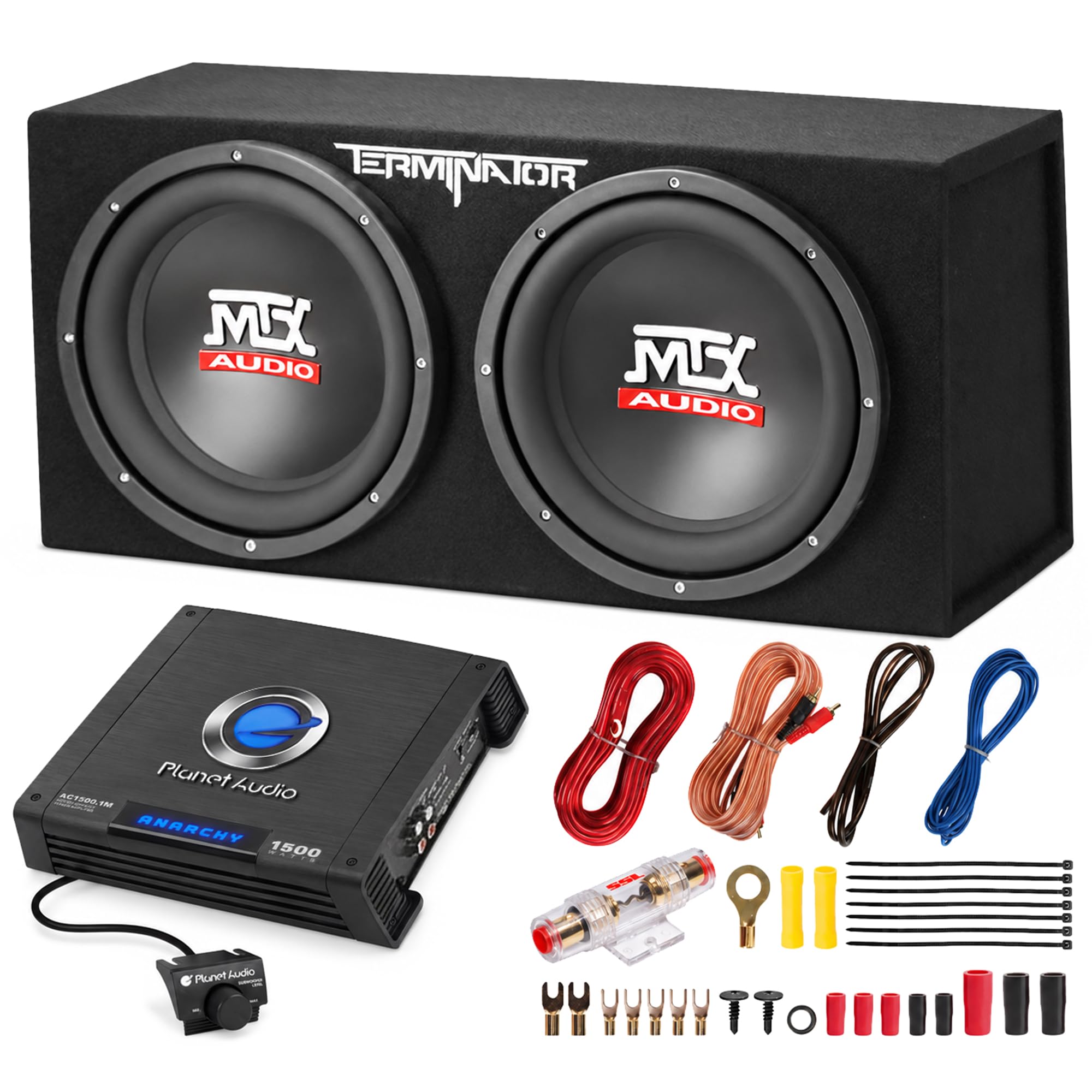
Two 12s, an amp, and a wiring kit — the full bass package in one box.
This system is not a speaker upgrade, it is an entire bass solution. You get the MTX 1200-Watt dual 12-inch enclosure, a Planet Audio 1500W monoblock amplifier, and a Soundstorm 8-gauge wiring kit. The 1200W figure is peak system load, not continuous output. The 5/8-inch MDF enclosure, black-carpeted, measures 13.5 by 26.63 by 14 inches, so it needs real trunk room.
Owner feedback on sound is the loudest signal here, with descriptions like heart-pounding bass and quality that holds up. Compared with the compact 10-inch Seventour, this is a much larger install — dual 12-inch drivers and a separate amplifier, not a self-contained box. You also need a compatible head unit or line-output converter, and your electrical system has to support the added load.
The included wiring kit is the weak spot. Its 8-gauge cables draw poor marks, and a few buyers report the supplied amplifier does not deliver close to its rated figure. If you budget for a better gauge wire and a more capable amp down the line, the enclosure and drivers themselves have a good reputation. Professional installation is the safer route.
The full-system advantage: enclosure, amp, and wiring in one purchase saves you from matching parts yourself.
Where corners got cut: the included cabling and the near-the-limit amplifier are the upgrade targets.
For the bass-obsessed: anyone with trunk space and an appetite for real subwoofer pressure.
Skip if: you want a self-powered box or you cannot spare the cargo area.
9. Sony XAV-AX3200 7-Inch Multimedia Receiver
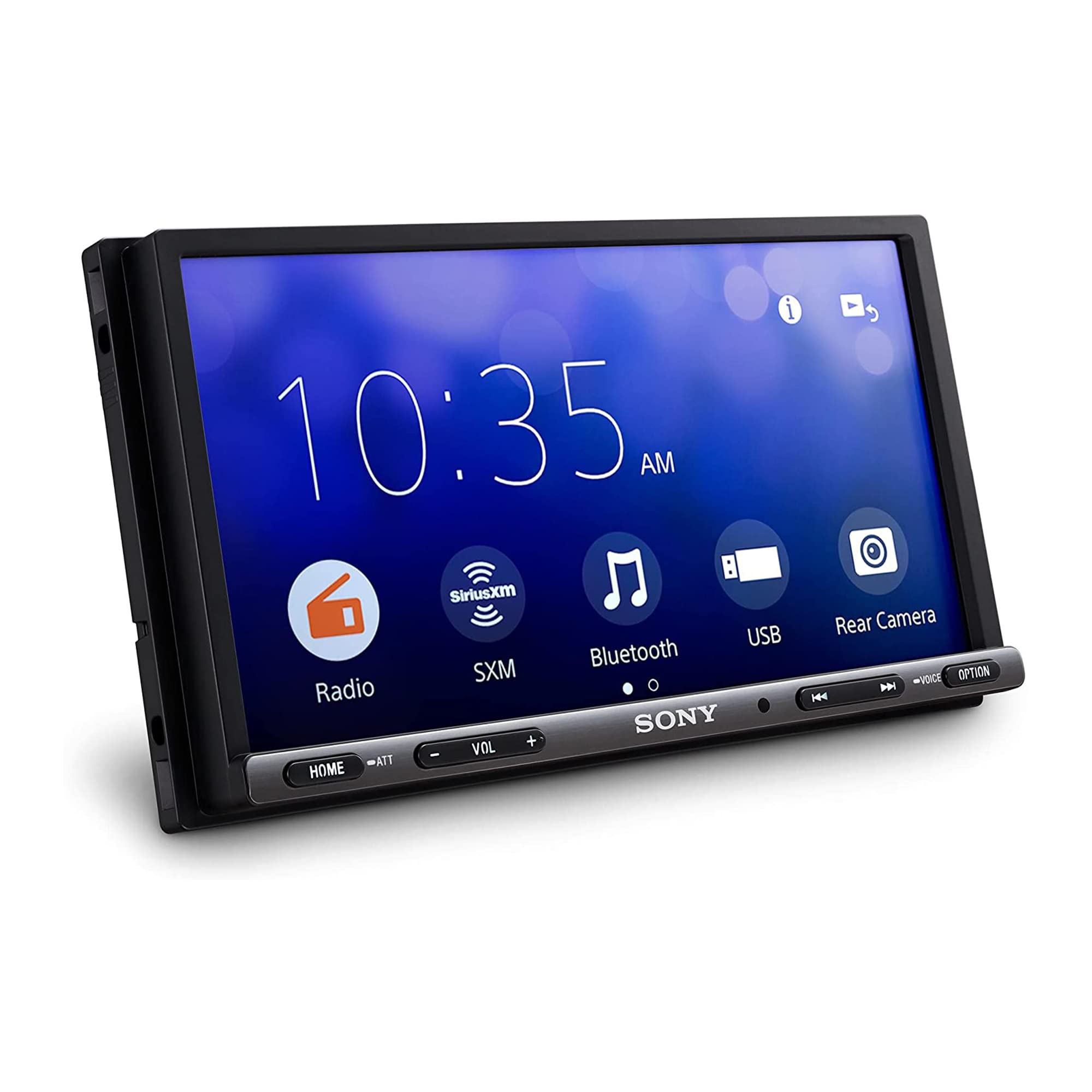
Maps, music, and calls on a 7-inch screen you can actually see.
The XAV-AX3200 brings Apple CarPlay and Android Auto to a 7-inch resistive touchscreen with an anti-glare coating. The compact rear chassis slips into more dash openings than a full-depth unit, and the built-in rear camera input, 2V front/rear/sub preamp outputs, and rear 3.5mm A/V input give you room to build on later. It is SiriusXM ready too.
If you want a modern screen, this is the pick that gets you there. Sound quality gets steady praise, and the interface is called intuitive in nearly every account. The anti-glare layer is a practical touch — factory glossy screens wash out badly in direct sun. The 55W x 4 peak power and 10-band EQ handle the basic tuning.
Be realistic about two things. The resistive panel is not as sharp or smooth as a capacitive phone screen, and display brightness is a genuine split — some find it fine, others note it struggles on the brightest days. The touch response is also slower than a modern phone.
The Case For A Screen
- Apple CarPlay and Android Auto on a 7-inch anti-glare display
- Compact rear chassis fits more dash openings
- 2V front, rear, and subwoofer preamp outputs
- Backup camera input and SiriusXM readiness built in
The Limits To Accept
- Resistive touch is slower and less sharp than a phone
- Sunny-day visibility divides opinion
Worth it for: drivers who want CarPlay and navigation on a dedicated dash screen.
Rethink it if: you do most of your driving in harsh direct sunlight or you dislike resistive touchscreens.
Know the Specs
Peak Power vs RMS Power
Peak power is the burst a speaker can survive for a fraction of a second. RMS power, or continuous handling, is what it can take all day without distorting. A speaker rated at 500W max and 120W RMS is a 120W speaker in daily use. That is the figure you match to your amplifier output — if your amp pushes 100W per channel and the speaker handles 120W RMS, you have a healthy match.
Sensitivity and Impedance
Sensitivity in dB tells you how much sound you get per watt. A 94dB speaker plays louder than an 88dB one on the same power. Impedance in ohms is the electrical resistance the speaker presents to the amplifier. A 3-ohm speaker pulls more current than a 4-ohm one, so it goes louder on modest power but stamps harder on the amp. Lower impedance is a way to get more output from the system you already own.
Common Questions
Will a 6.5-inch speaker fit my car’s factory location?
Do I need a separate amplifier to run these speakers?
What is the difference between 500W max and 120W RMS on the Pioneer P.R.O.?
Can I install an under-seat subwoofer in a truck with limited space?
Does the Sony XAV-AX3200 work with both Apple and Android phones?
How much trunk space does the MTX dual 12-inch enclosure need?
Is a component speaker set harder to install than a coaxial set?
Will a new head unit make my factory speakers sound better?
Why does the JVC KD-SX27BT lose time on its clock?
Are the MTX Terminator’s included amp and wiring enough?
The Bottom Line
The best unique car audio upgrade for most drivers is the Pioneer P.R.O. Series TS-M651PRO — 94dB sensitivity and 120W continuous handling mean real volume from modest power, with clear component staging. If you want to add bass without giving up cargo space, the Seventour 10-inch under-seat subwoofer is the space-smart pick. And for a screen with maps and music, the Sony XAV-AX3200 brings CarPlay and Android Auto to a 7-inch anti-glare display. Match each speaker’s RMS rating to your amp’s per-channel output, measure mounting depth and tweeter clearance before ordering, and the install goes smoothly.
How we choose
We do not accept paid placement. Every pick is matched to a real buyer and a real use-case; we do not hands-on test units.
Sources
Specifications: manufacturer listings and product documentation. Review insights: verified customer reviews, as of November 2026. Pricing: not shown on this page (it changes often); check the current price via the retailer link.
As an Amazon Associate, Tactical Gear Guy earns from qualifying purchases. This does not affect which products we feature.