Specs are compiled from manufacturer listings and verified buyer reviews and can change over time — please confirm the key details on the product page before buying.
If your desktop shuts off the instant the neighborhood power blinks, you already know the cost: lost work, a corrupted file, sometimes a dead drive. The fix is a UPS (an uninterruptible power supply — a box with a battery inside that keeps your PC and router alive for a few minutes after the wall outlet goes dead). The trick is buying the right one, because a unit too small dies in seconds and a unit too big wastes money on capacity you never touch. Here are seven that genuinely hold the line, sorted so you can pick in one sitting.
This guide is built by comparing the manufacturers’ published specifications and the patterns across verified customer reviews, so you get each pick’s real strengths and trade-offs instead of marketing spin.
You will see how outlet counts, battery chemistry and wattage ratings decide whether your machine rides out a two-minute dip or a full outage. Below is the shortlist of the best Uninterruptible Power Supply for PC buyers who want their work saved, their router fed, and their gear protected.
Top Picks


How To Choose The Best Uninterruptible Power Supply for PC
Start with your actual load, not the box size. Add up the watts your PC, monitor and router draw, then look for a UPS whose watt rating clears that number with room to spare. A unit rated close to your draw will trip its overload warning the moment you add a second monitor.
Watts versus VA — the number that matters
VA (volt-amperes) is the headline figure on the box, but watts are what your equipment actually consumes. A 1500VA unit here is rated 900W, and a 900VA unit is rated 480W. If you only read the VA number you can end up with less usable power than you planned for.
Why waveform matters to a modern PC
Cheaper units output a stepped, simulated sine wave; premium ones output a pure sine wave. A power supply with active PFC (the power-correction circuit in most modern desktop PSUs) can shut down when fed a stepped wave. If your desktop is recent and beefy, lean toward a pure sine wave model.
Outlets, AVR and battery chemistry
Count battery-backed outlets separately from surge-only ones — only the battery-backed ports keep gear running. AVR (automatic voltage regulation) trims brownouts back to a stable 120V without draining the battery. And battery chemistry decides long-term cost: standard lead-acid cells age out and need replacing, while a lithium-iron unit is rated for a far longer service life.
Side-by-Side Comparison
| Model | Best For | Power Rating | Battery Outlets | Battery Type | Amazon |
|---|---|---|---|---|---|
| CyberPower AVRG900LCD★ Best Overall | All-round desktop protection | 900VA/480W | 6 of 12 | Lead Acid | Amazon |
| APC BE600M1Router Saver | Router and small-office backup | 600VA class | 5 of 7 | Lead Acid | Amazon |
| SKE SK850 | Compact tower for a workstation | 850VA/480W | 6 | Lead Acid | Amazon |
| APC BX1500M | Long runtime for a full desk | 1500VA/900W | 5 of 10 | Lead Acid | Amazon |
| GOLDENMATE 1000VA | Low-maintenance lithium build | 1000VA/600W | 8 | Lithium-Phosphate | Amazon |
| CyberPower CP1350PFCLCD | Active-PFC desktops | 1350VA/880W | 6 of 12 | Sealed Lead Acid | Amazon |
| Tripp Lite OMNI1500LCDT | Servers and multi-device racks | 1500VA/810W | 10 | Lead Acid | Amazon |
Detailed Reviews
1. CyberPower AVRG900LCD Intelligent LCD UPS Battery Backup
Our pick — 4.5+★ from 650+ verified ratings; the strongest balance of quality and price.
Twelve outlets and a live LCD readout make this the desk-friendly default for most PC owners.
This is the crowd favorite for good reason: 4.5+ stars across 600+ ratings, and the power output is what buyers talk about most. The 900VA/480W rating gives you a real safety margin for a typical desktop plus monitor, and the front LCD shows you load and battery state at a glance instead of making you guess.
Outlet count is where it separates from the small APC below. This unit gives you 12 NEMA 5-15R outlets — six with battery backup and surge protection, six surge-only — against just 5 battery outlets on the APC BE600M1. That means your PC, monitor, router, modem and a couple of chargers can all stay live during an outage without daisy-chaining strips.
AVR (automatic voltage regulation) trims small sags and spikes back to steady power without touching the battery, so brownouts during a summer storm don’t eat your runtime before the real outage hits. It ships UL listed and carries a 3-year warranty that covers the battery too.
What earns its keep
- Six battery-backed outlets alongside six surge-only ports
- Front-panel LCD shows load and battery at a glance
- AVR corrects sags without burning battery reserve
- 3-year warranty that includes the battery
Where it asks patience
- Reliability is the most-discussed topic and the feedback is genuinely split — some units quit early
- Uses a stepped simulated sine wave, not pure sine
- Lead-acid cell rated for about 3 years before replacement
Solid pick for: a single desktop, monitor and router setup that needs a wide outlet spread and clear status readout.
Look elsewhere if: your power supply is active PFC and fussy about waveform — step up to the pure sine CyberPower further down.
2. APC UPS Battery Backup BE600M1
The compact unit built to keep your Wi-Fi alive when the block goes dark.
The spec that tells the story here is runtime: 23 minutes at a 100W load. That is enough to keep a router and modem humming through a short outage, or to shut a desktop down cleanly once the lights drop. Compare it to the APC BX1500M at 68 minutes and you see the trade clearly — this one is the router-and-desk-staples unit, not the server backup.
Setup wins people over. The functionality and ease-of-setup feedback is strongly positive, and most owners describe unpacking it and having it running in minutes. Five of the seven outlets carry full battery backup, with two surge-only ports for less critical gear. A built-in 1.5A USB port keeps a phone topped up even when the wall is dead.
The honest caveat is noise and long-term battery life. Alarm beeps and a high-pitched whine come up as a recurring gripe, and some batteries fail earlier than expected. The internal cell is replaceable (APC part APCRBC154, sold separately), which keeps the unit alive instead of forcing a full replacement.
Runtime read: 23 minutes at 100W is a safe-shutdown window, not an all-evening power source — size your expectations to that.
Fit note: best for a router, modem and one desktop; a full multi-monitor workstation will drain it fast.
Reach for this if: your priority is keeping internet and a modest desktop alive through short outages.
Think twice if: you need long runtime for heavy gear — the BX1500M’s 68 minutes suits that job better.
3. SKE SK850 850VA/480W UPS Battery Backup & Surge Protector
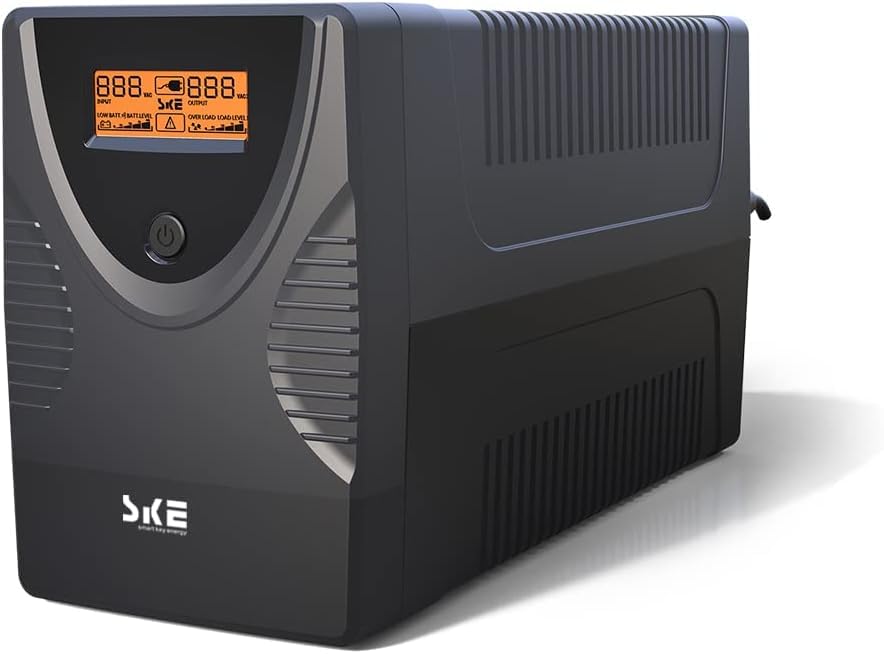
A metal-bodied tower that tucks beside a workstation without shouting for attention.
Reliability is the thing owners bring up most, and the feedback lands solidly on the positive side. The 850VA/480W rating covers a home-office desktop, and the metal enclosure stands up to being shoved under a desk far better than the plastic shells on most rivals. Six outlets, all on an IEC 320 connector, feed your PC, monitor and network gear.
One spec worth flagging: this unit draws 2.18 A, against 15 A on the CyberPower AVRG900LCD above. For a single workstation that lower draw is not a problem; it just tells you this is a modest home-office unit, not a rack-filling power plant. AVR voltage regulation and the LCD readout both do their jobs, letting you watch input voltage and load in real time.
Value is the one point where opinions divide, so weigh it against your needs rather than the badge. If you want a compact metal tower with a clear display for a single desk, it earns its place. If you are powering a gaming rig with a big GPU, look at the higher-wattage picks.
Build note: a metal enclosure is a genuine upgrade for desk life — it survives knocks and stays tidy in a tower form factor.
Size honesty: 480W of output covers an office PC, not a high-draw gaming build.
Suits: a home office with one desktop, a monitor and a router that wants a sturdy metal tower with an LCD.
Not for: a power-hungry gaming PC that needs every watt of headroom.
4. APC UPS Battery Backup & Surge Protector BX1500M
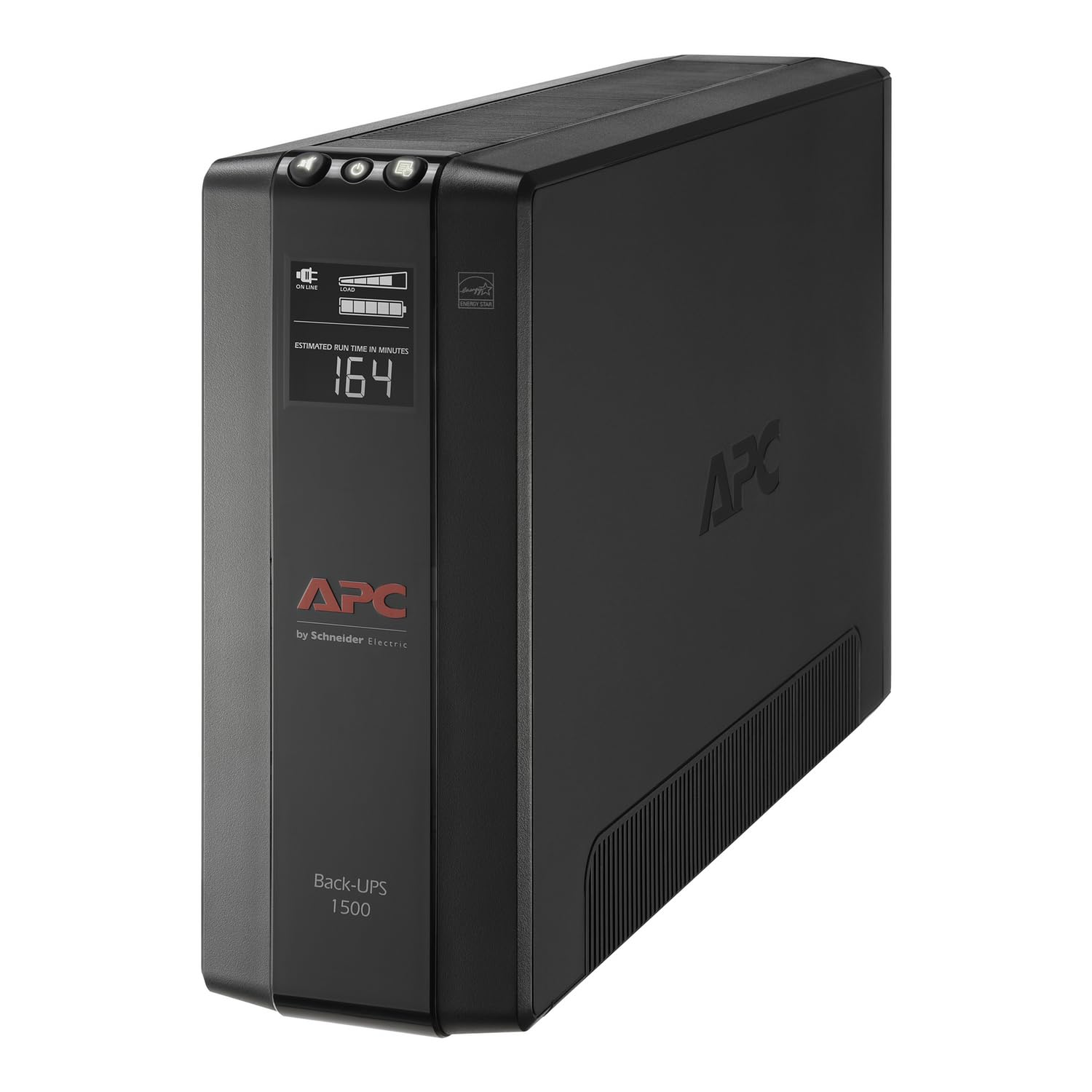
Sixty-eight minutes of runtime at a 100W load is the headline that sells this tower.
That runtime figure is the whole argument. At 68 minutes it is roughly triple the 23 minutes you get from the APC BE600M1 above, which is the difference between a quick safe-shutdown and actually riding out a long outage with your router still broadcasting. The 1500VA/900W rating gives a full desktop, dual monitors and network gear plenty of room.
Owners describe unpacking and setting it up in about an hour, then forgetting about it until the day it saves the machine. The LCD shows battery charge, estimated runtime, connected load and input voltage, and AVR holds output at a stable 120V. It is also active PFC compatible, which matters for modern power supplies. Ten protected outlets split into five battery-backed and five surge-only, plus coaxial and Ethernet dataline protection.
The catch is that this is a physically large tower — at 15.04 inches deep it is the biggest footprint on this list and needs real floor space under or beside the desk. Battery life and noise draw mixed notes, with a buzzing whine during operation and some cells losing capacity over time. The battery is replaceable via APC part APCRBC124, sold separately.
Argues its case
- 68 minutes at 100W outlasts the small APC nearly three to one
- 1500VA/900W covers a full multi-device desk
- LCD plus AVR keep you informed and protected from sags
Costs you room
- 15.04-inch depth demands real floor space
- Buzzing and whine come up as a recurring note
- Battery capacity fades for some owners over time
Good match for: a full desktop-and-monitors desk that wants long outage coverage.
Skip if: your space is tight — this tower is the largest in the lineup.
5. GOLDENMATE 1000VA/600W Lithium UPS

A lithium-iron battery rated at 10 years means you likely never swap a cell during the life of the PC.
The math is simple: 10 years of rated battery life here against roughly 3 years on the lead-acid CyberPower AVRG900LCD. That is a lifetime-of-the-machine purchase rather than a component you plan to swap. The LiFePO4 (lithium iron phosphate — a stable lithium chemistry) cell is rated for 10 years, which justifies the premium for anyone tired of swapping lead-acid blocks every 3.
Eight NEMA outlets all carry battery backup and surge protection, and this one outputs a pure sine wave — the clean waveform active-PFC desktop supplies prefer. A battery management system watches the cell, and a cooling fan keeps it quiet at under 50 dB (a whisper-level hum) and only spins up under heavy battery use. A color LCD shows live battery and power status.
The honest limit is output ceiling. This is a 1000VA/600W unit, and buyers report it doesn’t exceed 600W — which is fine for a standard desktop and network gear, but tight for a high-draw gaming rig or a workstation with a power-hungry GPU. Keep your connected load comfortably under that 600W rating.
Chemistry advantage: 10 years versus 3 years matters most if you keep gear for a long run and hate battery swaps.
Wattage ceiling: 600W caps what you can plug in — a heavy gaming build needs more headroom.
Choose it for: a mid-range desktop and network setup where a pure sine wave and a decade-long battery win out.
Pass if: your console runs a high-wattage GPU — 600W will feel tight.
6. CyberPower CP1350PFCLCD PFC Sinewave UPS Battery Backup

The pure sine wave output that keeps a fussy active-PFC power supply from shutting down.
If your desktop PSU shuts off the moment it hits a stepped waveform, this is the model built for you. It puts out a true sine wave and is explicitly designed to support active PFC and conventional power supplies alike — a meaningful step up from the simulated sine of the AVRG900LCD at the top. At 1350VA/880W it out-powers the smaller units and clears most single-GPU gaming desktops.
Twelve outlets split six battery-backed and six surge-only, the same layout as its smaller sibling but with more wattage behind it. The color LCD tilts up to 22 degrees, showing battery and power detail, and AVR corrects small fluctuations before they cost you battery. A 3-year warranty covers the battery, and the connected-equipment guarantee. Owner sentiment is overwhelmingly positive on reliability and quiet operation.
The one genuine trade-off is battery life feedback — some units deliver generous minutes, while a minority lose capacity faster. Lead-acid cells are rated about 3 years, so plan for a replacement down the road. It is also the priciest CyberPower here, which you pay mostly for the clean waveform.
Waveform payoff: pure sine output is the cure when a picked power supply refuses to run on stepped power.
Longevity note: the lead-acid battery ages out around the 3-year mark; factor a replacement into your plan.
Best for: a modern gaming or workstation PC with an active-PFC power supply that needs clean sine power.
Factor in: the lead-acid battery will need replacing eventually, so budget for it over the years.
7. Eaton Tripp Lite OMNI1500LCDT 1500VA UPS 810W 10 Outlets

Ten outlets and 810W of backup for a small server or a desk full of gear.
Performance is what owners talk about most, and it earns the praise. The 1500VA/810W rating powers a desktop workstation, a small server or a whole peripheral stack. Ten outlets give you room for a tower, monitors, a NAS and network gear without a single power strip, and 650 joules of surge protection back up the battery side.
The extras suit a home-lab setup. AVR corrects brownouts and overvoltages between 92V and 150V back to a safe 120V without leaning on the battery, so shaky utility power costs you nothing in runtime. It also carries 100 Mbps Ethernet RJ45 protection and telephone/DSL RJ11 dataline protection. A six-foot extension cord reaches a standard outlet, and the LCD reports runtime, wattage load, overload, AVR and battery status.
Two honest notes. The lead-acid cells are rated at 7.5 minutes average runtime, enough to shut down cleanly but not to ride out a long outage; the RBC51 cartridge is user-replaceable. And the display is bright and readable, but some wish the backlight could dim or switch off.
Why it holds up
- Ten outlets cover a full desk or small server
- 650 joules of surge protection plus battery backup
- AVR holds 120V steady across a wide input range
- Ethernet and phone line dataline protection built in
Know before buying
- 7.5-minute average runtime is a shutdown window, not extended run
- Backlight stays on and can’t be dimmed or turned off
- Lead-acid cells age out over time
Great fit for: a small server, workstation or multi-device desk that needs the most outlets and network protection.
Weigh carefully if: you need long runtime — the 7.5-minute average only covers a clean shutdown.
Know the Specs
VA and Watt Ratings
VA (volt-amperes) is the headline capacity; watts are the power your gear actually uses. A 1500VA unit here is rated 900W, and a 900VA unit is rated 480W, so always check the watt figure against your load. Size your draw comfortably under the watt rating or the unit will overload during an outage.
Sine Wave versus Simulated Sine Wave
Pure sine wave output mirrors the clean power from your wall and suits active-PFC power supplies. Simulated (stepped) sine wave is cheaper and fine for most gear, but some modern PSUs trip on it. If your desktop is recent and its PSU is active PFC, a pure sine unit is the safer bet.
Battery Chemistry and Lifespan
Lead-acid is the common cell and ages out over a few years, so a replaceable battery cartridge keeps the unit alive. Lithium-iron (LiFePO4) is rated around 10 years versus about 3 for lead-acid, so you buy fewer replacement cells. Match the chemistry to how long you keep your equipment.
AVR and Runtime
AVR (automatic voltage regulation) corrects sags and spikes without drawing on the battery, preserving runtime for true outages. Runtime itself is quoted at a set load (often 100W), so a heavier PC drains faster. Treat the quoted minutes as a shutdown window, not a promise of hours.
Common Questions
How many minutes will a UPS keep my PC running during an outage?
Does my PC need a pure sine wave UPS or is simulated sine fine?
What size VA and wattage UPS do I need for a gaming PC?
How often does a UPS battery need replacing?
Can a UPS keep my router and internet running when the power goes out?
Why does my UPS beep or whine during normal operation?
Will a UPS protect my PC from brownouts as well as blackouts?
How many outlets on a UPS actually run on battery?
Is it safe to plug a power strip into a UPS?
Can I replace the battery myself instead of buying a new UPS?
The Bottom Line
For most desktop owners, the uninterruptible power supply for pc winner is the CyberPower AVRG900LCD because it spreads 12 outlets across your whole desk with AVR and an LCD to watch it all. If you want a pure sine wave for an active-PFC power supply, grab the CyberPower CP1350PFCLCD. And for a small server or a desk full of peripherals, the Tripp Lite OMNI1500LCDT is the one to reach for.
How we choose
We do not accept paid placement. Every pick is matched to a real buyer and a real use-case; we do not hands-on test units.
Sources
Specifications: manufacturer listings and product documentation. Review insights: verified customer reviews, as of November 2026. Pricing: not shown on this page (it changes often); check the current price via the retailer link.
As an Amazon Associate, Tactical Gear Guy earns from qualifying purchases. This does not affect which products we feature.