Specs are compiled from manufacturer listings and verified buyer reviews and can change over time — please confirm the key details on the product page before buying.
You bought a camera to fit more of the world into one frame — and then you hit a wall, literally. Interior shots feel cramped, landscapes lose their sweep, and vlogs put your face in a giant bubble. An ultrawide angle lens is the fix, because it pulls far more of a scene into a single shot than your kit lens can. The trick is matching the lens to your camera mount, then picking an aperture and focal length for the light you actually shoot in. This guide covers the picks worth your money and where each one quietly falls short.
This guide is built by comparing the manufacturers’ published specifications and the patterns across verified customer reviews, so you get each pick’s real strengths and trade-offs instead of marketing spin.
Wide glass splits into two families: fixed-focal primes and zoom lenses that cover a range. Below are the models that hold up in real use, sorted so you can see exactly where your camera fits. My breakdown of the ultrawide angle lens covers mount compatibility, aperture speed, and honest trade-offs for each one.
Top Picks


How To Choose The Best Ultrawide Angle Lens
Before you compare sharpness, check the mount: a Sony E-mount lens will not fit a Nikon Z body, and a Canon EF lens needs the right adapter on a mirrorless camera. Get that wrong and every other spec is irrelevant.
Mount compatibility comes before anything else
Each lens here is built for one mount family: Sony E, Nikon Z, Canon EF, Fujifilm X, or Micro Four Thirds. Check your camera body’s mount name on the manufacturer’s spec sheet before you shop. Full-frame lenses also behave differently on APS-C bodies, where a lens’s field of view narrows because the sensor crops the image circle.
Prime versus zoom: pick by how you shoot
A prime lens has one fixed focal length, like 10mm or 20mm. It tends to be brighter and sharper because the glass is tuned for one distance. A zoom lens covers a range, like 14-30mm or 16-35mm, so you reframe without moving your feet. Real estate and event shooters usually prefer the zoom’s flexibility; night-sky and astro shooters tend toward the brightest prime they can afford.
Aperture speed and low light
A lower f-number means a wider opening that gathers more light. An f/1.4 or f/1.8 lens lets you shoot handheld in dim rooms and keeps noise down at night. An f/2.8 or f/4 lens needs more light or a slower shutter, but keeps the body smaller and the price friendlier.
Distortion control matters most indoors
Extremely wide lenses bend straight lines near the edges of the frame. Lenses marketed with “Zero-D” or close-to-zero distortion keep door frames and walls straight, which saves you correction work in editing. If you shoot architecture or interiors, that spec deserves real weight.
Side-by-Side Comparison
| Model | Best For | Focal Length | Max Aperture | Mount | Amazon |
|---|---|---|---|---|---|
| Sony FE 20mm F1.8 G★ Best Overall | All-round full-frame prime | 20mm | f/1.8 | Sony E | Amazon |
| VILTROX 9mm F2.8 EWidest View | Widest view on a budget | 9mm (13.5mm equiv.) | f/2.8 | Sony E (APS-C) | Amazon |
| Sigma 16mm f/1.4 DC DNLow-Light Star | Low-light Micro Four Thirds | 16mm | f/1.4 | Micro Four Thirds | Amazon |
| Fujifilm Fujinon XF16mmF2.8 R WR | Weather-sealed travel | 16mm | f/2.8 | Fujifilm X | Amazon |
| VILTROX AF 16mm F1.8 | Full-frame video work | 16mm | f/1.8 | Sony E | Amazon |
| Laowa 10mm f/2.8 Zero-D | Straight-line architecture | 10mm | f/2.8 | Sony E | Amazon |
| Canon EF 17-40mm f/4L USM | Budget L-series zoom | 17-40mm | f/4 | Canon EF | Amazon |
| Nikon NIKKOR Z 14-30mm f/4 S | Compact full-frame zoom | 14-30mm | f/4 | Nikon Z | Amazon |
| Canon EF 16-35mm f/4L IS USM | Stabilized landscape zoom | 16-35mm | f/4 | Canon EF | Amazon |
| Sony FE 14mm f/1.8 GM | Astrophotography prime | 14mm | f/1.8 | Sony E | Amazon |
| Nikon NIKKOR Z 14-24mm f/2.8 S | Pro constant-aperture zoom | 14-24mm | f/2.8 | Nikon Z | Amazon |
Detailed Reviews
1. Sony FE 20mm F1.8 G Full-Frame Ultra-Wide Prime Lens
Our pick — 4.5+★ from 650+ verified ratings; the strongest balance of quality and price.
A 20mm prime at 13.2 ounces that stays glued to the camera all day
You get a genuinely wide view without the stretched, warped corners of an extreme ultrawide, thanks to the 20mm focal length. That balance makes it the safest first wide lens for a full-frame Sony body — it handles real estate, scenery, landscapes, and vlogs without a compromise you notice. At f/1.8, the aperture (the opening that lets light in) is wide enough that dim rooms and evening streets stay clean instead of noisy. Its 20mm focal length is 2.2 times longer than the VILTROX 9mm on this list, so you crop in less and put less bend on people at the edges of the frame.
You get sharpness and close-focus ability that keep distortion low, so lines stay honest even when you shoot indoors. The focusing is quiet enough for video, and the two XD linear motors (Sony’s fast, near-silent focus motors) snap onto a subject quickly. Owners who hike and backpack rate the light carry highly, and the clickless aperture ring — a control dial that changes your f-stop with no hard clicks — lets video shooters change exposure without a jump in the footage.
It is not the absolute widest lens here. A 20mm view is roomy, not dramatic, so if you want an entire room in one frame with headroom to spare, a 14mm or 10mm will pull in more. There is no image stabilization inside this lens either, which is fine on a stabilized body but worth knowing. And while it is the crowd favorite by rating — 4.5+ stars across 650+ ratings — it carries far fewer reviews than the Canon 17-40mm’s stack, so treat the score as a strong signal rather than a huge sample.
What earns its keep
- f/1.8 aperture keeps low-light shots clean and blur controlled
- 13.2 ounces packs into a hiking bag without a second thought
- Clickless aperture ring makes f-stop changes silent for video
- Close focus keeps distortion low on interior and architectural work
Where it asks for patience
- 20mm is roomy but not the dramatic sweep a 14mm or 10mm gives
- No built-in stabilization, so a stabilized body does the work
- The prime view is fixed — you reframe by walking, not zooming
Reach for this if: you shoot a full-frame Sony and want one wide prime that handles scenery, interiors, and video in one carry.
Look elsewhere if: you need to pull an entire room into frame with dramatic width — go wider.
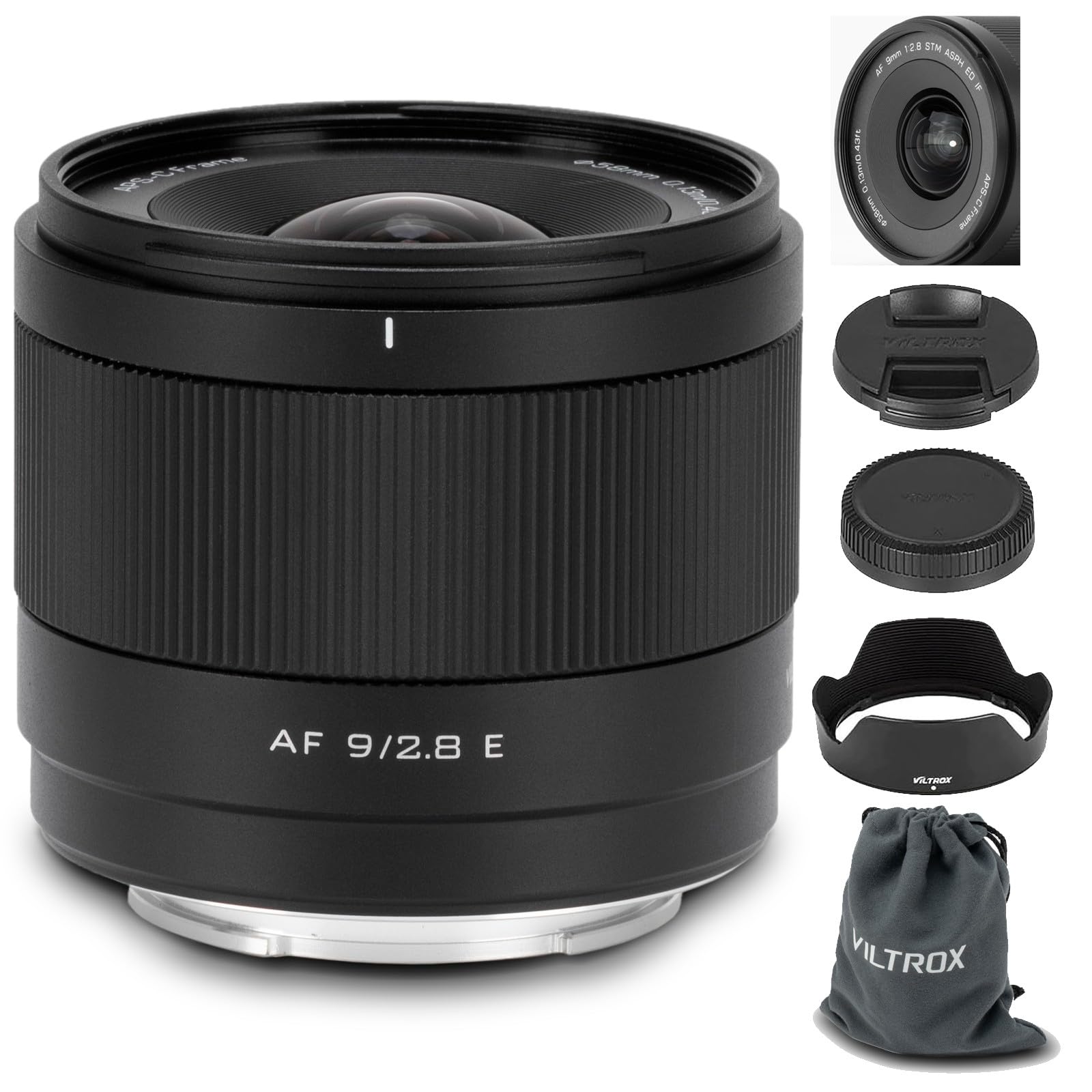
2. VILTROX 9mm F2.8 E
A 113.8° sweep that crams a whole room into a single frame
You get the widest view on this list: the VILTROX 9mm delivers a 113.8° field of view — the amount of the world the lens pulls into one shot — which works out to about a 13.5mm view on a full-frame camera. That beats the 105.6° angle of the VILTROX 16mm by a real margin, which is exactly the difference between “a room” and “the whole room plus the hallway.” It is built for Sony APS-C bodies like the A6000 line, ZV-E10, and A6700, and at 175g it disappears on the camera.
The near-focus trick is where this surprises people. With a 0.13m minimum focusing distance — the closest distance at which it can still lock focus — you can push right up to a foreground object and get that stretched near-far look in a single shot. Eye and face detection autofocus keeps your subject sharp when they are moving. Lens quality and image quality are what buyers rave about, and the value story holds up next to pricier glass. It ships with a hood, pouch, caps, and cleaning cloth so you are ready on day one.
Wait for it: this is APS-C glass, not full-frame. On a full-frame Sony body it will not cover the whole sensor, so the huge 113.8° view only tells the true story on an APS-C camera. Autofocus results are also split — quick in good conditions, slower in some situations. And this lens has no image stabilization, so a steady hand or a stabilized body keeps handheld night shots clean.
The buy for APS-C: the 113.8° field of view and 175g weight make it the widest, lightest option on this list for Sony APS-C, and the 0.13m close focus adds creative range most wides skip.
Honest check: it is crop-sensor only and autofocus speed is inconsistent, so fast-moving subjects can test it.
Best For: APS-C Sony shooters who want the widest possible frame for vlogs, tight interiors, and group selfies.
Not the one if: you shoot a full-frame Sony body or rely on lightning-quick autofocus for sports.
3. Sigma 16mm f/1.4 DC DN
The f/1.4 aperture that turns a dark room into a usable scene
Micro Four Thirds bodies fight for light, and this Sigma answers with a fast f/1.4 maximum aperture. That f/1.4 opening gathers 56% more light than the Sony 20mm’s f/1.8, which is the difference between a usable handheld interior shot and a noisy one. It translates to a 24mm equivalent focal length on M43, wide enough for interiors and landscapes but controlled enough for the edges to stay clean. The optical design uses 16 elements in 13 groups, with three FLD elements, two SLD elements, and two molded aspherical elements to keep color fringing and distortion in check.
What people love about it is the glass-like rendering and the creamy bokeh — the soft blur behind your subject. In low light the f/1.4 aperture keeps handheld shots clean without extra lighting. The 9-blade diaphragm and 67mm filter thread (standard screw-on filter size) keep it versatile. Build quality is praised alongside the sharp images, and the value holds up against pricier Panasonic and Leica wides.
The caveat is autofocus speed. It is not the quickest to lock on, and some find it slow compared to the fastest M43 glass. It is also 395g, noticeably heavier than the tiny ultrawides here. Plan around those two things and it is a brilliant low-light tool.
Why it earns a spot: the f/1.4 aperture makes it the fastest lens on this list, and the 24mm-equivalent view suits interiors, travel, and handheld night work equally.
The trade: slower autofocus and a 395g carry mean it rewards patience over speed.
Pick it when: your Micro Four Thirds body needs a fast wide that shoots clean in dark rooms and delivers creamy bokeh.
Pass if: you need the quickest autofocus for fast action.
4. Fujifilm Fujinon XF16mmF2.8 R WR Lens – Black

Built to keep shooting when the weather turns against you
Fujifilm shooters who wander with the camera in rain or dust get something specific here: nine seals around the barrel and a rating to work down to 14° Fahrenheit. That build, plus a compact frame, is why this ends up in a lot of Fuji bags. Edge-to-edge sharpness comes from 10 elements in 8 groups, two of them aspherical, which keep chromatic aberration and field curvature — the blur and bending that show up at the corners — under control.
Autofocus uses an inner-focus stepping motor, which moves internal glass with precise electrical pulses for fast, near-silent focus. It is the quiet focus that gets singled out almost as often as the optics. The lens is light enough that owners describe carrying it around town for handheld shots without noticing it. For landscape and street work it is a natural fit, and the color and sharpness are what earn the praise.
One honest limit: at f/2.8 it is not the fast glass for night skies. If deep low-light is your priority, the f/1.4 version of the same focal length exists — and some buyers size that up first. It is also a Fujifilm X-mount lens only, so it lives and dies by your body choice. For a travel and landscape wide, though, it is a strong, weather-ready answer.
Solid at the two things that matter
- Nine seals and a 14° Fahrenheit working low make rain and dust a non-issue
- Near-silent stepping-motor autofocus suits discreet street shooting
- Compact and light enough for all-day handheld carry
- 10 elements in 8 groups keep corners sharp
Know before you buy
- f/2.8 gives up low-light speed to the f/1.4 glass
- Fujifilm X mount only — no adapting to Sony or Nikon
Fits best with: Fujifilm shooters who hike, travel, and shoot in weather and want a compact wide that survives the trip.
Think twice if: your work is mostly after-dark.
5. VILTROX AF 16mm F1.8
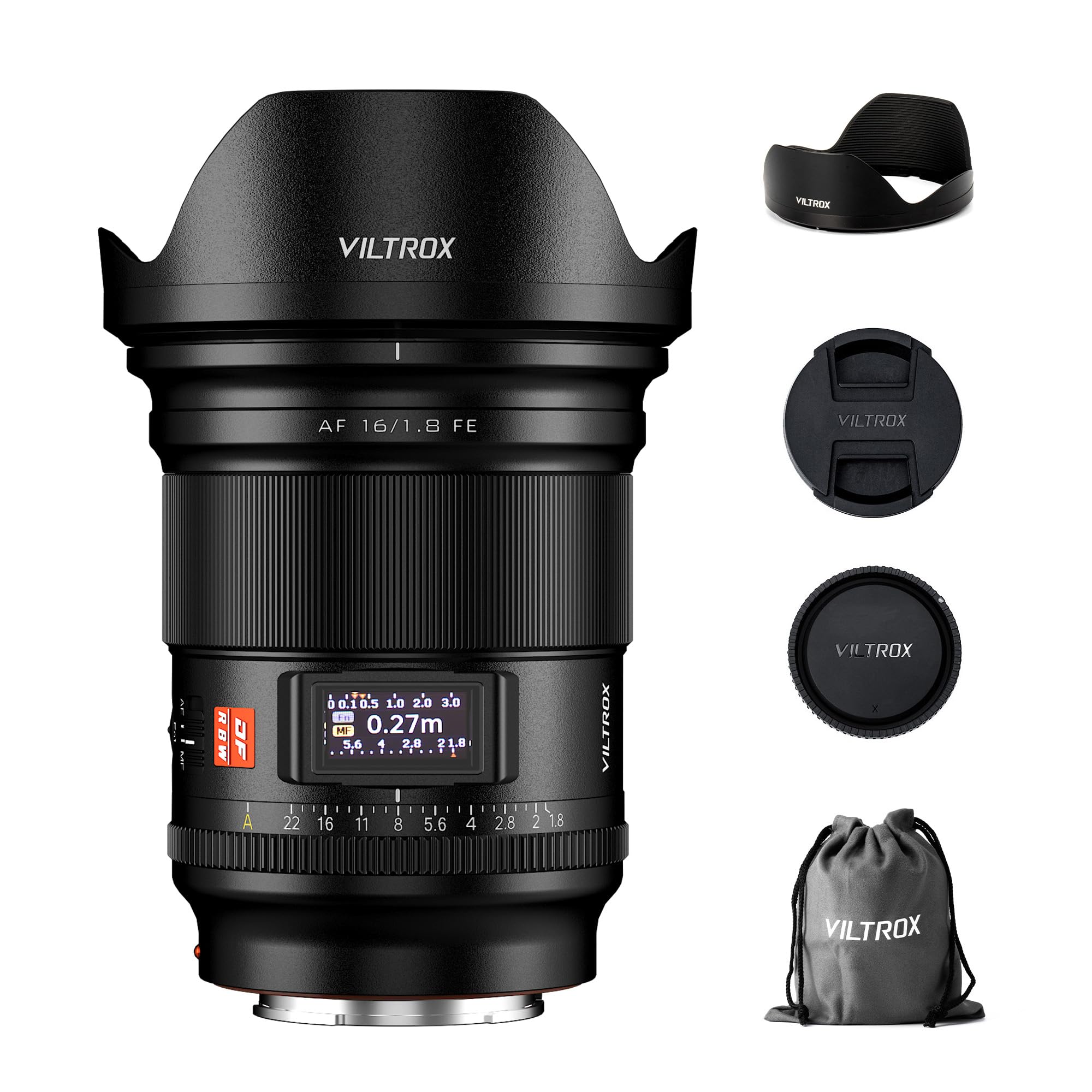
A full-frame 16mm with an LCD on the barrel and f/1.8 glass
You fit an entire room or skyline into the frame with a Sony a7 body, thanks to the full-frame 16mm wide view and 105.6° angle of view. The f/1.8 aperture keeps low-light work clean, and the shallow depth of field separates your subject from a softly blurred background. Optical construction runs to 15 elements in 12 groups, three of them aspherical, for high resolution across the frame. what separates it from most glass in this class is the built-in LCD on the lens barrel — it shows aperture and focus distance at a glance, so you keep your eye on the shot instead of the camera screen.
Quality is what gets brought up first and most often with this lens, with value right behind it. The STM stepping motor and eye/face tracking keep autofocus fast and quiet, and the manual focus ring is smooth enough for video pull-focus. For creators, the Fn1/Fn2 buttons, click switch on the aperture ring, and AF/MF lever make it a built-for-video tool. At 19.5 ounces it carries some heft, but the metal body and dust-protection structure justify it.
The heft is real — this is a heavy lens for a compact body, so a small camera can feel front-heavy. It is also Sony E-mount only. If you need the lightest possible carry, a prime like the Sony 20mm will feel handier. For full-frame video and everyday wide work, the barrel LCD alone makes this a practical pick.
What stands out: the built-in LCD for shooting parameters and the f/1.8 full-frame aperture are a rare combo at this level, and the video-focused controls (Fn buttons, click switch, AF/MF lever) set it up for creators.
The weight note: 19.5 ounces is heavy enough to notice, so pair it with a larger body.
Built for: full-frame Sony video shooters and hybrid creators who want a bright 16mm with control dials and a readout LCD.
Skip the idea if: you want the lightest carry possible.
6. Laowa 10mm f/2.8 Zero-D

A 130.4° full-frame view that keeps walls and door frames straight
Real estate photographers read “Zero-D” and pay attention. This full-frame 10mm suppresses distortion to a close-to-zero level, so both horizontal and vertical straight lines stay straight from corner to corner. The 130.4° angle of view pulls a dramatic sweep of a landscape into one frame. At just 7cm long and 0.93 lbs, it stays portable enough for travel and gimbal work despite the extreme width.
The close-focus capability is a quiet bonus: with a 12cm minimum focusing distance you can lean right up to a subject and get wide-angle macro-style shots with separation between the object and the background. Optics run to 15 elements in 9 groups, two aspherical and three ED, for sharpness and chromatic aberration control. Owners who shoot professional home tours talk about clean, crisp results in even the smallest rooms, and the distortion control comes up as its strongest suit.
The reality check is reach. At 10mm, that 130.4° view is extreme, and extreme means you must compose carefully or every frame drags in half a room of clutter. It is also a premium spend for a fixed-focal lens. If you want a flexible zoom or a tighter standard view, look elsewhere. If you want the widest clean-line full-frame option here, this is it.
Straight-line champion: close-to-zero distortion at 130.4° lets interior and architecture shooters skip most correction work, and 0.93 lbs keeps the wide carry manageable.
The catch: 10mm is very wide, so careful framing is required to avoid crowded edges.
Your lens if: you shoot architecture, real estate tours, or dramatic landscapes on a full-frame Sony and want distortion kept near zero.
Not your lens if: you want a zoom’s flexibility or a tamer edge-of-frame look.
7. Canon EF 17-40mm f/4L USM

The affordable door into Canon’s L-series wide zooms
For Canon shooters who want a zoom covering 17 to 40mm, this is the long-running value pick. The f/4 maximum aperture is constant across the range, so you do not lose light as you zoom in. Three aspherical elements and a super UD glass element hold optics together, and the ring-type ultrasonic motor gives fast, near-silent autofocus. It focuses as close as 11 inches and takes screw-in 77mm filters — a standard size that keeps filter shopping simple.
The lens quality and sharpness are what people single out, with build quality close behind. It is well made and light, and as a walk-around lens it makes easy work of weddings, events, and landscapes. Many owners find the wide end lets them capture small groups without constantly backing up. Weather-resistant construction means it shrugs off dust and moisture, and the results are clean.
Image quality gets a mixed report: some find it soft at wide-open apertures, and a visible vignette (darkening at the corners) shows up around 17mm. Stop it down and it cleans up. This is also an EF-mount lens for SLR cameras — on mirrorless it needs an adapter, and that changes how autofocus feels. For the money, a huge number of owners call it among the most useful buys they made.
Where the money goes
- Constant f/4 across the 17-40mm range keeps light steady as you zoom
- Three aspherical elements plus super UD glass for build-level sharpness
- Weather-resistant body handles dust and moisture
- Takes standard 77mm screw-in filters
The honest fine print
- Softer wide open and a visible vignette at 17mm until you stop down
- EF mount means an adapter for mirrorless bodies
Best For: Canon SLR shooters who want L-series wide coverage on a sensible budget.
Look past it if: you shoot mirrorless and want native mount focus speed.
8. Nikon NIKKOR Z 14-30mm f/4 S

A full-frame wide zoom that collapses flat enough to live in a sling bag
Nikon designed this one around packing. The retractable lens mechanism collapses the barrel down to 3.5 inches when not in use, so it fits into a small bag next to your other glass. The 14-30mm range with a fixed f/4 aperture covers everything from dramatic wide landscapes to tighter architectural shots. Corner-to-corner sharpness is the headline, and the lens stays usable even wide open at f/4.
What owners appreciate most is the lens quality and how well it behaves wider than 24mm without falling apart. Real estate shooters on Nikon Z6 bodies lean on it, and it handles close-quarters architecture where a longer lens would hit a wall. A stepping motor gives smooth, fast, quiet autofocus, and it takes standard 82mm screw-in circular filters — no cumbersome filter holders needed for polarizers and ND glass. It is light enough to hike with, and it performed without drama on real trips.
The f/4 aperture is a deliberate trade: this lens favors portability over night-sky speed. A distortion note comes up at the very wide 14mm end, so straight-line interiors may need a correction pass in editing. And while it is a strong value, the very fastest glass costs more and offers more light. For a walkabout wide on a Z body, the compactness is hard to argue with.
Why it carries: the 3.5-inch collapsed profile and 82mm filter thread make it a practical travel wide, while corner-to-corner sharpness handles architecture and landscape without a correction tax.
The trade-off: f/4 needs more light for astro, and 14mm distortion asks for a cleanup pass.
Takes the spot if: you own a Nikon Z body and want one wide zoom that packs small, focuses quietly, and takes standard filters.
Another route if: you need fast aperture for night skies.
9. Canon EF 16-35mm f/4L IS USM Lens – 9518B002, Black

Sharp corners plus stabilization that steadies low-light handheld shots
You get edge-to-edge sharpness even wide open and image stabilization rated up to four stops — two things that matter for landscapes and interiors. Those four stops of shake control mean you can handhold a dim room at a slow shutter and still walk away with a clean frame. Nine diaphragm blades keep out-of-focus highlights round, and full-time manual focus lets you tweak focus by hand even while autofocus is on — useful for video and critical sharpness.
Image quality and sharpness are where this lens draws the most praise. Owners shooting real estate and landscapes find it holds together in very low light handheld. The wide zoom range gets called out for flexibility, and some owners compare it to a macro lens for how close it focuses. It carried an APS-C body well in one report, and the stabilization got singled out for video rigs on a Glidecam.
It also lives on DSLRs or adapted mirrorless bodies. If your budget is firm, the 17-40mm above covers a similar range for less. If you want stabilization and sharper corners, this is the one to stretch for.
Where it wins: four stops of image stabilization plus corner-to-corner sharpness make it a handheld low-light specialist, and the full-time manual focus keeps critical shots in your hands.
The step-up cost: EF mount and a higher spend put it in premium territory over the 17-40mm.
Fits: Canon shooters who want stabilized, sharp 16-35mm coverage for landscapes, interiors, and handheld video.
Steer away if: you need native mount or the lowest cost wide.
10. Sony FE 14mm f/1.8 GM Prime Lens

A 14mm f/1.8 G Master built to pull stars out of a black sky
Bright glass and a very wide view is the astrophotography recipe, and this is it. The 14mm focal length reaches wider than the Sony 20mm on this list, and the f/1.8 aperture gathers enough light to shoot the Milky Way handheld or on a simple tripod. Two extreme aspherical (XA) elements, one aspherical, two ED glass, and one Super ED element, all under Nano AR coating II, work to keep contrast high and chromatic aberration, flare, and ghosting down. At 460g it is light for a G Master prime.
Owners describe it as sharpest and widest glass in their kit. The image quality holds from center to edge with detail and contrast in low light, and a 9-blade circular aperture gives smooth bokeh with round defocused highlights. The internal focus design makes it friendly for gimbals and small grips, so vlogging and video work get the same wide view. For tight interiors it also delivers — the wide angle captures far more of a small space than a standard lens.
The one honest wrinkle is that a lens this wide will show slight distortion, which is expected at 14mm and fixable. It is also a specialized prime — no zoom flexibility — so you reframe on your feet. For night-sky and dramatic wide work, though, few lenses combine this aperture and this view.
Built for the dark
- f/1.8 aperture pulls in enough light for handheld night-sky shots
- 14mm view outpaces the 20mm prime for sweeping landscapes and tight rooms
- 460g keeps a G Master prime bag-friendly
- Internal focus design works on gimbals and grips
Fair warning
- Some distortion at 14mm, expected for such a wide view
- Fixed prime — no zoom to reframe with
Your move if: astrophotography, night landscapes, or dramatic wide interiors are your priority on a full-frame Sony.
Look past it if: you want zoom flexibility or a tighter standard view.
11. Nikon NIKKOR Z 14-24mm f/2.8 S
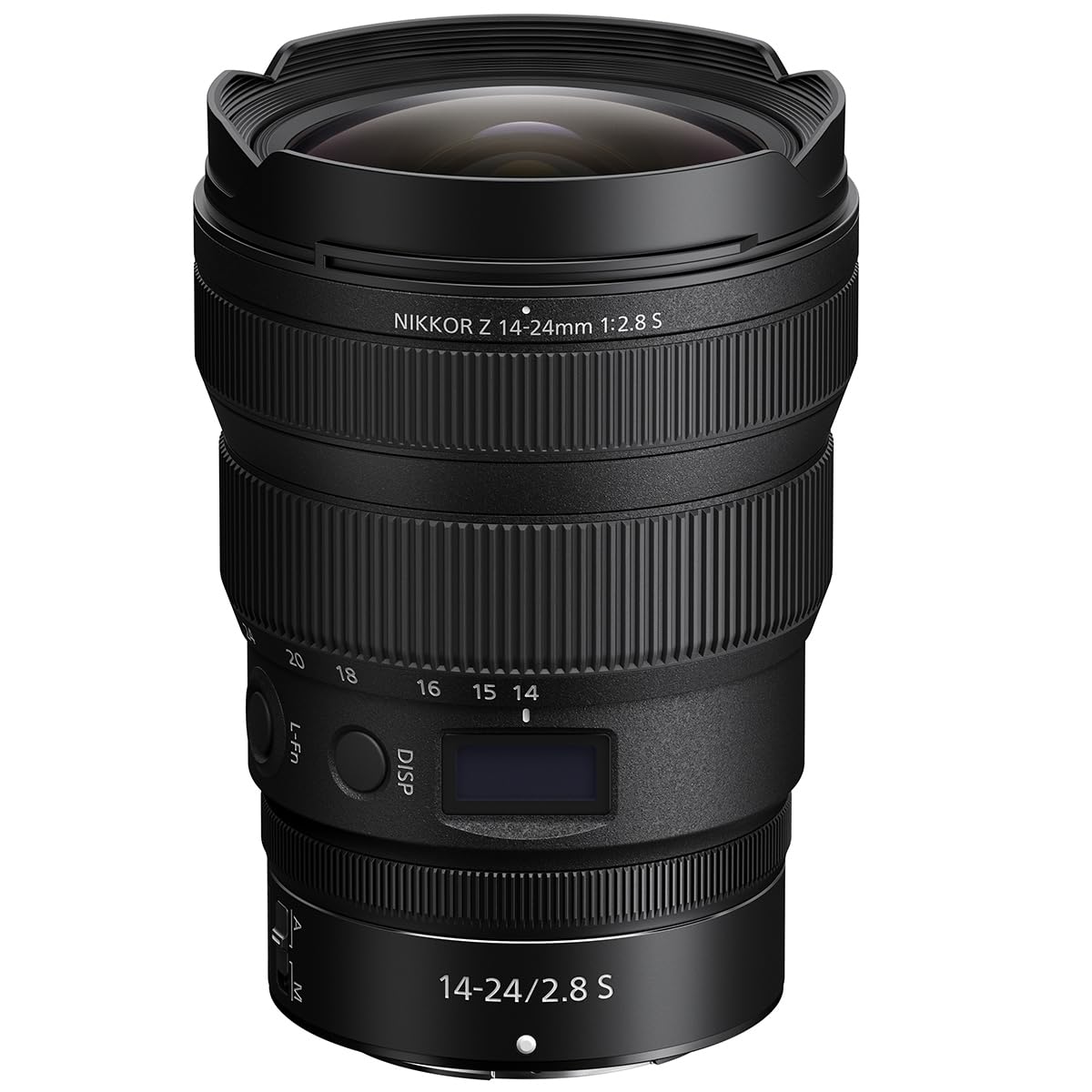
A constant f/2.8 full-frame zoom for the shooter who needs every stop
The pro argument for this lens is simple: a 14-24mm range with a constant f/2.8 aperture that never slips as you zoom. That means night skies, dim interiors, and evening cityscapes all hold up, and the Nano Crystal Coating keeps flare and ghosting controlled. At 650g with a weatherproof build, it is meant to go where the work is. It mounts to any Nikon Z body, and the optical design holds sharpness and resolution across the entire frame.
Image quality and the low-light reach are where it earns its keep. The f/2.8 aperture lets you shoot in challenging conditions and keep shooting, and the wide focal range means you frame an entire concert or event without swapping glass. It takes screw-in filters more easily than the older F-mount version, which owners call a real usability gain. The 14-24mm zoom range adds reach on top of the 14mm base wide view.
Two things are worth naming. It is big and heavy relative to the f/4 zooms — bulky enough to notice when packing, and the filters for it are costly. And the spend is stiff, with more owners questioning the value than anything else. If the constant f/2.8 is not something you will use, the lighter 14-30mm f/4 is the more sensible call. If you shoot paid night and event work, the extra stop justifies itself.
What the premium buys
- Constant f/2.8 across 14-24mm keeps night and interior shots bright at every zoom
- Nano Crystal Coating controls flare and ghosting
- Weatherproof build with 650g weight keeps it field-ready
- Takes screw-in filters more easily than the older F-mount design
Where it’s a burden
- Big and bulky enough to notice when packing
- Costly, with filters adding to the spend
For the working shooter: Nikon Z users who shoot paid night, event, and interior work and need a constant f/2.8 wide zoom.
Not for: casual shooters who can live with f/4 and want a lighter bag.
Know the Specs
Focal length and field of view
Focal length — the number in millimeters on the lens — sets how much of a scene fits in frame. A smaller number like 10mm or 14mm pulls in more and bends edges harder; a 20mm or 24mm keeps the frame wider than a standard lens without extreme stretch. On an APS-C or Micro Four Thirds body, the smaller sensor crops the image, so you see a narrower view than the same focal length on a full-frame camera. That is why the VILTROX 9mm on APS-C equals roughly a 13.5mm view on full-frame.
Maximum aperture and light gathering
The f-number is the size of the lens opening. A lower number such as f/1.4 or f/1.8 lets in more light, which keeps handheld interior and night shots clean and gives you a soft, blurred background. A higher number such as f/4 needs more light but keeps the lens smaller, lighter, and easier on the wallet. A constant-aperture zoom holds the same f-number through its whole range, so zooming in does not dim your shot.
Distortion and straight-line control
Extremely wide lenses bow straight lines near the frame edges — door frames lean, horizons curve. Lenses that advertise close-to-zero distortion, like the Zero-D design, keep those lines straight so you skip most correction later. If you shoot architecture, real estate, or product interiors, this spec saves real editing time.
Minimum focusing distance
This is the closest distance at which the lens can still lock focus. A short number like 0.13m or 12cm lets you push right up to a foreground object and create a dramatic near-far look with a wide view. A longer distance means you step back before you can focus, which matters in tight rooms.
Common Questions
Will a Sony E-mount ultrawide lens fit my Nikon Z camera?
Can I use an APS-C ultrawide lens on a full-frame camera?
Is a prime or a zoom better for real estate photography?
How wide do I need for astrophotography?
What does Zero-D distortion mean on a wide lens?
Do ultrawide lenses need image stabilization?
Will a Canon EF ultrawide work on a mirrorless camera?
Can I use screw-in filters on an ultrawide lens?
What is the difference between 16mm on APS-C and 16mm on full-frame?
Do I need weather sealing on an ultrawide lens?
The Bottom Line
For most full-frame Sony shooters, the ultrawide angle lens that gets the call is the Sony FE 20mm F1.8 G. It hits a balance few wides manage: a true-wide 20mm view, a bright f/1.8 aperture for dim rooms and evenings, and a 13.2-ounce carry that disappears in a bag. If you shoot Micro Four Thirds and live in low light, the fast f/1.4 glass of the Sigma 16mm f/1.4 is your move. For architecture and interiors where bowed walls would wreck the shot, the close-to-zero distortion of the Laowa 10mm f/2.8 Zero-D earns its place. And if you want the widest frame on APS-C for vlogs and tight spaces, the VILTROX 9mm pulls in a 113.8° view at 175g.
How we choose
We do not accept paid placement. Every pick is matched to a real buyer and a real use-case; we do not hands-on test units.
Sources
Specifications: manufacturer listings and product documentation. Review insights: verified customer reviews, as of November 2026. Pricing: not shown on this page (it changes often); check the current price via the retailer link.
As an Amazon Associate, Tactical Gear Guy earns from qualifying purchases. This does not affect which products we feature.