Specs are compiled from manufacturer listings and verified buyer reviews and can change over time — please confirm the key details on the product page before buying.
You want a giant picture without mounting anything to the ceiling, and you want it to survive a room with the curtains open. That is exactly what an ultra short throw laser projector does: it sits on your media cabinet and throws a huge image up from inches away. The catch: brightness, contrast and throw ratio swing widely across these machines. Here is what separates them.
This guide is built by comparing the manufacturers’ published specifications and the patterns across verified customer reviews, so you get each pick’s real strengths and trade-offs instead of marketing spin.
Below are eight projectors worth your time, sorted by the room and the viewer they suit. The quick table sums up throw ratio, brightness, and contrast side by side, which is how you should read every one of these. Start here for the ultra short throw laser projector that matches your wall.
Top Picks

How To Choose The Best Ultra Short Throw Laser Projector
Buying one of these is really two purchases: the projector and the screen you put it in front of. Get the throw ratio wrong and the projector hangs off the front of your cabinet. Get the screen wrong and you lose the brightness you paid for.
Measure the cabinet before you read anything else
The throw ratio tells you how far the projector has to sit from the wall to make a given picture size. A 0.25:1 ratio means the unit needs roughly 8.5 inches from the wall for a 100-inch image. A 0.175:1 ratio needs about 7.6 inches for the same picture. That difference matters when your media console is shallow — the tighter ratio lets you place the projector properly on a shallower shelf.
Brightness in the real world
Laser projectors hold their brightness better than lamp models, but the number still decides how forgiving your room is. Watch for the labeling: ISO lumens and ANSI lumens are different measurement standards and are not interchangeable. A unit rated around 4,000 lumens is aimed at daytime sports and living-room lighting. Anything around 1,800 to 2,500 lumens is best in a dim room or paired with an ambient-light-rejecting screen.
Contrast and black levels
Contrast ratio is how far a projector can push a bright highlight and a dark shadow at the same time. Higher is better for dark scenes, where you want the black space around a space station to actually look black. Some units add dynamic laser dimming, which lowers the laser output during dark scenes to deepen black further.
The screen and the wall behind it
A dedicated ambient-light-rejecting screen is what makes an ultra short throw projector usable with the lamps on. It is a fixed screen with a specially shaped surface, so budget for it the same way you would a television. A plain light grey wall can work in a dark room, and several buyers report exactly that with their own walls.
Side-by-Side Comparison
| Model | Best For | Throw Ratio | Brightness | Contrast Ratio | Amazon |
|---|---|---|---|---|---|
| AWOL VISION LTV-3000 Pro★ Best Overall | Built-in center-channel sound and 3D | 0.25:1 | 2000 lm | 2500:1 | Amazon |
| XGIMI MIRAClosest To The Wall | Tight spaces and built-in Google TV | 0.175:1 | 2000 ISO lumens | 20000:1 | Amazon |
| NexiGo Aurora ProGamer’s Screen | Console gaming at 4K 120Hz | — | 2400 lm | at least 3000:1 | Amazon |
| Nova Pro | Native Netflix and family viewing | 0.23:1 | 2100 ISO lumens | 3000:1 | Amazon |
| Formovie Theater | Dark-room movie nights | — | 1800 ISO lumens | 3,000+:1 | Amazon |
| Hisense PT1 | Daytime sports and bright rooms | — | 2500 ANSI lumens | 3000:1 | Amazon |
| NexiGo Aurora Pro MKII | Low-latency gaming plus deep blacks | 0.21:1 | 2400 lumen | 30000:1 | Amazon |
| Epson EpiqVision LS800 | Bright rooms, no color-wheel artifacts | — | 4000 lumen | Over 2,500,000:1 pixels | Amazon |
Detailed Reviews
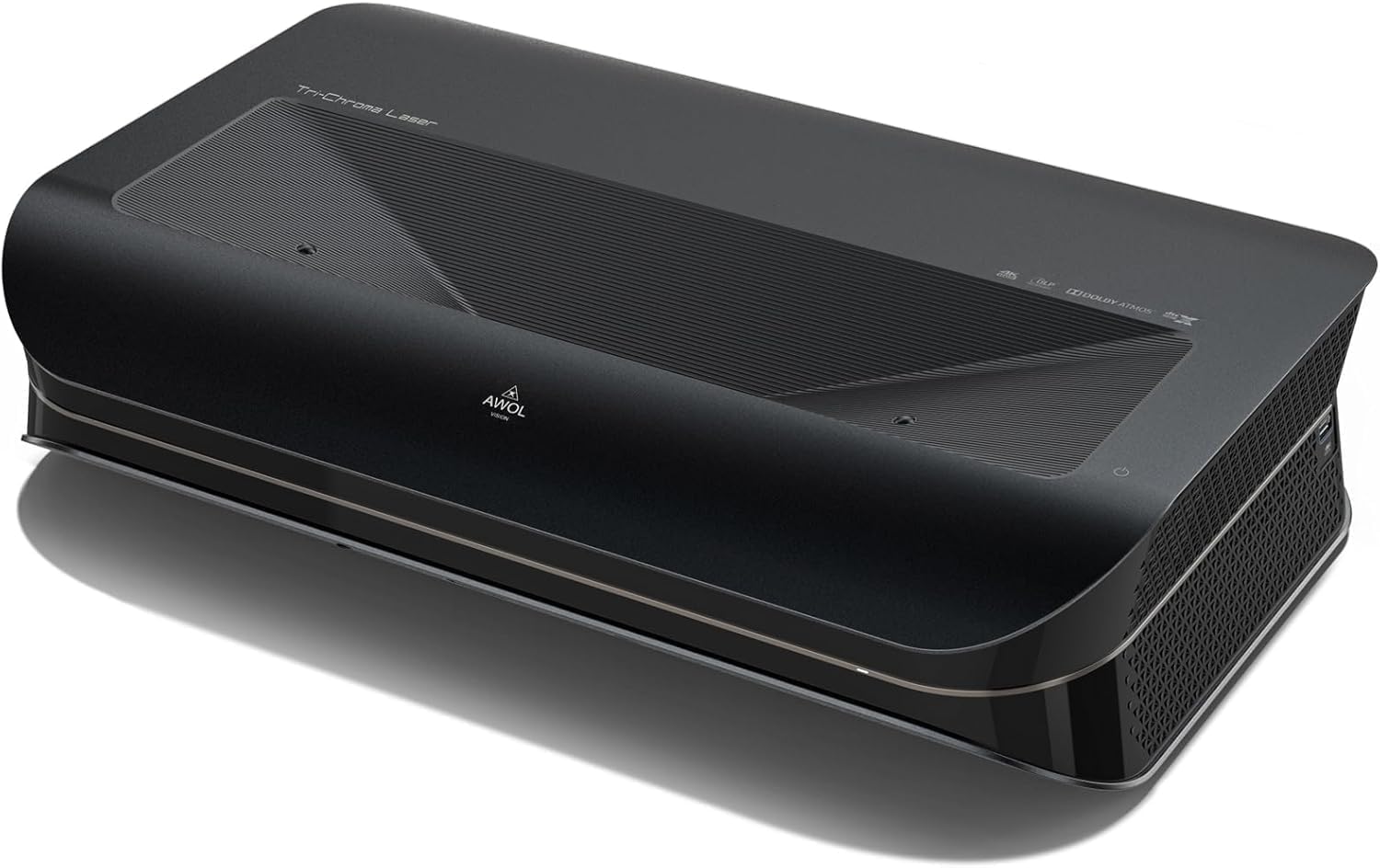
1. AWOL VISION LTV-3000 Pro Projector
Our pick — 4.0+★ from 200+ verified ratings; the strongest balance of quality and price.
The projector that puts the dialogue speaker inside the box, so nobody has to find room for a soundbar.
Start with the placement math, because it decides whether this fits your room at all. The AWOL LTV-3000 Pro uses a fixed 0.25:1 throw ratio — roughly 8.54 inches from the wall for a 100-inch image, and 12.84 inches for the full 150 inches. If your cabinet is deep enough to sit it there, you get a big picture from a piece of furniture. If not, AWOL sells a motorized slider that moves the unit forward and back for focus and screen size.
Its triple laser engine has no color wheel, so there is no spinning disc to wear out or flicker. It covers 107% of BT.2020 and 147% of DCI-P3, which in plain terms means the color range reaches past what a cinema projector targets. Dolby Vision and HDR10+ both land on top of that. The contrast ratio is 2500:1, which is the honest figure here — the XGIMI MIRA lists 20000:1 on its spec sheet, so if a pitch-black space scene is your priority, that is a real gap to weigh.
Where it earns its place is the center channel. AWOL maps a dedicated center speaker so the dialogue comes from the screen itself, and it pairs with their ThunderBeat surround system for a 5.2.2 layout. Picture quality is the thing owners rave about, and the color accuracy and brightness hold up with the curtains open. The recurring gripe is screen pairing: this unit is happiest in a dark room or behind AWOL’s own ALR screen, and their listing steers you toward a screen guide for a reason. The LTV-3000 Pro is the pick when you want a complete theater in one box.
What It Brings To The Wall
- Built-in center-channel speaker puts dialogue at the screen instead of off to the side
- Triple laser with no color wheel — 107% BT.2020 and 147% DCI-P3 coverage
- Dolby Vision, HDR10+, Dolby Atmos and 3D support in one unit
- PJ Link IP control for home automation systems like Control4
Where It Pushes Back
- Fixed 0.25:1 ratio needs a deeper cabinet — 12.84″ for 150 inches
- 2500:1 listed contrast sits well below the XGIMI MIRA’s 20000:1 figure
- Wants an AWOL ALR screen to look its best in daylight
Reach for this if: you want the projector to be the whole theater — dialogue, surround, 3D and 4K from one cabinet-top box.
Check your console first: the fixed 0.25:1 ratio and 12.84-inch distance for a 150-inch image leave no room for a shallow shelf.
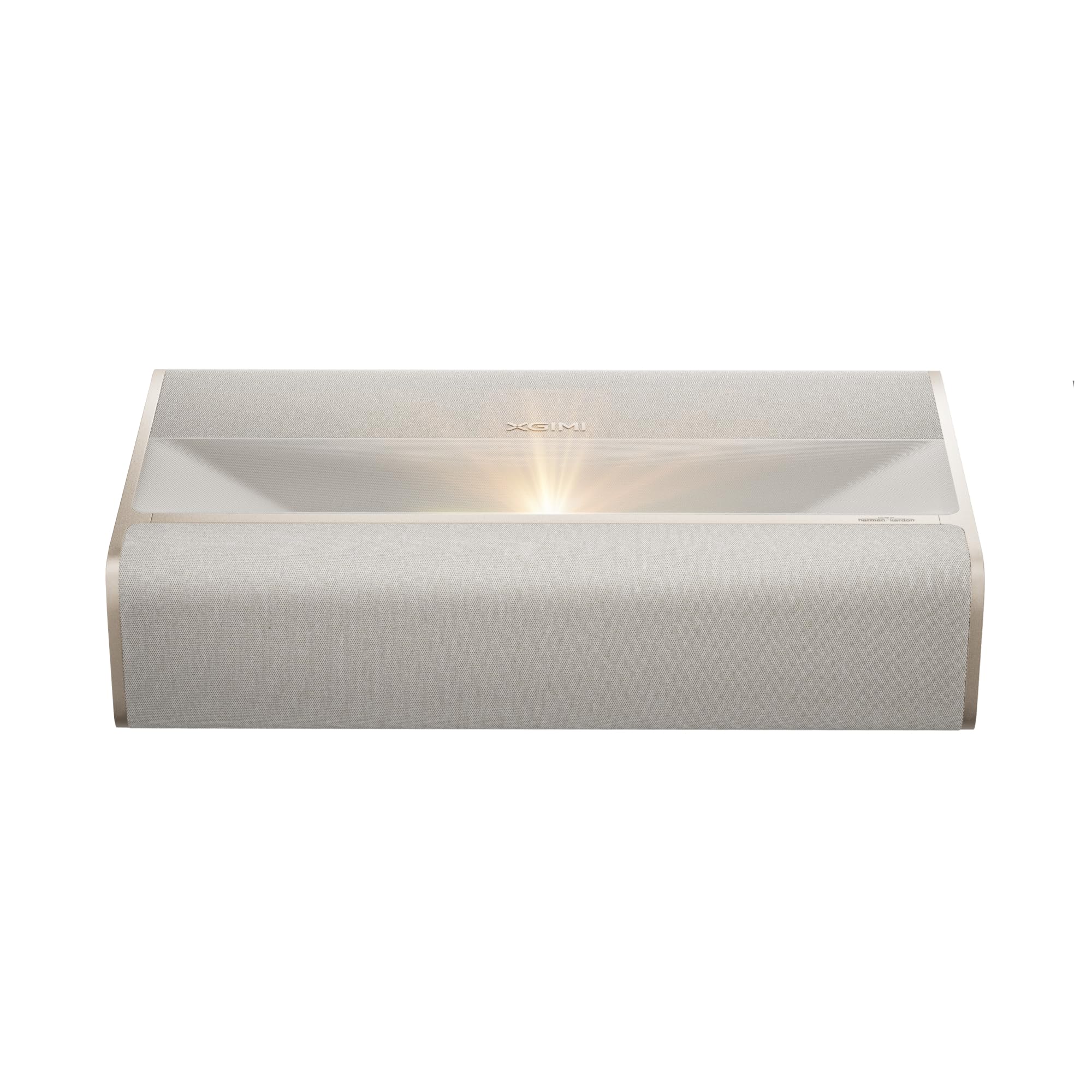
2. XGIMI MIRA 4K Triple Laser Ultra Short Throw Projector
Seven and a half inches from the wall buys you a hundred-inch picture — the tightest squeeze on this list.
If your media console is shallow, this is the reason to read on. The MIRA’s 0.175:1 ratio projects a 100-inch image from about 7.6 inches away, against the AWOL’s 8.54 inches for the same size. That is the difference between a projector hanging over the front edge of a slim shelf and one sitting properly on it. Apartments, bedrooms and narrow living rooms are the whole target here.
Inside, it is an RGB triple laser rated at 2000 ISO lumens with a 110% BT.2020 color gamut and a stated ΔE<1 color accuracy — the last figure describes how close the projected color sits to the source, and under 1 is a tight margin. The 20,000:1 contrast ratio (with dynamic black enabled) is the headline spec of this list, and it is what makes dark scenes look like dark scenes. Dolby Vision, HDR10+, HLG and MEMC motion smoothing all come along, plus 36W of Harman Kardon audio and Google TV built in.
Owners are clear about what works: the picture quality draws the most praise, the audio gets close behind it, and the fact that it vanishes against the wall without cluttering the room comes up again and again. Reliability is the honest friction point — the review pages carry a report of a unit failing after 10 days, and that thread shows up in the consensus as a genuine disagreement rather than a one-off. Buy this for the room-saving ratio and the contrast, not as the safest long-term bet on the list. The XGIMI MIRA is the space-saver’s answer.
The ratio that matters: 0.175:1 against the AWOL’s 0.25:1 — that gap is the whole argument for a small room.
The honest trade-off: a 2000-lumen rating and mixed reports on long-term reliability mean you are buying placement and contrast, not guaranteed years of service.
Best for the cramped wall: anyone whose cabinet depth rules out a wider throw, and who wants Google TV and real audio without extra boxes.
Think twice if: you want the most proven track record on the list — this one asks you to accept a little more uncertainty.
3. NexiGo Aurora Pro Projector
The one built around a controller instead of a remote — 8ms of lag on a wall-sized screen.
Console players get the clearest instruction here. It accepts 4K at 120Hz and lists 8ms input lag — the lowest tested figure among ultra short throw projectors. Input lag is the delay between your button press and the on-screen reaction, and 8ms is roughly the point where you stop feeling it. Add 120Hz MEMC motion smoothing and the ghosting that ruins fast camera pans drops away. The brightness also leads: 2400 lm against the AWOL LTV-3000 Pro’s 2000 lm, a 20% advantage on paper.
The black-level engineering is the other half of the pitch. NexiGo’s ALPD 4.0 RGB+ engine delivers a native 3000:1 contrast ratio, and dynamic laser dimming pushes black further by reducing the black level by more than 60% while claiming over 30% energy savings. It is one of the few ultra short throw units with Dolby Vision alongside HDR10+, and their improved tone-mapping handles the HDR pass. Sound comes from 60W of stereo — two 15W woofers and two 15W tweeters — with Dolby Atmos and eARC for a soundbar handoff.
What wins people over is the overall build quality and the clarity of the image; buyers describe it doing better than expected with strong black levels. The most-discussed friction is value: a chunk of the audience finds it costly for what it adds over the base model. Setup is another mixed area, and this is a unit that rewards careful screen alignment. For a dedicated game room with a console and a dark wall, the Aurora Pro does the job the others only approximate.
Built for the controller: 4K at 120Hz, 8ms input lag and 2400 lm make this the pick for console and PC gaming on a big screen.
The catch: it costs more than the base Aurora and demands careful alignment — value is the debate, not the picture.
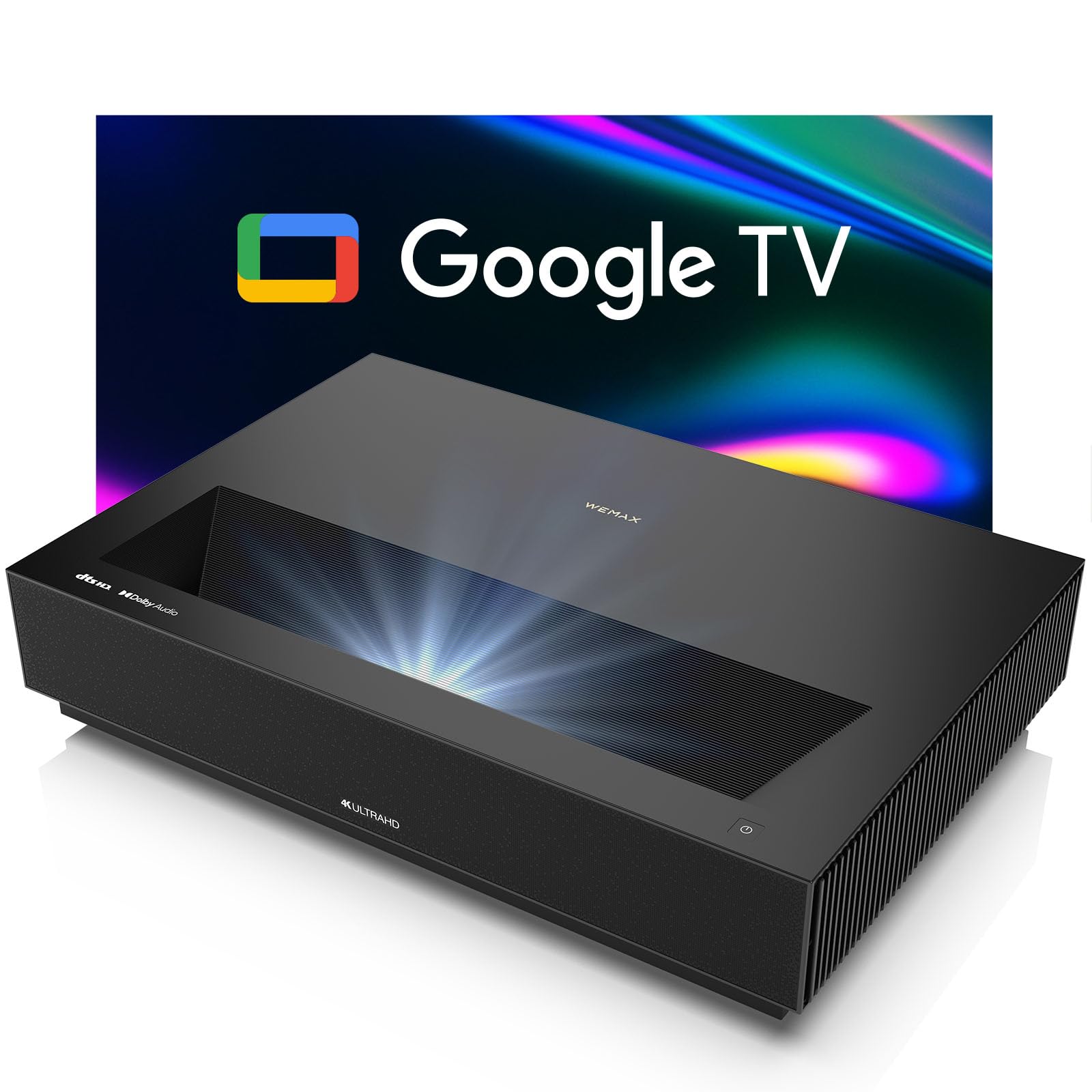
4. Nova Pro 4K Ultra Short Throw Projector
Netflix built in, a 150-inch picture from 19 inches out, and a 0.23:1 ratio that forgives a deep shelf.
Nothing here is more plug-and-watch than this one. The Nova Pro runs Google TV with native Netflix and access to over 700,000 movies and shows across 10,000+ apps, plus a kids mode and multi-user profiles. There is no streaming stick to add and no second remote to lose. Google Assistant voice search handles navigation and playback, and Google Cast throws your phone up on the wall.
The optics are ALPD laser tech with a true 4K UHD panel, a 110% Rec.709 gamut and 1.07 billion colors. Brightness is 2100 ISO lumens with a 3000:1 contrast ratio, which is squarely a moderate-ambient-light machine — darken the room or pair an ALR screen and it looks considerably better. The 0.23:1 ratio casts that 150-inch image from roughly 19 inches (49cm) away. HDR10 and HLG handle dynamic range, MEMC smooths motion for sports and action, and Active 3D is included for the family movie night.
Quality is what people talk about most here, with picture quality a close second, and setup gets flagged as genuinely easy. Audio comes from dual 15W speakers with Dolby Audio and DTS-HD, and connectivity runs HDMI 2.1, USB, optical, LAN, Wi-Fi 6 and Bluetooth — enough to feed a console and a soundbar at once. Reliability is where the comments split: plenty of owners mention zero issues over time, while some units stop working unexpectedly. Buy it for the built-in apps and the forgiving throw, and keep the warranty paperwork handy. The Nova Pro is the living-room default.
Why Families Pick It
- Native Netflix and Google TV — no streaming stick required
- 0.23:1 ratio throws 150 inches from about 19 inches out
- Wi-Fi 6, Bluetooth, HDMI 2.1, optical and LAN all on board
- Kids mode and multi-user profiles keep the library tidy
Set Your Expectations
- 2100 ISO lumens and 3000:1 contrast want a dimmed room or an ALR screen
- Reliability reports split between flawless and sudden failures
- 30W of built-in sound is fine, not a replacement for a real system
Pick it for the built-in apps: Google TV, native Netflix and a 150-inch image from 19 inches make this the easiest setup for a family room.
Look elsewhere if: you need daytime brightness above everything — the Epson below runs at 4000 lumens.
5. Formovie Theater Ultra Short Throw 4K Laser Projector

The judges’ pick at the Laser TV Showdown two years running, tuned by Bowers & Wilkins engineers.
This is the pick for the person who reads the award list before the spec sheet. It took first place and judge’s pick at the 2022 and 2023 Laser TV Showdowns. That reputation is why it sits on this list despite a brightness figure that trails the field at 1800 ISO Lumens. In a dark room, that number is plenty; with the lamps on, it is the one place this projector asks for help.
The light source is ALPD 4.0 triple laser, which Formovie states is 30% more powerful than ALPD 3.0, outputting 107% of Rec.2020 and over 1.07 billion colors. Contrast is 3000:1 FOFO with HDR10+ decoding on top, plus Dolby Vision support. Sound is the standout: bespoke speakers tuned by Bowers & Wilkins engineers with Dolby Atmos, from dual 15W full-range drivers. Certified Android TV 11.0 brings Google Play and Chromecast with 5000+ apps including Disney+, HBO and Hulu.
Performance is the thing owners praise most — buyers describe it exceeding expectations and being well worth the money. Brightness is where opinions divide, and it is worth taking seriously if your room has big windows. The remote is the genuine snag; the complaint that surfaces is a remote dying within a couple of days, so plan on a universal remote or the app as backup. For a light-controlled room and a music-first ear, the Formovie Theater is a specialist’s tool.
For the dark room: 1800 ISO lumens and 3000:1 contrast are aimed at a dedicated cinema space, not a sunlit lounge.
Sound worth noting: Bowers & Wilkins tuning with Dolby Atmos means no soundbar on day one.
For the award-list reader: a two-time Laser TV Showdown winner with Bowers & Wilkins audio built in.
Skip if: your room gets direct sun — 1800 ISO lumens needs the lights down.
6. Hisense PT1 Ultra Short Throw Triple Laser Projector

Three pure color lasers at 2500 ANSI lumens, built for the room where the blinds are always open.
Brightness is the reason to put this on your short list. The PT1 hits 2500 ANSI lumens from three pure color lasers, and it meets total HDR standards with Dolby Vision on top. IMAX Enhanced certification and a 3000:1 contrast ratio round out the picture. In practice, that means the glint in an actor’s eye and the folds of a dark cloak both stay visible instead of washing into grey. It covers 80 to 150 inches, so it scales from a bedroom wall to a full living room.
The Hisense Pro Laser Engine handles Dolby Vision and Dolby Atmos together, and the 4K AI Upscaler gives older DVDs and standard-definition streaming a sharper pass. Google TV is built in, with curated recommendations across 10,000+ apps and personalized profiles for each member of the house. A 240 high refresh rate helps with gaming and fast motion, and Active 3D is supported. Control runs through app, remote, voice or button, so however you like to drive it, there is a path.
Owners describe it as one of the best ultra short throw projectors they have used, and the recurring note is that it looks good even on a plain light grey wall — no screen required in a dark room. Sound is the split opinion; some find it strong and others want it louder than it goes, which is routine for a built-in speaker. The performance is the top praise, with picture quality right behind it. The Hisense PT1 earns its spot on raw brightness.
Right answer for a bright room: 2500 ANSI lumens and IMAX Enhanced processing fight back against daylight.
Plan around it: built-in sound is the weak link — budget for a soundbar, because the picture deserves better.
7. NexiGo Aurora Pro MKII 4K Tri-Color Laser UST Projector

A 30000:1 contrast ratio, a 0.21:1 throw and 4.2ms of lag — this is the flagship of the list.
The number to hold onto is 30000:1. The MKII’s Scene Adapt Engine pairs Dynamic Iris with Dynamic Laser Dimming, reading the content and adjusting laser output in real time to deepen black and brighten highlights. It also claims about 70% lower energy consumption as a side effect. ALPD 5.0 drives the color at 2400 lumens, 107% BT.2020 and a ΔE≈1 accuracy figure, and NexiGo states the engine improves focus enough to eliminate soft corners — a real annoyance on wide-throw setups.
Lifespan is where this pulls away from the rest. NexiGo rates the ALPD 5.0 laser at 30,000 hours — 18+ years of average viewing. The throw ratio of 0.21:1 sits between the MIRA’s 0.175:1 and the AWOL’s 0.25:1, so it is more forgiving than either on cabinet depth while still filling up to 150 inches. Gaming runs at 4K 120Hz with latency between 4.2ms and 8ms in Gaming Mode, and the 60W speakers with Dolby Atmos and HDMI eARC cover the audio side.
Performance is the dominant praise, and buyers rate it above the older Mogo 4 laser model by name. Brightness, picture sharpness and compact size all draw positive notes, and setup is called easy. Color quality is the mixed thread — some find it wants tuning from the start. Dolby Vision and HDR10+ both land here, and there is Active 3D if you still have the glasses. For the longest laser life and the lowest lag in one box, the Aurora Pro MKII is the top-tier answer.
Life and latency: 30,000 hours of laser life and 4.2ms–8ms in Gaming Mode are the two specs nothing else here matches.
Worth knowing: color from the start wants a tune-up, so leave time for calibration before you judge it.
For the long-haul buyer: 30000:1 contrast and a 30,000-hour laser make this the set-and-keep-it pick.
Not the instant-gratification option: expect to spend an evening dialing in color before it looks its best.
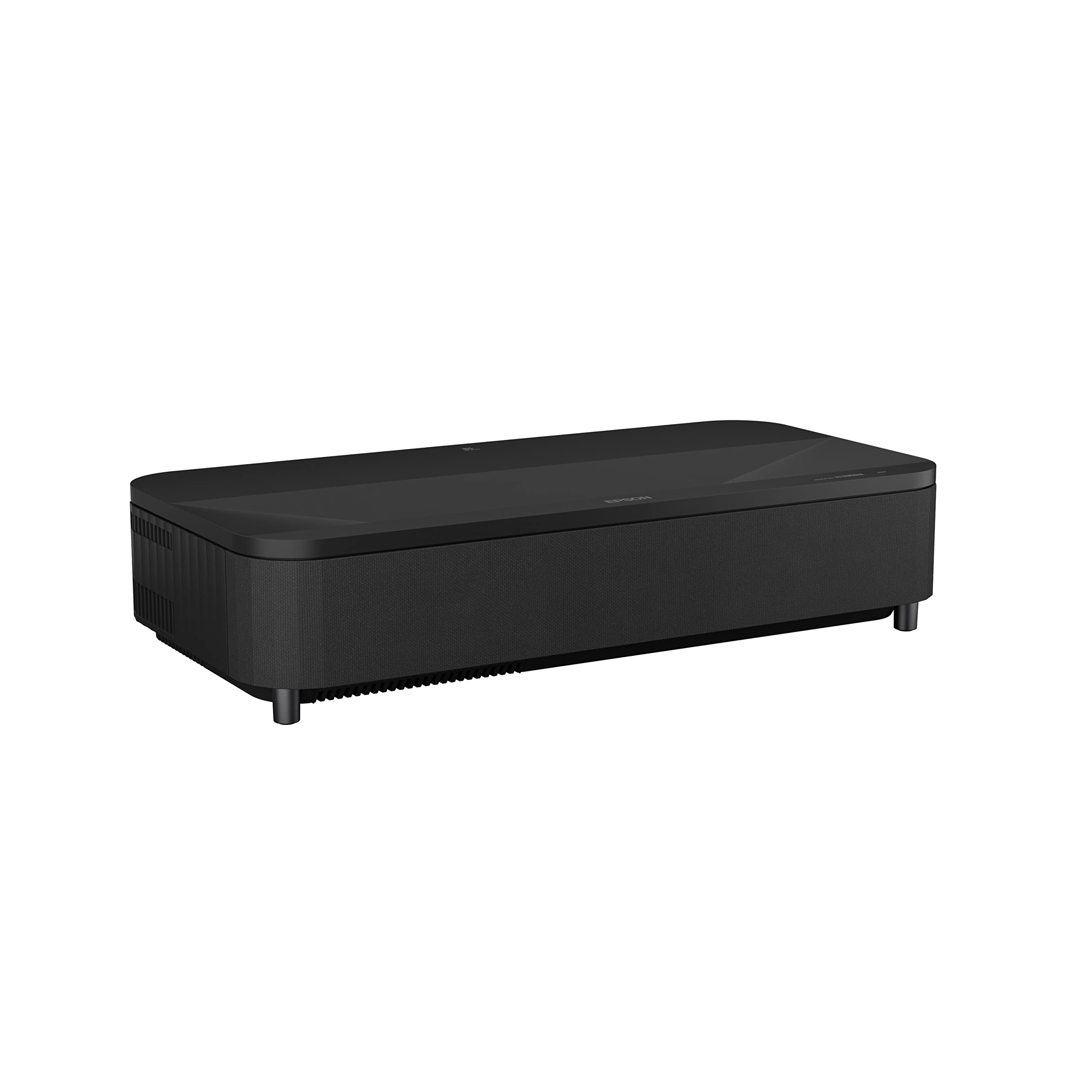
8. Epson EpiqVision LS800 Projector
Four thousand lumens from three LCD chips — the daylight champion, and the one with no color wheel at all.
If your room is the problem, this is the fix. The LS800 uses a true 3-chip 3LCD engine rated at a full 4000 lumens of color and white brightness for every frame. That is the highest figure on this list, and it is aimed at daytime sports and a room with the lamps on. The 3LCD design also means no spinning color wheel and no “rainbowing” — the colored fringing some viewers catch on single-chip DLP projectors during fast pans.
It handles 150 inches of picture from just a few inches away, and the multi-point picture adjustment plus individually adaptable feet make the initial setup quicker than most. 4K PRO-UHD uses advanced pixel-shifting across three high-definition LCD chips to build a sharp 4K image without sacrificing brightness. Full 10-bit HDR processing accepts 100% of the HDR source, so HDR content arrives faithfully rather than being flattened by the panel.
Picture quality is the consistent note — buyers describe forgetting they are looking at a projected image rather than a screen. The mixed feedback sits in functionality and compatibility, with a share of units reported as not working at all, so buy from a seller with a clean return path. Brightness and value both draw split opinions, though the 4000-lumen figure does the heavy lifting on its own. This is the projector for the wall you cannot darken, and the Epson EpiqVision LS800 owns that job.
The Daylight Case
- 4000 lumens of color and white brightness on every frame
- 3-chip 3LCD means no color wheel and no rainbowing
- Full 10-bit HDR accepts 100% of the HDR source
- Multi-point adjustment and adaptable feet speed up setup
What To Watch
- Compatibility and functionality reports are mixed — some units arrive dead
- Value is debated at this tier
- No built-in streaming platform named in the specs
For the sunlit room: 4000 lumens and a 3LCD engine with no color wheel make this the pick when you cannot draw the curtains.
Buy with a safety net: mixed reports on units arriving faulty make a solid return policy part of the purchase.
Know the Specs
Throw Ratio
A throw ratio is the distance from the lens to the wall divided by the image width — the lower the number, the closer the projector can sit. An ultra short throw unit sits on a cabinet rather than the ceiling, so this figure decides whether it fits your furniture. The XGIMI MIRA’s 0.175:1 is the tightest here, needing about 7.6 inches for 100 inches. The AWOL LTV-3000 Pro’s 0.25:1 needs about 8.54 inches for the same size, and 12.84 inches for 150 inches.
Brightness Ratings
Brightness tells you how much light the projector throws, and it governs how forgiving your room is. ISO lumens and ANSI lumens are different standards, so compare like with like. A rating around 1800 to 2500 lumens suits a dark or dimmed room and a dedicated screen. A 4000-lumen unit like the Epson LS800 is built to compete with daylight and room lamps. Pair a lower-lumen projector with an ambient-light-rejecting screen before blaming the projector.
Contrast Ratio and Laser Dimming
Contrast ratio measures the gap between the brightest white and the deepest black a projector can hold at the same time. Higher figures deepen dark scenes. Dynamic laser dimming goes a step further by lowering the laser output during dark moments, which is how the NexiGo Aurora Pro MKII reaches its stated 30000:1. Some units also use dynamic iris control to squeeze more black out of the frame.
Laser Lifespan and Color Accuracy
A laser light source is rated in hours of operation rather than bulb replacements, and the Aurora Pro MKII lists 30,000 hours. Color accuracy is often stated as a ΔE figure, where a lower number means the projected color sits closer to the source; ΔE under 1 is a tight margin. Triple laser designs skip the color wheel entirely, which removes the moving part and the rainbow fringing some viewers see on single-chip DLP units.
Common Questions
How far does an ultra short throw projector need to sit from the wall?
Can I use an ultra short throw projector on a plain painted wall?
What is the difference between ISO lumens and ANSI lumens?
Is a triple laser projector better than a single laser one?
Do I need an ALR screen for an ultra short throw projector?
Can an ultra short throw projector handle 3D movies?
Is input lag a problem for gaming on a UST projector?
Will a laser projector work in a room with a lot of daylight?
How long does the laser light source last?
Will an ultra short throw projector replace my television?
The Bottom Line
For most buyers, the ultra short throw laser projector winner is the AWOL VISION LTV-3000 Pro — a triple laser engine rated at 2000 lm with 107% BT.2020 coverage, a center-channel speaker built in, and Dolby Vision, Atmos and 3D all handled in one box. If your cabinet is shallow and the room is small, the XGIMI MIRA squeezes a 100-inch image out of 7.6 inches and pairs it with a 20000:1 contrast ratio and 36W of Harman Kardon sound. And if the wall you cannot darken is the whole problem, the Epson EpiqVision LS800 answers with 4000 lumens and a 3LCD engine that never rainbows.
One last thing worth saying plainly: the highest-scoring pick here is the AWOL at 4.0+ stars from 200+ owners, and the Nova Pro carries more ratings overall — 400 to 249 — but the AWOL holds the higher score. Match the projector to your room and your screen, not to a spec sheet on its own.
How we choose
We do not accept paid placement. Every pick is matched to a real buyer and a real use-case; we do not hands-on test units.
Sources
Specifications: manufacturer listings and product documentation. Review insights: verified customer reviews, as of November 2026. Pricing: not shown on this page (it changes often); check the current price via the retailer link.
As an Amazon Associate, Tactical Gear Guy earns from qualifying purchases. This does not affect which products we feature.