Specs are compiled from manufacturer listings and verified buyer reviews and can change over time — please confirm the key details on the product page before buying.
You want a bag that disappears into your luggage and still hauls water, snacks, and a rain shell up a hill. That is the whole job of an ultra lightweight day pack — you should barely feel it empty, and it should fold small enough to forget about. Below are nine packs that do exactly that, split by how much structure you want on your back. The short answer: buy the ZOMAKE if you want the most capacity for the least fuss, pick the Nanobag if you want to fold it into a pocket, or step up to a framed Osprey or Deuter if you hike hard and want the weight to sit on your hips.
This guide is built by comparing the manufacturers’ published specifications and the patterns across verified customer reviews, so you get each pick’s real strengths and trade-offs instead of marketing spin.
One pack here carries 30 L and folds to the size of a sandwich, while another weighs 1.15 oz and still carries 66 lb. Every pack below is under 2.4 lb empty, and the lightest is 1.15 oz.
Top Picks


How To Choose The Best Ultra Lightweight Day Pack
If you are scared of picking a bag that is too small, weighs too much, or falls apart after a season on the trail, focus on two things: how heavy it is when empty and how much stuff it physically holds. Everything else is secondary. The ZOMAKE holds 30 L at 0.74 lb, the best capacity-to-weight ratio here.
Weigh the pack, not the marketing
An “ultralight” pack should be something you can carry with two fingers when empty. The Nanobag lists 1.15 oz, while the Osprey Talon 22L is 2.4 pounds, and those are very different loads on a long hike. Write the empty weight down before you buy — a difference of half a pound is noticeable if you are hiking all day.
Decision: packable or framed?
A packable bag folds into its own pocket and lives in a suitcase — that is the ZOMAKE and the Seektop, and both roll down small. A framed pack like the Osprey Talon or the Osprey Sportlite carries a heavier load because the weight sits on your hips and back, not just your shoulder straps. Choose packable for travel and city days; choose framed for long trail days.
Capacity in liters is not the only spec
A liter count tells you how much volume the main body holds — 30 L fits more than 16 L. Two bags with the same liter count can feel different on your back, though, depending on straps. A 20 L pack with wide, breathable straps will feel lighter than a 20 L pack with thin straps once you put bottles in.
Side-by-Side Comparison
| Model | Best For | Capacity | Empty Weight | Fabric | Amazon |
|---|---|---|---|---|---|
| ZOMAKE 30L Packable Backpack★ Best Overall | Most capacity for travel | 30 L | 0.74 lb | Nylon | Amazon |
| Nanobag Daypack 16LFeatherweight Pick | Pockets-packing lightest buy | 16 L | 1.15 oz | Diamond Ripstop Nylon | Amazon |
| Seektop 20L Waterproof DaypackRain-Ready Pick | Rainy day hikes | 20 L | 13.6 oz | High-density nylon | Amazon |
| SKYSPER 18L Anti-Theft Daypack | Anti-theft travel | 18 L | 0.66 lb | 300D polyester | Amazon |
| WATERFLY Small Packable 15L | All-day comfort on a trail | 15 L | 0.68 lb | Nylon | Amazon |
| Osprey Sportlite 20L | First framed pack | 20 L | 595 g | Recycled nylon ripstop | Amazon |
| Deuter Speed Lite 21L | Fast, moving hikes | 21 L | 470 g | 140D recycled nylon | Amazon |
| Bellroy Lite Daypack | City days and commuting | Not listed | 350 g | Recycled fabric | Amazon |
| Osprey Talon 22L | Heavy trail loads | 22 L | 2.4 lb | 70D recycled nylon | Amazon |
Detailed Reviews
1. ZOMAKE Lightweight Packable Backpack 30L
Our pick — 4.5+★ from 16,500+ verified ratings; the strongest balance of quality and price.
The pack that swallows a weekend of gear and then vanishes into a rucksack pocket.
Thirty liters is the biggest bag on this list, and it weighs just 0.74 lb empty. That is the trade worth paying for if you want to carry real kit — a jacket, a camera, two water bottles — without hauling a frame around. The capacity is the reason it takes the top spot. Where the Nanobag Daypack manages 16 L, this ZOMAKE holds 30 L, so it carries nearly twice the gear in the same packable package.
The build backs that up. It is nylon rather than a papery thin shell, with double-layered stitching through the stress points, a two-way SBS metal zip with resin teeth so it does not jam, and a set of pockets that includes two front bags, two side bags, and a privacy pocket. Two big water bottles sit in the side pockets without a fight, and the main compartment swallows clothing or a travel document wallet. The folding point is the clever bit: the whole bag folds down to 10 x 8 x 3 inches, which is roughly the size of a sandwich, so it lives in a suitcase until you need it.
A light pack has to earn its weight with features that keep you safe, and this one does. There is a chest protection buckle, a rescue whistle built into the strap, protective buckle bands on the side pockets to stop your bottle and umbrella falling out, and reflectors on the front so you are visible after dark. The complaint that turns up in reviews is the one you would expect from a packable: the fabric shrugs off light rain but is not fully waterproof, so a downpour will get through. A dry bag for your phone solves it. That is a fair price for the volume and the fold-down size.
What carries the day
- 30 L capacity is the largest here, and it folds to 10 x 8 x 3 inches
- 0.74 lb empty — light enough to forget until you fill it
- SBS metal zip, double-layered seams, and buckle-locked side pockets for bottles
- Built-in whistle and night reflectors add real safety on evening walks
Worth knowing before you buy
- Nylon is water-resistant, not fully waterproof, so heavy rain can soak through
- No frame or hipbelt, so a very heavy load sits on your shoulders
Buy it if: you want one packable bag that holds a trip’s worth of gear and disappears when empty.
Think twice if: you plan to carry loads over 20 lb on long trail days — that job wants a framed pack.
2. Nanobag Daypack 16L Ultralight Packable Travel Backpack
A 1.15-ounce bag that stuffs into a glove compartment and still hauls 66 lb.
If the thing you hate is a bag that bulges in your carry-on, this is the one. It weighs 1.15 oz and packs into its own attached pouch with no folding — it just stuffs in. That makes it smaller to stow than the Seektop 20L, which packs to a flat shape but is a chunkier bundle. The fabric is a 0.05mm ultra-thin shell, so the bag compresses down to pocket size, then opens into a 16 L daypack.
Thin does not mean flimsy here. The body is diamond ripstop nylon, with reinforced bartack stitching at the stress points, a YKK zip on the main opening, and a PFC-free water-repellent coating for light rain. The straps are wide and 27 inches long, so the load sits more evenly across your shoulders instead of digging in. The brand rates it to carry up to 66 lb. In real use, buyers report it surviving a full three-week international trip, and say it swallows submarine sandwiches, chips, and water bottles without strain.
The honest catch is the fabric. At 0.05mm it feels papery in the hand, and it is built for light rain and dry days, not a soaking. Treat it as a spare, a travel bag, or a gym bag that lives in your luggage — not a pack you drag through brambles. If you want one bag that does everything including rough trail use, a slightly heavier ripstop like the Seektop or Bellroy suits better. For pure packability, nothing here gets smaller.
The packability math: 1.15 oz and a stuff-into-its-own-pouch design means this pack rides in a purse or glove box and stays out of the way until you need it.
The honest limit: the ultra-thin shell handles a light drizzle but not a soaking, so a dry bag for your phone is cheap insurance.
Reach for this if: you want a backup bag that takes up no space and still empties a shopping run into itself.
Look elsewhere if: you need a pack to survive trail abuse — the fabric is built for lightness, not scrapes.
3. Seektop Packable Waterproof Hiking Backpack 20L
The 20-liter pack that keeps your phone dry when the sky opens up mid-hike.
Waterproofing is the headline. This is a high-density nylon shell with waterproof zippers, and the point of the design is to stop rain getting to your clothes, cash, or phone. Buyers confirm it does the job — one mentions it working well in rain, and the pattern across reviews is that it keeps contents dry during use. That is the reason to pick it over the other packable bags here, which stop at water-resistant.
It carries 20 L across five zippered compartments, so it spreads a day’s gear out instead of cramming it into one pit. There is a breathable padded back panel and padded shoulder straps to cut sweat, a removable and adjustable chest strap, an external suspension system with trekking pole attachment, and reflective detailing for night visibility. The weight is 13.6 ounces, heavier than the packable crowd, but you are paying that weight for the padding and the rain protection. It also meets carry-on luggage standards.
The compromise: with this much structure it does not pack as small as the Nanobag or the ZOMAKE. It folds flat to 7.4 x 8.4 inches, which fits a suitcase but is not a pocket-sized bundle. Owners are also quick to point out the straps are comfortable for a day bag, not for heavy loads — this is a hiking daypack, not an expedition pack.
The rain case: waterproof fabric plus waterproof zips is the whole point here, and it is the reason a 20 L pack outweighs the 0.74 lb ZOMAKE and still gets carried.
Who should skip it: gram-counters who want the whole bag to fit in a jacket pocket should look at the Nanobag instead.
Pick it for: wet-weather day hikes and trips where your electronics must stay dry.
Pass if: you measure everything in ounces and want the smallest packed bundle on the market.
4. SKYSPER Anti Theft Hiking Backpack 18L RFID Packable Daypack

The travel pack with a lockable main zip and a pocket that shields your cards.
If your trips run through train stations and busy streets, security is the spec that matters. This 18 L pack has a zipper lock on the main compartment, a hidden zipper pocket on the back panel against your body, and an RFID-blocking middle pocket with a hidden zip — the coating that stops contactless card readers from pulling your details. It holds a passport, ID, and wallet comfortably. Weighing 0.66 lb and folding to 7.9 x 7.1 inches, it also stows easily in other luggage.
The body is 300D polyester, a thicker weave than the papery shells on the lightest packs here, with reinforced stitching on the shoulder straps and top handle. Custom zippers run smooth, the back has reflective strips for night visibility, and the shoulder straps adjust for breathability. For walking day trips and city exploring, it handles the job. The thing buyers flag is sizing: some find it surprisingly spacious for 18 L, while others say it runs smaller than expected. Read the listed 5″D x 10″W x 15″H dimensions against your own gear before you commit.
Durability draws mixed feedback too — plenty call it sturdy, a few say it is not built for hard use. Treat it as a travel and city bag, not a pack you throw down a scree slope with. For the security features it brings, it is a sensible choice if anti-theft is your priority over raw volume.
Security is the selling point: a lockable main zip, a hidden back pocket, and an RFID-blocking middle pocket make this the pick for crowded transit.
The sizing caveat: feedback splits on whether 18 L feels roomy or tight, so check the 15-inch height against what you carry.
Best matched to: travelers who want their cards and passport shielded on busy streets.
Not for: hikers who need maximum volume — 18 L fills fast with a jacket and a camera.
5. WATERFLY Small Lightweight Packable Backpack 15L

A 15-liter that treats your shoulders gently and still folds into a handbag.
Comfort in a packable bag is rare, and that is the angle here. The shoulder straps are ergonomic and breathable, built to cut sweat and pressure across a full day, and the adjustable chest strap keeps the bag snug instead of swinging. It weighs 0.68 lb and holds 15 L, with a full size of 16.54 x 11.02 x 4.72 inches and a fold-down size of 7.87 x 6.3 x 2.16 inches. That fits most airline carry-on rules and slots into a handbag when empty.
Features line up for hikers who want small extras. There is a built-in emergency whistle, reflective accents for night visibility, and a trekking pole loop. Organization is four main compartments: a double-zipper main pocket with an inner slip pocket, a middle zip pocket, a quick-access front pocket, and two side mesh pockets with buckles to keep bottles and umbrellas from slipping out. An elastic front strap takes extra clothing. The nylon shell is water-resistant, tear-resistant, and wear-resistant, and the SBS metal zips plus reinforced stress points suggest it holds up better than the thin-shell packables.
Where it falls short is volume. At 15 L this is the smallest full pack on the list, smaller than the 20 L Seektop and 18 L SKYSPER, so it suits short day trips and errands rather than a full hiking day with layers. If your gear load is modest, the comfort and organization win. If you need to haul a jacket, lunch, and camera at once, size up.
Where it shines
- Breathable shoulder straps and a chest strap for all-day carrying comfort
- Two side mesh pockets hold water bottles securely with buckle closures
- Whistle, reflective accents, and trekking pole loop cap trail-ready
- Folds to 7.87 x 6.3 x 2.16 inches and meets carry-on rules
Where it trails
- 15 L is the smallest capacity here — tight for a full day with layers
- Water-resistant nylon handles light rain but not sustained downpours
The fit: short day trips and hours of walking where strap comfort matters more than cargo volume.
The mismatch: if you carry a jacket plus lunch plus camera, 15 L runs out of room fast.
6. Osprey Sportlite 20L Lightweight Hiking Backpack
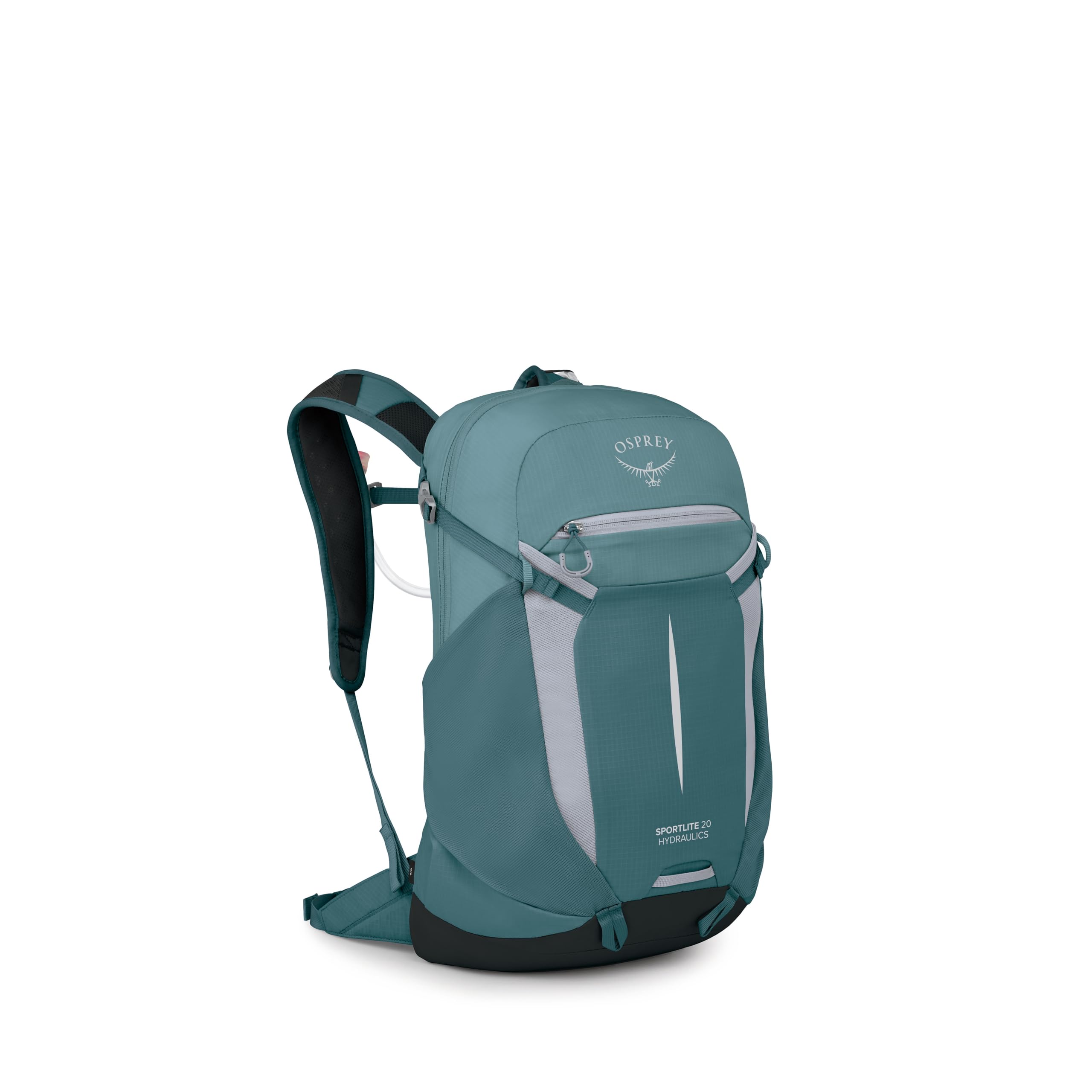
The step up to a real back system, built from ocean-sourced recycled nylon.
At 595 g this is where you stop carrying a stuff sack on your shoulders and start carrying a pack. The main body is ripstop fabric made from 100% recycled, ocean-sourced nylon, and the whole bag is a streamlined technical daypack for day hikes. That structure — a webbing hipbelt with padded hipwings, a sternum strap with a safety whistle — moves load onto your hips instead of your shoulder blades, which is the jump the packable bags here cannot make.
The AirScape backpanel is the comfort feature: mesh-covered foam with airflow channels so your back vents while you walk. There is a stretch side pocket for water, a front shove-it pocket for a wet shell, a zippered front pocket with a key clip, and an internal hydration sleeve — reservoir sold separately. The side compression straps secure trekking pole handles at the top and loops at the front capture the tips, so your poles ride hands-free. One size, unisex fit keeps it simple. It also meets bluesign PRODUCT requirements for third-party environmental and social criteria in production.
The trade-off is on weight. At 595 g it is heavier than any packable in your bag, though lighter than the Talon at 2.4 lb, so it splits the difference for hikers who want support without the bulk. If you are just grabbing a pack for a stroll around town, a 0.74 lb packable gives you more volume for less weight. If you are doing real day hikes and want your back to breathe, the structure pays for itself in comfort.
What you gain: a padded hipbelt and AirScape panel move the load to your hips and keep airflow moving, the comfort upgrade a packable cannot offer.
What you give up: 595 g is heavier than any stuffable bag on this list, and the hydration reservoir is not included.
Upgrade to this if: your day hikes last hours and a shoulder-strap-only bag is starting to ache.
Hold off if: you mostly need a bag to fold flat in a suitcase — the packables do that better.
7. Deuter Speed Lite 21L Hiking Lightweight Backpack
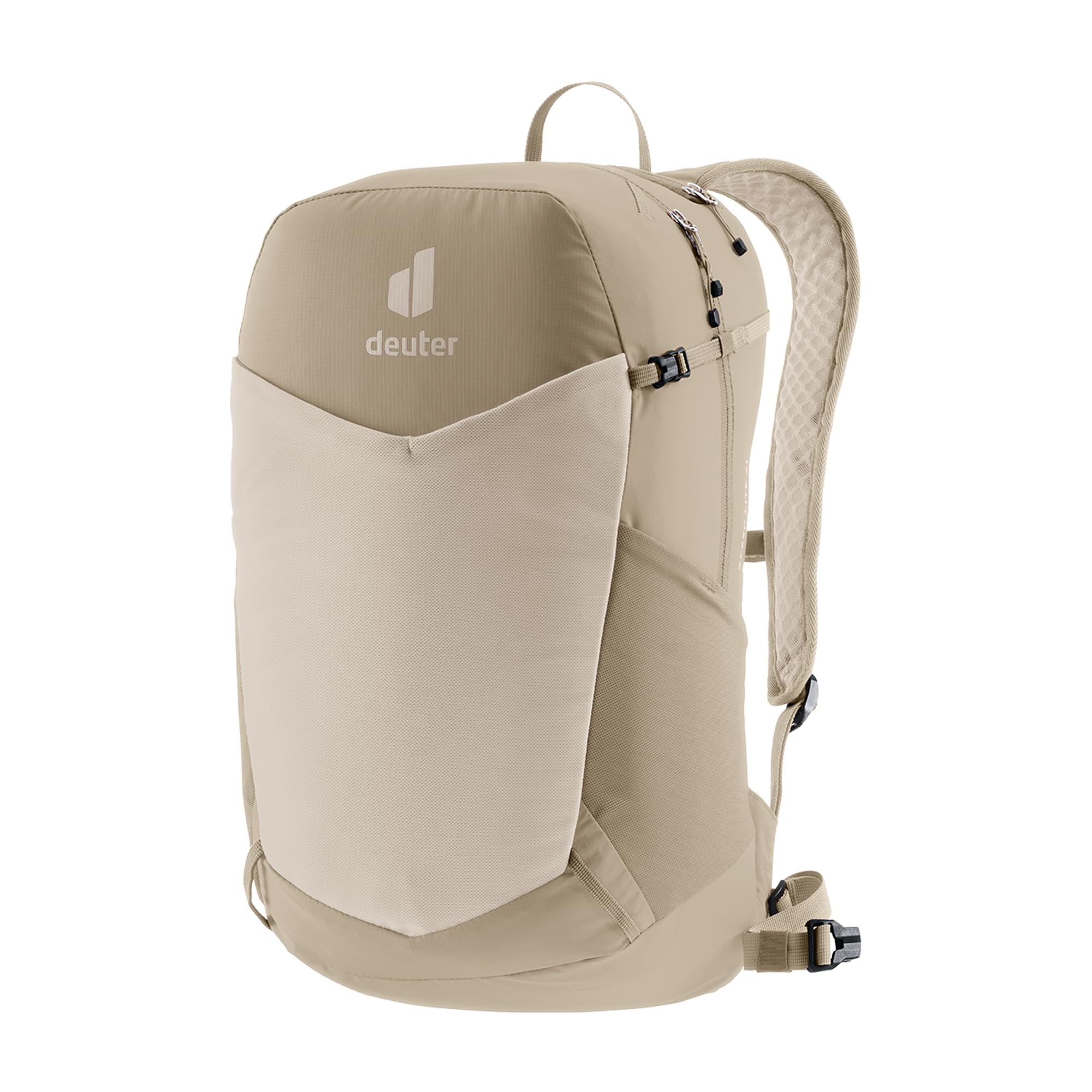
At 470 g, the lightest framed bag here — built to let you move, not sit still.
This is the lightest pack on the list that still has a real suspension system. The 470 g weight comes from a V-shape design that keeps the load close to your body and lets your arms and torso move freely, so it suits hiking that involves motion — scrambling, fast walking, biking. For comparison, the Osprey Sportlite is 595 g and the Talon is 2.4 lb, so this is the framed option for people who count grams.
The features are built for the trail. There is a detachable waist belt, sturdy zipper pulls sized for gloved hands, precision-adjustable sternum straps, and compression straps for good load transfer. Storage includes a zippered valuables pocket on top with a key clip, two stretch side pockets, a stretch mesh front pocket for gloves, a large stretch compartment inside, a glasses stow system on the shoulder strap, and compatibility with Deuter’s 2-liter hydration system (sold separately). The body fabric is 100% recycled 140D REC PA RS, made under the bluesign standard.
The catch is the same one every framed pack carries: it does not fold into a pocket. If you want a bag to stash in a suitcase for a trip, a packable wins. But if the trail is the point and you want 21 L of gear on a back system that weighs 470 g, this is the best weight-to-support ratio in the group.
The numbers that matter: 21 L capacity, 470 g weight, and a suspension system — a combination the packable bags here cannot match.
Before you commit: the hydration reservoir is extra, and this bag is built for active hiking rather than folding flat in luggage.
The right owner: fast hikers and bikers who want support without dragging a heavy pack uphill.
The wrong owner: travelers who need their day pack to disappear into a suitcase — nothing here folds down.
8. Bellroy Lite Daypack, Lightweight Backpack

The 350-gram bag that looks like a city commute and packs flat like a travel spare.
Bellroy’s Lite Daypack is the lightest pack in this whole group at 350 g, and it wears its lightness well — a clean shape that suits a commute as much as a walk. It packs flat for travel, so it slides into luggage between trips. The fabric is water-resistant and made from 100% recycled materials. The dimensions are 18.5 x 13.8 x 5.5 inches, which the brand shows on a 6’1″ male and a 5’6″ female model for a sense of the fit.
Organization is the strong suit for city days. There is a document slip pocket for a folder, an internal improve zip pocket, a stretch water bottle sleeve, and a quick-access sunglasses pocket. The back panel is padded breathable mesh with contoured shoulder straps, plus an adjustable and detachable sternum strap, so it feels comfortable over a long walk. There are accessory attachment loops too, including an integrated bike light loop for riders. The one recurring note is laptop fit — the size feedback is mixed, and it does not accommodate some 14″ laptops, so check your machine against the 18.5-inch height before you buy.
The other caveat: at 350 g it is a lighter shell than a hiking pack. It is built for urban use and travel, not trail abuse, and the fabric has medium stretch rather than a rigid structure. For commuting, coffee runs, and weekend city breaks, this is the right shape. For mountain ridges and rocky trails, the Osprey Talon or Deuter Speed Lite holds up better. For the weight and the looks, it earns its spot.
The city-travel case
- 350 g is the lightest pack here, and it packs flat for travel
- Document slip pocket, zip pocket, bottle sleeve, and sunglasses pocket keep daily gear sorted
- Padded breathable mesh back and contoured straps with a detachable sternum strap
- Integrated bike light loop for commuters
The grab-bag of limits
- Does not accommodate some 14″ laptops, so check your machine first
- Light metro fabric is built for city use, not rough trail abuse
Made for: commuters and city travelers who want light, tidy, and good-looking on the back.
Skip if: you need to carry a 14″ laptop or hit rocky trails — this one stays on pavement.
9. Osprey Talon 22L Men’s Lightweight Hiking Backpack

The 22-liter pack with a real hipbelt, built to put serious miles behind you.
Buy this one when your day hikes turn into long days. The Talon 22L carries 22 L on a full suspension system: an AirScape backpanel that sits close to your body and moves air, an adjustable sliding yoke, and a BioStretch hipbelt that wraps your hips and takes the load off your shoulders. That is the difference between finishing a long hike fresh and finishing it sore. At 2.4 pounds it is the heaviest pack here, and for good reason — the frame and hipbelt are what let it carry weight comfortably.
It is built for multi-sport days. The Stow-on-the-Go trekking pole attachment lets you stow poles without stopping, the LidLock carries a bike helmet, and there is a tuck-away ice ax attachment. Storage covers dual-zippered hipbelt pockets, a spacious top panel pocket, and stretch mesh side pockets for bottles. There is an internal hydration sleeve too, with the reservoir sold separately. The lining is bluesign APPROVED 100% recycled 70D nylon with a DWR treatment made without PFAS.
The honest downside is the opposite of every other bag here: it does not fold, it does not go in a pocket, and 2.4 pounds is a real weight to carry empty. For a hike that is the price of comfort. Buyers use it as an airline personal item and for long-distance hikes, and the fit and weight distribution come up as the things that keep them happy. For long trail days where your shoulders should not carry the load, this is the pick. For a pack that folds into a suitcase, the ZOMAKE or Nanobag is the better fit.
The long-mile argument: a real hipbelt, an adjustable yoke, and an AirScape panel carry 22 L the way a stuff sack cannot, at 2.4 lb.
The weight you accept: 2.4 pounds empty is the heaviest here, so it is a trail pack, not a travel spare.
Choose it when: your plan is a full day on the trail and your shoulders should not be doing the work.
Leave it when: you want a bag to fold into a suitcase or a purse — it is built to stay on your back.
Know the Specs
Empty weight (oz and grams)
The most important number in this category is how much the pack weighs before you put anything in it. The grams or ounces on the listing are the bag’s own load, so 350 g feels different from 2.4 pounds on a long walk. A packable bag under an ounce is basically nothing in your hand, while a framed pack with a hipbelt adds weight for a reason — the structure carries the load better. Decide what your day looks like, then pick a weight that fits it.
Capacity in liters
Liters describe how much volume the main body holds. A 30 L pack fits more gear than a 16 L pack, but the number alone does not say how comfortable it will be to carry. A 20 L pack with a padded back and wide straps can feel better than a bigger bag with thin straps. Match capacity to what you actually carry: 15 to 18 L for a short day and errands, 20 to 22 L for a full day hike with layers, and 30 L when you need a trip’s worth of gear in one bag.
Common Questions
How light should an ultra lightweight day pack be when empty?
Can a packable bag really hold a full day of hiking gear?
Is a framed pack like the Osprey Talon better than a stuffable day pack?
What does RFID-blocking mean on the SKYSPER daypack?
Will the Bellroy Lite Daypack fit my laptop?
Are these packs waterproof in a downpour?
Can I take these backpacks on a plane as a carry-on?
What fabric lasts longest on an ultralight day pack?
Does the Deuter Speed Lite work for long hikes or just short ones?
Can I attach trekking poles to these packs?
The Bottom Line
If you want one pack that carries the most gear and then disappears into your luggage, the ZOMAKE 30L Packable Backpack is the pick — 30 L of capacity at 0.74 lb, with a fold-down size of 10 x 8 x 3 inches. If stuffing a bag into a purse or glove box is the priority, the Nanobag Daypack wins on 1.15 oz alone. And if your weekends are long trail days, the Osprey Talon 22L puts 22 L on a real hipbelt and back panel, which is the comfort the packable bags simply cannot deliver.
Choose packable for travel and city errands, framed for long trail days.
How we choose
We do not accept paid placement. Every pick is matched to a real buyer and a real use-case; we do not hands-on test units.
Sources
Specifications: manufacturer listings and product documentation. Review insights: verified customer reviews, as of November 2026. Pricing: not shown on this page (it changes often); check the current price via the retailer link.
As an Amazon Associate, Tactical Gear Guy earns from qualifying purchases. This does not affect which products we feature.