Specs are compiled from manufacturer listings and verified buyer reviews and can change over time — please confirm the key details on the product page before buying.
If you are tired of saying “what?” at the dinner table, the fix is not always a prescription. Over-the-counter hearing aids now fit mild to moderate hearing loss without a clinic visit. The models worth your money are the ones that tame feedback (that squeal when sound leaks out), keep speech sharp in noisy rooms, and run long enough to forget they are on your ears. This guide separates the genuine speech tools from the simple amplifiers that just make everything louder.
This guide is built by comparing the manufacturers’ published specifications and the patterns across verified customer reviews, so you get each pick’s real strengths and trade-offs instead of marketing spin.
You will see which designs hide best behind the ear, which batteries outlast a full day of streaming, and where fit decides everything. The list below breaks down each contender so you can find the right ultra hearing aid for your ears, your routine, and the rooms you actually sit in.
Top Picks
How To Choose The Best Ultra Hearing Aid
Buying a hearing aid is closer to buying glasses than buying earbuds — the wrong fit means the device fights you all day. The good news is that over-the-counter models now handle mild to moderate hearing loss without a prescription. So the decision depends on three things: how cleanly the device separates speech from noise, how long it runs between charges, and whether it will stay put in your ear canal.
Gain and noise handling beat raw volume
Gain is how much a hearing aid boosts quiet sounds, measured in decibels (dB). A higher number is not automatically better — a device that amplifies everything equally just makes a noisy restaurant louder. Look for models that advertise noise cancellation or feedback reduction, because that is what keeps voices in front of the room and whistling out of your ears.
Battery life and the charging case
Most rechargeable hearing aids give you a full day on one charge, and the better ones ship with a case that holds several extra charges. That case is your travel insurance — a weekend away without a wall outlet stops being a worry when the case itself carries backup power. Check the single-charge hours and the case capacity together, not separately.
Fit and how invisible it really is
In-ear models sit inside the canal and hide behind almost nothing, while behind-the-ear models rest outside and disappear under hair. Fit matters more than looks: a loose dome lets sound leak out and feedback whistle in. Look for a device that ships with multiple dome or ear-tip sizes so you can dial in a seal without guessing.
Side-by-Side Comparison
All three spec columns use the same dimension on every row so you can scan trade-offs at a glance. A dash means the maker did not publish that figure.
| Model | Best For | Amplification | Battery Per Charge | Style / Fit | Amazon |
|---|---|---|---|---|---|
| Auiioes OTC Hearing Aids for Seniors★ Best Overall | Everyday TV and phone listening | — | — | In-Ear, both ears | Amazon |
| Vivtone Lucid508Backup Power Champ | Long trips and backup power | 41dB peak gain | 25 hours | Behind-the-ear | Amazon |
| MDHearing NEO XSAlmost Invisible | Nearly invisible wear | — | Full day | In-Ear, tan | Amazon |
| Audien Atom X | No-app control via touchscreen | — | 16 hours | In-Ear, beige | Amazon |
| ELEHEAR-Beyond (Champagne Gold) | App-tuned clarity in crowds | 50dB | 20 hours | Behind-the-ear | Amazon |
| ELEHEAR-Beyond (AI Speech) | Bluetooth calls and app control | 50dB max gain | 20 hours | Receiver-in-canal | Amazon |
| Yeasound RIC700 | Extended battery and hi-fi audio range | Up to 8000Hz audio | 279 hours | Receiver-in-canal | Amazon |
| Yeasound RIC800 | Five listening profiles with Bluetooth | Up to 8000Hz audio | 23 hours | Receiver-in-canal | Amazon |
| Sennheiser All-Day Clear | Brand-name Bluetooth streaming | — | Up to 24 hours | Receiver-in-canal | Amazon |
| Jabra Enhance Select M2 Swift | Self-fitting with app and Auracast | — | Over 24 hours | Receiver-in-ear | Amazon |
| Jabra Enhance Select M3 Aureon | Full remote audiology access | — | Over 24 hours | Receiver-in-ear | Amazon |
Detailed Reviews
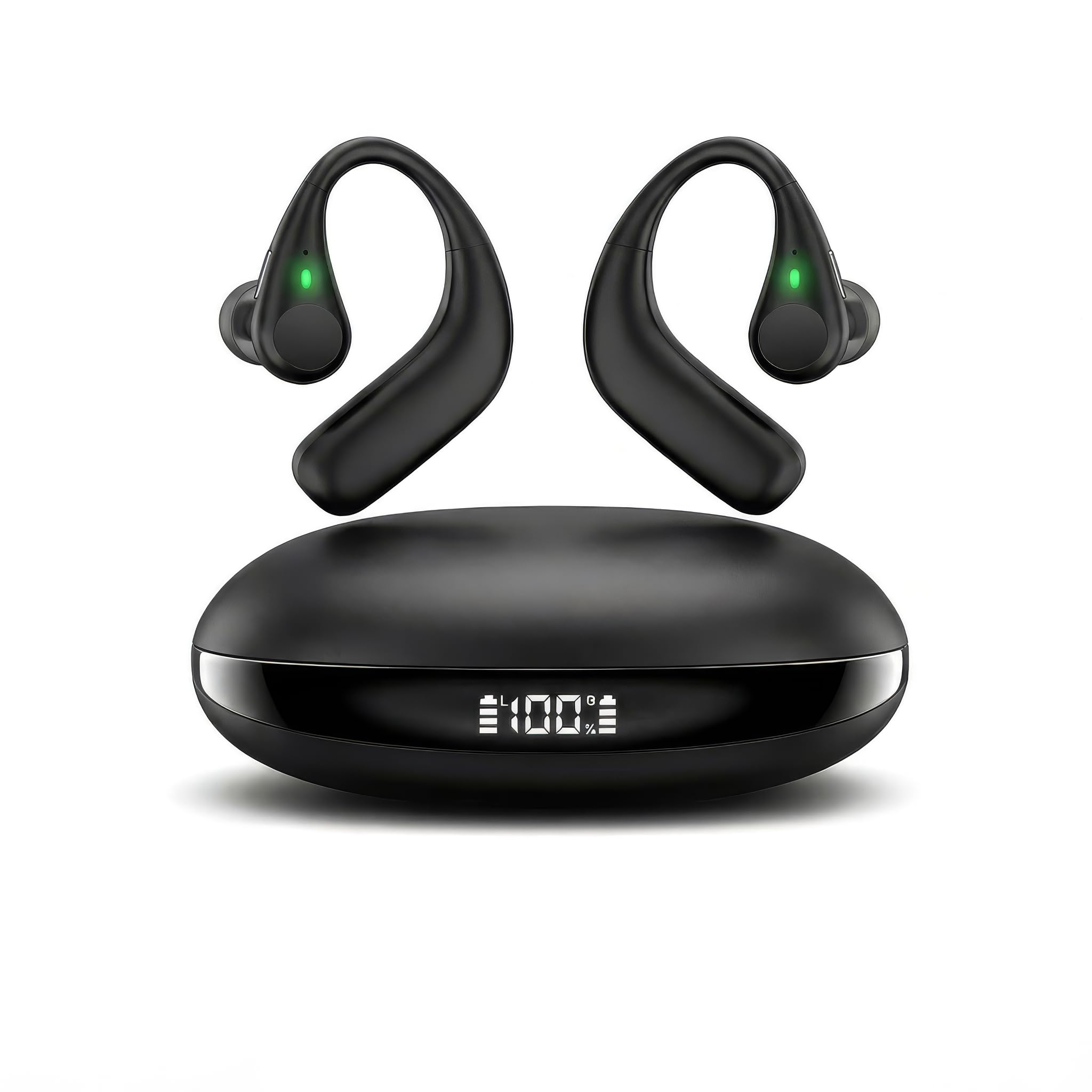
1. OTC Hearing Aids for Seniors with Hearing Loss (Auiioes)
Our pick — 4.5+★ from 350+ verified ratings; the strongest balance of quality and price.
An in-ear OTC pair tuned for TV dialogue and phone calls, no clinic visit required.
It is a true in-ear OTC hearing aid for a mild to moderate loss, and it pairs with the things you already use — a smartphone, a tablet, or the television. A built-in smart chip does the sound processing, so voices come through shaped and filtered rather than just cranked up. You get three sound modes and eight volume steps, which is enough granularity to find a setting that suits your living room without hunting through a menu.
What wins people over is the sound, and the appearance follows close behind — the shiny black shells carry a seahorse design that a lot of buyers find genuinely good-looking rather than clinical. The kit ships as a both-ear set with two included lithium polymer batteries, and at 0.5 g per battery the shells stay light enough for a full day in the canal.
You get fast, low-latency pairing with Bluetooth 5.3 (the current wireless standard that keeps audio in sync), and the spec sheet lists it alongside the three modes. The catch is a simple one: this is an in-ear design, so a loose fit will let sound leak and feedback creep in. These are also pitched as a gift, and a first-time wearer often needs a few days with a smaller dome (the soft tip that seals your ear) before the seal settles. There is no published battery-hour figure, so plan on topping them up nightly until you learn your own routine.
What buyers praise loudest
- Clear, shaped sound for TV and phone calls thanks to the onboard smart chip
- Three modes and eight volume levels give you real tuning range
- Shiny black finish and seahorse detailing make it feel like a personal device, not medical hardware
- Bluetooth 5.3 with a two-battery, both-ear setup
Where it asks patience
- In-ear fit demands a good dome seal or you will chase feedback
- No published per-charge battery hours on the listing
Buy it for: a first OTC pair where clear speech on the TV matters most and you want something that looks good enough to leave in.
Pass on it if: you need documented battery hours before you commit — this one keeps those figures off the label.
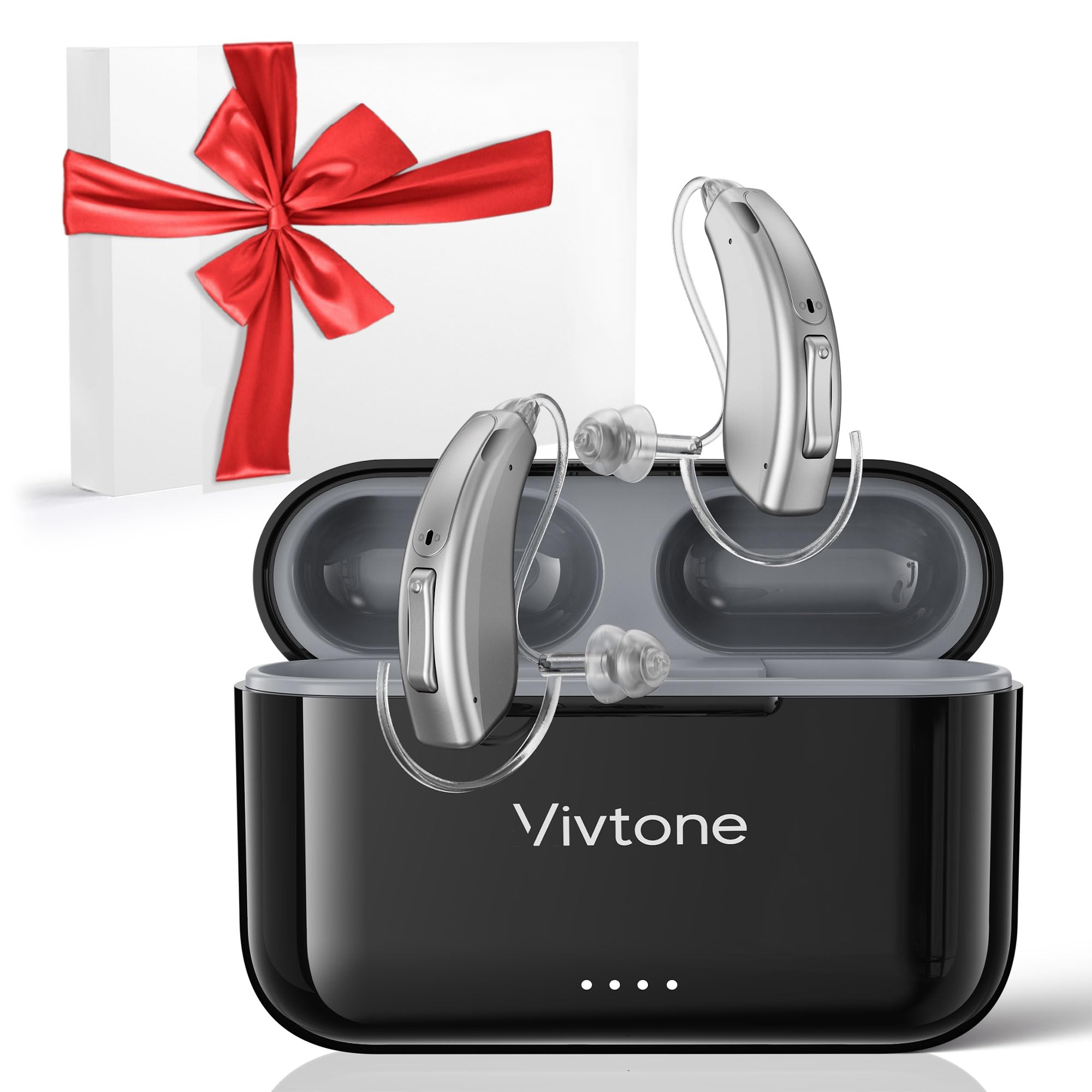
2. Vivtone Lucid508 Rechargeable Hearing Aids
A behind-the-ear pair whose charging case carries 125 hours of backup power.
Peak gain reaches 41dB, which is the boost ceiling this device can deliver to quiet sounds, and the maker specifies it for mild through significant hearing loss. Three listening modes cover your bases: a quiet mode for the kitchen, a noisy mode that pulls human voice forward by cutting background, and a tinnitus masking mode that plays a soothing tone for ringing ears. The auto-on/off is the quiet hero — lift them from the case and they wake up, set them back and they sleep, so there is no tiny switch to hunt for.
The charging math is the story. Each unit runs 25 hours per charge, a full top-up takes 2 hours, and the case carries four additional charges for 125 hours of total backup. That is a weekend bag, a hospital stay, or a long road trip covered without hunting an outlet. The shell is small and lightweight enough to sit nearly invisible behind the ear, and the maker states the materials are medical-grade for comfort.
Functionality and quality are what the review pages talk about most, and the recurring note is that the noise-reduction mode does its job in genuinely loud rooms. Sound quality does split opinion — some ears want more natural tone — and volume adjustment draws a mixed read, so expect a short settling-in period. A free anti-lost lanyard and clip are offered through the listing’s promotion area, which is a small touch that saves a lot of sofa-cushion searching.
Tuned for everyday rooms: the quiet/noisy split plus tinnitus masking covers more real situations than most entry options, and the 125-hour case total means you charge it roughly once a week.
One worth knowing: the sound profile is not everyone’s favorite — some prefer a warmer tone, so plan on using the volume steps to dial in your own.
Reach for this if: you travel, or you simply hate a nightly charging ritual and want a case that carries days of power.
Look elsewhere if: you want concert-hall tone rather than reliable speech — the tonal character draws split opinions.
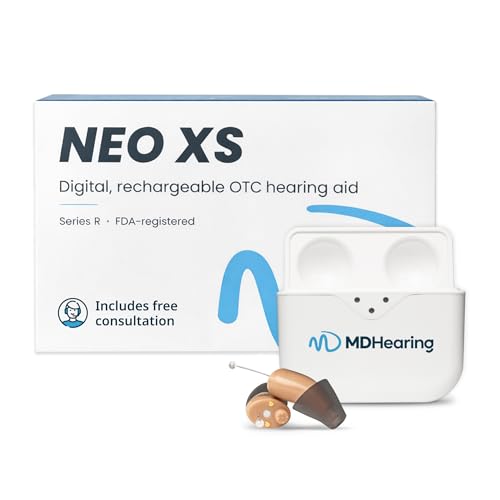
3. MDHearing NEO XS OTC In-Ear Hearing Aids
Tan in-ear shells that sit inside the canal and disappear at conversation distance.
Here is the size fact that matters: each MDHearing battery weighs 0.33 g. That lightness points to the whole design philosophy — the NEO XS is contoured to rest inside the ear canal in a tan shade chosen to blend with skin. The compact button lets you tap through volume and program settings without pulling out a phone, and the whole kit includes the hearing aids plus a case.
Power is a single full day per charge, and the charger carries up to 6 additional full charges without being plugged in — a genuinely useful buffer for a week of normal use. Smart noise canceling with multiple preset audio settings does the filtering, automatically suppressing feedback and background chatter so speech arrives naturally. The maker also notes the adjustment period honestly: changes are noticeable right away, but your brain needs time to relearn how to filter sound, and the support team is offered to help you through it.
The honest limit is documentation. There is no published gain figure on the listing, so if you want to see a decibel number before you buy, this pick makes you take the maker’s word on clarity. It is also a true in-ear canal fit, which delivers the invisible look but leaves less room for error on dome sizing — get that seal right and the whistling disappears.
The invisibility argument: skin-tone in-ear shells with multiple preset settings and a case that holds 6 charges are exactly what you want if being noticed is the thing you dread most.
What you give up: no published gain spec, so you are trusting the maker’s tuning rather than comparing a number.
Made for: wearers who want the hearing aid hidden inside the ear canal and a full week of charging buffer in the case.
Think twice if: you prefer to compare published gain figures before spending — this listing keeps them private.
4. Audien Atom X OTC Hearing Aid with Touchscreen Control
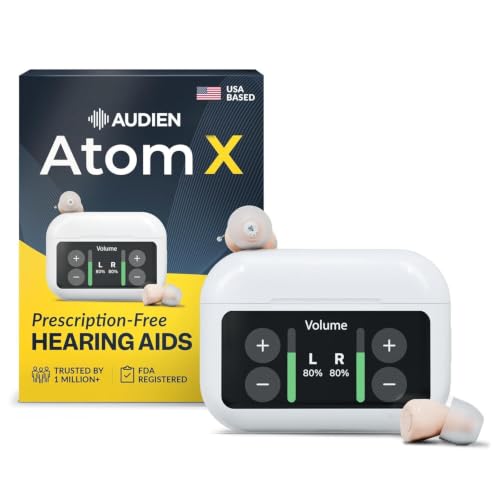
A touchscreen charging case handles volume and modes, so there is no app to learn.
The Atom X puts a touchscreen on the charging case itself — CaseControl — so volume and listening mode are a tap away instead of buried in a smartphone app or a button too small to feel. Four pre-programmed environments cover the common rooms: Conversation for one-on-one talks, Crowd for noisy restaurants, TV for clearer dialogue without cranking the set, and Comfort for easing into hearing aid use. Switching between them takes seconds, which is the point — you change modes as the room changes, not after you get home.
Battery is 16 hours on a single charge, and the portable case adds up to 48 hours of total use, so there are no disposable batteries to buy. Silicone shells in beige sit in the ear with side-specific shaping for comfort, and the kit is thorough: the pair, the touchscreen case, USB-C cable, wall adapter, cleaning brush, six pairs of earbuds, and a wax guard kit. Every purchase also includes a guided setup session, which is the part first-time wearers underrate.
Quality and ease of use drive the positive side of the record, and people routinely compare these against prescription pairs that cost many times more. But fit is the honest catch, and the review pages reflect it plainly: on smaller ear canals the shells can work loose, so a proper dome choice matters more here than on a behind-the-ear design. Effectiveness and sound quality split opinion, so buy this for the control scheme as much as the audio.
The control you get: a touchscreen case with four listening modes and 48 hours of case power is a genuinely different way to live with a hearing aid.
The fit caveat: in smaller ear canals the seal can drift — work through the six dome pairs until they stay put.
Pick this one if: you or the person you are buying for does not want to manage a hearing aid through a phone app.
Skip the shortcut if: your ear canals run small — plan on a careful dome fit or you will fight the seal.
5. ELEHEAR-Beyond OTC Hearing Aids (Champagne Gold)

Fifty decibels of gain with app control over volume, frequency, and directionality.
Amplification reaches 50dB, and VOCCLEAR AI is the maker’s name for the processing that boosts speech clarity by 17% and cuts 24dB of background noise. Whether you trust those numbers or not, the design goal is clear: keep voices forward in places where sound crowds in. Four scene modes give you presets for different rooms, and everything else — volume, frequency, sound directionality, environment profiles — is adjustable through the ELEHEAR app.
Battery is where this pair stands out. You get up to 20 hours of runtime on a single charge, four extra charges from the case for 100 hours total, and a fast top-up that puts 6 hours of runtime back in 15 minutes. That last figure is the one that matters on a weekday morning when you forgot to charge overnight. The champagne gold shells nestle behind the ear, and nine dome sizes give you real room to find a snug fit for workdays, workouts, or an evening out.
What owners consistently report is that the adjustable settings make a visible difference in different listening environments — you are not stuck with one tuning for every room. The sound quality itself splits: some ears call it crisp and clear, others describe a shrill edge at higher gain. One setup step matters: remove the protective films before first use, or you will spend an evening troubleshooting silence.
The tuning advantage: four app-driven scene modes plus frequency and directionality control mean you can tailor the sound rather than accept a single factory tuning.
A fair caveat: the high end can turn sharp at strong gain, so take advantage of the frequency controls rather than pushing volume.
This is your pair if: you want to shape the sound yourself and appreciate nine dome options for a behind-the-ear fit.
Consider the alternative if: you would rather set and forget than open an app to tune — this one rewards a hands-on owner.
6. ELEHEAR-Beyond OTC Hearing Aids with AI Speech Enhancement

The Bluetooth sibling of the Beyond, streaming phone calls straight into the ear.
You get the same 50dB maximum gain (how much louder the aid can make sound) as its gold cousin, but this version puts Bluetooth and the app front and center. VOCCLEAR AI delivers up to 50dB of gain with 24dB noise attenuation (it turns down background noise by that amount), built for mild to moderate hearing loss. The ELEHEAR app works on both iOS and Android and adds volume adjustment, AI translation, serene sound relief, telephone speech enhancement, and user-customized compensation. That means it is not just a volume dial but a tuning tool for phone conversations.
Battery math matches the family: 20 hours on a single charge, four extra cycles from the case for 100 hours total. Auto-on/off means the aids wake when lifted out and sleep when returned, and the receiver-in-canal design with soft contoured materials is shaped to follow the ear for all-day wear. Multiple dome sizes ship in the box, so ears of different sizes get a fair shot at a proper seal.
What the review pages reward most is quality, with value for money close behind — the Bluetooth pairing wins particular praise for working cleanly with Android phones and pairing without fuss. Sound quality, noise cancellation, and battery life each split opinion, so treat the tuning as a starting point rather than a finished sound. ElePro remote audiology care is also included, which is real support if you want a professional to help dial in settings from home. One caveat the maker states outright: this is an OTC device and may not meet severe hearing loss needs.
Why it stands near the top
- 50dB gain with 24dB noise attenuation for mild to moderate loss
- Bluetooth pairing that wins particular praise on Android phones
- 100 hours of total power — 20 per charge, four case cycles
- ElePro remote audiology care included with the purchase
The straight talk
- Sound and noise handling split opinion — tuning is a starting point
- Not built for severe hearing loss; the maker says so plainly
The right call for: someone who wants app control and streamed phone calls from a behind-the-ear design with remote care support.
Not the one for: severe hearing loss — this is an OTC device for mild to moderate, and the maker is honest about it.
7. Yeasound RIC700 Hearing Aids
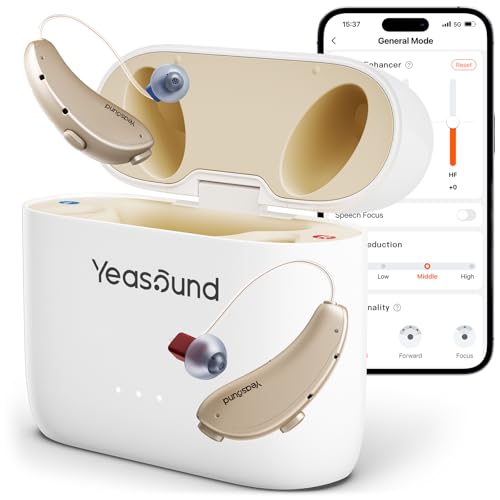
A three-hour charge that runs up to 279 hours, with Bluetooth streaming for iOS.
The headline here is endurance. A full charge takes 3 hours, delivers up to 279 hours of hearing support, and gives 162 hours if you stream Bluetooth. The maker frames that as roughly 7 days of typical use on one charge, so the charging cable becomes a weekend habit rather than a nightly one. Audio range reaches up to 8000Hz, which captures the higher ends of speech and the detail in birdsong and whispers that many devices smooth away.
AI-powered processing reduces background noise and squealing feedback, and the maker publishes a 5.3ms processing figure — that is the lag between a sound entering and leaving the device. Low latency is what keeps a conversation feeling live instead of slightly delayed, and it is the same spec that keeps TV audio in sync with lips. Physical controls are tactile rather than touchscreen: hold the top button for 1 second to power on, and a single press adjusts volume.
At 0.088 oz and 1.23 inches in length, the shell is designed for a full 16 hours of wear without becoming obvious in a work meeting or a dinner out. The Yeasound app handles volume, program switching, and personalized settings, and Bluetooth streaming works with iOS devices. What buyers report is real-world quiet and a clean fit, with the sound drawing the most praise. The caveat is Bluetooth: it is the one area the reviews split on, with dropouts developing over time, so treat streaming as a handy extra rather than the main reason to buy.
The endurance play: 279 hours on a charge and 162 while streaming is the longest battery figure on this list, by a wide margin.
Where to be careful: Bluetooth reliability is the spotty part — the hearing function is the star, not the streaming.
Choose it for: an owner who is tired of nightly charging and wants near-audiophile detail at the high end.
Don’t pick it for: heavy Bluetooth use — connection stability is the weakest link here.
8. Yeasound RIC800 Hearing Aids
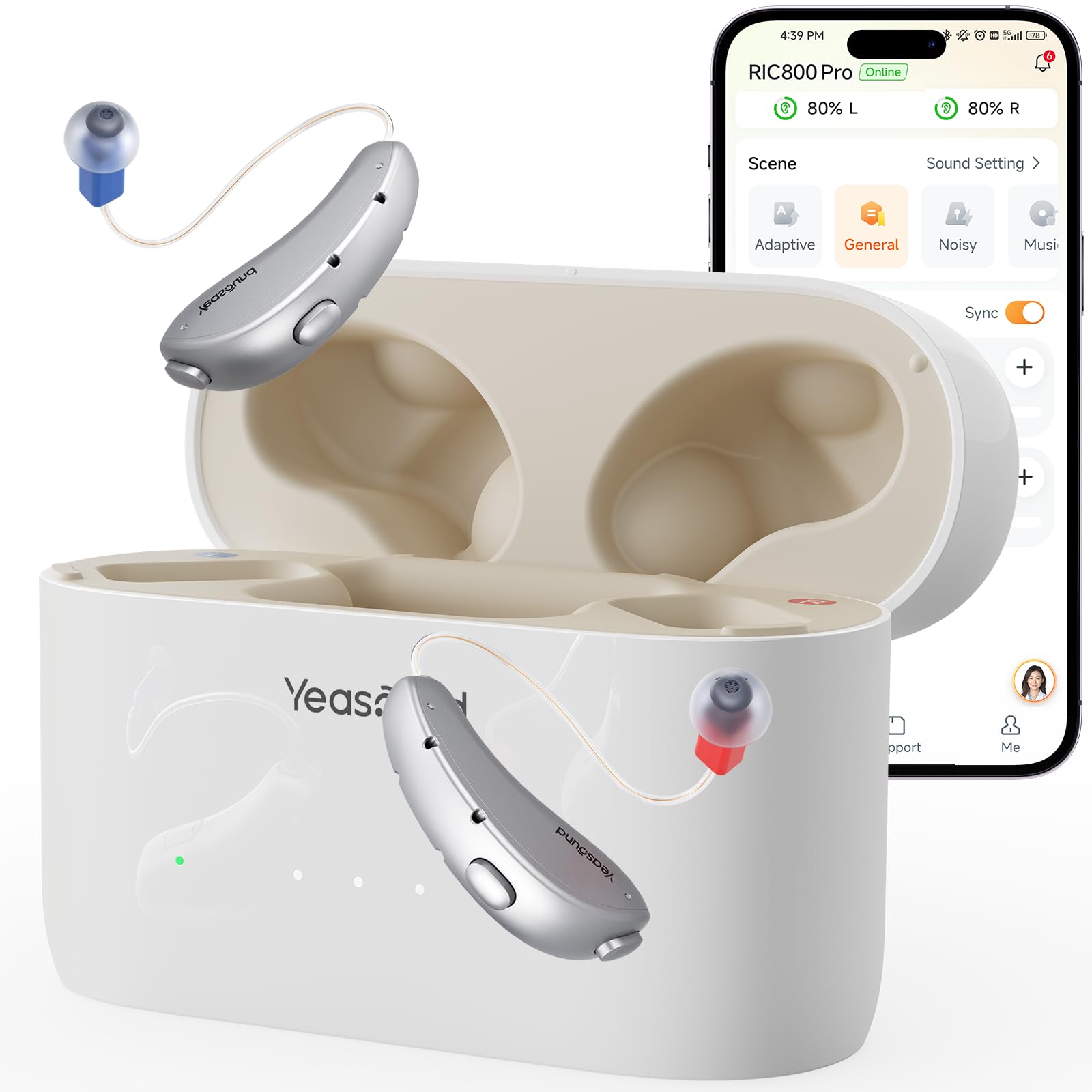
Five hand-tuned environments, Bluetooth on both phone platforms, and a shell that hides.
Where the RIC700 keeps it simple, this one layers on profiles. You get five specialized settings — Adaptive, General, Noisy, Music, and Outdoors — each tuned with its own noise reduction and speech enhancement. The AI picks the right one automatically as the room changes, and you can still choose manually when you know better than the algorithm. An AI assistant inside the app handles quick troubleshooting, which saves a call when something stops sounding right.
Bluetooth compatibility spans both iOS 14+ and Android 10+, so iPhone and Android owners are covered for calls and music streaming. Processing speed is 5.3ms, the same near-instant figure as its sibling, which keeps conversation and TV audio from trailing behind. Audio range reaches up to 8000Hz. Each earpiece runs independently with no complex pairing setup, and volume is adjusted through tactile buttons on the shells.
Battery gives you up to 23 hours in hearing mode or 12 hours while streaming, and the portable case adds three full charges for 4-5 days of total use. Wireless charging means dropping the case on a pad rather than finding a cable. The 0.088 oz, 1.23-inch shell carries an IPX8 rating, meaning it is built to survive water immersion — the figure to note if you sweat, get caught in rain, or habitually leave gear near a sink. The recurring strength in reviews is effectiveness, with noise reduction and tinnitus support both called out.
What makes it different: five modes plus an IPX8 rating make this the pick for an active owner who moves between rooms and weather.
The softer side: lithium-ion batteries inside hearing aids do decay over years of daily cycles — expect capacity to settle below its first-month peak.
Best matched to: someone active who wants the device to shift modes for them and survive a sweaty afternoon or a surprise downpour.
Less ideal if: you want the simplest possible control scheme — five profiles ask you to understand what each one does.
9. Sennheiser All-Day Clear Bluetooth Hearing Aids

A name you know from headphones, applying its audio tuning to a self-fitting hearing aid.
Sennheiser is a well-known audio brand, and this is its take on the OTC category: an FDA-cleared, self-fitting device supported by hearing care professionals. It uses a receiver-in-the-canal design that keeps the electronics behind the ear and the sound delivery in the canal, which is one of the more discreet form factors. Automatic environmental adjustment means it reads the room and adapts, so you are not constantly reaching for a setting.
Setup runs through the app in a few minutes, with personalization options and no audiologist appointment. Battery is up to 24 hours of continuous use, dependent on how you run it, which covers a full day even with some streaming. Bluetooth connects to iOS or Android for hands-free calls, music, podcasts, and audiobooks. The included kit is thorough: the pair, charging case, USB cable, wall plug, eight ear tips in S/M/L, wax guards, cleaning brush, and manual. The maker also offers a 30-day risk-free trial.
Where this one struggles is stubborn real-world rooms. Comfort and performance draw praise, and one owner’s note highlights moderate hearing loss as the balance. But sound quality splits — noisy environments and background hiss are the recurring friction points — and battery life, value for money, and customization all land in mixed territory. Bluetooth connectivity is also a split read. The brand name buys you polish and support, not a guarantee of perfect tuning in every room.
The case for it: a recognized audio brand, a receiver-in-canal fit, a 30-day trial, and eight ear tips mean you get real support behind the purchase.
The friction you may hit: noisy rooms and hiss are the weak spots, so this is a better home-and-office device than a crowded-restaurant one.
Worth it for: a buyer who values a familiar brand, a trial window, and a fit kit that ships with eight tips.
Think twice if: your daily life runs through loud restaurants — that is where this one gets hard to hear.
10. Jabra Enhance Select M2 Swift
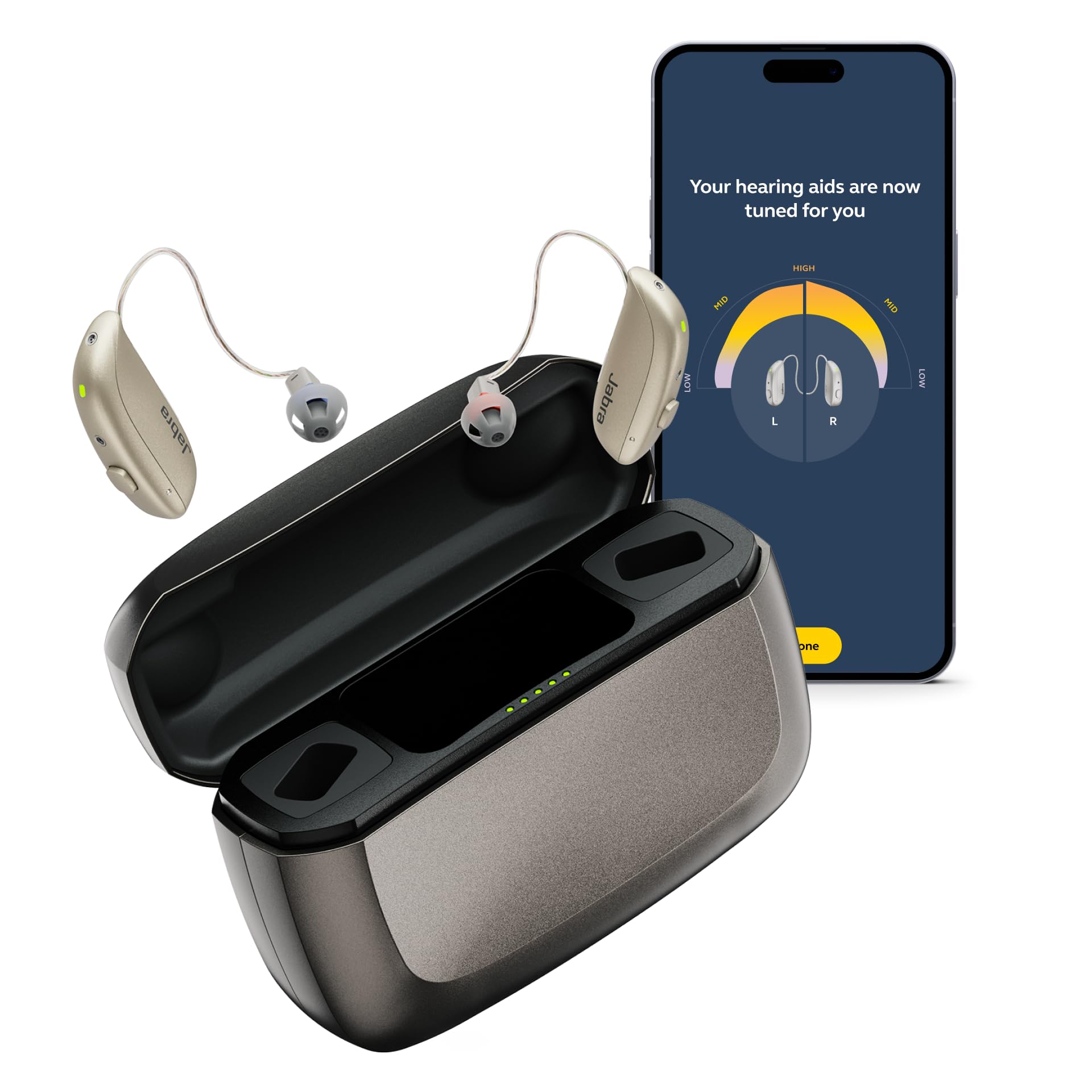
A do-it-yourself fitting test in the app, wrapped in a 2.12-gram shell rated for rain.
Weighing 2.12 grams, the M2 Swift is engineered to sit comfortably all day without announcing itself. The interesting part is the setup: an FDA-cleared self-fitting hearing test lives right inside the app, so you skip the appointment and dial the device to your own hearing curve. SoundScape is the maker’s speech clarity technology, and it works with auto-adjusting volume so speech levels follow you from a quiet office to a busy street.
The M2 Swift packs over 24 hours of listening on one charge, ships with a portable charger, and carries an IP68 rating with weatherproof nano-coating to fend off rain, sweat, and dust. Bluetooth handles hands-free calls and streams music and video from compatible Apple or Android phones. It also supports Bluetooth LE Audio and Auracast — that is the newer broadcast standard for beaming audio directly to compatible devices, handy in public spaces that support it.
In the app you can adjust volume, bass, and treble, and switch between environmental presets rather than a single setting. The maker bundles a 1-year warranty with 1-year loss and damage protection, and the device is FSA or HSA eligible (you can pay with pre-tax health savings). A fair caveat: the loss and damage protection is the biggest benefit of buying at this tier, but the app is where tuning happens — if you would rather not learn a phone interface, the setup work lives there.
The value read: self-fitting, IP68, Bluetooth LE Audio, and a year of loss and damage protection make this feel like a good trade.
What to know: the app is not optional — the hearing test and tuning both live inside it.
Good for: the person comfortable running a hearing test on a phone app who wants a discreet receiver-in-ear fit with a year of damage cover.
Not for: anyone who wants a device that arrives pre-tuned and never asks them to open an app.
11. Jabra Enhance Select M3 Aureon
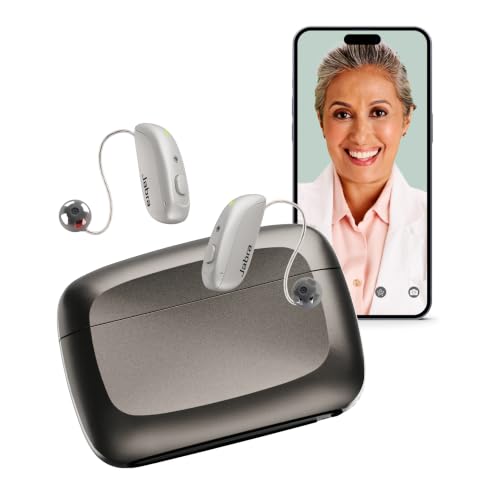
The top of the ladder: real audiologist access bundled with the smallest receiver-in-ear shell Jabra makes.
The Aureon is the most advanced device in this group, built around SoundScape with Auto Focus and Advanced Adaptive Listening that reads your environment in real time. Noise reduction and speech volume adjust themselves in complex situations, so you are not hunting for a mode. The maker describes it as its smallest receiver-in-ear hearing aid yet, a micro design weighing 2.12 grams for all-day wear that stays inconspicuous.
What separates it from the M2 Swift is the personalization ceiling. You can run the in-app FDA-cleared self-fitting test, or send in your audiogram for professional programming, allowing the device to be tuned by a licensed professional. Beyond the app test, clinical software open up the full capability, and you get unlimited adjustments plus appointments with a licensed hearing professional seven days a week. That is the “clinic from home” experience the maker is selling, and it is the real reason to step up a tier.
Bluetooth supports hands-free calls with TapControl — a double-tap answers the phone, no rummaging for a button — and streams music and media from compatible Apple or Android devices. LE Audio and Auracast support keep it current with newer broadcast audio. Battery runs over 24 hours per charge with a portable charger, and IP68 with weatherproof nano-coating handles rain, sweat, and dust. The maker includes a 3-year warranty with 3 years of loss and damage protection, against 1 year of warranty with 1 year of loss and damage protection on the M2 Swift below.
Why professionals buy in: audiogram-based programming, unlimited adjustments, and seven-day-a-week access to a licensed professional make this the closest thing to a clinic.
The real cost of entry: you are paying for service as much as hardware — the programming and support are what the premium buys, and the 3-year loss and damage cover reflects that.
Best for: a buyer who wants a licensed professional’s programming and ongoing support rather than a self-tuned app.
Overkill if: your loss is mild and you are happy tuning it yourself — the service layer is the point of this one.
Know the Specs
Gain (dB) and Noise Cancellation
Gain is the boost a hearing aid gives quiet sounds, measured in decibels. A higher figure can help more significant loss, but it is useless if the device also amplifies the dishwasher. Noise cancellation is the counterweight: it cuts background so speech stays forward. Look at both together — 50dB of gain with weak noise handling is louder, not clearer. For moderate loss at a noisy dinner table, the noise figure matters as much as the gain.
Battery Hours and Case Capacity
Two numbers matter, not one. The single-charge figure is hours per wear; the case figure is how many extra charges it carries without a wall outlet. A device with 20 hours per charge and four case cycles gives you roughly a workweek of use in your bag. Also check charging time — a 2-hour top-up is a Sunday chore, while a 15-minute quick charge for hours of use is a different kind of freedom.
IP Ratings and Water Resistance
The IP rating tells you how well the shell stands up to dust and water. A higher second digit means deeper water survival, which matters if you sweat, get caught in rain, or wear the device near a pool. For a hearing aid, the rating is a rough durability guide, not permission to swim with it. If your routine is indoors, a lower rating is fine; if you are active outdoors, prioritize it.
Form Factor: In-Ear vs Behind-the-Ear
In-ear models sit inside the canal, so they all but vanish but demand a precise dome seal or feedback returns. Behind-the-ear and receiver-in-canal designs keep the electronics hidden and the sound delivery in the canal, which can be more forgiving on fit and often more discreet for longer wear. Match the form to your ear shape and how invisible you want to be.
Common Questions
What is the difference between an OTC hearing aid and a personal sound amplifier?
Will an ultra hearing aid work with my Android phone?
How long should a hearing aid battery last on a single charge?
How do I stop my hearing aid from whistling?
Is a behind-the-ear hearing aid more comfortable than an in-ear one?
Can I wear a hearing aid while exercising or in the rain?
Do I need an audiologist to set up an OTC hearing aid?
How many dome or ear tip sizes should a hearing aid come with?
What does it mean if a hearing aid is FDA-cleared versus FDA-registered?
Can a hearing aid help with tinnitus ringing in the ears?
How much gain do I need for mild versus moderate hearing loss?
The Bottom Line
After weighing published specs against what owners actually live with, the ultra hearing aid winner is the Auiioes OTC Hearing Aids for Seniors. It pairs Bluetooth 5.3 with three sound modes and a both-ear in-ear fit that many buyers find genuinely good-looking — a device you will actually keep in. If long battery is your priority, the Yeasound RIC700 delivers up to 279 hours on one charge, and the Vivtone Lucid508 adds a 125-hour charging case for travel. And for hands-off control, the Audien Atom X puts the whole interface on a touchscreen case.
How we choose
We do not accept paid placement. Every pick is matched to a real buyer and a real use-case; we do not hands-on test units.
Sources
Specifications: manufacturer listings and product documentation. Review insights: verified customer reviews, as of November 2026. Pricing: not shown on this page (it changes often); check the current price via the retailer link.
As an Amazon Associate, Tactical Gear Guy earns from qualifying purchases. This does not affect which products we feature.