Specs are compiled from manufacturer listings and verified buyer reviews and can change over time — please confirm the key details on the product page before buying.
The short answer: the Emporia 48 Amp Level 2 Charger is the one to beat here — 4.5+ stars across 500+ ratings — because it pairs five UL standards and ENERGY STAR certification with a 25 ft cable, hardwired 48 A output, and a working energy app. But that is not the right charger for everyone. If you drive a Tesla with a NACS port, if you want a charger that works with no app at all, or if you have an 80 A circuit sitting in your garage, the right answer changes below.
This guide is built by comparing the manufacturers’ published specifications and the patterns across verified customer reviews, so you get each pick’s real strengths and trade-offs instead of marketing spin.
What follows is a plain-English walkthrough of the plug types, amp ratings, and enclosure ratings that actually decide whether a charger fits your car and your garage panel. It closes with the best ul certified ev chargers ranked by what they do well, not by how loud the box shouts.
Top Picks
How To Choose The Best UL Certified EV Chargers
An EV charger is a permanent electrical appliance bolted to your wall that runs at high current for hours, usually overnight, often unattended. That is why the UL mark on the label is not paperwork — it is the proof that an independent lab ran the unit through shock, cable-integrity, and ground-fault testing before it ever reached your garage. A charger without that listing is a fire risk you cannot inspect yourself.
Start With The Connector On Your Car
Two plug standards dominate North America, and picking wrong costs you an adapter or a return. J1772 is the round, multi-pin connector on most non-Tesla EVs — the Chevrolet Bolt, VW ID.4, Ford Mustang Mach-E, Hyundai Ioniq 5, Kia EV6, and Nissan Leaf all use it. NACS (also called J3400) is the Tesla-style connector that Tesla and a growing share of newer EVs use.
Several chargers in this list ship with both. The MACH 1 and MACH 2 include a J1772 connector plus ApexCharger’s PRO 1 NACS adapter in the box, so one unit covers both car types. Others are J1772-only and expect you to buy the adapter, and one — the ChargePoint HomeFlex — is natively NACS, which means it is a Tesla-first purchase.
Amp Rating, Breaker Size, And What You Actually Get
Amperage is the honest measure of how fast the box will refill your battery, and it is capped by your home’s wiring. A 40 A charger needs a 50 A circuit breaker. A 48 A charger needs a 60 A breaker, and most 48 A units in this list are hardwired for that reason — a standard NEMA 14-50 outlet tops out at 40 A. The 80 A Grizzl-E Ultimate needs a 100 A breaker, which most houses simply do not have spare.
Miles-per-hour figures are the manufacturer’s estimate for a typical EV and will vary with your car’s efficiency. The practical rule: a 40 A home charger refills most drivers overnight without ever touching a public station.
Weatherproofing And Where You Mount It
If the charger hangs in a carport, on an exterior wall, or beside a driveway, the enclosure rating decides whether it survives. IP65 and IP66 ratings mean the housing is sealed against dust and water spray. NEMA 4 and NEMA 4X mean the metal enclosure is built for indoor and outdoor duty, and NEMA 4X adds corrosion resistance. An occasional unit arriving with cosmetic damage is a shipping story, not a design fault — but a rating of NEMA 4 or IP66 is what you want written on the box.
Smart Features You Will Actually Use
Scheduling is the one feature that genuinely saves money, because it lets you charge during off-peak utility rates instead of at peak. Load balancing is the second: it lets two chargers share one circuit safely when you have two EVs and one panel. Everything else — remote diagnostics, energy graphs, RFID cards — is convenience.
Be honest with yourself about Wi-Fi. Every smart charger here connects only on the 2.4 GHz band, so a garage that sits at the edge of your router’s reach will drop the app connection. If your garage has weak signal, a dumb charger that simply charges is the better purchase.
Side-by-Side Comparison
| Model | Best For | Amperage | Connector | Cable Length | Amazon |
|---|---|---|---|---|---|
| EMPORIA Level 2 Charger★ Best Overall | Most home garages | 48 A | J1772 | 25 ft | Amazon |
| MACH 1 Level 2 ChargerMost Versatile | Two-car households, mixed plug types | 48 A | J1772 + NACS adapter | 30 ft | Amazon |
| Grizzl-E Ultimate 48AWeatherproof Build | Harsh-weather outdoor mounting | 48 A | J1772 | 25 ft | Amazon |
| MACH 2 Hardwired | Garage installs with strong reviews | 48 A | J1772 + NACS adapter | 30 ft | Amazon |
| IYILO 48A NACS Charger | Tesla and NACS vehicles | 48 A | NACS (J3400) | 25 ft | Amazon |
| Lectron Nexus J1772 | Long-cable outdoor installs | 48 A | J1772 | 23 ft | Amazon |
| ChargePoint HomeFlex | Tesla owners who want the network | 50 A | NACS | — | Amazon |
| Enphase IQ 50 | Long-term warranty buyers | 40 A | J1772 | 25 ft | Amazon |
| Grizzl-E Classic Connect 40A | Simple, rugged everyday charging | 40 A | J1772 | 25 ft | Amazon |
| VEIPHLOX 40A Charger | No-app, no-Wi-Fi simplicity | 40 A | J1772 | 25 ft | Amazon |
Detailed Reviews
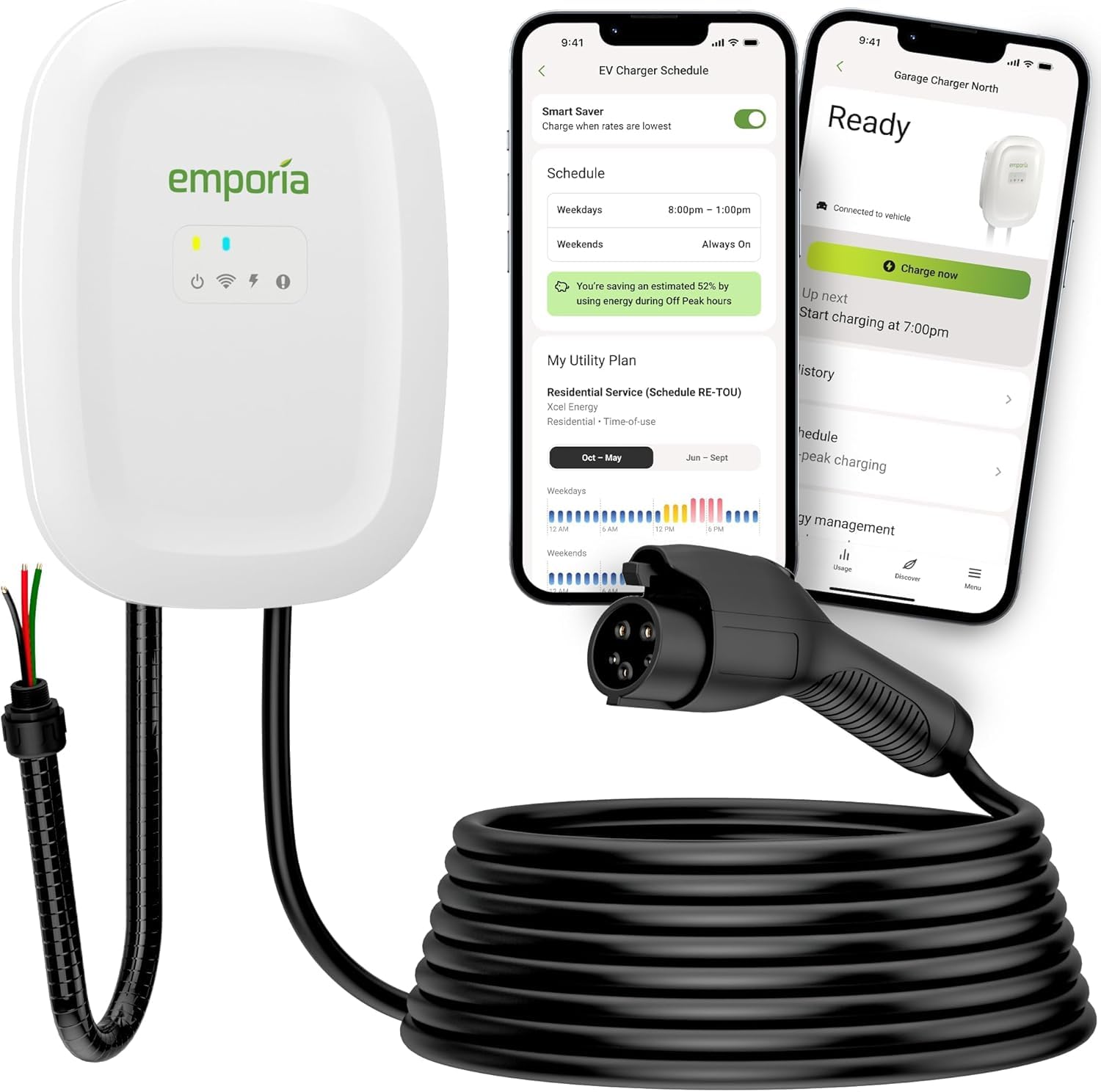
1. EMPORIA Level 2 EV Charger — 48 Amp, 240V WiFi Enabled
Our pick — 4.5+★ from 500+ verified ratings; the strongest balance of quality and price.
The charger that nails the boring stuff — a genuine UL listing, a real energy meter, and 48 amps on a hardwired circuit.
If you want one hardwired box that covers a normal two-car garage without drama, this is it. The Emporia runs hardwired at 48 A on 240 V, which the manufacturer rates at up to 46 miles of range per hour — roughly nine times what a standard wall outlet delivers. That number is an estimate for a typical EV, but the direction is honest: you plug in at 25% and the company’s own owner reports put 80% about 3.5 hours away.
What wins people over is the depth of the certification: five separate UL standards, not just one mark. The unit is UL listed to UL 817, UL 991, UL 2231, UL 2251, and UL 2594, and meets NEC 625 and SAE J1772 on top of that. It also carries ENERGY STAR certification. In plain terms, an independent lab tested the shock protection, the cable, and the charging electronics, not only the plastic shell. Owners consistently describe it as a solid home charger that keeps working with whatever J1772 car is in the driveway.
The energy app is the other half of the pitch: real-time consumption data and off-peak scheduling on 2.4 GHz Wi-Fi. Connect it on 2.4 GHz Wi-Fi and you get real-time consumption data plus the ability to schedule sessions around cheaper utility rates. Owners who already run Emporia’s Vue3 monitor report the two talk to each other cleanly, which makes the whole picture of your home’s power use visible in one place.
Where it earns the top spot
- Five separate UL standards plus ENERGY STAR, which is about as thoroughly vetted as a home charger gets.
- 48 A hardwired output rated up to 46 miles per hour of range.
- 25 ft cable and a wall mount plus handle holster in the box, so installation hardware is not a separate errand.
- Real-time energy data and scheduling through the app, and it pairs with Emporia’s Vue3 monitor.
What to weigh before you buy
- Hardwired only — the included whip means an electrician, not a DIY wall plug.
- J1772 connector, so a Tesla needs the separate Emporia Tesla model or an adapter.
- Wi-Fi runs on 2.4 GHz only; a garage at the far edge of your router’s range will struggle.
Buy it if: your car has a J1772 port and you want one charger that covers certification, speed, and energy reporting without a subscription.
Look elsewhere if: your garage has no 240 V hardwire path or your router’s 2.4 GHz signal dies at the garage door.
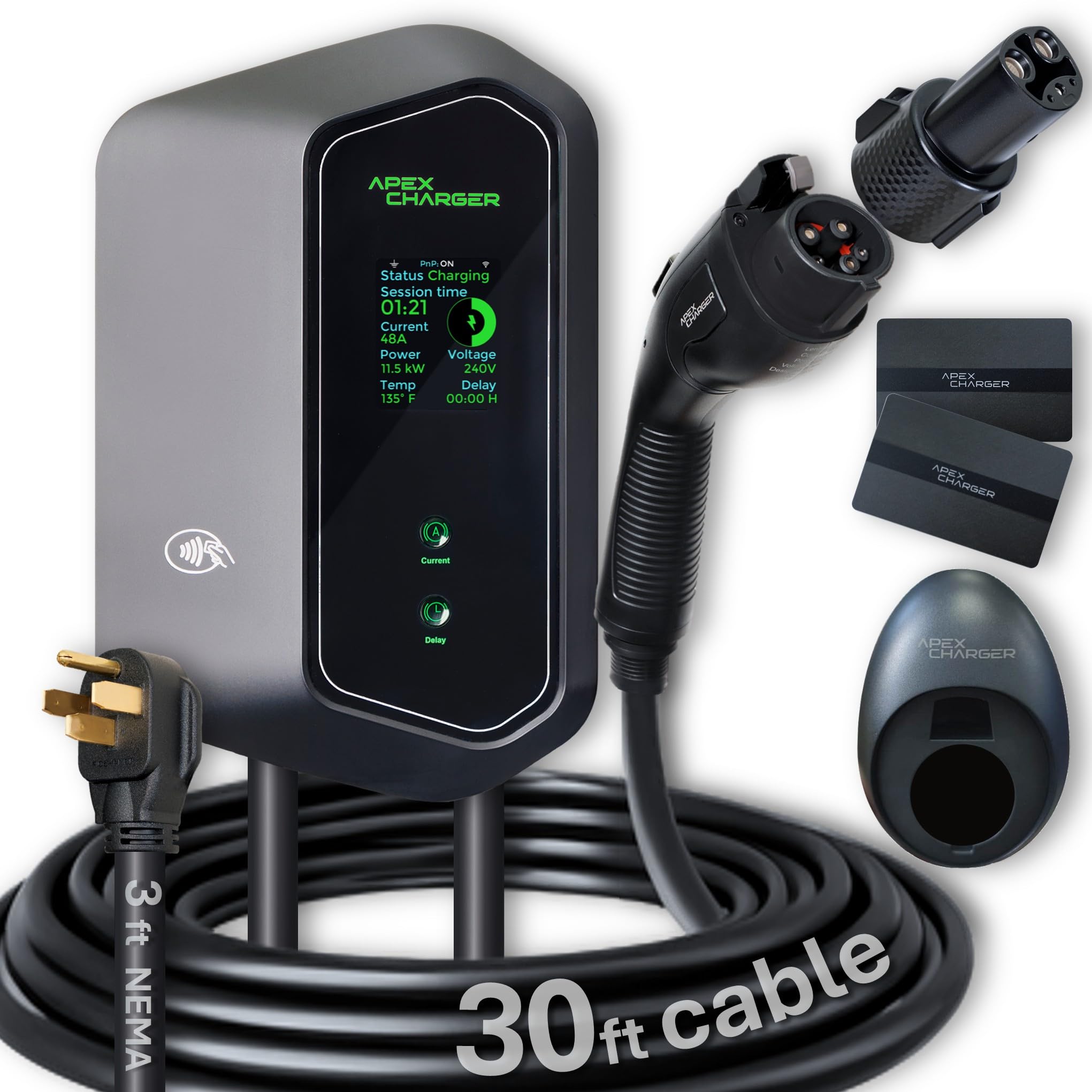
2. MACH 1: Fast 48 Amp Level 2 EV Charger
One charger, two plug standards, and a cable long enough to reach the far bay.
Here is the comparison that matters if your household has two different cars in it: the MACH 1 includes both a J1772 connector and ApexCharger’s PRO 1 NACS adapter in the box, so it covers a Tesla and a non-Tesla without a second purchase. Pair that with 48 A on 240 V and it is the most flexible unit in this lineup for a mixed driveway.
The cable is the spec owners talk about most after the price. At 30 ft, it measures 5 ft longer than the Emporia’s 25 ft, which is the difference between backing in and threading a cable around a support post. And this is where the size comparison with the VEIPHLOX gets dramatic: the MACH 1’s 3.15″D x 6.72″W x 10.35″H body sits far smaller on the wall than the VEIPHLOX’s 18.5″D x 8.66″W x 14.17″H footprint — a wall-hugging box versus one that stands well out from the studs.
On installation, it offers both paths: a NEMA 14-50 plug on a 50 A breaker for 40 A, or the included hardwire kit on a 60 A breaker for the full 48 A. The 2.4 in LED display, Bluetooth plus Wi-Fi, two RFID cards, and an anti-theft bolt are all in the box. Owners who charge in snowy climates report it keeping on through winter, and it is note the certified coverage is broad — ETL, ENERGY STAR, and UL certified up to UL 2594:2022 Ed.3.
The realistic downside: the smart app and Wi-Fi setup assume a 2.4 GHz signal in the garage, and the feature pile is large enough that the first setup session takes patience. Consider it a one-time cost rather than a daily annoyance.
The right call for: a garage with both a Tesla and a J1772 car, or anyone who wants the extra 5 ft of reach.
Think twice if: you want a set-and-forget box with no app or RFID cards to manage.
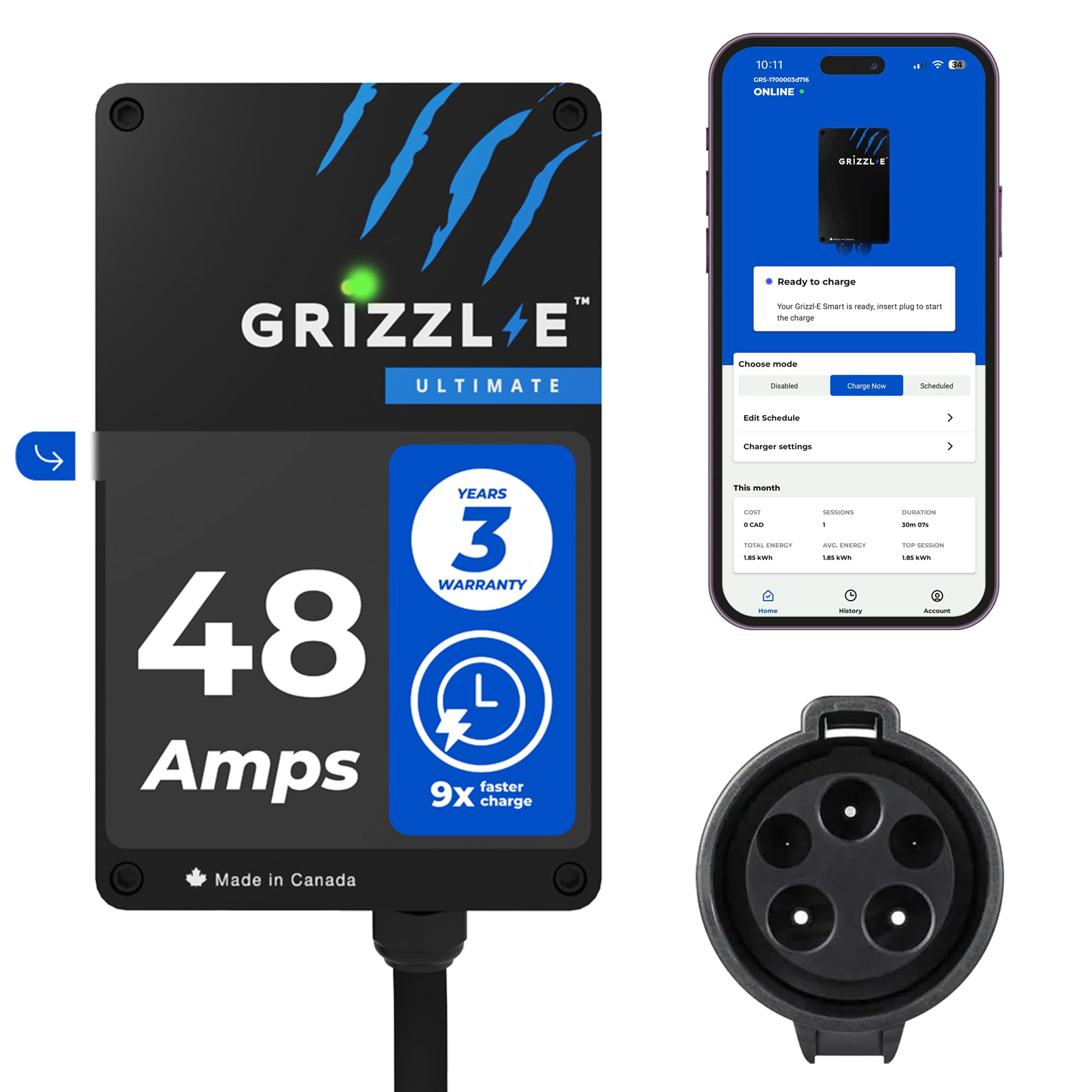
3. Grizzl-E Ultimate 48A Level 2 Charger
A cast aluminum shell built for a driveway in February, not a showroom.
Mounting a charger outside is a different purchase from mounting one inside, and this Grizzl-E treats it that way. The housing is a UL Type 4 rated aluminum cast enclosure — meaning sealed against rain, snow, and dust — with a 25 ft J1772 cable. It is built in Canada, UL certified, and ENERGY STAR certified. If your unit lives on an exposed exterior wall, this is the case you want around the electronics.
Power sits at 48 A and the manufacturer rates it up to 11.5 kW, nine times a basic charger. Owners describe startup taking less than 3 minutes and a run to 90% in roughly 5 hours, which lines up with what a 48 A hardwired unit should do. What people talk about most is the functionality — it simply does what it is told — followed closely by raw charging performance.
The honest friction points are the app and the Wi-Fi, both of which draw mixed feelings rather than praise. Charging works with or without an online connection, so the fix is easy: treat the app as optional and let the car charge. There is also a one-time activation fee for the premium OCPP integration, which is worth knowing before you count on it. Load balancing across multiple chargers is included, which is a genuine asset if you ever add a second EV.
Who it is built for: anyone whose charger faces the weather, or who wants Canadian-built metal rather than a plastic shell.
The trade-off: hardwire only — the included kit means an electrician, and the smart layer is the weakest part of an otherwise sturdy unit.
Reach for this if: the charger hangs outdoors and you want the toughest enclosure plus 48 A.
Pass if: you refuse to pay a one-time activation fee for advanced app integration.
4. MACH 2: Fast Hardwired Level 2 EV Charger
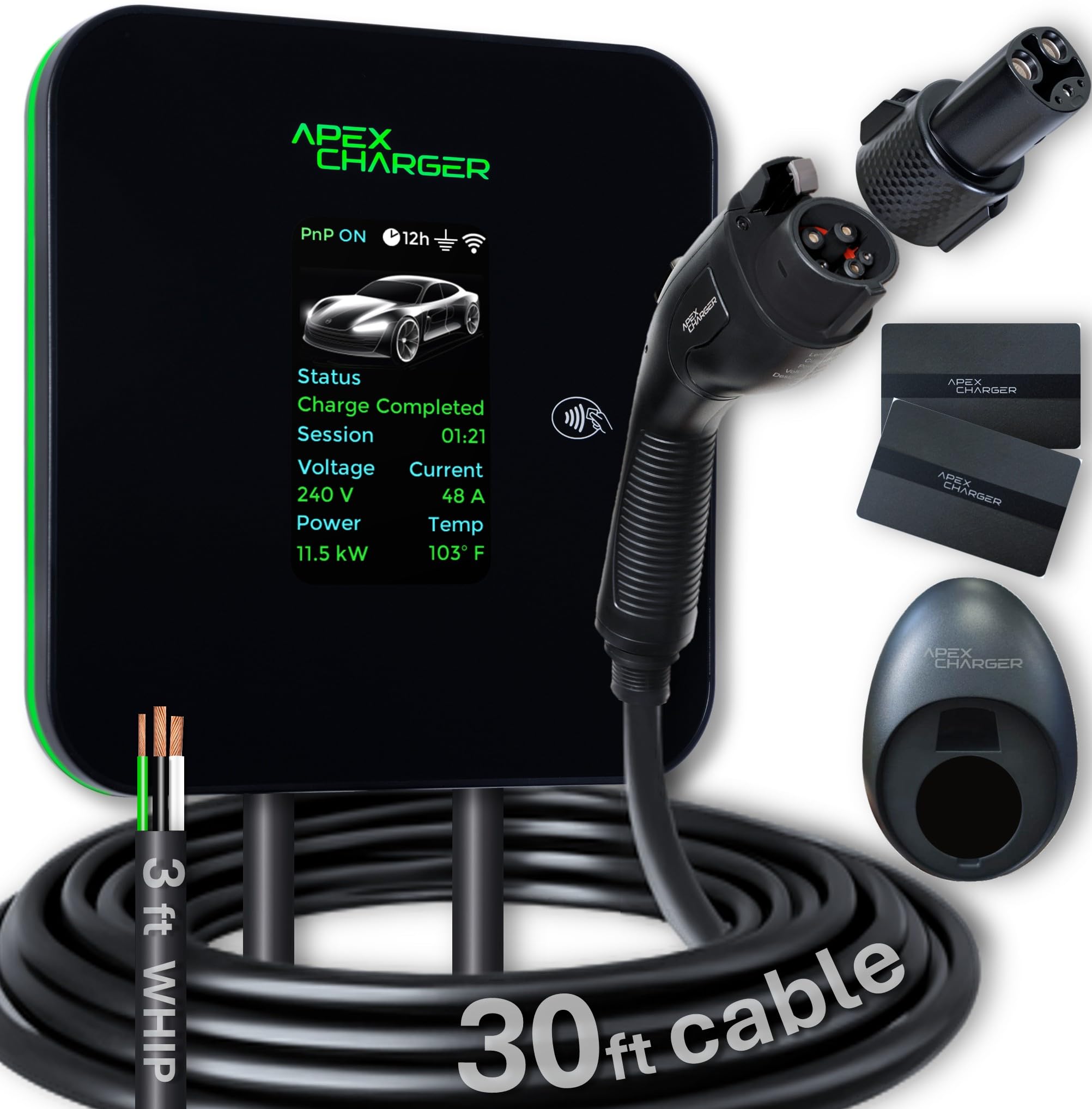
The hardwired sibling of the MACH 1, with a bigger display and the longest coverage in the lineup.
This is the garage-permanent version of ApexCharger’s design. It hardwires at 48 A and 240 V for up to 11.5 kW, keeps the dual J1772 plus PRO 1 NACS adapter arrangement, and adds a 4 3/4″ LED display with a standby function so the screen does not glow all night. The Bluetooth and Wi-Fi stack, the two RFID cards, the True Plug N’ Play function, and the connector holder all carry over from the MACH 1.
The standout number here is the coverage: 5 years, the longest of any charger on this list. The unit is ETL, ENERGY STAR, and UL certified up to UL 2594:2022 Ed.3, and the IP rating protects both the cable and the main unit from snow, water, and dust — an outdoor rating, not an indoor-only claim.
Where it earns its spot is simplicity of install. The recurring theme in what buyers report is that it arrives complete, with nothing else to buy, and setup goes in without a fight — a BMW X5 xdrive50e plug-in hybrid owner put it plainly as working great with that car. The anti-theft bolt and included fittings are small things that save a trip to the hardware store.
This one suits: a permanent garage install where the 5-year coverage and a bigger display are worth paying for.
Not the pick for: renters or anyone who needs to unplug and move the unit — hardwiring is the whole design here.
5. IYILO 48A Level 2 EV Charger for Tesla (NACS)
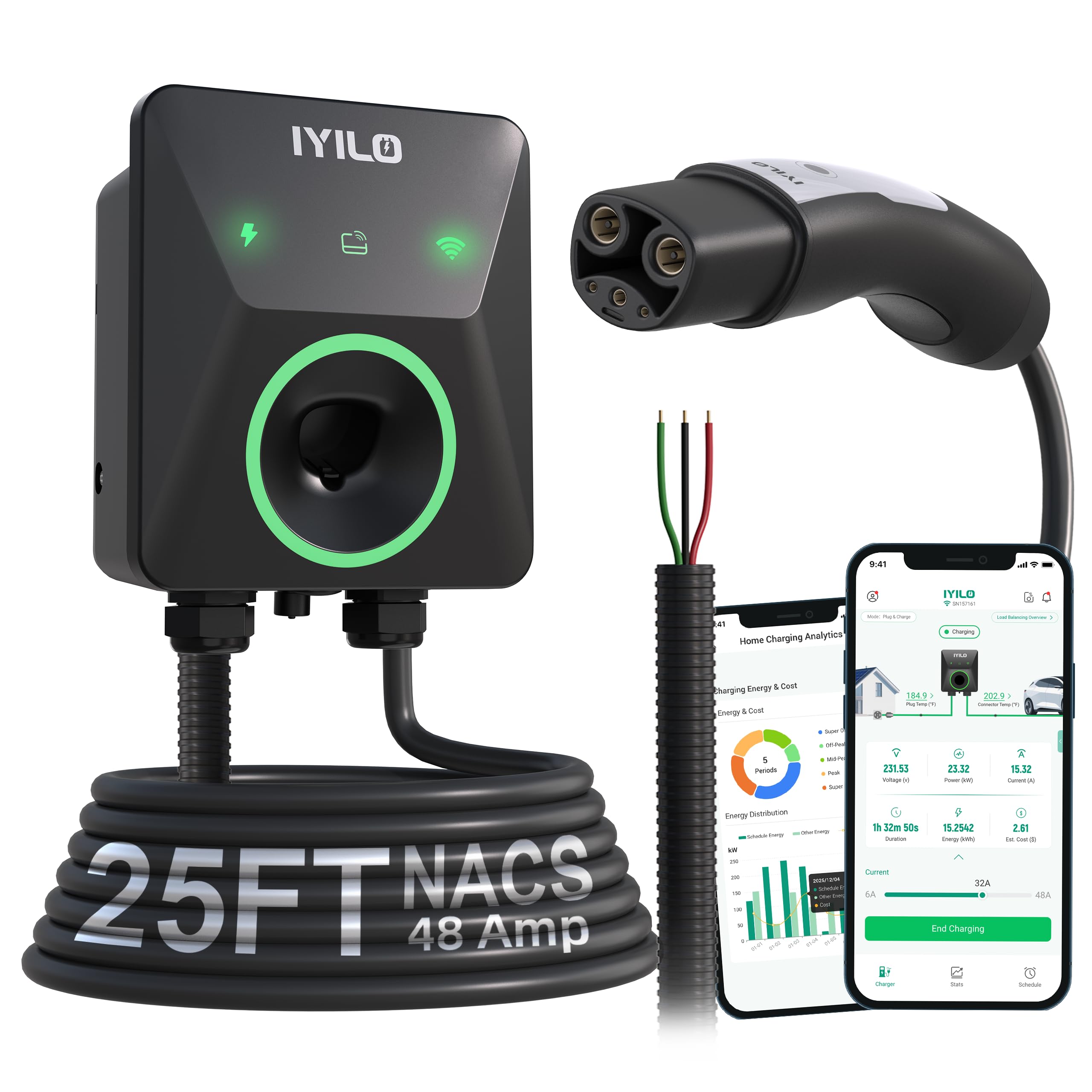
A native Tesla-style connector with a temperature sensor living inside the plug itself.
Most chargers in this list reach Tesla owners through an adapter. This one is built NACS (J3400) from the start, with a 25 ft heavy-duty cable, so no adapter sits in the chain adding resistance or a loose joint. It delivers 48 A and 11.5 kW, rated at up to 46 miles of range per hour, and the current is adjustable in 1 A steps from 6 A to 48 A — a useful range if you ever need to dial it down to share a circuit.
The feature worth calling out is the NTC temperature sensor built into the connector. It watches the plug’s temperature in real time and shows the reading in the app; if the connector passes 221°F (105°C), the charger reduces power or shuts off entirely. That is a genuine safety layer at the exact point where heat builds up on a high-current connection.
The app handles time-of-use rate scheduling, energy and cost tracking, multiple user accounts, and over-the-air updates, and the unit supports power sharing so two chargers can run off one breaker without overloading it. Certifications are broad: a UL 2594 test report, ETL, ENERGY STAR, and CSA. Note the fine print — Wi-Fi is 2.4 GHz only, and the company’s own support hours are Monday to Friday with two windows during the day. It also lists itself on several utility EV charging program portals, worth checking against your own provider.
Tesla owners gain here
- Native NACS plug, so no adapter in the chain.
- Connector temperature monitoring with automatic power reduction or shutoff past the limit.
- Adjustable current from 6 A to 48 A in 1 A steps.
- Power sharing for two chargers on one circuit, plus load balancing with the separate Energy Meter.
- 3-year warranty and a UL 2594 test report alongside ETL, ENERGY STAR, and CSA.
Before you commit
- J1772 cars need an adapter that is not included.
- 2.4 GHz Wi-Fi only.
- Support runs Monday to Friday in two daily windows rather than around the clock.
Best match for: a Tesla or any NACS-equipped EV, especially if you want to schedule around off-peak rates.
Wrong turn if: your car has a J1772 port and you do not want to buy an adapter.
6. Lectron Level 2 J1772 Nexus EV Home Charger

The sealed outdoor unit with the heaviest certification list and the longest cable here.
Three numbers define this one. First, 48 A at 240 V for 11.5 kW, rated up to 46 miles of range per hour. Second, an IP66 rating — the highest water-and-dust seal in this lineup — so rain, snow, heat, and dust are all covered. Third, a 23 ft cable, which is the longest here, and it comes on a 21.6 lb unit that feels like serious hardware on the wall.
The certification list is the reason to trust it outdoors. It carries UL 2594, UL 2231, and UL 2251 testing with ETL listing, plus ENERGY STAR and FCC. In plain terms, the shock protection, cable integrity, and system reliability were each independently tested, and the internal protections cover overheating, overcurrent, voltage faults, and ground faults. A charger holster is included, so cable management is a mounting decision rather than another purchase.
Because this is a hardwired 48 A unit, the install path is a 240 V hardwire job with a professional. Expect a bigger electrical bill for that work than a plug-in unit would need; in exchange, you get a permanent installation that never asks for a receptacle. For anyone mounting where the weather hits hardest, this is the most protected box in the list.
The tightest seal: IP66 plus three UL standards is the strongest weather-and-safety combination on this page.
Where it falls short: hardwired only, so plan for the electrician, and the 48 A output still asks for a 60 A breaker.
Choose it when: the charger faces driving rain or snow and you want the tightest enclosure available.
Skip the hardwire path if: your garage only has a NEMA 14-50 outlet and you want a plug-in install.
7. ChargePoint HomeFlex Level 2 EV Charger (NACS)

A Tesla-native hardwired unit backed by the largest charging network in North America.
The reason to consider ChargePoint is not the box — it is the ecosystem behind it. The company’s app connects to a network of 274k+ stations across North America and Europe, plus 565k+ roaming partner stations, which means one login covers home charging and public stops. If you road-trip in your Tesla and want a single map and a single bill, that is a real advantage the other units here do not offer.
The hardware is a native NACS connector with a 50 A current rating, hardwired at 240 V, and a cold-resistant cable for outdoor installs. It is UL certified and built for indoor or outdoor mounting with an electrician. The 24/7 support line is another benefit the smaller brands here cannot match.
Speed is where you need to read carefully. The app and setup draw praise as super simple, but charging performance is the split point — some Tesla owners mention it charging at maximum rate while others find it not charging at the correct amperage. That is the profile of a unit that works well for most and needs a firmware or wiring check for a few. If you want a network-backed charger and your wiring is sound, this is the Tesla pick that most directly maps to your car.
Worth it for: Tesla owners who want native NACS, a hardwired 50 A setup, and the network app for public charging.
A weaker fit if: you want a plug-and-charge unit at 48 A — this is hardwire only and the amp output is the spec to verify for your car.
8. Enphase IQ 50 (Formerly ClipperCreek) 40 Amp Smart Charger

A 40-amp unit sold on the promise of a five-year warranty and a sealed enclosure that never quits.
For a permanently installed appliance, the warranty is part of the value, and this sits at the top: a 5-year limited warranty with 24/7 customer support. It is a 40 A J1772 charger at 240 V that requires a 50 A circuit, rated up to 38 miles per hour of charging, and it carries UL 2594 safety certification plus ENERGY STAR. The sealed NEMA 4-rated enclosure is built for indoor or outdoor duty.
The smart layer is Wi-Fi through the Enphase App, which handles charging schedules and off-peak rate reminders. If you have an Enphase Energy System at home, it pairs for solar charging, which is a meaningful advantage for a solar-equipped house. The rugggedized J1772 connector and the included connector holster round out the hardware.
The car you drive decides this one. It is ideal for vehicles with acceptance rates up to 9.6 kW — a 40 A ceiling, not 48 A — so a car that can take more power will charge a bit slower here than on the higher-amp units. In exchange you get the longest warranty, a proven enclosure, and the Enphase ecosystem. If solar charging is part of your plan, this is the pick that fits the system.
Fits best with: a solar-equipped home or an owner who values a long warranty over maximum amps.
Not for you if: your car accepts more than 9.6 kW and you want every amp your circuit can supply.
9. VEIPHLOX 40 Amp 9.6kW Level 2 EV Charger

No app, no Wi-Fi, no account — a 40-amp charger that plugs into an outlet and just starts charging.
Not every buyer wants a smart charger, and this is the answer to that. It is a 40 A, 9.6 kW unit with a NEMA 14-50 plug on a 50 A circuit, and a 25 ft cable. The whole design is plug-and-charge: you hang it, you plug it in, it charges. The internal cord-holding design and the built-in connector socket mean you never buy a separate holster — the cable coils inside the body and the handle slides into its own groove.
The weatherproofing is solid for a value unit: an IP65 housing rated for dust and water spray, a UL-certified 25 ft cable, an ETL and UL approved 14-50 plug, and protection against over-current, over-voltage, over-temperature, lightning, and surges. It recovers on its own after a power outage, which is a real convenience if your garage loses power in storms.
What people value most is reliability — customers note it performing well even at -40 degrees, and it is described as more convenient than public charging stations. The trade-off for that simplicity is a longer fill: the unit’s own stated battery charge time is 7 hours. And it stands 18.5″D x 8.66″W x 14.17″H, which is a far bulkier wall footprint than the compact MACH 1 at 3.15″D x 6.72″W x 10.35″H. If you need a charger in a tight garage corner, check the depth before you buy.
The case for the simple box
- No app, no Wi-Fi, no account to manage.
- Plug-in NEMA 14-50 install on a 50 A breaker, and the company says setup can take about 5 minutes on an existing outlet.
- Built-in cable management and handle socket, so no extra holster to buy.
- IP65 housing with self-recovery after a power outage.
- Reliability holds up in extreme cold, per owner reports.
The honest trade-offs
- No scheduling or app features; it charges whenever it is plugged in.
- The stated battery charge time is 7 hours, slower than the 48 A units.
- A bulky 18.5″D wall footprint compared to the compact units here.
The simple choice for: renters and owners who want a plug-in charger with zero accounts or apps.
Not the one for: anyone wanting off-peak scheduling or a fast overnight refill on a large battery.
10. Grizzl-E Classic Connect 40A / 9.6 kW Level 2 Charger

The best-known Grizzl-E design, now with Wi-Fi and a NEMA 4 metal case at a reasonable 40 amps.
This is the smart version of Grizzl-E’s bestselling classic. It runs 40 A on a NEMA 14-50 plug and a 50 A breaker with a 25 ft cable, which the company rates at 28-30 miles per hour. Unlike the hardwired units here, it plugs in: install a simple 14-50R outlet and you are ready, which saves on electrician work and makes the unit easy to unmount and carry between locations.
The case is the reason it earns a spot: a heavy-duty NEMA 4 metal enclosure rated for indoor and outdoor use, with over-current, over-voltage, under-voltage, missing-diode, ground-fault, and over-temperature protections, self-monitoring and recovery, a built-in GFCI, and a 3-year warranty. It is UL tested and certified, eligible for the federal rebate program, and made in Canada. Amperage is adjustable from 40 A down to 16 A to match smaller breakers.
What buyers get out of it is the stuff that does not break — the design has a reputation summed up best as a “dumb charger that never fails,” even with a smart layer bolted on. The app tracks charging costs and handles schedules, and the app setup draws good feedback rather than complaints. The premium OCPP integration carries a one-time activation fee, which is the one line item to know about before you buy. If what you want is a rugged 40 A charger that still works if Wi-Fi drops, this is the balanced pick.
Why it sells: a NEMA 4 metal case, a built-in GFCI, and UL testing on a plug-in 40 A unit that works without a network.
The fine print: 40 A caps you below the 48 A units, and the premium OCPP integration costs extra to activate.
Pick this for: a plug-in 14-50 install where rugged build and reliability matter more than the extra 8 amps.
Look at the 48 A Grizzl-E instead if: your panel supports a 60 A hardwire and you want the faster rate.
Know the Specs
Amperage And Breaker Size
Amperage is the current the charger draws, and every amp needs breaker headroom behind it. The rule that runs through this whole list: a 40 A charger needs a 50 A breaker, a 48 A charger needs a 60 A, and an 80 A charger needs a 100 A. The practical outcome is simple — a 40 A unit fills most cars overnight, and a 48 A unit does it a little faster on a car that accepts the power. If your panel has no spare 60 A capacity, a 40 A plug-in charger is the honest choice.
IP And NEMA Enclosure Ratings
These ratings describe the housing, not the electronics. IP65 and IP66 mean the shell issealed against dust and water spray, with the second digit covering the water side of the seal. NEMA 4 and NEMA 4X mean a metal enclosure built for indoor and outdoor duty, with 4X adding corrosion resistance. What that means for you: an IP66 or NEMA 4 unit can hang on an exposed exterior wall, while an unrated unit belongs inside a garage.
Connector Type: J1772 Vs NACS
The connector is the physical plug, and picking wrong means an adapter or a return. J1772 is the round multi-pin plug on most non-Tesla EVs. NACS, also called J3400, is the Tesla-style plug. Several chargers here ship with a J1772 connector plus a NACS adapter in the box, which covers both car types in one purchase. A native NACS unit like the IYILO or the ChargePoint HomeFlex is the cleaner path if everyone in the house drives a Tesla.
Hardwired Vs Plug-In Installation
Hardwiring means the charger is wired directly into a breaker with no outlet, which is what open up 48 A and 80 A output and gives the most weather-tight connection. Plug-in units use a NEMA 14-50 outlet and top out at 40 A, but they install in minutes on an existing receptacle and can be unmounted and moved. The trade is speed and permanence against simplicity and portability — and a hardwired install needs an electrician either way.
Common Questions
Will a J1772 charger work with my Tesla?
Do I need a 60 amp breaker for a 48 amp charger?
What does UL certified actually mean on an EV charger?
Can I install a hardwired EV charger myself?
How fast will a 40 amp charger fill my car overnight?
Can I mount an EV charger outside in the rain?
Does my smart charger work if the Wi-Fi in the garage is weak?
Is an 80 amp charger worth it over a 48 amp one?
Do these chargers qualify for federal or local rebates?
What is the difference between a smart charger and a dumb charger?
The Bottom Line
For most garages, the ul certified ev chargers winner is the Emporia Level 2 EV Charger because it stacks five separate UL standards and ENERGY STAR on top of 48 A hardwired output and a working energy app. The catch worth knowing: it is hardwired only, so you need a 240 V circuit and a 60 A breaker in the garage — confirm that first. If your household has both a Tesla and a J1772 car, grab the MACH 1 for its included NACS adapter and 30 ft cable. And for an outdoor wall that takes real weather, the Lectron Nexus is the one to reach for, with IP66 sealing and three UL standards behind it.
How we choose
We do not accept paid placement. Every pick is matched to a real buyer and a real use-case; we do not hands-on test units.
Sources
Specifications: manufacturer listings and product documentation. Review insights: verified customer reviews, as of November 2026. Pricing: not shown on this page (it changes often); check the current price via the retailer link.
As an Amazon Associate, Tactical Gear Guy earns from qualifying purchases. This does not affect which products we feature.