Specs are compiled from manufacturer listings and verified buyer reviews and can change over time — please confirm the key details on the product page before buying.
Buying a surge strip is not about outlet count — it is about whether the strip will still be clamping voltage when a lightning strike comes down the line. A strip marked “surge protector” on the box is not the same thing as one actually tested to UL 1449, the safety standard that governs transient voltage surge suppressors. That distinction decides whether your gear gets sacrificial protection or just a plastic bar with sockets in it.
This guide is built by comparing the manufacturers’ published specifications and the patterns across verified customer reviews, so you get each pick’s real strengths and trade-offs instead of marketing spin.
Below you will find real joule ratings, real cord lengths, and the honest trade-offs that separate a surge suppressor from a fancy extension cord. If you want a strip that actually earns its place behind your desk or in a rack, this breakdown of the ul 1449 power strip field tells you exactly which one to screw to the wall and which to leave on the shelf.
Top Picks

How To Choose The Best UL 1449 Power Strip
The single most useful thing you can do before buying is read the certification line, not the outlet count. UL 1449 is the safety standard written specifically for transient voltage surge suppressors. A strip that conforms to it has been tested for how much excess voltage it will let through and how it behaves at the end of its life. A strip that only says “UL Listed” may simply be certified as an extension cord — a different, weaker standard that says nothing about surge clamping.
Start with the certification line, not the joule number
Look for UL 1449 named on the listing or the housing itself. Some strips carry related marks alongside it — UL 1363 covers the general power strip construction, and UL 497A covers phone-line protection. A strip that names both UL 1363 and UL 1449 has been tested as both a cord assembly and a suppressor. That combination is the one you want behind expensive electronics.
Then size the joule rating to your gear
Joules measure how much transient energy a suppressor can absorb before sacrificing itself. A 500-joule strip suits a lamp and a phone charger. A 2,000-joule strip handles a desk setup. A 3,000-joule-plus strip is built for home theater receivers, servers, and anything with a motor or a big power supply. Higher is not automatically better for every room, but under-speccing the strip in front of your main equipment is the more common mistake.
Check where it will physically go
A flat plug lets furniture sit flush against the wall, which matters in a bedroom or behind a sofa. Keyhole slots on the back let you hang the strip under a desk or on a workbench. If the strip is headed into a server rack, 1U rack ears and a 19-inch width are non-negotiable, and outlet placement on both front and rear becomes a real convenience rather than a spec-sheet extra.
Side-by-Side Comparison
| Model | Best For | Surge Rating | Outlets | Cord Length | Amazon |
|---|---|---|---|---|---|
| Eaton Tripp Lite SUPER-7 White★ Best Overall | Desk and bedroom setups | 2160 joules | 7 | 7 ft | Amazon |
| Belkin 12-Outlet Surge ProtectorMost Outlets Per Dollar | Whole-desk charging hub | 3480 joules | 12 | 6 ft | Amazon |
| Eaton Tripp Lite HT10DBS Isobar | Home theater and A/V stacks | 3840 joules | 10 | 8 ft | Amazon |
| DEWENWILS 4-Pack 10FT | Covering several rooms at once | 500 joules | 6 | 10 ft | Amazon |
Detailed Reviews
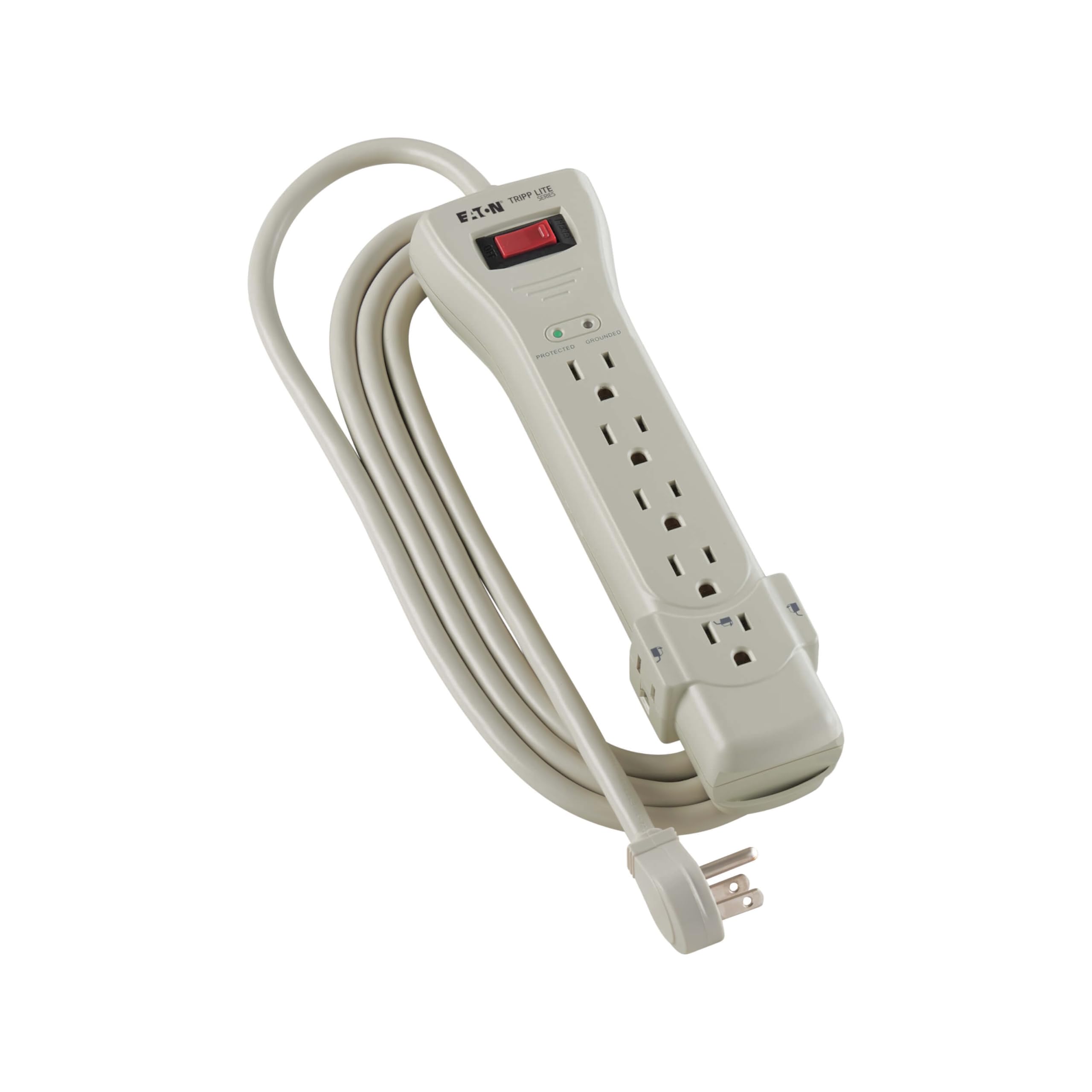
1. Tripp Lite SUPER-7 Surge Protector
Our pick — 4.5+★ from 2,500+ verified ratings; the strongest balance of quality and price.
The desk strip that swallows a 2,160-joule hit and still sits flush behind the furniture.
For a bedroom outlet or a desk that gets pushed back against the wall, this is the strip that earns its spot. The flat plug is the physical detail that changes daily life — furniture and equipment can move flush against the wall instead of leaving a hand-width gap for a chunky plug head. It carries a 7-foot cord, so the strip reaches from a wall outlet up onto a desk or across to a nightstand without an extra extension cord.
The surge side is honest and well-specced: a 2160-joule rating (a measure of how much transient energy it can absorb before giving up), paired with EMI/RFI filtering that scrubs the electrical noise which can cause damage or data loss. A 15-amp circuit breaker and diagnostic LEDs confirm your wall outlet is properly grounded and protected — you get a visual answer instead of a guess. Three of the seven outlets are wide-spaced to fit bulky transformer plugs, so a router brick does not eat two sockets. Eaton lists it as tested to UL 1449, UL 1363, cUL and IEEE 587 A&B, which is the certification stack you actually want.
Where it sits in the lineup is the interesting part. The Belkin below holds 3480 joules versus this one’s 2160, but this Tripp Lite is the one to grab when the strip has to tuck behind furniture and still fit a transformer or two. It is also backed by a Lifetime Limited Manufacturer’s Warranty and connected equipment insurance. The trade-off is the joule ceiling — for a receiver stack or a gaming PC with a big supply, the extra capacity of the Belkin or the Isobar is the smarter call.
What earns it first place
- 2160 joules of clamping paired with EMI/RFI noise filtering
- 7-foot cord and space-saving flat plug sit flush to the wall
- Three wide-spaced outlets take bulky transformer bricks
- UL 1449, UL 1363, cUL and IEEE 587 A&B certification, plus connected equipment insurance
Where it stops short
- 2160 joules is below the Belkin’s 3480 — heavy A/V stacks want more headroom
- Seven outlets fills up fast in a multi-device desk setup
Reach for this if: your strip needs to disappear behind furniture and still take a couple of wall warts — the flat plug and wide-spaced outlets do that job better than anything else here.
Step up instead if: you are protecting a receiver, amplifier, or tower PC and want the bigger joule reserve.
2. Belkin 12-Outlet Surge Protector
Twelve sockets, three USB ports, and the highest joule count in this lineup bar the Isobar.
Count the devices on your desk right now. Monitor, laptop brick, phone charger, tablet, a couple of smart-home bridges, a lamp. This strip powers fifteen of them at once — 12 surge-protected AC outlets plus 2 fast-charging USB-A ports and 1 USB-C port. That USB-C port pushes 22.5W of charging power, which is enough to top up a phone or a small laptop without hunting for a wall adapter.
The joule story is where the Belkin pulls away from the Tripp Lite SUPER-7. It holds 3480 joules against the SUPER-7’s 2160 — meaningfully more headroom in front of a home office or entertainment center. The 12 outlets are widely spaced enough to fit big plugs without blocking neighbours, and the 6-foot cable plus included wall mount means it can live behind a desk or hang on the wall. A master on/off switch kills everything at once. Belkin lists it as ETL Listed and conforming to UL 1449, with overload and overvoltage protection baked in.
What buyers consistently talk about is the outlet spacing — it is the thing that makes a 12-outlet strip usable instead of decorative, because a crowded strip with tight sockets is just a ten-outlet strip with two dead slots. The catch is the 350+ ratings behind its 4.5+ score: thinner feedback than the Tripp Lite models here, so you are leaning more on the published spec than on a long track record. It is also the widest strip in the group at 11.93 inches, which matters if the outlet you are feeding is tight.
Why the spacing wins: a 12-outlet strip only helps if the sockets accept real plugs, and this one is built for the bulky ones — the gap between sockets is the design decision that makes the count meaningful.
The honest read: more joules and more outlets than the SUPER-7, but less proven over time and bigger on the wall.
Who it beats: anyone with a dozen devices on one desk — the 3480 joules and 15 total power points handle a full workstation in a single strip.
Who it does not: tight spaces, where its 11.93-inch width and 6-foot cord may not reach or fit as cleanly as the flat-plug SUPER-7.
3. Tripp Lite HT10DBS Surge Protector
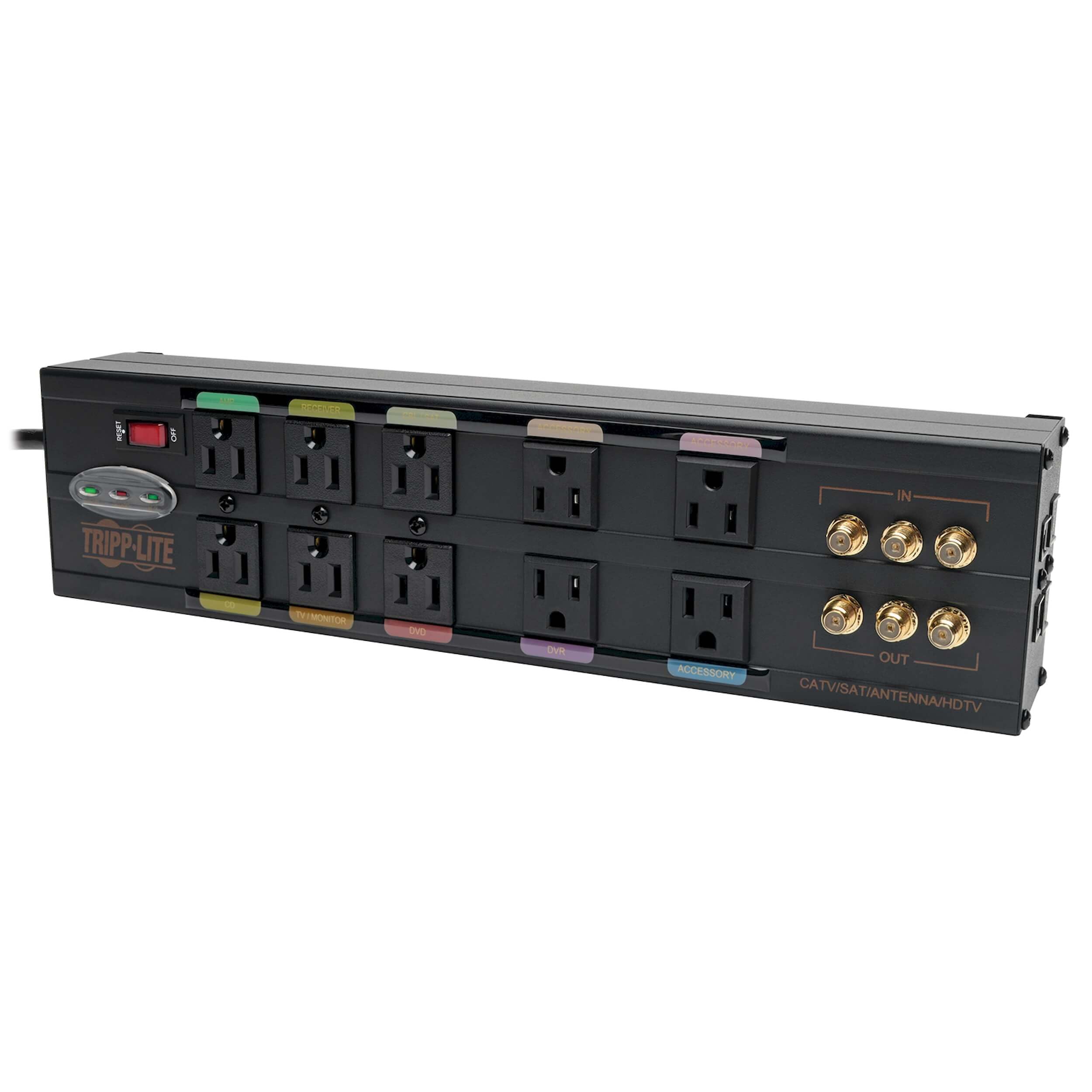
The one that guards the coax and Ethernet lines too, not just the wall socket.
Most surge strips only defend the AC path — and in a home theater, the surge often rides in on the cable or satellite coax instead. The Isobar closes that door. It has ten NEMA 5-15R outlets split across two isolated filter banks, so a noisy component on one bank cannot pollute the gear on the other. Alongside the AC protection it carries three-line 22 GHz gold coaxial protection, one-line phone/modem protection, and one-line high-speed Ethernet protection. For a receiver, TV, and media server fed by a cable line, that is the complete picture.
The joule number is the biggest here at 3840 — more clamping reserve than the Belkin’s 3480, the DRS-1215’s 3000, or the SUPER-7’s 2160. A 12A circuit breaker shuts down connected equipment on overload, diagnostic LEDs show grounded-and-protected status at a glance, and the metal housing is built to be stacked with other gear. Color-coded labels above each outlet keep a ten-device stack sorted. The 8-foot cord and right-angle flat plug reach a wall outlet behind a media console, and keyhole slots let it hang. Certification covers UL 1449, UL 1363, UL 497A, FCC Part 68 and cUL.
The thing that wins people over is the sheer build — a heavy metal box that feels like part of the system rather than an accessory. The honest caveat is noise: some units buzz audibly when under load, which is the price of heavy filtering in a quiet room. Keep that in mind if the Isobar is going inches from your listening chair rather than tucked in a cabinet. The lifetime warranty and connected equipment insurance cover the gear plugged into it, not just the strip.
Where it stands alone: coax, phone, and Ethernet protection in the same metal box as 3840 joules of AC clamping — no other pick here shields the signal lines.
The trade-off: the biggest joule reserve and the most complete protection come with a metal box that can hum under load, so placement matters.
Match it to: a home theater or A/V cabinet where the TV, receiver, and modem all need protection and a coax line enters the room.
Look past it if: your setup is AC-only — the signal-line protection is wasted and the buzz becomes the only thing you notice.
4. DEWENWILS 4-Pack 6-Outlet Surge Protector
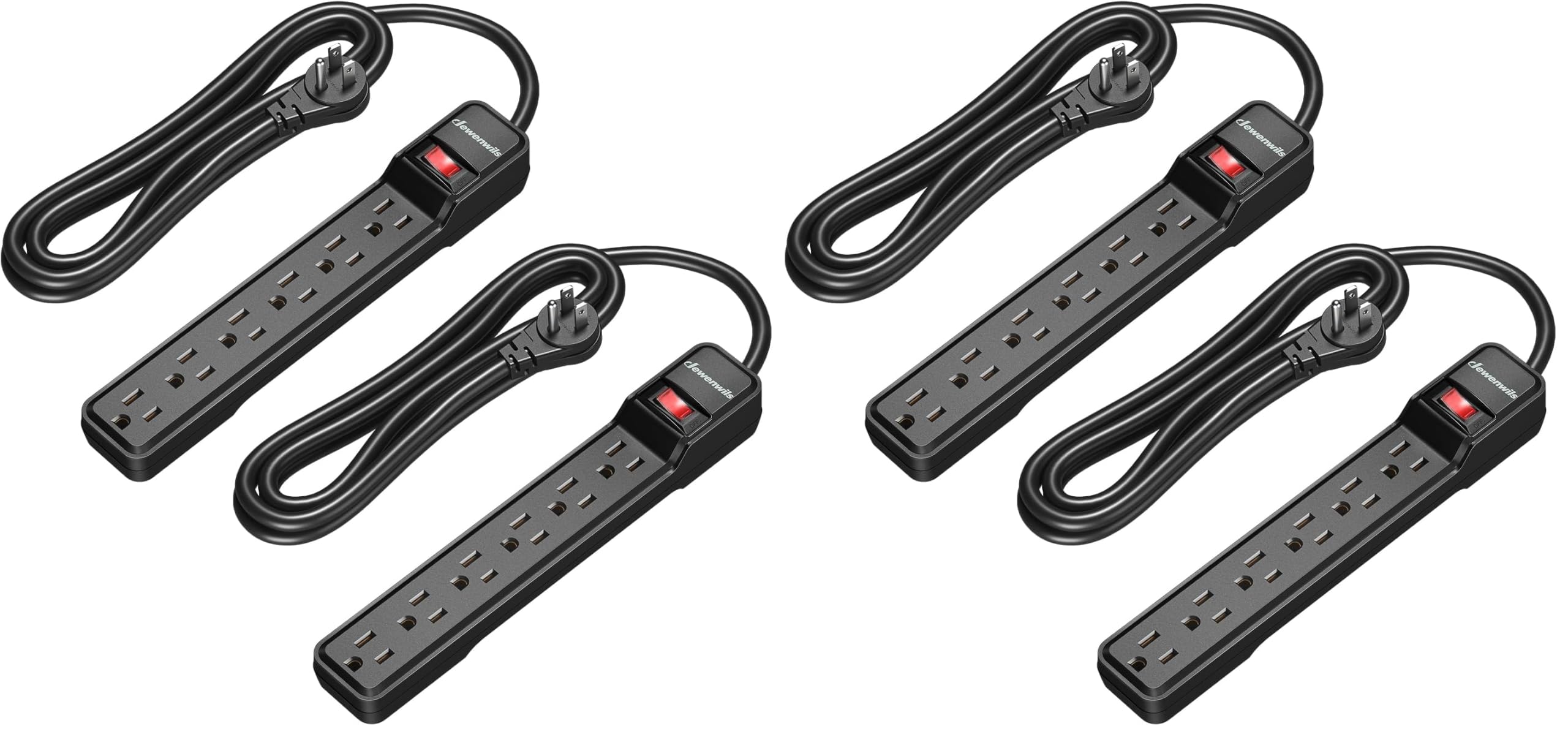
Four strips, four rooms, ten feet of cord each — the spread-it-around option.
One strip rarely covers a whole house. This box puts four of them in your hands, each with six grounded three-prong outlets, a 10-foot cord, and a low-profile flat plug that lets furniture sit flush to the wall. Running 15A at 120V and 1800W, each strip is rated for the everyday load of an entertainment center or office desk. The SJT 14/3C cord is a heavier-gauge build than a bargain extension cord, so it holds up to being dragged around and plugged in daily.
Where this sits honestly against the rest: at 500 joules, each strip absorbs a fraction of what the Belkin manages with its 3480 or the Isobar with 3840 — the gap between the Belkin and one of these is a comparison you should take seriously before trusting it with a receiver. Still, 500 joules is real UL 1449 protection, and it conforms to both UL 1363 and UL 1449, with a 15-amp fused circuit breaker guarding against lightning, spikes, short circuits, and overloads. Two keyhole slots on the back make wall or under-desk mounting easy. What owners keep coming back to is the cord reach — 10 feet per strip means the wall outlet stops dictating furniture placement — and the overall build quality.
Why the four-pack makes sense
- Four separate strips cover four rooms in one purchase
- 10-foot cord on each unit reaches the awkward outlet
- Flat plug sits flush and two keyhole slots allow wall mounting
- Conforms to UL 1363 and UL 1449 with a 15A fused breaker
What you give up
- 500 joules per strip is the lowest surge capacity in this group
- Not the choice for a main A/V stack or a server rack
Best used for: scattering protection across a house or apartment — one strip in the bedroom, one at the desk, one behind the TV, one in the garage.
Not the one for: the single outlet guarding your most expensive electronics, where the bigger joule ratings of the Belkin or Isobar belong.
Know the Specs
Joule Rating
A joule rating tells you how much transient energy a suppressor can absorb before it fails. Think of it as a fuel tank for surges: a 500-joule strip suits a lamp and a phone charger, while a strip in the 3,000-to-3,800-joule range carries enough reserve to sit in front of a home theater or a rack of servers. Higher is not automatically right for every room, but matching the rating to the value of the gear behind it is the core decision. A strip that has absorbed its rated energy is spent and should be replaced rather than trusted.
UL 1449 and Companion Marks
UL 1449 is the safety standard written specifically for surge suppressors, testing how much excess voltage is let through and how the strip behaves at end of life. A “UL Listed” label alone may only certify the strip as a general cord assembly under a different standard. Look for both names on the listing or housing. You will also see UL 1363 for the strip construction itself and UL 497A for telephone-line protection. Seeing all three tells you the strip was tested as a suppressor, a cord assembly, and a signal-line protector.
EMI/RFI Filtering
EMI and RFI are electrical and radio-frequency noise riding on the line — the kind that can cause data loss or interference in sensitive gear. Filtering is measured in decibels, and a higher figure means more of that noise is scrubbed. The DRS-1215 lists up to 80 dB of filtering, which is the spec that matters if your equipment is picky about clean power. Isolated filter banks go a step further, keeping one bank’s noisy devices from contaminating the other.
Plugs, Cords, and Mounting
A flat, right-angle plug lets furniture and equipment move flush against the wall instead of leaving a gap for a plug head. Cord length in feet decides how far the strip can reach from the outlet — 6 feet for a desk, 10 or 15 feet for a rack or a distant wall socket. Keyhole slots on the back allow wall mounting, while 1U rack ears let a strip bolt into a standard 19-inch rack. These are the physical specs that decide where a strip can actually live.
Common Questions
Does a UL 1449 strip protect against a direct lightning strike?
How many joules do I actually need for a home theater?
What is the difference between UL 1449 and “UL Listed”?
Can I put a surge strip behind a dresser against the wall?
Will a rack-mount strip fit a standard 19-inch rack?
Does surge protection cover the coax and Ethernet lines too?
How long does a surge protector last before it needs replacing?
Can I plug a space heater or air conditioner into these strips?
Is the four-pack any good for a server rack?
The Bottom Line
For most people, the ul 1449 power strip winner is the Eaton Tripp Lite SUPER-7 — a 2160-joule flat-plug strip that tucks behind furniture, fits transformer bricks in its three wide-spaced outlets, and is certified to UL 1449, UL 1363, cUL, and IEEE 587 A&B. If you want maximum clamping and signal-line protection for a home theater, grab the Eaton Tripp Lite HT10DBS Isobar and its 3840 joules plus coax, phone, and Ethernet coverage. And for a rack build, the Eaton Tripp Lite DRS-1215 bolts into a 1U slot with 14 outlets and a 15-foot cord. Do not overlook the Belkin if outlet count is your priority — its 3480 joules and 12 AC sockets plus a USB-C port make it the best desk hub here. The decision is simple: match the joule rating to your gear and the plug style to your outlet, then buy the strip that fits the room it lives in.
How we choose
We do not accept paid placement. Every pick is matched to a real buyer and a real use-case; we do not hands-on test units.
Sources
Specifications: manufacturer listings and product documentation. Review insights: verified customer reviews, as of November 2026. Pricing: not shown on this page (it changes often); check the current price via the retailer link.
As an Amazon Associate, Tactical Gear Guy earns from qualifying purchases. This does not affect which products we feature.