Specs are compiled from manufacturer listings and verified buyer reviews and can change over time — please confirm the key details on the product page before buying.
If you want the short answer: buy on brightness and throw ratio before anything else, because those two numbers decide whether your movie night actually works in your room. A projector that claims 4K but puts out 400 lumens will wash out the moment you turn on a lamp, and a long-throw lens will force you to mount it across the room. The picks below cover the real span of home projector types — lamp-lit LCD budget units, laser light engines, short-throw gaming boxes, and true 3-chip theater projectors — so you can match the one that fits your wall, your light, and your seating.
This guide is built by comparing the manufacturers’ published specifications and the patterns across verified customer reviews, so you get each pick’s real strengths and trade-offs instead of marketing spin.
It helps to know that the light engine and lens do most of the work, not the streaming apps. Below, each model is described in plain terms with the exact specs that change your picture. These are the types of home projectors worth putting on your shortlist.
Top Picks


How To Choose The Best Types of Home Projectors
Picking a projector type starts with two honest questions about your room. How much light can you shut out, and how far can the machine sit from the wall? Answer those and the field narrows fast. Everything else — resolution, apps, audio — is a layer on top.
Brightness: the number that decides your room
Brightness is measured in lumens, and it is the first thing to check. A dim room can get away with a lower figure, while a living room with afternoon sun needs far more. Look for ANSI or ISO lumens, which are measured standards — not vague “light source” numbers. For a dedicated dark theater, a few hundred lumens can look lovely; for a multi-use room, aim higher. This is also where a laser type separates itself from a cheap lamp unit.
Throw ratio: where the projector can sit
Throw ratio is the relationship between how far the lens sits from the wall and how big the picture gets. A short-throw model can throw a big image from close up, which suits small rooms and gaming setups where the player sits near the screen. A standard-throw unit needs more distance, so measure your room before you commit. Some models also offer optical zoom, which lets you resize the picture without physically moving the machine.
Light engine: laser, LED, or lamp
The light engine is what actually produces the image. Laser types tend to run bright and hold color without the rainbow fringing some older designs show. LCD with an LED lamp is common in budget types and keeps costs down. A true 3-chip 3LCD design throws the full color signal for every frame, which is why theater-focused models lean on it. Match the engine to how you will use the room — dark theater night, or a lit family room.
Smart features and setup helpers
Built-in streaming means you can open Netflix or YouTube without plugging in a stick. Auto focus and auto keystone correction keep the picture sharp and square after you move the unit. If you plan to ceiling-mount it or shift it between rooms, those helpers matter more than any app shortcut.
Side-by-Side Comparison
| Model | Best For | Brightness | Resolution | Light Engine | Amazon |
|---|---|---|---|---|---|
| Valerion VisionMaster Pro2★ Best Overall | Dark-room cinema | 3000 ISO lm | 3840 x 2160 | DLP RGB Triple Laser | Amazon |
| HAPPRUN Google TV 1080PBudget Streamer | Budget streaming | 400 lm | 1920 x 1080 | LCD | Amazon |
| HAPPRUN 2000 ANSIAuto-Setup Pick | Auto-setup ease | 2000 ANSI lm | 1920 x 1080 | LCD | Amazon |
| ONOAYO ONO5Pro 2.0 | Lit-room movie nights | 600 lm | 1080P (4K support) | LCD | Amazon |
| Epson EpiqVision Flex CO-FH02 | Portable business use | 3000 lumen | 1920 x 1080 | LCD | Amazon |
| Dangbei DBOX02 Pro | Daytime laser viewing | 2000 ISO lm | 3840 x 2160 | Laser | Amazon |
| XGIMI Elfin Flip 4K | Travel and portability | 1600 lm | 3840 x 2160 | DLP | Amazon |
| BenQ TH671ST | Short-throw gaming | 3000 lm | 1920×1200 | DLP | Amazon |
| Epson Home Cinema 3800 | Dedicated home theater | 3000 lumen | 3840 x 2160 | LCD (3-chip) | Amazon |
Detailed Reviews
1. Valerion VisionMaster Pro2 Triple Laser Projector 4K
Our pick — 4.5+★ from 550+ verified ratings; the strongest balance of quality and price.
A triple-laser light engine that treats a dark room like a real cinema.
This is the type of projector you buy when the room can go dark and you want the picture to hold up in the shadows. A 15,000:1 contrast ratio with Enhanced Black Level keeps night scenes readable instead of turning to grey mush. The 110% Rec.2020 color gamut pushes color into territory most home units cannot reach, and 3000 ISO lumens means the brightness is measured, not guessed.
For scale, the contrast figure here is measured against the budget HAPPRUN Google TV unit’s 2000:1 — a 10.0x gap that explains why dark scenes look different between the two. Resolution also leads: this one tops out at 3840 x 2160 pixels versus 1920 x 1080 on the HAPPRUN 2000 ANSI model, a 2.0x jump in pixel count. The OpticFlex lens (a 0.9-1.5 throw ratio) lets you fit a big image in a compact or spacious room, and it can project up to 300″.
Gamers get 4ms input lag and a 240Hz refresh rate on ultrawide screens, and the MT9618 chipset with 4GB RAM and 128GB ROM is a step above the 2GB/32GB memory typical elsewhere. Google TV+ is built in, with AirPlay 2, Miracast, and Chromecast for casting. The crowd favorite backs it up — 4.5+ stars across 500+ owners — and the praise centers on raw performance and picture quality. Adjustability is the mixed note; the auto-focus and auto-keystone help, but expect to fine-tune a little when you change placement.
Where it wins
- 15,000:1 contrast with EBL technology for deep blacks
- 3000 ISO lumens, so daytime viewing is realistic
- 0.9-1.5 throw ratio flexes to almost any room
- 4ms input lag plus 240Hz for fast gaming
Note first
- Setup and adjustability draw mixed feedback, so plan to tweak placement
- It is the priciest type here — best saved for a dedicated dark room
Built for: a light-controlled theater room where you want laser contrast and 4K detail to be the whole show.
Weigh this: the auto adjustments still want a level surface, so budget a few minutes to dial it in.
2. HAPPRUN Official Licensed Google TV 1080P Projector
Opens Netflix without a stick or a cable — the instant-start type.
For a bedroom or a starter setup, the appeal is simple: Licensed Google TV is built in, so you sign in and start streaming instead of hunting for a streaming dongle. The 1920 x 1080 native resolution and 4K support cover most content the way most people watch it, and the 300-inch screen size adapts to the room. A 5W speaker handles casual audio, and Bluetooth 5.2 lets you pipe sound to a soundbar or headphones for a private session.
Wi-Fi 6 keeps the streaming steady rather than buffering mid-scene, and three ways to install — ceiling, desktop, or tripod — make it easy to place. What wins people over is the overall quality for the outlay, with picture quality close behind. Reliability is the honest caveat: a few units have been reported to stop working after some months, so treat it as a value pick rather than a lifetime fixture. Sound and brightness draw mixed feelings, and the fan can be audible when things warm up.
Set it against the pricier HAPPRUN 2000 ANSI and the trade is clear. This one runs 400 lumens against that model’s 2000 ANSI lumens, and its 2000:1 contrast trails the 20000:1 figure there — so if ambient light matters, spend up. For a dark bedroom where you mostly stream, this remains the simplest way into a smart projector.
The streaming shortcut: built-in Google TV plus voice search saves you the cost and clutter of an extra stick, and Wi-Fi 6 keeps it stable.
The light-room limit: at 400 lumens, plan on dimming the room for the best picture, and keep expectations modest on the built-in speaker.
Reach for this if: you want a low-fuss smart projector for a dark bedroom and value the built-in app suite over raw brightness.
Look elsewhere if: your room has daytime light or you need a bigger, brighter image.
3. HAPPRUN 2000 ANSI 4K Decoding Projector with Auto Focus
Point it at the wall and it squares the picture itself in about five seconds.
The headline here is the setup brain. Auto focus plus 6D auto keystone correction get you a clear, rectangular picture within 5S of startup, and the unit adds AI obstacle avoidance and auto screen alignment so a lamp or shelf in the frame gets worked around. It can sit on a table, beside the bed, wall mounted, or ceiling mounted and still correct itself. That makes it the friendly type for people who move the projector around.
Brightness is a genuine step up at 2000 ANSI lumens with a 20000:1 contrast ratio, and 4K decoding means supported content renders sharp. The 8W HiFi speaker with bidirectional Bluetooth 5.2 can even work in reverse — use the projector as a Bluetooth speaker for music from your phone. Wi-Fi 6 handles wireless screen mirroring from iOS and Android, and two HDMI ports plus two USB ports, an AV input, and a 3.5mm jack cover consoles, sticks, and laptops.
One real limitation to plan for: the autofocus wants a level surface and a perpendicular wall, and it can fail if the angle goes past 15°. Some apps like Disney+ and Prime Video require a streaming stick due to licensing, so keep a dongle on hand. Otherwise this is a strong balance of brightness and hands-off setup across a wide 300″ range.
Setup that does the work: auto focus, 6D keystone, obstacle avoidance, and screen alignment handle the fiddly part, so you spend time watching, not adjusting.
The placement rule: keep the lens level and square to the wall — past 15° of tilt, the autofocus gives up.
Choose this: for a multi-room household where the projector gets shifted between table and ceiling mount and you want it self-correcting.
Skip the shortcut if: you expect Disney+ or Prime Video to open without a streaming stick — licensing needs the dongle.
4. ONOAYO ONO5Pro 2.0 4K Support Movie Projector
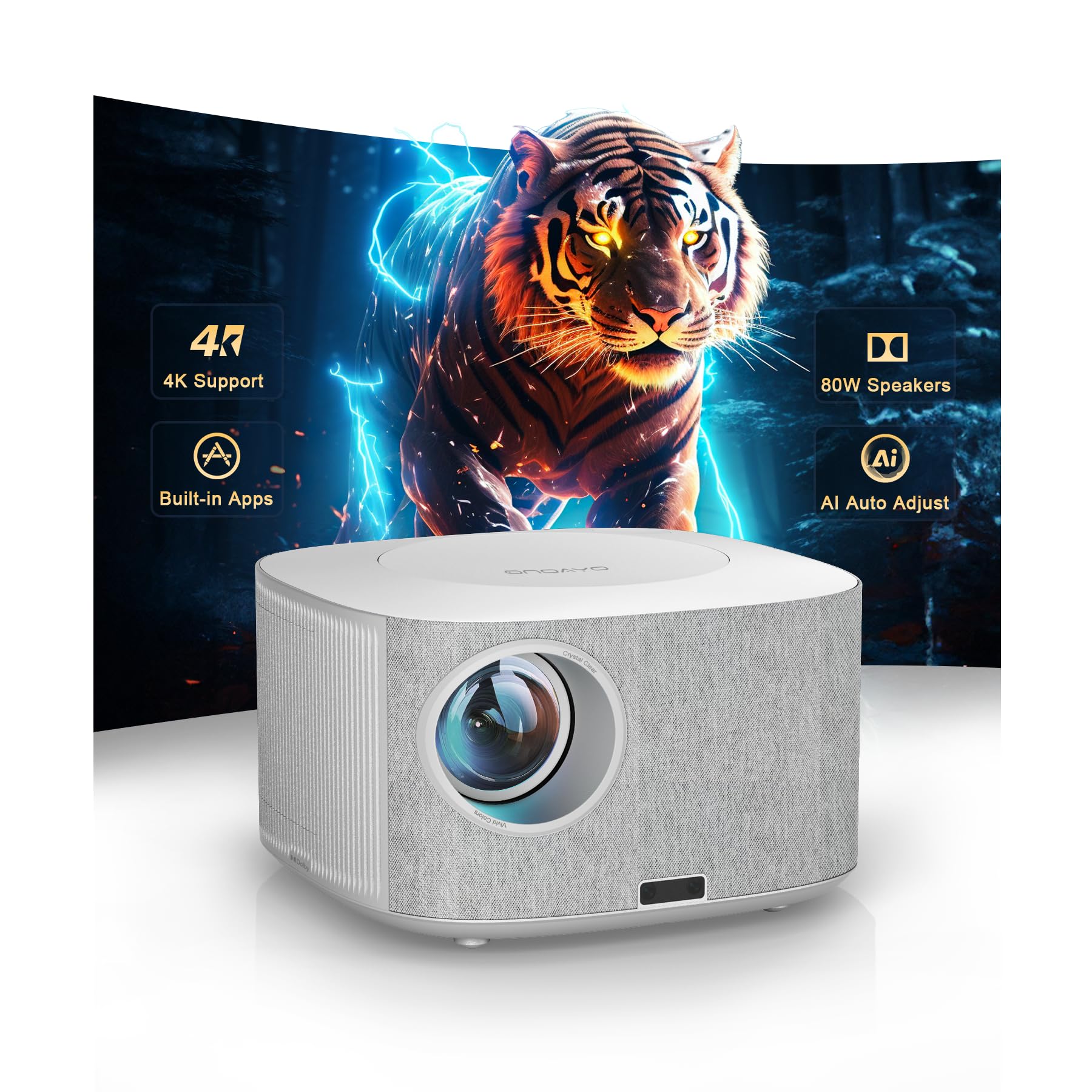
A white-finish projector built to sit in the open, not hide in a dark corner.
The design angle is unusual for this category: an Oleophobic and Anti-UV coating on the matte white chassis resists fingerprints, dust, and yellowing, so it can live on a shelf as decor. Under the shell, the VisionIQ calibration system handles auto focus, keystone correction, obstacle avoidance, screen fit, and orientation detection, landing a crisp, aligned image in about 3 seconds even on tilted surfaces. Dynamic zoom spans 50%-100% without losing resolution as you resize.
Picture comes from the AI Image Engine Pro with a 98% NTSC color gamut and 1.07 billion colors, and an ambient light sensor adjusts brightness and contrast on its own. Movies play at native 1080P with 4K support. For gamers, game mode drops to 18ms input latency over HDMI 2.1, and Wi-Fi 6 keeps streaming steady. The 80W Dolby-certified stereo speakers mean fewer reasons to add a soundbar.
A fully sealed optical engine keeps dust out, which helps the picture stay consistent over time, and a triple-temperature control system watches for overheating. What buyers value most is the solid build and the picture it throws, even in partial lighting. The honest catch is brightness: at 600 lumens, a fully sunlit room will still soften the image, and 4K-labeled video displays at native 1080P.
Standout strengths
- 3-second auto calibration for a straight, focused picture
- 80W Dolby speakers cut the need for extra audio gear
- Sealed optical engine keeps dust off the internals
- 18ms game mode and HDMI 2.1 for console play
Honest caveats
- 600 lumens wants a dimmer room for the best image
- 4K is supported, not native — content plays at 1080P
The fit: a living room or bedroom where the projector stays on display and you want big sound and quick auto-setup without an external speaker.
The trade: treat it as a dim-room performer, because the 600-lumen output needs some lighting control.
5. Epson EpiqVision Flex CO-FH02 Full HD Smart Projector
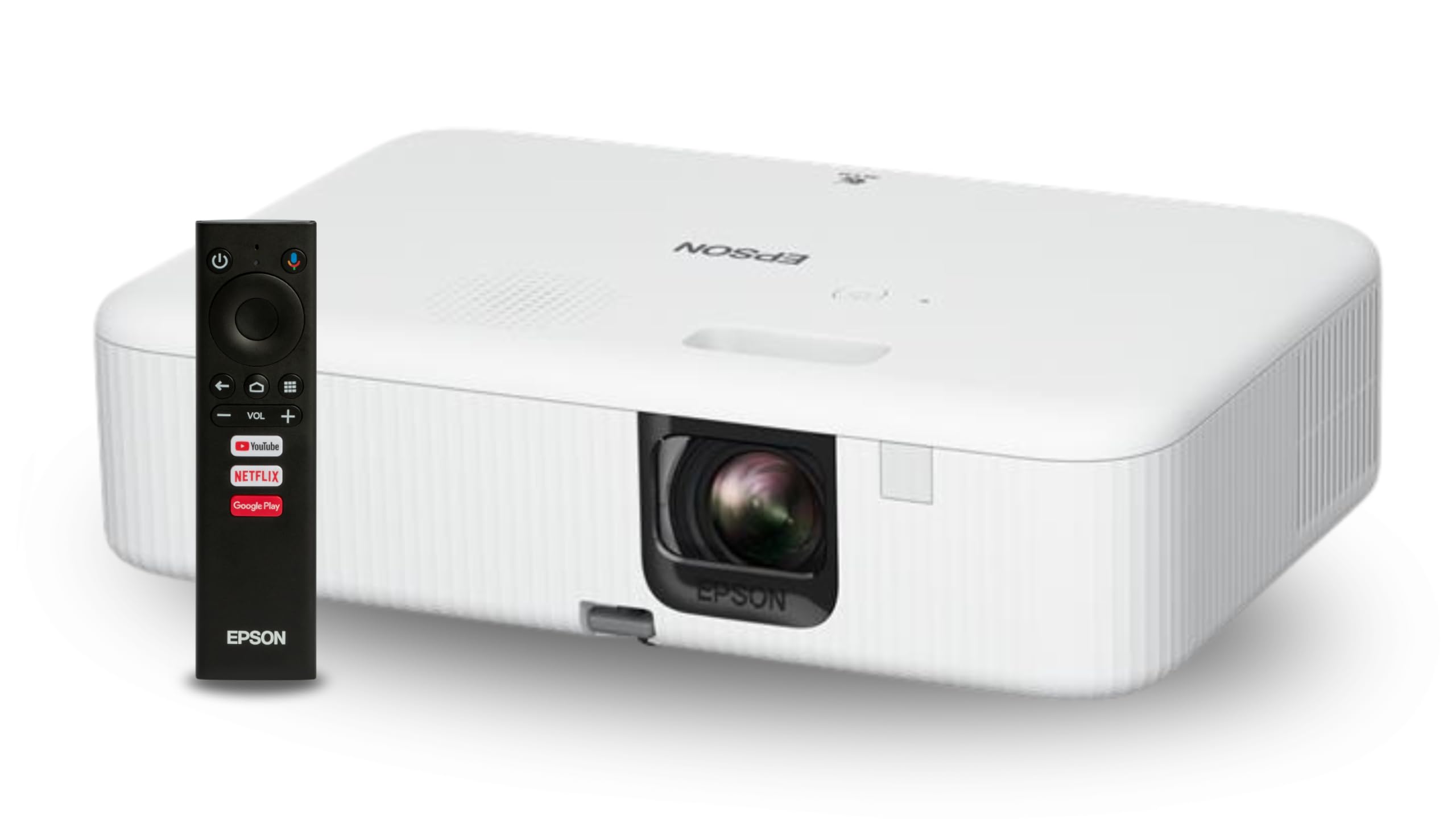
Three thousand lumens in a body light enough to carry to the next room.
If your viewing happens with the lights on, this is a brightness-first pick. The 3,000 lumens of color and white brightness let the image hold up in a variety of lighting conditions. An Android TV interface with Google Assistant voice search means Netflix, Apple TV+, Disney+, and HBO Max open without extra hardware. Full HD 1080p projects up to 300″, four times larger than a 75″ flat panel in the maker’s comparison.
The 3-chip 3LCD design throws 100% of the RGB color signal for every frame, which is where the freedom from rainbow fringing comes from. The compact body fits in a backpack, so it travels. What customers praise most is the overall quality and the picture, and setups are quick; turning it on and watching with the lights up is a common theme. Reliability and value land as mixed points, and Bluetooth connectivity draws some negative feedback — plan on HDMI for your sound source if wireless audio is the goal.
Against the ONOAYO’s 600 lumens, this Epson’s 3000 lumens is the clear choice for a bright room. Against the Valerion’s 3000 ISO lumens, it is the more portable option rather than the more cinematic one. It is a business-and-family type first, a dark-theater type second.
Daylight advantage: 3,000 lumens plus 3-chip 3LCD color is the combination that keeps the image usable when the room is not fully dark.
Know before you buy: Bluetooth audio is the weak link here, so keep a wired connection in mind for speakers or a soundbar.
Made for: a bright family room or a presenter who carries the projector between locations and wants brightness and built-in streaming.
Not the one for: a sound-system-first setup — the Bluetooth path is the shakiest part.
6. Dangbei DBOX02 Pro 4K Laser Projector

A laser light source built to keep 4K sharp while the sun is still up.
Laser plus 2000 ISO lumens is the pairing that makes daytime viewing a real option, and true 4K UHD at 3840×2160 delivers the detail. HDR10+/HLG with a 108% REC-709 color gamut deepens blacks and enriches color. The built-in gimbal stand rotates 360° and tilts 120°, so you can point it at a wall from almost anywhere and project 40″-300″ at consistent 4K clarity.
Google TV is certified in, with access to 700,000+ movies and shows and 10,000+ apps, plus “Hey Google” hands-free control and Wi-Fi 6 for smooth streaming. The InstanPro AI setup handles auto focus, real-time keystone, screen fit, and obstacle avoidance, and eye protection guards viewers who walk into the beam. Dual 12W speakers with a 600cc acoustic chamber push Dolby Audio, and HDMI eARC lets you route to a serious sound system.
What buyers rave about is the picture — it reads richer than a commercial theater to some eyes — and the value for a true 4K laser unit. Audio is the mixed bag: some find it whisper-quiet, others hear fan noise, so it depends on where you sit relative to the unit. Brightness gets its own praise, and the ability to dial it down is a plus in a dark room.
The laser edge: 2000 ISO lumens and true 3840×2160 resolution give you a bright, sharp 4K image that does not need a pitch-black room.
The sound question: fan noise and audio quality split opinions, so a soundbar over HDMI eARC smooths that out.
The right buyer: someone who wants true 4K and laser brightness for a living room that is not always dark, and values the flexible gimbal stand.
Think twice if: you are sensitive to fan noise and plan to sit close to the unit.
7. XGIMI Elfin Flip 4K Portable Projector
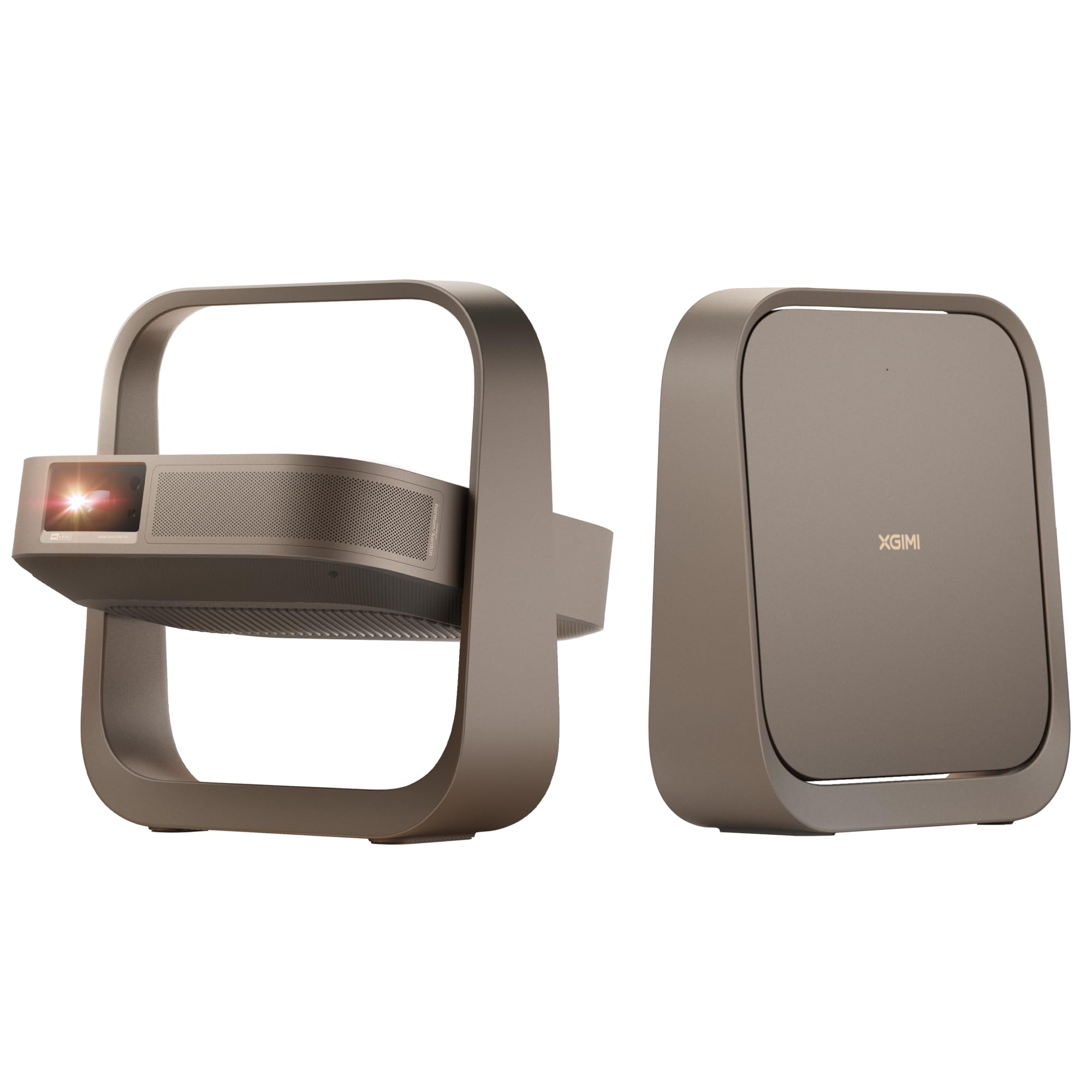
A book-sized 4K box that follows you from room to room.
Portability is the whole point of this type. It is designed as a book-sized powerhouse with 4K UHD clarity, so a blank wall in any room becomes a screen. Google TV is built in with access to 700,000+ movies and episodes across Netflix, YouTube, and Prime Video, and dual Harman Kardon speakers deliver the audio without a soundbar. You power it on and play.
At 1600 lumens it is not a bright-room champion — the laser and 3000-lumen units above out-punch it there — but it does travel in a way they do not. Auto focus keeps the image sharp, and Bluetooth and HDMI cover casting and consoles. Customers describe it as easy to use and set up, with clear picture quality, and it can run off a power bank, which suits a backyard or camping session.
The honest read: this is the type to choose for convenience, not maximum brightness or a permanent dark-room install. It leads on portability and built-in sound, and falls short of the bigger units on pure light output.
What it does best
- Book-sized 4K body moves between rooms
- Dual Harman Kardon speakers built in
- Google TV ready without extra hardware
- Can run off a power bank for outdoor use
Where it holds back
- 1600 lumens is dimmer than the bright-room picks
- Not a permanent theater install — portable first
Pick it for: a renter, traveler, or backyard host who wants one projector that moves with them and sounds good on its own.
Leave it if: you need maximum brightness for a lit living room and will keep it in one place.
8. BenQ TH671ST 3000 Lumens 1080p Short Throw Projector

A 100-inch picture from five feet away — the small-room gamer’s answer.
Short throw is the defining feature here, and it changes what rooms are possible. This one projects a 100-inch screen from just 5 feet away, and it can go up to 300 inches, so you do not need a long wall behind the seating. Native Full HD 1080p with 92% Rec. 709 color accuracy and 3000 lumens means it holds up in rooms with ambient light, and a 10000:1 contrast ratio keeps the picture solid.
Gaming is the second reason to pick this type. Ultra-fast low input lag and a refresh rate that matches the max output of Xbox One X and PS4 Pro keep motion smooth without blur, which suits a player sitting close to the screen. The 3-year limited parts and labor coverage is a reassuring commitment for a long-term install. What buyers praise most is the overall performance, with picture quality and brightness close behind — bright, HD, and sharp enough for 100-120 inch screens.
Set it against the Epson CO-FH02’s 1080p output and the BenQ’s short-throw lens is the clear advantage for a tight room; the two share a 3000-lumen brightness figure but serve different spaces. This is the short-throw type first and a bright-room generalist second.
Room-friendly optics: the short throw and 3000 lumens together mean a big screen in a small, lit room without a long cable run.
Keep in mind: it is built around gaming and quick placement, so pair it with a source that matches its low-lag design to get the most from it.
Best matched to: a compact game room or basement where the projector must sit close and the player sits near the wall.
Not for: someone chasing native 4K detail — this is a 1080p short-throw specialist.
9. Epson Home Cinema 3800 4K PRO-UHD 3-Chip 3LCD Projector

A true 3-chip theater build with lens shift for a permanent install.
This is the type you ceiling-mount and leave alone. A true 3-chip 3LCD design displays 100% of the RGB color signal for every frame without rainbow effect or color brightness issues. 4K PRO-UHD processing uses pixel-shifting across three high-definition LCD chips to parallel-process millions of pixels, and Full 10-bit HDR accepts the full HDR source for faithful reproduction. A 100,000:1 contrast ratio gives rich black detail, and 3,000 lumens covers both color and white brightness.
The Epson Precision Lens is a multi-element glass structure with edge-to-edge focus uniformity, and precision vertical and horizontal lens shift lets you align the image without moving the mount. Full 18 Gbps HDMI 2.0 supports 4K HDR content at 60 Hz, and dual 10W rear-firing speakers plus apt Bluetooth cover casual audio. What buyers praise most is the picture quality, with brightness and the quick-corner adjustability close behind — the screen alignment tools are a common favorite.
Two notes worth planning around: performance and noise level land as mixed points, so give it breathing room and expect some fan sound, and this is a fixed-install type, not a carry-around unit. Against the portable XGIMI Elfin Flip, this Epson’s 3840 x 2160 processing and lens shift mark it as the theater build; the XGIMI wins on portability.
Theater-first engineering: 3-chip 3LCD, lens shift, and a 100,000:1 contrast ratio are the ingredients of a settled, permanent big-screen room.
The install reality: noise is a mixed note, so leave clearance around the unit and mount it away from the seating.
Worth it for: a dedicated room where you ceiling-mount, want accurate color without rainbow fringing, and value lens-shift alignment.
Not your type if: you need to move the projector between rooms — this one wants a permanent home.
Know the Specs
Lumens and ANSI/ISO brightness
Brightness is the raw light output of the projector, and it decides whether you can watch with the room lights on. ANSI and ISO are measured standards, so an ANSI or ISO figure is a fairer comparison than a vague “light source” number. A few hundred lumens suits a dark bedroom, while 2000 to 3000 lumens is the range that holds up in a lit living room. Match the figure to your room, not to the biggest number on the page.
Contrast ratio and color gamut
Contrast ratio is the gap between the darkest black and the brightest white, and it decides how much shadow detail survives in a night scene. A higher ratio means deeper blacks and a more dimensional image. Color gamut, quoted as a percentage of a standard like Rec.2020 or Rec.709, describes how much of the color range the projector can show. Together they explain why two projectors with the same brightness can look very different.
Throw ratio and lens shift
Throw ratio ties the distance from lens to wall to the size of the picture, so it tells you where the projector can sit. A short-throw model produces a large image from close up, while a standard-throw unit needs more distance. Lens shift moves the image up, down, or sideways without physically repositioning the mount, which matters for a ceiling install. Optical zoom lets you resize without moving the machine.
Light engine and resolution
The light engine — laser, LED, or lamp — shapes brightness, color, and upkeep. Laser units tend to run bright and avoid the rainbow fringing of some older designs, while a true 3-chip 3LCD design throws the full color signal every frame. Resolution is the pixel count; “4K supported” or “4K decoding” means the projector accepts a 4K signal and displays it at its native panel, which may be 1080p. Check the native number if true 4K matters.
Common Questions
Do I need a screen or can I project on a plain wall?
What is the difference between 4K supported and native 4K?
How bright does a projector need to be for a living room?
What is throw ratio and why does it matter for my room?
Do these projectors work with a Bluetooth soundbar or headphones?
Can I use a home projector for gaming?
How long does a projector lamp or laser last?
Why do some apps like Disney+ need a streaming stick?
What is auto keystone correction and why does it help?
Is a laser projector better than an LED or lamp type?
The Bottom Line
For most buyers, the winning type among these types of home projectors is the Valerion VisionMaster Pro2, because its triple-laser engine, 15,000:1 contrast, and true 3840 x 2160 resolution deliver the most complete cinema picture for a dark room. If you want true 4K and laser brightness for a living room that is not always dark, grab the Dangbei DBOX02 Pro. And for a compact game room where the projector must sit close, the BenQ TH671ST is the short-throw one to reach for. Choose on room light and throw distance first, and the rest falls into place.
How we choose
We do not accept paid placement. Every pick is matched to a real buyer and a real use-case; we do not hands-on test units.
Sources
Specifications: manufacturer listings and product documentation. Review insights: verified customer reviews, as of November 2026. Pricing: not shown on this page (it changes often); check the current price via the retailer link.
As an Amazon Associate, Tactical Gear Guy earns from qualifying purchases. This does not affect which products we feature.