Specs are compiled from manufacturer listings and verified buyer reviews and can change over time — please confirm the key details on the product page before buying.
A Type V PFD is a special-use flotation device — often a slim belt pack that only puffs up when you pull a cord or hit the water. That low-profile design is exactly why people keep it on while paddling, casting, or working the deck. The catch is that Type V vests only count as legal flotation while you are wearing them, so fit and comfort are not luxuries here. They decide whether the vest is on your body when it matters.
This guide is built by comparing the manufacturers’ published specifications and the patterns across verified customer reviews, so you get each pick’s real strengths and trade-offs instead of marketing spin.
Below you will find five USCG-approved Type V options sorted by how you actually use them on the water, from a manual belt pack you forget you have on to a heavy-duty work vest built for inspected vessels.
Top Picks


How To Choose The Best Type V PFD
Ask yourself two things before you buy: what are you doing on the water, and will you keep a vest on your torso for three hours? A Type V inflatable (a low-profile vest that inflates when you pull a cord or hit the water) earns its place because it stays out of your way. But that only works if the belt sits where you can reach the cord and the pack does not ride up when you twist to paddle. Everything else follows from that.
Manual versus automatic inflation
A manual vest waits for you to yank a cord. That is the right call for a confident swimmer on flat water who wants zero chance of a surprise inflation from a wave slapping the pack. Automatic inflation fires on water contact, which helps if you go in unconscious or stunned — but it also means spray, rain, and a wet deck deserve respect. Hydrostatic auto-inflators are the refinement: they read water pressure rather than a dissolving bobbin, so a rainy day or heavy humidity will not set them off.
Buoyancy in pounds, and what it buys you
Buoyancy is listed in pounds, and it is the number that tells you how much lift the bladder provides once inflated. A belt pack in the mid-teens of pounds behaves like a foam Type III vest. The bigger bladders push past that, and a work vest can go well beyond. If you fish offshore, carry gear, or wear heavy clothing, put more weight on this figure than on pack thickness.
Sizing is a measurement job, not a guess
Chest and waist ranges are printed on every listing for a reason. A belt pack that gaps at the waist can slide up under your ribs when it inflates, which is uncomfortable at best. Measure your chest at its widest point and your waist where the belt will sit, then check both against the stated range. Also confirm the minimum weight rating — most of these are approved for wearers over 80 pounds.
Side-by-Side Comparison
All five are USCG-approved Type V devices. The columns that matter most are buoyancy, how the vest fires, and the chest range it covers.
| Model | Best For | Buoyancy | Inflation | Chest Fit | Amazon |
|---|---|---|---|---|---|
| BLUESTORM Cirro 16 Belt Pack★ Best Overall | Paddlers who want a pack they forget they have on | 16.5 lb (29 lb oral backup) | Manual pull cord | 30–52 in | Amazon |
| BOTE Inflatable Belt PFDBest for SUP | SUP and light-tackle anglers | — | Manual pull cord with oral backup | 30–52 in | Amazon |
| BLUESTORM Cirro 26 Auto/Manual | Boaters who want it to fire on its own | 26 lb | Automatic or manual | 30–56 in | Amazon |
| Mustang M.I.T 100 Auto | Cold-water and open-water boaters | 26 lb | Automatic, 500D Cordura shell | 30–52 in | Amazon |
| Mustang HIT Hydrostatic Work Vest | Deck crews and inspected vessels | 35 lb | Hydrostatic automatic | — | Amazon |
Detailed Reviews
1. BLUESTORM Cirro 16 Manual Inflatable Belt Pack
Our pick — 4.5+★ from 250+ verified ratings; the strongest balance of quality and price.
A belt pack so low-profile you will reach for it instead of leaving it in the truck.
The Cirro 16 is a manual-only inflation belt pack (you inflate it yourself, with no automatic trigger), and that one choice defines who it suits. You pull the “Jerk to Inflate” cord and the pillow-style bladder fills to 16.5 pounds of buoyancy — the same lift class as a foam Type III vest, but delivered in seconds instead of worn across your chest all afternoon. Want more reserve? The oral tube lets you top the bladder up to 29 pounds by mouth. That second path uses no cartridges, so a spare cylinder is not your only backup.
Where this pack wins is on a paddleboard or in a kayak cockpit. The minimalist belt leaves your shoulders and arms completely free, and the nylon shell with a breathable lining keeps you cooler than a foam vest in summer heat. D-rings let you clip a leash, a knife, or a tether where you can reach it. The universal fit spans 30–52 inch chests across small through XXL, and it is approved for wearers 16 and older or over 80 pounds. What buyers rave about most is exactly that fit — the belt lands where it should rather than riding up on a narrow waist.
The honest catch is the cylinder. It ships in a storage pocket inside the belt pack and has to be threaded into the inflation mechanism before the vest is functional, so this is not a grab-and-go purchase on day one. Plan on a spare re-arm kit too, since the mixed feedback on value comes largely from replacement cost rather than the vest itself. Treat the pack as a system with a consumable cylinder, and the math makes sense.
What earns its keep
- 16.5 lb of buoyancy from a pack that sits flat at your waist
- Oral top-up to 29 lb gives you a second inflation path
- Breathable nylon lining beats a foam vest in hot weather
- Fits 30–52 inch chests for both men and women
What to plan around
- Cylinder ships in a pocket and must be installed before use
- Manual only — nothing fires unless you pull the cord
- Replacement cylinders add ongoing cost
Reach for this if: you paddle flat water, want full arm freedom, and will actually yank a cord yourself.
Look elsewhere if: you boat solo in cold water where an automatic trigger is the point.
2. BOTE Inflatable Belt PFD
The belt pack built for the board under your feet, not the boat you sit in.
BOTE shapes this one as a paddleboard-first device: a USCG-approved Type V with Type III performance, sized for 30–52 inch chests and 21.5–57.5 inch waists. That waist figure matters more than most shoppers realize. A belt pack rides at the waist, so a wide adjustment window is what keeps the bladder from migrating up your ribs when it fills. Manual pull-cord inflation handles the primary job, with an oral tube as backup.
The material is soft-touch neoprene, which is the difference you feel on a bare torso after two hours of paddling. It flexes with you instead of digging in, and the low-profile pack keeps your casting arm clear whether you are working a flat for redfish or paddling a lake. A 16g CO2 cylinder comes in the box, so the device is complete when it arrives — unlike the manual Bluestorm above, which ships its cylinder loose in a pocket. That is a real convenience difference on day one.
What buyers consistently appreciate here is the build. It reads as solid and well-made in the hand, the kind of construction that does not feel like a compromise next to a foam vest. The one thing to internalize is that the Type V rating is conditional: the vest must be worn to be legal, and the device must be armed before you launch. If you are the type to stow a PFD in a hatch, this is the wrong format for you.
Where the money goes: Neoprene is the premium material in belt packs — it grips a wet torso without chafing and stays supple through a season of sun exposure.
The rearms you will need: the re-arming kit crosses over from Leland, so keep that part number noted before your first inflation.
Best for: stand-up paddlers and light-tackle anglers who want a vest already armed from the start.
Think twice if: you need automatic inflation — this one waits for your hand.
3. BLUESTORM Cirro 26 Automatic/Manual Inflatable Life Jacket

The middle ground: it fires when you hit water, or when you decide to pull.
Two numbers separate the Cirro 26 from the belt pack at the top of this list. The first is 26 pounds of buoyancy, a step up from the 16.5 pounds the Cirro 16 delivers on a pull. The second is the trigger. This vest inflates automatically on submersion via a replaceable CO2 cylinder, and a cylinder comes with the purchase. If the automatic mechanism is not what you want in a given moment, the “jerk to inflate” cord and the oral backup tube are both there. Three ways to get air, essentially.
The shell uses a long, flat profile so the waist belt sits low instead of riding at your sternum. Chest coverage runs 30 to 56 inches, which is the widest window in this group and the one to check if you sit between standard sizes. Bluestorm rates 26 pounds as twice the minimum buoyancy of a Type III foam vest — worth knowing if you fish offshore or wear layers on cold mornings.
Here is the follow-up question a careful buyer asks: what happens after it fires? The cylinder is replaceable, and Bluestorm’s 24-gram CO2 re-arm kit is the matched part. Budget for that as a consumable and check the cylinder date before each season. The other consideration is that automatic inflation is a behavior, not a guarantee — it responds to water, and heavy spray on an open boat is a different situation than full submersion.
The buoyancy math: 26 pounds of lift comfortably clears the 16.5-pound class of most manual belt packs, which is why this one suits bigger water.
The service rhythm: one cylinder per inflation, and the re-arm kit is a specific 24-gram part — buy two so a fired vest never benches your next trip.
Pick this one if: you want automatic protection without stepping up to the premium tier, and you like having a manual cord as a fallback.
The trade-off: an auto trigger can fire from a soaking, and every fire costs you a cylinder.
4. Mustang Survival M.I.T 100 Auto Activation PFD
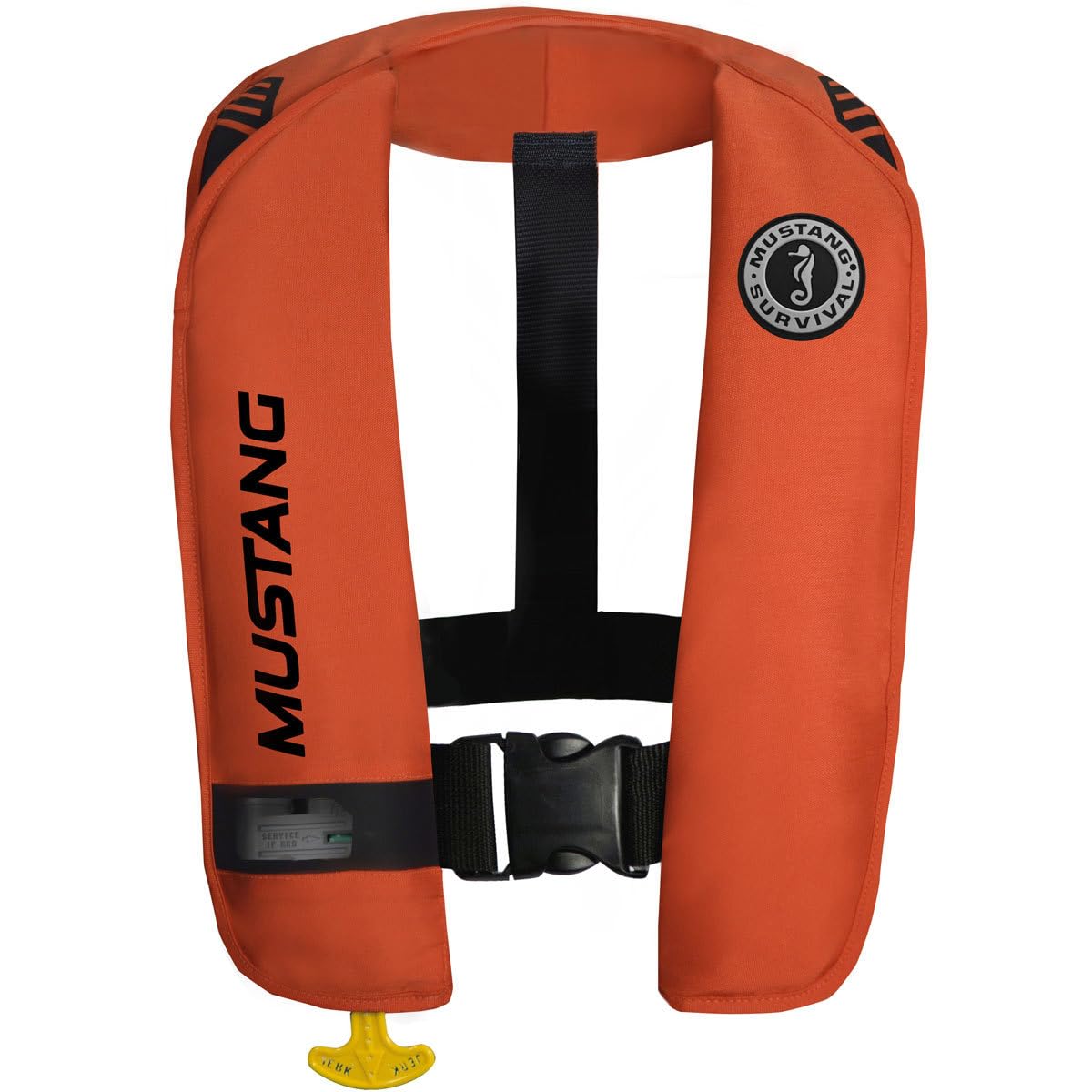
A 500-denier shell that shrugs off dock edges, rod racks, and a season of salt.
Mustang builds this one to take abuse. The outer is 500 Denier Cordura (a tightly woven nylon that resists scuffs far better than the thin shells on light belt packs), so brushing past a cleat or dropping it on concrete is not a crisis. Auto-activation fires when you hit the water, for anyone 80 pounds and up. The adjustable waist strap and harness span 30 to 52 inch chests, and buoyancy lands at 26 pounds.
At 1.9 pounds, it is the lighter of the two Mustang vests in this guide by a hair — the HIT work vest below runs 2 pounds. That gap is small, but it shows the design split: this M.I.T 100 is a recreational vest you wear over a jacket, while the HIT is a work vest built around a hydrostatic trigger (a mechanism that only fires when water pressure builds, not from rain or spray). Both are USCG Type III and Type V certified, so either satisfies the legal side on recreational water.
Owners point to mobility as the reason it stays on — the vest does not foul a fishing rod or a work task, and the fit stays comfortable through a long day. That combination of 500D Cordura and low interference is what justifies the premium tier here. A reflective tape strip and a whistle are part of the package, which are the small details that matter at dusk or in a chop. The one adjustment to expect: automatic triggers respond to water, so drying it properly between trips protects the mechanism.
Durability you can feel: the 500D Cordura face is the standout spec, and it is the reason this vest survives environments that chew up softer shells.
The auto-inflation reality: a fired vest needs a fresh cylinder and a dried trigger before it is ready again — plan the service, do not assume it.
Choose it for: open-water boating and fishing where the vest takes real contact with boat hardware.
Not the pick for: paddlers who want the smallest possible pack on their waist — this is a torso vest, not a belt.
5. Mustang Survival HIT Inflatable Work Vest (Auto Hydrostatic)
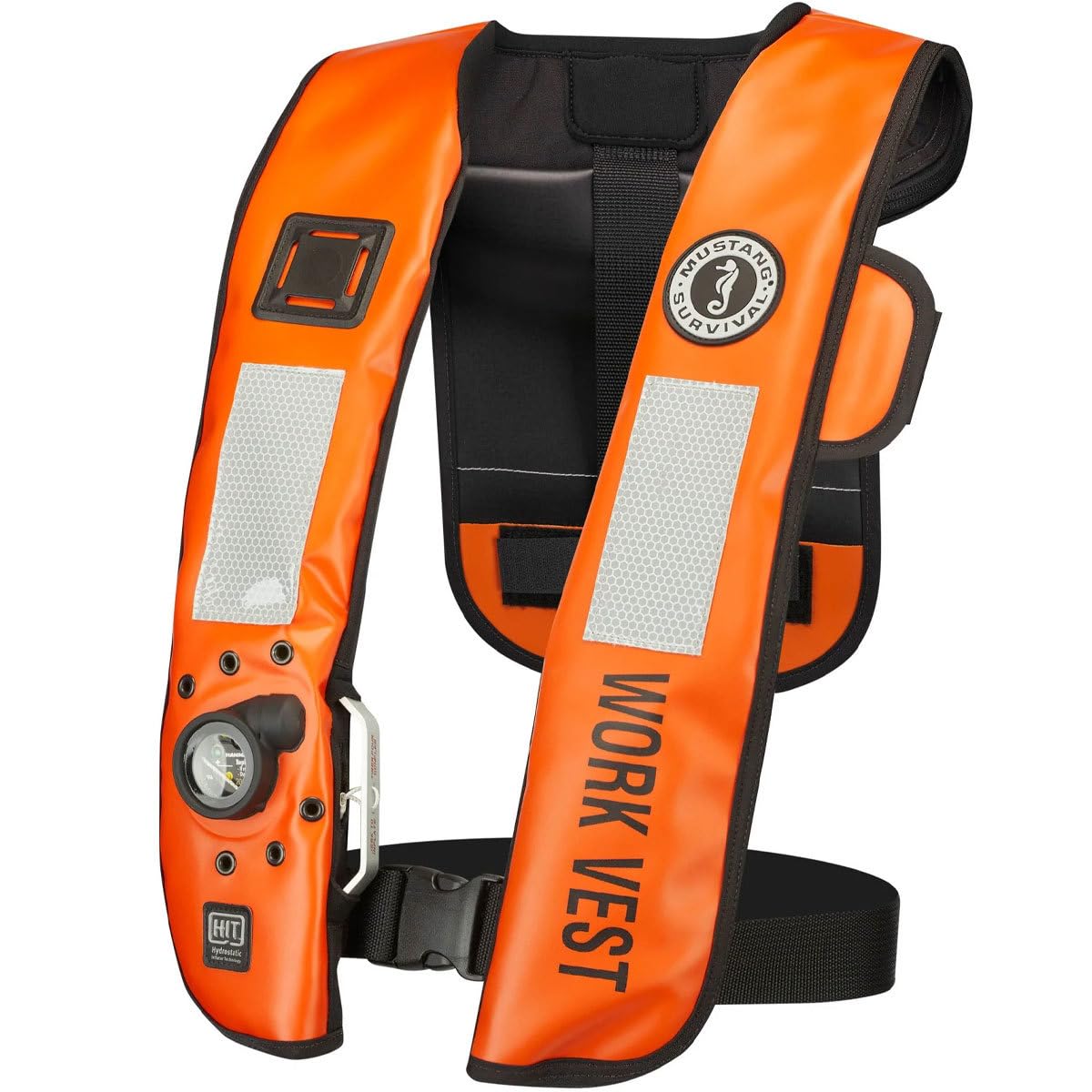
The only vest here that ignores rain and spray and waits for real submersion.
Most automatic vests use a water-sensitive trigger that can fire in a downpour. This one uses a 1F auto hydrostatic inflator, which reads water pressure instead. It inflates when you go under, not when the sky opens — a meaningful distinction if you work a wet deck all day. The bladder delivers 35 pounds of buoyancy, the highest figure in this guide.
Then there is the certification. This vest is approved for use on inspected and uninspected vessels of any size — a broader legal envelope than the recreational vests earlier in this list. The urethane-coated nylon outer shell, SecureZip closure (it stays shut in high winds and still opens on inflation), SOLAS reflective tape (high-visibility tape that shows up in a searchlight), and a safety whistle all point to the same buyer: someone whose PFD is part of the job, not an accessory. Mustang also rates the shell to 50 mph dynamic strength testing.
The trade-off is plain. It is the heaviest vest here at 2 pounds, and it is the priciest by a wide margin — buyers report they are split on whether the value justifies it, with some calling it a great buy and others finding it steep. For a commercial crew or a serious offshore angler, the hydrostatic trigger and the inspected-vessel approval are the whole argument. A weekend paddler pays for that capability and never uses it.
Why crews pay for it
- Hydrostatic trigger will not fire from rain, spray, or humidity
- 35 lb of buoyancy, the highest figure in this group
- Approved on inspected and uninspected vessels of any size
- SecureZip closure holds in high wind and opens on inflation
- Cylinder sits inside the bladder to resist corrosion
The cost of that capability
- Heaviest vest reviewed here at 2 pounds
- Premium-tier spend that casual paddlers will not recoup
Buy it if: your PFD has to survive salt, spray, and a shift on a working deck.
Skip the upgrade if: you paddle calm inland water — a manual belt pack covers that job for far less.
Know the Specs
Buoyancy in Pounds
This figure tells you how much lift the inflated bladder provides. A 16.5-pound bladder behaves like a foam Type III vest, while a 35-pound work vest gives you substantially more reserve. More buoyancy helps when you carry gear, wear heavy clothing, or face rough water. It does not make a calm-water paddle safer than a well-fitted vest of lower rating — fit keeps the vest on your body, which is the larger factor.
Manual vs Automatic vs Hydrostatic
Manual inflation waits for a cord pull, so nothing fires by accident — good for confident swimmers on flat water. Automatic inflation fires on water contact, which helps if you cannot act, but a soaking can set it off. Hydrostatic inflators read pressure instead of moisture, so spray and rain do not trigger them. Choose by the water you are in and how much you trust your own reaction time.
Type V and the Wear-It Rule
A Type V device is approved for special uses and carries Type III performance in most of these vests. The critical condition is that it must be worn to count as legal flotation — stowed in a hatch, it is not a PFD in the eyes of the law or in the water. That is why belt packs work: they keep the device on you without the bulk of foam.
Chest and Waist Range
Sizing shows up as a chest range in inches, and on belt packs, a waist range too. Both need to be checked against a real measurement. A belt that gaps can slide up when the bladder fills, and a vest that is too tight restricts your paddle stroke. Confirm the minimum weight rating as well — most of these are approved for wearers over 80 pounds.
Common Questions
Does a Type V PFD count as legal flotation if I keep it in the boat?
Will an automatic inflatable fire in the rain?
How much buoyancy do I actually need on a paddleboard?
How do I size a belt pack PFD correctly?
What happens after my inflatable PFD fires once?
Is a Type V vest the same as a Type III?
Can I wear an inflatable PFD on a commercial or inspected vessel?
Will a belt pack interfere with paddling or casting?
What is the minimum weight rating on these vests?
The Bottom Line
For most paddlers, the type v pfd that wins is the BLUESTORM Cirro 16. It gives you 16.5 pounds of buoyancy with an oral path to 29 pounds, in a belt pack that stays flat at your waist and out of your paddle stroke. It is the one you will actually wear — and a Type V only counts as flotation while it is on your body.
If you want the vest to act for you, step up to the BLUESTORM Cirro 26 and its 26 pounds of automatic-or-manual inflation. And if your PFD is work equipment rather than weekend gear, the Mustang HIT is the only vest here with a hydrostatic trigger and approval for inspected vessels of any size — capability you buy only when the deck demands it.
The Cirro 16 earns the top spot on its fit and comfort reputation rather than a raw buoyancy figure. Its wide 30–52 inch chest range is why so many paddlers keep it on all day instead of stowing it.
How we choose
We do not accept paid placement. Every pick is matched to a real buyer and a real use-case; we do not hands-on test units.
Sources
Specifications: manufacturer listings and product documentation. Review insights: verified customer reviews, as of November 2026. Pricing: not shown on this page (it changes often); check the current price via the retailer link.
As an Amazon Associate, Tactical Gear Guy earns from qualifying purchases. This does not affect which products we feature.