Specs are compiled from manufacturer listings and verified buyer reviews and can change over time — please confirm the key details on the product page before buying.
You want a life jacket that does not turn a hot afternoon on the paddleboard into a sweaty, shoulder-restricting chore. That is exactly what a Type V inflatable belt pack is for: it sits around your waist as a small pouch, stays out of your way while you paddle or cast, and turns into a full flotation device when you pull the cord or hit the water. The short answer: the BLUESTORM Cirro 16 is the best all-round belt pack for most paddlers, the Cirro 26 adds automatic inflation and 26 lb of lift, the BOTE is the low-profile SUP pick, and the Mustang Survival HIT is the hydrostatic work-boat vest.
This guide is built by comparing the manufacturers’ published specifications and the patterns across verified customer reviews, so you get each pick’s real strengths and trade-offs instead of marketing spin.
Fit is what actually decides whether you wear the thing, so below you get chest ranges, buoyancy in pounds, and inflation style side by side, all pulled from the listings and owner feedback for the best Type V Life Jacket.
Top Picks

How To Choose The Best Type V Life Jacket
A Type V is a “special-use device” — a life jacket the US Coast Guard has approved for a specific activity rather than general boating. On these belt packs the label carries Type III performance, which means it delivers the flotation of a standard foam vest once it is inflated. The catch built into every Type V belt pack is simple: it only counts as legal flotation while you are wearing it. Take it off and toss it in the hull, and you are back to having nothing on.
Match the inflation trigger to how you fall in
Manual inflation means you yank a “jerk to inflate” cord yourself, which is fine for a paddler who expects to go in and has their hands free. Automatic inflation fires the CO2 cylinder when the device senses submersion, which helps if you take an unexpected dunk. Hydrostatic inflation goes a step further and triggers on water pressure, so rain, spray, and humidity will not set it off. Every one of these styles also gives you an oral inflation tube as a backup, so you can top the bladder up with your own breath if the cylinder is spent.
Read the buoyancy number in pounds
Buoyancy is the lift the inflated bladder provides, and the listings here run from 16.5 lb up to 35 lb. A foam vest is the yardstick most people know, so treat the pound figure as your comparison point against the vest you already own. Higher lift generally means a bulkier inflated shape, so there is a real trade between how compact the pack rides and how much it floats you.
Get the chest and waist range right
These are universal-fit devices, and the fit lives or falls on the stated range. Some list chest only, some list both chest and waist, and the difference matters because the belt has to cinch down tight enough to stay put when the bladder fills. Check the range against your actual measurements, not your shirt size, and confirm the adult weight and age approvals on the label before you buy.
Side-by-Side Comparison
| Model | Best For | Inflation | Buoyancy | Fit Range | Amazon |
|---|---|---|---|---|---|
| BLUESTORM Cirro 16★ Best Overall | All-round paddling and fishing | Manual + oral | 16.5 lb (29 lb oral) | 30–52 in chest | Amazon |
| BOTE Inflatable Belt PFD | Low-profile SUP and casting | Manual + oral | — | 30–52 in chest, 21.5–57.5 in waist | Amazon |
| BLUESTORM Cirro 26 | Auto-inflation and more lift | Automatic + manual + oral | 26 lb | 30–56 in chest | Amazon |
| Mustang Survival HIT | Work boats and rough water | Auto hydrostatic + oral | 35 lb | — | Amazon |
Detailed Reviews
1. BLUESTORM Cirro 16 Manual Inflatable Belt Pack
Our pick — 4.5+★ from 250+ verified ratings; the strongest balance of quality and price.
The belt pack that disappears around your waist until the moment you need it.
The numbers that decide this one are 16.5 lb of buoyancy from the CO2 cylinder and 30–52 inches of chest fit. The listing rates that 16.5 lb as Type III foam-vest performance, so the low-profile waist design does not cost you flotation. The second figure is why it takes the top spot: a 30–52 inch chest range covers small through XXL, and it is the widest fit band of the two Cirro models here.
What wins people over is the fit, and it is not close — 42 buyers bring it up and 37 of those are positive, with comfort close behind at 25. The bladder inflates on a jerk of the cord, and you also get an oral tube that takes it to 29 lb if you want more lift after the fact. D-rings give you a place to clip a leash or a tool. For SUP, kayak, and canoe duty the pack stays flat against your lower back instead of pushing into your shoulder blades.
Here is the catch, and it shows up in the same buyer feedback: the CO2 cylinder ships in a storage pocket inside the belt pack and has to be installed into the manual mechanism before the vest will inflate on the cord. Several buyers either missed that or expected a spare, so read the setup sheet before you head to the ramp. The other honest note is value — the re-arm cylinders draw mixed feelings, since a spent cartridge means buying a replacement to keep the manual trigger live.
What works in the water
- 16.5 lb buoyancy from the cylinder, with 29 lb available through the oral tube
- 30–52 inch chest range covers small through XXL
- Nylon shell with a breathable lining, so it stays cool in summer heat
- D-rings for clipping on accessories
What to sort out first
- Cylinder arrives in a storage pocket and needs installing before the cord works
- Replacement cartridges add ongoing cost once you inflate it for real
The clear default: Paddlers and anglers who want a compact waist pack and are happy to pull a cord themselves.
The one setup step: Install the CO2 cylinder before your first trip, or the jerk cord will not do anything.
2. BOTE Inflatable Belt PFD

Built for the paddler who wants the deck clear and the arms free.
Where the Cirro 16 lists a chest range only, this BOTE publishes both — a 30–52 inch chest and a 21.5–57.5 inch waist. That waist figure is the useful one for a belt device, because the belt is what holds the pack against you when the bladder fills. If your waist sits outside that band, no amount of chest fit will keep the pack from riding up.
The soft-touch neoprene lining is the other thing you notice immediately. It sits against skin without the chafe you get from a stiff nylon strap on a long paddle. Manual pull-cord inflation does the work here, with oral inflation as the backup, and the belt pack ships with a 16g CO2 cylinder included — a step beyond the Cirro 16, where the cartridge starts in a storage pocket. The rearming kit is specified as the Leland V87000-82123Z if you ever need a replacement.
Owner feedback is thin on volume but consistent in tone: well-made and functional. Quality is the most-discussed point and it skews positive, with safety close behind. Nobody is calling it a bargain, and it is the plainest of the group on features — no D-rings, no auto trigger, no extra lift spec. What you are buying is a clean, low-profile belt with good materials from an established paddle brand. The label also spells out the rule plainly: this is a Type V non-convertible device and it must be worn to be legal.
Where it wins: Two published fit dimensions — chest and waist — plus a CO2 cylinder in the box and a neoprene lining that behaves on bare skin.
What you give up: No automatic trigger and no buoyancy figure to compare, so if you want the reassurance of a stated lift number, the Cirro models put one on the page.
Reach for this if: You paddle a SUP and want a belt that stays flat through the stroke, with the cartridge already in the box.
Look elsewhere if: You want an automatic or hydrostatic trigger, since this one is pull-cord only.
3. BLUESTORM Cirro 26 Automatic/Manual Inflatable Life Jacket

Automatic inflation and 26 lb of lift for the paddler who wants a safety net.
The headline figure is 26 lb of buoyancy, which the listing rates at twice a Type 3 foam vest. Compare that with the Cirro 16 at 16.5 lb and you can see the family split: same waist-pack idea, meaningfully more lift and a bulkier inflated pillow. If you are a bigger paddler, or you simply want more margin when it deploys, this is the model that gives it.
The trigger setup is the bigger difference. This one inflates automatically on submersion via a replaceable CO2 cylinder, and it ships with one cylinder in the purchase. You can still fire it by hand with the jerk-to-inflate cord, and the oral tube backs both of those up. The long shell design lets the belt rest low on the hips rather than riding high at the ribs. Fit spans 30 to 56 inches of chest, which is the widest chest band of the four picks, and that reaches a size up on each end versus the Cirro 16.
The trade you make for that automation is maintenance. Once the vest has inflated you swap in a replacement, and the re-arm kit is listed as the BLUESTORM CO2 Re-Arm Kit 24 Gram, which includes one arming mechanism. Treat that as a running cost of the auto feature rather than a fault. The polyester shell is light and the flat profile keeps it comfortable for sail, fish, or paddle duty. Factor the replacement into your thinking from day one and this one behaves exactly as advertised.
Reasons this earns the upgrade
- 26 lb of buoyancy, described as twice a Type 3 foam vest rating
- Automatic submersion inflation, plus manual cord and oral backup
- 30–56 inch chest fit, the widest chest band here
- One CO2 cylinder included with the purchase
The upkeep to plan for
- Every real deployment means buying the 24 Gram re-arm kit afterward
- The higher lift comes with a fuller inflated shape than the 16.5 lb pack
Worth the step up: Anyone who wants the device to fire itself on submersion and prefers the extra lift over the compact feel.
Budget for this: A spare re-arm kit, because an automatic vest that has inflated once needs a fresh cylinder to work again.
4. Mustang Survival HIT Inflatable Work Vest
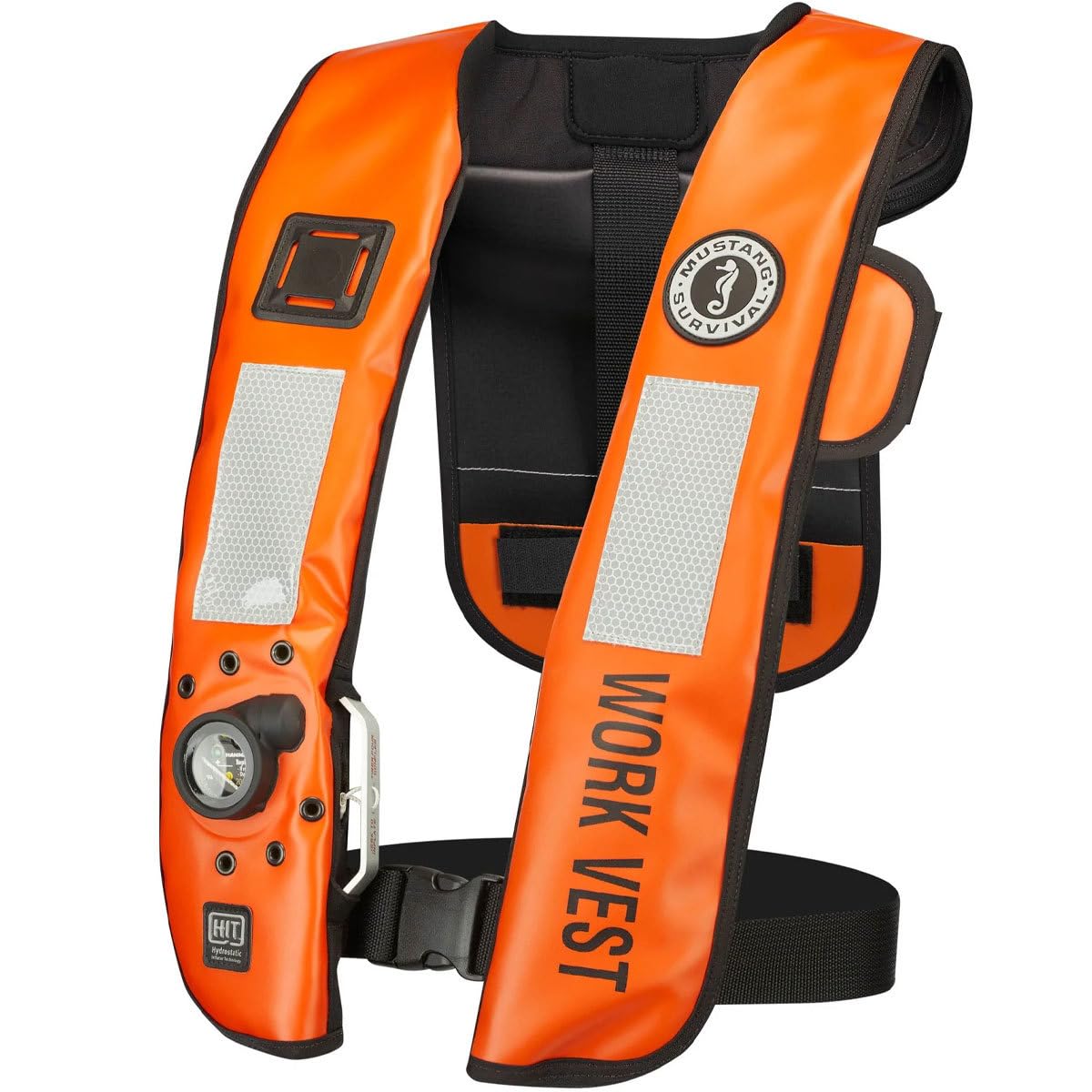
The one that stays dry in a squall and still floats you hardest when it counts.
At 35 lb, this is the highest buoyancy in the group — the listing rates it at more than twice standard foam PFDs. The inflator is the real story though. It is a hydrostatic design that fires on water pressure rather than a simple moisture sensor, which means rain, spray, and humidity do not set it off — only going under does. That single difference is why this vest suits a wet, windy deck where the others would need more care.
The construction backs up the work-boat label. The outer shell is heavy-duty urethane-coated nylon, and the cylinder sits inside the bladder to protect it from corrosion. A SecureZip closure stays shut in high winds and still opens on inflation. There is SOLAS reflective tape and a safety whistle on board, and the build is described as 50 mph dynamic strength-tested. It is approved for inspected and uninspected vessels of any size. At 2 pounds it is no heavier on the body than a foam vest to wear.
Comfort and quality both come up evenly in owner feedback, and quality is unanimously positive — this is gear that reads as serious kit, not a leisure accessory. The honest trade-off is value, which is the mixed note in the reviews: it is the premium pick by a wide margin, and some owners feel the price is steep for a device they hope never to deploy. If you are on a recreational paddle, that spend is hard to justify. If you work the water or fish offshore in rough conditions, the hydrostatic trigger earns its keep.
The case for it: 35 lb of buoyancy, a hydrostatic inflator that ignores spray, and a urethane-coated nylon shell built for hard use.
The honest limit: It asks premium money for a device with no recreational frills, and the value split in owner opinion reflects exactly that.
Made for: Deckhands, offshore anglers, and anyone who needs a vest that stays armed through rain and wash.
Think twice if: Your water time is a calm weekend paddle, where the hydrostatic hardware is more vest than you need.
Know the Specs
Inflation Style: Manual vs Automatic vs Hydrostatic
Manual means you pull a cord and the CO2 cylinder fills the bladder — you have to be conscious and able to reach it. Automatic adds a sensor that fires on contact with water, which covers you if you go in unexpectedly. Hydrostatic is the most selective: it reads water pressure, so rain and spray will not trigger it. All three styles here also include an oral tube, so you can always inflate by mouth as a fallback.
Buoyancy in Pounds
Buoyancy is how much lift the inflated bladder gives you, and it is the fairest way to compare a belt pack against the foam vest you already own. The picks here range from 16.5 lb to 35 lb. More lift generally means a fuller inflated shape, so a higher number is not automatically better for a paddler who wants a compact pack — match it to your body size and the conditions you actually go out in.
Common Questions
Does a Type V life jacket count as legal flotation if I am not wearing it?
What is the difference between manual and automatic inflation on a belt pack?
Will a hydrostatic inflator go off in the rain?
Do these inflatable life jackets come with a CO2 cylinder?
How much buoyancy do I need from a belt pack?
Can I reuse the vest after it inflates once?
What chest and waist size does a belt PFD fit?
Is a belt pack as safe as a foam vest for open water?
What age and weight do these Type V devices approve?
Do I need a Type V belt pack for flat-water kayaking and SUP?
The Bottom Line
The winner in this lineup is the BLUESTORM Cirro 16, because it pairs 16.5 lb of cylinder buoyancy with a 30–52 inch chest fit and a waist design that stays flat through a paddle stroke. What owners rave about most is the fit, and that is the thing a belt pack lives or dies on. If you want the device to inflate itself and float you harder, grab the BLUESTORM Cirro 26 for its automatic trigger and 26 lb of lift. And if you work the water in rain and spray, the Mustang Survival HIT is the one to reach for, with its hydrostatic inflator and 35 lb of buoyancy.
One last nudge: the Cirro 16 is the crowd favourite at 4.5+ stars across 200+ owners, and its waist-pack fit makes it the easiest of the four to wear all day. Whichever you pick, arm the cylinder and check the fit before you launch — a Type V only counts when it is on you.
How we choose
We do not accept paid placement. Every pick is matched to a real buyer and a real use-case; we do not hands-on test units.
Sources
Specifications: manufacturer listings and product documentation. Review insights: verified customer reviews, as of November 2026. Pricing: not shown on this page (it changes often); check the current price via the retailer link.
As an Amazon Associate, Tactical Gear Guy earns from qualifying purchases. This does not affect which products we feature.