Specs are compiled from manufacturer listings and verified buyer reviews and can change over time — please confirm the key details on the product page before buying.
Here is the short answer: buy the First Alert BRK 3-Pack if you are simply swapping old hardwired alarms on existing wiring. Buy the Kidde 20SA10-V if you want a voice that says the word “Fire” instead of only a horn. Buy the First Alert 7020BSL if someone in the house is deaf or hard of hearing and needs a light to wake them. Every pick here is a two-wire hardwired unit — meaning it runs on your home’s existing alarm wiring and, when you link them, one alarm triggers all of them.
This guide is built by comparing the manufacturers’ published specifications and the patterns across verified customer reviews, so you get each pick’s real strengths and trade-offs instead of marketing spin.
The catch most people miss is that “two-wire” describes the wiring, not the power source. These alarms all draw 120V AC from the house and carry a battery backup for outages. Below, you’ll see which ones link cleanly, which chirp, and which need a second look before you buy a two wire smoke detector.
Top Picks
How To Choose The Best Two Wire Smoke Detector
Your house already has the wiring. That is the whole point of this category. You are not running new cable through the attic — you are matching a new alarm to the three-wire harness and the interconnect line your previous unit used. Get the match right and the swap takes about ten minutes per unit.
Confirm the wiring before anything else
A two-wire alarm uses three conductors: hot, neutral, and a third travel wire that carries the interconnect signal between units. If your ceiling plate has all three, you are in the right category. Four-wire and wireless units live in a different lane entirely.
Pick your sensor for the fire you actually fear
An ionization sensor reacts fastest to a flaming fire — paper, grease, a candle tipping over. A photoelectric sensor reacts fastest to a smoldering fire that throws thick smoke before it flames. Neither sensor is inherently better. The right answer depends on where the alarm sits and what burns near it.
Match the interconnect, not just the brand name
Interconnect compatibility is the number one source of frustration in this category. A Kidde alarm links to other Kidde alarms, and a First Alert links to First Alert. If you have a house full of one brand, stay with that brand even if a rival model looks nicer on paper.
Decide what “battery backup” means to you
A removable AA or 9V backup means you will replace it on a schedule. A sealed 10-year battery means you will not touch it again — but the whole alarm retires when that battery does. Both backup styles appear in the picks below.
Side-by-Side Comparison
| Model | Best For | Sensor | Backup | Pack Size | Amazon |
|---|---|---|---|---|---|
| First Alert BRK 3-Pack★ Best Overall | Whole-floor swap | Ionization | 9V battery | 3 units | Amazon |
| Kidde 20SARBest Value | Budget-first replacement | Smoke detection | 2 AA batteries | 1 unit | Amazon |
| Siterlink GS562AQuietest Operator | Quiet-house pairing | Photoelectric | 9V battery | 2 units | Amazon |
| Kidde i12040 | Large interconnected homes | Ionization | 9V battery | 1 unit | Amazon |
| First Alert 7020BSL | Deaf and hard-of-hearing households | Smoke + strobe | 10-year sealed | 1 unit | Amazon |
Detailed Reviews
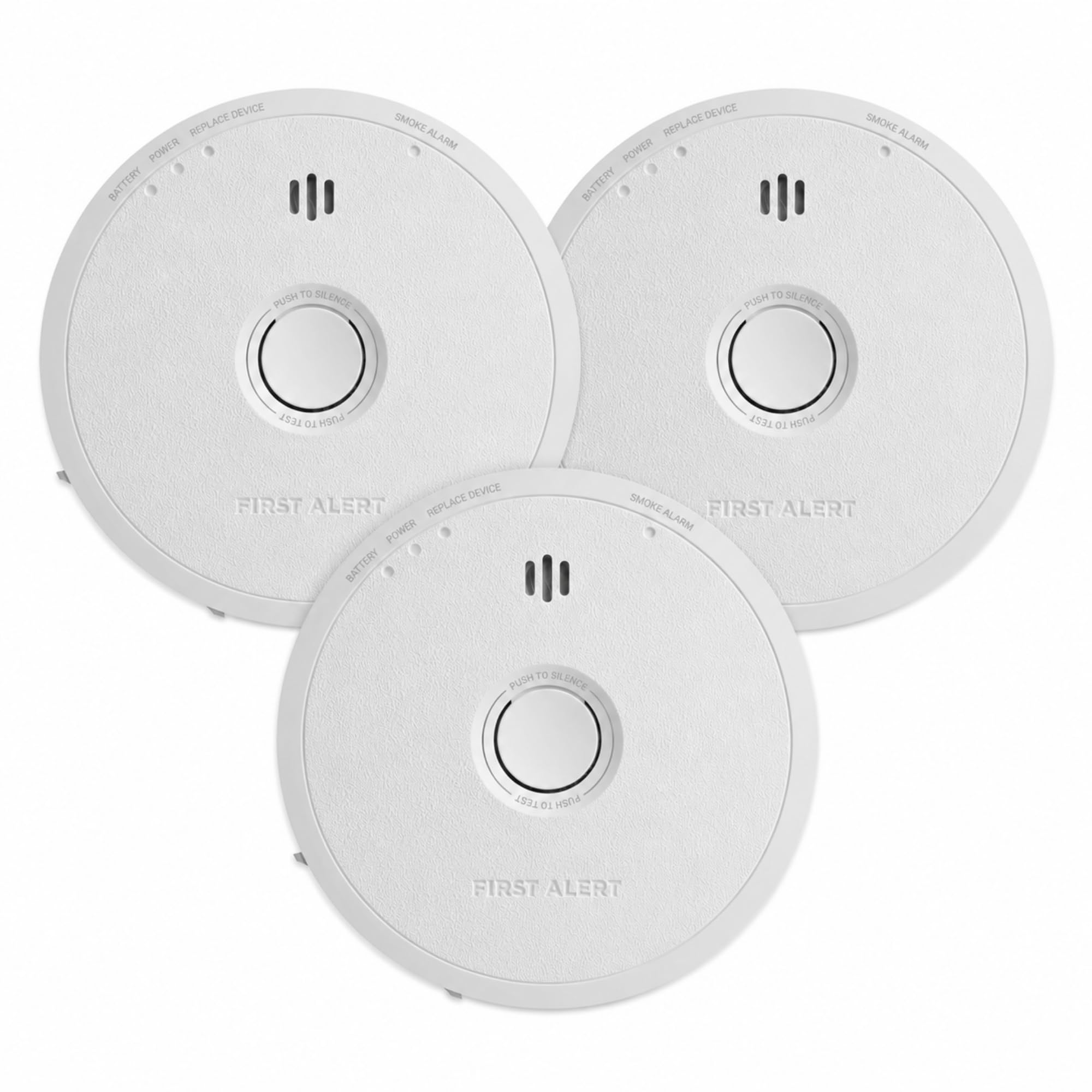
1. First Alert BRK Smoke Detector 3 Pack
Our pick — 4.5+★ from 400+ verified ratings; the strongest balance of quality and price.
Three alarms in one box turns an afternoon chore into a single one.
If you are replacing the alarms in a hallway, a bedroom, and a basement, buying singles is a slow grind. This box gives you three identical units, and the number that matters is simply that: three. The Kidde 20SAR ships as one unit. Three at once means one trip up the ladder, one wiring routine repeated exactly the same way, and no chance of finishing two rooms and putting off the third until next month.
Owners point to functionality more than anything else. These behave like the alarms they replaced — no new quirks, no learning curve, no mystery chirps on a schedule you did not expect. Installation lands right behind that, and the reason is mechanical rather than clever: the mounting hardware matches the holes already in your ceiling, so the swap is a screwdriver-and-hook-up job with no drywall work and no new anchors.
Here is the trade-off to think through. Each unit measures 6″D x 2″W x 6″H, so it is chunkier than the Kidde 20SAR at 1.88″D x 5″W x 5″H. In a tight hallway where the old alarm sat flush, you will see a little more plastic. The full box weighs 16 ounces, which is fine on drywall but worth knowing if you are mounting to a thin panel or a soffit.
What sells these
- Three units in the cart at once, so a whole floor gets done in a single pass
- Mounting aligns with existing ceiling hardware — no new drilling
- Ionization sensing handles a flaming fire fast, which is what a hallway or bedroom alarm usually faces first
- Owners say it works better than the older model it replaced
Before you order
- The 6-inch diameter is bigger than a compact Kidde unit, so it can look bulky on a small ceiling patch
- You are locked into First Alert if you want these to talk to alarms you already own
The right buy if: you are refreshing several rooms at once on First Alert wiring and want the job finished in one afternoon.
Look elsewhere if: your existing alarms are Kidde — a mixed-brand ceiling will not interconnect, and one silent alarm defeats the point.
2. Kidde Smoke Detector 20SAR 1 Pack
The tightest profile here, and the easiest one to sell a landlord on.
This is the alarm that disappears into a ceiling. At 1.88″D x 5″W x 5″H, it sits noticeably flatter than the First Alert 3-pack unit at 2″ deep and 6 inches across. That matters in a hallway where the old detector already felt like a bump on the drywall. Kidde packs two AA batteries, the alarm, the mounting hardware, and the user guide in the box, so you are not hunting for a harness clip at 9 p.m.
The 85-decibel horn is the headline number. That is loud enough to pull you out of deep sleep from the next room, and a red LED gives a visual confirmation while the alarm is sounding. Kidde claims this model detects smoke over 25% faster than its own prior reference point. The sensing is tuned to cut down on false trips from cooking steam — the bane of any alarm mounted anywhere near a kitchen.
The honest catch is interconnect compatibility. Some owners pairing these with other same-brand alarms ran into connection trouble. If this is a straight one-for-one replacement on a single loop, you are fine. If you are building a linked network across a big house, test the interconnect before you commit the whole ceiling to it.
Go this way for: a single-room replacement or a landlord patching one dead alarm without overthinking it.
Think twice if: every alarm in the house needs to sing in unison from different eras of Kidde hardware.
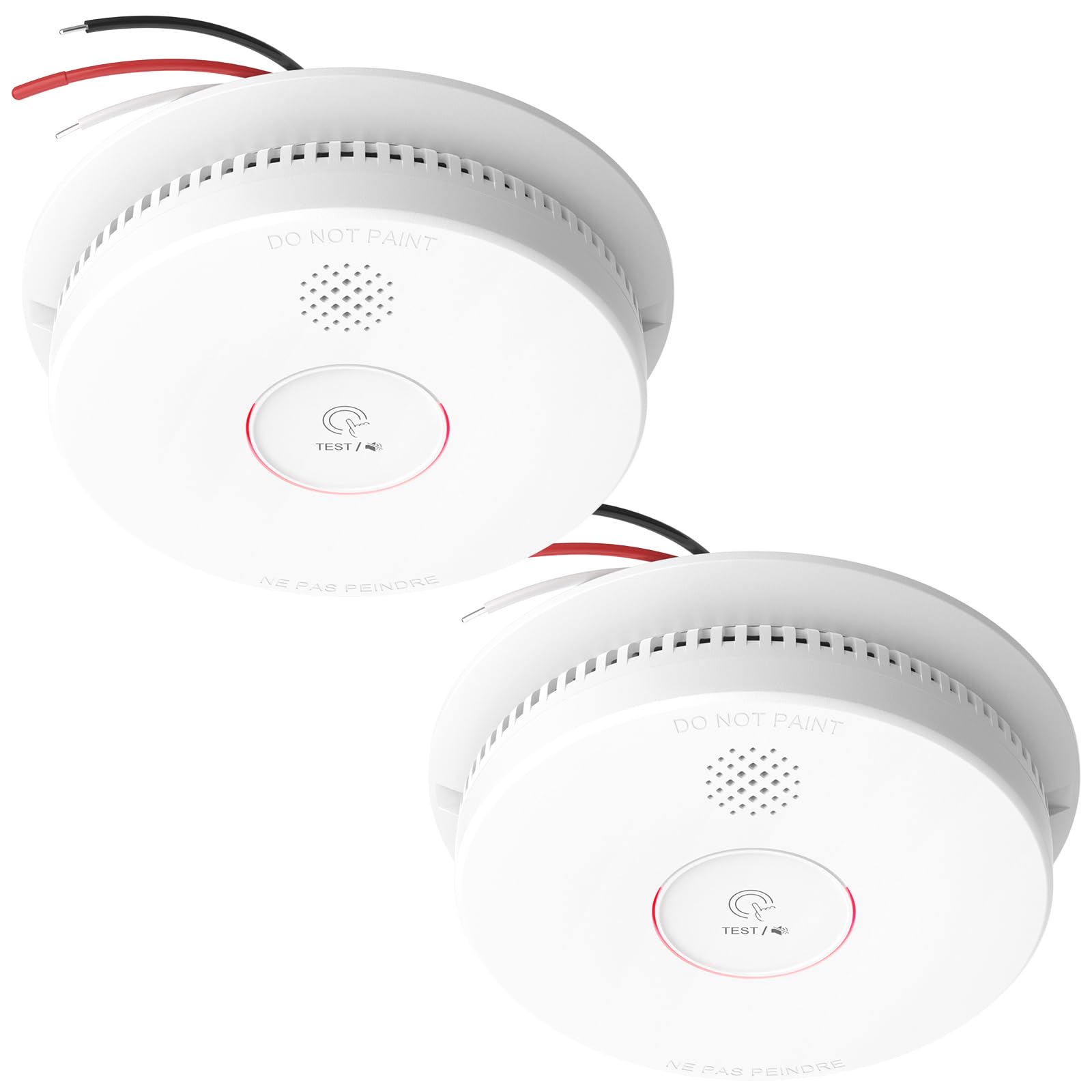
3. Siterlink GS562A Smoke Detectors 2 Pack
Photoelectric sensing and a ten-hour silence button — the alarm for a house that cooks.
This is a photoelectric alarm, meaning it watches for scattered light inside its chamber rather than the ionized air current an ionization unit relies on. Practically, that means it is tuned toward a smoldering fire that produces thick smoke before it ever bursts into flame — the sofa cushion, the overloaded extension cord, the dryer vent. It is a different detection philosophy from the ionization picks above, not a weaker one.
The one-touch silence button is the feature that will actually change your evenings. It mutes the alarm for up to 10 hours, so a pan of bacon at breakfast does not turn into a stand-on-a-chair-and-fan-it routine. The built-in LED indicator is deliberately soft and hidden rather than a bright blink, which Siterlink positions for a child’s room where a flashing light would be counterproductive.
Two units per box is the practical middle ground between a single replacement and a full floor pack. The 9V backup keeps it live through an outage. And when you wire these together, one alarm sounding triggers every connected unit — the evacuation signal arrives in the far bedroom at the same moment it arrives in the kitchen. Worth checking that your existing interconnect line is live before you buy, because the whole benefit rides on that third wire.
What the pair buys you: two photoelectric heads, two 9V backups, and a 10-hour mute — enough to cover a hallway and an adjacent bedroom with matching sensors.
Worth knowing: a 2-pack means a three-bedroom house needs a second box, so plan the count before you order.
Pairs well with: a kitchen-adjacent hallway where nuisance alarms have been a running argument.
Not the pick for: a shopper who wants a sealed decade battery and never wants to think about a 9V again.
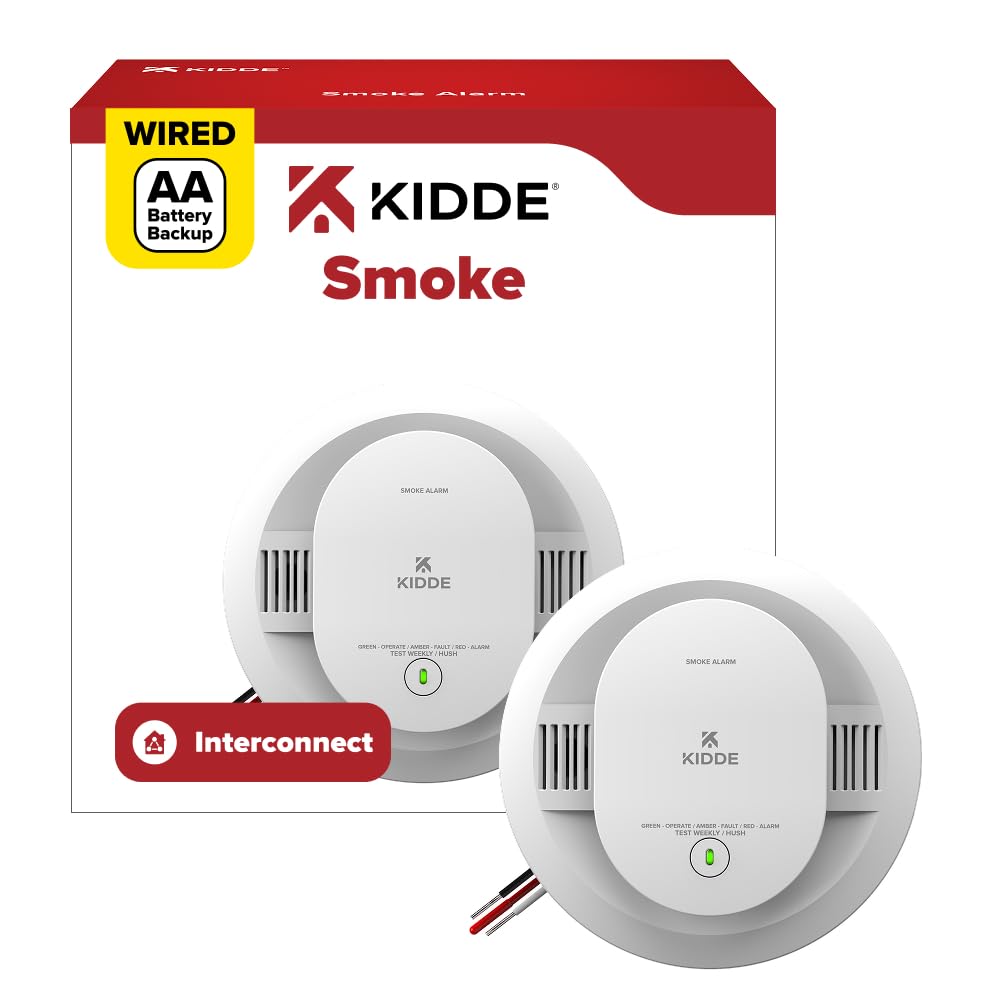
4. Kidde Smoke Detector 20SA10-V 1 Pack

One alarm rings, twenty-four devices answer — the networking champion of the group.
For a large house or a multi-unit building, the interconnect ceiling is the spec to check first. This unit links up to 24 devices, of which 18 can be initiating alarms, and the network can include smoke, CO, and heat alarms together. That is the widest reach in this lineup, and it is why a whole-building install makes sense around this model rather than around a single-room unit.
The installation details are quietly excellent. A pre-stripped wiring harness with an easy-off cap means no wire stripper tool needed at the ceiling. The tinned strands increase conductivity and give the wire nut more to bite on — a small thing that translates directly into a connection that holds. A large mounting base covers old paint rings and wall imperfections, so the new alarm does not leave a halo of mismatched ceiling around it.
Two features earn their keep over the life of the unit. Alarm memory flashes a red LED on the specific unit that started the event, so in a linked system you know exactly which room tripped instead of guessing. And battery run-down protection shuts down alarm memory when AC power is absent, which cuts down on low-battery chirping during an outage. A dust cover keeps the sensor clean during construction or remodeling. Quality is clearly what sells this model — it is the most-praised attribute by a wide margin in the feedback.
Where it wins
- Links 24 devices with 18 initiating — enough for a full house plus a detached garage
- Alarm memory tells you which unit fired first, saving guesswork on a big system
- Pre-stripped, tinned harness installs without a stripper tool and holds the wire nut firmly
- Large mounting base hides old paint rings and surface imperfections
The other side
- Durability draws mixed feedback — some units run a full year, others quit well short of it
- It is a single unit, so a whole-house build means buying several
Worth it for: anyone wiring a full house or an outbuilding who wants every alarm on one talking network.
Not the priority if: you need one replacement in one hallway — the networking capacity is wasted on a single unit.
5. First Alert BRK 7020BSL Smoke Detector

A 177 candela flash that reaches someone who cannot hear the horn at all.
Sound is useless to a deaf sleeper, and that is the entire reason this unit exists. The integrated strobe puts out 177 candela — candela being the measure of light intensity in a given direction — so the warning arrives as a bright flash rather than a noise. First Alert combines the smoke alarm and the strobe in a single housing that needs only one junction box, which saves both time and money on an install that would otherwise mean two openings in the ceiling.
The smart strobe is the detail that makes it usable day to day. It runs separate flash patterns to distinguish between a smoke event and a carbon monoxide event, so the light itself tells you which danger you are facing. When multiple units are installed, the strobes synchronize and flash in unison rather than strobing at random intervals, which is both less disorienting and easier to read from a distance.
Power comes from AC wiring with a 10-year sealed battery backup, so an outage does not silence the warning. The feature list is rounded out by tamper-resist locking, alarm memory, and a battery pull tab. What owners respond to most is straightforward: the flash is bright enough to be effective, and it delivers a real measure of confidence for hearing-impaired residents. The 10-year limited warranty runs from the purchase date with the original receipt.
Essential for: any household with a deaf or hard-of-hearing resident who needs a warning they can see from across a dark room.
Overkill for: a standard hearing household where a loud horn already does the job — the strobe earns its single-junction-box design only when light is the point.
Know the Specs
Two-Wire Interconnect, Explained
A two-wire alarm runs on the household AC supply and uses a third travel wire to carry a signal between units. When one alarm trips, it sends power down that wire and every connected alarm sounds at once. That is why matching the interconnect type matters more than matching the color of the plastic — a unit that cannot read the signal will sit silent while the rest of the house screams.
Ionization vs Photoelectric Sensing
An ionization sensor uses a tiny current of ionized air and reacts fast to a flaming fire — paper, grease, an open flame. A photoelectric sensor watches for light scattering off smoke particles and reacts fast to a smoldering fire that smokes heavily before it flames. Both are legitimate; the practical choice is a mix across the house rather than one sensor type everywhere.
Decibels and Candela
A decibel rating measures how loud the horn is. The units here are rated at 85 dB, which is loud enough to wake most sleepers through a wall. Candela measures light intensity from a strobe — the 7020BSL’s 177 candela is what makes its flash visible across a room. If hearing is not the issue, decibels matter. If it is, candela is the number that counts.
Battery Backup Varieties
Removable AA or 9V backups are easy to replace and keep the alarm live through an outage, but they need swapping on a schedule. A sealed 10-year battery needs no maintenance at all and carries a warranty matching its lifespan, but it does not get replaced — the alarm retires when it does. Neither is a flaw — just two different maintenance routines.
Common Questions
Will a two-wire smoke detector work with my existing hardwired alarm wiring?
Can I mix Kidde and First Alert alarms on the same interconnect line?
What is the difference between an ionization and a photoelectric smoke alarm?
How loud is an 85-decibel smoke alarm in real life?
Does a sealed 10-year battery alarm really mean no maintenance?
Why does my hardwired smoke detector chirp when the power is on?
Can a two-wire alarm interconnect with carbon monoxide and heat alarms?
What does the candela rating on a strobe smoke alarm mean?
How long do hardwired smoke detectors last before they need replacing?
The Bottom Line
For most people, the two wire smoke detector to start with is the First Alert BRK 3-Pack, because three ionization units drop onto existing First Alert mounting without new drilling and finish a whole floor in one pass. If you want a spoken “Fire” warning and a sealed 10-year battery you never touch, grab the Kidde 20SA10-V. And for a household with a deaf or hard-of-hearing resident, the First Alert 7020BSL with its 177 candela strobe is the one to reach for — its flash arrives where a horn cannot. Match the brand to your existing interconnect loop and the swap is straightforward.
How we choose
We do not accept paid placement. Every pick is matched to a real buyer and a real use-case; we do not hands-on test units.
Sources
Specifications: manufacturer listings and product documentation. Review insights: verified customer reviews, as of November 2026. Pricing: not shown on this page (it changes often); check the current price via the retailer link.
As an Amazon Associate, Tactical Gear Guy earns from qualifying purchases. This does not affect which products we feature.