Specs are compiled from manufacturer listings and verified buyer reviews and can change over time — please confirm the key details on the product page before buying.
Losing a kid at a crowded trailhead or watching your crew split across a jobsite with no way to reach them is exactly when a radio has to earn its keep. It has to reach, it has to be heard over noise, and it has to survive a drop in a puddle. The picks below do all three, sorted by what you will realistically use them for. The headline pick is the Retevis RB48 pair, which carries MIL-STD-810H and IP67 ratings and holds 4.5+ stars across 900+ ratings. Which one fits you depends on if you need waterproofing, glove-friendly buttons, or a long battery on a six-radio team.
This guide is built by comparing the manufacturers’ published specifications and the patterns across verified customer reviews, so you get each pick’s real strengths and trade-offs instead of marketing spin.
A radio’s channel count, wattage, and waterproof rating decide whether you hear your group or just static. This breakdown of the two way radio field covers nine real pairs and packs with the specs and trade-offs that actually matter.
Top Picks
How To Choose The Best Two Way Radio
The number one mistake buyers make is trusting a range figure printed on the box. A radio rated for miles in open air will not do that inside a warehouse, a forest, or a city block full of interference. Pick the radio whose real use case matches where you actually stand.
FRS vs GMRS vs UHF: what the band means for you
An FRS radio (Family Radio Service) needs no license at all — you switch it on and talk. A GMRS radio (General Mobile Radio Service) uses a slightly different band and in the US needs a license for some channels, so check before you rely on one for a work crew. A UHF radio, like the SAMCOM unit, often needs a license too depending on how it is configured. If you want zero paperwork, stay in the FRS lane.
Channels and privacy codes in plain terms
Channels are the wide lanes your voice travels on — more channels means less chance of sharing with strangers. Privacy codes are sub-filters inside a channel so you ignore chatter you did not ask for. A radio with 22 channels and 121 privacy codes (like the Motorola T210) gives you the standard FRS set plus filtering; a 999-channel unit (like the Baofeng) is built for ham operators who want wide tuning.
Waterproofing, drops, and glove-friendly buttons
IP67 means the radio can survive being dunked in water rather than just rained on, and some float. IPx4 only means splash-resistant. If you work in rain, near water, or on a boat, IP67 is the number to look for. Big side PTT buttons matter more than people think — if you wear gloves all day, tiny rubber keys fight you.
Battery: milliamp-hours versus real hours
Battery capacity is listed in mAh (milliamp-hours), a measure of stored charge — higher is generally longer between charges. Real runtime also depends on how much you transmit and at what power. A 2000mAh pack and a 2500mAh pack can land in similar territory if one is used more heavily, so read the rated hours as a starting point, not a promise.
Side-by-Side Comparison
| Model | Best For | Channels | Battery | Rating Standard | Amazon |
|---|---|---|---|---|---|
| Retevis RB48★ Best Overall | Rugged outdoor and jobsite use | FRS (fewer than 999) | 2000mAh, up to 20 hours | IP67 / MIL-STD-810H | Amazon |
| Motorola T210Best for Beginners | Households and beginners | 22 + 121 codes | 800mAh, ~18 hours | FRS, backlit display | Amazon |
| Midd Kacy MK108Long Runtime Pick | Long-runtime campers | 60 + 121 codes | 1800mAh, up to 120 hours | IP55, 2m drop | Amazon |
| Baofeng UV-5RM | Ham operators and survival kits | 999 | 2500mAh, USB-C | FCC ID, dual-band | Amazon |
| Motorola T475 | Construction and noise | 22 + 121 codes (2,662 combos) | NiMH 800mAh, up to 12 hours | IPx4 weather-proof | Amazon |
| Gaswei G2pro+ | Water workers and boaters | 22 + 121 codes | up to 120 hours | IP67, floats | Amazon |
| Midland GXT1000VP4 | Long-range camping groups | 50 + 142 codes | NiMH rechargeable, 10 hours | JIS4 water resistant | Amazon |
| Retevis RT22S | Hotels, retail, and crews of six | 22 | 1000mAh, 10 hours | Dust proof, shatterproof | Amazon |
| SAMCOM FPCN30A | Professional business teams | 20 (PC programmed) | 1500mAh, 24 hours | UHF, 5W, drop-proof | Amazon |
Detailed Reviews
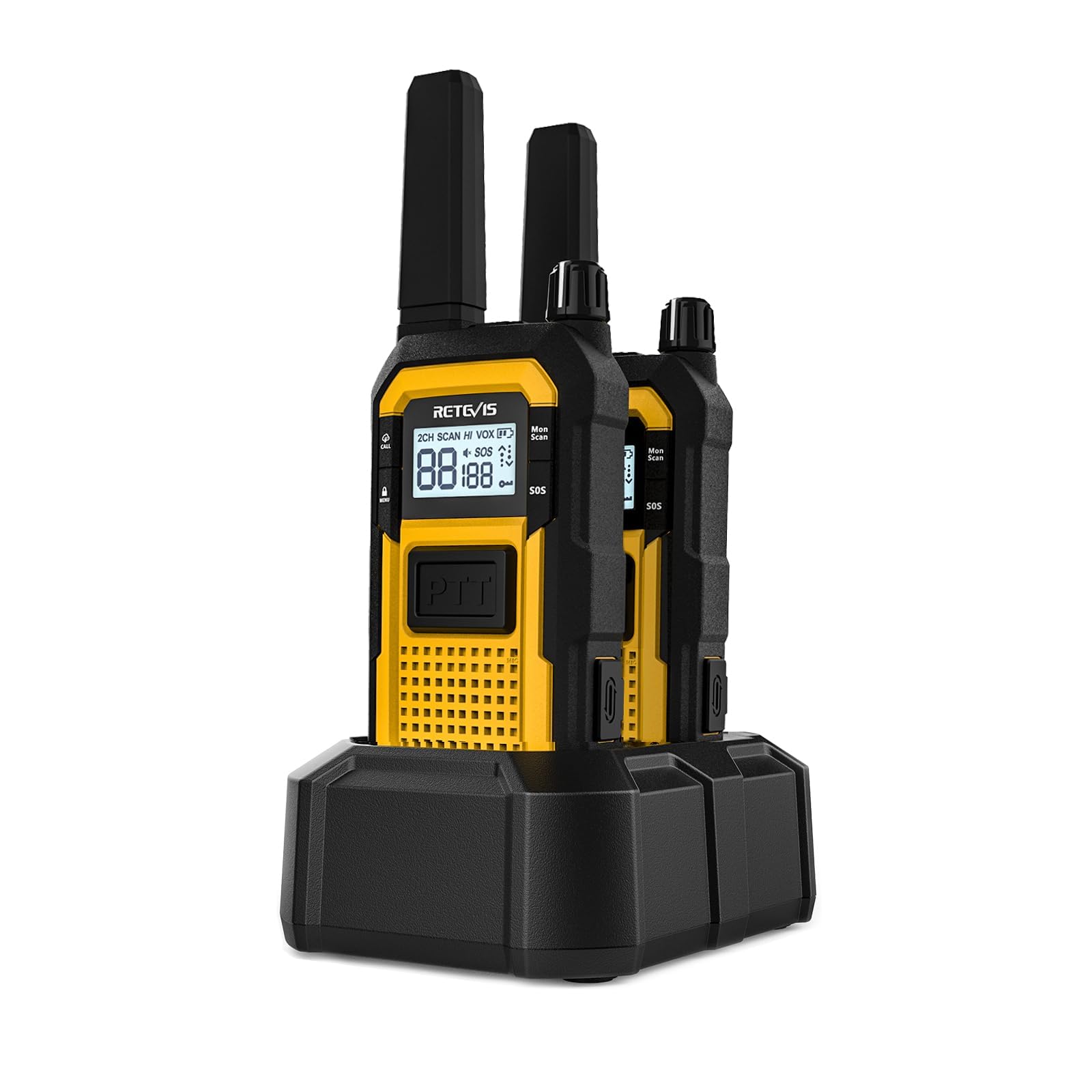
1. Retevis RB48 FRS Walkie Talkies
Our pick — 4.5+★ from 900+ verified ratings; the strongest balance of quality and price.
The yellow tank built to be dropped, dunked, and handed to a gloved hand.
What earns this pair the top slot is MIL-STD-810H, which tests the radio against drops, dust, vibration, heat, and cold. Add IP67 waterproofing and a body the maker says survived 1000 two-meter drops, and you have a radio you can hand to someone in the rain. The bright yellow shell is not a style choice — it is so you can find it in tall grass or on a dark shelf.
On the trail, this pair is rated to cover up to 300,000 sq.ft. and 25 floors of signal range, which suits a hiker who drifts off the back of the group. The battery is a 2000mAh pack rated up to 20 hours, rechargeable by USB-C or the included charging dock. It is built for gloves too: dual PTT buttons on the side, silicone covers over the keys, and an optional roger beep that confirms your transmission finished so you are not left guessing.
Build quality is the most-praised trait of the RB48 by a wide margin, with functionality second. Buyers report clear voice transmission and solid performance for hiking and camping. Most say the range delivers good coverage rather than a straight line you can count on everywhere. Weighing 730 g for the set, the pair runs heavier than the Motorola T210 two-pack at 136 g, so this is a radio you belt-clip rather than pocket. And it needs a license? No — it is FRS, license-free.
What holds up under abuse
- MIL-STD-810H plus IP67 — rated to survive drops, dust, and full water dunking
- 2000mAh battery rated up to 20 hours per charge
- Dual PTT and silicone key covers made for gloved hands
- Bright yellow shell for high visibility
- License-free FRS, so no paperwork to start talking
Where you give something up
- Heavier than a basic household pair — 730 g for the set
- Range still depends on terrain, buildings, and interference
- FRS band means fewer channel options than a ham radio
Reach for this if: you need one radio that will survive mud, rain, and a rough jobsite without quitting.
Look elsewhere if: you want the lightest possible pocket unit for casual family walks — the 730 g set is built for toughness, not pocket carry.
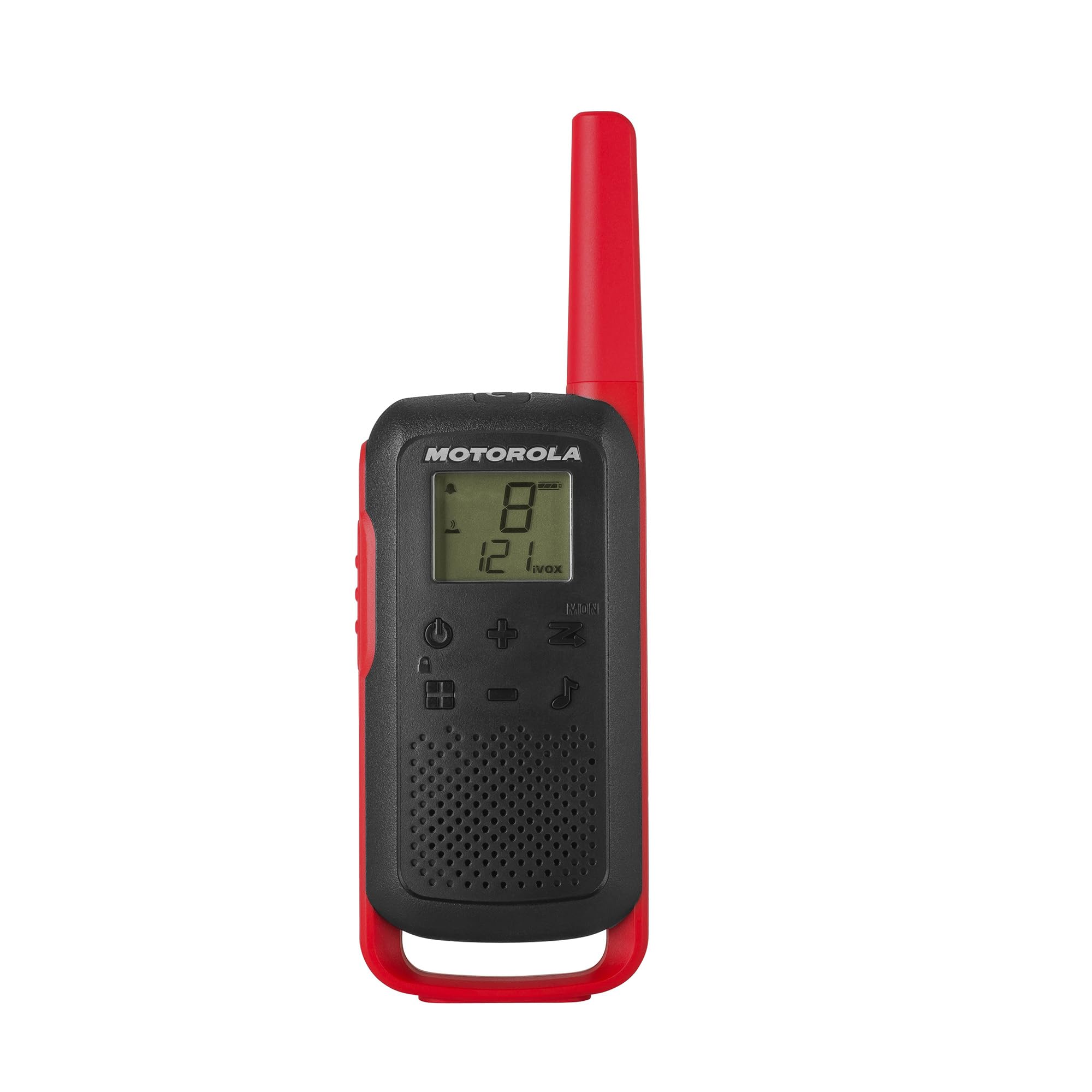
2. Motorola Solutions T210 Two-Way Radio Black W/Red Two-Pack
The featherweight starter pair that talks to any FRS radio on the same channel.
If your first radio is going into a glove box or a kid’s hand, the T210 makes the entry easy. It runs on the standard FRS band (Family Radio Service, license-free), so it will talk to other FRS radios from any brand as long as you land on the same channel and privacy code. You get 22 channels and 121 privacy codes, a backlit display, and easy pairing from the start, plus NOAA weather alerts. The 800mAh battery is rated around 18 hours.
What makes it the lightest in this group by far — 136 g for the pair — is also what makes it a pocket radio rather than a jobsite tool. That is a real advantage for a hiker or a family on a walk, and a real limit on a construction site. Owners praise its solid feel and reliability, reporting it works from a good distance indoors and out. Range is the honest soft spot: some report up to 2 miles, others say it does not reach a mile. Battery follows the same pattern — some see a day and a half, others half a day.
Weighing it fairly, this is a properly good simple radio for the money, not a long-range specialist. The controls are simple enough that setup takes seconds, which is why kids enjoy them and why first-time buyers keep them. Pair it with a spare set of AAA cells and you can keep it running when the rechargeable pack tires out.
The honest bottom line: a light, reliable, easy-to-pair household radio that will not stretch to long open-country range.
The fit note: treat the range figure as a neighborhood-distance radio, not a mountain-ridge one.
Suits you best if: you want a first two-way radio for family outings and quick neighborhood coordination.
Skip past it if: your group spreads across a large property and needs long-range coverage as the priority.
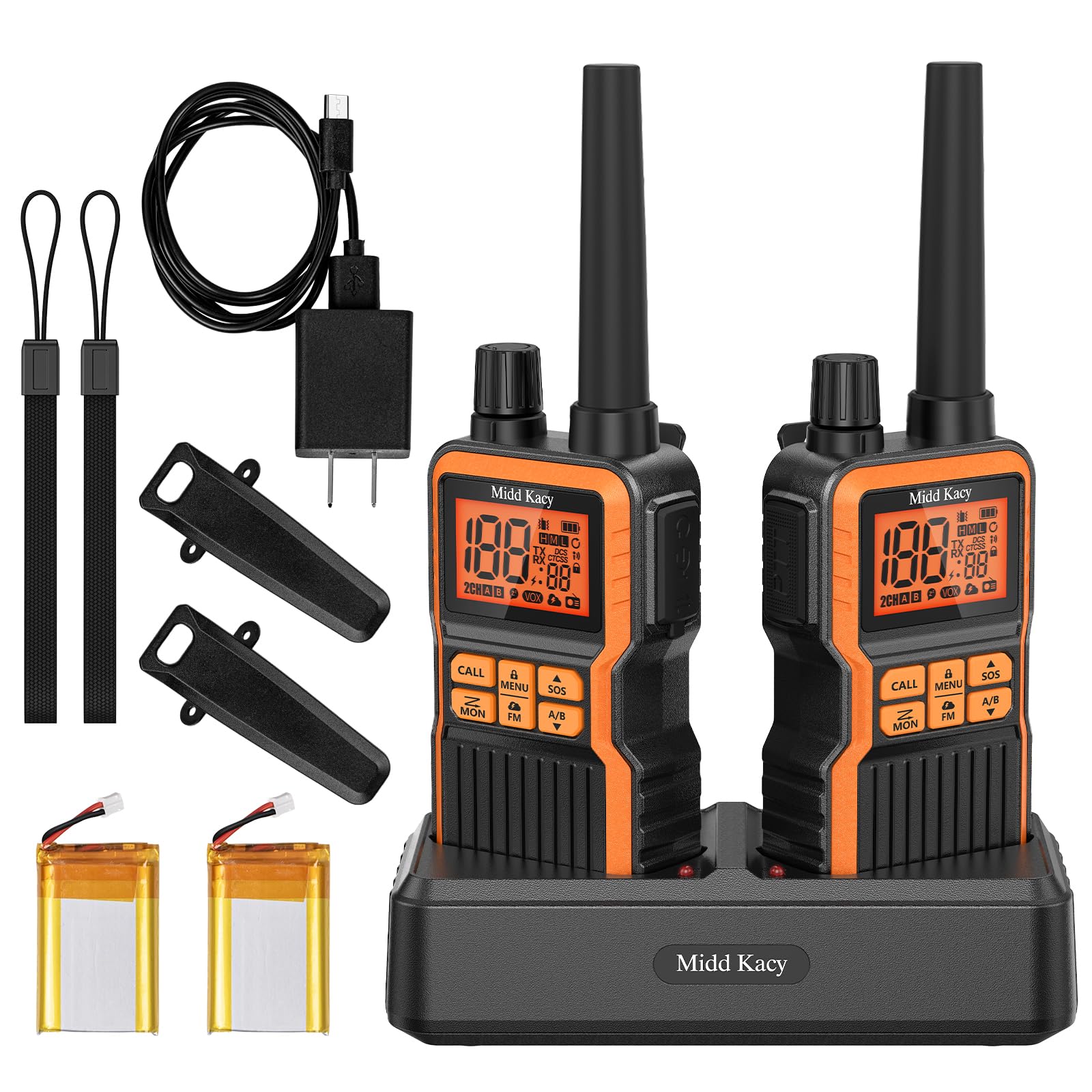
3. Midd Kacy MK108 Walkie Talkies 2 Pack
The campsite radio that keeps a charge for days and packs a weather radio, SOS, and FM tuner.
The standout spec here is the 120-hour battery rating — that is the biggest runtime in this whole group, and it means a weekend camper can leave the charger at home. Each radio carries an 1800mAh lithium-ion pack with up to 60 hours of standby time, and you can top it up by USB-C or the included dual-slot desktop charger. It is a GMRS radio (General Mobile Radio Service) with 60 channels and 121 privacy codes, so check licensing rules before you rely on it for a business. As a camp and family radio, it is very useful.
You get more features than a consumer pair usually carries. Dual watch (it listens on two channels at once) means you can keep the crew channel and a backup open together. VOX hands-free (voice activation, so it transmits when you talk) has nine sensitivity levels, so you can set it to your voice in a noisy cab. There is also a whisper mode for quiet talk, NOAA weather alerts (US official weather warnings), an SOS alarm that signals nearby radios, an FM tuner, a 2.5 mm headphone jack, and an orange backlit display for night use. The housing is rated IP55 (protected against rain, splashes, and dust, but not submersible) and survives 2 m (6.6 ft) drops, so a fumble off a tailgate is not the end of it.
Be realistic about range. The maker claims up to 6 miles open, 5 in suburbs, and 3 in cities, but owners find that optimistic in everyday conditions — a lot of them only manage about a mile. Durability splits too: most say it shrugs off being tossed around, while a few had units quit early. Its strength is quality and value: the features per radio are tough to top in the mid-range.
Feature value: you get weather, SOS, FM, dual watch, and VOX in one radio that runs for a rated 120 hours.
The reality check: treat the mile figures as open-sky best case and plan for city range to be shorter.
Best for: weekend campers and families who want a loaded, long-running radio and do not mind shorter real-world range.
Not the one if: you are coordinating a sprawling search party where maximum reach is the whole point.
4. Baofeng UV-5RM Ham Radio Handheld
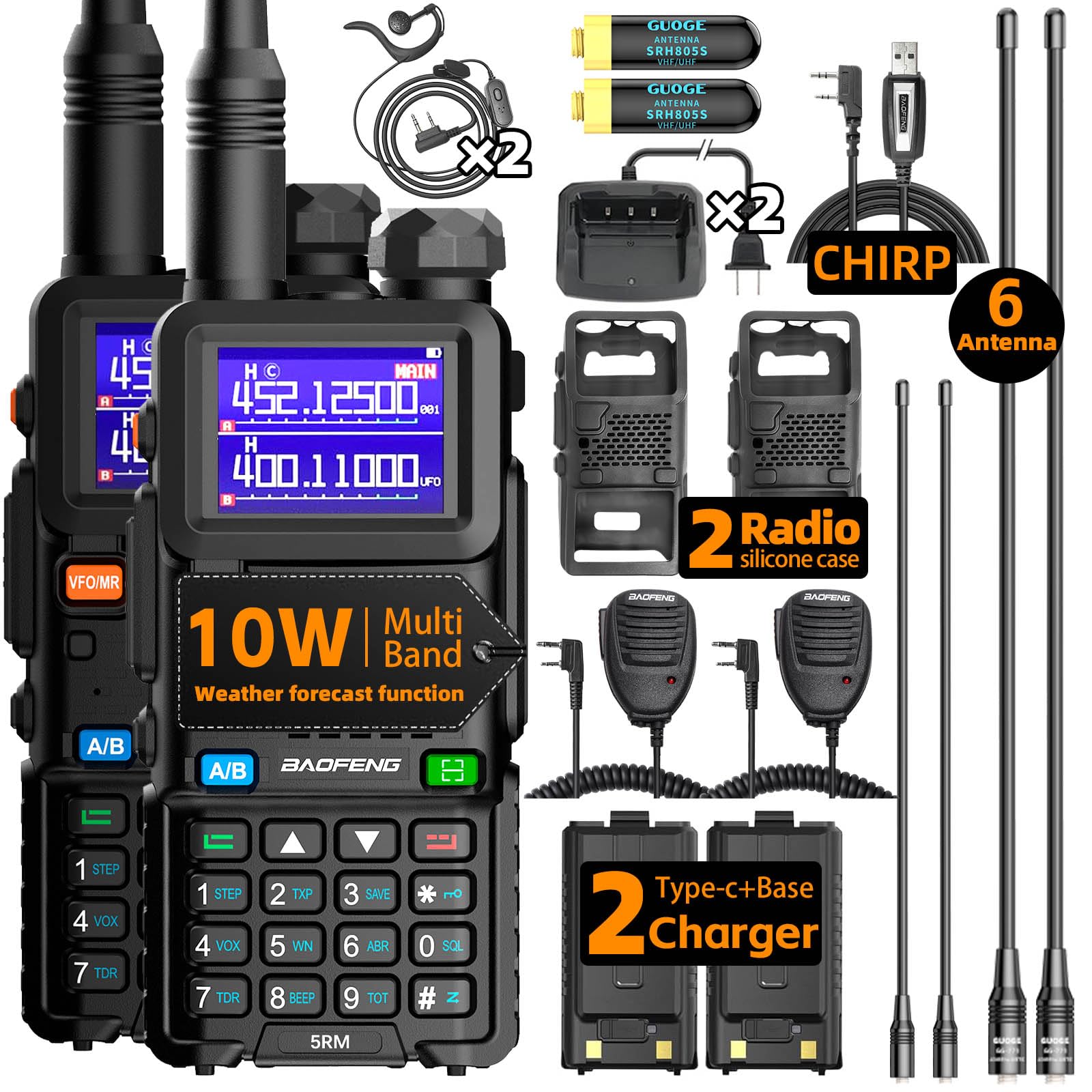
The 999-channel ham handheld for the operator who wants to tune, not just talk.
If you know what a dual-band handheld is, this is the one to look at. The UV-5RM holds 999 memory channels — nearly forty-five times the 22-channel count of the Retevis RB48 — and covers a huge receive range (108-136MHz, 136-174MHz, 220-260MHz, 350-390MHz, 400-520MHz) while transmitting on licensed ham bands (144-148MHz and 420-450MHz). It carries an FCC ID (2AJGM-5RH), which matters if you want a properly certified radio rather than a gray-market one. It also works with CHIRP programming software for frequency management.
Power comes from a 2500mAh battery — the largest capacity in this group and more than triple the Motorola T210’s 800mAH — chargeable by USB-C from a wall outlet, power bank, laptop, or car adapter. The 1.77-inch color display makes channel navigation readable, and the one-touch frequency copy lets you clone settings from another compatible radio without typing in a plan. A NOAA weather receiver adds storm alerts, and each unit ships with a speaker mic and earpiece.
The catch people hit first is the learning curve. Ham-capable radios are not plug-in-and-talk for a beginner, and transmitting outside the license-free bands asks you to hold the right license. That is not a flaw so much as a line in the sand — this radio rewards the operator who puts in a little time learning it.
Why ham users pick it
- 999 channels and wide receive coverage from 108 to 520MHz
- 2500mAh battery, the largest in this group, charged by USB-C
- FCC ID 2AJGM-5RH and CHIRP software support
- NOAA weather receiver plus speaker mic and earpiece in the box
What you take on
- Ham transmitting on 144-148MHz and 420-450MHz needs a license
- Programming is a real skill to learn, not a switch-flip
The match for: licensed ham operators, preppers, and tinkerers who want tuning range and a replaceable-to-full-feature package.
Wrong tool for: a parent who wants to hand a radio to a child and go — start with an FRS pair instead.
5. Motorola Talkabout T475 Two-Way Radio
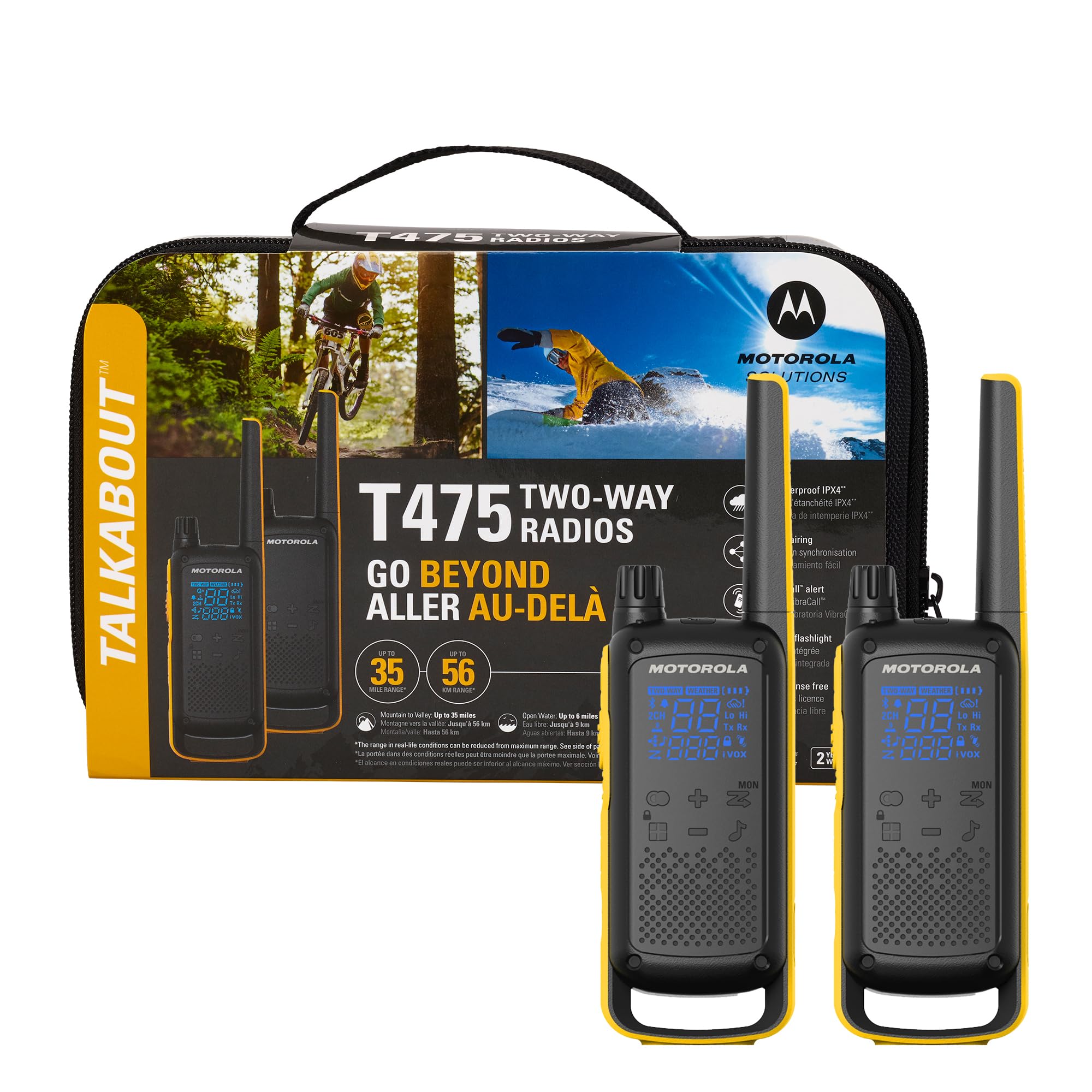
A construction-site radio with a flashlight, a vibration alert, and buttons you can hit in gloves.
When your crew is running saws and hammers, hearing a radio is half the problem. The T475 delivers clear sound that owners say cuts over construction noise, and a VibraCall alert (a vibration instead of a beep) so a silent buzz tells you to check in when you cannot hear the speaker. The 22 channels and 121 privacy codes multiply out to 2,662 channel-and-code combinations, which is plenty to find a clear lane on a busy site. It is FRS, so license-free, and it is rated IPx4 weather-proof for splashes.
The battery is a NiMH 800mAh pack rated up to 12 hours, and you also get dual power — swap to standard cells when the rechargeable pack runs out. The built-in flashlight is a small but real work-day asset. It ships with a carry case, belt clip, earpiece, lanyard, and the charger.
Reliability is the most-discussed topic on this radio, and it splits. Some crews report good performance, while others had units that stopped working early or would not work beyond a short distance. Battery life splits the same way, between all-day and half-day runs. For light to moderate site coordination, where you can fall back on the flashlight and a spare set of cells, it does the job. Just buy it knowing you are picking a well-heard speaker, not a bomber-durable one.
Sound over sawdust: the audio clarity is the part that keeps people talking — a speaker designed to be heard over power tools.
Where it strains: treat reliability as average, and keep spare cells handy because the run time depends heavily on how hard you push it.
Made for: construction and event crews who need audible, vibration-alerted comms near loud machinery.
Overall weaker choice if: you want a radio that will survive full submersion or years of harsh abuse without a hiccup.
6. Gaswei G2pro+ IP67 Waterproof Floating FRS Walkie Talkies
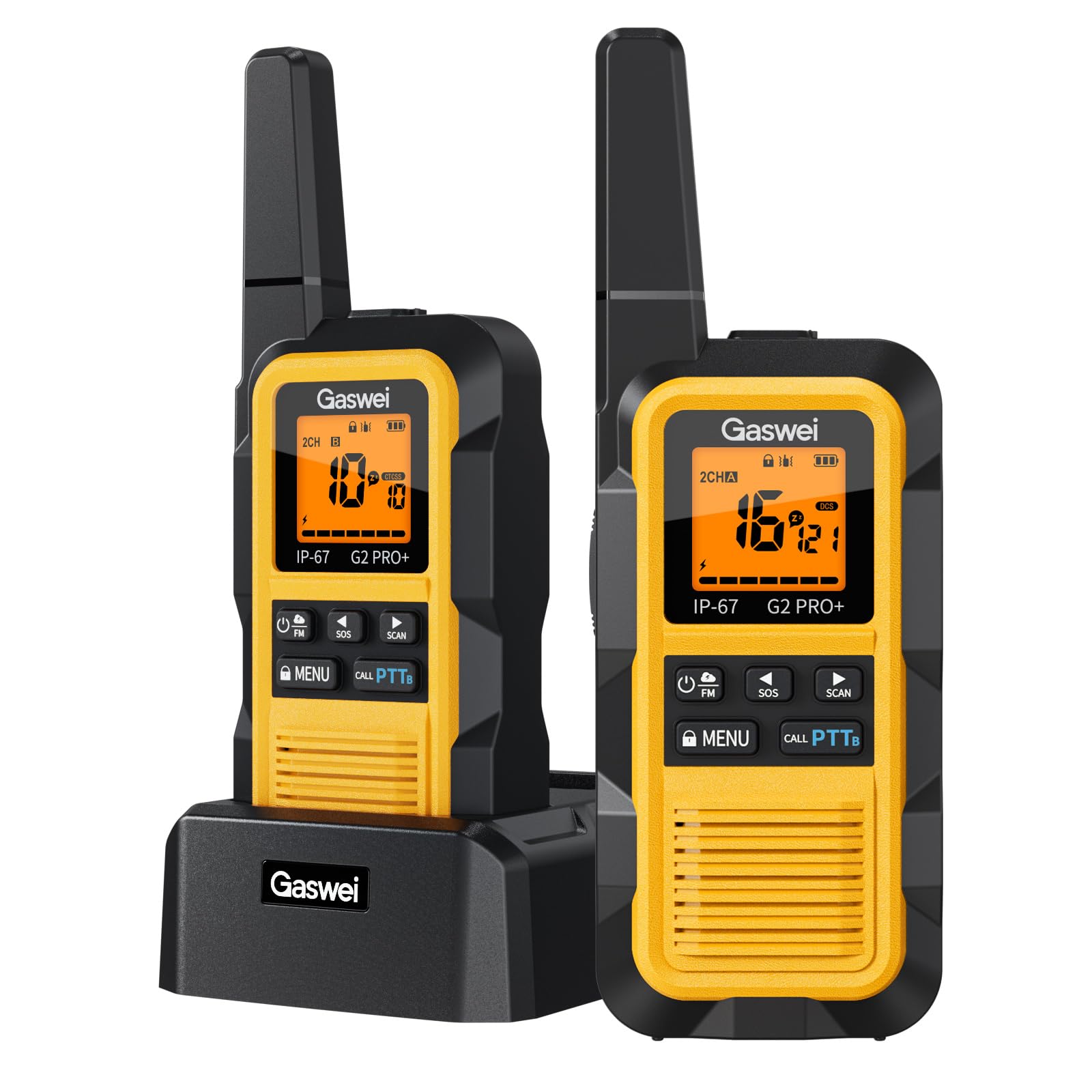
Drop it in the river, and it comes back up still talking.
Most waterproof radios survive the rain; the G2pro+ floats. That IP67 rating means dust-tight and dunk-proof, and the floating design means a fumble over the side of a kayak does not end your communication. If you fish, paddle, or work on the water, this is the spec that matters more than any range claim. Under 2 watts of high power it is rated up to 6 miles or more over open water, 2-4 miles in open areas, 1-3 in neighborhoods, and 0.5-1.5 in urban areas.
It packs an FM radio, VOX hands-free with nine sensitivity levels, a whisper mode, high and low power settings, an SOS alert, vibration reminders, quiet charging, keypad lock, and memory channel scanning. Two PTT buttons and a dual watch mode that runs two channels at once are handy when you are coordinating a group split across water and shore. It is FRS and license-free with 22 channels and 121 privacy codes, and the runtime is rated up to 120 hours.
Range is the honest mixed note here — some owners find it excellent, others say it does not reach far, which tracks with how much water and terrain sit between you. Everything else earns steady praise: build quality is the most-appreciated aspect, with functionality behind it, and owners call it versatile, durable, and good value. At 195 g per unit it is easy to clip on and forget about until you need it.
The water test: an IP67 floating body is the main buying reason here, and it delivers that in spades for boaters and fishermen.
Fair warning on reach: plan your distances around the range figures, not a single number on the box.
The right call if: your radios get wet or go overboard — the floating design is worth the whole price of admission.
Think twice if: your whole route is dry land and range over open country is what you need most.
7. Midland GXT1000VP4 GMRS Two-Way Radios 2 Pack
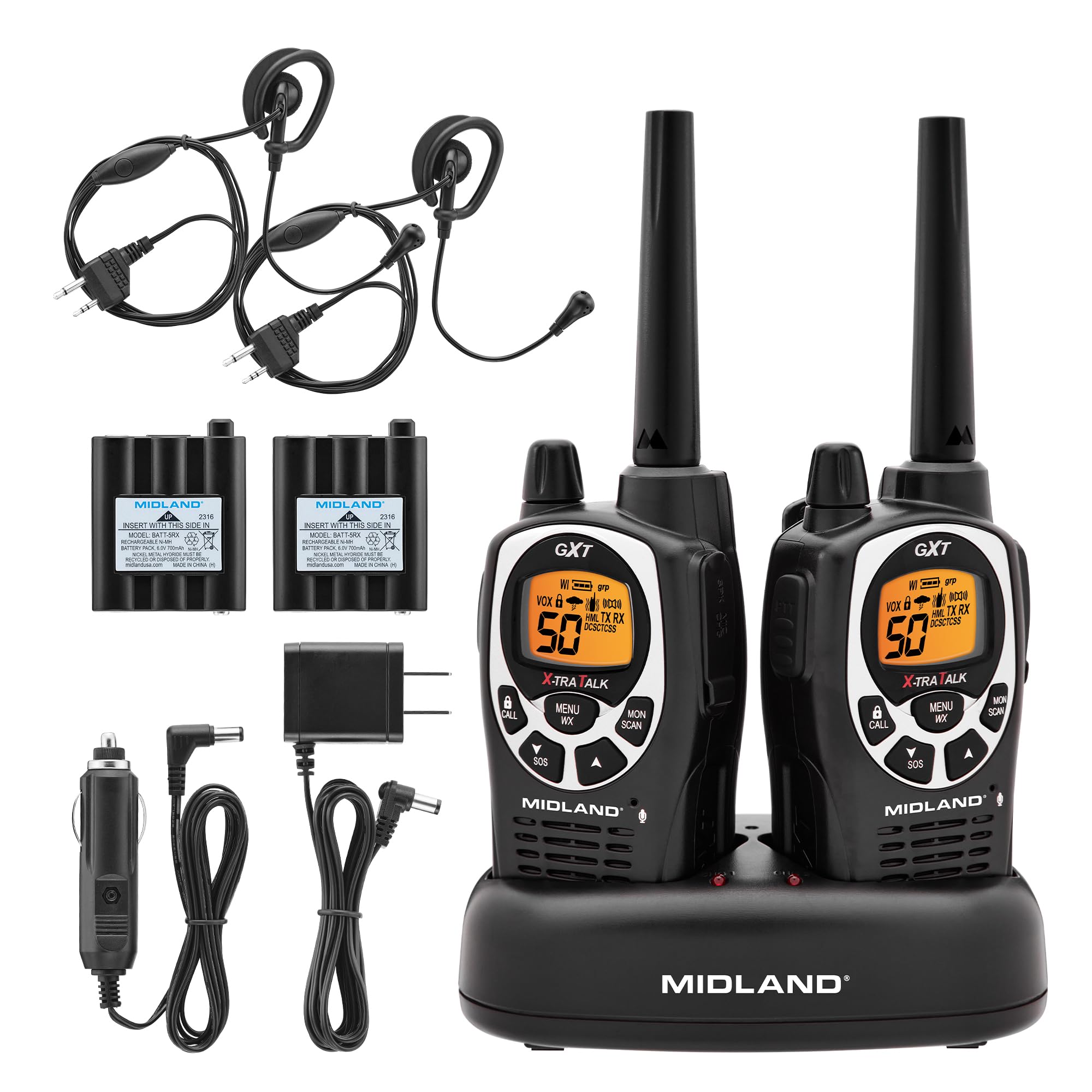
The campground classic with 50 channels and 142 privacy codes to keep your group clear.
Family camping and overlanding setups keep reaching for this radio because 50 channels and 142 privacy codes (sub-channels that filter out other talk) give you plenty of room to route around other users. The GMRS band (General Mobile Radio Service, a licensed US band) is designed for longer outdoor runs than a bare FRS pair (Family Radio Service, the license-free band). It earned a large following over many years, and the sheer volume of feedback makes it the most-reviewed radio here by a wide margin, so the consensus is well tested. Its 462-467 MHz range is the same FRS/GMRS territory the other radios in this list use.
Midland packs in practical features. EVOX hands-free voice activation lets you talk with your hands on the wheel. A NOAA weather scan sounds an alert before a storm rolls in, and there is an SOS siren, keypad lock, vibrate mode, and ten call tones. The body is JIS4 water-resistant (a Japanese standard for splashes, not a dunking). It runs on rechargeable NiMH packs (nickel-metal hydride, a rechargeable battery type) and a desktop charger, with dual-power mode so you can switch to standard AA cells when the charge runs down. Each unit is rated at roughly 10 hours of battery.
Where it deserves a caveat: range and battery are the two topics that split most among owners, with some reporting very good distance and others finding it short of the marketing claim. Durability is a similar story, mostly holding up well but with a handful reporting early failures. The honest read is that the GXT1000VP4 is a proven, feature-rich long-range radio for recreational use — not a guaranteed-by-the-numbers one.
What you are buying: the most widely used, most feature-complete recreational radio on this list, with headsets included and AA backup power.
The honest trade-off: real-world range varies more than the brochure suggests, and a few units have not lasted the distance.
Consider it for: family camping, ski trips, and road trips where you want deep channel choice and headset-ready hands-free talk.
Look past it if: you need a radio you can entirely trust on a paid crew all day — the durability report is mixed.
8. Retevis RT22S Walkie Talkies
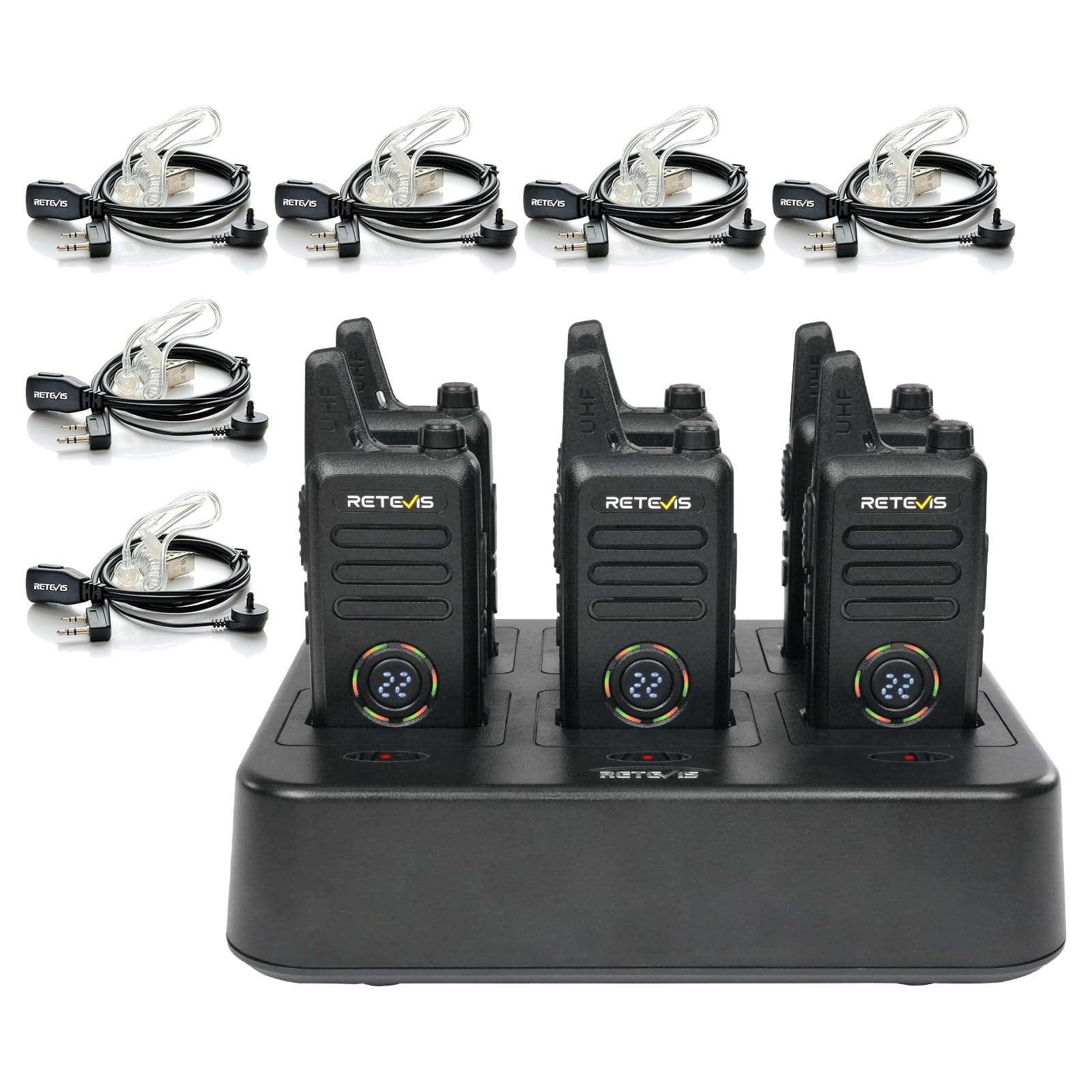
Six radios, six headsets, one six-slot gang charger — a small crew’s kit in one box.
For a hotel front desk, a retail floor, or a school staff, the practical problem is outfitting six people at once. The RT22S solves that with a six-radio bundle that includes six acoustic-tube earpieces, six 1000mAh cold-resistant batteries, and a six-way multi-gang charger with overcharge, over-voltage, and short-circuit protection. The radios are 22-channel FRS and license-free, and a channel display shows the active channel with a flashing indicator light so you know when a signal is coming in. There is also a hidden shatterproof display.
Each radio is compact enough to pocket or clip on a belt, and the earpiece and mic set with a finger PTT button lets staff talk hands-free without the whole lobby hearing the reply. The battery is rated at 10 hours, and a power-saving function stretches it. What owners notice most is build quality, followed by how well the units perform day to day — they call these good quality, easy to set up, and worth the price.
Two caveats matter before you buy. Sound through the headsets is the split point — some find it clear, others find it faint. And the radios only work with other RT22-family units on channels 1-5, not every Retevis out there. If you are standardizing a whole staff on one setup, that compatibility detail matters. Standardize on the RT22S family and you are fine.
The small-crew advantage
- Six radios, six earpieces, and a gang charger in one bundle
- 1000mAh cold-resistant battery per unit, rated 10 hours
- License-free 22-channel FRS with a channel display
- Compact and pocketable for hospitality and retail staff
Worth checking first
- Headset audio is a mixed experience — some find it faint
- Only talks to the RT22 family on channels 1-5, not all Retevis units
Made for: hotels, schools, and retail crews that need six radios, headsets, and one charging station ready to go.
Not for: a mixed-brand radio fleet where cross-compatibility across every unit is a requirement.
9. SAMCOM FPCN30A Two Way Radio 6 Pack

The six-radio UHF pack with a group-call button made for coordinating a whole crew.
This one is built for teams, not families. The standout is the dual PTT design: a side button for your main channel and a dedicated GROUP button that reaches every configured radio even when their main channel numbers differ. That is how you wrangle a warehouse, a construction site, or event security staff who all need to hear one announcement. The radios are 5W UHF (ultra-high frequency) on a 406.1MHz-470MHz range, with 20 channels programmable by PC. Because they are UHF business radios, operating one typically requires an appropriate license in the US — check your local rules before you deploy them.
The build is heavy-duty: a rugged housing that resists drops, dust, scuffs, and scrapes, rated weather-proof and rainproof. Each of the six units carries a 1500mAh battery rated 24 hours, and the pack ships with a long 6.7-inch antenna, a K-type earpiece, a dock charger, and a pre-assembled belt clip for every radio. It is designed for construction, factory, hotel, school, church, and event crews.
The reputation here is strong — quality and reliability are what owners praise most, describing radios that work well at various ranges with no problems. Battery life earns its own respect, with several noting it charges quickly and lasts all day, and the audio draws comparisons to a clear bell. One practical thing to know: the maker updated the frequency of this model, so if you need it to talk to older units in your fleet, there is a provided method to reset the version. Plan that step once and you are set.
Why crews standardize on it: a group-call button plus PC programming makes a six-person operation manageable from day one.
The fine print: UHF operation generally needs a license, and older-fleet compatibility may need a version reset — do a quick compatibility check before ordering a large batch.
Right fit for: construction, security, and facility managers who need six matched UHF radios with a group-call feature.
Wrong pick if: you want a license-free radio for casual family use — this is a business tool, not a weekend toy.
Know the Specs
Channels and Privacy Codes
A channel is the frequency lane your radio transmits on. More channels means more lanes to spread a big group across, and privacy codes are sub-filters that mute anyone not using your code. A 22-channel, 121-code radio gives the standard FRS set; a 50-channel, 142-code radio gives you noticeably more room on a busy campsite. A 999-channel ham radio covers a different job entirely — wide scanning and tuning rather than simple group talk.
Wattage and Range
Wattage is the radio’s transmit power, and higher wattage generally pushes a signal further — the SAMCOM sits at 5W, the Gaswei lists 2W. But power is only part of the story. Hills, buildings, metal structures, and interference all cut range, which is why a radio rated for miles on open water can fade to a fraction of that inside a warehouse. Read range figures as best-case conditions, then plan for less.
IP Ratings and Durability
An IP rating is a two-digit standard for dust and water protection. IP67 means dust-tight and safe to dunk briefly; IPx4 means splash-resistant only; IP55 means partial dust protection and water jets. A MIL-STD-810H badge is a separate military durability test suite covering drops, temperature swings, vibration, and more. If you work outdoors or on water, a higher IP number is worth prioritizing.
Battery Capacity vs. Rating
Battery capacity in mAh tells you how much charge is stored — a 2500mAh pack holds more than an 800mAH one. Rated runtime in hours tells you how long a manufacturer expects it to last under typical use. Neither number guarantees how long you will get, because heavy transmitting drains faster. A dual-power radio that also accepts standard AA or AAA cells gives you a backup lane when the rechargeable pack dies mid-shift.
Common Questions
Do I need a license to use a two way radio?
Will a two way radio really reach the miles printed on the box?
Can two way radios from different brands talk to each other?
How long will a walkie talkie battery actually last?
What does IP67 mean and do I need it?
Is a GMRS radio better than an FRS radio?
How many radios do I need for a team or job site?
Can a two way radio survive a drop or a dunk?
What is the difference between 2W and 5W radios?
Can I program a two way radio to use specific frequencies?
The Bottom Line
For most people, the two way radio that earns the top spot is the Retevis RB48. It pairs MIL-STD-810H and IP67 durability (IP67 means it survives dust and a dunk in water) with a rated 20-hour battery and glove-friendly controls — the rare radio built to be used, not babied. If your world gets wet, grab the Gaswei G2pro+, whose floating IP67 design survives going overboard. For a paid crew of six needing group-call coordination, reach for the SAMCOM FPCN30A. The strongest nudge here is the Retevis RB48’s durability-to-runtime balance — that MIL-STD-810H build is the reason to make it your first radio rather than your third.
How we choose
We do not accept paid placement. Every pick is matched to a real buyer and a real use-case; we do not hands-on test units.
Sources
Specifications: manufacturer listings and product documentation. Review insights: verified customer reviews, as of November 2026. Pricing: not shown on this page (it changes often); check the current price via the retailer link.
As an Amazon Associate, Tactical Gear Guy earns from qualifying purchases. This does not affect which products we feature.