Specs are compiled from manufacturer listings and verified buyer reviews and can change over time — please confirm the key details on the product page before buying.
The hard part of buying a two-story rabbit hutch is not the price — it is the wood. Nearly every listing promises fir panels and a ramp, then the panels split at the screw holes or the tray jams after a month of bedding. What you actually need is a hutch whose upper floor holds your rabbit’s weight, whose ramp has a real anti-slip surface, and whose tray slides out without a fight. This guide breaks down those three things across ten two-story hutches, using each maker’s published specs and what the buyer feedback consistently shows. The crowd favorite of the group, the GDLF 62-inch, carries 4.0+ stars across 700+ ratings, and it earns the top slot on the strength of its tray design.
This guide is built by comparing the manufacturers’ published specifications and the patterns across verified customer reviews, so you get each pick’s real strengths and trade-offs instead of marketing spin.
Size is the second trap. A hutch labeled “large” can mean 62 inches of length or 29 inches of length, and that difference decides whether your rabbit can actually hop between levels. Below you will find the real measurements, the door counts, the ramp design, and the honest limits of each model so you can match one to the space you have. The right pick here is the best two story rabbit hutch for your animal, your yard, and how much cleaning you want to do.
Top Picks

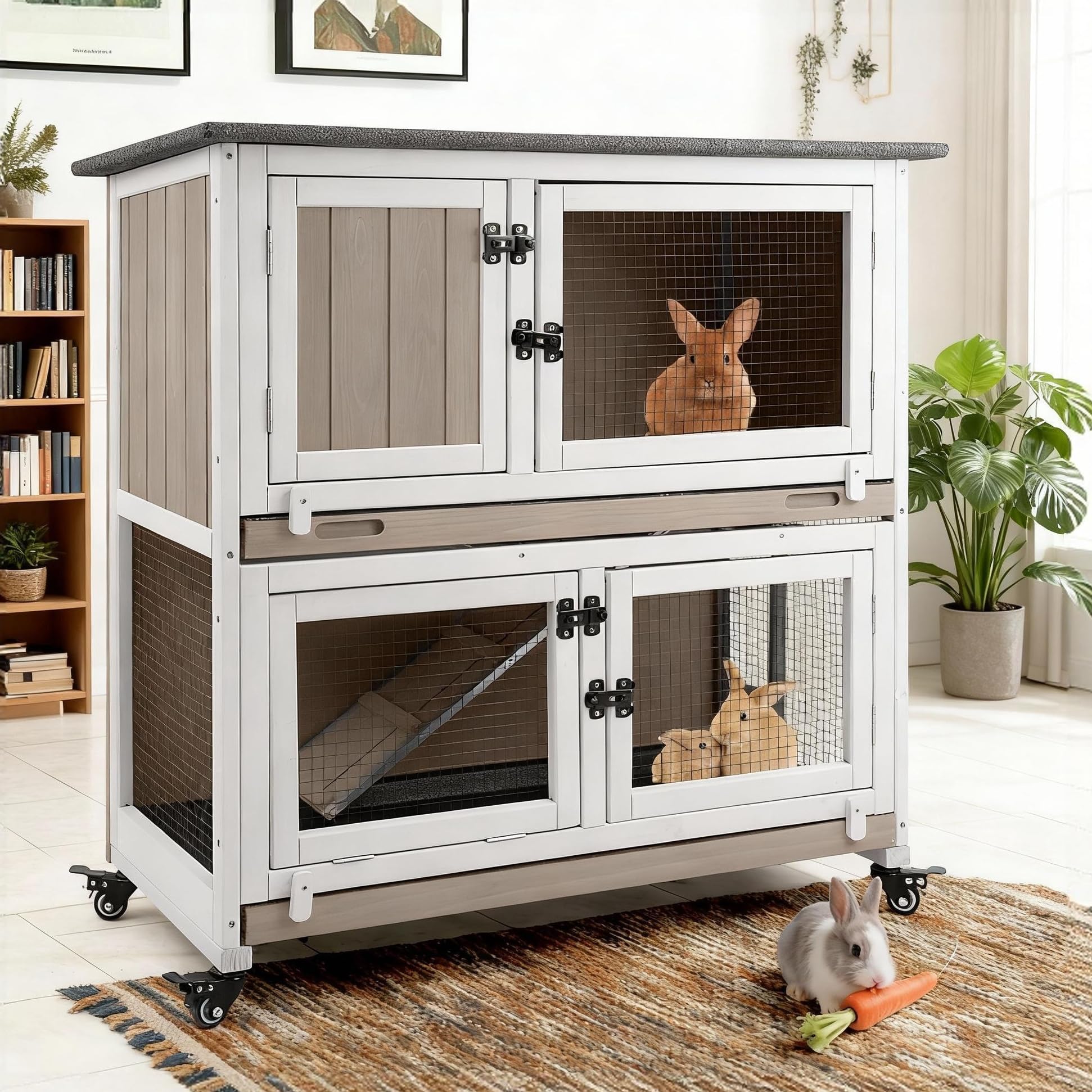
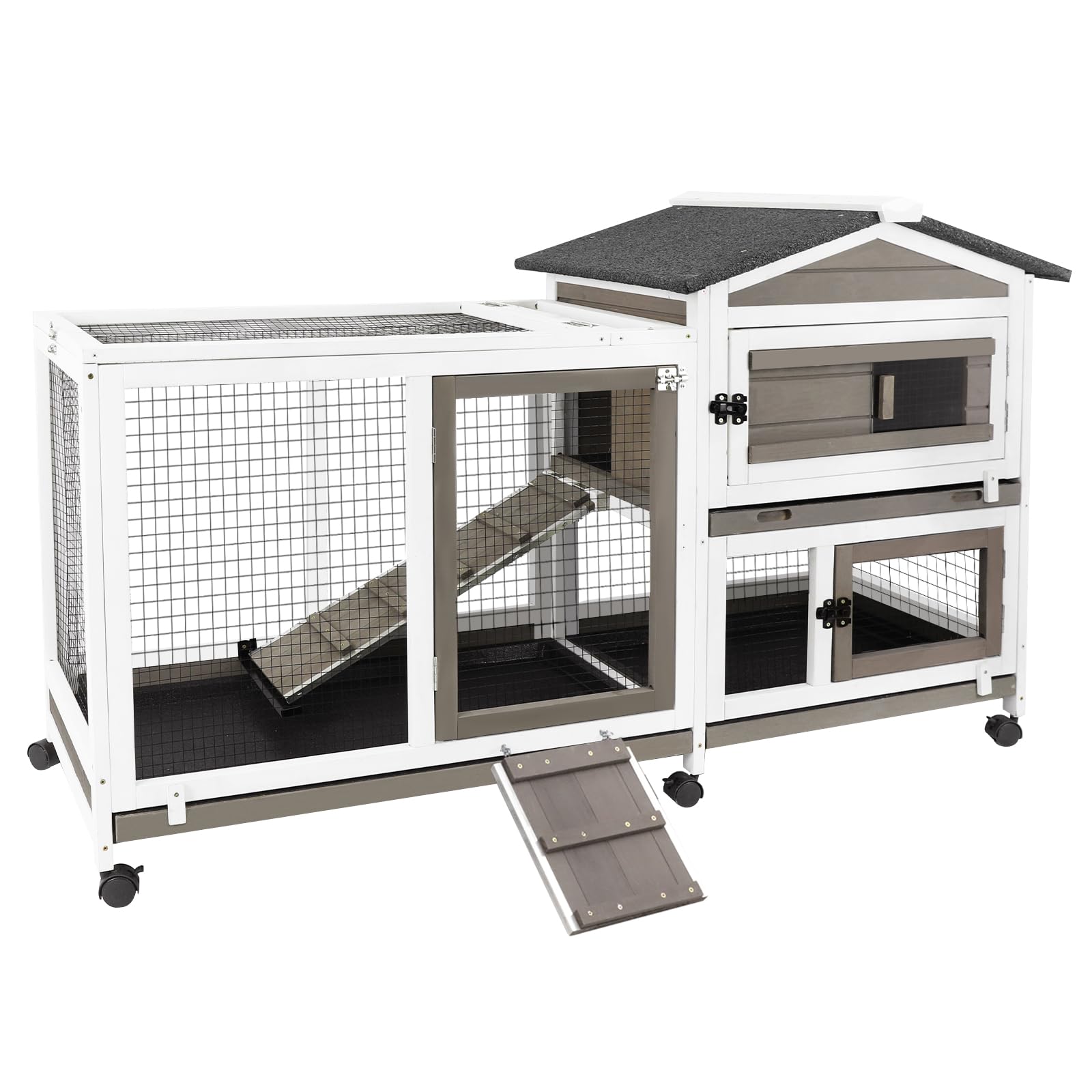
How To Choose The Best Two Story Rabbit Hutch
A two-story hutch only works if both floors get used. That means the ramp has to be climbable, the upper floor has to be big enough to turn around in, and the whole thing has to stay dry enough that the lower level does not become a swamp. Work through these four points before you pick a model.
Ramp grip and ramp angle come first
A smooth wooden ramp on a steep angle is the most common reason a rabbit refuses the top floor. Look for ridges, a textured surface, or metal-guarded edges along the ramp. The GDLF uses timber ridges above its ramp to keep feet from slipping backward, and the GUTINNEEN AIR19-X line adds full-length metal edges that also block gnawing. If the ramp is bare plywood, expect to add grip strips yourself.
Wood material and chew protection
Fir is the standard for these hutches, and it holds up when it is thick and sealed. Thinner panels split at the screw holes during assembly, which is the complaint that shows up most across the category. Two things help: a painted or water-based finish that seals the grain, and metal edging on the parts a rabbit can reach. The Aivituvin model goes a different route with aluminum alloy framing, which resists chewing differently than bare wood does.
Trays, doors, and how much you will actually clean
A deep pull-out tray is the single biggest time saver on a two-level hutch. One tray means you lift the animal out to reach the corners; two or three trays means you slide each level clean on its own. Check the door count too. A hutch with four or five access doors lets you reach every corner without contorting your arm through one opening.
Wheels, roof, and where it can live
Locking casters let you roll the hutch onto a patio for cleaning and back under cover for weather. An asphalt or composite roof over the run area keeps rain out of the lower level, which matters far more on a two-story design than on a single-level one. If the hutch will sit outdoors year-round, the roof and the waterproof finish on the wood are not optional extras.
Side-by-Side Comparison
| Model | Best For | Overall Size (L x W x H) | Levels / Doors | Weight | Amazon |
|---|---|---|---|---|---|
| GDLF 62″ Rabbit Hutch★ Best Overall | Best all-round two-story hutch | 62″ x 21″ x 37″ | 2 levels / 3 doors | 49.7 lb | Amazon |
| Mayugardening 2 Story Hutch with WheelsEasiest to Move | Rolling it around the yard | 36″ x 17.8″ x 36.7″ | 2 levels / multiple doors | 31.5 lb | Amazon |
| PetsCosset 55.3″ Outdoor Bunny HutchBest Run Access | Indoor and outdoor use | 54.98″ x 17.5″ x 34.4″ | 2 levels / 4 doors | — | Amazon |
| Aivituvin 2-Story Hutch with Stand | Chewers and gnawers | 36.6″ x 19.6″ x 36.6″ | 2 levels / side door | — | Amazon |
| GUTINNEEN Large 2-Story Hutch | Multi-rabbit households | 62″ x 22.6″ x 33.5″ | 2 levels / 5 doors | — | Amazon |
| PawHut 54″ 2-Story Hutch | Compact footprint indoors | 53.75″ x 19.75″ x 36.5″ | 2 levels / multiple doors | 44.8 lb | Amazon |
| GUTINNEEN Bunny Cage on Casters | Long runs and big spaces | 93.7″ x 22.6″ x 33.5″ | 2 levels / 2 doors | — | Amazon |
| Joyqinchen Wooden Two-Story Hutch | Budget start with a stand | 19.6″ x 36.6″ x 36.6″ | Two-story / removable stand | — | Amazon |
| AMZOSS 2-Story Guinea Pig Cage | Small animals on a tight budget | 29.25″ x 15.75″ x 28.5″ | 2 levels / 2 doors | 19.5 lb | Amazon |
| TRIXIE natura Deluxe Hutch with Run | Maximum run space outdoors | 44.1″ x 45.3″ x 53.1″ | 2 levels / multiple doors | 110 lb | Amazon |
Detailed Reviews
1. GDLF 62″ Rabbit Hutch
Our pick — 4.0+★ from 750+ verified ratings; the strongest balance of quality and price.
The hutch that gives a rabbit a genuine second floor instead of a shelf.
Start with the footprint, because it is where this one separates. At 62 inches long, 21 inches wide, and 37 inches tall, the GDLF is more than twice the length of the compact AMZOSS two-story cage and roughly twice its width as well. That length is what lets the upper house — 27.5 inches by 18 inches by 20.5 inches — sit above a real run area rather than above a sliver of floor. For two to three rabbits or three to four guinea pigs, this is the size class that stops the pacing.
Daily cleaning gets easier because the access design solves the usual frustration. You get three doors total, including a 7-inch by 6-inch stair door at the ramp, and a removable bottom tray that slides out on its own. A grid door on the front lets you watch your rabbit without opening anything. The pitched roof keeps the run area usable in rain instead of turning it into a wet patch. The fir frame wins people over most: the panels are sealed with a waterproof non-toxic varnish, and that finish is the difference between a hutch that survives a wet autumn and one that swells.
The wood is fir, and fir splits if you over-tighten the screws during assembly — run them down snug, not hard, and the panels hold. Some owners also find the tray channel needs bedding swept out before it will slide cleanly. Neither is a design flaw so much as maintenance the hutch asks for. The plastic tray upgrade is note for anyone who has fought a rusty metal tray on an older cage.
Where it earns its keep
- 62-inch length gives both levels real room for two to three rabbits
- Upper house at 27.5 x 18 x 20.5 inches is a true sleeping chamber, not a ledge
- Sliding removable tray plus three doors keeps cleaning quick
- Pitched roof keeps the run usable in rain
- Waterproof, non-toxic varnish finish on the fir frame
What to plan around
- Fir panels can split if screws are overtightened during assembly
- Bedding has to be cleared from the tray channel before it slides
- At 49.7 pounds it is a two-person lift before assembly
Worth it for: anyone housing two or more rabbits who wants the upper floor to be a real room.
Think twice if: you want a hutch you can roll around — this one sits where you put it.
2. 2 Story Rabbit Hutch
Two trays, four wheels, and a chew strip on the edge — built for the person who moves the cage weekly.
Most two-story hutches are furniture: you pick a spot and they stay there. This Mayugardening model brings four locking casters to the party, so the whole cage rolls out to the patio for a hose-down and rolls back under cover. It is also the lightest of the larger models here at 31.5 pounds — noticeably lighter than the GDLF’s 49.7 pounds — which makes the roll and the reposition easy on one person.
The cleaning setup is the other reason to look here. Two deep slide-out trays, one per level, mean you are not reaching through a top door to scrape the lower floor. The open-and-wipe, pull-the-tray, clean-the-corners routine is genuinely three steps. The metal strip along the chew-prone edge is a small thing that saves a larger repair, and the gentle ramp is shaped so a rabbit can climb without a hop.
The trade-off is assembly temperament. The wood here can crack and split if the panels are forced, and the instructions are not the clearest in the category. Set aside a calm hour, keep a drill on low torque, and dry-fit each panel before you drive screws. Do that and the quality of the finished cage is what stands out — the frame comes together square and the trays line up.
Rolling habitat, small footprint: this is a tower rather than a long run at 36 inches long by 17.8 wide by 36.7 tall, so it fits a corner of a room or a covered porch better than a big garden run.
Fit check: the leak-proof trays and locking wheels are the standout features; the build is solid once assembled, but the assembly itself is the part that asks for patience.
Reach for this if: the hutch needs to move between indoors and out on a weekly rhythm.
Look elsewhere if: you want a long ground-level run for a pair of rabbits to stretch out in.
3. 55.3″ W 2 Story Bunny Hutch
Four doors, a full run below, and acrylic windows so you can watch without opening anything.
Four access doors on one hutch is the detail that stands out. It beats the two-door AMZOSS cage and matches the five-door GUTINNEEN, and it means you can reach the sleeping area, the run, and both trays without dragging the animal out first. The layout is the classic split: a large ground-level run for sunshine and movement, an upper room for sleeping, connected by an anti-slip ramp.
The run gets full-coverage waterproof asphalt roofing on both the sleep area and the play area. That is a step beyond a single peaked roof, because the lower level — the part closest to wet ground — is the one that actually needs protecting. The tray is deeper than average and locking, so it will not slide open on its own when the hutch is nudged. Feeding and interaction happen through the mesh-covered sides, which double as ventilation and predator protection.
Check the measurements closely before you buy. The listing title says 55.3 inches, but the specs list 54.98 inches long by 17.5 wide by 34.4 tall — the narrower width is the one that matters, because it limits how much turning room the run gives a larger rabbit. The maker specs it for two to three rabbits. Assembly is a genuine two-person job and takes roughly 60 minutes with the pre-drilled holes and numbered parts. A few builds arrive with a caster working loose, so check the wheels after the first week.
What the run buys you: an upper sleeping chamber and a lower play yard connected by an anti-slip ramp, with four doors giving access to all of it.
The one number to weigh: 17.5 inches of width is snug for a big breed — fine for bunnies and guinea pigs, tight for a large rabbit.
Its balance: a pair of rabbits kept mostly outdoors that need shade and shelter in the same footprint.
The honest limit: that narrower width means a large-breed rabbit will feel the walls.
4. Aivituvin 2-Story Rabbit Hutch
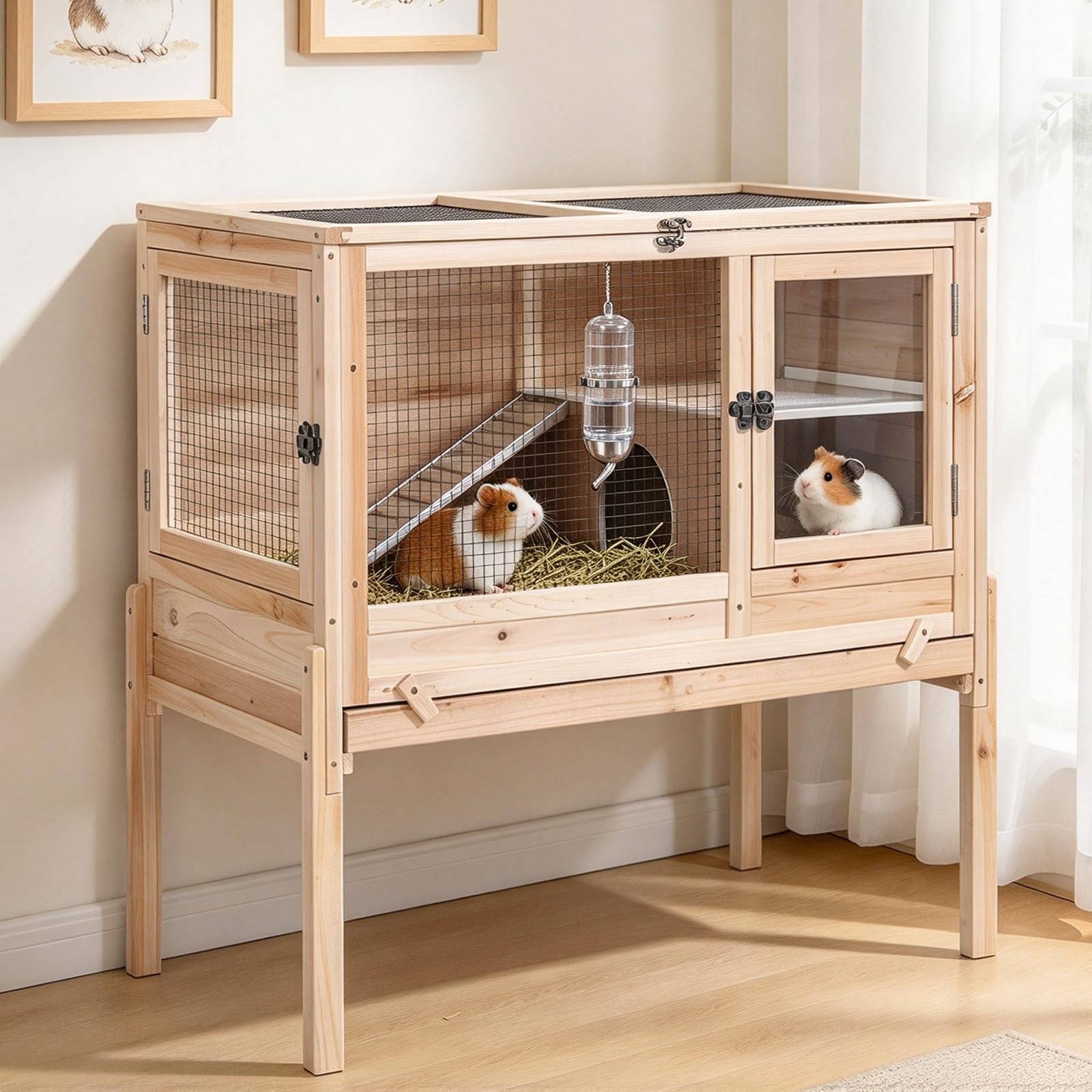
The one that swaps wood framing for aluminum where a rabbit’s teeth actually land.
If your current hutch has chewed corners, this is the model to study. Aivituvin builds the frame from aluminum alloy rather than relying on wood alone, and aluminum does not give a rabbit the satisfying splinter a fir panel does. That is a different anti-chew approach than the metal edge strip on the Mayugardening cage — this one changes the material of the structure itself. For a determined chewer, that is the more meaningful protection.
The layout is a 2-in-1 multi-level design with dedicated zones for sleeping, eating, and toileting, plus a large upper play area. Overall size is 36.6 inches long by 19.6 wide by 36.6 tall. The maker specs it for one rabbit or one to two small pets, so this is a single-animal habitat with vertical room rather than a multi-rabbit run. The deep removable tray pairs with a side door, and the maker includes PVC panels alongside galvanized wire panels — the wire goes on in summer for airflow, the PVC goes on for daily use and easier wipe-downs.
What holds this one back is sturdiness consistency. The frame earns praise for how it goes together and how it looks, and the assembly instructions are clear. But the wood components can crack if a panel is stressed, and the sturdiness record is genuinely split between owners who find it solid and owners who do not. Treat the panels gently during assembly and this is a good indoor cage for one bunny. Expect it to need occasional re-tightening over a season.
Standout design choices
- Aluminum alloy framing resists chewing at the structure, not just the edges
- Three separate functional zones keep sleep, food, and toilet apart
- Galvanized wire for summer airflow plus PVC panels for daily use
- Deep removable tray with a side door for quick cleans
- Clear instructions and a design that looks good in a living space
Know before you buy
- Wood components can crack if panels are stressed during assembly
- Sturdiness is genuinely inconsistent between units
- Spec’d for one rabbit or one to two small pets — not a multi-rabbit run
The pick for: a single rabbit with a chewing habit, kept indoors where the stand and finish matter.
Not the pick for: a bonded pair, since the 36.6-inch length is a one-animal footprint.
5. GUTINNEEN Large 2-Story Rabbit Hutch
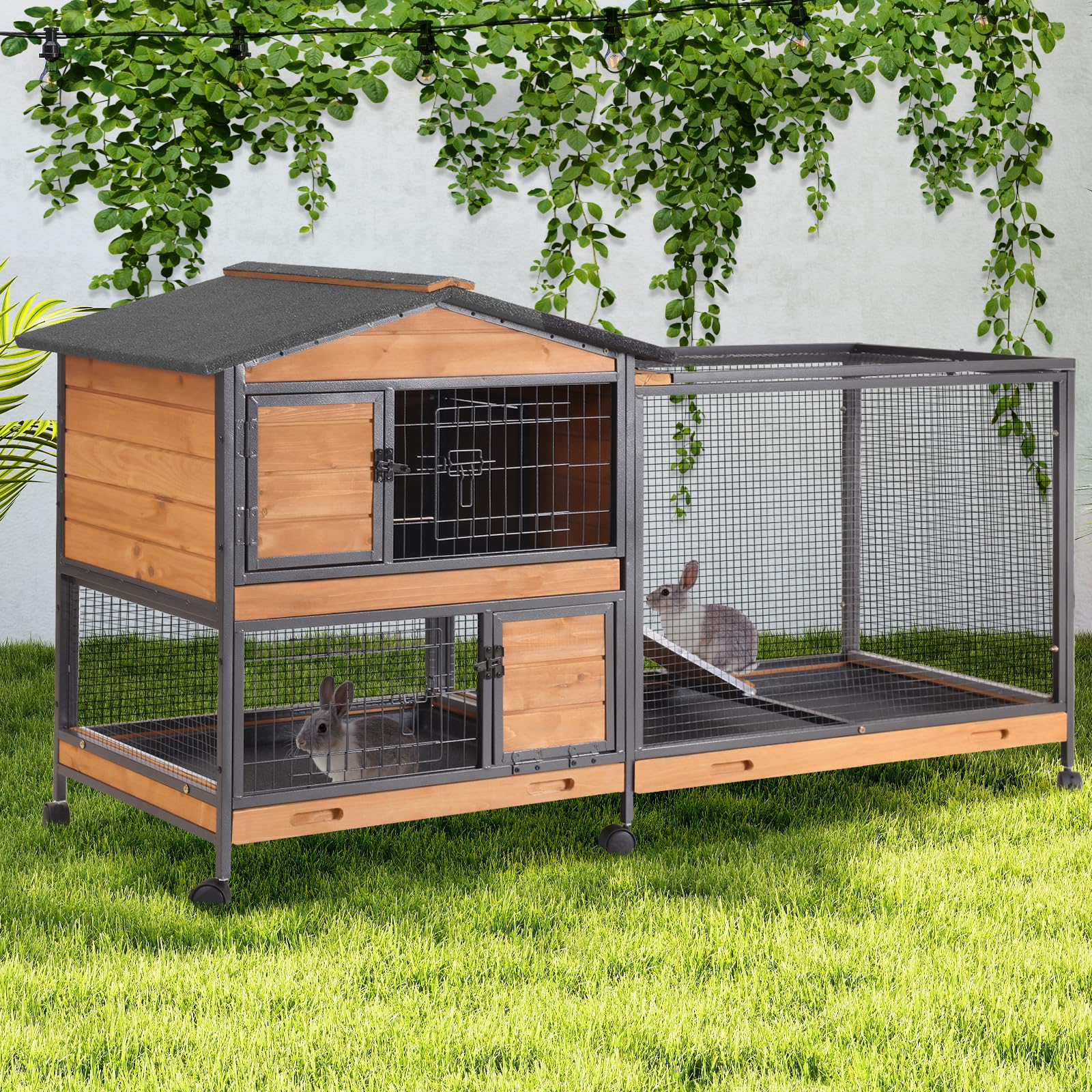
Five doors, three trays, and six wheels — the most over-equipped hutch in this group.
The spec sheet reads like someone tried to solve every hutch complaint at once. Five access doors plus an openable run roof, three individual deep pull-out trays with locking design, six swivel casters with two safety brakes, and a chew-resistant ramp with full-length metal edges. At 62 inches long, 22.6 wide, and 33.5 tall, the maker specs it for two to four rabbits. That is a wider footprint than the GDLF’s 21-inch width, and the extra 1.6 inches across makes a difference when two animals share the lower level.
Three trays across two levels is unusual, and it changes the cleaning chore. Instead of one tray to pull and lift the animal out for the rest, you slide each waste tray independently. The openable run roof means deep cleaning does not require dismantling. The ramp’s metal-guarded edges are aimed squarely at rabbits that gnaw, and the textured surface is there to protect footpads on the climb. Assembly is pre-drilled and the maker claims 30 minutes with all hardware included.
The honest caveat is the mesh. Build quality and durability land as genuinely mixed on this model, and the specific weak point owners hit is flimsy wire mesh and occasional breakage. The wheels are also the part to check first — lock them and confirm they hold before you trust them against a jumping rabbit. Size is another split: the maker specs two to four rabbits, and the lower end of that range is closer to the truth for larger bunnies.
Where the extras pay off: three independent trays and five doors turn a two-level hutch into something you can clean in stages rather than in one awkward reach.
What to inspect on arrival: the wire mesh panels and the caster locks — those are the two places this model shows wear first.
Built for: a household with two to three rabbits that wants the top floor used and the cleaning split across trays.
Different need if: you are buying for four full-grown rabbits — this footprint is better suited to the smaller end of its stated range.
6. PawHut 54″ 2-Story Rabbit Hutch

Two cages stacked into a narrow tower that does not eat your patio.
PawHut’s pitch here is footprint efficiency, and the numbers back it. At 53.75 inches long, 19.75 wide, and 36.5 tall, it occupies almost the same length as the GDLF while staying nearly an inch and a quarter narrower. The design stacks two cages into a compact house — upper level for resting, lower level open for play. If the hutch has to live along a wall or on a narrow porch, that width difference is the whole argument.
Access is multiple side doors that close securely, plus two pull-out trays for reaching the inside space during cleaning and feeding. The roof is composite asphalt, which shelters the animals from rain and shades them on sunny days — the same roof strategy the PetsCosset uses over its run. The frame is fir with metal components, and it weighs 44.8 pounds assembled, so it is manageable for two people to shift but not something you roll around.
Where this one asks for care is the gap size. The listing shows a 4-inch gap dimension, which is a measurement worth confirming against the actual opening before you trust it to hold a small rabbit. Assembly runs under an hour and the appearance holds up well in a room. The size is generous for the footprint, and the value is fair for what you get. Just verify the mesh spacing and door latches yourself on arrival rather than taking the listing at its word.
The narrow-footprint trade: 19.75 inches of width fits where a 21-inch hutch will not, and the stacked-cage layout gives you two usable floors in that tighter envelope.
Verify on delivery: check the gap dimension and every door latch against the animal you plan to house before you rely on it.
Best fit: a narrow patio, a wall run, or a porch where length is fine but width is not.
Check first: the opening gaps against your rabbit’s size, since the listed gap needs confirming in person.
7. GUTINNEEN Bunny Cage
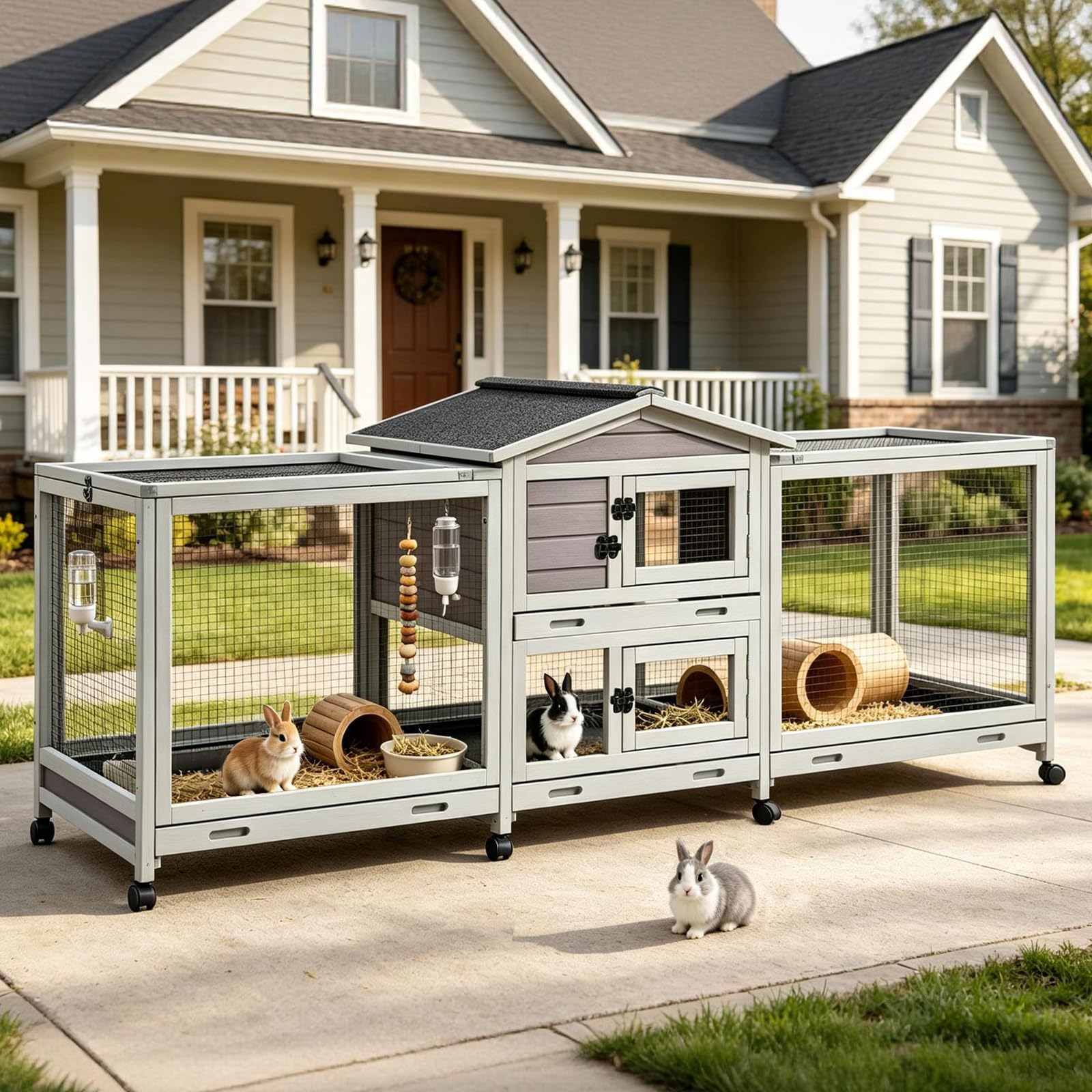
Nearly eight feet of hutch on eight wheels — the biggest footprint in this guide.
At 93.7 inches long, 22.6 wide, and 33.5 tall, this is in a different size class from everything else here. For comparison, the GDLF runs 62 inches long — this one adds more than two and a half feet of ground-level space on top of that. The maker describes it as having two large running areas plus an opening roof, which is what that extra length buys. If your rabbits are used to a long hop instead of a turn-and-stop, this is the model that respects that.
The mobility hardware is equally serious: eight wheels total, four of them locking casters, so the whole run can be moved and then locked in place. Cleaning is handled by four deep removable pull-out trays accessible from both front and back, with better plastic than the standard tray and a design intended not to leak. The ramp leads to an upper platform, and the roof is rain-resistant with a safeguard lock. Two front doors plus a middle sliding access door give you a way to catch a rabbit without dismantling anything.
The size is what people respond to first and most, and on this model it is genuinely earned. The trade-off is durability, which is the real weak spot. The wood chips easily, and the stability report includes trays that stick and wheels that come loose over time. None of that makes it a bad hutch — it makes it a hutch that rewards a careful build and periodic re-tightening. Lock the casters properly and check the tray guides each season, and it holds together.
The space is real: 93.7 inches of length and two large running areas give rabbits room to actually move, not just stand.
The maintenance is real too: wood chipping, sticky trays, and loose wheels mean this hutch needs seasonal attention to stay solid.
Made for: a garden or large patio with the room for an eight-foot hutch and rabbits that need the run.
Skip if: you want a set-and-forget build — this one expects you to tighten and adjust as it ages.
8. Two-Story Wooden Rabbit Cage Hutch

A small two-story wooden cage that lifts off its stand for cleaning day.
The removable stand is the idea worth noticing here. It lets you lift the entire cage off its base rather than bending around a fixed frame, which helps if you are cleaning on a floor or moving between rooms. The two floors connect via a ramp, and the pull-out tray slides free without you having to disturb the animals. Wire mesh on the sides keeps air moving and gives you a view in.
Build quality is this cage’s better trait. The wood goes together well and the brown-and-white finish looks better than its price class suggests. The anti-chewing design is wood-based rather than metal-edged, so it slows gnawing rather than stopping it — set expectations there. It is spec’d for guinea pigs, rabbits, and other small pets, and the base can be lined with wood shavings or paper bedding to keep the floor dry.
The comments about this cage are not all kind, and the honesty matters here. Some units chip during assembly and some owners find it falls apart faster than they expected, so treat the panels carefully and re-check the joints after the first week. The footprint is small — this is a starter cage or a single-small-animal home, not a pair-of-rabbits run. For the money, it is a reasonable first two-story setup if you go in knowing its limits.
What works
- Removable stand makes cleaning and repositioning easier
- Build quality is solid for the price tier
- Wire mesh sides keep ventilation good
- Pull-out tray cleans without disturbing the animal
What to expect
- Wood-based anti-chew design slows gnawing but does not stop it
- Some panels chip during assembly and joints loosen over time
- Small footprint — best for one small animal
Right for: a first two-story cage for one guinea pig or one small rabbit on a tight budget.
Wrong for: housing a bonded pair — the floor space will feel cramped fast.
9. AMZOSS 2-Story Guinea Pig Cage

The smallest two-story cage here, with the thinnest gap and the widest ramp.
This hutch suits a small animal in a small room, not a rabbit that needs to run, because at 29.25 inches long by 15.75 wide by 28.5 tall it is roughly half the length of the GDLF. The two-tier split gives you an upper retreat area and a lower play area, plus a wide ramp that some smaller and older animals find easier to climb than a narrow one. The gap size is 0.5 inches, one of the tighter measurements in this group.
The material claim is specific: 10mm Finnish spruce panels rather than cedar, finished with a water-based paint. Cedar can be a concern for small animals, so a spruce build with a sealed finish is a fair starting point. Flip-top doors secured with metal buckles, a deeper galvanized pull-out tray, and a wire roof with a UV-proof panel round out the design. The maker lists it for bunnies, guinea pigs, dwarf rabbits, hedgehogs, hamsters, and similar small animals.
This is the lowest-rated pick in the guide, and it earns that position honestly. Quality and durability are the recurring issues — panels that separate and gaps in the slats are the specific failures, and the size runs smaller than some buyers expect. The listed weight of 8.85 kg is far lighter than the GDLF’s 49.7 pounds, which tells you how much wood you are comparing. Worth buying as a compact setup for a dwarf hamster or a single guinea pig, with eyes open.
Where it stands out: 10mm Finnish spruce panels and a 0.5-inch gap make it one of the more carefully specified small cages in this group.
Where it falls short: panel separation, slat gaps, and a size that runs small — check it thoroughly on arrival and be ready to reinforce joints.
Good match: a dwarf rabbit, guinea pig, or hamster in a small apartment where 29.25 inches of length is all the space available.
Look up instead: if you need it for a standard rabbit — the 28.5-inch height and short run will not suit.
10. TRIXIE natura Outdoor Deluxe Rabbit Hutch

The full outdoor enclosure: a two-story house plus a secure run built into one frame.
Most two-story hutches give you a hutch and then ask you to buy a separate playpen. TRIXIE’s deluxe model builds the playpen in. The overall dimensions come in at 44.1 inches long, 45.3 wide, and 53.1 tall — that wide footprint is the run, and it makes this the most complete outdoor setup in the guide. It weighs 110 pounds, so this is a permanent installation for two people, not something you reposition.
The build detail that stands out is the habitat design. There is a hatch door connecting the two levels, a non-slip ramp for the climb, two pull-out cleaning trays, and a dual-opening peaked roof for maintenance. The deluxe features go further: weather-resistant walls, a draft-free sleeping area, and an attic for storage. The doors are 20 by 12 inches, which is large enough for a person’s hand and forearm to reach in easily. The framing uses fir, metal, plastic, and composite asphalt shingles on the roof.
The honest read is that this hutch is at its best with the animals and at its weakest with the wood. Pet happiness and size are where it earns its marks — bunnies do use the run and the upper quarters. But durability is the recurring concern, with pieces breaking off and the wood peeling over time, and the instructions have been called misleading by some. It is also the heaviest hutch here by a wide margin at 110 pounds. Buy it for the run, plan to seal and maintain the wood, and budget the setup as a two-person afternoon with a helper reading the instructions.
The case for it: a built-in secure run, a non-slip ramp, two trays, and weather-resistant walls make this a complete outdoor home rather than a cage plus accessories.
The case against: 110 pounds is a fixed installation, and the wood will need sealing and repair as seasons pass.
Buy it for: a permanent outdoor setup where the run and the secure playpen are the priority.
Rethink it for: a renter or anyone who needs to move the hutch — at 110 pounds, this one stays put.
Know the Specs
Overall dimensions and usable floor area
The listed length, width, and height tell you the footprint, but the usable floor area is what your rabbit actually gets. A 62-inch hutch with a 21-inch width gives a rabbit a long path to hop; a 36-inch hutch with a wide run gives a shorter, rounder space. On a two-story design, check the upper house size separately from the overall dimensions — the GDLF lists its upper house at 27.5 by 18 by 20.5 inches, which is the part the animal sleeps in. Match that upper size to your rabbit’s length with some room to turn around.
Door count and tray access
Door count is a cleaning spec, not a cosmetic one. Two doors means you reach most of the hutch through two openings; four or five doors means every corner is accessible without contorting. Trays work the same way. A single-tray design means you lift the animal out to clean the upper floor. Two or three trays mean each level cleans independently. On a two-story hutch, look for at least one tray per level, and check whether the tray locks so it does not slide open when the hutch is bumped.
Ramp grip and ramp angle
The ramp is the hinge of a two-story design — if the animal will not climb it, the upper floor is wasted space. Look for a textured surface, ridges, or a non-slip coating. The GDLF uses timber ridges; the GUTINNEEN AIR19-X uses full-length metal edges; the PetsCosset lists anti-slip ramps. A steep, smooth ramp is the most common reason a rabbit stays on the ground floor. A wide ramp helps smaller and older animals more than a narrow one does.
Wood material, finish, and chew protection
Fir is the standard, and it works when the panels are thick and sealed with a waterproof finish. Thinner panels split if screws are overtightened, which is the most common assembly complaint in the category. Chew protection comes in three forms here: metal edging on the reachable parts, wood treated to resist gnawing, or a metal and aluminum frame like the Aivituvin. None of them stops a determined rabbit completely. They slow the damage enough that the structure holds together over a season.
Wheels, weight, and placement
Castors decide where the hutch can live. Locking wheels let you roll it onto a patio for cleaning and back under cover for weather. The Mayugardening model runs four locking casters at 31.5 pounds; the GUTINNEEN on casters uses eight wheels, four of them locking, at 93.7 inches long. At the other end, the TRIXIE at 110 pounds is a permanent installation. Weigh the two things against each other: mobility is useful for cleaning, but a heavier fixed hutch tends to feel more stable against a jumping rabbit.
Roof coverage and weatherproofing
On a two-story hutch, the roof protects the lower level as much as the upper. A single peaked roof covers the sleeping area; an asphalt or composite roof over the run keeps rain out of the ground level where the animal spends its play time. The PetsCosset lists full-coverage waterproof asphalt roofing on both areas, and the PawHut uses composite asphalt to shelterand shade. If the hutch sits outdoors year-round, roof coverage over the run and a sealed finish on the wood are the two specifications that decide whether it lasts.
Common Questions
Is a two-story rabbit hutch better than a single-level one for a pair of rabbits?
How much floor space does one rabbit actually need in a hutch?
Will a rabbit actually use the upper level of a two-story hutch?
How long does a wooden rabbit hutch last outdoors?
Do the pull-out trays actually make cleaning easier on a two-level hutch?
Can I keep a two-story hutch outdoors year-round?
Are locking caster wheels strong enough for a hutch with rabbits in it?
Is fir wood safe for a rabbit that chews on the hutch?
How long does assembly take and do I need two people?
Should I pick a metal-framed hutch or a wooden one for a chewing rabbit?
The Bottom Line
The GDLF 62″ Rabbit Hutch solves the most problems at once, and the reason is not the length alone. It is the combination: a 62-inch footprint that gives two or three rabbits real run room, an upper house at 27.5 by 18 by 20.5 inches that is a true sleeping chamber, three doors, a sliding removable tray, and a waterproof varnish finish on the fir. It is the only pick here where the size, the access, and the finish all line up without a compromise on any one of them. No other pick here matches all three at once.
If your priority is moving the hutch rather than living with it in place, the Mayugardening 2 Story Hutch with four locking wheels and two leak-proof trays does that job at 31.5 pounds. For a chewing rabbit kept indoors, the Aivituvin 2-Story Hutch and its aluminum alloy framing is the pick that changes the material rather than just the edges. And if you have the garden space for a permanent outdoor enclosure, the TRIXIE natura Deluxe Hutch builds the run in, giving bunnies a full playpen instead of a cage plus accessories.
Whatever you choose, look at the ramp first, the tray count second, and the wood finish third — those three decide whether the upper floor gets used and whether the lower floor stays dry. Get those three right and the upper floor gets used and the lower floor stays dry.
How we choose
We do not accept paid placement. Every pick is matched to a real buyer and a real use-case; we do not hands-on test units.
Sources
Specifications: manufacturer listings and product documentation. Review insights: verified customer reviews, as of November 2026. Pricing: not shown on this page (it changes often); check the current price via the retailer link.
As an Amazon Associate, Tactical Gear Guy earns from qualifying purchases. This does not affect which products we feature.