Specs are compiled from manufacturer listings and verified buyer reviews and can change over time — please confirm the key details on the product page before buying.
Drilling stainless steel with the wrong bit is how an afternoon disappears: the tip skates, the hole smears, and the bit turns blue and dies. The fix is a tungsten carbide bit — a drill with a cemented carbide tip that stays hard at temperatures where coated high-speed steel gives up. This guide covers six solid carbide picks, sorted by the metal each one drills best.
This guide is built by comparing the manufacturers’ published specifications and the patterns across verified customer reviews, so you get each pick’s real strengths and trade-offs instead of marketing spin.
The six picks below span from a single 7.3mm bit for stainless to a full six-piece set, and every pick is judged on carbide grade, point angle, and how it behaves in a hand drill. Here is the honest shortlist of tungsten carbide drill bits for metal.
Top Picks
How To Choose The Best Tungsten Carbide Drill Bits for Metal
Carbide is not a forgiving material. It keeps a sharp edge at temperatures that ruin a coated high-speed-steel bit, but it chips instead of bending when it snags. To buy right, match the point angle (the angle at the tip) and flute design (the grooves that clear chips) to the metal you actually drill. Also accept that a bit this hard needs a steadier hand.
Point angle decides whether the bit walks
A 130° point angle (the angle of the cutting cone at the tip) spreads contact over more surface, so the bit centers itself on a hardened plate and stops skating off your scribed line. A 118° point is a more conventional angle that suits softer materials and general shop work. If you drill stainless, the steeper 130° point is what you want.
One bit or a set — pick by job, not by size
Single-bit picks like the Drill America 1/4″ or the PATIKIL 7.3mm exist for a reason: you replace the size that died, or you buy the exact diameter a fastener needs. A set makes sense when you drill pilot holes across a range of stock sizes all week. Buying a set when you only drill one diameter wastes more money than any other mistake here.
Why your drill setup matters as much as the bit
Solid carbide fails under vibration. A loose chuck or a wobbly drill press stand costs you the bit before the hole is finished — every one of these bits wants a rigid tool holder and a firm clamp on the workpiece. Feed slow, keep the speed up, and let the flutes clear chips instead of forcing the tip.
Side-by-Side Comparison
| Model | Best For | Cutting Diameter | Point Angle | Pieces | Amazon |
|---|---|---|---|---|---|
| PATIKIL 7.3mm Carbide★ Best Overall | Hardened and stainless steel | 7.3mm | 130° | 1 | Amazon |
| HOYUSK 5/32″ SetPrecision Pick | Small precision holes | 4mm | — | 2 | Amazon |
| LU&MN Jobber 3/16″ | CNC and shop machining | 4.76mm | 118° | 2 | Amazon |
| HOYUSK TiSiN 5/32″ | Hardened steel and cast iron | 3.97mm | — | 2 | Amazon |
| Drill America DMOD1/4 | High-temperature abrasive stock | 0.25″ | 118° | 1 | Amazon |
| HOYUSK 6-Piece Set | Covering six hole sizes | — | — | 6 | Amazon |
Detailed Reviews
1. PATIKIL 7.3mm Drill Bit Carbide
Our pick — 4.5+★ from 100+ verified ratings; the strongest balance of quality and price.
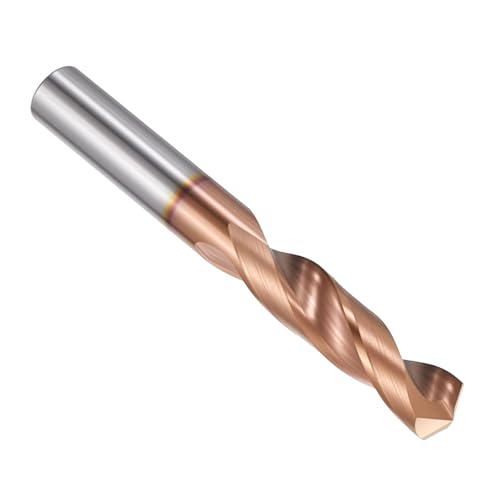
One cemented-carbide bit with a 130° nose built to bite stainless without wandering.
The 7.3mm cutting diameter is the size that matters here, because it clears the shank of common fasteners while still leaving you a manageable hole to tap. A titanium aluminum silicon nitride coating sits on the bit to hold off heat, so the edge keeps cutting instead of glazing over. The point is ground to 130° — steeper than the 118° of the LU&MN below — and that steeper angle gives you a self-centering tip that stays put on a hardened plate.
What wins people over is simply that it works on the metals that kill ordinary bits. Hardened steel and stainless steel cut cleanly, and the spiral flutes carry chips out instead of packing them in the hole. The flute length is 30mm (1.18 inch) with a 60mm (2.36 inch) overall length, so there is enough bit to reach a through-hole in plate but still enough shank to clamp rigid.
Here is the honest catch. Solid carbide is brittle by nature — PATIKIL’s own notes say the material fails under vibration, so a loose chuck or an unclamped workpiece can chip the point. The finish quality draws a mixed reaction, and a few units have chipped on first use when the setup was sloppy. Feed it slow in a rigid holder and this bit is a different animal.
What earns it the top spot
- 130° point self-centers on hardened and stainless steel
- TiAlSiN coating keeps the edge cool under heat
- 1.18″ flute length reaches through plate without excess shank
Where it asks more of you
- Carbide chips if your chuck or clamp is loose
- Finish quality draws mixed reports from buyers
Reach for this if: you drill stainless or hardened plate and want a single replacement bit that centers itself.
Think twice if: your only drill is a hand-held with a worn chuck — that setup is where carbide fails.
2. 5/32″ Drill Bits Solid Carbide
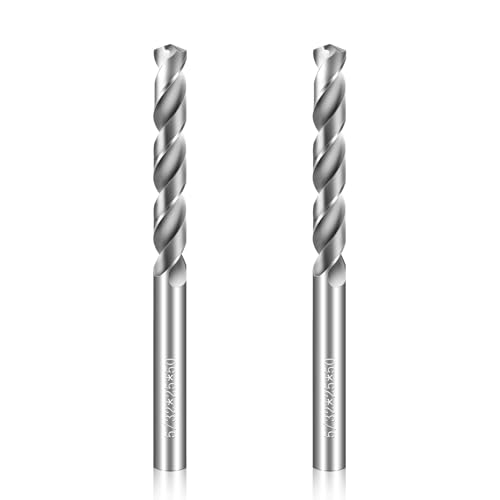
A two-pack of tiny 5/32″ carbides for fitting into tight spaces where big bits cannot reach.
The 0.6um micro-particle cemented carbide is the headline — a finer grain means a harder, more wear-resistant cutting edge. At 0.156″ drill diameter (roughly 5/32″) with a 1″ flute and 2″ overall length, these bits are for small, precise holes rather than deep boring. That makes them the pick for detail work where a large bit simply will not fit.
The cutting action is what buyers notice most — the two sharp spiral flutes clear chips fast and keep heat down, and the round shank grips without slipping. You get two bits, so there is a spare for the day one snags.
The fair warning: durability is the weak spot in the feedback — a brittle carbide this small will snap if you lean on it, and buyers report both sharp edges and early breaks. Value reads mixed too. Use a light touch and these cut well; force them and they are gone.
Best suited to: hobbyists and repair techs drilling small pilot holes in stainless, aluminum, or copper.
Steer clear if: you need a big hole fast — this is a precision size, not a hogging bit.
3. LU&MN Solid Carbide Jobber Drill Bit, 3/16″ Dia, 2 Pcs
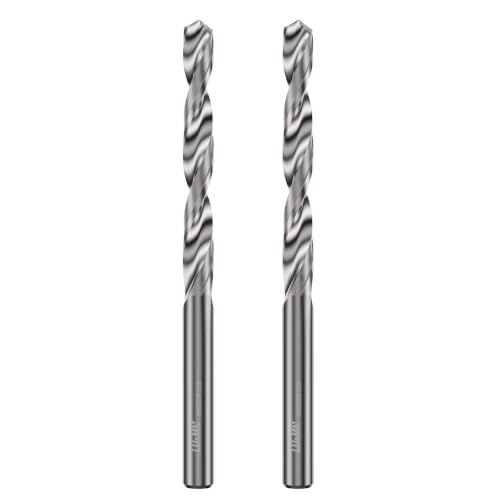
A 3/16″ jobber bit ground on Swiss machines, so the tolerances are tight enough for CNC work.
At 4.76mm cutting diameter, this is the widest of the small-bit picks — it holds a 20% larger diameter than the HOYUSK 5/32″ TiSiN set’s 3.97mm. The point is a 118° split point, so it needs a pilot on hard stock rather than self-centering the way the PATIKIL’s 130° nose does. For CNC setup, that 118° geometry is normal and predictable.
The Swiss 5-axis grinding is the real story: ultra-fine micro-grain carbide with a reverse taper that keeps the drill body off the hole walls, plus a mirror-bright finish that speeds chip evacuation. In shop use it cuts through annealed hardened steel, stainless, and even Zamak cleanly, and the performance here draws the strongest positive reaction of any small bit in this group.
The recurring gripe is durability. This is a brittle bit — the small-diameter piece in particular snaps at the tip for plenty of buyers, and the quality and value calls are split. Treat it as a precision cutting tool for controlled feed rates, not a bit you stress with hand pressure.
Why machinists like it
- Swiss 5-axis grinding holds tight tolerances
- Reverse taper cuts friction and heat
- Up to HRC52 material on the spec sheet
What will bite you
- Small piece snaps at the tip under feed pressure
- 118° point wants a pilot hole on hard stock
Pick this when: you run a controlled-feed machine and value dimensional accuracy over brute force.
Leave it for someone else if: you need one bit to survive rough hand drilling all day.
4. Solid Carbide 5/32″ Drill Bits with TiSiN Coated, 2 Pcs
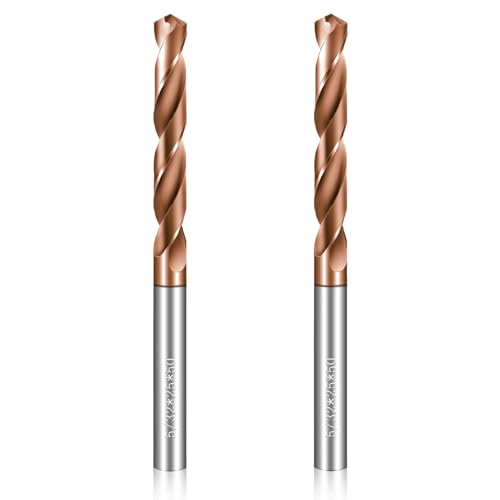
A coated 5/32″ bit where the titanium silicon nitride layer is meant to survive hardened steel.
This is the smallest-diameter pick in the group at 3.97mm — the one to grab when the HOYUSK 4mm and LU&MN 4.76mm both punch holes a touch too wide. The difference is real: it runs 20% narrower than the LU&MN 3/16″ bit, which is exactly the kind of margin that matters for tap-sized holes.
The titanium silicon nitride finish is a hard coating applied for heat resistance on high-hardness materials, and the bits handle stainless, bearing steel, cast iron, mold steel, and carbon steel. Buyers praise the hardness most, and the ability to cut through hardened steel is the standout. The round shank clamps tight and the sharp flutes keep cuts burr-free.
The trade-off is that same small diameter working against durability — small carbide bits break quickly under load, and the cost feels steep to some. Keep the feed steady and this survives; lean into it and the point lets go.
The value read: the TiSiN coating resists heat better than a bare uncoated bit of this size, so it holds its edge longer on hardened steel.
Made for: drilling a precise 5/32″ hole through hardened steel with a coating built to shed heat.
Skip the risk if: you expect a bit this small to tolerate a wobbly hand drill all week.
5. Drill America DMOD1/4 1/4″ Solid Carbide Drill Bit
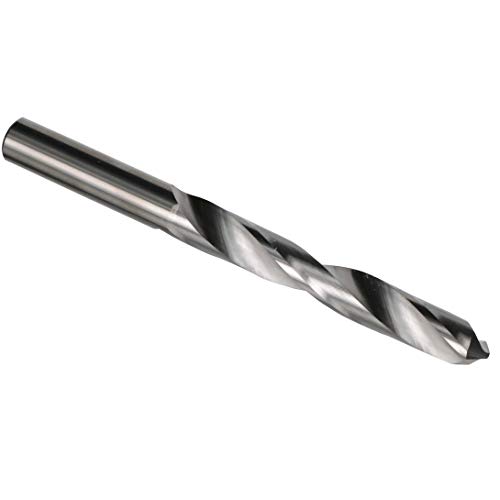
A 1/4″ carbide built for abrasive stock where accuracy and high heat both matter.
Drill America points this bit at a specific job: abrasive materials that need a straight, accurate hole. At 0.25″ cutting diameter it is the biggest single-bit pick here, and it runs a 118° point so it wants a pilot hole in anything hard. The two-flute spiral clears chips and holds the hole wall, and the bit is rated for high-temperature drilling applications.
It thrives on cast iron, bronze, brass, hard rubber, plexiglass, and high-silicon aluminum. What buyers consistently confirm is that it is functional and well-made for those softer and abrasive jobs — it does the work without drama on the materials it was built for.
The catch is directional. Touched to annealed steel, this bit chips at the point and breaks — it is not a stainless bit, and buyers who tried it on harder steel found it unsuitable. Carbide also runs brittle and needs a rigid holder. Match it to the right material and it is a solid, accurate tool.
Where it delivers
- Holds accuracy on abrasive stock like cast iron and bronze
- Rated for high-temperature drilling
- True 1/4″ diameter for straight, clean holes in cast iron, bronze, and aluminum
The limits you accept
- Chips and breaks on annealed steel
- Overpriced in some buyers’ eyes for a single bit
The right buyer: anyone boring cast iron, plexiglass, bronze, or aluminum and needing a true 1/4″ hole.
Not your bit if: your project is stainless — this one wants softer, abrasive stock.
6. 6 Pcs Solid Carbide Drill Bit Set

One box covering six hole sizes, with the range to handle pilot through clearance in a single kit.
Instead of buying sizes one at a time, this set gives you 1/2″, 3/8″, 1/4″, 3/16″, 1/8″, and 1/16″ in a single pack. The 0.6um micro-particle cemented carbide is the same construction HOYUSK uses across its single bits, and the split-point style helps the bit start without skating. Spiral flutes on every size keep chips moving so the hole walls stay clean.
Cutting performance is the draw here — owners mention the bits cutting hardened steel with little resistance, and the sharp edges across the range make it a versatile kit for a maintenance bench. The round shank clamps tight so longer bits do not chatter.
The most-discussed topic is quality, and it is genuinely mixed — some buyers find the bits as good as single purchases, while others report them snapping under little force. Durability reads mixed as well, and the cost feels high for a set whose large pieces carry real breakage risk. It is a complete kit, but treat the big sizes with the same care you would a stand-alone carbide.
Who it fits: the shop or maintenance bench that needs five or six sizes on hand and wants them all in carbide.
The honest trade: you are paying for range — if you only ever drill one diameter, a single bit is the smarter buy.
Grab it if: you want a complete size range of solid carbide bits ready on one shelf.
Pass if: you drill one hole size and would rather spend on a single proven bit.
Know the Specs
Point angle (130° vs 118°)
The point angle is the shape of the cutting cone at the bit’s tip, and it decides how the bit starts a hole. A 130° point spreads the load wider, giving a self-centering tip that stays put on hardened steel and stainless. A 118° point is a standard shop angle that cuts well but wants a pilot hole or center punch on hard stock. Match the angle to your material, not the other way around.
Cutting diameter and flute length
Cutting diameter is the width of hole the bit makes — 3.97mm, 4mm, 4.76mm, 7.3mm, or 0.25″ depending on the pick. Flute length is how deep the cutting flutes reach, and overall length is the full bit. A longer flute reaches a through-hole in thicker plate; a shorter one keeps the bit rigid. Buy the diameter your fastener or tap actually needs, then check the flute length reaches your stock.
Common Questions
Can these carbide bits be used in a regular hand drill?
Is a 130° or 118° point better for stainless steel?
Why did my solid carbide bit snap on the first hole?
Will the HOYUSK 5/32″ bits drill through hardened steel?
Can I use the Drill America 1/4″ bit on stainless steel?
What does the TiSiN coating on the HOYUSK 5/32″ do?
Is a single bit or a six-piece set the better buy?
How do I keep a carbide bit from chipping at the point?
The Bottom Line
For most people shopping tungsten carbide drill bits for metal, the PATIKIL 7.3mm carbide bit is the one to start with. Its 130° self-centering point (a tip angle that keeps the bit from wandering) and TiAlSiN coating (a hard film that resists heat) handle the stainless and hardened steel that wreck ordinary bits. If you drill small pilot holes in tight spaces, the HOYUSK 5/32″ two-pack covers the precision end. And for a bench that needs range, the HOYUSK six-piece set puts six carbide sizes on one shelf. Whichever you pick, slow the feed and clamp your stock — carbide rewards a steady hand with a clean, accurate hole.
How we choose
We do not accept paid placement. Every pick is matched to a real buyer and a real use-case; we do not hands-on test units.
Sources
Specifications: manufacturer listings and product documentation. Review insights: verified customer reviews, as of November 2026. Pricing: not shown on this page (it changes often); check the current price via the retailer link.
As an Amazon Associate, Tactical Gear Guy earns from qualifying purchases. This does not affect which products we feature.