Specs are compiled from manufacturer listings and verified buyer reviews and can change over time — please confirm the key details on the product page before buying.
Buying a tube cutter is really a question of three things: what metal you cut, how much room you have around the pipe, and whether your arm can take another hundred squeezes. Get those three right and the tool lasts years. Get them wrong and you end up with an oval pipe end, a leaking joint, and a cutter that sits in the drawer. This list sorts the hand-powered, cordless, and bench-mounted options by the jobs they actually do well, so you can match one to your bench instead of guessing from a spec sheet.
This guide is built by comparing the manufacturers’ published specifications and the patterns across verified customer reviews, so you get each pick’s real strengths and trade-offs instead of marketing spin.
Every pick below is judged on cut capacity, drive type, and how it behaves in a tight corner. Here is the shortlist that earns its place on the bench as a tube cutting machine.
Top Picks

How To Choose The Best Tube Cutting Machine
The fastest way to buy wrong is to shop by brand first. Start with the pipe in front of you instead: its outside diameter, its wall thickness, and how much clear space sits around it. Those three answers narrow the field to two or three tools before you ever look at a listing.
Match the O.D. capacity to your largest pipe
Cut capacity is written as an O.D. range — the outside diameter span the cutter’s wheel can reach. A cutter rated 1-7/8-inch to 4-1/2-inch simply will not close around a half-inch copper line. Buy for the biggest pipe you expect, then check the small end too, because a cutter that handles four-inch PVC often struggles at the tiny sizes.
Decide between screw feed and quick release
A screw-feed cutter tightens the wheel onto the pipe with a knob you turn by hand. A quick-release design lets you open and reposition the tool without backing the knob all the way out, which saves time on a run of cuts. For one-off jobs the screw feed is fine; for a day of repeat cuts the quick release earns its keep.
Know when a notcher replaces a cutter
A notcher is not a cutter. It uses a hole saw to carve a saddle-shaped profile into the end of a tube so it can be welded to another tube at an angle. If you are joining round tubing for a frame or rail, you need a notcher; if you are just shortening pipe, you need a cutter.
Weight and clearance around the pipe
Hand cutters run from about a pound and a half up to nearly four pounds, and that mass matters when you are working overhead. Clearance matters just as much — a close-quarters cutter is built skinny so it can spin next to a wall or inside a cabinet where a full-size body will not fit.
Cordless versus hand power
A cordless cutter spins a cutting wheel with a motor so you are not squeezing a knob a hundred times. That is a real relief on long copper runs, but it adds a battery platform to your kit and a bare-tool listing often ships without the battery. Hand tools need no charging and no battery, which suits occasional work.
Side-by-Side Comparison
| Model | Best For | Cut Capacity (O.D.) | Drive Type | Weight | Amazon |
|---|---|---|---|---|---|
| Reed TC3QP★ Best Overall | Plastic pipe and tubing | 3/8″ – 3-1/2″ | Hand powered, quick release | 2.5 lb | Amazon |
| RIDGID 32940 #30Best Screw Feed | Copper, brass, aluminum, thin-wall steel | 1″ – 3-1/8″ | Hand powered, screw feed | — | Amazon |
| Milwaukee 2471-20 M12Top Performer | Long copper runs, up to 1″ | 3/8″ – 1″ | Cordless, 500 RPM motor | 16 oz | Amazon |
| REED TC4QPVC | Large-diameter PVC | 1-7/8″ – 4-1/2″ | Hand powered | 1270 g | Amazon |
| RIDGID 154 31652 | Big copper and aluminum runs | 1-7/8″ – 4-1/2″ | Hand powered, quick acting | 3.7 lb | Amazon |
| Jeremywell Notcher | Saddle notches for welding | 3/4″ – 3″ round tubing | Drill driven, 1/2″ chuck | 20.7 lb | Amazon |
| DEWALT DCE154B | Fast repetitive copper cuts | 1/4″ – 1-1/4″ | Cordless, variable speed | 3.8 lb | Amazon |
| WHEELER-REX 4992RED | Close-quarters work | 1/4″ – 2-3/8″ | Hand powered | 1.5 lb | Amazon |
| Baileigh TN-250 | Shop-scale tube fabrication | Adjustable notch, 220° carriage | Bench-mounted, drill driven | — | Amazon |
Detailed Reviews
1. Reed TC3QP Tubing Cutters
Our pick — 4.5+★ from 150+ verified ratings; the strongest balance of quality and price.
A 2.5-pound hand cutter for PE, PB, and ABS plastic pipe, with a quick-release head that opens without unwinding the knob.
If you are cutting PE, PB, or ABS plastic pipe, this is the cutter to beat. It is hand powered, so there is no battery to charge and no motor to flood, and the 3/8-inch to 3-1/2-inch outside-diameter range covers the small and mid plastic lines that show up in most residential work. The quick-release head pops open and reseats without you winding the knob all the way back out, which is what makes running a batch of cuts feel fast rather than fiddly.
What wins plastic-pipe buyers over is the build and the straightness of the cut. Reviewers consistently rate the build and cut quality highest, and the tracked head keeps the wheel on line so ends come out square. The head tracks the pipe cleanly instead of wandering, so the end comes out square enough to glue or fit without a reaming session. At 11 inches overall and 2.5 pounds, it is a two-hand tool that stays comfortable on a ladder.
Here is where it sits against the cordless Milwaukee: the Reed is a fraction of the weight — 2.5 pounds versus 16 ounces on the Milwaukee — but it asks your arm for the effort the motor would have supplied. That trade-off is the honest one. There is a small group of buyers who find the weight a touch heavy for overhead plastic runs. On a bench or a low wall, that never comes up.
Why plastic-pipe crews like it
- Quick-release head opens and reseats without backing the knob out
- 3/8-inch to 3-1/2-inch O.D. range covers most PE, PB and ABS lines
- Tracked, square cuts that fit or glue without reaming
- No battery, no motor, nothing to flood
The honest catch
- 2.5 pounds is real weight when you work overhead
- Hand power means your arm does the cutting, not a motor
- It is a plastic-pipe specialist, not a copper tool
Reach for this if: your pipe is PE, PB, or ABS and you want square ends without a battery in the bag.
Look elsewhere if: you are working copper or thin-wall steel — this wheel is built for plastic, and a copper cutter is the right tool for that job.
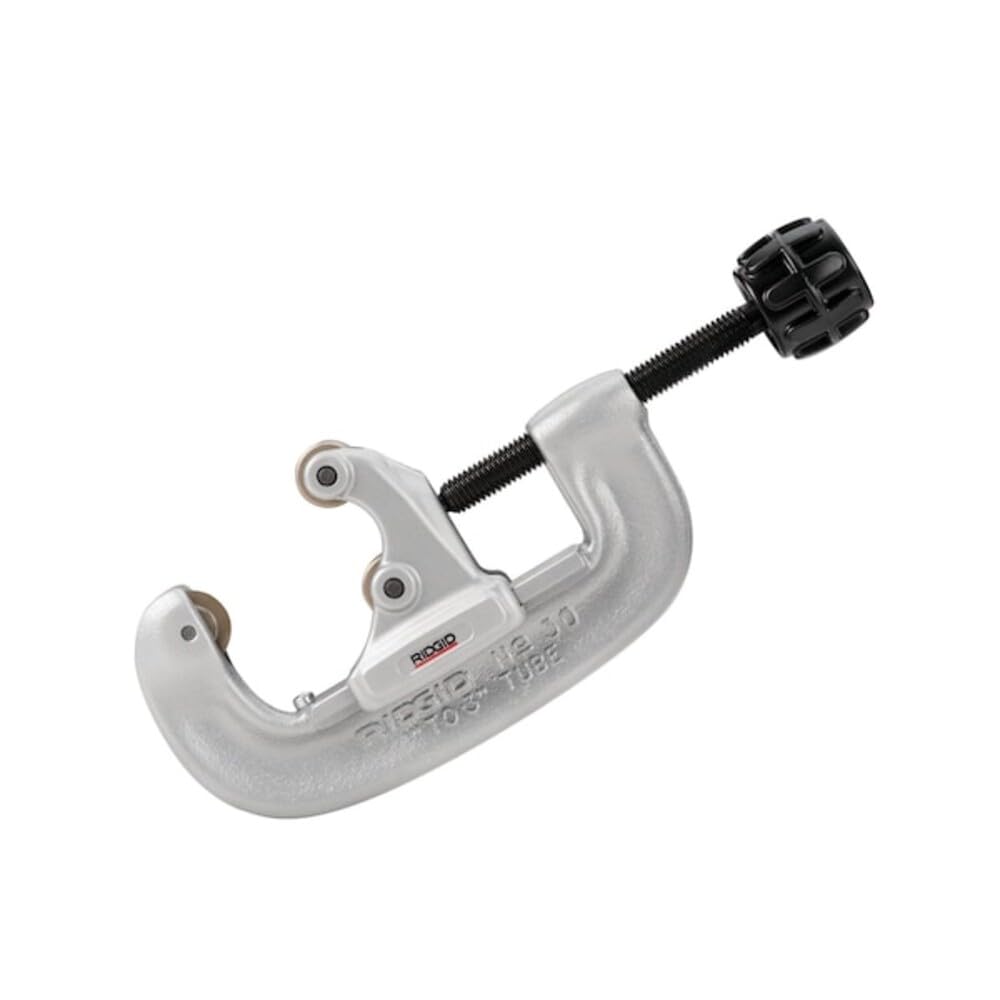
2. RIDGID 32940 #30 Tubing Cutter
One knob, one wheel, and cuts that come out square on copper, brass, aluminum, and thin-wall steel.
Metal is the whole point here. This RIDGID handles copper, brass, aluminum, and thin-wall steel through a 1-inch to 3-1/8-inch outside-diameter range, which makes it the general-purpose metal cutter on this list. The large X-CEL knob is sized for a firm grip, so you can lean into the feed without your fingers slipping off. At 5 inches long and 5 inches wide, it is a compact body that slips into a toolbag alongside the fittings.
The cutting wheel is machined from high-grade steel, and a spare wheel comes in the box — that spare is the detail that keeps the tool working when a wheel dulls mid-job. RIDGID backs it with a lifetime warranty against material and workmanship defects for the normal life of the tool.
Screw feed is slower than a quick release because every reposition means winding the knob. The reward is a controlled, steady pressure that produces clean square ends on hard metals, and that control is what you want on conduit and brass. If you cut the same size repeatedly, the winding gets old; if you cut a mixed bag of metal, the fine feed is a benefit.
The metal-first pick: four metals, a spare wheel in the box, and a lifetime warranty — that combination is what separates it from the plastic-focused Reed at the top.
Where it slows down: the screw knob has to be wound back out for every reposition, so a long run of same-size cuts feels more deliberate than a quick-release head.
Best matched to: plumbers and installers cutting copper, brass, aluminum, or thin-wall steel in mixed sizes.
Wrong tool if: you are cutting PVC or plastic all day, or you want speed over finesse on repeat cuts.
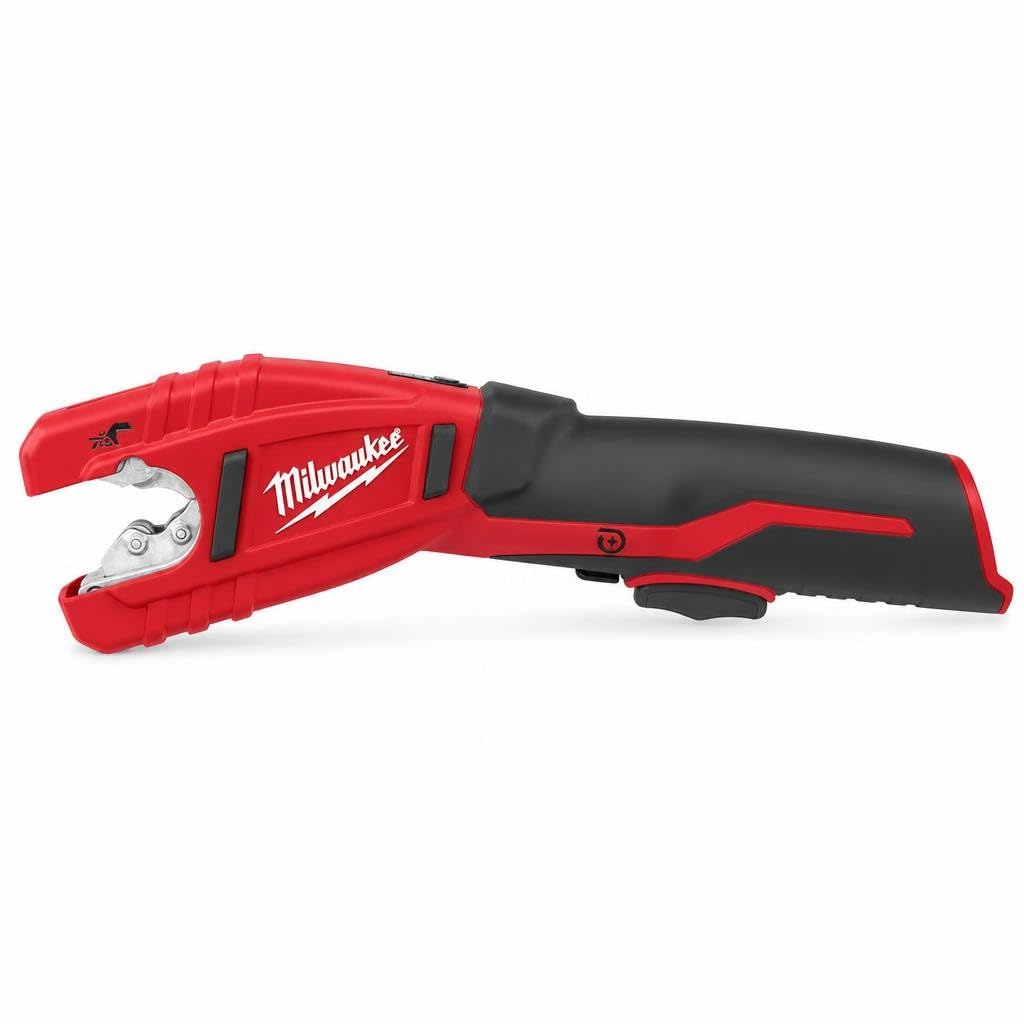
3. Milwaukee 2471-20 M12 Cordless Copper Pipe and Tubing Cutter
Wrap it around copper, squeeze the trigger, and let a 500 RPM motor save your wrist.
This is the pick for anyone whose shoulder aches after a day of hand cutting. The head wraps around type K, L, and M copper and self-adjusts between 3/8-inch and 1-inch, so you do not stop to swap parts between sizes. The motor turns at up to 500 RPM, and Milwaukee claims it cuts up to 10 times faster than standard hand-operated cutters. The head is sealed to keep water out of the motor, which suits plumbing work where the tool lives near wet pipe.
Low clearance is the quiet advantage. The tool works on piping as little as 1 1/2 inches away from a wall without damage to the tool or the pipe, which is exactly the gap you find behind a finished cabinet. It runs on the Milwaukee M12 battery lineup, and the listing is the bare tool only, so check your battery drawer before ordering.
The honest limit is the small end of the range. Cutting performance and functionality draw mixed feedback in the reviews — it earns strong marks on 3/4-inch copper but shows up short on 3/8-inch refrigerant tubing for some buyers. Durability draws more criticism than any other point, so treat it as a copper specialist that rewards careful use rather than a beater. What the reviews consistently praise is speed: it saves time and spares the wrist.
The wrist-saving trade: you trade a battery and a bare-tool purchase for a motor that does the squeezing, and that exchange is what everyone praises most about it.
Where it disappoints: 3/8-inch refrigerant tubing is the size some buyers cannot get a clean cut on, so measure your smallest line before you commit.
Buy it when: you already own M12 batteries and you cut 3/4-inch and 1-inch copper day after day.
Think twice when: your work is mostly 3/8-inch refrigerant tubing or you have no M12 battery to drop in.
4. REED TC4QPVC Tubing Cutter for PVC (04144)

The PVC specialist that walks through four-inch pipe instead of fighting it.
Four-inch PVC is where hand cutters usually give up, and this REED is built for exactly that pipe. Its outside-diameter range runs 1-7/8 inches to 4-1/2 inches — 48 mm to 114 mm — so it covers the big drain and vent sizes a plastic-focused cutter cannot reach. The tracked head is designed to hold its line, which is what keeps the wheel from wandering on a wide pipe and producing a slanted end.
Against the smaller Reed TC3QP above, this one gives up nothing on the material and adds real capacity: the TC4QPVC measures 13.2 by 6.4 by 2.1 inches versus 11 by 5 by 2 inches on the TC3QP, and that extra body is the difference between reaching around four-inch pipe and not. Weighing 1270 grams, it is a bench-and-ladder tool that wants two hands.
The reviews settle on speed and sturdiness: four-inch pipe goes down in under two minutes for some buyers, and the body reads as heavy-duty. The recurring caution is the cutter wheel and pin — the wheel is replaceable for longer tool life, but a few buyers report the wheel or pin coming loose. Treat it as a precision tool and check the wheel seating before a big run.
What earns it a spot
- 1-7/8-inch to 4-1/2-inch O.D. capacity reaches large drain pipe
- Tracked head keeps the wheel from wandering on wide PVC
- Replaceable cutter wheel extends the tool’s working life
- Heavy-duty body that cuts four-inch pipe quickly
Worth knowing first
- 1270 grams is a two-hand tool, not a pocket cutter
- The wheel and pin need checking — a few report them working loose
- Built for PVC, so keep it away from copper work
The right call for: drain, vent, and irrigation work where the pipe gets big and the wheel has to track straight.
Not the right call for: small-line metal work or anyone who wants a one-hand pocket cutter.
5. RIDGID 154 31652 Tube Cutter

Built for the four-inch copper and aluminum runs that smaller cutters simply cannot span.
A 1-7/8-inch to 4-1/2-inch cutting capacity — 48 mm to 116 mm — is the headline, and it is aimed at large copper and aluminum. The quick-acting design opens wide fast instead of winding, and the I-beam construction with hardened wear surfaces is there to keep the body rigid over years of use. Thrust-bearing slide assemblies smooth the feed so the wheel pressure stays even around a wide pipe.
The X-CEL wheel pin uses a ball-detent design, so you swap the precision-machined, high-grade steel wheel without tools and without hunting for a lost clip. That sounds minor until a wheel dulls halfway through a run. Compared to the RIDGID #30 above, this one is physically bigger at 6.6 by 13.6 inches versus 5 by 5 inches — the size difference is the capacity difference, and you feel it in the hand.
Owners point to the build first; the tool reads as well made, and cutting performance draws steady praise across 3-inch ABS, four-inch copper, and aluminized exhaust pipe. The value question is where opinions split — a few think the tool asks a lot for what it does. At 3.7 pounds it is a two-hand tool, and that mass is the price of spanning four-inch pipe.
Where it shines: spanning four-inch copper while keeping the feed smooth through thrust-bearing slides.
The split opinion: value is the one point buyers argue about — a handful feel the tool costs more than the job warrants, while the build and cut quality win the rest over.
Pick it for: big-diameter copper, aluminum, and exhaust work where capacity is the deciding factor.
Pass on it for: small-line plumbing, where the 1-7/8-inch floor leaves your half-inch copper uncovered.
6. Pipe & Tube Notcher Punch

A drill-driven notcher that cuts saddle joints into round tubing from 3/4 to 3 inches.
This is not a pipe shortener — it is the tool that carves a saddle into the end of a tube so it can meet another tube at an angle for welding. It handles round tubing from 3/4 inch to 3 inches in outside diameter, and the notching angle sets anywhere from 0 to 50 degrees on an engraved scale. The scale is the feature that matters on a batch: set it once, lock the bearing block, and return to the same angle on every joint.
You power it with a hand drill that has a 1/2-inch chuck, and the spindle runs in a needle bearing to keep the cut steady as it turns. The body is solid steel at roughly 21 pounds, so it stays put whether you bolt it to a workbench or clamp it in a bench vise. The thread adapter takes 5/8-18 UNF internal and 1/2-20 UNF external threads, and the hole saw is not included — you size it to the outside diameter of the mating tube.
Buyers rate durability and value highest, and most get it assembled and set up quickly. The bearing is the one weak point: a handful report loose bearings that let the tool wobble and make it unusable for them. Check the bearing play on arrival, and if it is loose, address it before the first cut rather than after.
The fabrication answer: an engraved 0–50° scale plus two mounting options make repeat saddle joints a measured job instead of an eyeballed one.
The check on arrival: bearing play is the recurring note, so spin the spindle by hand before you trust it on a welded joint.
Worth it for: fabricators who join round tube at angles and want a repeatable notch without a full shop machine.
Skip it for: anyone who just needs to shorten pipe — that is a cutter’s job, and this tool will not do it.
7. DEWALT 20V MAX XR 1-1/4 in. Copper Tubing Cutter (DCE154B)
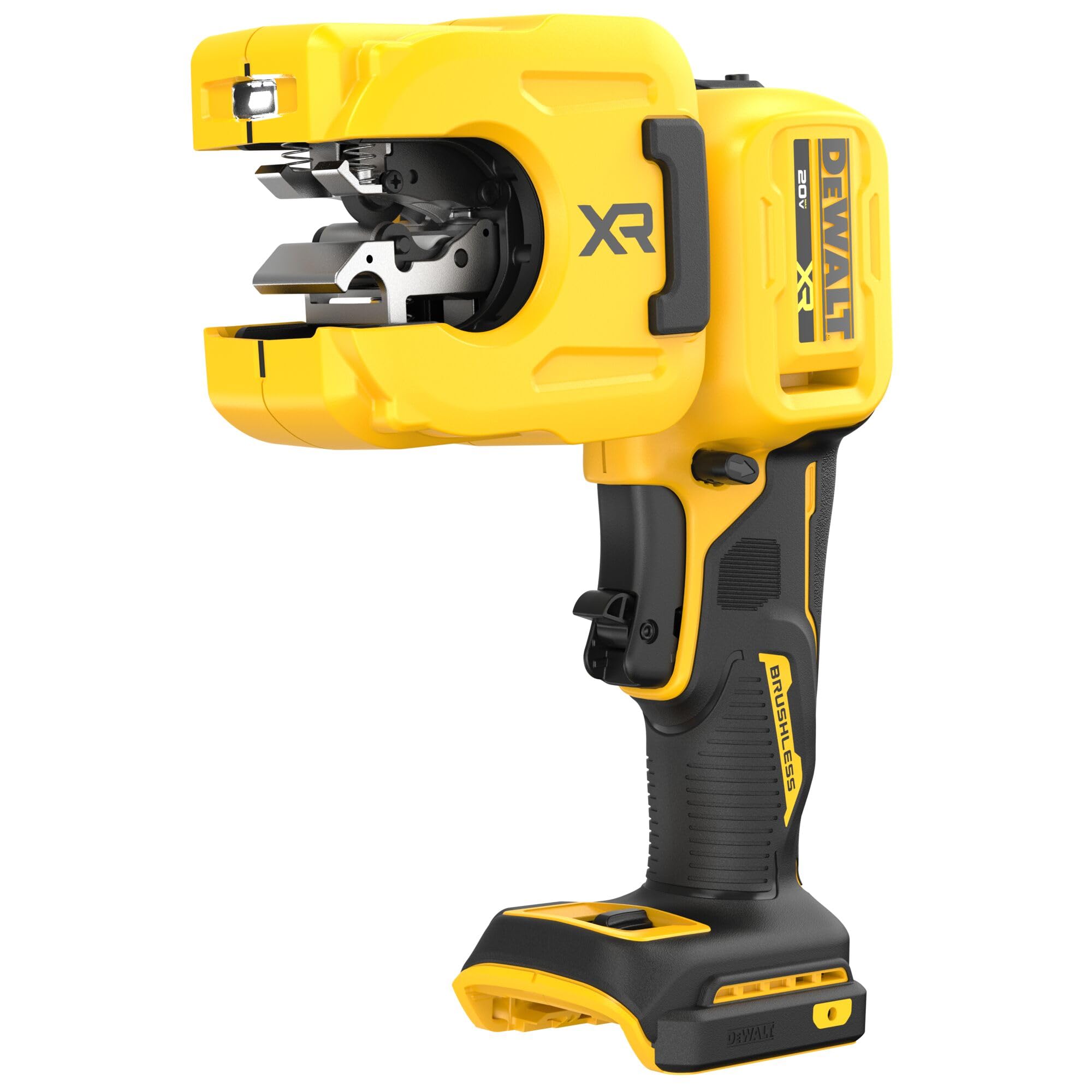
A cordless copper cutter that claims a cut in as little as 1.2 seconds and up to 550 cuts per charge.
Speed is the pitch here, and DEWALT rates it at 1.2 seconds per cut and up to 550 cuts per charge. It handles 1/4-inch to 1-1/4-inch type K, L, and M hard and soft copper. The auto-size cutting head means you move between pipe sizes without swapping parts, and the pivoting head rotates 90 degrees so you can aim the cut at awkward angles.
Versus the Milwaukee 2471 above, DEWALT claims it cuts up to 2 times faster than the Milwaukee 2471 M12 and needs 46% less cut clearance than the Milwaukee 2471-20. Those are manufacturer figures, not independent tests, but they point at the same idea: the DEWALT reaches tighter and cuts quicker. A variable-speed trigger lets you dial the speed to the metal, and an onboard LED lights dim work. Like the Milwaukee, it is a bare tool — the listing is the cutter only.
Fit is where it stumbles. Some buyers find the cutting wheel too small for the job, and cut quality opinions split against that. Speed and value read as the strong points, and the swivel head draws approval from buyers reaching tight spots. At 3.8 pounds it is slightly heavier than the Milwaukee’s 16 ounces, and that extra mass is the trade for the wider 1-1/4-inch ceiling.
What the spec sheet promises
- 1/4-inch to 1-1/4-inch capacity on K, L and M copper
- 1.2-second cuts and up to 550 cuts per charge, per the maker
- Pivoting head rotates 90 degrees for tight angles
- Auto-size head skips the part changes between sizes
What buyers push back on
- The cutting wheel is too small for some buyers’ taste
- Cut quality opinions are mixed, not unanimous
- Bare tool only — no battery in the box
Good fit for: high-volume copper work where seconds per cut add up and you already run 20V MAX batteries.
Less ideal for: anyone expecting factory-perfect cuts on every pipe or who has no DEWALT battery on hand.
8. WHEELER-REX 4992RED Tubing Cutter
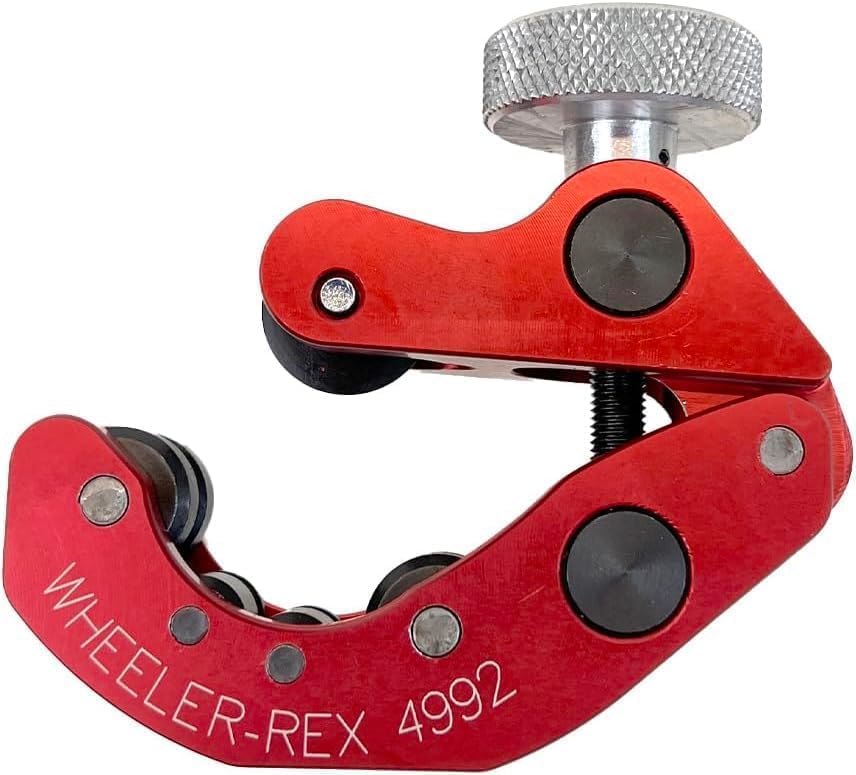
A 1.5-pound cutter that gets its nose into the corner where full-size bodies cannot go.
Tight spaces are this tool’s whole reason to exist. The close-quarters body reaches around pipe in the 1/4-inch to 2-3/8-inch outside-diameter range, covering the small copper and plastic lines that run behind cabinets and against framing. At 1.5 pounds it is the lightest hand cutter on this list — lighter than the 2.5-pound Reed and the 3.7-pound RIDGID 154 — and that matters when you are reaching into a corner with one arm.
Buyers praise the build quality most, calling it well made and worth the money. The tight-space performance earns its own approval, which is exactly what the design promises. It is a Limited Red Edition, and the maker’s warranty runs 12 months.
The recurring caution is durability: the knurled nut, handle, and trim rod are the parts owners mention coming loose during use. Cutting performance gathers mixed notes, with clean cuts for some and a slightly sloppy edge for others. Treat the fasteners as something to check before each job — a quick tighten keeps the tool honest.
The corner specialist: 1.5 pounds and a close-quarters body make it the pick for reach that other cutters cannot manage.
The fastener check: the knurled nut, handle, and trim rod are the parts that work loose, so a pre-job tighten is worth the ten seconds.
Choose it when: the pipe is boxed into a corner and a full-size cutter will not fit round it.
Steer past it when: you want a set-and-forget cutter for open-bench work where a heavier body is no problem.
9. Baileigh Tube and Pipe Notcher (TN-250)

A bench notcher that pivots 220 degrees so you can attack a notch from the back side.
This is shop equipment, not a hand tool. The carriage pivots up to 220 degrees left to right, which lets you cut from the back side of a notch — the move that hand notchers cannot make. The patented self-centering vise clamps anywhere on the tube, including the middle of a bend, and two slotted mounting rails move up and down on scales for offset notches up to 1 inch.
The backbone is 0.75-inch steel plate, and the all-interlocking components are built to create a rigid platform that reduces vibration and prolongs hole-saw life. A 1.25-inch Thompson shaft rides in sealed, oiled needle bearings for smooth travel, and a large engraved angle finder keeps back-side notches lined up. The fully adjustable axis takes almost any notch combination. Hole saws are sold separately, and the maker’s warranty runs 1 year.
It is the heaviest and most expensive tool here, and it is meant to be — a bench notcher at this scale is for repeat fabrication, not a weekend joint. The 24 by 18 by 6-inch footprint wants permanent bench space. If your work is occasional, a drill-driven notcher like the Jeremywell above covers the same joint for far less bench real estate.
Where the money goes: a 220-degree pivoting carriage and self-centering vise turn awkward back-side notches into a repeatable setup.
The space question: a 24 by 18 by 6-inch footprint wants a dedicated bench — this is not a tool you tuck in a drawer between jobs.
Built for: fabrication shops that cut the same saddle joints week after week and want the angle to repeat exactly.
Overkill for: one-off joints or a home bench where the tool has to share space with everything else.
Know the Specs
Cut capacity (O.D. range)
The outside-diameter range is the span of pipe the cutter’s wheel can reach. A 1/4-inch to 1-1/4-inch rated cutter covers small copper lines; a 1-7/8-inch to 4-1/2-inch rated tool reaches drain-size pipe. Always check both ends of the range, because a wide top end often means the tool cannot close tightly on the smallest lines. Match the range to your biggest pipe first, then confirm the small end covers your tightest work.
Screw feed versus quick release
A screw feed tightens the wheel with a knob you wind by hand, which gives fine control and suits mixed metal sizes. A quick-release or quick-acting design opens and reseats without unwinding the knob, which speeds up repeat cuts. Screw feed is steadier on hard metals; quick release is faster when you move the tool from pipe to pipe. Neither is better overall — it depends on whether you value control or speed.
Cordless cutters and battery platforms
A cordless cutter spins the wheel with a motor so your hand only guides it. That saves wrist strain on long runs, but the tool usually ships as a bare tool, meaning you supply the battery from that brand’s lineup. Check which batteries fit before ordering, and weigh the battery cost against the time you will save. Hand cutters need no battery and no charging, which suits occasional jobs.
Notchers and hole-saw compatibility
A notcher uses a hole saw to cut a saddle into a tube end for welding. It does not shorten pipe. The thread adapter on the spindle determines which hole saws fit — 5/8-18 UNF internal and 1/2-20 UNF external threads on the Jeremywell, for example — and you size the saw to the outside diameter of the mating tube. Hole saws are commonly sold separately.
Common Questions
Can a tubing cutter handle both copper and PVC?
What is the difference between a tube cutter and a tube notcher?
How do I know which O.D. range I need?
Do cordless tubing cutters come with a battery?
Why does my cutter leave a slanted or oval end?
How much clearance do I need around a pipe to cut it?
Can I cut thin-wall steel with a copper tubing cutter?
How long do cutting wheels last and can I replace them?
What kind of drill does a tube notcher need?
Is a bench-mounted notcher worth it over a drill-driven one?
The Bottom Line
For most people working plastic pipe, the tube cutting machine worth grabbing first is the Reed TC3QP — a hand-powered quick release that covers 3/8-inch to 3-1/2-inch O.D. and cuts PE, PB, and ABS cleanly without a battery. If your work is metal, the RIDGID #30 takes copper, brass, aluminum, and thin-wall steel in one compact body. And when you are joining round tube for welding rather than shortening it, the Jeremywell notcher turns a drilled saddle into a measured joint. Whichever you pick, check the small end of the O.D. range against your tightest pipe before you order — that one number decides whether the tool works on day one.
How we choose
We do not accept paid placement. Every pick is matched to a real buyer and a real use-case; we do not hands-on test units.
Sources
Specifications: manufacturer listings and product documentation. Review insights: verified customer reviews, as of November 2026. Pricing: not shown on this page (it changes often); check the current price via the retailer link.
As an Amazon Associate, Tactical Gear Guy earns from qualifying purchases. This does not affect which products we feature.