Specs are compiled from manufacturer listings and verified buyer reviews and can change over time — please confirm the key details on the product page before buying.
A triathlon wetsuit is not a surfing suit with a different label on it. The neoprene is built to lift your hips, cut drag through the water, and peel off your shoulders in seconds when you hit T1. Get the thickness, the sleeve cut, and the size wrong, and you will spend your whole swim fighting the suit instead of the water. This guide walks through eleven real neoprene options, from sleeveless warm-water suits to full 5mm buoyancy machines, so you can match one to your race, your water temperature, and your budget tier.
This guide is built by comparing the manufacturers’ published specifications and the patterns across verified customer reviews, so you get each pick’s real strengths and trade-offs instead of marketing spin.
Thickness, sleeve type, and buoyancy placement do more for your swim than any logo on the chest. Here is how to pick the right triathlon neoprene suit without wasting a race entry on the wrong fit.
Top Picks


How To Choose The Best Triathlon Neoprene Suit
The mistake most first-time triathletes make is buying a wetsuit the way they buy a t-shirt: pick a size, hope it fits. A triathlon wetsuit has to feel tight on dry land and loosen up the moment it hits water. If it feels roomy in the store, it will balloon full of water on the swim.
Match thickness to water temperature, not to how tough you think you are
Neoprene thickness is measured in millimeters and it controls two things at once: warmth and buoyancy. A suit with 5mm panels in the chest and upper legs floats your hips into a more horizontal position, which is why cold-water and beginner suits use them. A 3mm core keeps you lighter and more mobile, which suits warmer races and stronger swimmers. Many suits mix the two — a thick core with thinner 2mm arms and shoulders — so you get lift where you need it and stretch where you stroke.
Sleeveless versus full sleeve is a temperature and shoulder decision
A sleeveless suit opens up ventilation and frees your stroke, which makes it the sensible pick for warm-water races and anyone who hates the feeling of neoprene clamped around the arms. A full-sleeve suit seals out cold water and adds buoyancy down the arms, but it puts more material between you and a smooth catch. Both are legal for WTC (Ironman) and USAT racing when the brand says so, so the choice is comfort, not legality.
Read the size chart by height and weight together
A wetsuit size is not a number you can guess. Manufacturers publish height and weight ranges because both matter — a tall, light swimmer and a short, heavier swimmer can wear the same labelled size for completely different reasons. If you land between two sizes, the common guidance on performance-fit suits is to take the smaller one. That is what stops water from pooling at your lower back and dragging through the swim.
Look at the collar, the zipper, and the seams
The neckline is where most wetsuit misery lives. A soft low collar with SmoothSkin on both sides cuts the choking and chafing that full-sleeve suits are known for. A rear anti-corrosion YKK zipper lies flat against your back, opens fast in transition, and resists the corrosion that kills cheaper hardware. Bonded and stitched seams hold panel junctions together over a season of races instead of splitting on the first pull.
Side-by-Side Comparison
| Model | Best For | Thickness | Sleeve Type | Material | Amazon |
|---|---|---|---|---|---|
| XTERRA Men’s Volt Full Body★ Best Overall | All-round open-water racing | 3mm | Long sleeve | Neoprene | Amazon |
| TYR Men’s Hurricane Cat 1Warm-Water Pick | Warm-water races | — | Sleeveless | — | Amazon |
| TYR Women’s Hurricane Cat 1Women’s Value Pick | Women’s warm-water racing | — | Sleeveless | — | Amazon |
| Zoot Men’s Maui | First-timers in warm water | 5mm chest / 3mm lower back legs | Sleeveless | Neoprene blend | Amazon |
| XTERRA Women’s Volt Sleeveless | Women’s training and racing | 3/2mm | Sleeveless | Neoprene | Amazon |
| ORCA Men’s Vitalis Hi-Vis | Open water with boat traffic | 2.5mm Yamamoto 38 | Long sleeve | Neoprene | Amazon |
| Synergy Women’s Volution Full | Women’s full-sleeve comfort | 3mm | Long sleeve | Neoprene | Amazon |
| XTERRA Men’s Vortex Full | Training and racing all-rounder | — | Long sleeve | Neoprene | Amazon |
| Synergy Men’s Endorphin Full | Cold-water maximum buoyancy | 5mm core / 3mm legs / 2mm arms | Long sleeve | Neoprene | Amazon |
Detailed Reviews
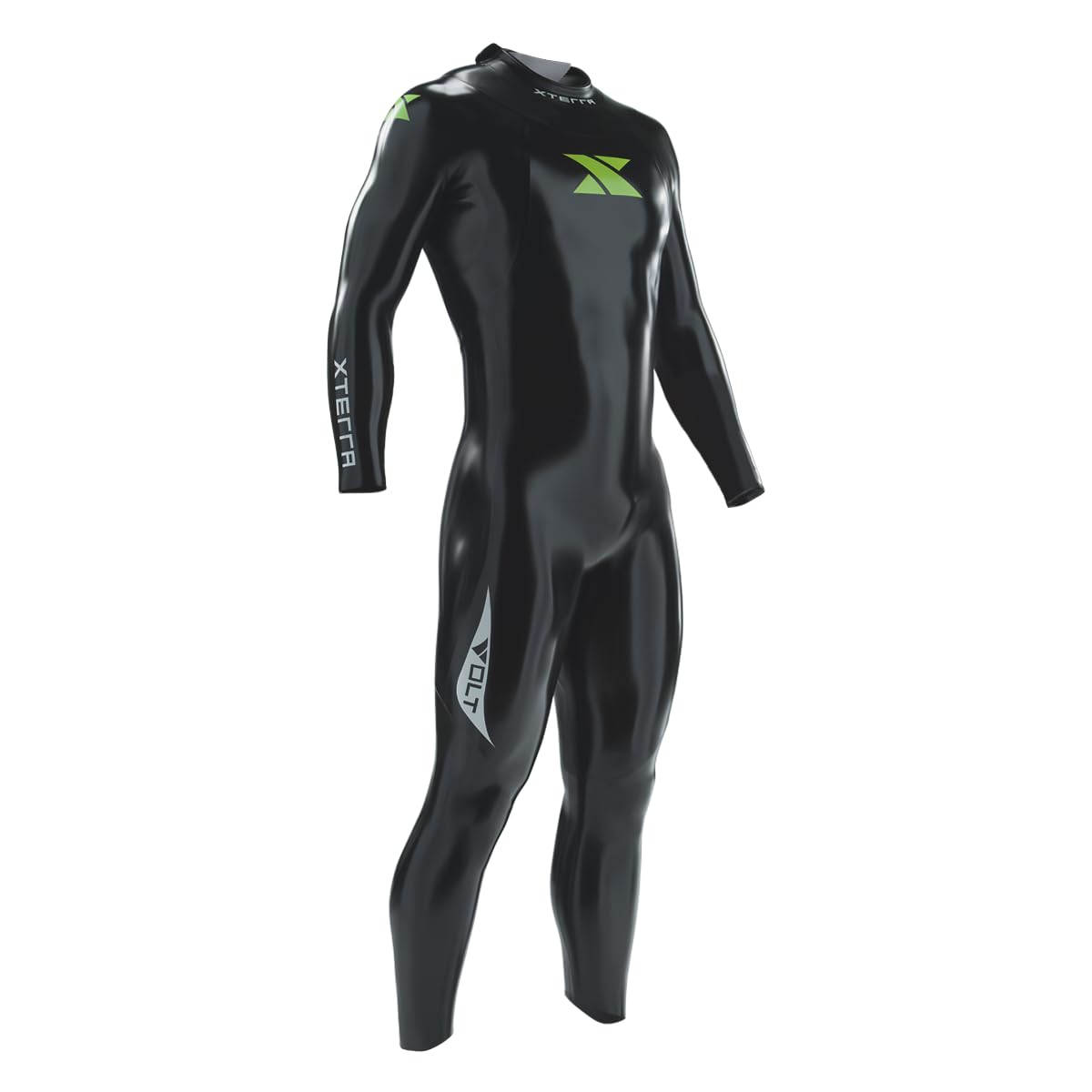
1. XTERRA Men’s Volt Triathlon Wetsuit Full Body
Our pick — 4.5+★ from 70+ verified ratings; the strongest balance of quality and price.
A 3mm full-body suit that keeps water out and keeps its shape race after race.
The Volt is the suit to buy if you want one wetsuit that handles training swims and race day without a second thought. It runs 3mm neoprene through the body, which is a middle-weight build — thin enough to let your shoulders roll, thick enough to hold warmth on a cool morning start. The X-SLICE coating on the outside is there to reduce drag, so you cut through the water instead of catching on it. That is the difference between gliding and dragging through a 1.5km swim.
What wins people over is the build quality — it comes through as the clear leader in owner satisfaction, with fit right behind it. The X-FLEX liner stretches in four directions and snaps back to its original shape, so the fit you get on day one is still the fit you get at the end of the season. Warmth gets steady praise too, and owners describe it as just the right amount of insulation rather than a suit that cooks you on a mild morning. The one thing buyers keep coming back to is how it keeps sloshy water from pooling inside — that sealed-in feel is what makes a wetsuit feel fast.
The catch is that 3mm is not a cold-water thickness. If you race in genuinely frigid lakes, you are better served by a 5mm-core suit like the Synergy Endorphin, which says outright that it creates nearly double the buoyancy of 3mm suits. For most age-groupers in mild-to-cool water, though, this is the balance point. A crowd of buyers agrees — it sits at the top of this list on both score and the sheer number of people who came back happy.
What earns the top slot
- 3mm neoprene gives you warmth without locking up your stroke
- X-FLEX liner holds its shape and fit over time instead of stretching out
- Seals sloshy water out so the suit stays snug through the swim
- X-SLICE coating cuts surface drag for a faster glide
Where it asks something of you
- 3mm is not built for genuinely cold water — go thicker for frigid races
- It has to fit snug, so ordering the correct size off the chart is on you
Best fit for: the age-grouper who wants one dependable full-body suit for mild-to-cool open water, training and race day alike.
Think twice if: your races run cold — that is 5mm territory, not 3mm.
2. TYR Men’s Hurricane Wetsuit Cat 1 Sleeveless
A sleeveless cut that frees your arms when the water is warm enough to skip sleeves.
If your race calendar leans toward warm-water swims, the Hurricane Cat 1 makes the case for going sleeveless. The cut removes the neoprene around your arms entirely, so your stroke stays unrestricted and heat has somewhere to escape. That matters on a summer race where a full-sleeve suit turns the swim into a sauna. TYR also states plainly that all Hurricane wetsuits are WTC (Ironman) and USAT legal, so you do not have to second-guess whether it passes the gate check.
You get a strong buyer score here, drawn from a smaller pool of owners — the clean, focused feedback you get when a suit does one job well. This is the men’s version of a design TYR makes for both sexes. TYR keeps the description short: no flashy thickness number and no long list of coatings. What you are buying is the sleeveless format from a swim brand with a deep competition pedigree. That is exactly what a warm-water triathlete needs, with your arms free to stroke.
Where it gives up ground is cold water. Sleeveless means exposed arms, and exposed arms mean you feel a frigid lake fast. Unlike the full-sleeve XTERRA Volt above, which wraps your arms in 3mm, this suit asks you to trust the water temperature. For a warm race, that is a smart trade; for an early-season cold swim, it is the wrong tool.
Why it works: the sleeveless format frees your stroke and dumps heat on warm race days, and the WTC / USAT legality is spelled out so check-in is not a gamble.
The honest limit: no arm coverage and no stated thickness — it is built for warm water, not cold.
Reach for this if: your races run warm and you want your arms completely free to breathe and pull.
Look elsewhere if: cold water is on your calendar — you want sleeves.
3. TYR Women’s Hurricane Wetsuit Cat 1 Sleeveless
The women’s version of TYR’s sleeveless race suit, built around a female fit.
This is the same sleeveless Hurricane Cat 1 formula as the men’s cut, shaped for a woman’s frame. The value here is straightforward: you get a competition-legal wetsuit with no sleeves and a lower stated weight — TYR lists the packaged weight at 3 pounds — so it travels light in a race bag. Sleeveless keeps your arms free, which is the whole point on warm-water courses, and the WTC (Ironman) / USAT legal note applies here too.
This women’s version sits a notch lower than the men’s cut — still a solid rating, just from a smaller and slightly more divided sample of buyers. The design is not trying to be a cold-water suit. So the honest read is that most of the spread depends on individual fit, not any structural knock. If you are shopping this tier, treat the size chart as the deciding document, not the star count.
You are really choosing two things here: the sleeveless format and a women’s-specific shape. Mild swims with maximum arm freedom are what it delivers. If the water runs cold, the full-sleeve options in this guide will serve you better.
The case for it: a women’s-specific sleeveless cut that is legal for Ironman and USAT, light in the bag at a stated 3 pounds, and free through the arms.
Worth knowing: it is a warm-water tool with no stated thickness, and the size chart is the real decision-maker.
Pick this for: women racing mild-water triathlons who want their arms unhindered and their suit carry light.
Skip if: you need arm coverage for colder swims.
4. Synergy Men’s Volution 3/2mm Triathlon Wetsuit Shorty
class=”whk-product-body”>
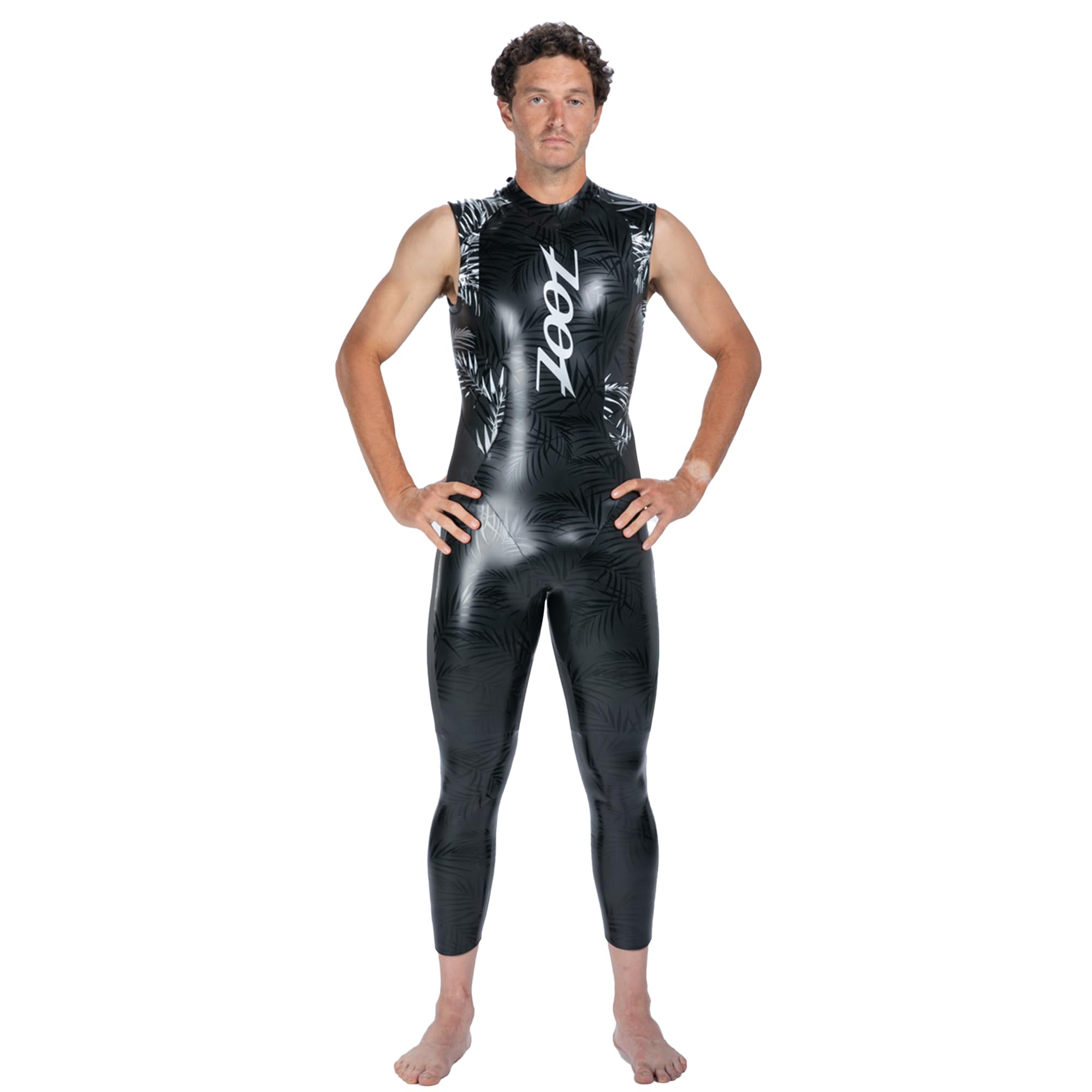
5mm of lift in the chest with no sleeves — a buoyancy-first suit for new swimmers.
Your hips get lifted toward a horizontal swim line, so you spend less energy keeping your legs up. That comes from 5mm neoprene through the chest and upper front legs — the buoyancy engine — plus 3mm Neoskin in the lower back legs. Zoot calls the Maui its most accessible wetsuit, and that layout backs the claim. The 5mm front panel is the number that sets the Maui apart: next to the full-body XTERRA Volt at 3mm, that is a meaningful step up in flotation thickness. It suits a newer swimmer who fights to stay level.
The sleeveless design adds ventilation and frees your stroke, which is the right pairing with a thick core — you get the lift without sleeves pinning your arms. The Neoskin SCS coating is a hydrophobic (water-repelling) skin that reduces surface drag and resists wear, so the suit slides through the water and takes a beating without fraying. Flatlock stitching and a silky nylon liner round it out to keep chafing down. Zoot also covers it with a warranty against material and workmanship defects.
The trade-off is the sleeveless nature itself. It is built for warm-water races, so the ventilation that makes it comfortable on a hot day is the same openness that leaves your arms exposed on a cold one. And if you are between sizes, Zoot’s own guidance is to take the smaller one for a performance fit — so measure honestly.
The buoyancy story: 5mm chest and front-leg panels push your hips up, and the Neoskin SCS coating cuts drag and fights wear — a smart starter that floats.
The warm-water caveat: sleeveless construction leaves your arms bare, so it is a mild-water suit, not a cold-lake one.
Go here if: you are a newer triathlete who fights to keep hips up, racing in warm water.
Heads-up: between sizes, size down per Zoot’s performance-fit guidance.
5. XTERRA Women’s Volt Triathlon Sleeveless Wetsuit

XTERRA’s women’s sleeveless take on the Volt, trimmed to a 3/2mm build.
The women’s Volt carries the same X-FLEX liner DNA as the men’s full suit, but here it is shaped to a female frame and pared to a 3/2mm sleeveless design. That build is meant to give you flexibility and buoyancy without sleeves. XTERRA says it tested the suit on four things — comfort, speed, buoyancy, and value — and the 3/2mm layout is the compromise that hits that spread. The X-FLEX liner stretches in all four directions and returns to its original structure, so the suit keeps its shape instead of bagging out over a season.
Comfort is the theme that carries this suit, with range of motion and ease of use right alongside it. Owners love how easy it is to get on and off, and one sums it up as perfect movement while swimming. That low effort matters in transition, where you are wet and rushed. The neck is the soft low type, which cuts the choke factor a sleeveless suit can otherwise carry.
Now the fit note, stated plainly: fit is the most-discussed topic here, and it is genuinely split — plenty love it, but a real share of buyers find it runs too small. This is a women’s-specific sizing issue, not a knock on the suit’s design, and the fix is the same as with any neoprene: follow the height and weight chart and do not size down on a hunch. Get the size right and the comfort and ease are exactly what the format promises.
Comfort first: buyers call out the easy on-off and free range of motion — the liner and sleeveless cut make it a low-fuss suit that is quick through T1.
The sizing truth: fit is the big debate and runs small for a real share of buyers, so let the chart decide.
For: women who prioritize comfort and quick transitions in mild-water races.
Size carefully: account for a tight cut on a women’s frame before you commit.
6. ORCA Men’s Vitalis Openwater Hi-Vis Wetsuit

A full-sleeve open-water suit in high-vis orange so boats and swimmers can spot you.
Boats, surfers, and other swimmers can spot you easily, because the Vitalis is built in high-visibility orange for open-water safety. Most wetsuits are black, which is fine until you are bobbing in open water near boat traffic and no one can pick you out. If you train or race in a busy harbor or a lake with powerboat traffic, that visibility is not cosmetic. It is a real open-water feature the all-black suits in this guide simply do not offer.
The material is ORCA’s 2.5mm Yamamoto 38 neoprene, used in the torso and legs. That thickness sits on the lighter side — it provides buoyancy plus thermal insulation without the bulk of a 5mm core. Highly elastic materials throughout give you a flexible, free-feeling swim stroke, and the sleeves let the suit hold a bit of warmth that a sleeveless design would lose. ORCA also backs it with a 3-year manufacturer warranty, the longest coverage in this guide.
What you give up with 2.5mm is the maximum-flotation feel of a thick-core suit. It is a buoyant, flexible open-water suit, not a dedicated cold-water buoyancy machine. Runners and swimmers who want warm, big-lift panels should look at a 5mm-core option instead. But for open-water confidence with genuine visibility, the Vitalis fills a slot nothing else here does.
what separates it: it moves with you while keeping you seen — a high-vis orange build with elastic 2.5mm Yamamoto 38 torso and leg panels, plus a 3-year manufacturer warranty. That makes it a safety-first open-water suit.
The trade-off: 2.5mm is light on buoyancy compared to thick-core suits, so it favors flexibility over maximum flotation.
Best for: open-water swimming where being seen by boats matters as much as swimming fast.
Not your suit if: you want the biggest buoyancy lift a wetsuit can give.
7. Synergy Women’s Volution 3/2mm Full Sleeve Wetsuit

The women’s full-sleeve suit that treats the neck as the thing worth fixing.
Full-sleeve wetsuits have a reputation: they strangle your neck and slow your catch. The Volution is designed around both problems. The SmoothSkin low-neck collar lines the inside and outside of the neckline to cut the chafing and choking that full suits are known for, and the high-stretch PowerMAX arm panels leave your catch and pull unrestricted. A 3/2mm SmoothSkin neoprene core panel through the chest and back adds lift and warmth, so you get buoyancy without the sleeves fighting your stroke.
The details show up in the transition. An anti-corrosion internal YKK zipper lies flat against your back to reduce drag and open fast, so you are not wrestling your suit in T1. Stitched and bonded seams reinforce every panel junction for durability and a smooth surface through the water. Quality is what owners celebrate — it is the suit’s strongest feedback theme by a wide margin — with warmth and comfort close behind, and flexibility getting its own share of praise. Synergy also provides a full size range with height and weight guidance to help you order right the first time.
The honest note on this one: fit is genuinely mixed. Some women find it fits beautifully, but others report it running small in the arms, and a share of buyers mention durability concerns. Treat the sizing as the deciding factor — a snug-on-land, releases-in-water fit is what Synergy tells you to expect, and the chart explains it. This is a premium women’s race suit, and it is worth taking the time to size it right.
Why women pick it
- Soft SmoothSkin low-neck collar kills the choke and chafe of full sleeves
- PowerMAX arm panels keep your catch and pull unrestricted
- Quality and warmth are the big, consistent feedback wins
- Fast-opening YKK zipper makes T1 smoother
Fit and durability to weigh
- Fit is mixed — some women report tightness in the arms
- A share of buyers mention durability concerns
Suits: women who want full-sleeve warmth without a strangled neck, and priorities a soft collar and free arms.
Be ready to: nail the size off the chart and check the arm fit expectations before committing.
8. XTERRA Men’s Vortex Triathlon Wetsuit Full

A full-body suit built for the athlete who trains and races in the same wetsuit.
XTERRA pitches the Vortex as an all-around wetsuit — the one you wear for training swims and race day without wanting to swap. It is the advanced sibling of the Volt, with X-FLEX Liner 2.0 through the interior for smoother transitions and upgraded neoprene aimed at more flexibility and buoyancy. The full-body coverage means sleeves and legs, which gives you the warmth and float of a complete suit for athletes who want one tool for the whole season.
Owners consistently land on the same two notes: quality and fit. The quality feedback is the suit’s biggest satisfaction theme, and fit follows it closely. Customers note it keeps the body warm, including protection against cold water and slimy seaweed on open-water swims. Value for money is the other recurring theme — this is a mid-range suit that buyers feel delivers what they paid for, without the premium tags of the Endorphin line. For a men’s full-body wetsuit, that combination is exactly what an all-rounder should be.
Where it sits relative to the Volt above is the useful contrast. The Vortex is the more advanced build with the updated liner, and it targets the same multi-use role with upgraded internals. If a full-body suit at mid-range value is your lane, the Vortex is a strong, well-reviewed fit.
What it delivers: upgraded X-FLEX Liner 2.0, full-body neoprene, and the flexibility and buoyancy to train and race in one suit — quality and fit are its strongest feedback.
The context: it is an all-round full suit, not a maximum-buoyancy model — for that, look to the Endorphin.
Choose it if: you want one full-body wetsuit to cover both training and racing with upgraded internals.
Go thicker if: your priority is the biggest flotation lift, not all-around flexibility.
9. Synergy Men’s Endorphin Full Sleeve Wetsuit

A 5mm-core full-sleeve suit that floats you high enough for cold-water racing.
The Endorphin is the buoyancy machine of this list. Synergy builds it with a 5mm core panel, 3mm lower legs and back, and 2mm arms and shoulders — a layered build that puts the thickest material where it lifts and the thinnest where you need to move. Synergy states 5mm is the maximum thickness allowed in triathlon wetsuits, and claims it delivers nearly double the buoyancy of 3mm suits, which the brand does not recommend for cold water. That makes this the suit to reach for when the water is genuinely cold and staying afloat requires effort.
The material is Yamamoto #39 neoprene with SCS silicone-coated SyPrene, and Synergy claims 680 percent flexibility. A soft low neck with SmoothSkin on both sides keeps the choke down, and the anti-corrode internal YKK zipper cuts drag and resists corrosion. Quality is the suit’s strongest theme by a clear margin, and it is backed by a 2-year warranty with product registration — a step beyond the single-year coverage many brands offer.
Two honest notes. Fit is mixed — some find it amazing, but tightness around the neck comes up — and value is debated, with some buyers feeling it should sit in a lower price tier. Neither is a design failure; they are fit and expectation notes. Size it right and the cold-water buoyancy is exactly why you buy a 5mm suit.
The cold-water case: 5mm core with 3mm legs and 2mm arms gives the strongest flotation build here, in Yamamoto #39 with a 2-year warranty.
The honest caveats: fit is mixed and neck tightness comes up — and value draws debate, so go in expecting a premium-tier purchase.
Made for: cold-water triathletes who want maximum buoyancy and warmth from a layered full sleeve.
Check before you buy: neck fit and the price-tier expectation, since both draw mixed feedback.
Know the Specs
Neoprene thickness in millimeters
Thickness is the number that controls warmth and lift. A 5mm panel floats your hips higher and holds more heat, which is why cold-water and beginner suits lean on it. A 3mm or 2.5mm build stays lighter and more mobile for warm water and strong swimmers. Many suits layer it — thick in the core, thinner in the arms and back — so you get flotation where it helps and stretch where you stroke. Thicker is not automatically better; it is warmer and more buoyant, but heavier and less flexible.
Sleeve type: sleeveless versus full sleeve
Sleeves seal out cold water and add buoyancy down the arm, but they put material between you and a clean catch. A sleeveless cut opens ventilation and frees your stroke, which suits warm-water races. The right choice tracks the water temperature and your own stroke comfort, not a ranking. Sleeveless is not a downgrade — it is a different tool for a different condition.
Buoyancy panels and placement
Buoyancy panels are the thick neoprene zones placed to lift specific parts of your body— most often the chest and upper legs, to push your hips into a horizontal swim line. A suit with a 5mm core panel and thinner 3mm legs is engineered to lift you where you fight to stay level. Placement matters as much as thickness: panels that lift the hips and chest do more for a freestyle swim than bulk spread evenly around the suit.
Collar, zipper, and seam construction
The neckline is where a wetsuit succeeds or fails on comfort. A soft low collar with SmoothSkin on both sides reduces the choking and chafing full-sleeve suits are known for. A rear anti-corrosion YKK zipper lies flat to cut drag, opens fast in transition, and resists the corrosion that stiffens cheap hardware. Bonded and stitched seams keep panel junctions together across a season of races instead of splitting on the first hard pull.
Common Questions
How do I know a triathlon wetsuit will fit me if I order online?
Is a 5mm wetsuit better than a 3mm wetsuit for triathlon?
Should I choose a sleeveless or full-sleeve triathlon wetsuit?
What does WTC and USAT legal mean on a wetsuit?
How should a triathlon wetsuit feel when I first put it on?
Why does my wetsuit choke me at the neck?
Will a triathlon wetsuit keep me warm in cold water?
What is a YKK zipper and why does it matter on a wetsuit?
How do I take care of a neoprene triathlon wetsuit so it lasts?
The Bottom Line
For most triathletes, the triathlon neoprene suit worth reaching for first is the XTERRA Men’s Volt Full Body. It fits the widest range of open-water races, balancing a 3mm neoprene build for warmth and mobility with a shape-holding X-FLEX liner and a drag-cutting X-SLICE coating. If you race warm water and want your arms completely free, the TYR Hurricane Cat 1 Sleeveless is the clean pick. And if the water on your calendar runs genuinely cold, the Synergy Men’s Endorphin puts a 5mm core under you for the biggest buoyancy lift here — the brand’s own words say 5mm is the maximum allowed in triathlon.
One thing worth saying plainly: the price tiers are not the whole story. The Volt at the top of this list earns its place on real owner satisfaction. The step up to a 5mm Endorphin is about cold water, not about buying “better.” Match the suit to your water temperature, your stroke, and a size you nailed off the chart. Then the suit works with your stroke instead of against it.
How we choose
We do not accept paid placement. Every pick is matched to a real buyer and a real use-case; we do not hands-on test units.
Sources
Specifications: manufacturer listings and product documentation. Review insights: verified customer reviews, as of November 2026. Pricing: not shown on this page (it changes often); check the current price via the retailer link.
As an Amazon Associate, Tactical Gear Guy earns from qualifying purchases. This does not affect which products we feature.