Specs are compiled from manufacturer listings and verified buyer reviews and can change over time — please confirm the key details on the product page before buying.
If you are cutting a water line, burying conduit, or setting a French drain, the shovel in your garage is probably the wrong tool. A wide round-point spade makes a messy, V-shaped hole. A proper trench digging shovel cuts a narrow, straight-sided channel that pipe actually sits inside. This guide points you at nine picks worth owning, sorted by what they do best.
This guide is built by comparing the manufacturers’ published specifications and the patterns across verified customer reviews, so you get each pick’s real strengths and trade-offs instead of marketing spin.
Blade width, handle length, and how the steel is cut matter far more than brand badges. Below you will find the trench digging shovel that fits your soil, your back, and the width of channel you actually need.
Top Picks


How To Choose The Best Trench Digging Shovel
The wrong shovel turns a twenty-minute trench job into an afternoon of chopped roots and a wobbly, widened ditch. Pick right and the blade tracks straight and the spoil piles up where you want it. Here are the five things that actually decide whether a trenching shovel works for you.
Blade width sets your trench width
A narrow trenching blade runs about 4 to 5 inches across, which is wide enough for irrigation pipe and still tight enough to keep backfill small. A wider blade makes a big hole you then have to fill. If you only ever run drip line or low-voltage wire, a narrower blade is easier to keep straight.
Steel gauge and blade material
Gauge is the thickness rating for sheet steel — a lower number means thicker steel. A 14-gauge blade is heavier stock than a 16-gauge blade, so it flexes less when it hits a rock. Tempered and high-carbon steels hold a sharper edge in gritty soil than plain metal, but they still need a wiping-down after wet ground.
Handle length and grip shape
The handle is your back-saver. A longer shaft cuts how far you bend, which matters when you are opening a run of trench across a yard. D-grips lock your hand in place for pushing; oversized ergonomic grips suit gloved hands and long sessions. Fiberglass handles shrug off rain and rot where wood eventually splits.
Foot steps and cutting edges
A forward-turned step gives your boot a flat ledge to press, so the blade sinks with your leg instead of your arms. Serrated or toothed blades slice roots and matted clay that a smooth edge just slides off. If you trench in rooted ground or hard clay, those teeth are the difference between cutting through and giving up.
Side-by-Side Comparison
| Model | Best For | Blade Width | Handle Length | Blade Steel | Amazon |
|---|---|---|---|---|---|
| VNIMTI Trench Shovel 56-Inch★ Best Overall | All-round trenching | 4 inches | 56 inches | Alloy Steel | Amazon |
| HANTOP Drain Spade 44-InchRoot Cutter | Roots and clay | 2 inches | 44 inches | 1050MN Steel | Amazon |
| TABOR TOOLS J213APrecision Pick | Tight spot work | 6 inches | 44.5 inches | Alloy Steel | Amazon |
| KOLEIYA Drain Spade 45-Inch | Hard clay and rocky soil | 5.3 inches | 45 inches | High Carbon Steel | Amazon |
| Truper Tru Pro California TRS-5CF | Confined commercial trenches | 5 inches | 48 inches | Alloy Steel | Amazon |
| Root Slayer 23711 | Irrigation and cable runs | 7 inches | 42 inches | Carbon Steel | Amazon |
| Bully Tools 92720 | Spoil removal | 4 inches | 47 inches | 14-Gauge Steel | Amazon |
| Seymour S702 | Heavy rock and clay | 5 inches | 48 inches | 14-Gauge Spring Steel | Amazon |
| Nupla SS14L-E Sharp Shooters | Sprinkler repair and planting | 4-3/4 inches | 48 inches | 16-Gauge Steel | Amazon |
Detailed Reviews
1. VNIMTI Trench Shovel
Our pick — 4.5+★ from 250+ verified ratings; the strongest balance of quality and price.
A four-inch V-blade on a 56-inch shaft — the width you want and the reach your back wants.
The blade is the story here: 4 inches wide with a V-shaped profile that funnels loose dirt out of the channel instead of smearing it back in. That narrow cut is what lets you lay irrigation line or low-voltage wire without a wide, sagging ditch to backfill. The head is high-strength alloy steel, and it is built to take a boot.
Then there is the length. At 56 inches overall, this is the longest handle among the 4-inch-blade picks here, and that extra shaft cuts how far you bend on every scoop. The fiberglass handle has a non-slip patch on top that turns tacky when wet, so a sweaty or rainy session does not turn into a slipping contest. At 3.5 pounds it is also the lighter end of the full-size group — the Seymour S702 and HANTOP both carry 4.4 pounds.
Buyers keep coming back to how solid it feels. Owners describe it as built like a tank, and that talk matches the thickness of the steel head. The honest catch is the head itself — the blade is narrow enough that some buyers find it too small a target to plant a boot on, so if you trench in rock-hard ground all day, size the head up. A few also note the weight in hand. Neither is a dealbreaker; both are worth knowing before you buy.
Where it earns its keep
- 4-inch V-blade cuts a clean, narrow channel for pipe and wire
- 56-inch fiberglass handle means far less bending per scoop
- Wet-tacky non-slip grip keeps your hand planted in the rain
- 3.5 pounds — lighter than the Seymour and HANTOP full-size spades
What to weigh first
- Narrow head gives a small target for your boot on hard ground
- Some find the in-hand weight noticeable on long runs
Grab this one if: you want one shovel for trenching, transplanting shrubs, and clearing ditches around the yard.
Think twice if: you trench in compact rock all day and need a broad step plate to drive the blade.
2. HANTOP Drain Spade Root Saw
Teeth on the blade — because roots and clay do not give up to a smooth edge.
This is the pick for ground that fights back. The reinforced blade carries serrated teeth, so it saws through roots and matted clay instead of bouncing off them. Owners find it strong in stubborn ground like Georgia clay and roots, and overall performance is the most-praised trait.
Two other things stand out. The blade is just 2 inches wide — the narrowest here by a wide margin, and the reason it slips into tight spaces and digs small, deep holes where a full-width spade will not fit. And those wide footsteps give your boot a flat ledge to push from, so your leg does the work. At 4.4 pounds it is on the heavier side, which is the trade for a head that takes real force.
Be honest about the steel. The durability reads mixed — many find it solid, but a few report it failing early under hard use. If you are trenching a one-off run in ordinary soil, that is unlikely to bite you; if you are a contractor abusing it daily, temper your expectations. The 44-inch fiberglass handle and D-grip make it comfortable for the homeowner digging a short run. Performance is what carries it.
Why it stands out: the serrated blade is the feature here — a smooth edge cannot cut roots the way teeth do.
Worth noting: at 2 inches wide it is a precision tool, not a bulk mover. You will be digging narrow and deep, not fast and wide.
Reach for this if: you trench through rooted ground, clay, or need to plant in tight spots the wider spades can’t reach.
Look elsewhere if: you want to move a lot of loose soil quickly — a broader blade is the better fit.
3. TABOR TOOLS J213A Trench Shovel
Two spades in one — a clean trench edge up top, a rounded tip down below.
You get two tools in one here: TABOR builds this as a trenching blade and a drain spade at the same time. The long blade has squared sides and a sharp pointed tip for cutting clean trench walls. A narrow head with slightly curved sides and a rounded tip handles spot work — adding flowers to a bed, clearing an existing trench, lifting small shrubs without tearing up the area around them. The J213A runs a 6-inch blade, against the 2-inch HANTOP, so it gives you more bite per scoop.
At 44.5 inches, the D-grip gives you room for a gloved hand plus a forward turned-step for boot pressure. The tempered steel head is powder-coated against rust, and a steel collar reinforces the joint where handle meets head. The fiberglass shaft won’t splinter the way wood does. What wins people over here is straightforward quality — that is the most-praised trait — with the lightweight feel and the value running close behind.
The catch shows up in hard use. Durability reads mixed, and a few report failures under serious ground. For a homeowner cutting a trench or tidying a bed, that is not likely to be your story; for heavy daily jobsite work, it is a limit to accept. Gardening utility is where it shines.
The practical read: one tool covers trench walls and transplanting, so you are not swapping spades mid-job.
Best fit for: the gardener who wants trenching and planting handled by one D-grip spade.
The limitation: the 44.5-inch reach is shorter than the 56-inch VNIMTI, so more bending on deep runs.
4. KOLEIYA Drain Spade
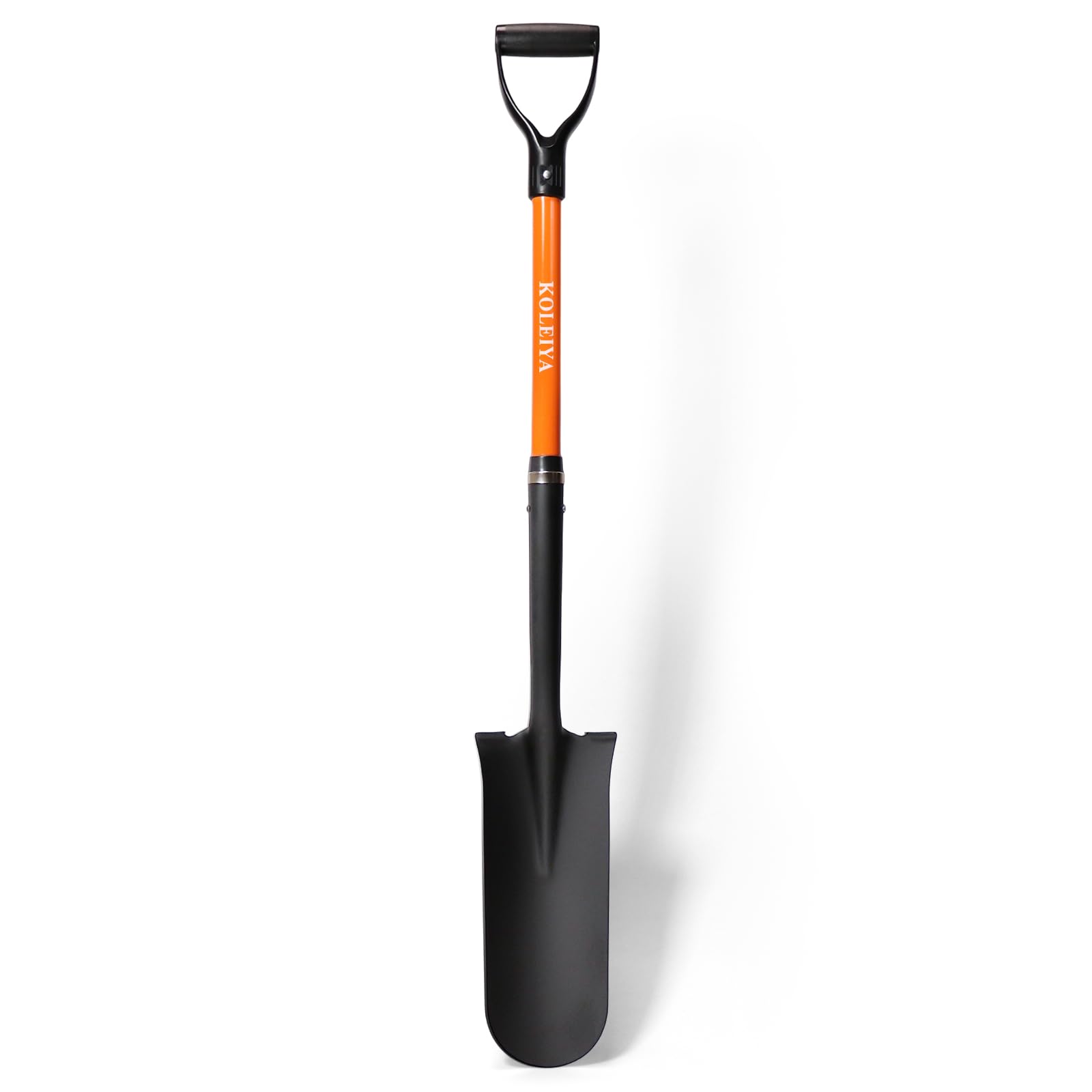
A reinforced steel head and footrest, built to take pressure in compact clay without folding.
When the ground is dense clay, rocky soil, or a nest of roots, the KOLEIYA is aimed straight at it. The high-carbon steel blade is long and narrow at 5.3 inches for precision digging in tight spaces, and the reinforced footrest lets you push down hard without the blade bending under you. The sharp tip slices through hard soil and clay instead of skidding off the top.
The 45-inch orange fiberglass shaft resists rust, rot, and breakage — the three ways wooden handles die — and the contoured D-handle gives a secure hold for extended sessions. It is balanced so it does not fight you, and the design is meant to suit users of different heights. Owners rate it sturdy, with quality and durability as the repeated words, and it does well in small, narrow spaces.
One thing this shovel asks of you: at 45 inches, it is a shorter reach than the 56-inch VNIMTI, so tall users on long trench runs will bend a bit more. That is the honest trade for a lighter, more controllable spade. Otherwise it is a solid all-rounder for trenching, planting, and drainage work.
The strengths
- Reinforced footrest drives the blade into compact clay without bending
- 5.3-inch narrow blade handles tight-space precision digging
- Fiberglass shaft resists rust, rot, and breakage
The honest trade
- 45-inch reach is shorter than the 56-inch VNIMTI — more bending for tall users
Go here if: your soil is compact clay or rocky and you want a blade that takes real boot pressure.
Skip if: you are over six feet tall and trenching long runs — the extra handle length on the VNIMTI will save your back.
5. Truper Tru Pro California Trenching Shovel

A 9-inch cushion grip and a reinforced socket — built for repeated digging, not one Saturday.
The details tell you who this is for. Truper fits a 9-inch non-slip cushion grip, which is a long handle-side handhold for repetitive digging, and reinforces the socket where blade meets shaft so hard leverage does not tear the joint apart. The California-style trenching configuration is cut for precision digging in confined, narrow work areas — between fence posts, along a foundation, down a utility trench.
The 5-inch alloy steel blade sits between the 4-inch picks and the wider drain spades. That makes it a jack-of-most-trenches width: wide enough to clear soil steadily, narrow enough to stay in a channel. The 48-inch fiberglass handle is weather resistant for jobsite use. Owners find it effective on narrow, shallow work, and praise the 5-inch blade width for trenching and planting.
Tall users bend less with this one: it measures 56.2 inches overall per the listing, against the 44 inches on the HANTOP. The trade-off is that a 48-inch handle with a 9-inch grip is a lot of shaft to swing. It is a professional’s tool, heavier in feel and less nimble than a compact spade. For a homeowner, that extra robustness goes mostly unused.
Built for repeat work: the reinforced socket and cushion grip target long sessions where joint failure is the real risk.
Honest limit: it is a professional’s spade — for one trench you may not need the durable socket at all.
Choose this for: repeated trenching in confined spaces, especially where you need a wide-ish 5-inch blade.
Not for you if: you want the lightest, most compact spade for occasional yard work.
6. Root Slayer 23711 42-Inch Carbon Steel Trenching Spade

The tempered blade that cuts dry, rocky soil without a fight — this one has fans.
Root Slayer’s name sells the job: a slim carbon steel blade for digging narrow trenches for irrigation lines, drainage channels, and cable installs. The blade is tempered, and the 11-inch blade length gives a long cutting run. Owners say it slices through dry, rocky soil where most spades stall.
The standout hardware is the wide foot platform, a large step plate that lets you apply steady downward pressure and drive the blade into compact soil with control. The shaft is resin-encased and reinforced for stability when you are digging trench after trench. Quality is the trait that earns the most mentions across its reviews, and this is a spade that owners describe as the best they have owned.
The one honest note: build quality is mixed in the review record, with a few reporting weld trouble at the blade joint. With a lifetime warranty from the manufacturer standing behind it, that risk is at least covered. For demanding trench work, it is a premium tool at a premium position in this list.
What buyers love
- Tempered carbon steel blade cuts dry, rocky soil that stalls other spades
- Wide foot platform gives steady pressure in compact ground
- Reinforced resin-encased shaft for structural stability
- Backed by a manufacturer’s lifetime warranty
Where it’s tested
- Build quality reads mixed — a few report the weld joint failing under hard use
the balance: you want a premium spade that slices through dry, rocky soil, and the lifetime warranty matters to you.
The catch: the weld at the blade is the part to keep an eye on if you are a heavy-use owner.
7. Bully Tools 92720 Trenching Shovel
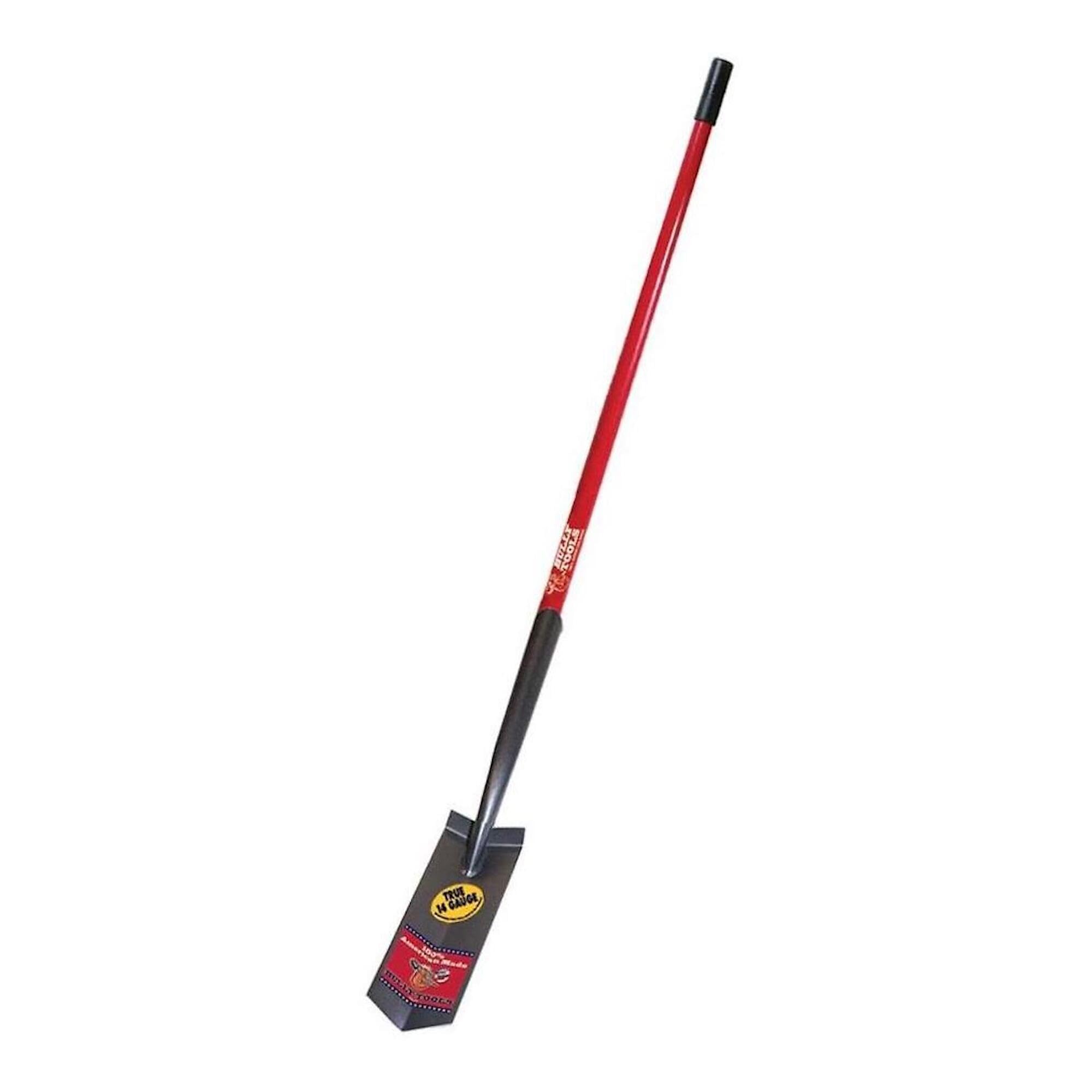
A 14-gauge V-blade made in Ohio — it gathers loose dirt out of the channel, not around it.
The V-shape is the trick. Instead of a flat blade that smears soil, this Bully Tools head scoops and gathers loose dirt out of the trench so the walls stay clean when you open and clear it. That is the feature that earns construction quality the top mention — most buyers point straight at how it is built. The 11.75-inch V-blade length gives you a real scoop each time.
It is 14-gauge tempered American steel. The pointed edge pierces compact dirt, the powder coat fights rust, and the 4-inch blade nails the narrow trench width for conduit, pipe, or wire. The fiberglass handle is polyester-veil coated to resist splintering, and the rubber grip cuts hand fatigue over long sessions. It assembles in under a minute with a Phillips head screwdriver.
Two honest notes. Durability divides buyers — many expect years of service, a few report it snapping under hard use. And opinions on value split along the same lines. For ordinary yard trenching it holds up well; for the toughest abuse, size up your expectations. It carries the identity of a family-owned, 100% Made in USA brand, which some buyers value on its own.
What it does well: the V-blade gathers spoil cleanly and the 4-inch width keeps the trench narrow.
The honest caveat: durability experiences vary, so treat it as a homeowner-grade tool rather than an indestructible one.
Pick this if: you want a clean V-blade trench, narrow width, and a made-in-the-USA tool from a family-owned brand.
Skip if: you plan to abuse it daily in the harshest ground — reliability reports are split.
8. Seymour S702 48-Inch Fiberglass Handle Trenching Shovel
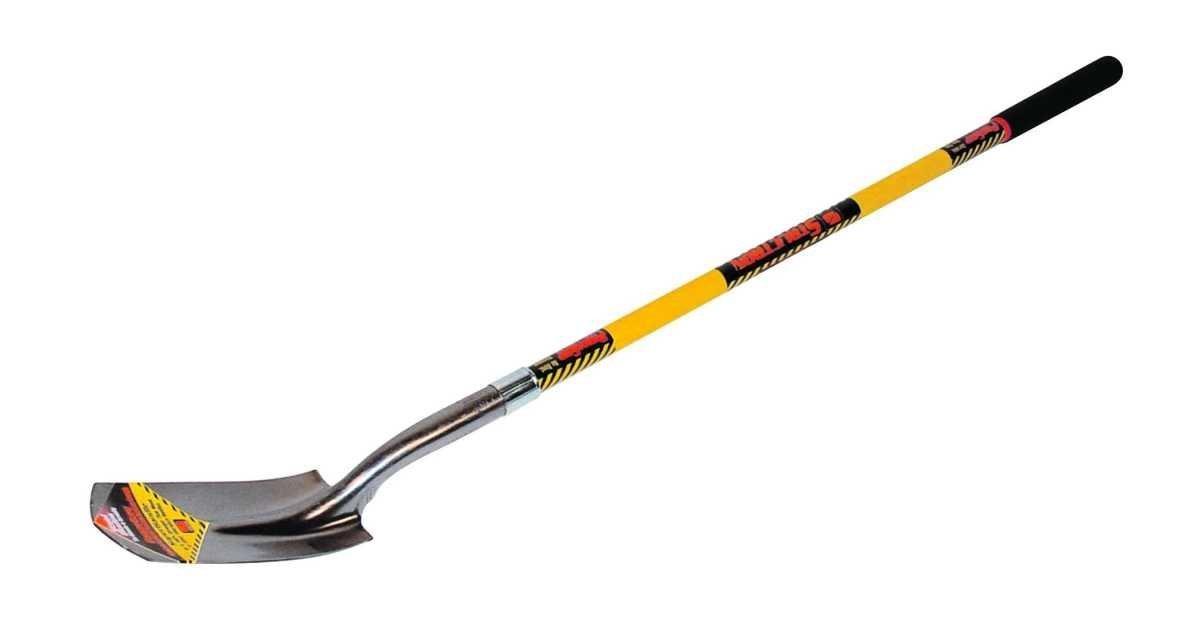
Spring steel and a 5-inch blade — the shovel for heavy rock and clay soil.
The Seymour S702 pairs a 14-gauge spring steel blade with a forward-turned step and a 5-inch width, so it takes real force in heavy ground without folding. Owners who work it in rock and clay soil say the spring steel holds up. The spring steel is the point — it flexes and returns under load, which matters when your blade meets a buried stone. Quality is the trait most often praised across its reviews, with performance close behind.
Seymour’s PowerCore and PermaGrip construction sits on a premium 48-inch fiberglass handle, and the ergonomic grip keeps your hand steady through long sessions. At 4.4 pounds it is a heavier spade than the 3.5-pound VNIMTI and Bully Tools picks, and that extra mass is the trade you pay for stability in tough soil. It also runs a 57.5-inch overall length per the listing, so it is a long tool — tall users bend less on it.
Durability holds strong here — owners note it won’t splinter — and value is rated well. Nothing in the record suggests fragility. The honest catch is simply that it is a big, weighty spade; if you only dig a short run in loose topsoil, you will feel the weight more than you need it. If you fight clay and rock, that feeling flips to an advantage.
Where it shines
- 14-gauge spring steel blade handles heavy rock and clay
- Forward-turned step and 5-inch width for reliable boot pressure
- Premium fiberglass handle won’t splinter; grip holds steady
Where it’s heavy
- 4.4 pounds is heavier than the 3.5-pound VNIMTI — noticed on light, loose soil
Made for you if: your ground is rock and clay and you want a heavy spade that will not give.
Not worth it if: you dig short runs in soft, loose soil where a lighter blade would be easier to carry and control.
9. Nupla SS14L-E Drain Spade

A 14-inch blade set in a heavy 16-gauge head — the sprinkler-repair specialist.
Nupla builds this as a drain spade for precise, targeted digging. The blade measures 4-3/4 inches by 14 inches with a rounded tip and a hollow back, so it sinks into a spot — a sprinkler head, a planting hole — without tearing up a whole bed around it. The forward-turned step gives your boot a secure ledge, and the blade is heavy 16-gauge steel for strength.
The 48-inch handle has a fiberglass and polystyrene core wrapped in a polypropylene sleeve, which is the recipe for resisting weather and chemicals. The oversized end on the grip gives control with a gloved hand. Owners say it makes digging in hard dirt easier for planting and sprinkler repair, and rate quality and value highly. The 4-3/4-inch width sits close to the 4-inch VNIMTI blade, so trench width is similar — this one is just built for point work.
The honest limit is the durability record, which is mixed: most say it should last long, a few report trouble on first use. For targeted repair and planting it is a strong tool. If you are trenching long runs through rough ground, it is not the spade you want. For the price position it holds, it is a premium specialist, not a generalist.
Best at: sprinkler-head swaps, planting, and any job where you want a clean, deep hole with minimal disturbance.
The trade: it is a specialist’s spade, and durability reports are split — treat it kindly on the first outings.
Right for: the homeowner who repairs irrigation and plants shrubs and wants a precise, deep-cutting drain spade.
Wrong for: trenching long runs through tough soil — a heavier, wider blade serves that better.
Know the Specs
Blade Width
The width of the cutting edge, measured across the bottom of the blade. A trenching blade runs roughly 4 to 5 inches, which is tight enough to keep backfill small yet wide enough to clear soil steadily. Narrower blades like the 2-inch HANTOP dig small, deep holes; wider ones move more dirt per scoop but make a bigger channel.
Steel Gauge
Gauge is the thickness rating for sheet steel — a lower number means thicker, stiffer stock. A 14-gauge blade flexes less under load than a 16-gauge blade, which matters when you hit roots or rock. Thicker steel carries more weight, so there is a balance between rigidity and how tired the shovel leaves you.
Handle Length and Grip
A longer shaft cuts how far you bend, so a 56-inch handle saves your back on long trench runs compared with a 44-inch one. D-grips lock your hand for pushing; oversized ergonomic grips suit gloved hands. Fiberglass shrugs off weather where wood eventually splits.
Foot Steps and Cutting Edges
A forward-turned step gives your boot a flat ledge to drive the blade down with your leg, not your arms. Serrated or toothed edges slice roots and matted clay that a smooth edge slides off. Together they decide how hard the shovel works in the ground you actually have.
Common Questions
How wide a trench does a trenching shovel cut?
Is a trench digging shovel better than a normal round-point spade?
Can I use one of these to dig through roots and clay?
What handle length should I pick?
Does steel gauge really matter for a shovel blade?
Will a fiberglass handle break like wood?
Are these strong enough for rocky ground?
How do I keep a steel blade from rusting?
Can a drain spade replace a trenching shovel?
The Bottom Line
If you are laying pipe or wire, the trench digging shovel to reach for is the VNIMTI 56-Inch. It pairs a 4-inch V-blade with the longest handle in that width group, and at 3.5 pounds it sits at the lighter end of the full-size spades. It holds 4.5+ stars across 200+ ratings, the strongest review record among the 4-inch picks here.
If your ground is rooted and clay-heavy, the HANTOP serrated spade cuts where a smooth blade stalls. For hard clay and rocky soil with real boot pressure, the KOLEIYA holds up. And for sprinkler repair and planting, the Nupla Sharp Shooters is the specialist’s pick. The right blade width and handle length are the two choices that matter most — get those wrong and no badge fixes it.
How we choose
We do not accept paid placement. Every pick is matched to a real buyer and a real use-case; we do not hands-on test units.
Sources
Specifications: manufacturer listings and product documentation. Review insights: verified customer reviews, as of November 2026. Pricing: not shown on this page (it changes often); check the current price via the retailer link.
As an Amazon Associate, Tactical Gear Guy earns from qualifying purchases. This does not affect which products we feature.