Specs are compiled from manufacturer listings and verified buyer reviews and can change over time — please confirm the key details on the product page before buying.
Most home treadmills that promise an adjustable incline give you a gentle 10% tilt and call it a day, which is fine for a stroll but does almost nothing for your glutes or your calorie burn. The picks below all move the deck under your feet automatically, and they range from a compact folder that tucks under a bed to a 20% climber built for hill intervals. If you only remember one thing: match the incline range and the running belt length to how you actually train, because a short belt on a steep grade feels like walking uphill on a tightrope. One quick note before the list: the crowd favorite here is the WELLFIT Foldable, at 4.5+ stars across 190+ ratings, and that holds true even though several pricier machines sit below it.
This guide is built by comparing the manufacturers’ published specifications and the patterns across verified customer reviews, so you get each pick’s real strengths and trade-offs instead of marketing spin.
You will see how each motor, belt width, and incline ceiling changes the way a machine feels in a real room, not just on a spec sheet. That is the whole point of this treadmill with adjustable incline breakdown, so you can pick the one your legs and your floor space will actually tolerate.
Top Picks
How To Choose The Best Treadmill with Adjustable Incline
The incline number gets all the attention, but it is only useful if the belt under you is long enough and the motor is strong enough to hold your pace while the deck tilts up. A machine that claims a huge climbing grade but pairs it with a narrow, short belt will feel unstable the moment you pick up speed. So start with the belt, then the motor, then the incline ceiling.
Belt length and width before incline percentage
Running belt length is the number that decides whether you can actually run, not just shuffle. A belt around 42.5 inches long (measured front to back) suits walking and light jogging, while a 55-inch or 60-inch deck gives a full stride room to land. Width matters too: 16.2 inches feels tight on a steep climb, while 18 to 22 inches lets your feet fall naturally. If you are tall, err longer; if you are broad-shouldered or heavy, err wider.
Motor horsepower and what it means for noise
Horsepower (hp) is the measure of how much sustained work the motor can do — think of it as engine size. A 2.5 hp motor handles steady walking and jogging; a 3.5 hp motor holds its speed better when you add incline and body weight. The decibel (dB) figure tells you how loud it runs: under 45 dB is roughly a quiet conversation, so a living-room machine at that level will not drown out a TV.
Folding footprint and where it will live
Every folding treadmill here collapses, but the folded height varies a lot. Some fold down to a slim slab you can slide under a sofa; others stand upright on their own and free up a small patch of floor. Measure the gap under your bed or couch first, then check the folded dimensions against it before you commit.
Side-by-Side Comparison
| Model | Best For | Max Incline | Motor | Running Belt | Amazon |
|---|---|---|---|---|---|
| WELLFIT Foldable★ Best Overall | All-round home use | 10% | 3.5 hp | 44″ x 17″ | Amazon |
| CURSOR Fitness Heavy DutySteepest Climb | Steep hill intervals | 20% | 3.5 hp | 42.5″ x 16.2″ | Amazon |
| HUAGEED Incline TreadmillEasiest to Run | Tech-shy first-timers | 15 levels | 2.5 hp peak | 42.5″ x 18″ | Amazon |
| MERACH T12 | Small apartments | 15% | 2.5 hp | 42.5″ x 16.5″ | Amazon |
| MERACH Auto Incline 18% | Serious home cardio | 18% | 3.5 hp | 47″ x 18″ | Amazon |
| ProForm Carbon | iFIT class fans | 10% | — | 55″ x 18″ | Amazon |
| Renestar 25% Auto Incline | Big-screen climbers | 25% | 3.5 hp | 47.3″ x 17.7″ | Amazon |
| NordicTrack T Series 6.5 S | Proven daily mileage | 10% | — | 55″ x 20″ | Amazon |
| VitalWalk Apollo 11 Ultimate | Upright storage | 20% | 3.5 hp | 49″ x 18″ | Amazon |
| Horizon Fitness Studio | Runners who stride long | 15% | 3.5 CHP | 60″ x 22″ | Amazon |
| NordicTrack Commercial 1750 | Decline training | -3% to 12% | — | 60″ x 22″ | Amazon |
Detailed Reviews
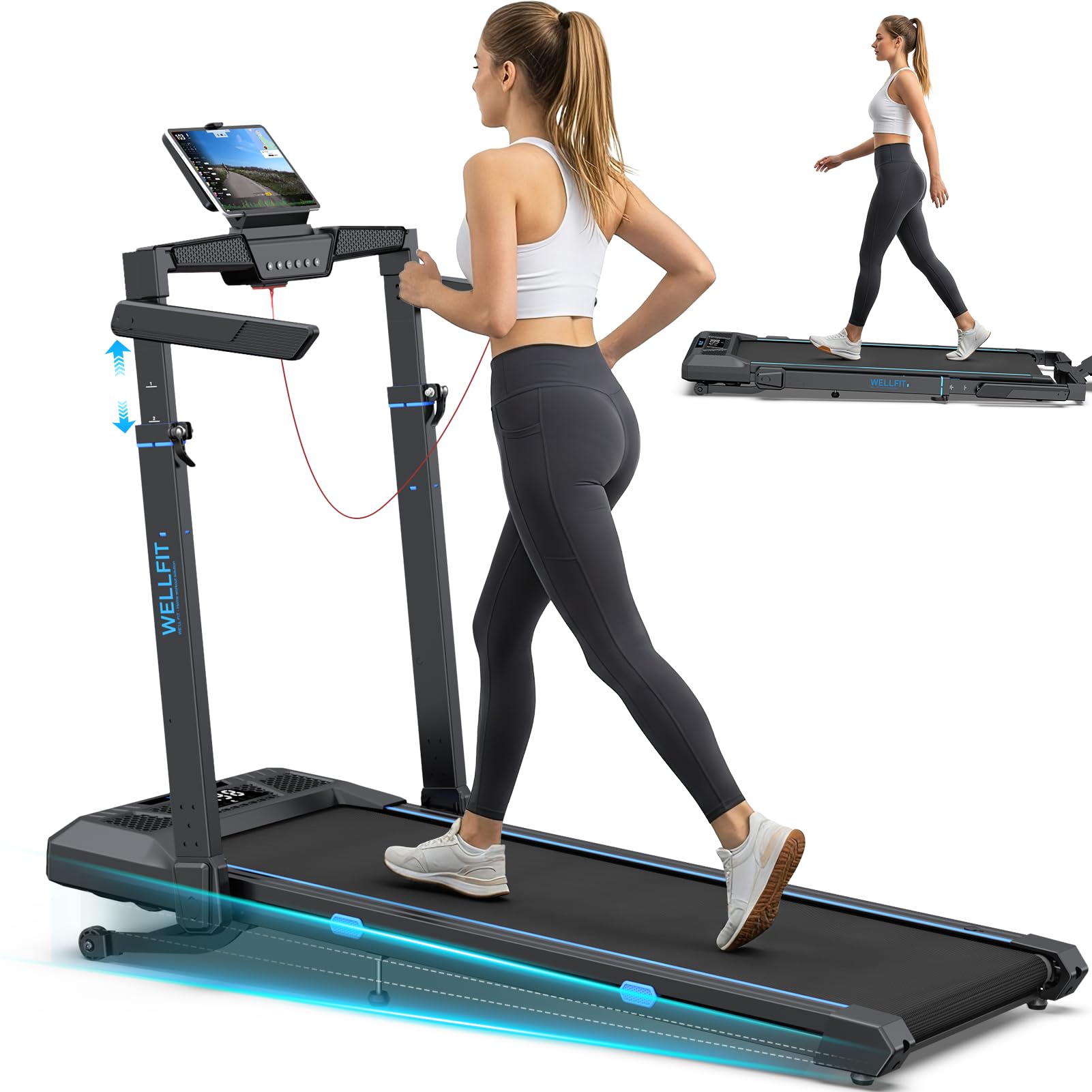
1. WELLFIT Foldable Treadmill with Auto Incline, 400 LBS
Our pick — 4.5+★ from 150+ verified ratings; the strongest balance of quality and price.
A 5-height handrail from 30.5″ to 41″ lets every member of the household walk upright at their own bar height.
What sets this WELLFIT apart is the handrail. It moves through 5 adjustable heights from 30.5″ to 41″, so a tall teen, a shorter adult, and an older parent can each grab a bar at a comfortable spot. That range lets everyone keep a straight-backed posture instead of hunching over a fixed handle — a real difference when you are walking a long incline session every day.
Your stride gets room to open up on a 44″ x 17″ deck (length by width). That is longer than the CURSOR’s 42.5″ x 16.2″ belt — a full 2.7 times the running area by the numbers. The incline climbs from 0 to 10% automatically, so you can add a hill without touching a dial. The 3.5 hp motor (horsepower, a measure of pulling strength) carries up to 400 lbs while running under 45 dB (decibels, the loudness scale) — roughly a hushed conversation, so a workout won’t drown out the TV. The 7-layer anti-slip belt and 8 built-in silicone shock absorbers soften each landing under your feet.
Setup is the part that wins people over. It arrives ready to use, folds to just 5.7″ tall for sliding under a bed or against a wall, and rolls on smooth wheels. You get a LED display showing time, distance, speed, and calories, plus speed control by console, remote, voice, or a fitness app with no subscription needed.
What buyers talk about most is performance — plainly, the thing works smoothly day after day — followed closely by how painless it is to set up. The honest limit is the incline ceiling: 10% is a solid walking grade, but if your goal is aggressive hill sprints, the CURSOR’s 20% gives you double the climb.
auto incline ease
- Handrail adjusts across 5 heights from 30.5″ to 41″
- 44″ x 17″ belt with a 400 lb capacity
- Folds to 5.7″ tall and rolls away
- 4 ways to change speed, app needs no subscription
heavy deck fold
- 10% incline suits walking more than sprinting
- 80.5 lb machine is a two-person lift to move far
fits small rooms: a household where different ages and heights share one machine and want an honest 10% climb.
check belt length: hardcore hill-interval runners who want a steeper grade than 10%.
2. CURSOR Fitness Heavy Duty Treadmill with 20% Auto Incline
A 20-level climber that folds down slimmer than a coffee table.
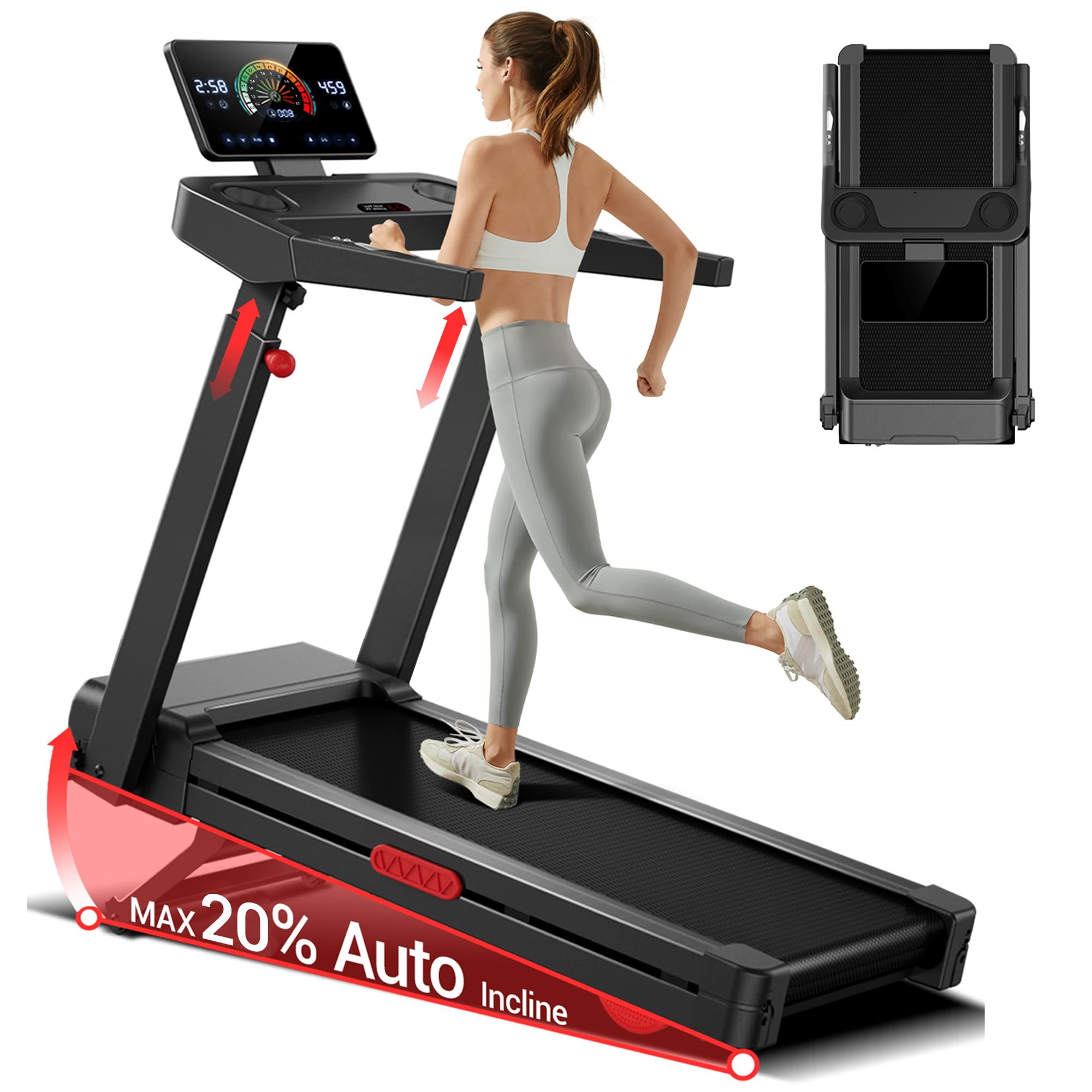
If you have been burned by a “10% incline” that felt like a speed bump, this is the answer. The CURSOR ramps from 2% to 20% across 20 levels with one touch, and that 20% ceiling is double the WELLFIT’s 10% — a genuine hill-climb grade for HIIT and climbing workouts rather than casual walks.
It folds from full size down to a 6.5″ slab in seconds, so it slides under a sofa or stands against a wall in a tight room. The 3.5 hp brushless motor runs under 45 dB and the 7-layer cushioned deck supports up to 400 lbs. The 16.2″ x 42.5″ belt runs at speeds up to 8.7 MPH and the handle height adjusts from 45.5″ to 53.5″ for different people.
One thing to weigh honestly: that 16.2″ belt is the narrowest on this list. It handles a steady jog fine, but a very broad-shouldered or long-striding runner will feel the edges on the steepest settings. The trade-off buys you the highest incline-per-dollar climb here.
steep 20 percent climb: if climbing is your goal, nothing else at this level gives you a 20% grade in a package that folds to a slim slab.
bulky footprint: a 42.5″ x 16.2″ deck favors walkers and joggers over tall sprinters, so test your stride against that width before committing.
grab for hills: your plan is hill intervals and steep-walk training and floor space is tight.
measure doorway: you are a tall fast runner who needs a wide, long deck under each stride.
3. HUAGEED Incline Treadmill
A wide 18-inch deck and a forgiving 2.5 hp motor for steady home miles.
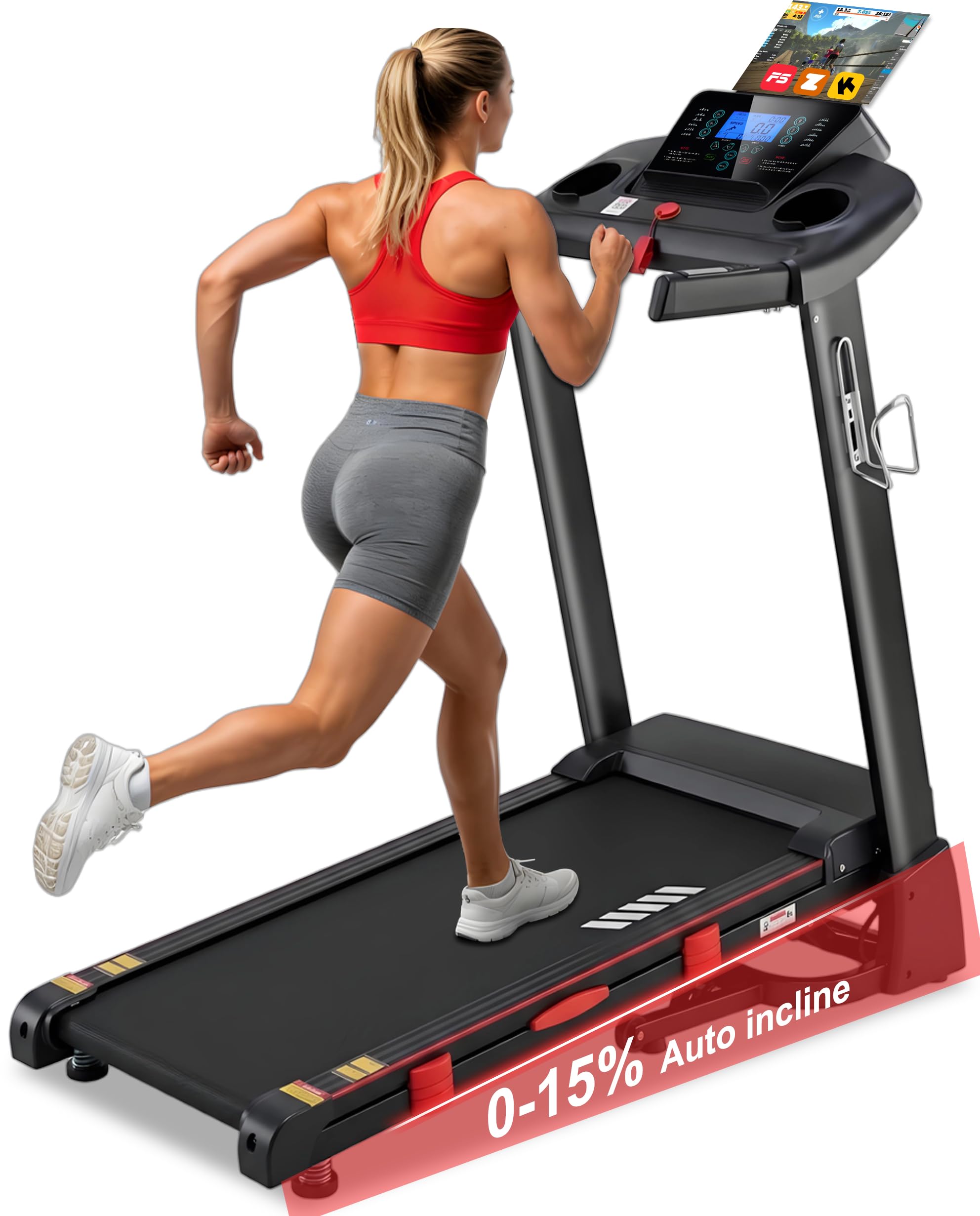
Where the CURSOR wins on climbing, this one wins on comfort underfoot. The 18″ x 42.5″ diamond-patterned belt is wider than the CURSOR’s 16.2″, built by consolidating 5 layers into one durable surface. A wider deck means your footfalls are not crowding the edges, which matters when you are tired late in a session.
You get 15 auto-incline levels and a 0.5 to 10 MPH speed range, so you can build HIIT blocks without fiddling with knobs. The double-deck construction with 8 built-in and 6 external cushions softens the landings, and the 2.5 hp peak motor carries a 300 lb load rating. Bluetooth speakers are built in, and the 5-inch LED display is basic on purpose.
You get a machine for people who do not want a wall of menus — that simplicity is the pitch. Speed tops out at 10 MPH (miles per hour), slower than the Horizon’s 12 MPH and the 1750’s 12 MPH. Its 2.5 hp motor also carries less horsepower than the CURSOR’s 3.5 hp. For walk-to-jog training, though, it has plenty. The recurring caution is size: it is roomy enough for most, yet a long-legged runner will want more length than 42.5 inches.
roomy stride pick: first-timers and casual joggers who want a wide, cushioned belt and a console they can learn in one minute. If you sprint or log long distances, the 10 MPH ceiling and 42.5-inch length will hold you back.
mind the weight: tall runners with long strides who would outgrow a 42.5-inch deck.
4. MERACH T12 Foldable Treadmill, 300 LBS Capacity
A near-silent folder that disappears into a small apartment corner.
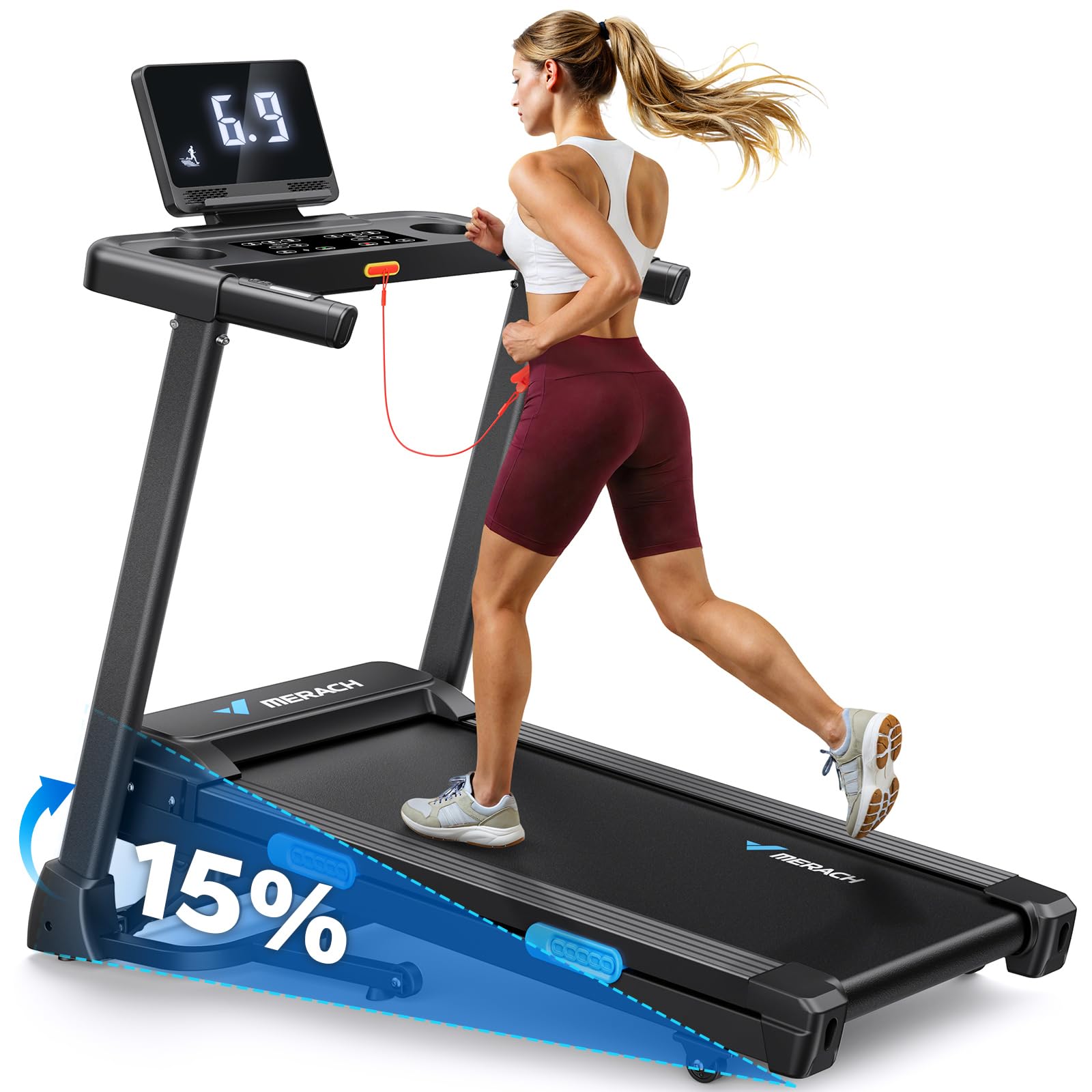
A late workout will not travel through thin walls, because the 2.5 hp motor keeps noise under 40 dB (decibels, the loudness scale) — whisper-level, and quieter than the 45 dB class many rivals claim. When you are done, it folds to 49.2″ x 25.6″ x 27.6″ and rolls on built-in transport wheels, making it among the most compact foldables here.
You can jog comfortably on the 42.5″ x 16.5″ extra-wide belt, and the 15% auto incline adds a real climb. Speeds run 0.5 to 7.5 MPH (miles per hour) — the slowest top speed in this group, so it is a walk-and-jog machine rather than a sprinter’s deck. The double-deck build with 4 silicone cushions and 6 shock pillars keeps landings soft, and handrail sensors read your heart rate.
Buyers report the overall build rates highly and consistently call it easy to use. Be honest about the incline, though: it is the most debated feature on this machine. Some find the 15% gentle in practice, and a handful report it missing altogether on arrival — worth a quick test the day it lands. For a small flat, that quiet and that footprint are hard to argue with.
folds compact fast: under-40 dB operation plus a 49.2″ folded length makes apartment life easier than most.
300 lb ceiling: confirm the auto incline engages before the return window closes, since that is the one feature with mixed word of mouth.
choose for storage: you live in a small flat or share walls and need a quiet, easily hidden treadmill.
skip for big users: you want to run fast — 7.5 MPH is the ceiling.
5. MERACH Treadmill with 18% Auto Incline, 3.5HP Brushless
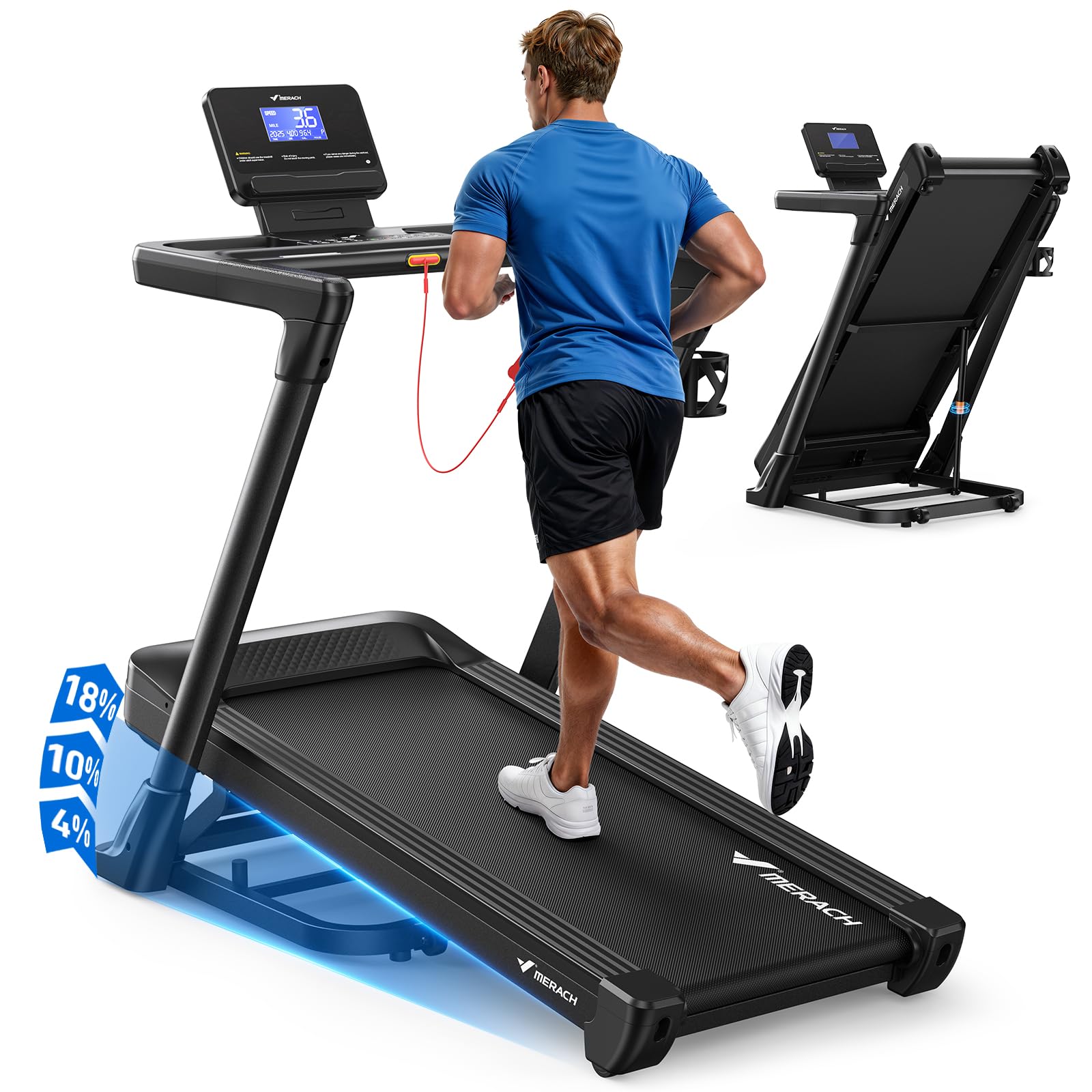
Commercial-grade steel that refuses to wobble, even at full tilt.
This is the tank of the list. A heavy-duty frame with 2.0mm thick core steel carries up to 350 lbs without shaking during high-speed or high-incline work, and the machine tips the scale at 122 lbs for exactly that reason. The 3.5 hp brushless motor pushes speeds to 8.7 MPH while staying under 45 dB.
Climbing is the point: an 18% auto incline simulates real hills and, paired with the free MERACH app, adds scenic routes so the session is not just a belt going round. The 18″ x 47″ non-slip belt is longer than the smaller MERACH T12’s 42.5-inch deck, giving your stride room to land. A multi-layer shock system is built to soften impact, and the LED display shows speed, time, distance, calories, incline, and heart rate at a glance.
Storage is clever: a hydraulic folding system sets it up or stows it in about 30 seconds, which is quicker than folding a deck by hand. One straight-talk note: at 122 lbs it is a heavy machine, and a couple of buyers mention wanting a longer belt for sprint work. The 18% grade is the showpiece — steeper than the WELLFIT’s 10% and the Horizon’s 15%.
brushless motor quiet
- 2.0mm core steel frame rated for 350 lbs
- 18% auto incline with a free app
- 3.5 hp brushless motor under 45 dB
- Hydraulic fold in about 30 seconds
console basics only
- 122 lbs makes it a real effort to reposition
- Top speed is 8.7 MPH, not a sprinter’s 10+
quiet home pick: buy it if you want a rock-solid climber that feels planted under a heavier body at speed.
expect simple screen: the same steel that kills the shake also makes moving it a two-person job.
6. ProForm Carbon Treadmill

The trainers take the wheel and move your incline for you.
ProForm’s angle is the connected workout. Pair a tablet with iFIT and the trainer’s terrain automatically drives your speed and incline, so you climb when the on-screen coach climbs. Training requires the iFIT membership, which is the catch to weigh up front — the hardware is only half the equation here.
On its own, the machine runs 0 to 10 MPH and 0 to 10% incline, which is a modest grade next to the MERACH 18% and the CURSOR 20%. The 55″ x 18″ deck is longer than most on this list, though, giving you room to stretch out, and ProShox cushioning softens the impact. A 5-inch LCD keeps your stats visible, and the folding frame with a hydraulic foot bar lands softly when you drop it.
The hardware earns steady praise — sturdy build, reliable operation over months, and a quiet belt that suits both walking and intense running. Assembly takes about 90 minutes by most accounts, and at roughly 300 pounds it is a two-person delivery. Buy this for the coaching ecosystem, not the incline ceiling.
sturdy frame build: hands-off auto-adjust workouts that track a trainer’s pace while you focus on breathing.
pricey for basics: the best features lean on a paid iFIT membership, and the 10% incline is gentle compared to steeper rivals.
buy for durability: guided classes keep you motivated and you want the treadmill to change settings for you.
pass on budget: you prefer a flat-fee machine with no ongoing membership to think about.
7. Renestar Treadmill with 25% Auto Incline
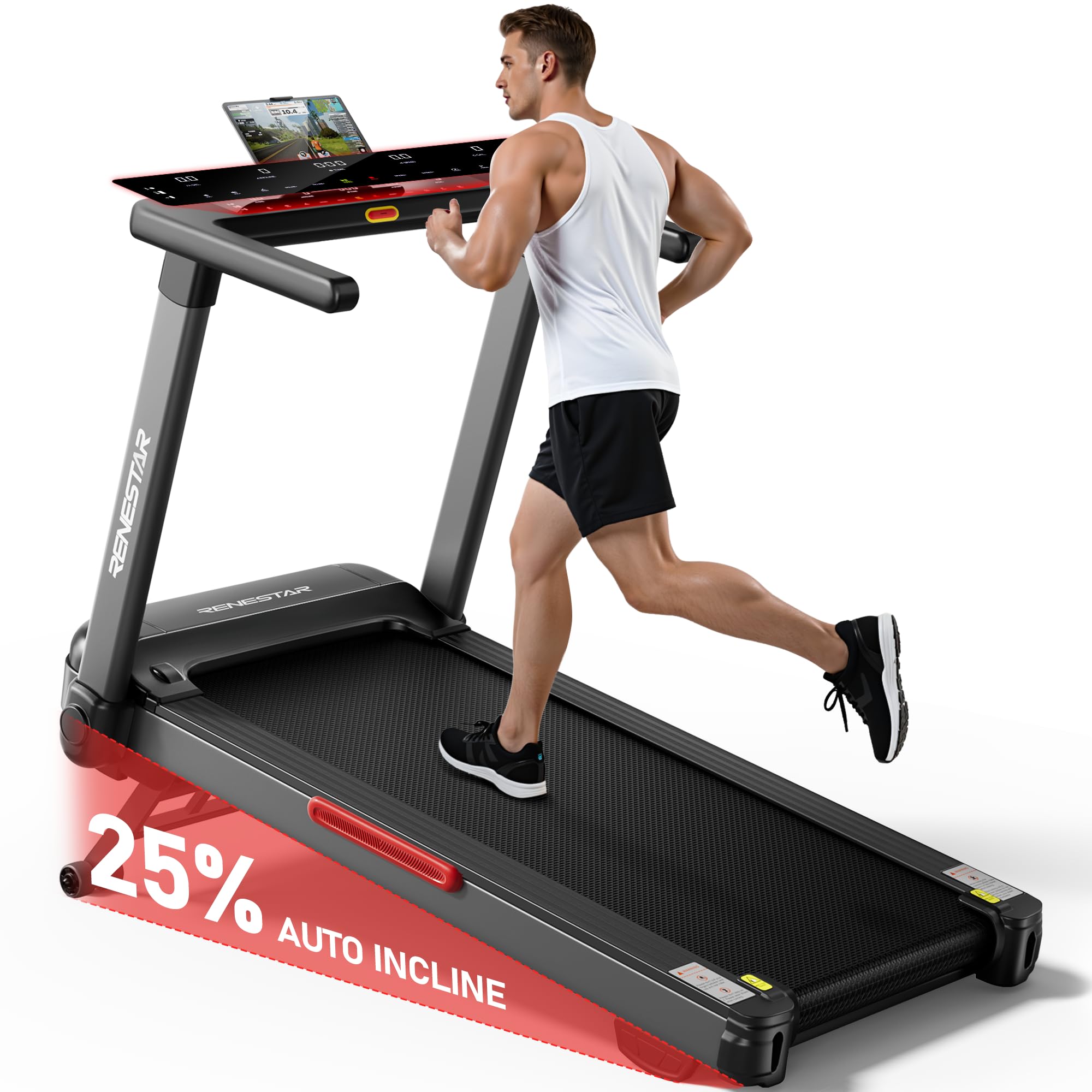
A 25-level climber with a touchscreen the size of a small TV.
This is the steepest grade on the list — 25 levels of auto incline running 0 to 25%, paired with 24 preset programs. For hill-and-interval training, that is more climb than the MERACH 18% or the WELLFIT 10%, and the 3.5 hp brushless motor holds speed while the deck tilts, running below 45 dB.
The 19-inch LED touchscreen is the other draw: it shows speed, distance, and calories in real time, with a 12-inch device holder beside it for a tablet or phone. The running belt spans 47.3″ x 17.7″ with 4-inch protective borders and an 8-layer textured surface, and the shock deck carries a 300 lb rating on 6 absorbers.
Do not take the incline number at pure face value, though. That is the single most debated point on this machine — some love the auto climb, while others find a mid-range setting feels shallower than the number suggests. It arrives 90% pre-assembled and sets up in about 15 minutes. Think of 25% as headroom rather than a promise, and you will be happy.
try for climbs: you want the biggest screen and the tallest advertised climb in one package.
test the deck: an exact incline percentage matters to your training plan — verify the feel, not the label.
8. NordicTrack T Series 6.5 S Treadmill

The household name with the long track record and a 20-inch-wide deck.
Your feet are not pinched at the edges on the T Series 6.5 S, because its 55″ x 20″ deck is wider than most here — wider than the WELLFIT’s 17-inch and the CURSOR’s 16.2-inch. At 55 inches long it suits a full running stride. Its long track record of real owners logging daily miles is rare among treadmills at this price.
Speed reaches 10 MPH and the auto incline spans 0 to 10%, a hiking grade that works with iFIT trainers who change it for you mid-session. KeyFlex cushioning softens impact, and the folding frame rolls away with a foot-bar assist. Like the Carbon, the coached features lean on a paid iFIT membership, so factor that into the long-term picture.
Pick this if you want a familiar brand and a proven frame for daily walking and jogging without surprises. If your priority is a spectacular incline, the Renestar and CURSOR climb higher — but neither has this kind of tenure behind it.
iFIT workout library: a wide 20-inch deck and a decade-plus of real owners proving the frame holds up.
subscription needed: the auto-adjust magic depends on that iFIT subscription, and 10% is a modest climb.
good starter unit: buyers who value a wide deck and a name with history over the steepest hill.
avoid without app: you want the tallest incline or a subscription-free experience.
9. VitalWalk Apollo 11 Ultimate Foldable Treadmill
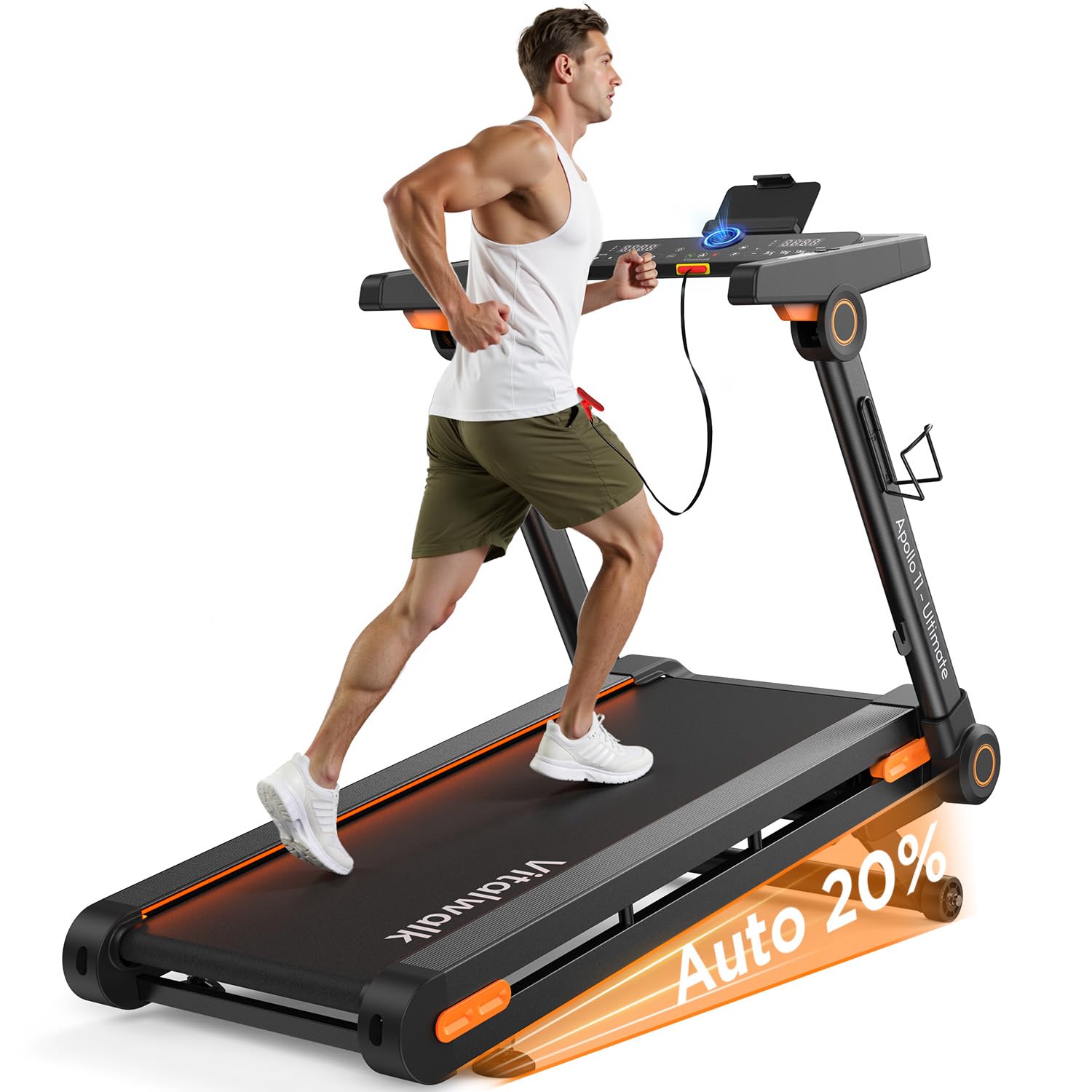
It folds up, stands itself upright, and frees a whole patch of floor.
The standout here is storage geometry. Using its patented one-touch quick-fold and the locking support, this machine stands upright on its own in a 2.67 sq. ft. footprint — smaller than the floor space of most folding treadmills, and a smart fit for an apartment or a shared room. Four bidirectional transport wheels help you wheel it wherever it needs to live.
The running surface is generous for that footprint: a 49″ x 18″ belt running at speeds up to 10 MPH, powered by a 3.5 hp brushless motor on a double-frame steel build rated for 350 lbs. A 20% auto incline adds a serious climb, and an 8-point cushioning system with a 7-layer belt softens each landing. It arrives roughly 99% pre-assembled, so you are jogging within minutes.
There is a small trade-off worth naming: a handful of buyers mention the belt runs somewhat narrower and shorter than they pictured for stride work, so measure your run length against 49 inches. Otherwise it is a complete package — a cooling fan, USB and Type-C ports, a device holder, bottle holder, and hand-pulse sensors round it out.
pick for tight flats: anyone whose main battle is floor space, and who wants a real 20% climb plus upright storage.
verify warranty: you have a very long stride — 49 inches of belt is comfortable but not oversized.
10. Horizon Fitness Studio Series Treadmill

A 22-inch-wide, 60-inch-long deck built for full strides at speed.
Real runners care about deck size before anything else, and this delivers. The 22″ x 60″ XL running surface is longer than the MERACH 47-inch and the CURSOR 42.5-inch decks, giving a full running stride room to land. Speed climbs to 12 MPH — topping the 10 MPH machines here — and the incline spans 0 to 15%, so you can walk, jog, or run a real grade.
QuickDial controls make it fast to switch between intervals without breaking your stride, and the RapidSync 3.5 CHP drive system drives quick speed and incline changes. Three-zone Variable Response Cushioning flexes through the whole stride, and the max user weight is 350 lbs. Programs include 5K, Calorie, Distance, Fat Burn, Hill Climb, Manual, and Max Heart Rate.
Two honest notes: it is a big machine at 76″ x 37″ x 63″ and around 300 pounds, so it wants dedicated floor space rather than a corner. Assembly also divides opinion — some find it straightforward, others call it a challenge. For a space you have already set aside, the deck quality makes the size worth it.
smooth run deck: 60 inches of length and a 22-inch width let you open up at 12 MPH without clipping the edges.
takes floor space: this is a permanent piece of furniture, not a closet-folder — plan the room before you buy.
runner friendly choice: committed runners with a dedicated gym corner who want the longest, widest deck here.
skip in studios: tight apartments or anyone who needs a machine to vanish between sessions.
11. NordicTrack Commercial 1750 Treadmill with iFIT

The rare treadmill that can tilt downhill as well as up.
Most machines only climb. This one goes both ways with a -3% decline to 12% incline range, so you can train the downhills that hammer your quads in real races. Speeds reach 12 MPH, the deck measures 60″ x 22″ for a genuine running stride, and a pivoting 16-inch touchscreen lets you stream classes or shows while you run.
The iFIT engine, SmartAdjust auto-tuning, and a Bluetooth heart-rate link all live behind the iFIT Pro membership — think of the software as the core of the experience here. RunFlex cushioning softens impact, and the folding frame rolls away with a foot-bar assist for smoother lowering.
This is the most feature-loaded machine on the list, and also the one where the reviews are more divided than most. Go in with eyes open and treat the membership as part of the deal rather than an extra. If downhill training and a big interactive screen are what you have been chasing, nothing else here matches that combination.
go premium here: downhill grade training and a large rotating screen are worth a subscription to you.
budget elsewhere: you want the simplest possible machine — the feature set is deep and the membership is expected.
Know the Specs
Incline percentage versus incline levels
An incline percentage is the steepness of the deck measured in grade — a 10% incline means the deck lifts the equivalent of 10 units up for every 100 forward. Incline “levels” are just the steps a machine offers across that range, so 20 levels on a 20% machine are roughly 1% each. Steeper percentages load the glutes and calves harder, and a decline range drops the deck below flat for downhill training.
Running belt size and why length wins
Belt length is measured front to back and width side to side. A 42.5-inch deck suits walkers and joggers, while a 55 to 60-inch deck gives a full running stride room to land. Wider belts — 18 to 22 inches — keep your feet from crowding the edges on a climb. If you are tall or carry a longer stride, prioritize length first and width second.
Motor horsepower and decibels explained
Horsepower measures how much sustained work the motor delivers. A 2.5 hp motor handles steady walking and jogging; a 3.5 hp motor holds speed better under incline and heavier loads. The decibel (dB) figure is the noise level: under 40 dB is library-quiet, under 45 dB is a hushed conversation, and both mean a living-room session will not overwhelm a TV.
Folded footprint and upright storage
Every machine here folds, but the folded shape differs. Some drop to a slim slab you can slide beneath a sofa; others stand upright on their own to reclaim floor space. Check the folded height and the footprint against the gap under your furniture before you buy. Transport wheels make moving a heavy machine far easier than lifting it.
Common Questions
How much incline do I actually need on a home treadmill?
Is a longer running belt better for tall users?
What is an auto incline and how is it different from manual incline?
Can I put a treadmill on an upper floor without shaking the house?
How loud is a treadmill with incline in an apartment?
Do I need an iFIT membership to use a ProForm or NordicTrack treadmill?
What weight capacity should I look for in an incline treadmill?
How much floor space does a folding incline treadmill need?
Will walking on an incline tone my glutes and calves more than flat walking?
How much assembly does a folding treadmill need from the start?
Does an incline treadmill burn more calories than a flat one?
The Bottom Line
For most homes, the treadmill with adjustable incline winner is the WELLFIT Foldable. It pairs a 44″ x 17″ deck and a 400 lb capacity with a handrail that adjusts across 5 heights, so the whole household can use one machine comfortably. If climbing is your goal, grab the CURSOR Fitness for its 20-level auto incline that folds to a slim 6.5″ slab. And for a quiet apartment machine, the MERACH T12 runs under 40 dB and stores in a corner.
One last nudge: the WELLFIT is the pick that balances a proven track record with a family-friendly handrail, so if you are on the fence, that is the one to start with. Buy the incline ceiling and belt length your training actually needs, and you will use the machine far more than one that collects dust because it was too much or too little for the way you move.
How we choose
We do not accept paid placement. Every pick is matched to a real buyer and a real use-case; we do not hands-on test units.
Sources
Specifications: manufacturer listings and product documentation. Review insights: verified customer reviews, as of November 2026. Pricing: not shown on this page (it changes often); check the current price via the retailer link.
As an Amazon Associate, Tactical Gear Guy earns from qualifying purchases. This does not affect which products we feature.