Specs are compiled from manufacturer listings and verified buyer reviews and can change over time — please confirm the key details on the product page before buying.
Here is the short answer: match the panel to your battery, not to the marketing badge. A 200W foldable is the right tool if you are filling a portable power station for a weekend. A sub-30W USB panel only makes sense if the phone in your pocket is the whole load. The picks below are split along that line, and every one of them folds flat enough to travel.
This guide is built by comparing the manufacturers’ published specifications and the patterns across verified customer reviews, so you get each pick’s real strengths and trade-offs instead of marketing spin.
The detail most buyers miss is that peak wattage almost never shows up on a real trail, because heat, shade and aim all steal from it. Each listing below tells you where a panel actually gets used, and which ones are worth carrying for the jobs you have in mind with a travel solar panel.
Top Picks


How To Choose The Best Travel Solar Panel
Start with what you need to refill. A phone holds a few thousand milliamp-hours; a mid-size power station holds hundreds of watt-hours. Those two loads sit at opposite ends of this list, and buying across that line is the single most common mistake. Pick the load first, then the panel.
Wattage and the load behind it
Wattage is the panel’s ceiling in perfect sun. A 200W panel gives a power station a real day of charging. A 25W panel is a trickle charger for a phone or a small power bank. If your whole kit is a headlamp and a phone, the big panel is dead weight.
Once you know the load, count the ports. Dual USB ports let you top up two small devices at once. An MC4 output (the round locking connector used on most solar gear) is what feeds a portable power station through its solar input.
Folded size, carry weight and weather sealing
These panels live by how they pack. Look at the folded footprint in inches and the carry weight in pounds. A panel that weighs 13 pounds is a car-camping tool; one under a pound disappears into a daypack. Then check the water rating: an IP number (Ingress Protection, telling you how well dust and water are kept out) is a quick shorthand for how much weather a panel shrugs off.
Side-by-Side Comparison
| Model | Best For | Max Power | Carry Weight | Efficiency | Amazon |
|---|---|---|---|---|---|
| Renogy 200W Portable★ Best Overall | Power stations and RV back-up | 200 W | 13.9 lb | 25% | Amazon |
| ELECAETNA 30W HPBCFeatherweight Pick | Backpacking phone power | 30 W | 0.5 kg | 25.4% | Amazon |
| SOLUPUP 30W FoldableTrail Value | Trail charging two devices | 30 W | 2.4 lb | 23% | Amazon |
| BigBlue 25W Ultra-light | Ultralight backpacking | 25 W | 0.84 lb | 25.4% | Amazon |
| ALLPOWERS SE100 | Chaining panels together | 100 W | 7.9 lb | — | Amazon |
| Mesuvida 100W 5-Port | Laptop and station charging | 100 W | 7.5 lb | 24% | Amazon |
| Ecosonique 200W | Briefcase-size car camping | 200 W | 11 lb | 23.5% | Amazon |
| TPDEFZQ 200W | Freedom camping and RV panels | 200 W | 17 lb | 25.5% | Amazon |
| BougeRV 200W N-Type | Long-cable camp charging | 200 W | 13.8 lb | 25% | Amazon |
Detailed Reviews
1. Renogy 200W Portable Solar Panel
Our pick — 4.5+★ from 950+ verified ratings; the strongest balance of quality and price.
A 200W folding panel that refills a portable power station in about four hours of good sun.
Two hundred watts is the number that puts this in the serious bracket. It is a 25% efficiency panel built on N-Type cells (a cell type that holds output better when the sun is thin or the day is hot). That combination is why buyers report it can refill a power station in roughly four hours of good sun — enough to keep an overnight camp running.
The physical trade is real but manageable. It weighs 13.89 lb and folds to 23.72 x 22.99 x 1.97 in, so it packs to backpack size, then rides in the vehicle rather than on your shoulders. A magnetic closure keeps the folds shut in transit, and four kickstands give you 40°, 50° and 60° aiming angles so you can chase the sun through the day instead of laying the panel flat.
Charging is split two ways. The MC4 output (the standard round solar connector) is what feeds your power station, and it is listed as compatible with Jackery Explorer 1000 v2, EcoFlow DELTA 3 and RIVER 3 Max, and Anker SOLIX S2000 among others. Just know the 4-in-1 adapter is sold separately, so check your station’s lead before you head out. The direct side is a USB-C PD 45W port plus dual USB-A, enough to top three small devices at once without unplugging the main line.
What earns its spot at the top
- 200W at 25% efficiency is genuine power-station territory, not trickle charging
- Three USB ports plus MC4 means the station and your phone charge together
- Four kickstands with 40°/50°/60° aim angles for tracking the sun
- Folded footprint is backpack-sized despite the output
Where it asks something of you
- 13.89 lb is a vehicle panel — it does not belong on a long hike
- The 4-in-1 adapter for some power stations is a separate purchase
- MC4 is the only station output; there is no XT60 on the panel itself
Buy this one when: you are filling a portable power station on car-based trips and want the whole kit charged from one panel.
Keep looking if: you plan to carry the panel on foot for miles — the 13.89 lb weight is the honest limit here.
2. ELECAETNA 30W HPBC Portable Solar Panel
Half a kilogram of panel that still pushes real current into a phone.
The headline here is efficiency, and it is the top figure in this whole round-up. HPBC cells (a newer cell build that keeps working better in low light and high heat than plain monocrystalline) take this 30W panel to 25.4%.
What makes it a travel piece is the weight. It comes in at 0.5 kg — about 1.1 lb — and ELECAETNA says it is 50% lighter and smaller than traditional panels of the same rating. Owners confirm it folds to roughly 8 x 8.25 x 0.5 inches and disappears into a pack. The ETFE laminate coating over the cells is the same class of surface used on hard-wearing outdoor gear, and it carries an IP68 rating, the highest water-and-dust level named on this list.
Output is USB-C and USB-A, both QC3.0, and both can run at once. The USB-C port holds its output well — one reviewer noted, “it delivers 20W consistently from the USB-C port” — which is what you want from a panel this size feeding a phone or a camera battery. It is not a power-station panel; there is no MC4 here. That is the honest line: 30W refills small devices fast and a big station slowly.
Best at the low end: if the load in your bag is phones, cameras, a GPS and a headlamp, the 25.4% efficiency and 1.1 lb weight make this the smartest pick of the small panels.
The line to know: there is no MC4 output, so this cannot charge a portable power station directly — it is a USB device charger, full stop.
Reach for this if: you want the least weight possible while still charging a phone in a morning of sun.
Look elsewhere if: your kit includes a power station that needs an MC4 feed.
3. 30W Foldable Solar Panel Charger
A 2.4 lb panel that folds to book size, clips to your pack and charges two devices at once.
This one is built for the hiker who wants to hang a panel off the back of a pack. It folds to 7.87 x 10.63 in — roughly book size — and weighs 2.4 lb. Carabiners let you clip it to your bag, and an adjustable stand aims it at the sun when you stop for a break. The storage bag doubles as a shade so your phone does not cook while it charges.
The cells run at 23% efficiency on a 30W panel, and there are dual USB-A and USB-C ports for two devices at once. A smart chip smooths the current so a power bank or tablet does not cut in and out, and it carries protection against over-voltage, over-current and short circuits. The IPX5 rating handles rain spray and dust on the trail. If the sun drops behind a ridge, output falls — that is physics, and the panel picks back up when the sun does.
Here is the trade worth naming: charging speed is the mixed note on this panel. Plenty of hikers get phones and battery banks topped up happily, but some find it slower than expected in anything short of strong overhead sun. It is a panel for patience, not for fast refills. There is no built-in battery, so pair it with a power bank of your own.
The honest read: what wins people over is how well the thing just works as part of a backpacking kit — setup, portability and everyday function all land well. It is a steady trail companion rather than a speed charger.
Pick this for: multi-day hikes where the panel lives clipped to your pack and slowly refills a phone and a power bank.
Let it pass if: you want fast charging in shade or weak light — this panel rewards strong, direct sun.
4. BigBlue 25W Solar Panel Charger

A 0.84 lb panel that folds to iPad size and carries an IP68 rating for rain and splashes.
If weight is the whole decision, this is the one. It folds to 4.65 x 6.42 x 1.38 in and weighs just 0.84 lb — lighter than the ELECAETNA above and small enough to ride in a side pocket. Carabiners let you hang it off a pack or a tent, and it asks only for direct, unobstructed sun.
The output numbers are modest by design: USB-A rated at 5V/2.4A and USB-C at 5V/3A, running two devices at once. That is a trickle next to the 11.3A MC4 feed on the Renogy at the top — the BigBlue’s 2.4A rating is a phone charger, not a station charger. What you get for that is N-Type cells that reach up to 25.4% conversion, matching the ELECAETNA’s figure and edging the SOLUPUP’s 23%.
The build is where it earns its keep. ETFE coating, UV-resistant EVA and a solid baseplate are all aimed at resisting the hairline cracks that kill folding panels, and the whole thing carries an IP68 rating for splashes, spills and light rain. Built-in smart charging handles the power delivery so your gear is not at risk. It is a backup piece for a daypack, not a power plant.
Where it fits: the ultralight hiker or day-tripper whose only load is a phone, a watch and maybe a speaker.
Honest limit: 25W over USB will not fill a power station in any reasonable time — treat it strictly as a small-device charger.
This is your panel if: every gram counts and rain is likely on the trip.
Skip the trade if: you carry a power station — a USB-only 25W panel will not keep up.
5. ALLPOWERS SE100 100W Portable Solar Panel Charger
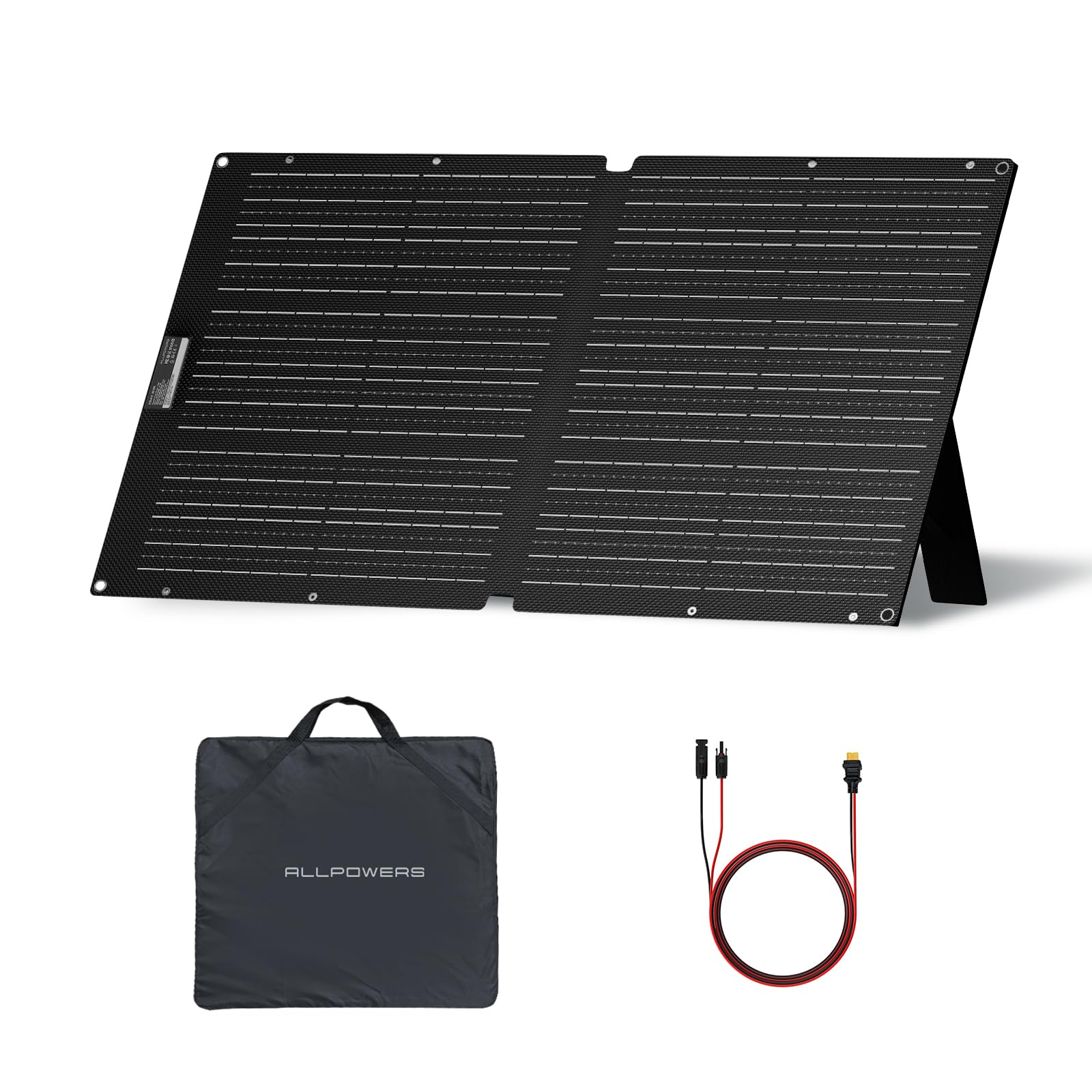
A 100W panel you can chain with more SE100 units into a single feed for extra output.
Most panels on this list stand alone. This one is built to be linked: the chainable feature lets you connect multiple SE100 panels together with the solar cable for more output when you need it. That is a genuinely different trick, and it is why this makes the list despite the caveats that follow.
The basics are sound. It is a 100W panel at 7.9 lb, folding to 23.11 x 21.46 x 0.98 in, with a bracket stand that tilts from 0 to 180 degrees so you can lay it back or stand it up to meet the sun. The fabric backing is meant to shed occasional rain, and it ships with a solar port to XT60 adapter for most power stations.
The catch is reliability, and it is the most-discussed point on this panel. Owners split on it — some report it works well and does what it says, while others report it failing after the first use, and one notes it dying after four months of use. That is not universal, but it is common enough that the three-year warranty is worth keeping the receipt for. Buy this for the chaining flexibility, and go in with your eyes open on long-term durability.
What it brings: 0–180° tilt, XT60 compatibility and the ability to chain panels for more output — the most flexible wiring of any pick here.
The watch-out: reliability is the mixed point on this model, so it is a fit for tinkerers who want to chain panels rather than for someone who needs a set-and-forget.
Best for: the off-grid user who wants to grow output by linking panels and will keep an eye on the kit.
Think twice if: you need plug-and-forget reliability above all — the durability reports here are mixed.
6. 100W Portable Foldable Solar Panel Charger
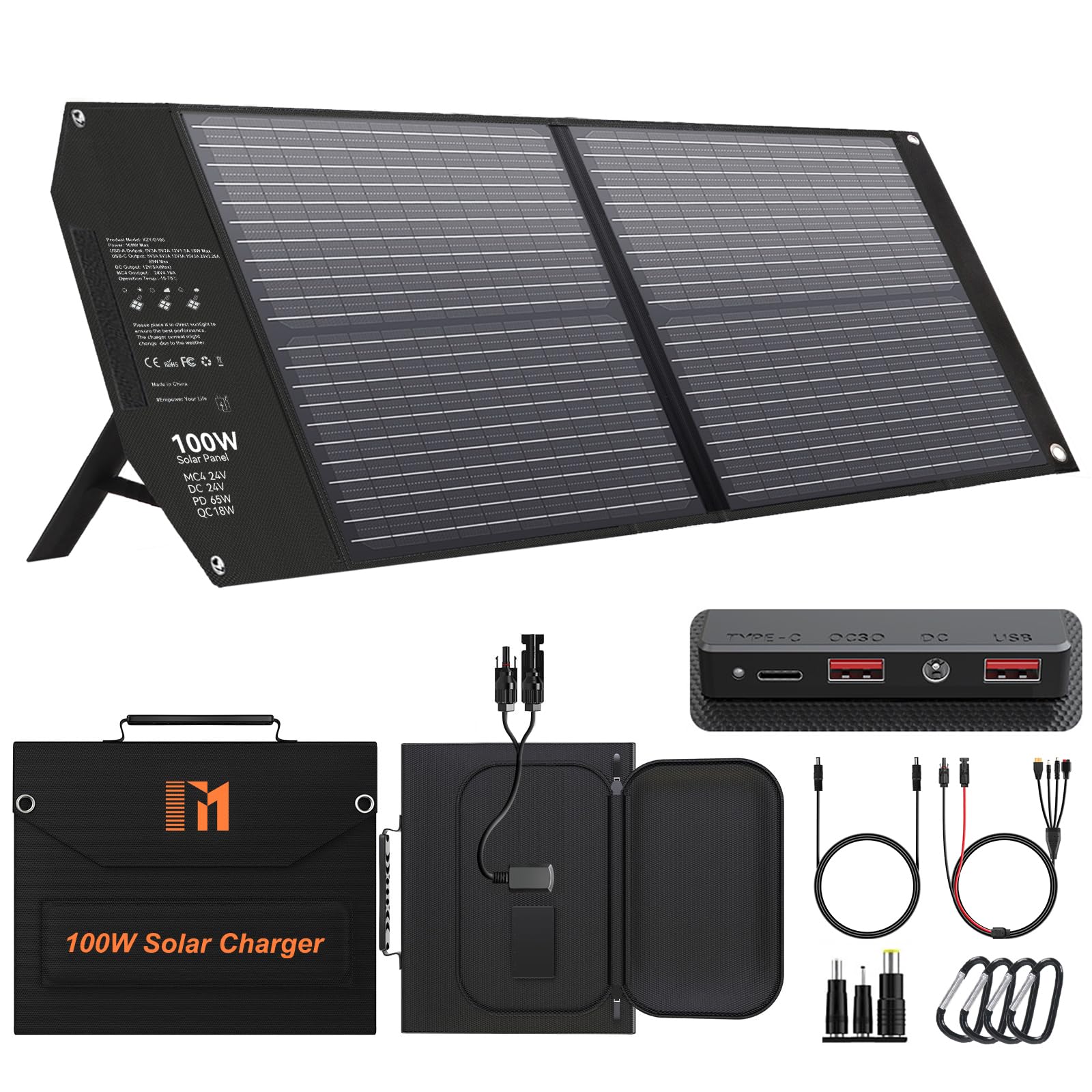
A 100W folding panel with five outputs, including USB-C PD 65W for a laptop.
For a 100W panel, the port count is unusually generous. There are five: MC4 at 24V, a DC outlet, two USB-A ports and a USB-C. The USB-C supports PD 65W, which is enough to charge a MacBook Air or feed a power station like an Anker 521, Jackery or EcoFlow River directly. The USB-A and USB-C also support QC 3.0 for charging several devices at once.
It weighs 7.5 lb and folds to about 22.8 x 19.7 in with a built-in carry handle, so there is no case to lose. An adjustable kickstand tilts the panel at the sun, and the built-in MC4 cable reduces power loss while letting you run panels in parallel or series if you scale up. Monocrystalline cells run at 24% efficiency — above the BigBlue’s 25.4%? No: it sits just under the small BigBlue’s 25.4%, and ahead of many larger panels on this list.
Owners find it well made and functional, with output that holds up on grey days. One buyer mentioned steady power at the top of its USB-C line, and the adapters mean it will talk to most small power stations, phones, tablets and cameras from the start. The included DC-DC and MC4-to-Anderson/XT60/7909/5525 cables cover the connectors most campers need. For a mid-size kit with mixed devices, this is the everything-panel.
Why it earns the Most Ports label
- Five outputs: MC4 24V, DC, two USB-A and USB-C PD 65W
- USB-C PD 65W can run a laptop or a power station directly
- Built-in carry handle and adjustable kickstand, no separate case
- Ships with a full set of DC adapters for most stations
Trade-offs to weigh
- 7.5 lb is car-camping weight, not a hiking panel
- 24% efficiency sits just under the small-panel leaders here
- Five ports only help if your devices match them
Choose this if: you are charging a laptop, a station and phones from one panel and want the connectors in the box.
Not for you if: you want a packable panel for on-foot trips — 7.5 lb is a base-camp piece.
7. Ecosonique 200W Portable Foldable Solar Panel

A 200W six-fold panel that packs to 18 x 16.3 in and weighs 11 lb.
Two hundred watts with the smallest folded footprint of the big panels here. The six-fold design brings it down to 18 x 16.3 in and 11 lb, and grommets let you hang it on a tent, an RV or a tree. Four adjustable kickstands aim it at the sun, and the 23.5% conversion rate does the actual work once it is positioned.
On the output side, you get 20V MC4 direct into a power station through a 3M cable, plus a 0.5M MC4 to XT60, Anderson, DC7909 and DC5525 adapter for EcoFlow, Jackery, Bluetti, Anker and others. USB-C PD3.0 at 45W and USB-A QC3.0 handle laptops, phones and battery packs. An intelligent chip guards against over-current, over-voltage and short circuits, and an auto-reboot picks things back up as the sun shifts.
What owners praise most is overall build quality, with performance right behind. Charging speed lands too — a 300-watt Bluetti power bank going from 13% to 100% in an hour is the kind of number that turns heads. The honest flip side: durability and stability both draw negative notes. The cloth-and-laminate construction rewards careful handling, and on a windy day you want it weighted or staked. Treat it as a fair-weather panel and it delivers.
The briefcase advantage: 200W in an 18 x 16.3 in fold is the most packable big-panel package here — ideal for the trunk of a car or a beach wagon.
The care it asks: durability and stability are the soft spots, so stake it down in wind and keep it out of the worst weather.
Good match for: campers and beach-trippers who want big output in a small folded footprint.
Pass it by if: you expect a panel to survive rough handling and high wind without being staked.
8. 200W Portable Solar Panel
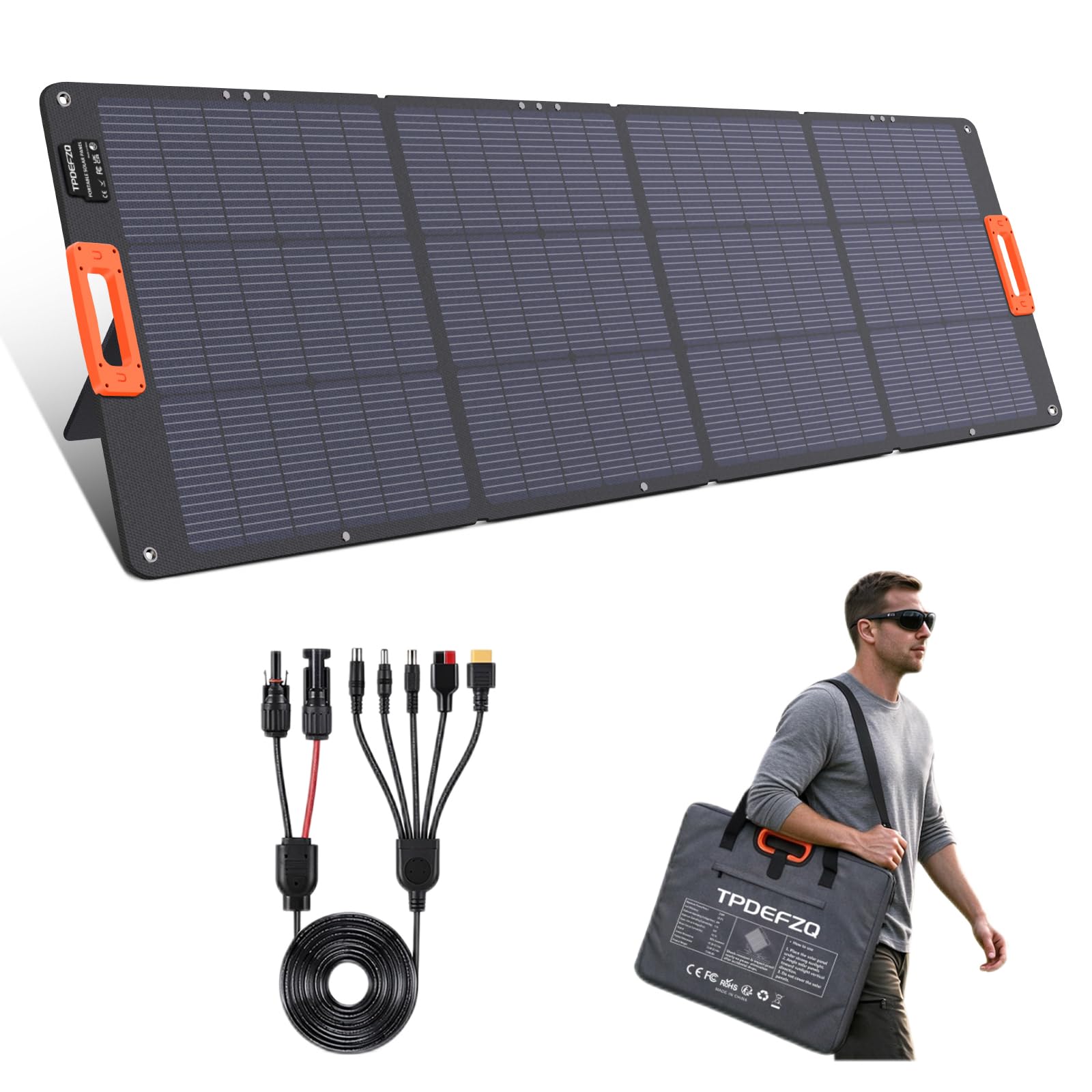
The highest-efficiency 200W panel here at 25.5%, and the heaviest at 17 lb.
On paper this is the efficiency leader among the 200W panels: 25.5% conversion from A+ grade monocrystalline cells, a hair above the 25% on both the Renogy and the BougeRV. That extra reach in transforming sunlight to current matters most on grey days and when the panel is not perfectly aimed.
Build-wise it is IP68 rated, wrapped in ETFE coating for water and dust, and folds to 21 x 23.22 x 1.77 in with a magnetic handle. Four mounting holes let you bolt it to an RV. The connector kit is comprehensive: an MC-4 to 5-in-1 adapter covering DC5521mm, XT60, DC7909, DC8020mm and Anderson, so it will talk to most solar generators like Jackery, EcoFlow, Bluetti, FlashFish, Goal Zero and Anker.
The catch on this one is size and weight, and the output picture is not entirely clear. At 17 lb it is the heaviest panel in this round-up, so it is a fixed-camp or vehicle panel, never a hiking one. And while the free power wins people over, some reporting pulls closer to 120W peak rather than the full 200W. Peak figures rarely show up in real sun, but set that expectation before you rely on it to fill a station in a single afternoon.
Why it stands out: 25.5% is the highest conversion rate of the big panels here, and the 5-in-1 adapter means it plugs into nearly any station.
What to know: 17 lb makes it a stay-put panel, and real-world output can land below the rated peak.
This one fits: a base camp or RV where the panel gets set up once and aimed all day.
Look on if: you need to carry it far — at 17 lb it is the heaviest on the list.
9. BougeRV 200W Portable Solar Panel
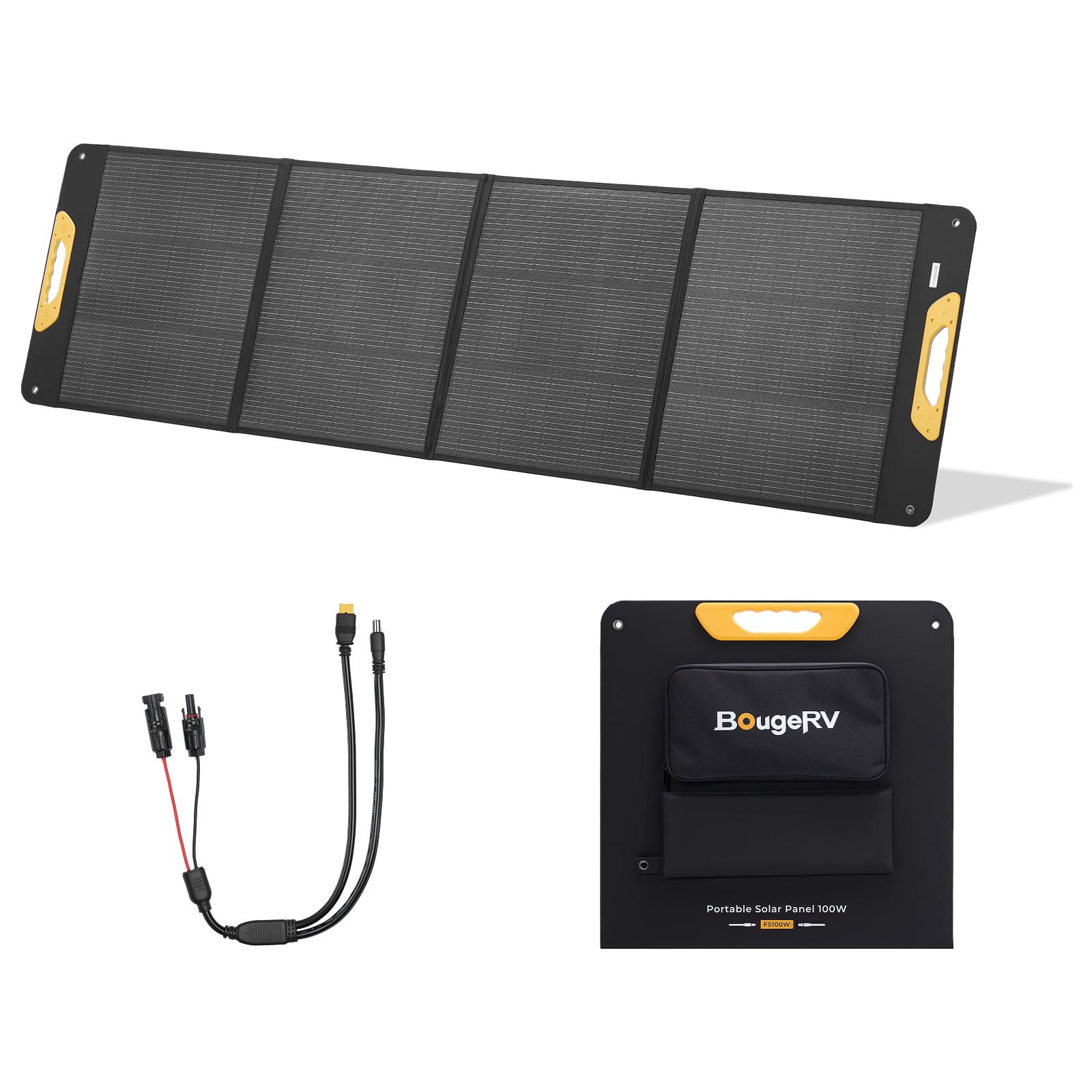
A fiberglass-backed 200W panel with a long cable that lets you chase the sun.
The design detail note first is the cable. An 8.2 ft extension separates the panel from your power station, so you can put the panel in full sun while the station sits shaded at camp.
N-Type cells give it 25% conversion, matching the Renogy’s figure and just under the 25.5% leader. The build uses a fiberglass layer meant to resist cracking and surface abrasion from repeated setup and transport — a real concern with folding panels. It carries an IP65 rating for rain and dust, and weighs 13.8 lb with built-in side handles for hand-carry. XT60 and DC7909 connectors cover most power stations and BougeRV portable fridge batteries.
What owners praise most is power output, and the numbers back it: one reports 186 watts in full sun, and another notes it charges a power bank to 100% in 2-3 hours. Performance and build quality land right behind. At 13.8 lb it is a car-camping panel, and IP65 is a step below the IP68 panels higher up the list — so keep it out of sustained downpour rather than trusting it to a storm.
The standout: the 8.2 ft cable is the longest reach on this list, letting you park the panel in the sun and the station in the shade.
The trade: IP65 is less weather-sealed than the IP68 panels, and 13.8 lb keeps it a vehicle-bound panel.
Reach for this if: cable reach and rugged construction matter and you camp from a vehicle.
Look past it if: you need full storm-proofing — IP65 is the honest limit.
Know the Specs
Wattage and conversion efficiency
Wattage is the panel’s power ceiling in ideal sun, and efficiency is the share of sunlight it turns into electricity — 25% means a quarter of the light that hits it becomes usable current. On small panels efficiency matters most, because a 30W panel at 25.4% squeezes more out of a limited surface than one at 23%. On big panels the difference is smaller. Remember that heat, shade and imperfect aim all pull real output below the rated peak, so plan around a figure lower than the badge.
Connectors, ports and water ratings
Connector types decide whether a panel charges your gear. MC4 is the round locking connector for power stations; XT60 and DC7909 are common station inputs; USB-A and USB-C cover phones, tablets and laptops. Match your station’s input before buying, and note whether the adapter is included or sold separately. For weather, the IP number tells you how well dust and water are kept out — IP68 is the strongest on this list, IP65 and IPX5 handle rain spray and dust but not sustained downpour.
Common Questions
Will a 200W folding panel charge my portable power station directly?
Is a 30W travel solar panel enough to charge a phone on a hike?
How much real power does a 200W panel actually put out?
What is the difference between IP65 and IP68 on a solar panel?
Can I chain two solar panels together for more power?
Do I need a separate charge controller for a folding solar panel?
How much should panel weight matter when hiking?
Will a foldable panel keep working on a cloudy day?
Does a folding solar panel need to be aimed at the sun all day?
Is a 100W panel better than a 200W one for travel?
The Bottom Line
For most people building a travel solar setup, the travel solar panel to start with is the Renogy 200W Portable, because 200W at 25% efficiency fills a power station while still folding to backpack size. If weight is your priority and a phone is your load, the ELECAETNA 30W brings 25.4% conversion at 1.1 lb. And for a mixed kit with a laptop, the Mesuvida 100W with its five ports — including USB-C PD 65W — is the one that plugs into everything.
How we choose
We do not accept paid placement. Every pick is matched to a real buyer and a real use-case; we do not hands-on test units.
Sources
Specifications: manufacturer listings and product documentation. Review insights: verified customer reviews, as of November 2026. Pricing: not shown on this page (it changes often); check the current price via the retailer link.
As an Amazon Associate, Tactical Gear Guy earns from qualifying purchases. This does not affect which products we feature.