Specs are compiled from manufacturer listings and verified buyer reviews and can change over time — please confirm the key details on the product page before buying.
A trailer tire that is a few pounds off can wear out fast, drag your fuel mileage down, and heat up on the highway. That is why the gauge you keep in the truck matters more than any other small tool in it. The picks below all read accurately up to at least 100 PSI, so they work on trailer tires, and several are built to reach the awkward inner wheel of a dually without you crawling under the fender. Quick note before you shop: this list uses flexible matching for gauges suited to trailer and high-pressure tires, so not every pick is the exact model you searched for. The nearest same-type gauge does the same job.
This guide is built by comparing the manufacturers’ published specifications and the patterns across verified customer reviews, so you get each pick’s real strengths and trade-offs instead of marketing spin.
Checking trailer tires should take seconds, not scraped knuckles. A gauge rated to 100 PSI or more is the dependable baseline for any trailer owner who wants accurate readings every single time. That is why this guide focuses on the best trailer tire pressure gauge for real-world towing. You will see digital and analog options side by side, plus the one feature that separates a frustration-free trailer check from a knuckle-busting one.
Top Picks


How To Choose The Best Trailer Tire Pressure Gauge
You want a gauge that hits your trailer’s target pressure dead on and keeps doing it after a season in a toolbox. Start with the pressure range, then think about how much reach you need.
Match the top of the pressure range to your tire
A gauge’s range is the window it can read. If your trailer tires run near the top of a gauge’s range, you want headroom above that so the reading stays precise. A gauge that tops out at 120 PSI works for many trailer tires, while a 150 PSI or 250 PSI gauge leaves room for heavier loads and truck tires. Picking a gauge that only just reaches your normal pressure leaves little margin for error.
Reach matters more than you think on a dually
Dual rear wheels push the inner valve stem back behind the fender. A dual-head chuck with one straight and one angled foot lets you press onto a forward-facing or reversed valve without twisting your wrist. Long stems — the Milton’s six-inch body, the Jon MFB’s extended straight gauge — put your hand clear of the wheel. If your trailer has normal single tires, a compact gauge is easier to carry.
Digital readout versus analog dial or bar
A digital gauge shows the number on a screen, often with a backlight so you can read it in a dark garage. A mechanical gauge uses a sliding bar or a dial and never needs a battery. A digital unit can resolve a finer step, so you see the exact pressure, while mechanical models move in fixed increments. Neither is automatically better. It depends on whether you would rather read a number or a needle, and whether you will keep batteries on hand.
Side-by-Side Comparison
| Model | Best For | Pressure Range | Readout | Reach Feature | Amazon |
|---|---|---|---|---|---|
| ETENWOLF T600 Digital★ Best Overall | All-around accuracy | 0–250 PSI | Digital, 0.1 PSI step | 360° rotating chuck, rubber hose | Amazon |
| Milton S-927 Dual HeadPocket-Size Pick | Compact analog durability | 20–120 PSI | Analog bar, 2 PSI step | Dual head, 6.02″ body | Amazon |
| SAFELIFE Dual Head 2-PackTwo-Gauge Value | Two gauges, one truck | 10–150 PSI | Analog bar, 2 PSI step | 11″ stem, 30° reverse chuck | Amazon |
| Number-one Digital 230 PSI | Dark-garage checks | 0–230 PSI | Digital LCD, 0.5 PSI step | Bi-directional dual head, 360° swivel | Amazon |
| Jon MFB 150 PSI Long Chuck | Bad knees, long reach | 10–150 PSI | Analog scale, PSI and kPa | Extended straight gauge, dual head | Amazon |
| Jon MFB Semi Truck 2-Pack | Fleet-style backup | 10–150 PSI | Analog scale, PSI and kPa | Dual-head air chuck, angled reach | Amazon |
| Rhino USA Digital 250 PSI | Low-light wheel checks | 250 PSI | Digital, 2″ glow dial | Braided hose, 360° brass swivel | Amazon |
| JACO ElitePro-X | One-hand sealing | 100 PSI | Analog dial, ±1.5% | Lightning push-to-lock chuck, 8″ hose | Amazon |
| TireMinder RV Gauge | Precision and warranty | 10–150 PSI | Digital, ±1 PSI | Interchangeable straight and 45° heads | Amazon |
Detailed Reviews
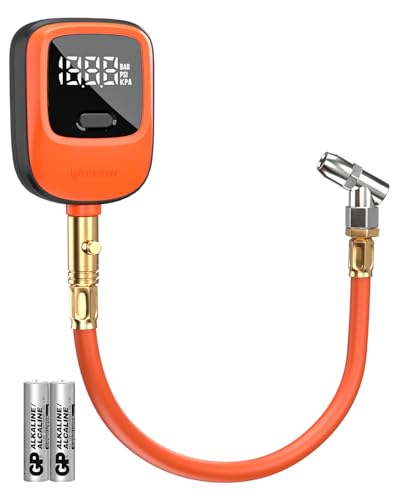
1. ETENWOLF T600 Digital Tire Pressure Gauge
Our pick — 4.5+★ from 350+ verified ratings; the strongest balance of quality and price.
The one-button gauge that reads to a tenth of a pound and still fits a glovebox.
Sand a trailer tire down to the exact number you want, and the T600 is the tool that gets you there. It reads from 0 to 250 PSI in steps of 0.1 PSI, so you see the fine difference that a slide-bar gauge hides between its marks. Its accuracy is rated at ±0.5% of full scale (a small margin of error across the whole scale) and it is calibrated to ANSI B40.7 Grade 2A, a published accuracy standard for pressure instruments. In plain terms: when the tire is supposed to sit at a set pressure, the gauge tells you how close you actually are.
What wins people over is the build and the precision together — quality is the thing that comes up most in owner feedback, with accuracy right behind it. The rubber hose and 360-degree rotating angled chuck let you press onto a recessed or awkward trailer valve from any angle without fighting the wheel. Readings lock on the display until you reset, so you can pull the chuck off and still read the number. If you overshoot, the built-in air bleeder lets you release air while the gauge is still connected and watch the pressure drop live. Just know it releases air only — it does not inflate.
Owners describe it as compact and sturdy, and say the backlit numbers stay readable even in bright sunlight. Two AA batteries come in the package and go in before first use, which is a small setup step people miss. At 2.4 ounces it outweighs the 1.6-ounce Milton, but that extra mass is the rubber hose and the electronics. The one honest limit: this is a checking and air-releasing tool, so you still need a compressor or inflator to add pressure.
compact digital readout
- 0.1 PSI steps let you dial a trailer tire to the exact number
- 360° rotating chuck reaches recessed valve stems
- Built-in bleeder releases excess air while connected
- Backlit display reads clearly in sun and in dim garages
battery reliance
- Needs two AA batteries before first use
- Checks and bleeds air only — no inflation
daily driver check: you want a single digital gauge that nails your trailer’s exact pressure and shrugs off weird valve angles.
fleet budget pick: you would rather never think about batteries and prefer a mechanical bar that works forever.
2. Milton S-927 Dual Head Truck Tire Gauge
A brass-and-nylon bar gauge that rides in a pocket and never asks for a battery.
If you want a gauge that lives in your jacket and works after years in the cold, the Milton S-927 is the analog answer. It measures 20 to 120 PSI in 2 PSI increments and reads in both kPa and PSI, so you are covered whether your trailer placard uses one unit or the other. At 1.6 ounces and 6.02 inches long, it slips into a glovebox or a chest pocket. That makes it lighter than the ETENWOLF’s 2.4 ounces and shorter than the 11-inch SAFELIFE stem, so it is the easiest of the bunch to carry.
The thing everyone raves about is the construction — quality is what comes up most, with function close behind. It is built from brass and nylon, made in the USA, and owners talk about it lasting a long while. The 2 PSI step is the catch: you see the tire climb in whole steps, so you cannot dial a tenth of a pound like the digital gauges. Some find it very accurate, while others report swings in the reading, so check it against a known pressure when it arrives.
For a trailer owner whose tires sit comfortably under 120 PSI, this is a fuss-free daily carry. The dual head switches between a standard and angled foot without any moving parts. It is one of the few here without electronics, so there is nothing to fail quietly in a toolbox.
dual head chuck: you give up fine digital resolution for a rugged little bar that never needs charging. For a simple trailer top-off routine, that is a fair swap.
truck stop duty: your trailer tires never push near 120 PSI and you value a pocketable, battery-free gauge you can trust for years.
car glovebox use: you want to see tenths of a pound or read pressures above 120 PSI.
3. SAFELIFE Dual Head Truck Tire Pressure Gauge 2-Pack
Two long-stem gauges so one can live in the truck and one in the trailer box.
Dually owners know the reach problem, and this pair is built to end it. The 11-inch stem with a zinc-alloy dual head puts one straight foot on outer wheels and a 30-degree reverse chuck on inner wheels or out-of-the-way valves, so you can hit a reversed stem without reaching under the fender. The scale runs 10 to 150 PSI on a two-sided aluminum bar with a laser-etched double scale, readable from either side. There is no battery to worry about, so it works whether the truck is cold or the sun has been beating on it.
The brass cores and rubber seals are there to stop air leaking out while you measure, which keeps the reading clean. It moves in 2 PSI increments with accuracy to one increment, so it is a step gauge, not a fine digital reader. The range tops out at 150 PSI — wider than the Milton’s 120 PSI ceiling — which matters if your trailer tires run toward the higher end. You get two gauges in the pack, so a spare can live in each rig or vehicle.
A hanging ring lets you stash it where you will not lose it, and the rubber guard makes it feel good in the hand. This is the pick for someone who tows two trailers or wants a backup already on hand. Treat the bar gently and it will keep reading true through many seasons.
pair for two rigs: dually and trailer owners who want long reach plus a spare gauge in one purchase.
single gauge need: you only need one gauge and prefer a digital readout to a sliding bar.
4. Number-one Digital Tire Pressure Gauge 230 PSI

A digital gauge with its own flashlight for checking tires after dark.
Checking a trailer at a rest stop at night is exactly where this one shines — literally. It pairs an LCD backlight with an LED flashlight, so you can find the valve stem and read the number without holding a phone in your teeth. The bi-directional push-pull dual head handles valve stems in different positions, which helps on inner and outer tires alike, and the swivel head is aimed at trucks, trailers, and RVs. It measures 0 to 230 PSI in 0.5 PSI increments, a finer step than the SAFELIFE’s 2 PSI bar.
You switch between four units with one button, which takes the guesswork out if you think in a different pressure unit. The metal connecting rod is heat-treated and turns a full 360 degrees, and the ABS handle is shaped to sit comfortably in your hand. Two AAA batteries are already installed, and the gauge shuts itself off within 30 seconds idle so the cells last. On the accuracy front, the read is what owners value most, with function close behind — it forms a seal quickly and gives a fast reading.
The honest catch is durability. You get a long feature list at an entry-level price, and buyers report the build breaking after about four months of use. If you check tires often or leave it bouncing in a truck bed, plan to treat it carefully. For occasional checks where the flashlight matters, it earns its place.
high 230 psi range: the backlit display plus flashlight combo is the standout, making dark-side tire checks genuinely easier.
oversized dial face: it is a lighter-duty unit, and long-term toughness is the trade-off for the low price and rich features.
heavy truck tires: you do a lot of nighttime or shaded-garage checks and want a lit readout at an easy price.
small vehicle tires: you want a gauge that survives years of rough handling — go analog or premium.
5. Jon MFB 150 PSI Semi Truck Tire Pressure Gauge

An extended straight gauge for anyone who would rather not crouch by the wheel.
If getting down to a trailer wheel is hard on your body, the length here is the whole point. The extended straight gauge with a dual head chuck reaches deep or stubborn valve stems on trucks and duallies, so you stand taller and reach farther instead of kneeling. It reads 10 to 150 PSI and 69 to 1034 kPa on an easy-read scale, covering the pressures trailer tires actually run. The head is industrial zinc alloy with brass ends, thick seals, and a solid brass core — hardware built to take a beating.
Owners value the accuracy most, with function close behind, and say it makes tracking air pressure simple. The dual pressure scale also lets you read in kPa if your placard uses that unit. At 5 ounces and 12.25 inches long, it is longer and heftier than the 6.02-inch Milton, which is exactly the trade that gets you the reach. The pack includes two gauges, so a spare goes in the cab.
This is a working tool, not a showpiece — it does not carry the fine 0.1 PSI resolution of the digital gauges. But if your goal is a quick, accurate read on a trailer or dually without a fight, the length earns it. The full-metal build means there is nothing electronic to wear out.
trailer tire checks: semi, RV, and dually drivers with deep valve stems who want accurate readings without bending low.
high pressure setups: compact-carry fans — this is a long bar, and it is a step gauge, not a digital fine-reader.
6. Jon MFB Semi Truck Tire Pressure Gauges 2-Pack

A two-pack of heavy-metal gauges built for the cab of a working tractor.
When one gauge is not enough, this pair covers both seats of a rig. The dual-head air chuck handles angled or hard-to-reach valve stems on trucks and tires, so getting onto a stubborn stem takes less fiddling. It reads 10 to 150 PSI and 69 to 1034 kPa on a clean scale, and the head is industrial zinc alloy with brass ends, thick seals, and a solid brass core. At 4.2 ounces and 11.25 inches, it is a touch shorter and lighter than the 12.25-inch Jon MFB long-reach single.
The build and the accuracy are what owners talk about — both come up as strengths, and the two-gauge pack is why it suits fleet-style use. A spare in the truck and one in the trailer box means you are never stuck without a way to check pressure. Like the other bar gauges here, it moves in fixed increments, so it is a fast reader rather than a tenth-of-a-pound instrument.
It carries a six-month warranty, which is shorter than the multi-year coverage on the premium picks — worth knowing if long-term support matters to you. For the price of two solid metal gauges, it is an easy way to equip more than one vehicle. The full metal body holds up to toolbox life far better than a plastic digital housing.
team driver kit: you want two durable metal gauges for a truck and its trailer without paying premium prices.
Consider the premium pick over this if: warranty length is your priority — this one covers six months.
7. Rhino USA Digital Tire Pressure Gauge (250 PSI)

A big glowing dial on a braided steel hose for low-light wheel checks.
Cold morning, dim shop, trailer to check — the 2-inch LED-backlit dial on this one is made to be read without squinting. The metal braided hose with a solid brass 360-degree swivel head lets you reach valve stems on large-offset wheels, reverse-mount rims, or a motorcycle tucked behind saddlebags. It is built to the ANSI B40.7 accuracy standard (a published spec for pressure instruments) and reads up to 250 PSI. When you are done, the reading holds until you press the relief valve, so you can pull the chuck off first.
Build and accuracy are what owners talk about, both landing as strengths, and the glow dial keeps the number visible in poor light. The heavy-duty air bleeder valve lets you bleed a tire down precisely while watching the dial. At 10 ounces it is one of the heavier picks on this list, so this is a shop-or-truck gauge rather than a pocket one.
The one honest split is value: some feel it is worth the money and others think it runs high, and there is mixed feeling about the “made in USA” claim versus where it is actually built. If the low-light dial and the swivel reach are what you need, the rest is easy to live with. Just know you are paying a bit for the brand and the glow.
rugged USA build: that 2-inch LED dial plus the braided hose and 360-degree head — the combination is genuinely comfortable to use in the dark.
premium price tag: it is one of the heavier gauges here and the value can feel mixed to some buyers, so buy it for the dial, not the badge.
offroad ready gauge: you check tires in low light and want a large glowing dial with an easy-to-reach swivel head.
budget conscious buy: you want a featherweight pocket gauge or the lowest-cost option.
8. JACO ElitePro-X Tire Pressure Gauge (100 PSI)
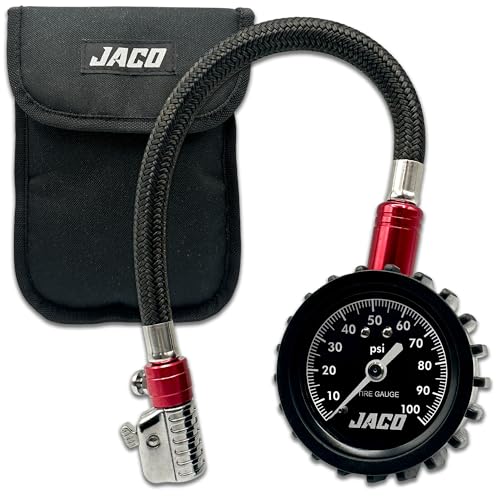
A no-battery analog gauge with a chuck that snaps on and seals itself.
You press the push-to-lock Lightning Chuck onto the valve stem and it locks with a secure, airtight seal, so you are not holding force against the tire to get a reading. That is the feature that makes this one different. Accuracy is calibrated to ANSI B40.1 standards (a published accuracy standard for pressure gauges) at ±1.5%, with a top reading of 100 PSI. That ceiling fits standard trailer tires rather than the heavy truck range. A quick-release button pops it off the valve with no air loss, so the numbers stay honest.
The 8-inch nylon-braided hose has a built-in fast-action bleeder, so you can dial a too-high tire down to target while the gauge is still connected. The aircraft-grade aluminum alloy body keeps it light at 4.8 ounces while staying durable. It comes with a padded storage pouch and a lifetime warranty from JACO. Build and accuracy are what owners appreciate most, with snug, air-free connection close behind.
Here is the trade: there is no battery, but that also means a mechanical dial, and the 100 PSI ceiling is the lowest range here. Some buyers find the value mixed relative to the premium price. If your trailer tires run well under 100 PSI and you want a one-hand, sealed connection, this is a beautifully made tool.
passenger car tires: owners of standard trailer tires who want a one-hand, no-battery gauge with a lifetime warranty.
truck tire duty: it tops out at 100 PSI — if your tires run heavier, this is the wrong ceiling for you.
9. TireMinder High Precision Digital Truck and RV Gauge

A metal-bodied RV gauge that holds ±1 PSI and backs it for five years.
For someone who wants the number they see to be the real number, the ±1 PSI precision from 10 to 150 PSI is the draw here. It is all-metal construction with a custom grip and a front-facing flashlight plus green LED backlight, so you can check tires on a dark trailer in the evening. Two interchangeable heads come in the box — a straight one and a 45-degree angled one — so you can match the tool to the wheel in front of you.
The build and the accuracy are what owners value, with exact readings on the lighted display named as a strong point. The all-metal body holds up, and the 45-degree head eases onto awkward stems. Replaceable AAA batteries are included, so you are not stuck when they run down. The 5-year warranty is the longest coverage in this lineup, which speaks to how the maker expects it to hold up.
The one thing to plan around: the power button can be easy to bump on accidentally, so store it where it will not get pressed in a toolbox. At 16 ounces it is much heavier than the compact analog gauges, so this is a glovebox or truck-cab resident. Set it up with the head you need and it is a precise, long-warranty companion.
RV precision accuracy: ±1 PSI precision plus a 5-year warranty makes it the most well-covered gauge for RV and truck use.
costlier than basics: it is heavy at 16 ounces and the power button can switch on by accident in storage.
RV and truck combo: you want RV-grade precision, both head angles, and the longest warranty here.
cheap backup gauge: you want a light carry gauge or worry about an easy-to-bump power button.
Know the Specs
Pressure range (PSI)
PSI stands for pounds per square inch — the unit tire pressure is measured in. A gauge’s range is the lowest and highest pressure it can read, and you want the top of that range comfortably above your trailer’s normal pressure. A 100 PSI gauge works for standard tires, while 150 PSI and 250 PSI gauges cover heavier truck and trailer loads. Reading near a gauge’s ceiling leaves less margin, so headroom keeps your numbers reliable.
Accuracy and increments
Accuracy is how close the gauge’s reading is to the true pressure, and the increment is the smallest step it shows. A digital gauge like the ETENWOLF moves in 0.1 PSI steps, while a bar gauge like the SAFELIFE moves in 2 PSI steps. Finer steps help when you want to hit an exact target, while coarse steps are faster for a quick top-off. Some gauges list a percentage figure, which is a margin of error measured across the whole scale.
The chuck and reach
The chuck is the part that presses onto the valve stem. A dual-head chuck has two feet — often a straight one and an angled one — so it fits a forward or reverse-facing stem. Long stems and braided hoses add reach for inner dually wheels. A push-to-lock chuck grips by itself, while a plain chuck needs you to hold pressure against the tire.
Bleeder valve and power
A bleeder valve releases air from the tire while the gauge is connected, so you can correct an over-inflated tire without taking the gauge off. Digital gauges run on AA or AAA batteries and often shut off automatically to save power, while analog gauges need no battery at all. If you dislike battery upkeep, a mechanical gauge never lets you down.
Common Questions
Will a 120 PSI gauge work on trailer tires?
How do I read an inner dually wheel without crawling under the fender?
Is a digital gauge more accurate than an analog gauge?
What does a bleeder valve actually do?
How long should a trailer tire gauge last?
Do these gauges need batteries?
Can I use a trailer gauge on my truck or car too?
Does a gauge rated to 250 PSI mean I can inflate to 250 PSI?
Can I inflate a tire with the ETENWOLF T600?
What is the difference between PSI and kPa on these gauges?
The Bottom Line
For most trailer owners, the trailer tire pressure gauge to grab is the ETENWOLF T600. It nails the exact pressure in 0.1 PSI steps across a 0 to 250 PSI range, and its rotating chuck reaches awkward valves. If you want a pocketable, battery-free gauge, take the Milton S-927. And if deep dually stems are your daily battle, the Jon MFB long-reach gauge saves your back. One nudge: the ETENWOLF leads the lineup on both accuracy and build, so it is the safest first pick if you want one gauge that does it all.
How we choose
We do not accept paid placement. Every pick is matched to a real buyer and a real use-case; we do not hands-on test units.
Sources
Specifications: manufacturer listings and product documentation. Review insights: verified customer reviews, as of November 2026. Pricing: not shown on this page (it changes often); check the current price via the retailer link.
As an Amazon Associate, Tactical Gear Guy earns from qualifying purchases. This does not affect which products we feature.