Specs are compiled from manufacturer listings and verified buyer reviews and can change over time — please confirm the key details on the product page before buying.
A trailer hitch lift is the difference between wrestling a deer or a generator into your truck bed by yourself and rolling it up with one hand on a crank. Every hoist here solves the same problem: you are alone at the tailgate, the load outweighs your back, and the bed sits too high to muscle it over. This guide walks you through eleven hitch-mounted hoists and cranes that actually bolt into a standard receiver, sorted by what each one does best so you can match the tool to the load you actually haul.
This guide is built by comparing the manufacturers’ published specifications and the patterns across verified customer reviews, so you get each pick’s real strengths and trade-offs instead of marketing spin.
Matching rated capacity to your real load and boom reach to your tailgate height cuts the list fast. That is exactly how I ranked every pick in this trailer hitch lift comparison.
Top Picks

How To Choose The Best Trailer Hitch Lift
The first thing to settle is what you are actually lifting. A field-dressed deer hung for skinning and a 500 lb generator hoisted into a truck bed put completely different demands on a hoist. Settle that number first and the low-capacity picks drop off your list.
Match the load rating to the load, then subtract a margin
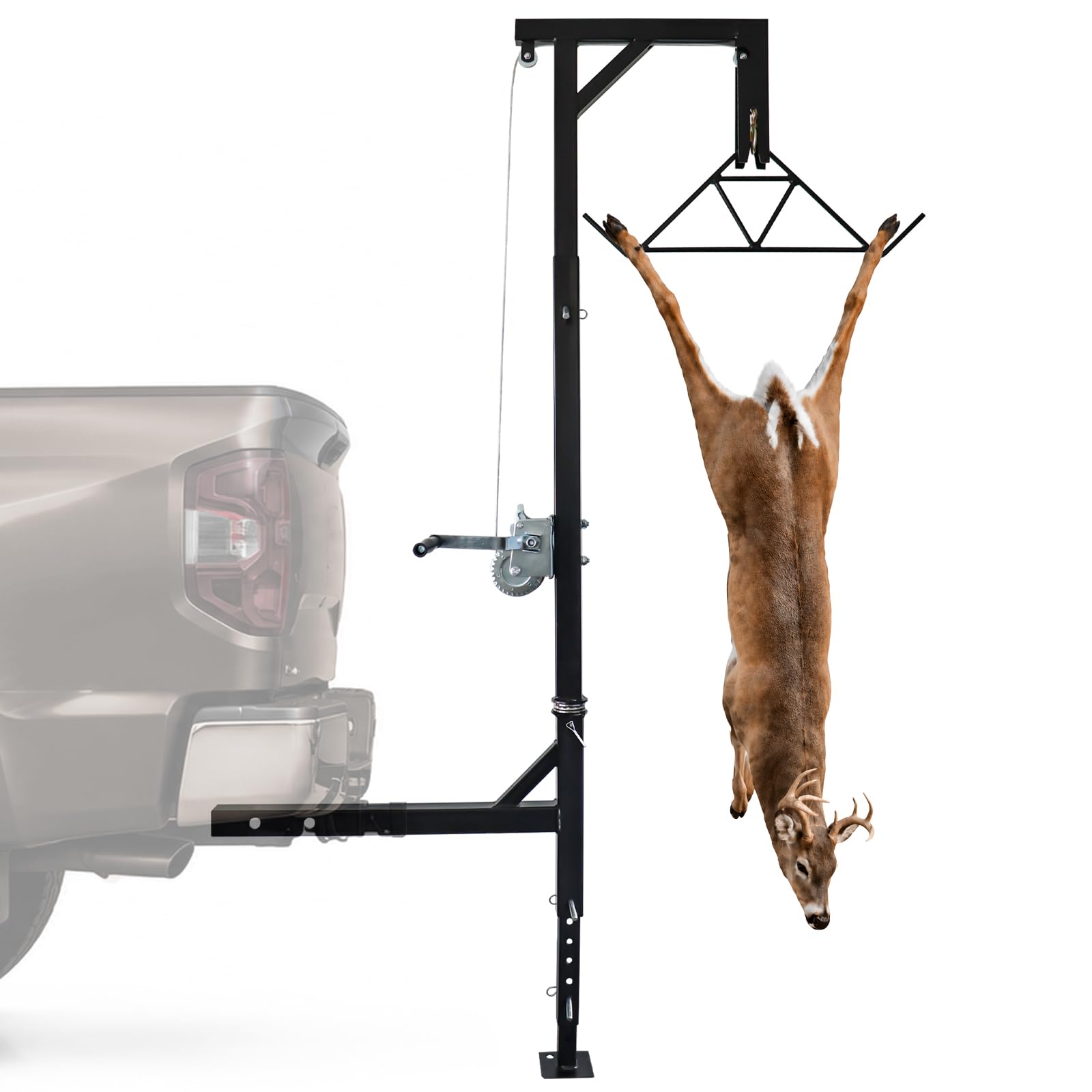
A hoist rated for 600 pounds is rated at its boom root with a fresh cable. The further you extend the boom and the more you swing it off-center, the less it will comfortably carry. Size the rating to the heaviest load you actually lift, not your typical one. The Highwild, for example, is rated to 600 pounds and lifts its hook from 81 inches up to 106 inches — plenty for hanging game, less suited to swinging a motor sideways.
Two capacities, not one
Several picks here list a hoist capacity and a separate lift capacity. The CROSSHIP, for instance, pairs a 400 lb hoist rating with a 250 lb lift rating. Read the smaller number as your real ceiling for anything you plan to raise onto a platform or bed. Ignoring the second number is how people overload a crane that looked strong on the box.
Receiver class and ground clearance
Most of these units slide into a standard 2-inch receiver. Some are built for Class III or IV hitches and put serious leverage on the mount, so a lightweight bumper hitch is not the place for a 1,000 lb crane. Ground clearance matters too — the CAMMOO wants 16 to 30 inches of clearance at the receiver, and the Larin needs a riser if your tailgate sits above 30 inches. Measure before you buy.
Manual crank, hydraulic, or 12V motor
Manual winches are simple and reliable but ask for real arm work. Hydraulic cranes use a pump and a jack to do the lifting, which suits heavier loads and single-person operation. A 12V motorized lift turns the job into a button press but adds wiring, a battery connection, and more that can go wrong. Pick a manual crank for occasional game, a hydraulic pump for repeated heavy lifts, and a 12V motor if you want a button press.
Side-by-Side Comparison
| Model | Best For | Rated Capacity | Lift Type | Boom / Height | Amazon |
|---|---|---|---|---|---|
| Highwild Truck Hitch Game Hoist★ Best Overall | Hanging and dressing game solo | 600 lb | Manual winch, 360° swivel | 81″–106″ | Amazon |
| KUAFU 2″ Hitch Mounted Deer HangerBest Value | Two-gambrel versatility on a budget | 600 lb | Manual winch, 360° swivel | 78″ max | Amazon |
| Viking Solutions Rack Jack IIMost Portable | Breakdown portability between hunts | 300 lb | Manual winch, 360° swivel | 20″ min | Amazon |
| Viking Solutions SwiveLift | Loading heavy cargo onto a platform | 300 lb | Hand winch, swing platform | 36.5″ x 21.25″ platform | Amazon |
| CROSSHIP Hitch Lifting System | Field dressing with a hoist and lift combo | 400 lb hoist / 250 lb lift | Heavy-duty winch, 360° swivel | Class III/IV 2″ receiver | Amazon |
| CAMMOO Truck Crane | Heavy shop and moving loads | 1,000 lb | 8T hydraulic pump, 360° swivel | 16″–94″ | Amazon |
| XtremepowerUS 500Lb Hitch Crane | Engine and PWC lifting at the dock | 500 lb | Hydraulic, 360° swivel | 36.2″–56.7″ | Amazon |
| Rugcel 1500 lb Hitch Crane | Biggest rated load on a budget crane | 1,500 lb | Hydraulic, 360° swivel | Telescopic, 3 lengths | Amazon |
| Lift Caddy Electric Bike Lift | Loading heavy e-bikes onto a rack | 200 lb | Motorized, push-button | 2″ hitch mount | Amazon |
| Silver Spring Scooter Carrier Lift | Mobility scooters on cars and vans | 350 lb | Powered lift, 20-second raise | 38″ L x 27.5″ W platform | Amazon |
| Larin TGL-500 Hitch Lift | Power lift for full-size trucks | 500 lb | 12V DC motorized | Up to 30.5″ | Amazon |
Detailed Reviews
1. Highwild Truck Hitch Game Hoist & Gambrel
Our pick — 4.5+★ from 150+ verified ratings; the strongest balance of quality and price.
The hoist that turns a two-person deer drag into a one-person job at the tailgate.
Start with the number that decides whether this thing can handle your biggest animal: a 600-pound load capacity on a frame of heavy-duty alloy steel with a powder coat built to shrug off rust. That rating sits at the top of the field here, and it is the reason this pick takes the crown. It is also the crowd favorite — 4.5+ stars across 190+ ratings — and the review pages confirm the reputation holds up over a full season.
Higher means the animal’s hind legs clear the ground while you work, so you are not crouching in the mud to skin. The adjustable support foot is the quiet hero — plant it before you hoist and the whole rig stops rocking while you put weight on it. A 360-degree swiveling shaft with a locking pin lets you swing the carcass around to face the truck without unbolting anything.
Setup is about as close to plug-and-play as a hoist gets. You slide it into a 2-inch truck receiver, lock the pin, and you are ready to field dress. Two small things to know going in. Some outer packaging on older stock still shows the previous weight rating, so trust the 600 lb figure on the unit itself, not the box. And the swivel is the one feature that splits opinion — a few buyers find the locking system fussier than they expected, so seat the pin fully before you swing a loaded animal.
Where it earns its keep
- 600 lb capacity on a rust-resistant steel frame that holds up season after season
- Height adjusts from 81″ to 106″ so game hangs clear of the ground
- Adjustable support foot steadies the whole hoist while you work a load
- 360° swivel with locking pin lets you face the animal any direction
Worth knowing first
- The 360° swivel is the feature that divides opinion — seat the locking pin fully before swinging a heavy load
- Ages of stock may arrive in packaging stamped with the older capacity figure
Built for: the solo hunter who fields-dresses at the truck and wants the load to hang at a workable height.
Give it a pass: if you need to swing heavy cargo sideways onto a platform — this is a hanger, not a crane.
2. KUAFU 2″ Hitch Mounted Deer Hanger
Two gambrels and a 197-inch cable for less than the price of most single-gambrel hoists.
The KUAFU packages something the others charge extra for: it ships with two differently sized gambrels plus a winch in one box. That is the draw for anyone who hunts deer one weekend and something bigger the next. The 197-inch cable gives you a long pull with room to work, and the 0.16-inch cable diameter is stout enough to handle a field-dressed animal without fraying scares. The bracket tops out at 78 inches with a 25-inch diagonal folding width, and it slides into a standard 2-inch receiver.
Where this one gets interesting is the honest gap between its headline rating and how it performs. The spec sheet says 600 pounds, and the manufacturer even lists a lower 400 lb working figure for stability in the same breath. That tells you the 600 is a ceiling, not a working load. If you are hanging a typical deer, you are well inside the margin. If you are trying to winch up a 550-pound animal, look at a beefier crane.
Buyers consistently report the hanger works well and is easy to operate once it is together. The assembly is the catch, and it is the single most-discussed topic — some find it straightforward, others wish the instructions were clearer and mention hardware that did not arrive. Do a parts inventory the day the box lands, before you drive out to hunt. Get that done and this is a lot of hoist for the entry-level tier.
The honest read: the KUAFU’s functionality wins people over, and the two-gambrel kit is real value. Just treat the 600 lb number as a maximum, not a target.
Where it asks patience: assembly instructions and the occasional missing bolt — check the box contents on arrival, not in the field.
Reach for this if: you want two gambrel sizes and a long cable without paying premium-tier money.
Think twice if: you regularly hoist near the rated limit — the 400 lb working figure is the truer everyday ceiling.
3. Viking Solutions Rack Jack II
Breaks into three pieces and stashes in the truck between hunts — the travel-friendly hoist.
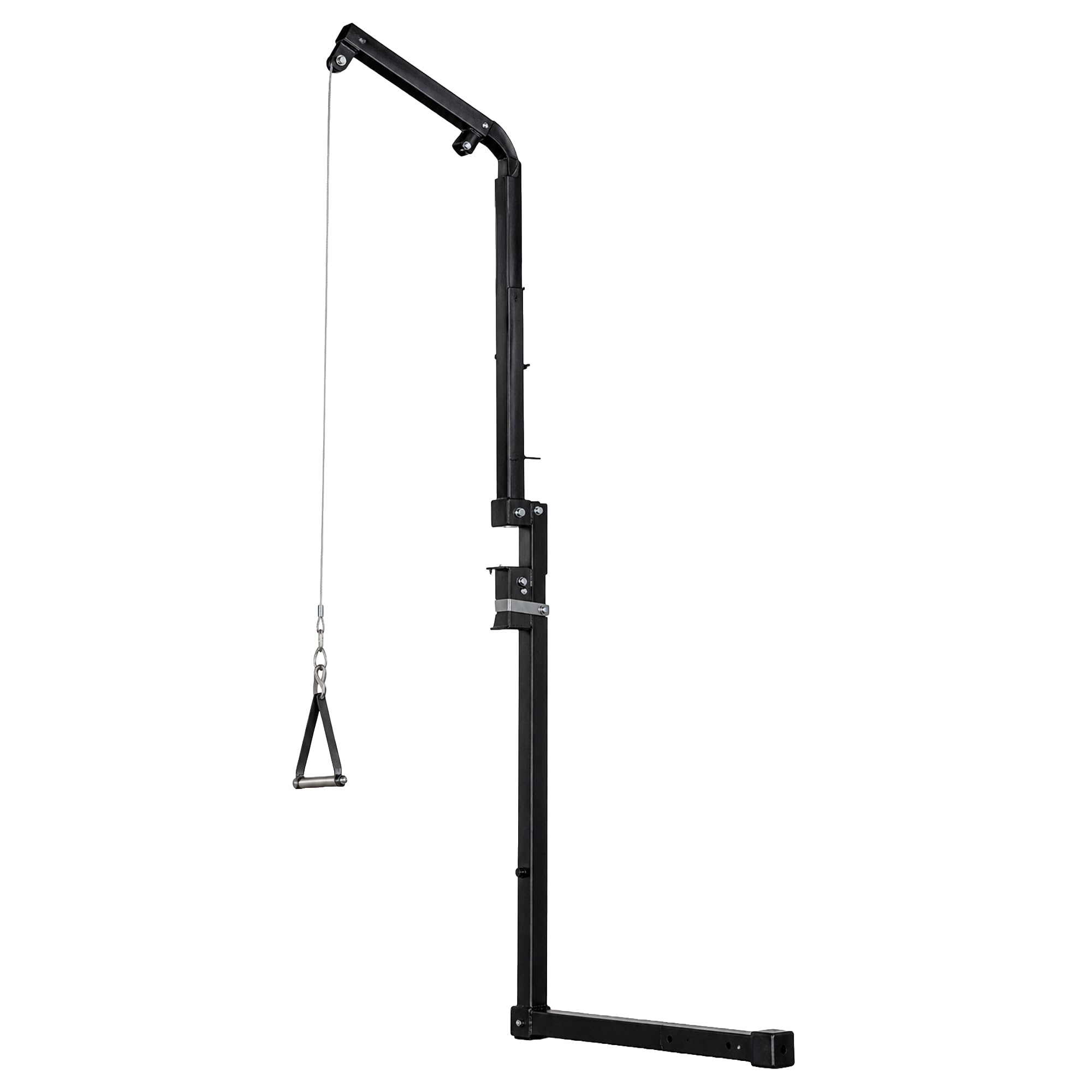
If your hitch is shared real estate — a bike rack on weekdays, a hoist on hunt weekends — the Rack Jack II is built for exactly that swap. It assembles in three pieces and breaks down just as fast for storage, and it weighs 42 pounds so one person can move it without a second set of hands. Machined pulleys deliver no-bind cranking, which is the difference between a smooth winch and one that fights you halfway up. A high-strength hook takes whatever gambrel you already own.
The 300-pound capacity is the lowest on this list, so be honest about your load. That covers deer, elk, and antelope for skinning and field dressing, which is precisely what this hoist is designed to do. What it will not do is lift a quartered animal onto a platform or raise a heavy generator. The 20-inch minimum height is a compact collapsed figure, not a working height — expect to raise the column before you hang anything.
The quality of this unit is the thing that carries it — the build earns the most praise of any aspect, and buyers describe it performing as advertised. A few mention it feeling heavy to handle and the boom not swinging as smoothly as they hoped, so keep the pivot clean and lubricated. The bigger honest caveat is value: some buyers think it is priced high for a 300 lb hoist when 600 lb models sit nearby on the shelf. You are paying for the breakdown design and the machined pulleys, not raw capacity.
The clever parts
- Three-piece breakdown packs down for transport and storage
- Machined pulleys crank without the bind cheaper winches fight
- Full 360° swivel with a simple receiver-pin install
The trade-offs
- 300 lb capacity is the lowest here — fine for game, tight for heavier cargo
- At 42 pounds it is a two-hand carry despite the portable design
Best match: hunters who need a hoist that disappears into the truck bed between trips and swings on a hitch they also use for other gear.
Not the one: if you need to lift beyond 300 pounds, a higher-rated hoist earns the space.
4. Viking Solutions SwiveLift
A swing-up platform that raises the load to tailgate height so you slide it, not hoist it.
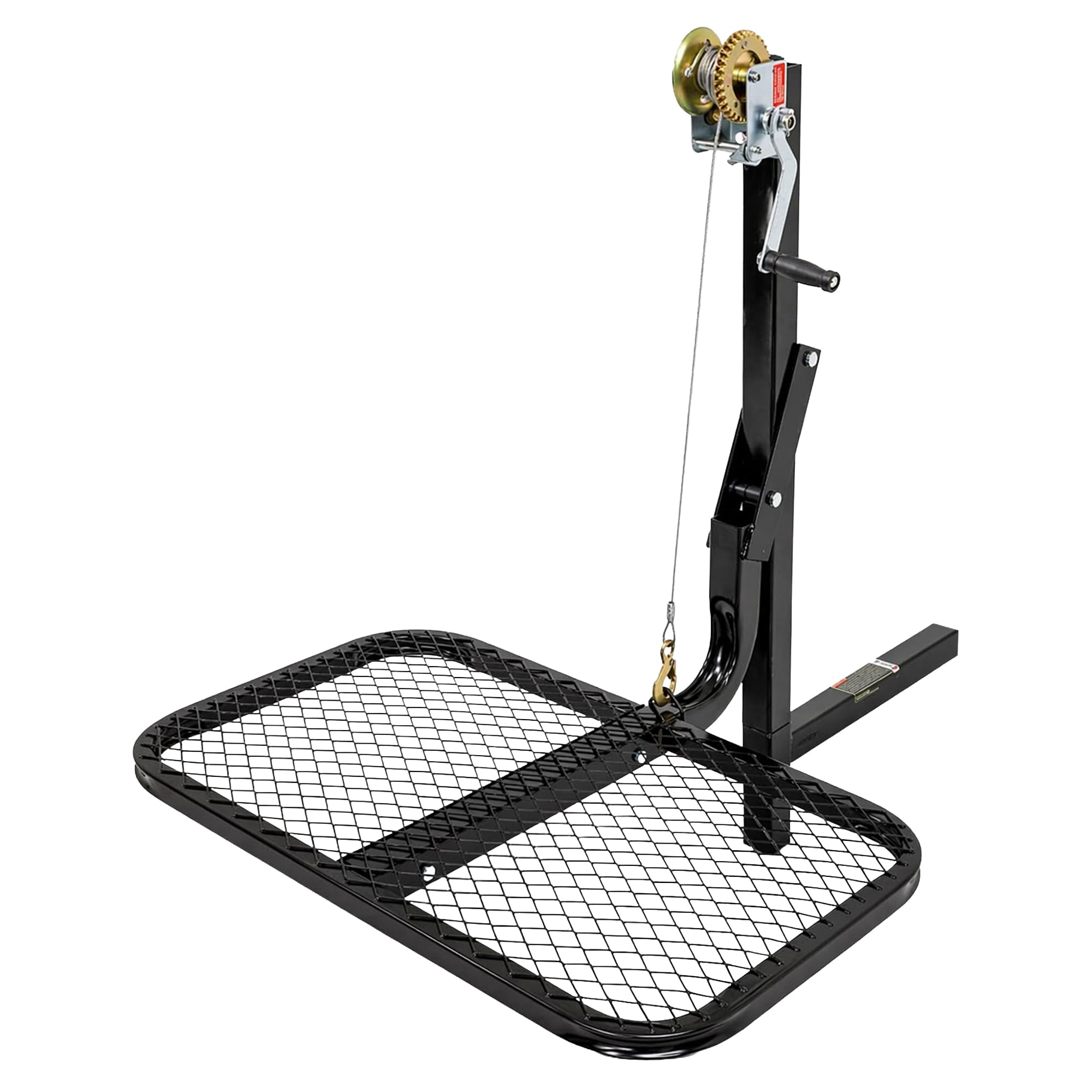
This is not a game hanger in the traditional sense — it is a loading assistant. A 36.5-inch by 21.25-inch platform takes your cargo, and a hand winch raises it just above tailgate level so you can slide boxes, coolers, or a field-dressed buck straight across. For anyone who has blown out a shoulder trying to swing a heavy cooler into a lifted truck, that geometry is the whole point. The build is powder-coated steel, and it breaks into three parts for transport.
The functional performance is what wins people over here — it simply works, and it does it for a huge cross-section of buyers, which is why it carries one of the higher rating counts on this list. Several say they would give it ten stars if the scale went that high, and the phrase “would buy again” shows up again and again. It is rated to lift loads up to 300 pounds, and assembly is quoted at under a minute once you know the sequence.
The catch is stability, and it is worth hearing plainly. The platform can let a load slide if it is not balanced, and there is some wobble in the raised position. That is a fit issue, not a defect — check that your cargo sits centered and strap it down before you crank. Assembly also trips up a few people, particularly the winch installation, so read that step twice. Set it up carefully and the SwiveLift is a genuinely useful piece of kit for camping, fishing, farming, and hunting loads alike.
Why it earns a spot: the platform-and-winch design solves the specific problem of getting awkward, heavy cargo up to bed height without a two-man lift.
The real caveat: stability — center the load and strap it before you raise the platform, and the wobble stops being an issue.
Pick this one if: your hauling is cargo — coolers, boxes, farm gear — and you want a lift-and-slide platform rather than a hanging hoist.
Look elsewhere if: you mainly hang game for skinning; a dedicated gambrel hoist serves that job better.
5. CROSSHIP Hitch Lifting System
One receiver, two jobs — a game hoist and a lift system in the same steel frame.
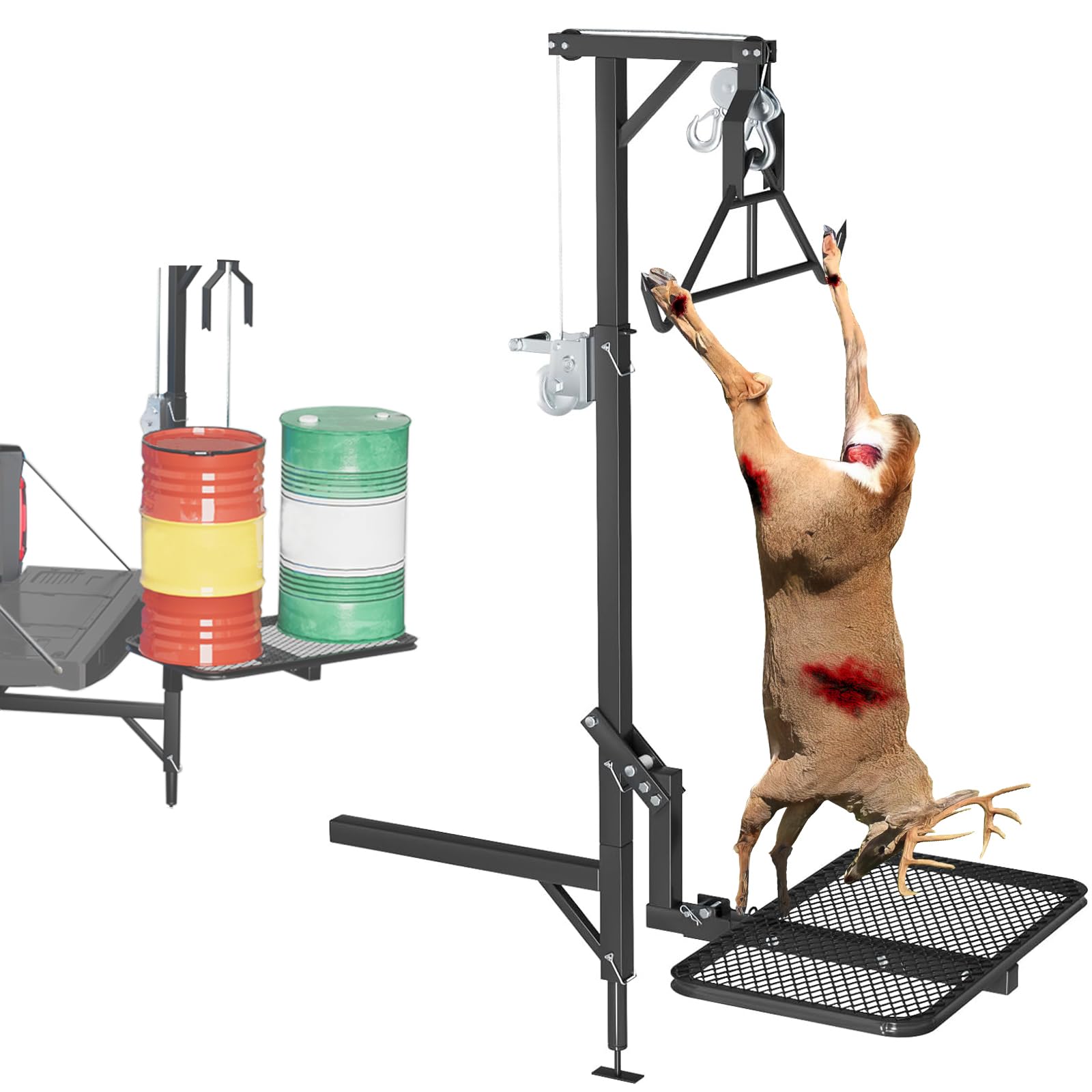
The CROSSHIP is the pick for the hunter who wants to hang an animal and then lift gear without buying two separate tools. Its spec sheet lists a 400 lb hoist capacity and a separate 250 lb lifting-system capacity, and that split matters. Hang a deer on the hoist side, and use the 250 lb figure as your ceiling for anything you raise and carry. It is built from alloy steel with a powder coat, runs a heavy-duty winch, and swivels a full 360 degrees.
The design detail that earns it a mention is collision avoidance. The wide gambrel and boom geometry are engineered to keep the load clear of your pickup’s door and spare tire, which is a real headache with shorter booms on other units. It is designed for Class III or IV 2-inch receivers, so confirm your hitch class before ordering. Reach and height are adjustable so you can tune the lift to your tailgate.
Data on this one is thin, but what exists points the same way — the material earns the most praise, and buyers report it working as expected and advertised. With a smaller review base, treat this as an early-run product and lean on the published figures rather than a long track record. The value proposition is the dual function: one mount, two capabilities.
What stands out
- 400 lb hoist rating paired with a 250 lb lift rating covers two kinds of work
- Wide gambrel and boom geometry keep loads clear of the door and spare tire
- Heavy-duty winch with full 360° swivel on a durable steel frame
Check before you buy
- Requires a Class III or IV 2-inch receiver — verify your hitch class first
- Lift side tops out at 250 lb, so heavy cargo is out of reach
Good fit for: the hunter with a Class III/IV hitch who wants one tool that hangs game and lifts moderate cargo.
Wrong tool: for anyone lifting past 250 pounds on the platform side or running a light-duty bumper hitch.
6. CAMMOO Truck Crane
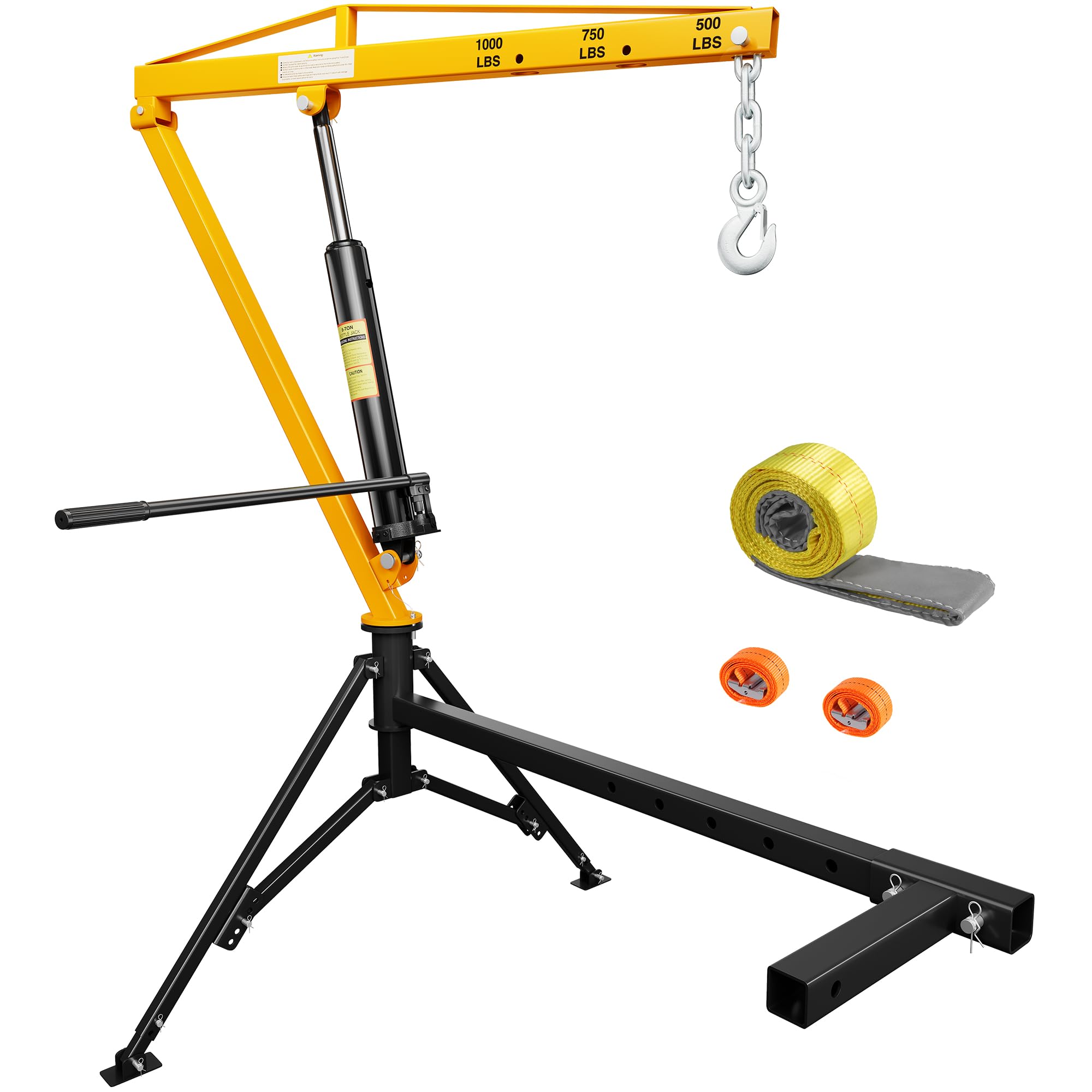
A hydraulic crane that lifts up to 1,000 pounds and reaches 94 inches into the sky.
The headline here is a three-position hydraulic boom rated at 500, 750, and 1,000 pounds, powered by an 8T hydraulic pump. That means one person can raise and lower serious weight with a pump rather than a crank, and it opens up jobs the manual hoists here cannot touch — moving appliances, loading shop equipment, commercial hauling. The boom extends to 94 inches of lift height and up to 53 inches of lifting length with the extra 6-inch boom section. Full 360-degree rotation lets you place a load precisely across the bed.
Ground clearance is the gating spec. This crane wants 16 to 30 inches at the receiver hitch, so measure that before you commit. Get it right and the fit is clean — the base comes pre-installed and the boom folds, so it stores without a full teardown. The build is the kind of solid the reviews keep returning to; buyers describe it as sturdy and easy to assemble with the included instructions, and the quick disconnect pins make setup fast.
The one thing to size up honestly is boom length. A cluster of buyers wish it reached further for their particular application, so if you are working deep into a long bed, walk that geometry against your truck before you buy. For everything else — stowage, height, and one-person lifting of heavy loads — the CAMMOO is the strongest hydraulic pick on this list.
Standout strength: the 8T hydraulic pump and triple-capacity boom lift loads up to 1,000 pounds without hand cranking, from 16 to 94 inches.
Measure twice: it needs 16 to 30 inches of receiver ground clearance, and a few owners found the boom reach shorter than they wanted for a long bed.
The right buyer: anyone hauling heavy equipment who wants hydraulic lifting instead of hand cranking, with the ground clearance to fit it.
Keep moving if: your receiver sits low or you need an extra-long reach deep into the bed.
7. XtremepowerUS 500Lb Hitch Crane
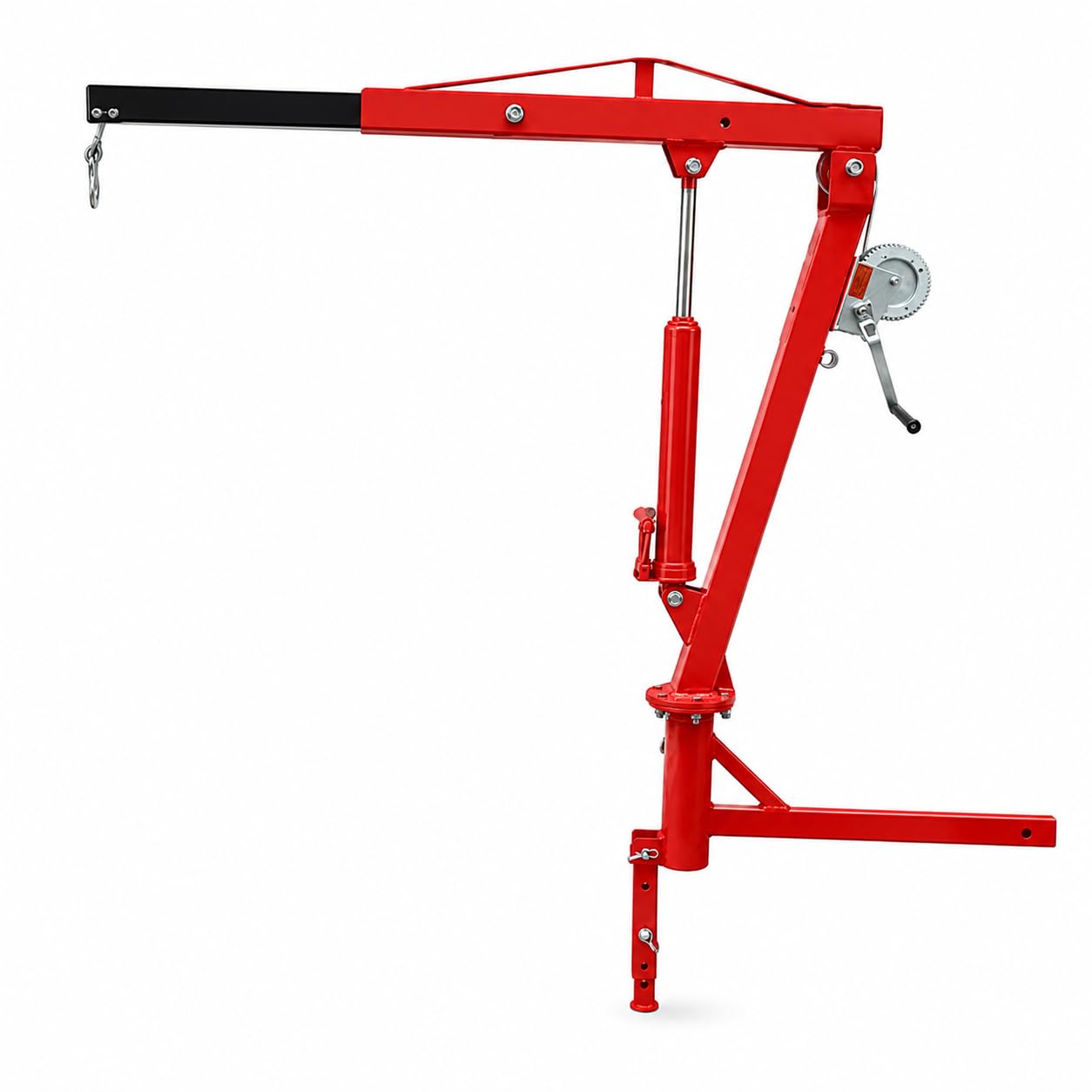
The dock-and-garage crane for engines and watercraft, built to lift with a handle.
XtremepowerUS designed this one around the single-person lift. A hydraulic design lets one operator raise a load with a manual handle control, aimed squarely at engine hoisting, PWC loading, and other garage and dock chores. The boom telescopes from 36.2 to 56.7 inches, and the tailgate-offset structure keeps your tailgate fully clear during the lift. A 360-degree rotating swivel plate lets you work either side of the truck.
The 2-inch standard receiver mount installs and removes as needed and saves space when it is off the truck. Adjustable support legs spread the load so the hitch receiver itself is not taking the full strain of a 500 lb lift. That matters — a crane that leans entirely on the hitch is a crane that wears your receiver mount. Ground level is the operating assumption, and the reviews confirm it works well and delivers good value for the money.
Two honest fit notes. First, its cable spooling is the most-discussed weak spot — the cable can jump the pulley or slip between bracket and pulley, so inspect the spool before each lift and consider a guide tweak. Second, assembly instructions are thin; several buyers figured it out without paperwork. On uneven ground the stability is only as good as your support-leg setup. Park on level surface, plant the legs, and this hoist earns its keep for years.
Where it shines: hydraulic single-person lifting with a 36.2″–56.7″ telescoping boom, tailgate-offset clearance, and a 360° swivel plate.
The honest catch: cable spooling wants attention — watch it each lift and keep it seated, and skip the uneven-ground jobs.
Suits you if: you pull engines or load a jet ski and want one crane for the garage and the dock.
Better skip: if you need a clean cable every single fire without watching the spool, or you lift on sloped ground.
8. Rugcel 1500 lb Hitch Crane
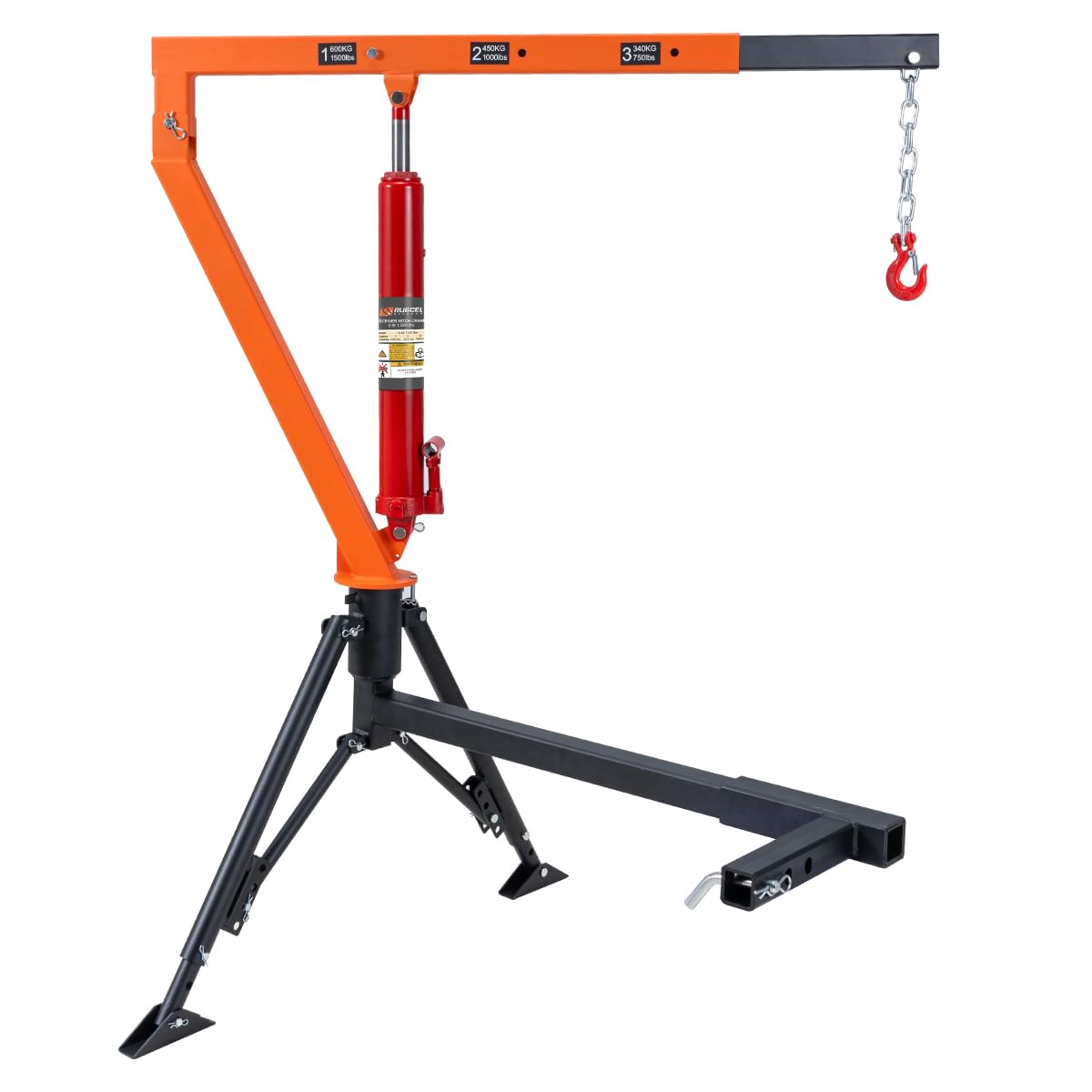
The biggest capacity on the list, telescoping out to a claimed 1,500 pounds.
On paper, the Rugcel out-muscles everything here. A double steel-pipe telescopic boom with three adjustable lengths promises a 1,500 pound load-bearing capacity, with the boom able to work at shorter lengths for lighter everyday loads and extend when you need reach. A detachable base makes the crane easier to install, and the whole thing rotates 360 degrees to place cargo exactly where you want it in the bed. It is aimed at generators, pressure washers, barrels, and heavy shop gear.
Assembly earns the most praise of any aspect, and buyers find it well worth the money with lifting that satisfies. The split is in the build itself. Some call it tough and substantial; others expected more steel for a 1,500 lb number and note the welds and durability did not match the ceiling on the box. That is a real gap on a crane this ambitious — a load rating is only as good as the weld behind it, so treat the top figure as a maximum and keep real lifts well south of it.
Functionality is genuinely mixed in practice — some owners mention it does the advertised job, others hit limits. The practical read: this is the pick for a buyer who wants maximum rated capacity on a mid-tier budget and who will use it for moderate shop loads, not for pushing the 1,500 lb limit every day. Inspect the welds on arrival and you will know exactly what you have.
Why buyers reach for it
- Three-position telescopic boom with a claimed 1,500 lb capacity — the highest rating here
- Detachable base and 360° rotation for flexible load placement
- Assembly is the aspect that earns the most praise
Look past the number
- Build and weld quality draw mixed feedback for a crane rated this high
- Some customers note durability limits — keep everyday lifts well under the ceiling
Choose it for: the biggest on-paper rating at a mid-tier price, for shop and truck-bed loads that stay well under the max.
Then don’t: push it to 1,500 pounds daily without inspecting welds first — a rating is not a guarantee.
9. Lift Caddy Electric Bike Lift

Press a button, watch your e-bike rise onto the rack — no more hoisting 80 pounds of motor.
If you have ever tried to lift an 80 lb e-bike onto a hitch rack alone, you already know why this exists. The Lift Caddy is a motorized lift that mounts to a 2-inch trailer hitch and raises your bike up to rack height on a button press, so you roll it on and roll it off. It carries up to 200 pounds and weighs 40 pounds itself, meaning the machine is lighter than the bikes it lifts. Your existing bike rack works on top of it — this replaces the lift, not the rack.
The real value shows up in the specs aimed at a specific back-saving job. It includes an anti-rattle locking hitch pin to take the slop out of the receiver connection, and a one-button operation that does the ascending and descending for you. Build quality is what owners praise most, and it earns that with high-quality materials built to handle regular use and weather. Reviewers point out it makes loading heavy e-bikes feel like nothing, which is the whole point.
Two things worth knowing. At 200 pounds, it is built for heavy bikes, not cargo — do not expect it to lift a generator. And because it adds 40 pounds of hardware and height behind your hitch, check the geometry of your setup before you load two fat-tire e-bikes. When the balance is right, this turns the worst part of an e-bike ride — getting the bike back onto the truck — into a non-event.
The winning combo: 200 lb capacity, a 40 lb self-weight, and push-button raise/lower that saves your back every single trip.
Size it first: it is a bike lift, not a cargo crane, and the added rear height means you should check clearance with heavy racks.
Takes the job if: you haul heavy e-bikes or scooters and want to load them without lifting a motor-driven bike overhead.
Not the tool for: cargo or game — this is engineered solely around getting a bike onto a rack.
10. Silver Spring Electric Hitch-Mounted Carrier Lift

One-key powered lift that raises a mobility scooter in 20 seconds and folds in six.
This one is built for a specific user and built well for it. A high-strength aluminum platform on a steel frame carries up to 350 pounds, and the platform measures 38 inches long by 27.5 inches wide, with an adjustable cradle that extends to 46 inches to fit different scooter lengths. It is designed for Class II hitches and up, and the powered lift raises the carrier in 20 seconds, folding in six. Four self-tensioning retractors hold the scooter secure, and there is a license-plate holder and a warning LED light included.
The manual back-up hand crank is the detail that makes this a serious piece of equipment rather than a gadget — if the motor ever fails with a scooter aboard, you can still get it down by hand. That kind of redundancy is note on a lift that could otherwise strand the very person who needs it. Build quality is the aspect that earns the most praise, and owners find it easy to assemble and operate and refreshingly practical.
The stability is the honest weak spot. Some shoppers say the platform not staying fully in the lowered position or not sitting flat on the ground, which makes loading a scooter a fussier job than it should be. Check that the platform seats level before you load up. On the power side, functionality is mixed in the reviews — plenty say it does the job, a few report it stopping. That split is worth knowing when you are depending on it, so look after the motor and wiring.
What makes it dependable: a 350 lb alloy platform with a back-up hand crank, self-tensioning retractors, and a 20-second powered raise.
What to watch: platform stability when lowered — make sure it seats flat and level before rolling a scooter on.
Now this fits: the mobility-scooter owner with a Class II hitch who wants powered lifting and a manual backup.
Look past it: if you do not want to manage platform positioning or need to lift heavier cargo than 350 pounds.
11. Larin TGL-500 Hitch Lift
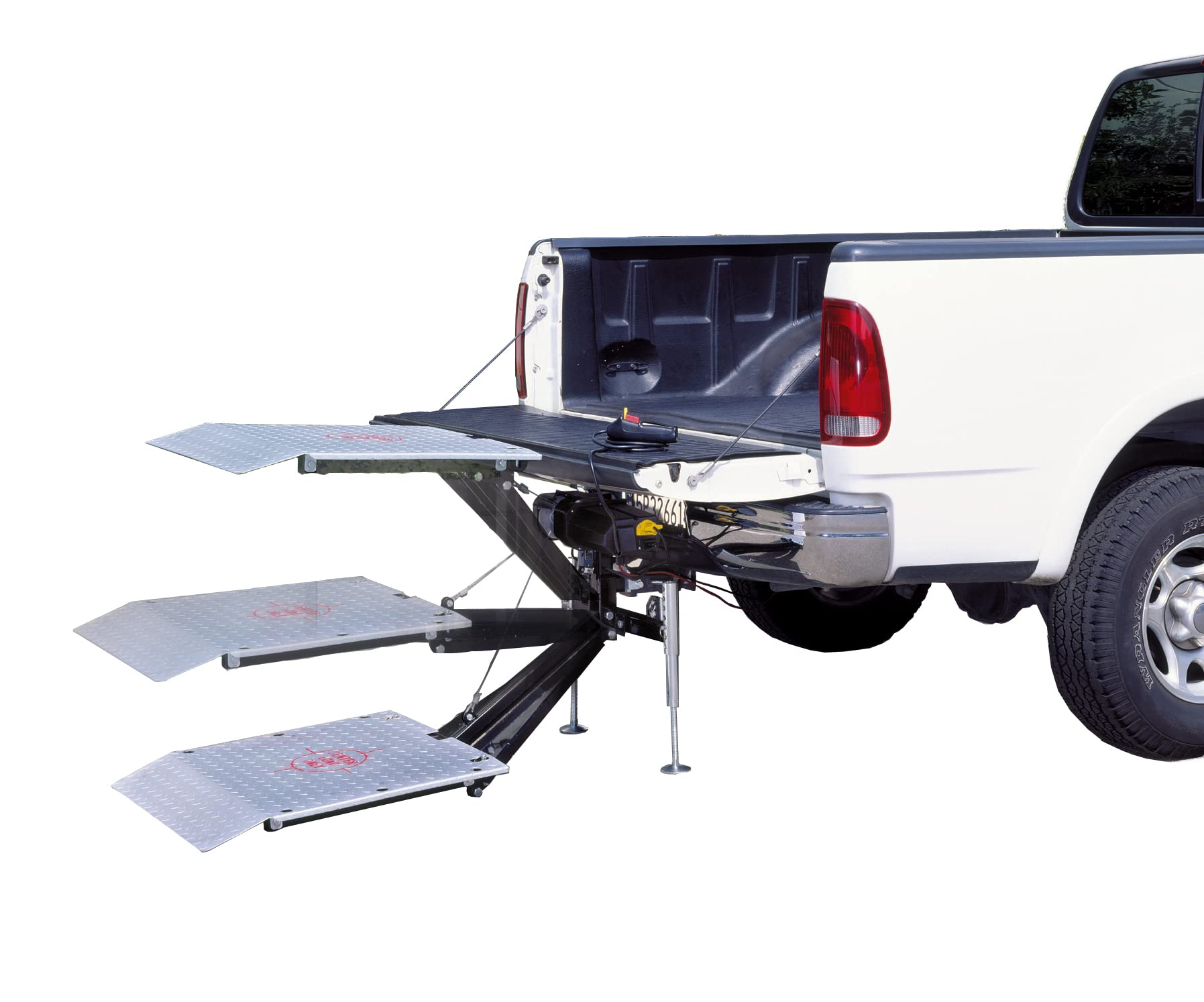
A 12V motorized deck plate that raises from ground to tailgate with no cranking at all.
The TGL-500 is the pick for the truck owner who does not want to crank anything. A heavy-duty 12V DC motorized cable module lifts the deck plate from ground level up to 30.5 inches, so the machine does the lifting. The deck plate measures 30.68 by 27.5 inches. A built-in adjustable limiting device lets the plate line up with your truck bed or drop to ground level, and twin safety outrigger assemblies add stability while you load. It mounts on a Class III hitch with a 2-inch square receiver and weighs 137 pounds.
Two specs decide whether it fits your truck, so check them before ordering. This lift is for trucks only, not SUVs or vans. And if your tailgate height is over 30 inches, you need a 3-inch hitch riser to make it work. Get those two right and the setup is straightforward, and the 21-foot cables for the battery connection give you reach to route power cleanly. The motorized deck-plate concept is easier on your body than any winch on this list.
The mixed part is the electronics. Some buyers report the up and down stops and auto-stop feature working inconsistently, so the travel limits are the one thing to test thoroughly on arrival. Assembly instructions are the low point — several owners found them unhelpful. And it is worth checking fitment against your specific truck, because some note compatibility trouble with certain heavy-duty models. Buy it for the motorized convenience, not for a perfect manual.
The case for it
- 12V DC motor raises the deck plate up to 30.5 inches from the ground — no cranking
- Twin safety outriggers stabilize the load while you work
- Built-in limiting device lines the plate up with the truck bed or the ground
The fine print
- Trucks only — and a tailgate over 30 inches needs a 3-inch hitch riser
- The up/down stops and auto-stop feature draw mixed feedback; instructions are thin
For the truck owner who: wants powered, hands-off lifting of heavy items onto the bed and has the right hitch class and tailgate height.
Skip for now: if you drive an SUV or van, run a tailgate over 30 inches without a riser, or expect clear assembly instructions.
Know the Specs
Rated Load Capacity vs Lifting Capacity
Many hoists list two numbers, and they are not interchangeable. A hoist rated for 600 pounds is rated at its strongest point with a fresh cable. Extend the boom or swing the load off-center and the safe working figure drops. Look for a separate lift rating where the maker provides one — that smaller figure is your real ceiling for anything you raise onto a platform or bed. Size the rating to your heaviest realistic load, not your typical one.
Boom Reach and Lift Height
These decide whether your load clears the tailgate or collides with it. A taller lift height keeps game’s legs off the ground while you work; a longer boom reach puts thehook out far enough to drop into the bed. Match the lift height and reach to your own tailgate — a crane that lifts to 94 inches deals with a tall bed, while a 20-inch minimum is about a compact collapsed package, not a working height. Measure your tailgate before you commit.
Receiver Hitch Class and Ground Clearance
Most of these lifts slide into a standard 2-inch receiver, but the hitch class decides how much leverage the mount can take. Heavy hydraulic cranes want Class III or IV, and a bumper-mounted hitch cannot safely carry a 1,000 lb crane. Ground clearance is the other gate: some cranes need a specific clearance range at the receiver, and a truck with a high tailgate may need a hitch extender. Check both figures against your own vehicle.
Manual Winch, Hydraulic, or Motorized Lift
A manual winch is simple, reliable, and light on electronics, but it asks for real arm work on every lift. A hydraulic crane uses a pump and handles of its own to do the heavy lifting for one person. A 12V motorized lift turns the job into a button press, but it adds wiring and a battery connection — more convenience, more to maintain. Pick a manual winch for occasional game, a hydraulic pump for repeated heavy cargo, and a 12V motor if you want push-button lifting.
Common Questions
What is the difference between a game hoist and a cargo crane for a hitch?
How much weight can a hitch-mounted hoist safely lift?
Do I need a special hitch class for a heavy crane?
Will a hitch hoist fit my truck if my tailgate is very high?
Is a hydraulic crane better than a manual winch hoist?
Can I use a hitch crane to load a mobility scooter or e-bike?
How long does it take to set up and take down a hitch hoist?
What happens if the motor fails on a powered hitch lift?
Can I leave a hitch hoist on my truck all the time?
Do I need a second person to operate a hitch-mounted lift?
The Bottom Line
If you want one dependable pick, the trailer hitch lift winner is the Highwild Truck Hitch Game Hoist & Gambrel because it pairs a 600 lb capacity with a height range that runs from 81 inches to 106 inches, and it earns its keep as the top-rated, most-recommended game hanger in this group. If you want the strongest hydraulic reach for heavy equipment, grab the CAMMOO Truck Crane. And for loading a mobility scooter without wrecking your back, the Silver Spring Electric Carrier Lift is the one to reach for.
One honest nudge before you decide: the pick that matches your load and your hitch class on paper is the pick that serves you for years, so measure your receiver and tailgate height first, then choose from the list above.
How we choose
We do not accept paid placement. Every pick is matched to a real buyer and a real use-case; we do not hands-on test units.
Sources
Specifications: manufacturer listings and product documentation. Review insights: verified customer reviews, as of November 2026. Pricing: not shown on this page (it changes often); check the current price via the retailer link.
As an Amazon Associate, Tactical Gear Guy earns from qualifying purchases. This does not affect which products we feature.