Specs are compiled from manufacturer listings and verified buyer reviews and can change over time — please confirm the key details on the product page before buying.
A 750-milliamp maintainer keeps a healthy battery topped up; a higher-amp charger or one with a force/recovery mode is what actually revives a flat one. This guide separates the two jobs so you stop buying a trickle charger for a dead-battery problem. One note up front: this list uses flexible, human-like matching for 12-volt charging (units that accept 6V/12V selectable charging), so not every pick is the exact number you searched — the nearest same-type capacity serves the same purpose.
This guide is built by comparing the manufacturers’ published specifications and the patterns across verified customer reviews, so you get each pick’s real strengths and trade-offs instead of marketing spin.
Small maintainers and big shop chargers solve different problems, and mixing them up is the fastest way to waste money on a unit that never brings a flat battery back. Below are nine chargers ranked by how well they handle that split, so you can pick the right one for a tractor battery charger.
Top Picks


How To Choose The Best Tractor Battery Charger
The single question that decides your pick: are you maintaining a healthy battery through the off-season, or trying to bring back a battery that has sat flat for months? Those two jobs need different amperage output, and a charger built for one often struggles at the other. Get that answer right and the rest of the specs fall into place.
Match amperage to your battery’s size and state
Amperage (the rate at which the charger pushes current into the battery) is the number that shapes everything. A low-amp unit around 750 milliamps is a maintainer — it holds a charged battery at full voltage without cooking it. A higher-amp unit of 5, 10, or 15 amps can actually refill a depleted battery in a reasonable time. A tractor battery that is still healthy wants a maintainer; one that sat dead all winter wants the higher amp rating plus a desulfation mode.
Confirm your battery chemistry is supported
A tractor often runs a standard flooded lead-acid or AGM battery, but more owners are switching to lithium (LiFePO4). Each chemistry charges on a different voltage curve, so check the charger’s compatibility list before you buy. A unit rated only for lead-acid will not properly charge a lithium pack, and one that supports both gives you room to change batteries later.
Look for float mode and desulfation for storage
Float mode is the charger’s “hold” setting — once the battery is full, it drops to a low output that keeps voltage steady instead of overcharging. Desulfation is a pulse routine that breaks down the sulfate buildup that forms on plates during long storage. For a tractor that sits for months, both features do the work that keeps the battery serviceable into next season.
Side-by-Side Comparison
| Model | Best For | Amperage | Battery Types | Notable Feature | Amazon |
|---|---|---|---|---|---|
| Battery Tender Junior 12V, 750mA★ Best Overall | Long-term storage | 0.75 A | Lead-acid, flooded, AGM, gel | 4-step float mode | Amazon |
| ECO-WORTHY 12V 5ABest for Lithium | Lithium and lead-acid both | 5 A | Lead-acid, LiFePO4 | LCD display with repair prompt | Amazon |
| NOCO GENIUS2 2ADead-Battery Rescuer | Dead-battery recovery | 2 A | Lead-acid, LiFePO4 | Force Mode to 0 volts | Amazon |
| Schumacher SC1280 15A | Fast shop charging | 15 A | Standard, AGM, gel, deep-cycle | 4-in-1 charge/test/restore | Amazon |
| Schumacher SC1363 8A | Reconditioning older batteries | 8 A | Standard, AGM | Reverse polarity protection | Amazon |
| CRAFTSMAN CMXCESM258 12A | Garage all-rounder | 12 A | Standard, AGM, LiFePO4, deep-cycle | Digital display | Amazon |
| Clore Automotive PL2310 10A | Stable power supply mode | 10 A | 6V and 12V lead-acid | 2/6/10 amp selectable rates | Amazon |
| NOCO GENIUS5 5A | Fast, compact maintainer | 5 A | Lead-acid, LiFePO4 | Force Mode and thermal sensor | Amazon |
| CTEK NXT 5 4.3A | Harsh-weather storage | 4.3 A | Lead-acid, LiFePO4 | IP65 rated housing | Amazon |
Detailed Reviews
1. Battery Tender Junior 12V, 750mA Charger and Maintainer
Our pick — 4.5+★ from 50,000+ verified ratings; the strongest balance of quality and price.
The set-and-forget maintainer that holds a stored tractor battery at full voltage all winter.
It pushes 0.75 amps (750 milliamps) — a low, steady current designed to hold a charged battery, not to refill a flat one. A full charge-and-hold cycle runs through four stages: Initialization, Bulk Charge, Absorption Mode, and Float Mode. That last stage is the one that matters for a tractor parked for months — it drops to a low output so the battery doesn’t overcharge while it sits.
The 750mA output is a fraction of what the bigger chargers in this list deliver. Against the Battery Tender’s 0.75 amps, the NOCO GENIUS2 pushes 2 amps and the Schumacher SC1280 pushes 15 amps. So if you need fast recovery on a dead tractor battery, this is not the tool. But for a battery that was healthy when you parked it, the low rate is exactly what keeps it that way. A 12-foot output cord reaches a battery tucked behind a grille or under a seat, and the fused ring-terminal harness lets you bolt a permanent connection for hard-to-reach batteries.
Its 4.5+ star rating ties the CTEK for the highest in the group, and the sheer volume of owner feedback tells one consistent story: it sits on a shelf and quietly keeps batteries alive without overcharging. What owners value most is straightforward quality and function — it does its small job without fuss. The compact body (about the size of a pack of cigarettes) means it stores in a toolbox. The honest trade-off: 0.75 amps takes a long time to fill a deeply drained battery, so buy this to maintain, not to rescue. Spark-proof circuitry and automatic reversed-hook-up detection keep the connection safe.
Where this pick earns its keep
- 0.75A float mode holds a stored tractor battery without overcharging through months of downtime.
- Four-stage cycle (Initialization, Bulk, Absorption, Float) tune charge without battery damage.
- 12-foot cord and fused ring-terminal harness reach awkward battery locations.
- Spark-proof circuitry and automatic reversed hook-up detection for safer connection.
The honest limits
- 0.75A is maintenance output — slow to refill a deeply drained battery.
- No desulfation mode, so it won’t recondition a neglected battery.
Reach for this if: you park the tractor for the season with a healthy battery and want it ready to start in spring.
Look elsewhere if: your battery is already flat and you need it back fast.
2. ECO-WORTHY 12V 5A Battery Charger
A dual-chemistry charger that handles both a standard lead-acid tractor battery and a lithium swap.
Here’s the appeal in one line: it charges both 12V lead-acid and 12V lithium (LiFePO4) batteries at 5 amps, so if you’re considering a lithium upgrade for the tractor, this unit won’t need replacing. The 5-amp output refills a battery at a real working rate — about 2 hours of charge time on its rated cycle, the fastest refill window in this group. The input range of 100-240 V AC means it plays nice with most household outlets.
A small LCD display makes this one easier to read at a glance. When the unit detects low voltage, sulfation, or lost capacity, it prompts you to repair and charge — or warns you the battery has lost value. That’s a useful heads-up for a tractor battery that’s sat neglected. The kit includes battery clips, O-ring terminal cables, and an SAE connector with a 10A fuse, so you can leave a permanent lead on the battery.
The charger is compact and light enough to mount near the tractor. Owner feedback centers on easy setup and wide battery compatibility — it does the job across several battery types. One thing to know: it’s designed for both chemistries, but you need to select the right mode for your battery type. Charge a lead-acid battery on a lithium setting (or vice versa) and it won’t charge correctly. That’s a setting to get right, not a defect.
What lands well: 5 amps of real charging power at roughly 2 hours of charge time gives this unit a quick refill, and the LiFePO4 support means it grows with your battery choice.
The one thing to watch: the LCD repair prompt tells you when a battery has degraded, but you still have to choose the correct chemistry mode yourself.
Best for: owners running a lithium pack or planning to switch, who want one charger that covers both battery types.
Skip if: you only ever run lead-acid and want the simplest possible setup.
3. NOCO GENIUS2 2A 6/12V Smart Battery Charger
The charger that can wake a battery sitting at zero volts — a trick most maintainers refuse to attempt.
Force Mode is the reason to pay attention here. Most chargers won’t touch a battery that has dropped to near-zero because their safety circuits read it as dead. The GENIUS2 can charge from as low as 1 volt, or use Force Mode to manually charge a completely dead battery down to zero volts. For a tractor that sat through a hard winter and won’t hold a reading, that’s the difference between a rescue and a replacement.
At 2 amps, it’s faster than the Battery Tender’s 0.75 amps but far slower than the 15-amp Schumacher. Think of it as a recovery and maintenance unit rather than a fast shop charger. It covers 6-volt and 12-volt lead-acid (AGM, Gel, SLA, VRLA) and lithium-ion (LiFePO4) batteries, including flooded, maintenance-free, deep-cycle, and marine types. An integrated thermal sensor adjusts the charge to ambient temperature so hot or cold weather doesn’t throw off the charge.
Precision pulse charging automatically detects and reverses battery sulfation and acid stratification — the two things that quietly kill a stored battery. The 2A charger ships with a 72-inch AC cable and an 80-inch DC cable, plus clamps and integrated eyelet terminals. Compared to the NOCO GENIUS5, it’s the smaller-output sibling: 2 amps vs 5 amps. The main caution is speed — if you want a fast refill, the 2 amps will feel slow.
What makes it worth it
- Force Mode charges completely dead batteries down to zero volts.
- Works with 6V and 12V lead-acid and LiFePO4 batteries.
- Thermal sensor adjusts charge for hot and cold conditions.
- Pulse charging reverses sulfation and acid stratification.
Where it falls short
- 2A output is slower than the 5A GENIUS5 or the 15A Schumacher.
- Manual Force Mode requires you to know your battery is truly dead.
Pick this when: a neglected tractor battery reads dead and you want to try a recovery before buying a replacement.
Not the one for: fast bulk charging of a big battery where 2 amps would take too long.
4. Schumacher Electric SC1280 15A 6V/12V Charger

The heavy hitter of the group — 15 amps of charging power for when you need the tractor back up today.
Speed is the headline. The 15-amp output is the highest amp rating in this list — 15 A versus 0.75 A for the 750mA Battery Tender. It’s a 4-in-1 device that charges, maintains, tests, and restores batteries, and it handles standard, AGM, gel, and deep-cycle types. Microprocessor control with auto voltage detection means it reads whether it’s hooked to a 6V or 12V battery without you flipping a switch.
Owner feedback highlights fast charging above all — 10% to full in about 4 hours is the turnaround a shop needs. The desulfation mode is noted for bringing neglected batteries back to life. A 3-amp trickle charge holds the battery once it’s full.
Reliability is the one thing buyers report mixed feelings about, because a charger this powerful has more going on inside. Treat it as a sturdy shop unit and follow the manual, and it earns its place. It also takes up more shelf space than the small maintainers, so plan room for it.
Why it earns a slot: at 15 A it’s the fastest bulk charger here — the pick for a shop that needs a battery topped up in an afternoon, not a week.
What to expect: the larger 2.7-pound body and 120V cord mean it’s a bench tool, not a pocket maintainer, and reliability feedback is more mixed than the smaller units.
Go with it if: turnaround time matters and you’re charging heavy tractor batteries in a garage with an outlet handy.
Think twice if: you only need a low-amp top-off during storage — the 15A is more charger than that job needs.
5. Schumacher Electric SC1363 8A Charger & Maintainer
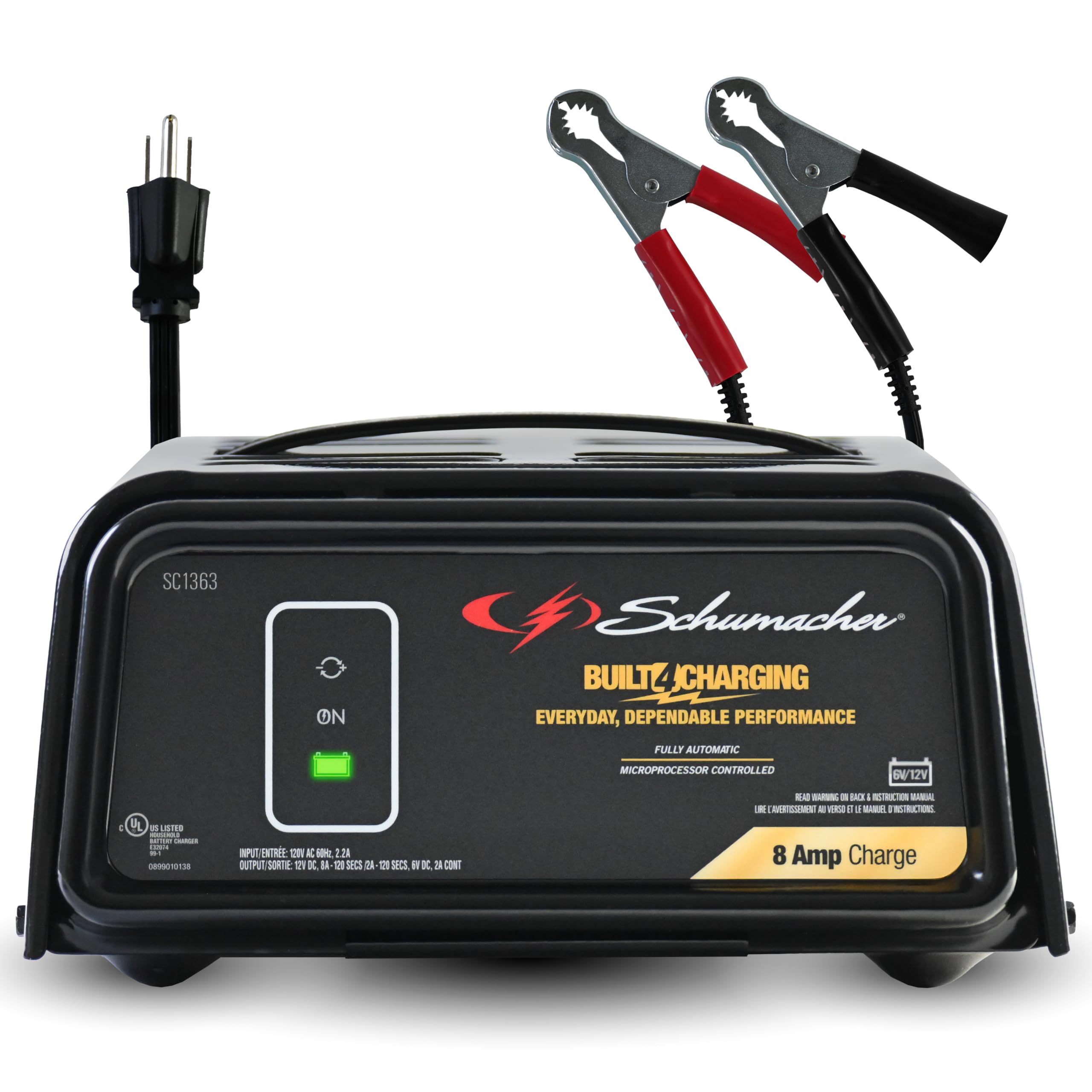
A middle-amp reconditioner built for the older tractor battery you’d rather revive than replace.
It charges, maintains, and reconditions in one unit — the reconditioning step uses a desulfation mode to break down the sulfate buildup that drags a tired battery down. It delivers 8 amps down to 2 amps for 12V charging and 2 amps for 6V, so you can dial the rate to the battery’s condition. The smart trickle charge holds the battery after the bulk phase without overcharging.
The safety detail worth knowing: reverse polarity protection means if you accidentally swap the clamps, the unit protects both the battery and the vehicle instead of sending current the wrong way. It works with gas and diesel vehicles and 6V/12V standard and AGM batteries. Multi-stage charging uses an advanced algorithm to look after battery health over the charge.
This is an AC-powered unit — a 6-foot power cord and booster cables mean it must be plugged in during use, so it’s a bench tool, not a cordless one. Charging speed is the area that draws mixed reactions: it settles into trickle after a full charge, but some batteries fill slower than people expect.
The right call for: a seasoned tractor battery that still holds a charge but needs desulfation to keep going.
Pass on it if: you want the fastest possible bulk charge — the 15A unit beats it there.
6. CRAFTSMAN CMXCESM258 12A Charger & Maintainer
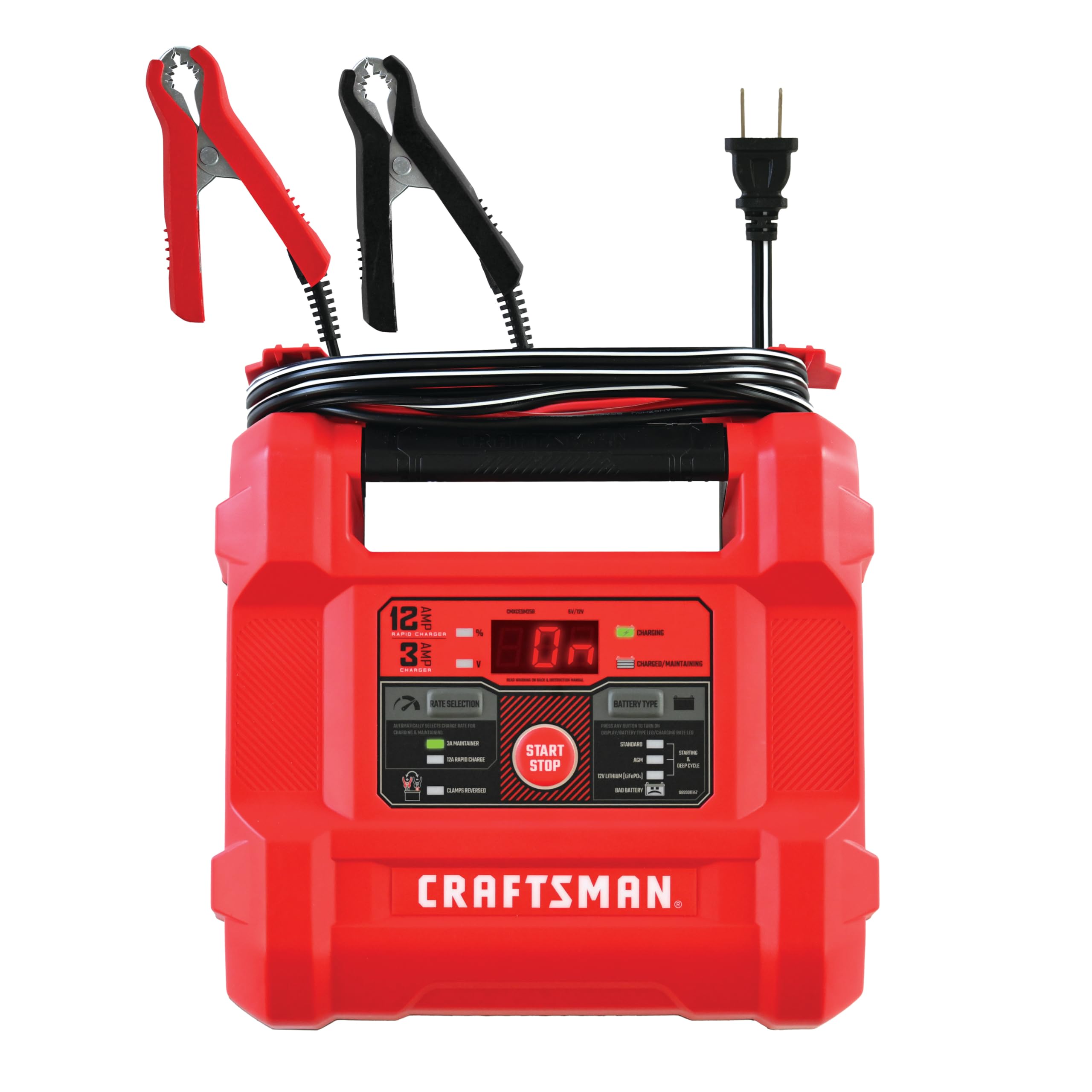
A 12-amp 4-in-1 that handles almost any tractor battery you throw at it.
The compatibility list is what stands out: standard, AGM, lithium (LiFePO4), and deep-cycle batteries, all on one charger. That 12-amp output covers a lot of ground — fast enough for a shop charge and flexible enough for the different battery types across a farm or garage. It charges, maintains, tests, and restores, and the digital display shows you what’s happening at a glance. Microprocessor control with auto voltage detection reads 6V or 12V on its own.
Two safety details matter for a tractor setup: reverse hook-up protection guards the battery if the clamps aren’t connected right, and the desulfation mode helps boost battery life over seasonal use. A 6-foot power cord plus 6-foot battery cables give you 12 feet of total reach, handy if the outlet isn’t right next to the tractor. Owner feedback leans on reliability — it works automatically for both charging and maintenance. Some owners mention a dead battery reaching 100% in about five hours.
Battery life is the one area with mixed feedback — some customers note batteries that stayed dead despite use. That’s worth understanding: on a battery already past saving, no charger will bring it back, and a charger that doesn’t behave the same on every battery can read as inconsistent. Weigh it as a fit note. The compact design makes it easy to store, and the 3.4-pound body stays manageable.
Why it fits a busy garage: 12 amps and four battery chemistries in one unit mean it covers most tractors and vehicles without buying a second charger.
The trade-off to weigh: battery-life results vary across owners — some batteries hold, some don’t, so this pick rewards a battery that still has life left in it.
Choose this if: you want one mid-amp charger that handles lead-acid, AGM, and lithium across a mixed fleet.
Look elsewhere if: you mainly need to revive a battery that’s already dead — a Force Mode unit is a better fit.
7. Clore Automotive PL2310 10A Smart Charger
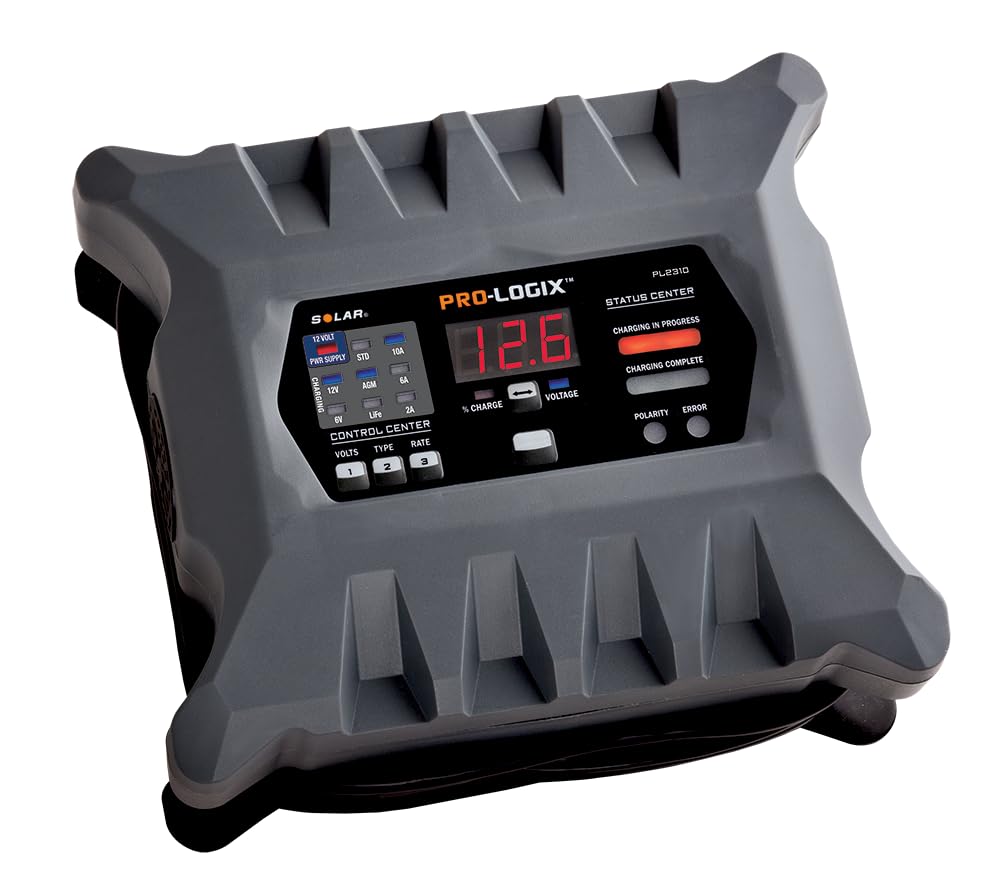
The one with selectable amp rates and a power-supply mode for keeping systems live during work.
Three charge rates — 2, 6, and 10 amps — let you match output to the battery instead of settling for one fixed rate. That’s more flexibility than the single-rate maintainers. The 10-amp top rate is fast enough for a proper bench charge, and the fully automatic multi-phase process adapts as the battery fills. It handles both 6-volt and 12-volt batteries, and it’s a charger, maintainer, and desulfator in one unit.
The power supply mode is the feature that sets this apart. It delivers stable power to maintain system voltage — useful if you need to keep a vehicle’s electronics alive while doing work rather than simply charging. Temperature compensation adjusts for the ambient conditions. A clear display shows voltage and percentage charge, which makes it easy to see where a battery stands rather than guessing from a light.
Owner feedback notes it performing well and offering plenty of features for the price. The display is a real help for a tractor battery you’re unsure about. The 3.9-pound body is the heaviest of the smaller units, so it lives on a bench. One thing to plan for: with three rates and a power supply mode, there’s a setting to choose for each job — a small learning curve compared to a plug-in-and-forget maintainer.
Worth it for: the owner who wants selectable 2/6/10 amp rates and a stable power supply mode in one charger.
skip it if: you’d rather not choose a rate — a fixed single-rate maintainer is simpler.
8. NOCO GENIUS5 5A 6/12V Smart Battery Charger

A compact 5-amp charger that shrugs off the cold and reads your battery’s temperature as it works.
The integrated thermal sensor is the standout: it adjusts charging voltage based on ambient temperature so a tractor battery in a freezing shed or a hot barn doesn’t get overcharged or undercharged. At 5 amps it’s 5 A versus the GENIUS2’s 2 A and far stronger than the 750mA Battery Tender — enough to refill a depleted battery at a workable pace. Owners consistently report satisfying charge speed, with full charges landing well under a day.
Like the GENIUS2, it charges 6V and 12V lead-acid (AGM, Gel, SLA, VRLA) and lithium (LiFePO4) batteries, including flooded, maintenance-free, deep-cycle, and marine types. Force Mode handles a battery down to zero volts, and pulse charging reverses sulfation and acid stratification. It can be left connected indefinitely without overcharging, which makes it a genuine storage option, not just a one-time refill.
The compact body is a running theme with owners. It’s small enough to tuck under a closed bonnet, and with the included mounting bracket and screws, you can bolt it permanently near the tractor battery. Compared to the smaller GENIUS2, you pay for a bigger output in a slightly larger shell. Overall, what wins people over is the combination of real charging power, a temperature-sensing brain, and a body that disappears into the engine bay.
Points in its favor
- 5A output gives a faster refill than the 2A GENIUS2 and 750mA maintainers.
- Thermal sensor adjusts voltage for hot and cold storage conditions.
- Force Mode recovers dead batteries down to zero volts.
- Compact enough for under-bonnet mounting with the included bracket.
Where it holds back
- Reliability feedback is more mixed than its quality feedback.
- Still slower than the 10A and 15A shop chargers for bulk refills.
The best match for: a tractor kept outdoors or in an unheated shed, where temperature swings need managing.
Not the fastest option: for bulk shop charging, the higher-amp picks get there quicker.
9. CTEK NXT 5 Fully Automatic 4.3A Charger
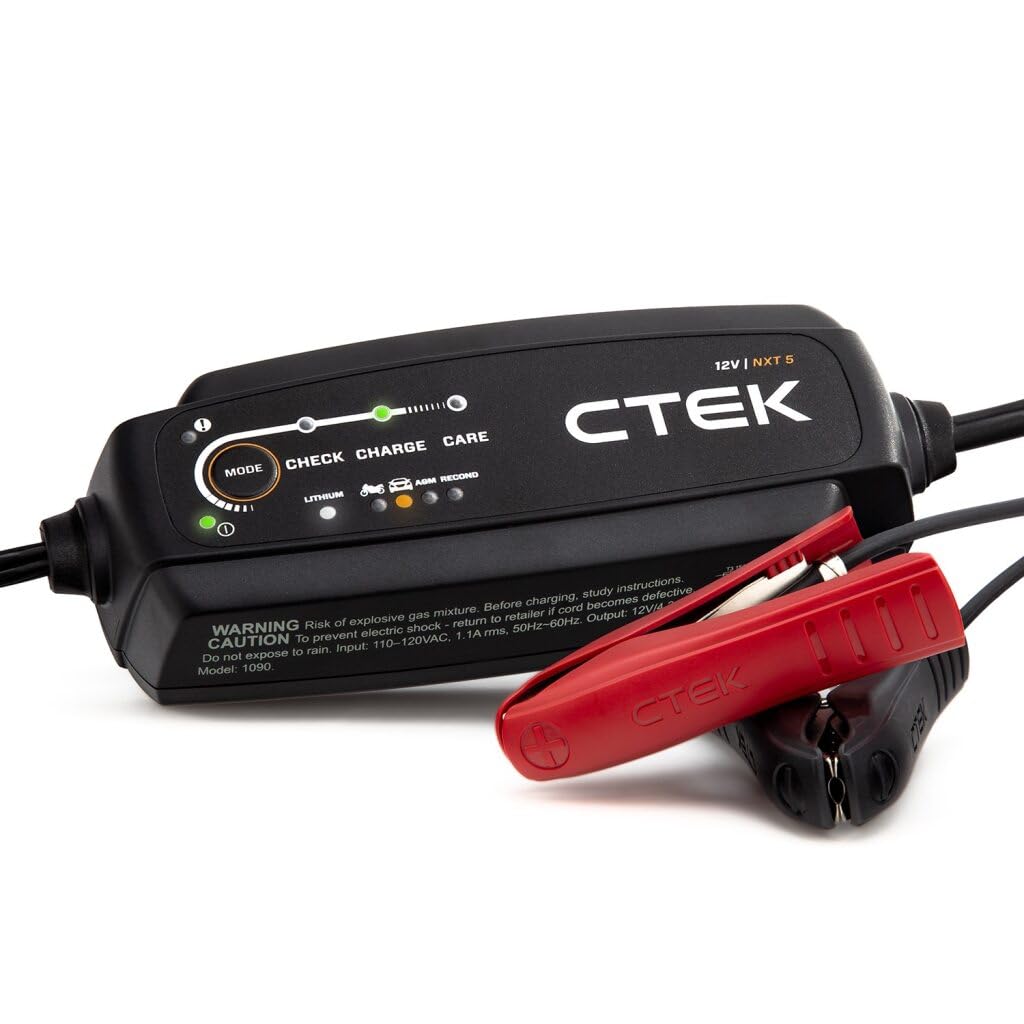
The rugged-housing charger built for a tractor battery that lives in a damp or dusty shed.
The IP65 rating is the reason to look here. That’s an ingress protection rating (a measure of how well the housing keeps out dust and water), and it means the unit is sealed against dust and low-pressure water jets. For a tractor stored in a dirty or moisture-prone barn, a sealed housing means the charger can sit near the work instead of being carried back to a clean bench.
It supports lead-acid (WET, MF, Ca/Ca, AGM, EFB, GEL) and lithium (LiFePO4) batteries from roughly 1.2 Ah up to 160 Ah — a wide spread that covers small powersport batteries up to big tractor packs. At 4.3 amps, it’s a solid maintenance and moderate-charge unit. The “Connect & Forget” design means you hook up, select the mode, and the automatic process handles the rest. Desulphation and “Recond” (reconditioning) modes can recover deeply discharged or sulphated lead-acid batteries.
The automatic temperature compensation adjusts charging voltage across a range of -4 °F/-20 °C to +122 °F/+50 °C, which matters when a barn gets cold overnight. The included Connect U-terminal lets you mount a permanent connection to the battery. Owners who use it for winter storage report it keeping batteries topped up reliably through the cold months. The one limit is the amp rating — at 4.3 amps it’s a storage specialist, not a fast charger.
Why the sealed housing matters: an IP65-rated body plus temperature compensation from -4 °F to +122 °F makes this a natural fit for a cold, dusty tractor shed.
The limit to know: 4.3 amps is maintenance territory — expect a long refill, not a quick one, on a deeply drained battery.
Ideal for: long-term winter storage where dust, damp, and temperature swings are part of the setting.
Not for: fast bulk charging, where the higher-amp picks do the job quicker.
Know the Specs
Amperage: what the output number really means
Amperage is the rate the charger pushes current into the battery. A maintainer around 750 milliamps holds a charged battery at full voltage without cooking it. A 5-amp or higher unit can actually refill a drained battery in a reasonable time. Higher amps don’t automatically mean better — a low-amp maintainer is the right tool for a battery that’s healthy and just sitting. Match the amp rating to whether you’re holding a charge or rebuilding one.
Float mode and desulfation: the storage features that save batteries
Float mode is the hold setting — once the battery is full, the charger drops to a low output that keeps voltage steady instead of overcharging. Desulfation is a pulse routine that breaks down sulfate buildup on the battery plates during long storage. For a tractor that sits for months, both features extend battery life. A charger without them can still top up a battery, but it won’t actively reverse the wear that storage causes.
Common Questions
What amperage do I need to charge a tractor battery?
Can these chargers handle both lead-acid and lithium batteries?
Is it safe to leave a charger connected to a stored tractor all winter?
What does Force Mode do on the NOCO chargers?
Will a charger with reverse polarity protection prevent damage if I connect the clamps wrong?
What is desulfation and why does it matter for a stored tractor battery?
Does the NOCO GENIUS5 leave a charger connected when the engine is running?
How do I know which amp rate to pick on a multi-rate charger?
Is the CTEK NXT 5 safe in a damp or dusty tractor shed?
Can a charger revive a battery that has sat dead for over a year?
The Bottom Line
For most tractor owners — especially those storing a healthy battery through the off-season — the Battery Tender Junior 12V, 750mA is the pick, because its four-stage float cycle keeps a stored battery at full voltage without overcharging. It’s the crowd favorite at 4.5+ stars across 50,000+ owners, and the reviews confirm that simple, reliable role. If you want real charging power with temperature compensation, grab the NOCO GENIUS5 5A. And for a fast shop refill on a drained battery, the Schumacher SC1280 15A is the one to reach for.
How we choose
We do not accept paid placement. Every pick is matched to a real buyer and a real use-case; we do not hands-on test units.
Sources
Specifications: manufacturer listings and product documentation. Review insights: verified customer reviews, as of November 2026. Pricing: not shown on this page (it changes often); check the current price via the retailer link.
As an Amazon Associate, Tactical Gear Guy earns from qualifying purchases. This does not affect which products we feature.