Specs are compiled from manufacturer listings and verified buyer reviews and can change over time — please confirm the key details on the product page before buying.
If you tow a trailer, drive a motorhome, or run a work truck, the tire you cannot see is the one that fails on you. A TPMS (tire pressure monitoring system) puts a small sensor on every valve stem and a monitor on your dash. A slow leak or a heat spike then shows up as an alert, not a shredded tire on the shoulder. The short answer: the TST 507 is the pick worth buying for most towable owners. It is the only kit here that bundles six cap sensors, a repeater, and a three-year warranty. Everything below is sorted by who each system actually fits.
This guide is built by comparing the manufacturers’ published specifications and the patterns across verified customer reviews, so you get each pick’s real strengths and trade-offs instead of marketing spin.
Range, sensor count, and how the monitor stays powered are what separate a kit that works from one that annoys you daily. Below you will find the real differences laid out plainly, so you can choose a TPMS Monitoring System that actually reaches your trailer axles and survives a season of sun and vibration.
Top Picks


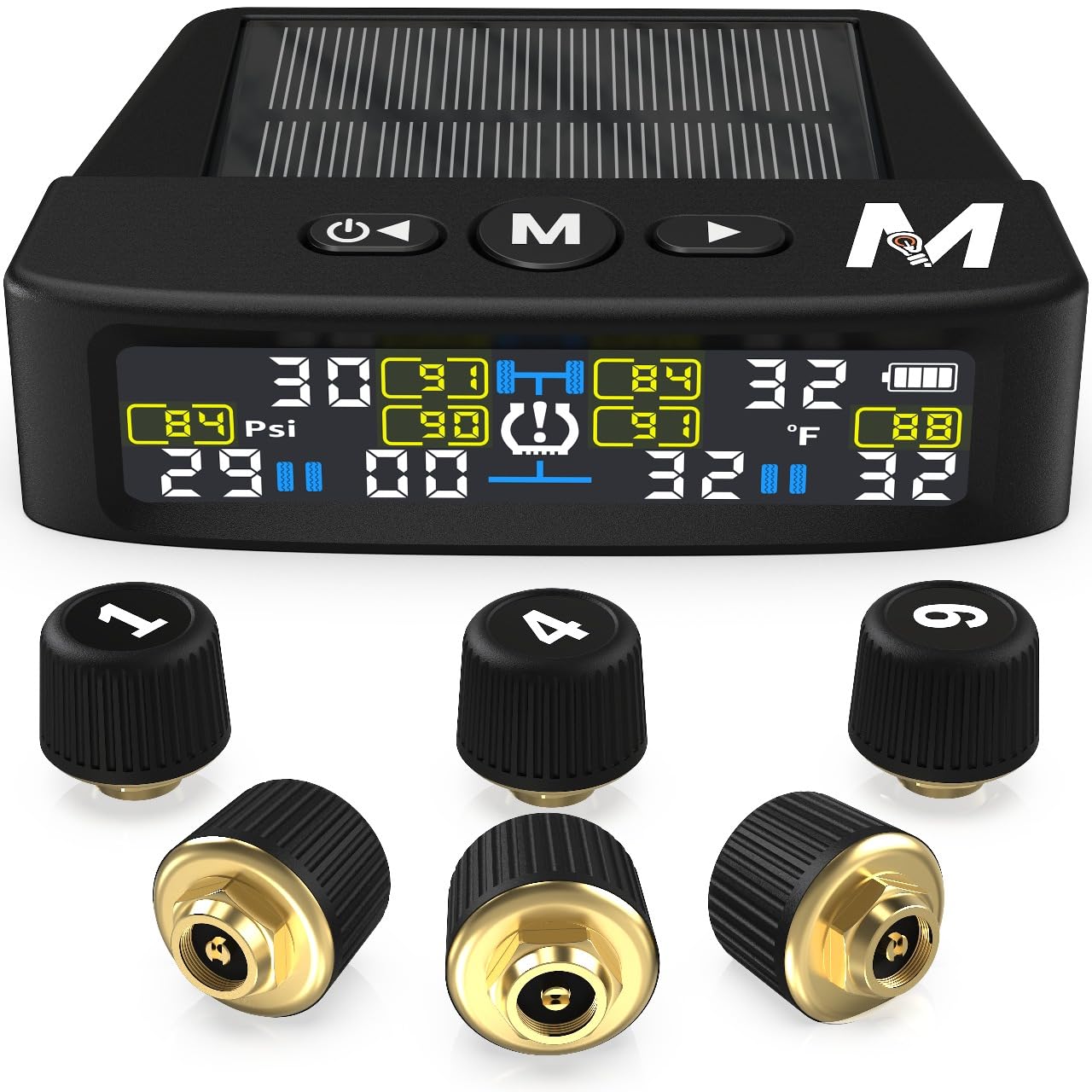
How To Choose The Best TPMS Monitoring System
Two numbers decide whether a kit is right for you before any other feature matters: how many tires it can read and how far that signal has to travel to reach the monitor. Get those wrong and you have bought a screen that only shows you the truck, never the trailer behind it.
Start with sensor count and total vehicle length
Count every tire you want watched — the truck’s four, the trailer’s four, and any spare you want tracked. A four-sensor kit covers a single-axle trailer fine. A six-sensor kit covers a dual-axle camper without doubling up. Once your combined length runs past roughly 36 to 38 feet, the factory note on several of these kits is a repeater or signal booster, sold separately in some cases.
Match the pressure range to your tires
Passenger cars and most SUVs sit well inside a 0 to 87 PSI window. Large RVs and heavy trailers can run far higher, which is why some kits here read to 144 PSI and one reaches 188 PSI. Buying a low-range kit for a high-pressure trailer tire means the sensor tops out before your tire does.
Decide how the monitor stays powered
Solar panels top up the monitor continuously while you drive, and a USB or cigarette-lighter cable covers shaded parking and overcast weeks. A monitor that loses power without warning leaves you blind to a failing tire.
Check the alarm set and the sensor battery
Six alarm modes covers the bases: high pressure, low pressure, rapid air loss, high temperature, low sensor battery, and lost sensor signal. Sensors run on small replaceable coin cells, and the listed lifespan varies widely between kits — from a stated six months per charge up to a stated four-year sensor life.
Side-by-Side Comparison
| Model | Best For | Sensors Included | Pressure Range | Alarm Modes | Amazon |
|---|---|---|---|---|---|
| TST 507 Series★ Best Overall | Multi-axle RV and trailer towing | 6 cap sensors | — | 4 alerts | Amazon |
| Tymate TM8Budget Champion | Daily commuters and shorter rigs | 4 sensors | 0-87 PSI | 6 | Amazon |
| Marcala V2.0Best for High Pressure | Large RVs and high-pressure tires | 6 sensors | 0-144 PSI | 6 | Amazon |
| Masoll M13 | Set-and-forget auto calibration | 4 sensors | 0-87 PSI | 6 | Amazon |
| Masoll M14+MZS2 | First-time TPMS buyers | 4 sensors | Max 99 PSI | 6 | Amazon |
| Hyphoon M11 Bluetooth | CarPlay drivers who want app history | 4 sensors | — | Multi-level alerts | Amazon |
| Tymate TM3 | Long trailers under 36ft | 4 sensors | 0-144 PSI | 6 | Amazon |
| GUTA GT40 | Heavy trucks and long trailers | 4 cap sensors | 0-188 PSI | 6 | Amazon |
| GUTA GT30 | Big multi-axle motorhomes | 6 sensors | Up to 188 PSI | 5 alerts | Amazon |
Detailed Reviews
1. TST 507 Series TPMS with 6 Cap Sensors
Our pick — 4.0+★ from 600+ verified ratings; the strongest balance of quality and price.
Six cap sensors, a repeater in the box, and a three-year warranty — the towing kit that leaves nothing to buy later.
This is built for the owner who tows something substantial. The kit ships with six cap sensors, so a dual-axle camper or a truck-and-trailer pair gets watched without buying extra sensors. A repeater is included too, which is the piece that carries sensor signal back to the cab when your trailer stretches out behind you — that alone saves you a separate purchase most kits require.
The monitor is a 3.5-inch color display with a rechargeable battery and a Micro-USB charger, and it comes with both a suction cup and a rubber dash mount so you can place it where you actually look. Four alerts cover the essentials: low pressure, high pressure, fast leaks, and high temperature. When a tire trips an alert, the unit auto-locks onto that problem tire instead of scrolling past it. Sensors run on user-replaceable CR2032 coin cells, a low-battery alert fires before a sensor goes quiet, and you can swap tire locations after a rotation without re-buying anything.
Owners praise reliability above all: readings hold steady mile after mile instead of drifting. Setup draws steady praise too, since the cap sensors thread on and the directions walk you through pairing. The premium buys USA-based live support and a three-year warranty on the whole system — the longest coverage in this group.
What earns the top spot
- Six cap sensors plus a repeater in one box, so multi-axle rigs are covered out of the gate.
- Three-year warranty and USA-based live customer service back the whole kit.
- Monitor auto-locks onto the problem tire so the alert does not scroll away.
- Expandable to your towing truck plus up to four towable vehicles.
Where it asks more of you
- Value is the one split topic in owner feedback — this sits in the premium tier while simpler four-sensor kits cost far less.
- Programming a new sensor takes a little patience, which is the other point owners flag as mixed.
Reach for this if: you tow a multi-axle trailer or motorhome and want the full kit — sensors, repeater, mounts, and the longest warranty here — in one order.
Think twice if: you run a single-axle setup and only need four tires watched, since the extra sensors and repeater are capability you would be paying for and not using.
2. Tymate TM8 RV TPMS with 4 Sensors
A four-sensor kit that reads to 0-87 PSI, charges off the sun, and mounts on the windshield where you already look.
Start with the range number, because it decides your fit: this kit reads tires from 0 to 87 PSI. That covers sedans, SUVs, MPVs, and pickups cleanly. A heavy trailer tire running well above 87 PSI is outside what it can read. Tymate itself suggests this model for total vehicle length under 20ft, so pair it with a short rig rather than a long travel trailer.
Power comes two ways — a solar panel on top keeps it topped up, and a USB port or cigarette-lighter cable (adapter not included) covers shaded parking. The 3.62 x 2.09 x 1.69 inch unit mounts on the windshield, which keeps your dash clear and puts the color LCD right in your line of sight. Six alarm modes cover high and low pressure, rapid air loss, high temperature, low sensor battery, and lost sensor signal, with accuracy stated at ±1.5 PSI or ±3°F. You can flip between ℃ and ℉, and between BAR and PSI, whichever you think in.
Owners get this one running in about five minutes, and the everyday function is what draws the most praise — it simply works on RVs and trucks and keeps feeding live pressure and temperature. Value is a recurring theme: this is repeatedly called out as a sensible stand-in for far pricier factory systems. The honest catch sits in durability, which is the one aspect where feedback turns negative rather than positive — treat the sensors kindly and expect the long-term wear question to be the open one.
One wiring detail matters before you order. This system pairs only with the Tymate TS3 sensor for spares, and Tymate recommends a metal valve stem for stability.
Plain-speak read: for a short rig and standard pressures, this is the least fuss and the least money for a genuinely capable four-tire watch.
Solid fit for: a sedan, SUV, or short trailer running standard pressures who wants solar charging and a windshield mount.
Look elsewhere if: your tires sit above 87 PSI or your combined length runs past 20ft.
3. Marcala V2.0 Trailer TPMS Set of 6
Two more sensors than the four-sensor kits and a ceiling of 144 PSI — enough headroom for big RVs.
This kit reads up to 144 PSI (pounds per square inch, the pressure unit on your tire gauge). That puts it well above the 0-87 PSI kits in this group, so it suits large RVs and heavy campers whose tires run high. It ships with six sensors and a hub. The first real difference versus a four-sensor kit shows in the sensor count: six here against four on the Tymate TM8. That is the extra margin a dual-axle trailer needs.
Setup is genuinely quick: the maker says ready to use in under a minute, and the sensor side runs at one-second updates while you are driving, so live pressure and temperature alerts land fast. When parked, the sensors drop into a battery-saving mode and update more slowly, which is normal and stretches sensor life. Each sensor is IP67 waterproof, a rating that means it keeps working in rain and road spray. The monitor uses a bright color LCD with auto-dimming, dual solar and USB charging, and six alert modes.
Display clarity is the standout in owner experience — the screen reads cleanly day or night, and installation is straightforward. Value holds up as well. A fair word of warning for the uninitiated: you may hear a brief hiss of air when you screw a sensor on, and that is the sensor seating, not a leak. If air keeps escaping after it is snug, the sensor did not seat right. Backing it is an American-owned family business with a lifetime replacement policy.
Pressure headroom: 144 PSI ceiling and six sensors make this the practical pick for a big trailer with high-pressure tires.
Best matched to: large RV and camper owners whose tire pressures run past what a standard four-sensor kit can read.
One thing to know: if your sensor signal drops at extended range, Marcala sells a separate range extender rated to boost signal up to 80 feet — budget for it if your rig is long.
4. Masoll M13 Tire Pressure Monitoring System

You set the tire to its standard pressure and the system learns the alarm thresholds for you.
No threshold menus, no punching in numbers. Inflate your tires to the pressure you want, install the sensors, and the M13 treats that as your reference point. From there it alarms if actual pressure climbs 25% above or drops 15% below that reference — and it re-calibrates itself any time you add or release air. For someone who has never set up a TPMS before, this removes the single most confusing step.
Four sensors cover a sedan, SUV, pickup, RV, or travel trailer under 38ft, and the reading range is 0 to 87 PSI with accuracy stated at 1.5 PSI from the built-in pressure chip. Power comes from a solar panel with overheat and overcharge protection, and the unit auto-sleeps when the vehicle stops and wakes when it starts again. The HD color LCD adjusts brightness for day and night, and an anti-reflective treatment keeps it legible in strong sunlight — a small detail that matters when your dash catches direct afternoon light.
Buyers report accurate temperature and pressure readings and a solar panel that keeps the unit fully charged without extra power runs. Installation is simple and the instructions are clear. If your rig runs longer than 38ft, Masoll recommends a signal booster to carry the transmission — that is the one length limit to check before buying.
Things it handles for you
- Automatic reference pressure — the system sets its own alarm thresholds from your inflated tire.
- Self-recalibrates after any inflation or deflation of the tires.
- Anti-reflective color LCD with automatic day and night brightness.
Before you buy
- Rig longer than 38ft needs a separately purchased Masoll signal booster.
- 0-87 PSI ceiling rules out high-pressure trailer tires.
Ideal for: the owner who wants zero setup homework and a monitor that just learns the limits.
Not the one for: rigs past 38ft or tires running above 87 PSI.
5. Masoll M14 Tire Pressure Monitoring System

Sensors come pre-paired from the factory — screw them on by the position markings and the data appears.
Setup friction is the first real barrier for a new TPMS buyer, and this kit removes most of it. The four sensors arrive already programmed to the monitor, marked by position, so you install them in order and the numbers come up. If the screen stays blank, a five to ten minute drive wakes the sensors and pushes the readings through. It is a forgiving first experience.
Power is dual: a solar panel handles continuous charging, and a USB cable is included for shaded parking or gray weeks. Six alarm modes cover high and low pressure, high temperature, fast leaks, low sensor voltage, and lost sensor signal, with auto-set alarm thresholds sitting at +25% to -15% of your reference pressure. Sensors carry a stated two-year battery life on replaceable CR1632 cells, ±1.5 PSI accuracy, and an anti-theft and waterproof design. Fits most four-wheel vehicles — sedan, SUV, MPV, van, pickup, RV. The maximum pressure it reads is 99 PSI, and trailers over 38ft need a Masoll signal booster.
The daily experience is what sells this one: it works right from the start, installs easily, and the readings are accurate. What divides feedback is the display. Several owners find the brightness dim and washed out in direct sun. Readability splits down the middle, with some finding it easy to read and others saying daylight makes it difficult. Treat that as a placement question rather than a defect; angle the monitor away from direct sun where you can.
Good starting point for: a first-time buyer with a four-wheel vehicle under 38ft who wants plug-and-play sensors.
Worth knowing: the screen is the weak link in bright sun, so mount it where glare is not hitting it head-on.
6. Hyphoon M11 Bluetooth TPMS
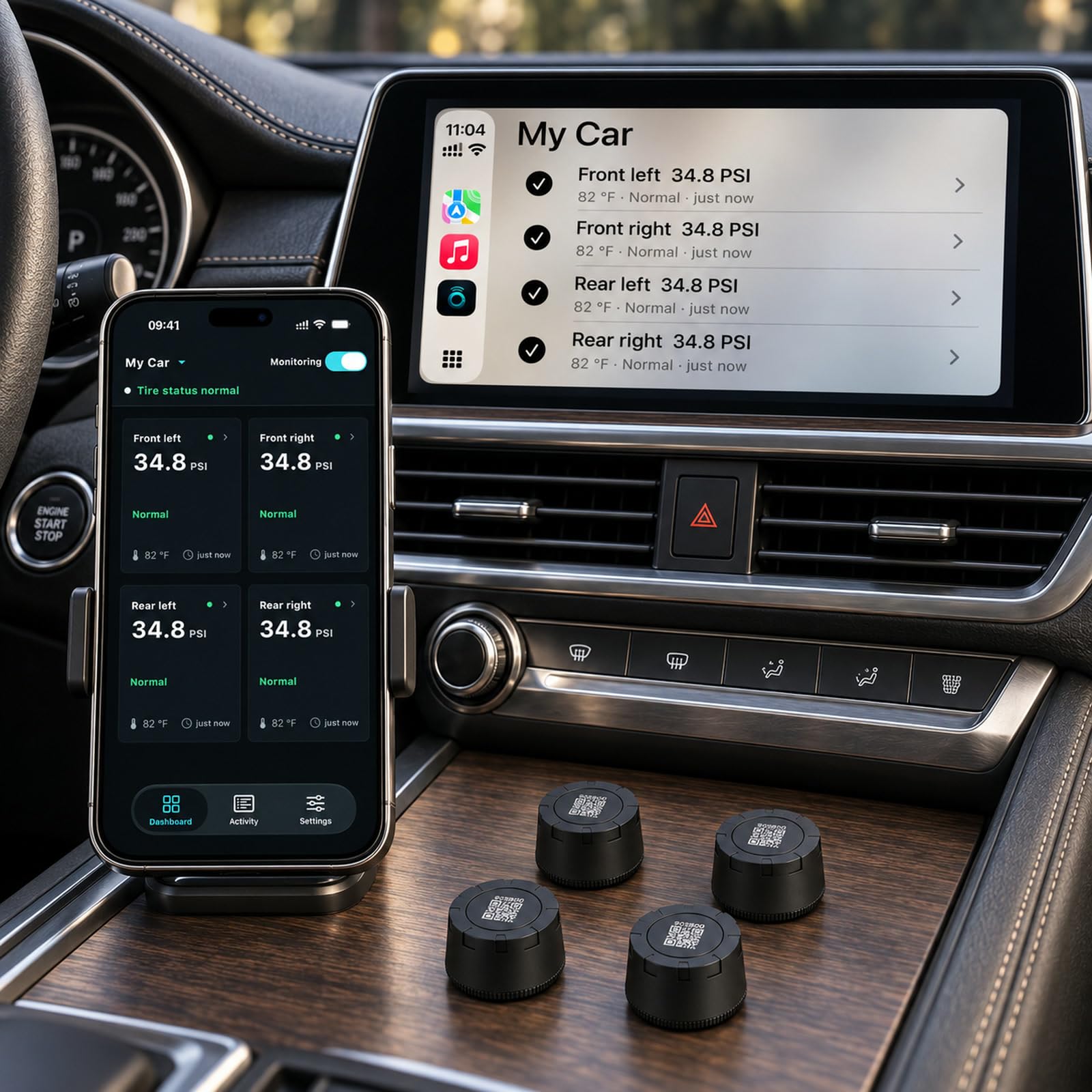
No dash monitor at all — alerts land on your CarPlay screen and phone instead.
This is a different animal from everything else here. There is no separate display unit; the four sensors talk over Bluetooth to the Hyphoon iPhone app and, on compatible cars, to your Apple CarPlay display. Tire pressure, temperature, and rapid air-loss alerts show up while you drive, so you catch an abnormal tire without picking up your phone at a stoplight. If you already live in CarPlay, this strips a screen off your dash entirely.
The app is where the depth lives. Four-tire pressure, temperature, and sensor battery status all sit in one view, each reading stamped with its reception time and freshness, and the last valid number stays visible and clearly marked outdated when fresh data stalls. Alerts run in three levels so a slow-leak reminder reads differently from an urgent problem, with notifications, vibration, alert sounds, and voice warnings. You get roughly 14 days of history per tire, seven-day trend summaries, and a temperature-adjusted reference pressure that helps spot a gradual leak. Records export as CSV or JSON, and you can build multiple vehicle profiles plus a spare tire with its own sensor and alerts.
What it does best: turns tire data into a trend chart you can actually read — the kind of history that reveals a slow leak before a warning ever fires.
The trade-off: everything runs through a phone app and a compatible CarPlay head unit, so there is no standalone screen if your car lacks CarPlay.
Made for: a CarPlay-equipped driver who wants tire alerts on the screen they already use and a real history log.
Not for you if: your vehicle has no CarPlay head unit and you would rather glance at a dedicated dash monitor.
7. Tymate TM3 RV TPMS with 4 Sensors

Sensors that sip power — up to six months on one coin cell, with a stated two-year lifespan.
Sensor longevity is the headline. Each of the four external sensors runs up to six months on a single CR1632 battery (a small coin cell), with a stated lifespan of up to two years. The sensors are IP67 waterproof, a rating meaning they shrug off rain and road spray. They also come pre-labeled and factory-paired, so there is no pairing step before first use.
Range is generous at 0 to 144 PSI, covering sedans up through RVs and travel trailers, with accuracy stated at roughly 3 PSI. The monitor offers solar charging plus USB-C and cigarette-lighter options (adapter not included), and its color LCD auto-adjusts its backlight for day and night. Six alarm modes handle rapid leaks, high and low pressure, high temperature, and low sensor voltage or signal loss. Once paired, the system sets the current pressure as its reference and alarms inside +25% to -15% of it. It can watch up to 10 tires, with the display swapable between front vehicle and trailer.
Owner feedback points to it working well on 3-wheel motorcycles as well as standard rigs, and setup draws real praise — the caps start reading almost immediately after screwing on. The one length caveat: for a truck towing a trailer at 36ft combined or longer, Tymate recommends their repeater, sold separately. A metal valve stem is also the recommended mounting base.
Battery-first thinking: the six-month-per-cell sensor spec and two-year lifespan mean fewer swaps and less mid-season fiddling than higher-drain sensors.
Strongest for: owners of trailers up to 36ft combined length who want low-maintenance sensors and a 144 PSI ceiling.
Plan for: a Tymate repeater if your combined rig reaches 36ft, since it is not in the box.
8. GUTA GT40 RV TPMS Set of 4 Sensors

Rated to 188 PSI and built to show ten tires at once — heavy-truck and long-trailer territory.
The pressure ceiling is what jumps out. Readings run from 0 to 188 PSI at ±2 PSI, which is headroom well past the 99 PSI cap on the Masoll M14 and beyond the 144 PSI on the Tymate TM3. For heavy trucks, big trailers, RVs, and pickups pulling heavy loads, that is the number that matters. It monitors up to 10 tires — 8 main plus 2 spare — all shown on a single screen at once, so you are not tapping through pages to find the tire that is off.
Sensors transmit up to 36 feet to carry signal across a long rig. Six alarm modes cover fast leaks, high and low pressure, high temperature, sensor low battery, and lost sensor signal, and pairing sets the current pressure as the reference so thresholds configure themselves inside +25% to -15%. Power is dual solar and USB, and the HD LCD auto-adjusts backlight. After ten minutes stopped, the unit sleeps to save energy and wakes when the car starts, and it keeps monitoring tire data even while asleep.
The sensor set arrives pre-configured, so you mount each cap by its position marking and the monitor auto-calibrates the current pressure as reference. Owners value the confidence most, and they call out battery life: the unit runs through a full night without a recharge. Buyers describe it as better built than cheaper options. Accuracy is the one split topic in that feedback, so a quick check against a handheld gauge after install is worthwhile.
Choose it when: your rig pushes high pressures and you want every tire on one screen without paging.
Budget a check: verify readings against a handheld gauge once at setup, since accuracy is the point where feedback divides.
9. GUTA GT30 Trailer TPMS with 6 Sensors
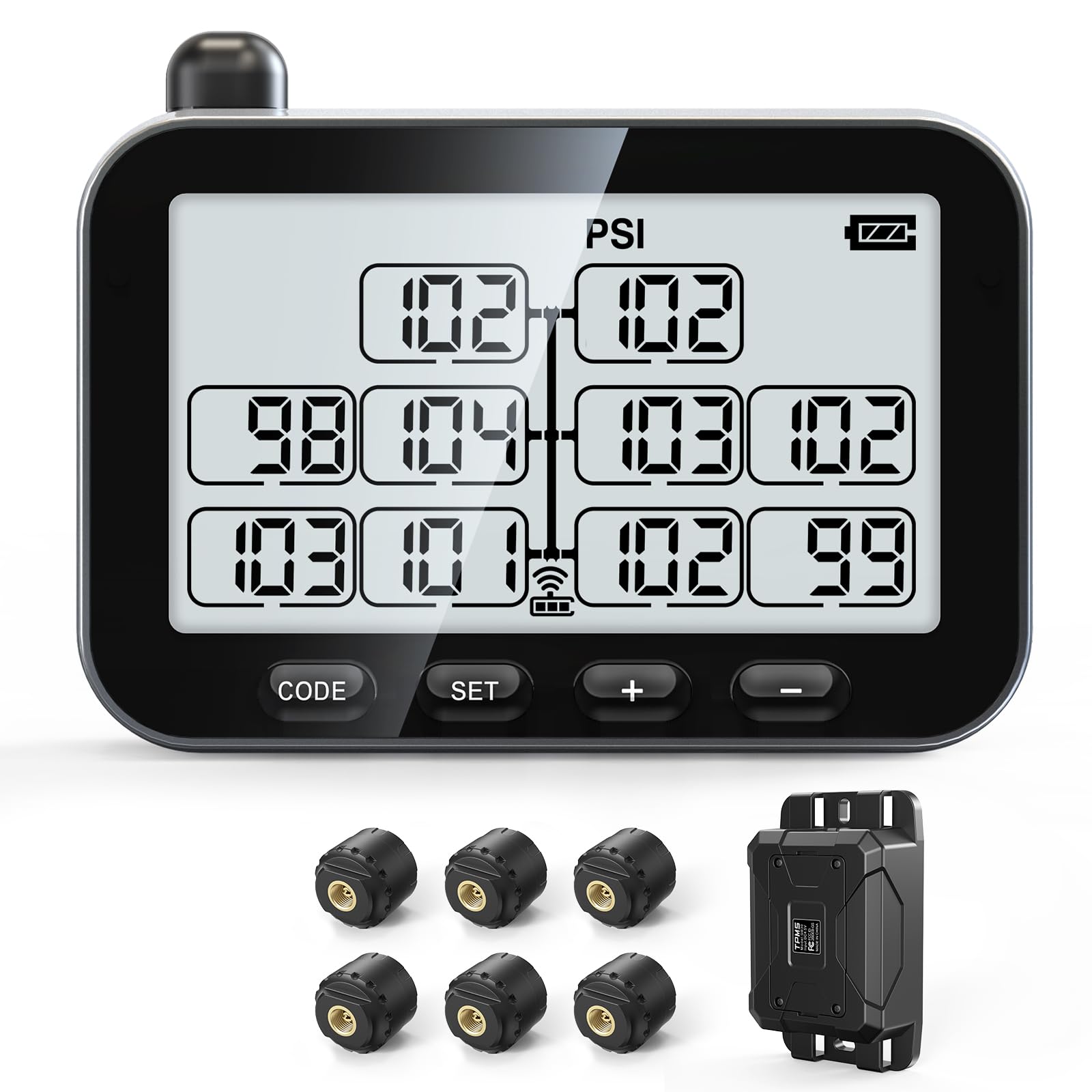
Six sensors, a huge screen, and the ability to view up to 46 tires — for the biggest multi-axle setups.
This is the capacity leader. The large screen shows up to 10 tires’ data on one page, then automatically switches between front trailer and rear sections, and the system can view up to 46 tires without pressing a button. Pressure handling reaches 188 psi and temperature up to 185 ℉, which is sized for large vehicles rather than passenger cars.
The monitor holds a built-in rechargeable lithium battery that runs 12 to 14 days after a four-hour full charge, and it drops into power-saving mode after 15 minutes without motion or vibration. Sensors send status every 5 minutes while under pressure, and sensor battery life is stated up to 4 years on a replaceable CR2032. Setup is wireless — you assign and program the anti-theft sensors before installing them, skipping the inflation-programming step older systems used. An additional signal booster can be added to overcome distance and electromagnetic interference.
Alerts cover high and low pressure, high temperature, fast leaks, missing sensor signal, and low sensor battery, with visual and audio warnings the moment data deviates. Owners find it installs easily, works right from the start, and rate its value and safety features well. The practical caution comes from the maker itself: install the cap sensors on metal valve stems, not rubber, and keep in mind that tire pressure monitoring is the aspect with the most mixed feedback.
The capacity case
- Wireless sensor programming before installation, no inflation-programming step.
- Built-in rechargeable battery good for 12-14 days after a four-hour charge.
- Sensor battery stated up to 4 years on replaceable CR2032 cells.
The honest limits
- A signal booster is an add-on for long rigs, not included.
- Tire pressure monitoring is the mixed-feedback aspect here — a careful setup and a gauge check go a long way.
Built for: a large motorhome or multi-axle trailer with a long list of tires and a high pressure ceiling.
Pass on it if: your setup is four standard tires on a short rig, where a simpler kit does the same job.
Know the Specs
Pressure Range (PSI)
PSI stands for pounds per square inch, the unit tire pressure is measured in. A kit’s range is the ceiling it can read; go past it and the sensor tops out before your tire does. Passenger cars and SUVs sit comfortably within a 0 to 87 PSI window. Heavy trailer and truck tires can run far higher, which is why some kits here read to 144 PSI and one reaches 188 PSI. Match the range to your heaviest tire, not your lightest.
Signal Range and Repeaters
The sensor has to send its reading back to the monitor, and distance eats signal. On longer rigs — the factory guidance puts the line around 36 to 38 feet — a repeater or signal booster relays the data so the trailer axles keep showing on screen. Some kits include one and some sell it separately, so check the box contents before you commit to a long trailer.
Solar Plus USB Charging
Solar charging keeps the dash monitor topped up while you drive, which means no wiring and no dash clutter. USB or cigarette-lighter charging covers the times the sun is not on the panel — shaded campsites, overcast weeks, indoor storage. Two power paths keep the monitor running when the panel sees no sun.
Alarm Modes
The standard set includes high pressure, low pressure, rapid air loss, high temperature, low sensor battery, and lost sensor signal. Rapid air loss is the critical one for blowout risk, catching a sudden drop before you feel it through the wheel. High temperature catches the heat buildup that precedes a failure on a long climb.
Common Questions
Will a six-sensor TPMS work on my four-tire trailer?
Do these sensors screw onto the valve stem or mount inside the tire?
What is the maximum trailer length before I need a repeater?
How accurate are the pressure readings on these systems?
Can I use a TPMS on a car that already has factory tire sensors?
Do I hear air escaping when I install the sensors?
How long do the sensor batteries last and are they replaceable?
Will the monitor work in shaded campsites without sun?
Can one TPMS watch both my truck and my trailer tires?
The Bottom Line
For most towable owners, the tpms monitoring system pick is the TST 507 Series. It ships with six cap sensors and a repeater in one box, plus a three-year warranty. That is the longest coverage here and the only kit that leaves nothing to buy later. If your tires run high pressure, grab the Marcala V2.0 with its 144 PSI ceiling and six-sensor kit. And for a first-time buyer who wants plug-and-play, the Masoll M14 gets you factory-paired sensors and auto-calibrating thresholds without the setup homework.
Match the sensor count and the PSI ceiling to your rig, and check whether your length puts you into repeater territory before you order.
How we choose
We do not accept paid placement. Every pick is matched to a real buyer and a real use-case; we do not hands-on test units.
Sources
Specifications: manufacturer listings and product documentation. Review insights: verified customer reviews, as of November 2026. Pricing: not shown on this page (it changes often); check the current price via the retailer link.
As an Amazon Associate, Tactical Gear Guy earns from qualifying purchases. This does not affect which products we feature.