Specs are compiled from manufacturer listings and verified buyer reviews and can change over time — please confirm the key details on the product page before buying.
If a bridge sign or a weight limit has ever made you pull over and re-plan a load at the last minute, the fix is a navigator built around your rig’s real height, weight and length — not a phone that thinks you’re driving a sedan. The eight units below all do truck-specific routing, and the standout is the Garmin dēzl OTR810, whose 8-inch screen and 7.87-inch length give you the most map real estate before you even tap a route. The crowd favorite here holds 4.5+ stars across 200+ owners, and the spread between the best and the rest depends on screen size, whether a dash cam is baked in, and how deep each unit’s truck-routing setup goes.
This guide is built by comparing the manufacturers’ published specifications and the patterns across verified customer reviews, so you get each pick’s real strengths and trade-offs instead of marketing spin.
You’ll see why screen size, routing depth and battery life separate these units, and which one actually earns its spot on your dash. Below is the breakdown that answers the question behind every search for the top truck gps.
Top Picks


How To Choose The Best Top Truck GPS
The mistake most first-time buyers make is treating a truck GPS like a bigger car GPS. It isn’t. The whole point is that the unit knows your trailer is 13 feet tall and 80,000 pounds loaded, so it steers you away from the low bridge and the posted weight limit before you’re committed to the ramp. Everything below flows from that one idea.
Custom truck routing is the feature that actually earns the purchase
Custom truck routing means the navigator builds your route around the size and weight you enter — height, width, length and load. When that’s working, you get on-screen alerts for upcoming bridge heights, weight limits, sharp curves and steep grades. A generic car GPS has none of this, which is exactly why a low-clearance road can trap a rig that a phone would happily send down.
One honesty note the manufacturers themselves print: custom routing isn’t available in all areas, and vehicle characteristics may not be accounted for in every suggestion. You still read the posted signs. The GPS is a second set of eyes, not a replacement for your own.
Screen size and resolution decide how much you can read without looking down
A bigger screen isn’t vanity — it’s the difference between glancing and squinting. The units here range from 6 inches up to a 10-inch panel, and the larger screens let you keep the map and a weather or route overview side by side. If your cab is bright and your eyes are on the road, a larger high-resolution display keeps the map readable at a glance.
Satellite arrival imagery saves the worst part of the job
BirdsEye Satellite Imagery (high-resolution aerial photos of your destination) shows you the loading dock, the truck entrance and the security gate before you arrive. If you’ve ever circled a distribution center looking for the right gate, this is the feature that turns a 20-minute hunt into a straight line in.
Dash cam, PrePass and battery backup are the tie-breakers
A built-in dash camera records your drive so you have a record if something happens. PrePass notifications flag upcoming weigh stations and bypass decisions, but they need an active PrePass account and the dēzl app paired over Bluetooth. And battery life matters more than you’d think: some units run on a stated 1 hour, one runs 5 hours, so unplugging to walk into a shipper is a real consideration.
Side-by-Side Comparison
Every row below uses the same three dimensions — screen size, weight and stated battery life — so you can scan trade-offs in one pass. A dash means the maker didn’t publish that figure for that unit.
| Model | Best For | Screen Size | Weight | Battery Life | Amazon |
|---|---|---|---|---|---|
| Garmin dēzl OTR810 | Best overall big-screen routing | 8 in | 13.7 oz | — | Amazon |
| Rand McNally TND 750 | Dash cam on a budget | 7 in | — | — | Amazon |
| Garmin dēzl OTR610 | Most proven all-rounder | 6 in | 6.17 oz | — | Amazon |
| Rand McNally RANDTAB8 | Big screen plus road IQ | 8 in | — | 5 hours | Amazon |
| TomTom Truck Sat Nav GO Expert | Fast interface, international routes | 6 in | — | 1 hour | Amazon |
Detailed Reviews
1. Garmin dēzl OTR810
The big-panel router that keeps your bridge heights and your next turn on one screen.
Start with the number that decides the cab experience: an 8-inch touchscreen — a display large enough to run in landscape or portrait and still show a split-screen weather and route overview. The panel itself is a wide-view IPS color TFT with an on-cell capacitive touch layer, which in plain terms means wide viewing angles and a finger-friendly surface. If your dashboard is wedged into a sunlit corner of the windshield, that brightness and viewing range keep the map readable.
The routing is the real reason to buy it. You enter the size and weight of your truck, and the unit flags upcoming bridge heights, weight limits, sharp curves and steep grades along your path. The route planner lets you review the whole trip and pin fuel stops, comfort breaks and overnight stays before you roll. Arrival planning with BirdsEye Satellite Imagery gives you high-resolution overhead photos of loading docks, truck entrances and security gates, so a first-time delivery doesn’t turn into a slow lap around the lot.
Weight is 13.7 ounces against the 6.17 ounces of the 6-inch dēzl OTR610 below — noticeably more heft on the mount, so plan on a firm suction or the included screw-down mount rather than a loose arm. The truck & trailer services directory filters stops by brand or amenity, so you can search for showers or a specific chain instead of scrolling. Pair it with the dēzl app over Bluetooth and you add live traffic, weather, smart notifications and PrePass weigh-station alerts, though those alerts need an active PrePass account.
What makes it the top pick
- 8-inch high-resolution display runs landscape or portrait for side-by-side route and weather.
- Custom truck routing flags bridge heights, weight limits, curves and grades by your truck’s size and weight.
- BirdsEye satellite arrival imagery shows loading docks and gates before you get there.
- Truck & trailer directory filters stops by brand or amenity like showers.
Where you’ll feel the trade-off
- At 13.7 ounces it’s the heftiest of the mid-size picks, so mount it solidly.
- PrePass weigh-station alerts need an active account and the paired app to work.
Reach for this if: you want the largest map on this side of the lineup and you lean on arrival imagery for unseen docks.
Think twice if: you swap windshields often and want something you can toss up without a firm mount.
2. Rand McNally TND 750
A sixth-generation truck unit that bakes the dash cam right into the navigator.
This is the pick for the driver who wants one device on the glass instead of two. Rand McNally calls the TND 750 a sixth-generation truck GPS, and the built-in dash cam lives inside the navigator itself rather than on a second mount. Dynamic weather overlays show the forecast across your route with precipitation, temperature and wind speed, which is the kind of thing that informs whether you push through a storm cell or take the long way.
The 7-inch LCD screen runs 7.3 inches long by 4.5 inches high, and 3D buildings and landmarks help you orient on detailed urban routes. Bluetooth, lane assist and voice control round out the day-to-day. For reference, the OTR810’s body weighs 13.7 ounces.
Here’s the honest part, and it’s the trade-off that matters most for this specific unit. Buyers report the battery side is the weak link — that it doesn’t charge or keep a charge and only lasts a couple of hours off the cord. The reliability and overall quality impressions are genuinely split, so a mixed batch of experiences is baked into this one. Treat it as a plugged-in navigator that lives on the 12-volt and you’ll be working with it the way it’s meant to be used.
One-device logic: the built-in dash cam plus weather overlays and lane assist make this the tidy choice for a crowded windshield.
Keep it plugged in: the battery is the recurring sore spot, so plan on the power cable rather than cordless use.
Best fit for: drivers who want dash-cam coverage and truck routing without adding a second device to the dash.
Look elsewhere if: you need the unit to run cordless for long stretches between charges.
3. Garmin dēzl OTR610

The compact workhorse that brings full dēzl routing down to a 6-inch panel.
What wins people over here is simple, honest usefulness: it’s a full dēzl navigator in a body that doesn’t crowd the windshield. The 6-inch multi-touch glass HD color TFT screen (a touch display with high-definition color) runs at 6 inches long and 0.7 inches deep, and it weighs just 6.17 ounces — less than half the 13.7-ounce OTR810 at the top, so it hangs light on a suction mount and moves between trucks without a fuss. Build quality is the thing buyers praise most, and suitability for truckers and RV drivers comes right behind it.
You get the same core routing logic as the bigger Garmins: custom truck routing based on your size and weight, with alerts for bridge heights, weight limits, sharp curves and steep grades. Arrival planning with BirdsEye Satellite Imagery, a route planner for fuel and overnight stops, and a truck & trailer services directory filtered by brand or amenity are all present. Voice control and hands-free calling are part of the package, and Bluetooth plus Wi-Fi handle connectivity.
The fair caveat is the one Garmin prints on every dēzl: custom routing isn’t available in all areas and may not account for every vehicle characteristic, so posted signs still rule. Accuracy and value impressions run a bit mixed, which is typical for a device this dependent on map data staying current. Pair it with the dēzl app and PrePass weigh-station notifications plus live traffic and weather come along — a feature set that behaves a lot like the flagship in a smaller shell.
The daily-driver case: at 6.17 ounces with full custom routing and BirdsEye arrival imagery, it disappears onto the mount and still does the big-Garmin jobs.
Same routing caveat: like its siblings, truck routing isn’t available in every area, so read the posted height and weight signs.
Pick this one if: you want proven dēzl routing and a light, compact footprint you can trust trip after trip.
Step up if: you need a bigger map or a 10-inch panel to read at a glance from a distance.
4. Garmin dēzl OTR620 Bundle

A tablet-style navigator with the deepest load-configuration options in this lineup.
If your loads change from week to week, this is where the detail lives. Rand McNally runs the RANDTAB8 on Rand Navigation 2.0 with 2025-edition maps, powered by Rand Road IQ, and lets you customize weight, height, width and every HazMat type — gases, explosives, flammables, oxidizers and more. Trailer types cover straight, 48-foot, 53-foot double and triple, with axles from 2 to 15. That’s the most granular load setup on the page, and it’s the reason a specialized hauler would look here first.
The 8-inch touchscreen is the biggest in the mid-range group, and the warnings are thorough: weigh stations, curves, hills, engine-brake restrictions, narrow roads, construction zones, speed-limit changes, red-light and speed cameras, scales and truck services. The built-in camera captures images, and the mount is a powered magnetic one with reinforced USB-C and barrel power options. Stated battery average life is 5 hours, the longest published on this list by a wide margin — a real edge if you step away from the cab with the unit in hand.
The honest caveat is a split record. Reliability and quality impressions are genuinely mixed, value takes a hit, and accuracy draws complaints — including issues finding addresses and incorrect speedometer readings. None of that makes it a bad tool for the hauler who needs the load-specificity, but it does mean this one earns its place on capability rather than polish. Compare it against the OTR810: both run an 8-inch screen, but the Garmin’s road record is stronger on the whole.
For the specialty load: HazMat types, trailer classes and axle counts up to 15 make it the most configurable router here, and 5 hours of battery backs it up.
Capability over polish: reliability and value read as genuinely mixed, so buy it for the deep load setup, not for a spotless reputation.
Choose it when: your trailer and HazMat setup changes often and you need the router to match every configuration.
Pass if: you want the simplest, most reliable 8-inch experience and won’t use the deep load menus.
5. TomTom Truck Sat Nav GO Expert
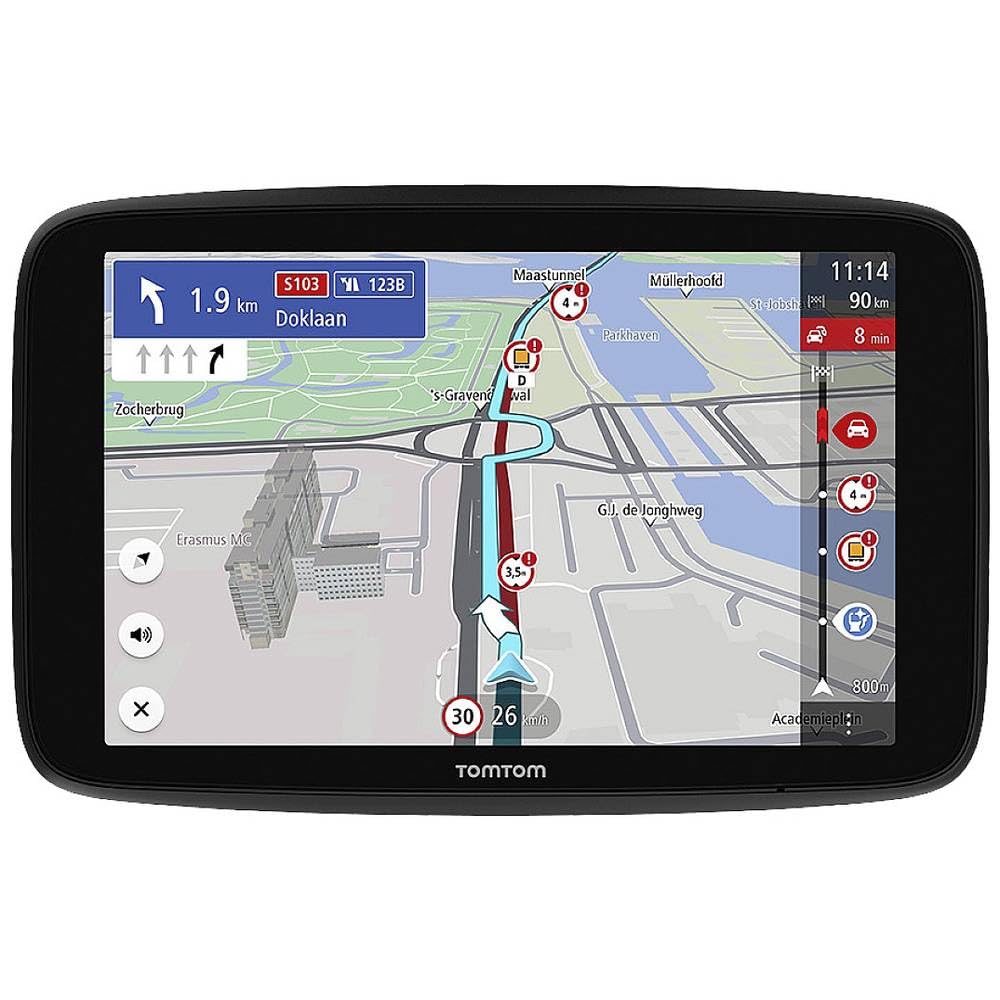
The routing screen that swipes and zooms without making you wait.
Look at the responsiveness first, because that’s what TomTom leads with. The GO Expert claims 4x faster responsiveness than its predecessor, with a modern interface that swipes and zooms smoothly. In a moving cab, a map that lags is a nuisance, and this is a unit built to keep up. The 6-inch HD screen pairs with a powerful speaker, and at 6.46 inches long and 0.71 inches deep it’s a slim bar across the dash.
The large-vehicle routing is genuinely professional-grade. You get custom routes and points of interest for a bus, truck or coach, with live alerts for bridge heights, ADR tunnels (tunnels with hazardous-goods restrictions) and UN Class restrictions. TomTom Traffic pushes fastest-route updates, jam-tail warnings give you a heads-up on the end of a queue, and the package includes 1 year of speed camera alerts. Those UN Class and ADR alerts are the differentiator here — they matter most to drivers hauling regulated loads through Europe.
The catch is worth knowing up front: the listing notes this is an international product sold from abroad that may differ from local versions in fit, language and instructions. For a U.S. driver used to Garmin’s domestic map updates and Love’s and Pilot loyalty hooks, that’s a real adjustment. Battery life is stated at 1 hour, so it lives on the charger too. Value it for the interface speed and the international restriction alerts, and you’ll know exactly what you’re buying.
Made to move fast: 4x faster responsiveness plus jam-tail and speed-camera alerts keep the screen in step with the road.
Mind the origin: it’s an international product sold from abroad, so language and instructions may differ from a local unit.
Right for: drivers who value a snappy interface and need ADR tunnel and UN Class warnings.
Skip if: you want a U.S.-focused unit with domestic map coverage and loyalty-point integration.
6. Garmin dēzlCam OTR725
Custom Truck Routing
This is the feature that separates a truck GPS from a car unit. You input your truck’s size and weight, and the navigator builds routes that account for them while flagging bridge heights, weight limits, sharp curves and steep grades. The manufacturers note it isn’t available in all areas and may not catch every vehicle characteristic, so it works alongside the posted signs, not in place of them.
Battery Life
Published battery average life on these units ranges from 1 hour to 5 hours. A 1-hour rating means the unit is designed to live on the power cable; the 5-hour RANDTAB8 gives you more cordless room for stepping away from the cab. If you plan to carry the unit into a shipper or walk it around the yard, the longer figure matters.
Weight & Mounting
These navigators range from about 6 ounces to 1.2 pounds. A lighter body (like the 6.17-ounce OTR610) hangs easy on a suction mount and moves between trucks; a heavier one (the 1.2-pound OTR1010) needs the powered magnetic or screw-down mount to stay secure. Match the mount to the weight and you’ll avoid a unit that drifts on a bumpy road.
Common Questions
What makes a GPS a true truck GPS rather than a car unit?
Will custom truck routing work on every road?
Do these navigators need a phone to work?
How long do these truck GPS batteries actually last off the charger?
What does BirdsEye Satellite Imagery actually do for me?
Is a bigger screen worth the extra weight?
What’s the difference between PrePass alerts and just reading the weigh-station sign?
Can I add a backup camera or headset to these navigators?
Does a built-in dash cam on a navigator replace a separate dash cam?
Do these units update their maps on their own?
The Bottom Line
For most owner-operators, the top truck GPS winner is the Garmin dēzl OTR810 because its 8-inch high-resolution screen, custom truck routing and BirdsEye arrival imagery cover the parts of the job that actually cost you time. If recording incidents alongside your routing matters, the Garmin dēzlCam OTR725 folds a 1080p dash cam into the same unit. And for the driver whose trailer and HazMat configuration changes constantly, the deep load setup on the Rand McNally RANDTAB8 is the one to reach for.
The one quiet nudge here: the OTR610 is the most-vetted pick by a wide margin, a 6-inch unit that dials the flagship’s truck routing into a compact body without asking you to gamble on a new name.
How we choose
We do not accept paid placement. Every pick is matched to a real buyer and a real use-case; we do not hands-on test units.
Sources
Specifications: manufacturer listings and product documentation. Review insights: verified customer reviews, as of November 2026. Pricing: not shown on this page (it changes often); check the current price via the retailer link.
As an Amazon Associate, Tactical Gear Guy earns from qualifying purchases. This does not affect which products we feature.