Specs are compiled from manufacturer listings and verified buyer reviews and can change over time — please confirm the key details on the product page before buying.
If you want the one pad that nearly every backpacker eventually lands on, it is the Therm-a-Rest Z Lite Sol — a closed-cell foam mat you fold like an accordion and never worry about puncturing. It holds 4.5+ stars across 4,000+ ratings, the highest rating count of any pad here. Everything below explains who each type of pad actually suits: foam, air, insulated, ultralight, and the wide versions for bigger sleepers.
This guide is built by comparing the manufacturers’ published specifications and the patterns across verified customer reviews, so you get each pick’s real strengths and trade-offs instead of marketing spin.
The quickest way to narrow the field is to decide your coldest night and your packed size first, then match the R-value and thickness to it. Get that match wrong and no amount of thickness keeps you warm.
Top Picks

How To Choose The Best Top Sleeping Pads for Backpacking
Your pad has one job on the trail: stop the ground from pulling heat out of your body all night. Everything else — padding, packed size, weight — is a trade-off against that. Here is what actually decides whether you sleep or lie there shivering.
Start with the R-value, not the thickness
R-value is a plain number that says how well a pad resists heat loss to the ground. Higher means warmer. A thin foam pad can beat a fat air pad on warmth if its R-value is higher — the Z Lite Sol is only 0.75 inches thick but carries an R-value of 2.6. A 4-inch air pad with a 7.2 R-value sits at the other end of the scale. Match the number to your coldest expected night, not to how plush it looks in the photo.
Foam or air: pick your failure mode
Closed-cell foam pads cannot leak and cannot puncture — the trade-off is a bulkier pack and less cushion. Inflatable pads pack smaller and sleep softer, but they depend on a valve and a leak-free shell. If you hike sharp ground or want zero fuss, foam earns its place. If you want comfort and a tiny packed size, air is the way, with a repair patch kit close at hand.
Weigh packed size against weight
You get more room for food when your pad packs to the size of a water bottle and slips into a side pocket. A folded foam accordion (a pad that folds like a fan) lashes to the outside of your pack instead. Neither is wrong — just decide if you want your pad inside the bag or strapped to it.
Side-by-Side Comparison
| Model | Best For | R-Value | Thickness | Weight | Amazon |
|---|---|---|---|---|---|
| Therm-a-Rest Z Lite Sol★ Best Overall | low-maintenance foam for any trip | 2.6 | 0.75 in | 0.41 kg | Amazon |
| TREKOLOGY UL R7Warmest Value | All-season warmth on a budget | 7.2 | 4 in | 2 lbs (900 g) | Amazon |
| Hikenture R6.2Cold-Weather Pick | Cold sleepers who want light | 6.2 | 3.2 in | 1.53 lb | Amazon |
| NEMO Switchback | Foam fans wanting more cushion | 2 | 5.5 in | 0.42 kg | Amazon |
| Sea to Summit Ether Light XR | Side sleepers in cool weather | 4.1 | 3.9 in | — | Amazon |
| NEMO Tensor Trail | Quiet ultralight air comfort | — | 3.5 in | — | Amazon |
| Big Agnes Rapide SL (Regular) | Three-season comfort, standard size | 4.8 | 3.5 in | — | Amazon |
| Therm-a-Rest NeoAir Xlite NXT | Ultralight year-round adventures | 4.5 | 3 in | 16 oz (450 g) | Amazon |
| Big Agnes Rapide SL (Wide Long) | Bigger sleepers wanting room | 4.8 | 3.5 in | — | Amazon |
Detailed Reviews
1. Therm-a-Rest Z Lite Sol Camping and Backpacking Sleeping Pad
Our pick — 4.5+★ from 4,000+ verified ratings; the strongest balance of quality and price.
A fold-up foam mat that will not puncture, will not leak, and will not let you down.
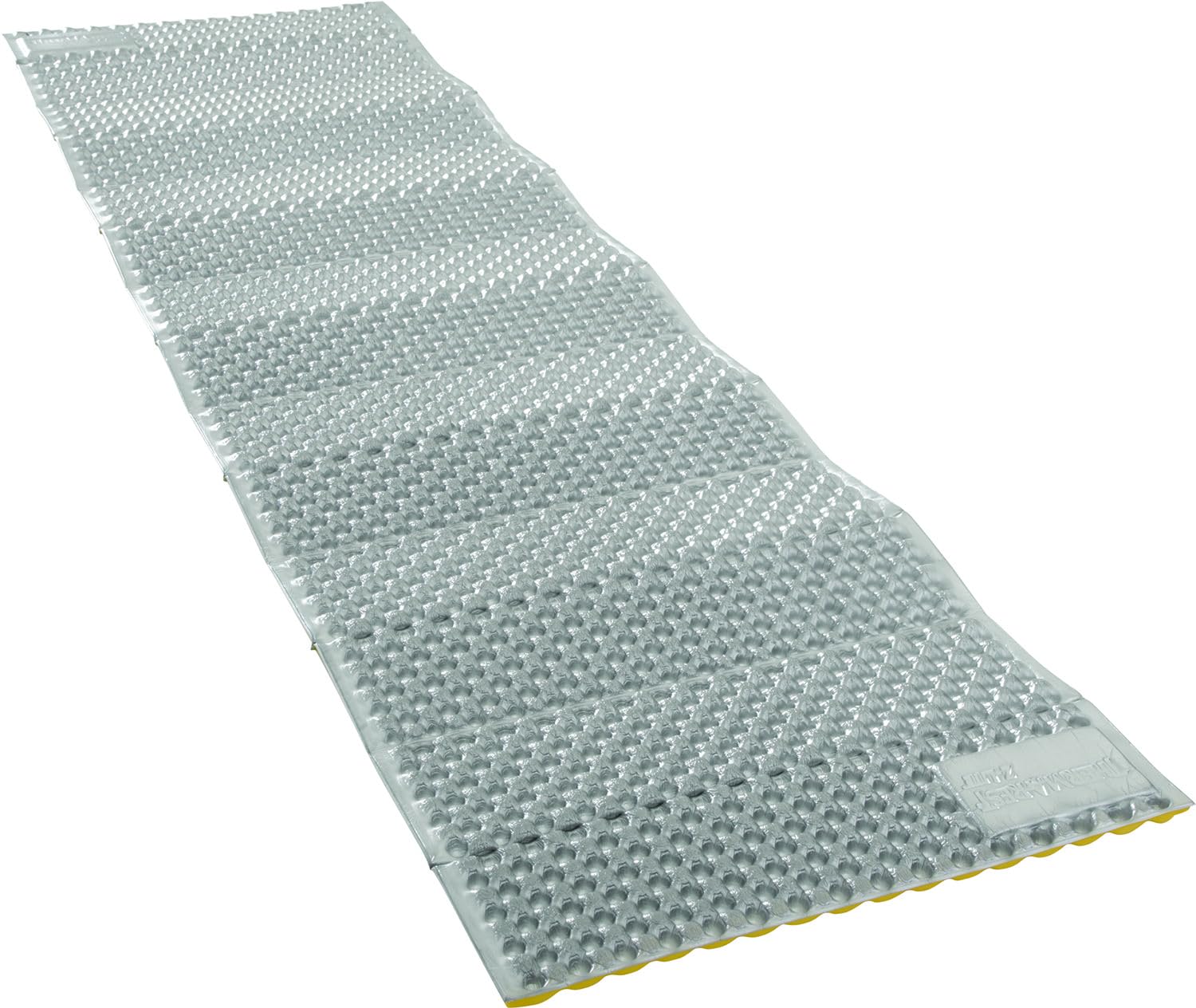
The Z Lite Sol is the pad you buy when you are done gambling on valves. It is a closed-cell foam mat, meaning it is solid material rather than an air chamber — there is nothing to inflate and nothing to pop. At 0.75 inches thick it is far thinner than the 4-inch TREKOLOGY air pad, but the reflective ThermaCapture coating and heat-trapping dimples lift its warmth to an R-value of 2.6. For a foam pad that is genuinely useful in three-season conditions.
What wins people over is the total absence of maintenance anxiety. It folds accordion-style down to 20 x 5 x 5.5 inches and weighs just 14 ounces, so it straps to the outside of a pack without eating interior space. The foam is softer on top for comfort and denser on the bottom for insulation and ground protection. Mountaineers have leaned on this design for generations, and it shows in how simply it works.
The catch is honest and physical: at an R-value of 2.6 it is not a deep-winter pad, and 0.75 inches of foam is a firm night’s sleep compared with a plush air pad. If you are a committed side sleeper who needs contouring, an inflatable like the Ether Light XR below will feel far kinder to your hips.
What it gets right
- Zero leak risk — solid foam has no valve or air chamber to fail
- R-value of 2.6 from reflective ThermaCapture coating and heat-trapping dimples
- Folds to 20 x 5 x 5.5 inches and weighs 14 ounces for easy packing
- Softer top layer for comfort, denser base for insulation and ground protection
Where it asks you to compromise
- 0.75 inches of foam is a firm night — side sleepers may feel it in the hips
- R-value of 2.6 is a three-season number, not a deep-winter one
- Bulkier in the pack than an air pad that rolls down small
Reach for this if: you want a dependable pad you never have to inflate or patch, and three-season warmth is enough.
Look elsewhere if: you need deep-winter insulation or a soft, contoured sleep surface.
2. TREKOLOGY Sleeping Pad
A 7.2 R-value air pad.
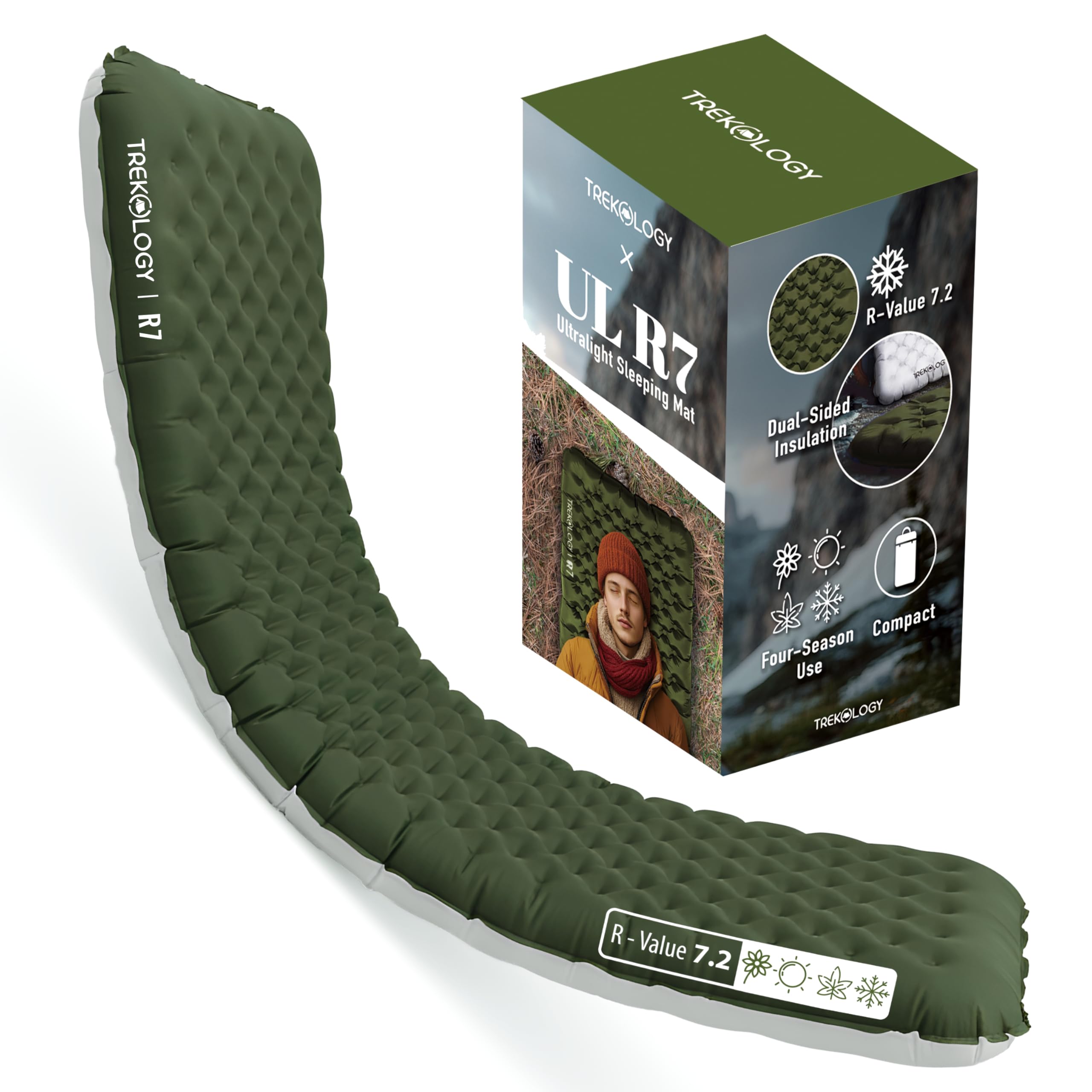
Here is the number that matters if you sleep cold: an R-value of 7.2. That is a serious insulation figure for an inflatable, and it comes from advanced insulating air chambers that spread your body weight and hold heat in. It is SGS-certified and beats the Sea to Summit Ether Light XR’s 4.1 and the Big Agnes Rapide SL’s 4.8.
You get real cushioning on roots and rocks because it is a full 4 inches thick — versus the Z Lite Sol’s 0.75. The feel is firm, and the 70.8 x 24 inch surface supports up to 330 lbs (150 kg). The 40D ripstop nylon (a tough, grid-reinforced fabric) with a TPU coating (a waterproof plastic layer) resists tears and water, so a scrape on granite does not open a hole. A patented anti-leak valve handles inflation and deflation. It weighs 2 lbs and packs down to roughly the size of a water bottle.
The catch is air management. There is no built-in pump, so you inflate by mouth or with a separate pump bag that is not included. Inflation and air retention are the mixed points in owner feedback — some find it holds firm all night, others find it needs a top-off. Carry a patch, learn the valve, and it rewards you with warmth.
Warmth-per-dollar read: a 7.2 R-value at this tier is the headline, and the 92 positive appearance notes back how good it looks set up too.
Pack weight reality: at 2 lbs it is the heaviest pad here by a clear margin — weight is the honest trade for that insulation.
Suits cold sleepers on a budget: if you camp in shoulder-season chill and want maximum R-value, this delivers.
Think twice if: you count every ounce, since at 2 lbs it is heavier than the ultralight picks.
3. Hikenture R6.2 Sleeping Pad
The cold-weather air pad that weighs less than most of the warm ones.
Where this one shines is what holds air: it stays firm when other inflatables are still deflating, and that reliability is what earns the most praise in the reviews. A pad that stays firm until morning is what an insulated mat is for. Its 6.2 R-value is tested to ASTM F3340-22, and an aluminum film reflects body heat back to you.
For the warmth you get, it travels light — 1.53 lb (listed at 1.5 pounds) and a 3.2-inch thickness that spreads pressure so you do not bottom out sitting or lying down. The included storage bag doubles as a 40L pump sack, inflated in three pumps. Two repair patches ship in the box, and there is a 12-month warranty.
Why it holds air well
- ASTM-tested R-value of 6.2 with reflective aluminum film
- 1.53 lb for a pad this warm
- Storage bag converts to a 40L pump sack — three pumps to fill
- Two repair patches and a 12-month warranty included
The honest fine print
- Noise is a split opinion — some find it quiet, some find it crinkly
- 3.2 inches is cushioned but not as deep as the 4-inch TREKOLOGY
Pick this for warmth that travels light: 6.2 R-value at 1.53 lb is a rare pairing in this field.
Skip the busy-campground night if: you are sensitive to crinkly air-pad noise under a sleeping bag.
4. NEMO Equipment Switchback Foam Sleeping Pad
A foam pad built for plushness first, with hexagonal nodes doing the plumping.
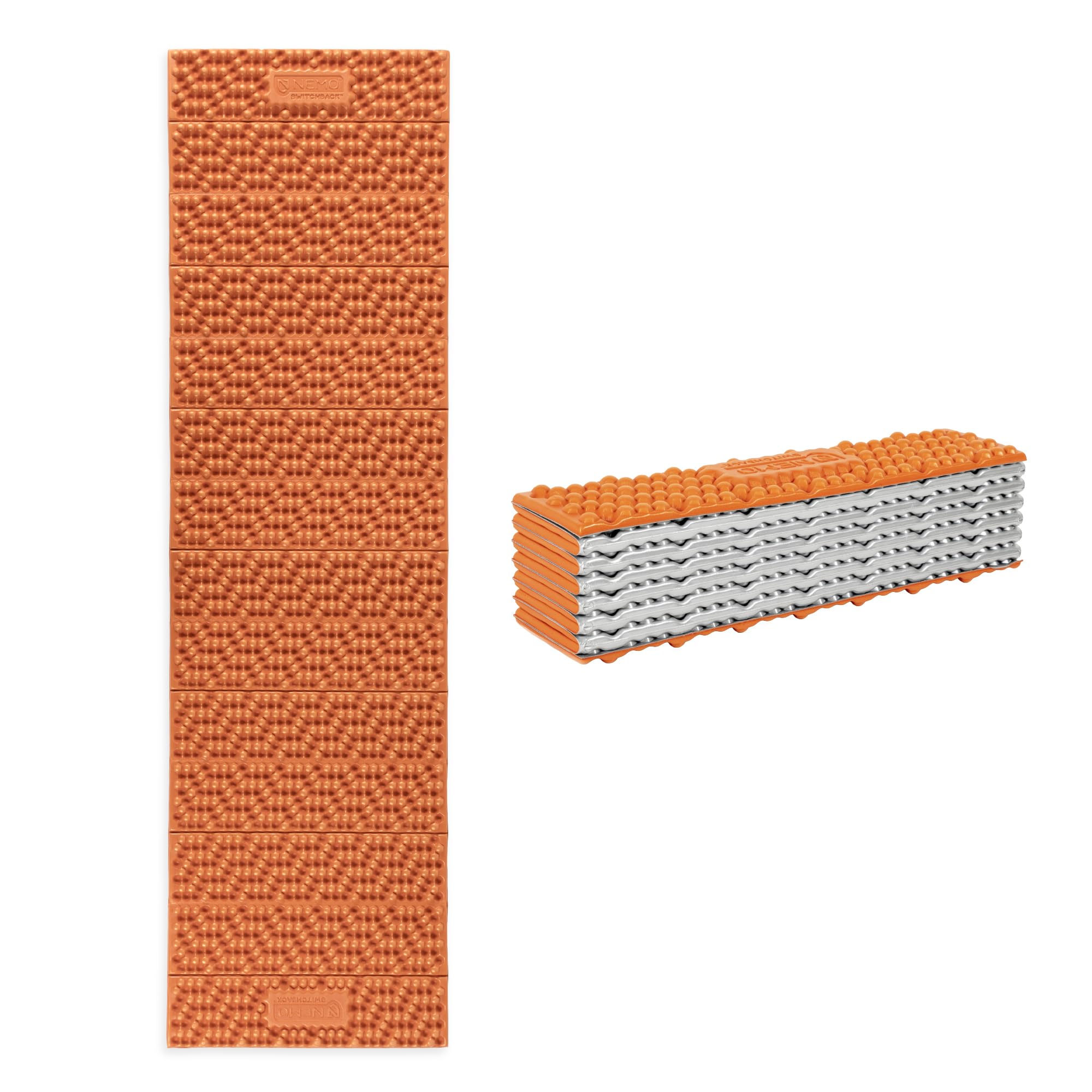
The Switchback takes the foam-pad idea and engineers it for comfort. Its hexagonal nesting pattern frees up space for taller, wider nodes — those raised bumps give the surface noticeably more plushness than a flat foam sheet. Dual-density Axiotomic foam pairs a supple top layer for comfort with a resilient base layer for support. Metallized thermal reflective film bounces heat back at you, and the R-value is 2.
At 0.42 kg it is a hair heavier than the Z Lite Sol’s 0.41 kg — close enough that weight is not the deciding factor. Its listed dimensions run 20″L x 5″W x 5.5″Th, which reflects its thick folded profile rather than a full-length flat mat, so check the exact size listing before you buy. Precise tooling packs the folded layers tight for a smaller bundle than older foam designs.
The recurring gripes are comfort and size, both mixed in owner feedback — a foam pad this firm is not for everyone, and the folded footprint is best measured against your pack. But what people keep coming back to is build quality. It also folds and stores in seconds, no valve, no pump, no patch kit needed.
Comfort-first foam: the tall hex nodes and supple top layer make this the plushest closed-cell option on the list.
One honest check before you order: confirm the exact length and width in the listing against your body size, since foam pads do not stretch.
Best fit for: hikers who want foam’s no-fail reliability but refuse to give up cushion.
Not your pad if: you want the low R-value replaced by a warm air chamber — this sits at 2.
5. Sea to Summit Ether Light XR Sleeping Pad Small

The air pad that contours to a side sleeper’s hip instead of fighting it.
If you roll onto your side and wake with a sore shoulder, this is where to start. The Air Sprung Cell construction and a 3.9-inch-thick body create stable, cushioned support that adapts to side, back, and stomach sleepers alike. That thickness sits just under the TREKOLOGY’s 4 inches and well above the Z Lite Sol’s 0.75, which is exactly the kind of cushioning a hip or shoulder needs.
Warmth comes from ThermalCore insulation using multiple TRM layers to reflect infrared heat back to you, all while staying quiet and low-bulk. The ASTM-tested R-value of 4.1 gives it extended three-season range — enough for cool-weather backcountry but short of the TREKOLOGY’s 7.2 or the Hikenture’s 6.2. Comfort and sleep quality are the strongest themes in owner feedback, with side sleeping right behind them.
Inflation is handled by an integrated Airstream Pumpsack, and the high-airflow XPRESS valve lets you fine-tune firmness and dump air fast in the morning. The catch is surface area: this is a tapered small pad listed at 66.1 x 21.7 inches, so a broad-shouldered or tall sleeper should size up. It is also the softest, most plush pad here rather than the firmest.
The side-sleeper’s match: 3.9 inches of contouring cushion plus a 4.1 R-value quietly handles three-season nights.
Size up if: you are wide-framed or tall — the tapered small cut runs narrow.
6. NEMO Tensor Trail Sleeping Pad Regular
Quiet insulation and stable baffles for sleepers who hate a crinkly pad.
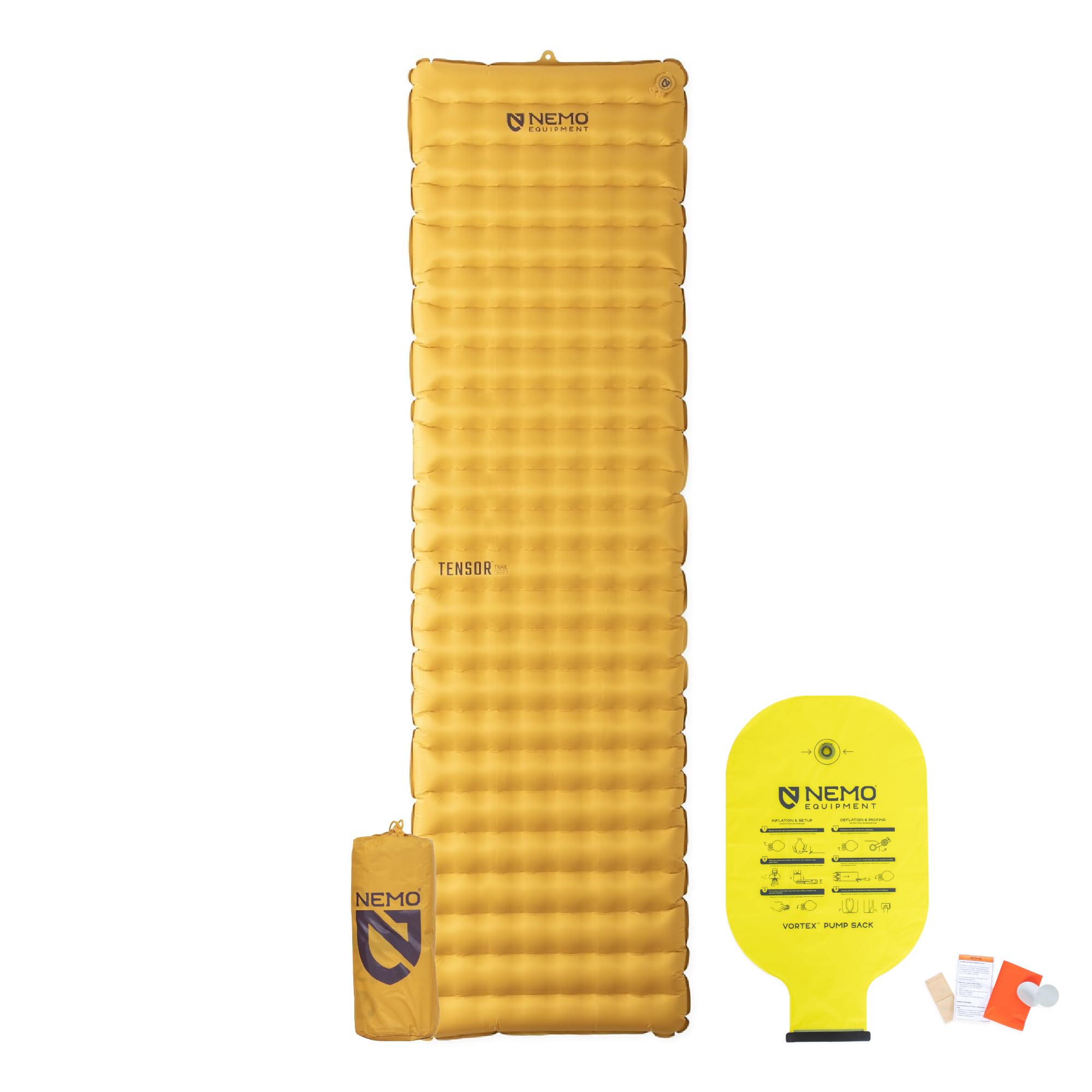
The Tensor Trail’s calling card is noise — or the lack of it. One layer of floating Thermal Mirror metallized film insulates silently, so you are not the person rattling the whole campsite every time you shift. That same film delivers a strong weight-to-warmth ratio, and the pad stays quiet even when you roll over.
Stability comes from Spaceframe baffles — low-stretch, die-cut trusses that cut down on springiness and spread weight evenly. Add 3.5 inches of cushioned loft and you get a sleep surface that holds its shape without the bouncy feel of a plain air mattress. Comfort is the standout in owner feedback, with lightness close behind.
Bluesign-approved premium nylon fabrics keep it light while resisting punctures and tears, and the Vortex Pump Bag is included for inflation. The catch: this is a warm-weather and three-season-leaning pad, and the listed size is a 72 x 20 x 3.5 inch regular — one clear width with no wide option named in the specs. If you sleep cold in shoulder-season frost, look at the higher R-value picks instead.
Why quiet matters: Silence on a shared campsite is worth more than any spec on paper, and the Thermal Mirror delivers it.
The body-fit note: a 20-inch-wide regular suits most frames but leaves bigger sleepers wanting the Rapide SL Wide Long below.
Choose it for the silence: a genuinely quiet 3.5-inch air pad that will not rattle at 2 a.m.
Pass it over if: your nights run below freezing — a 4.5 or higher R-value serves you better.
7. Big Agnes Rapide SL Sleeping Pad Regular

A quilted-top threesome-seasons pad that cradles without the air-mattress bounce.
Comfort here has a shape: a quilted top creates a pillowy sleeping surface, while proprietary offset I-Beam construction trims weight yet keeps the pad stable. At 3.5 inches thick with 4.25-inch outer chambers, it cups your sides rather than letting you roll off — the fade of foam-pad firmness or air-mattress bounciness replaced by a cradle. Two layers of heat-reflective film push the R-value up to 4.8.
Durability is built in — superlight double ripstop nylon with aviation-grade TPU lamination gives it strong weld strength, and every pad gets individual inflation testing at the factory. A Pumphouse high-volume inflation sack fills it in seconds without pumping moisture inside, plus you get a storage sack and repair kit. Owners regularly call it one of the best pads they have used, and the quality theme runs deep in the feedback.
The regular size’s catch is width and warmth shape, not the pad itself: a 72 x 20 inch surface is snug for broad frames. For true deep-winter capacity, the maker’s own suggestion is to add a closed-cell foam pad (a simple foam mat with sealed air pockets) underneath. For everything from spring to fall in mild country, though, it is dialed in.
The cradle effect
- Quilted top and 4.25-inch outer chambers hold you centered
- R-value up to 4.8 from two heat-reflective film layers
- Pumphouse sack fills it fast with no added moisture
- Factory inflation-tested, with a repair kit included
Where it stops short
- 20-inch width is close fit for big-shouldered sleepers
- Deep winter asks for an added foam pad underneath
For the three-season backpacker: a quilted, cradle-shaped pad with a 4.8 R-value makes most mild-to-cool trips easy.
Choose the wide version instead if: you want more shoulder room than 20 inches.
8. Therm-a-Rest NeoAir Xlite NXT Sleeping Pad

Sixteen ounces, three inches thick, and warm enough to carry through the year.
If pack weight is your religion, this is the pad that preaches it. It weighs 16 oz (450 g) — lighter than the TREKOLOGY’s 2 lbs and the Hikenture’s 1.53 lb — yet still delivers a 3-inch-thick profile with a baffled internal structure for stable support. Few pads pair 16 ounces with 3 inches of loft.
Warmth comes from reflective ThermaCapture technology, which traps radiant heat, plus a Triangular Core Matrix construction that minimizes convective heat loss for a 4.5 R-value. That clears the Sea to Summit’s 4.1 and lands close to the Big Agnes 4.8, which is a strong number for a pad this light. The dependable WingLock valve handles inflation and deflates lightning-fast in the morning.
It comes as a regular wide at 25 x 72 inches, with pump sack, stuff sack, and patch kit included, and the stuff sack uses a PFAS-free DWR coating that keeps gear dry. The mixed notes are size and value — some want a narrower cut, and the price tier is steep. Air retention draws a few comments too, so treat the valve with care and keep the patch kit handy.
The ultralight math: 16 oz with a 4.5 R-value and 3 inches of loft is the balance most thru-hikers chase.
Worth knowing: it runs as a wider 25-inch surface, which some find generous and a few wish were narrower.
Built for gram-counters: a 16 oz pad warm enough for year-round adventures, with the included pump sack and patch kit.
Look elsewhere if: you want a narrower, lower-cost pad — this one leans premium.
9. Big Agnes Rapide SL Sleeping Pad Wide Long
The same cradling Rapide SL, opened up to 25 by 78 inches for bigger frames.
A tall or broad sleeper gets real space here: this Wide Long version stretches the regular Rapide SL’s snug 20 inches of width to 25 x 78 inches. The quilted top still forms a pillowy surface, and the 4.25-inch outer chambers keep you centered instead of rolling off. The offset I-Beam construction (internal fabric beams that spread your weight) carries the load with less weight than a plain air-mattress build.
What people praise most is the cradling contour, and one owner’s take that it almost hugs you from the sides is the kind of thing you hear about this pad. Pack size is a running theme too — it packs very small for something this large, thanks to superlight double ripstop nylon and aviation-grade TPU lamination. Warmth matches the regular’s R-value up to 4.8 from two heat-reflective film layers.
Included in the box are the Pumphouse high-volume inflation sack, a storage sack, and a repair kit, and every pad is inflation-tested at the factory. The honest note is value — it is the priciest pad on this list, and some wish it cost less. But for a big sleeper, the extra surface is what makes the difference between a good night and a cramped one.
The big-frame answer: 25 x 78 inches of quilted, cradling surface with a 4.8 R-value.
Stay with the Regular if: you are average-sized and would rather not pay for surface you will not use.
Know the Specs
R-Value: how warm a pad really is
R-value is a plain number that tells you how strongly a pad resists losing your body heat to the ground. Higher is warmer. A closed-cell foam pad like the Z Lite Sol reaches 2.6 with only 0.75 inches of material, while an air pad like the TREKOLOGY hits 7.2 — and the Hikenture’s 6.2 is ASTM-tested. The lesson: warmth comes from what is inside the pad, not just how thick it looks. Match the number to your coldest expected night.
Thickness and width: what cushions you and what cradles you
Thickness is measured in inches and dictates how much your hip or shoulder sinks in before it stops. A 4-inch air pad like the TREKOLOGY cushions far more than a 0.75-inch foam mat, and the Sea to Summit’s 3.9 inches is the reason side sleepers favor it. Width works the opposite way — a 20-inch pad is the standard, while the Wide Long Rapide SL’s 25 inches is what keeps a bigger sleeper from rolling off.
Common Questions
What R-value do I need for three-season backpacking?
Is a foam pad or an air pad better for backpacking?
Will the Big Agnes Rapide SL Wide Long fit a tall sleeper?
How much does a backpacking pad weigh?
Does a thicker pad actually sleep warmer?
Can the Hikenture or TREKOLOGY pad be inflated by mouth?
Is the NEMO Tensor Trail noisy at night?
What is the difference between the regular and Wide Long Big Agnes Rapide SL?
Do these pads come with a repair kit or pump sack?
The Bottom Line
For most people heading out on the trail, the top sleeping pads for backpacking winner is the Therm-a-Rest Z Lite Sol because it eliminates the leak-and-patch gamble entirely while still providing a 2.6 R-value in 14 ounces. If you sleep cold and want maximum warmth for the weight, grab the Hikenture R6.2 — 6.2 tested insulation at 1.53 lb is a hard combination to beat. And for a bigger sleeper who wants room to stretch out, the Big Agnes Rapide SL Wide Long is the one to reach for, with its 25 x 78 inch cradling surface.
How we choose
We do not accept paid placement. Every pick is matched to a real buyer and a real use-case; we do not hands-on test units.
Sources
Specifications: manufacturer listings and product documentation. Review insights: verified customer reviews, as of November 2026. Pricing: not shown on this page (it changes often); check the current price via the retailer link.
As an Amazon Associate, Tactical Gear Guy earns from qualifying purchases. This does not affect which products we feature.