Specs are compiled from manufacturer listings and verified buyer reviews and can change over time — please confirm the key details on the product page before buying.
If you only buy one speed square, buy the Swanson SW1201K. It hands you a 7 inch square, a 12 inch “Big 12” square, and the Blue Book reference guide in one pack — all in die-cast aluminum. A speed square is the triangular layout tool carpenters use to mark 90-degree and 45-degree cuts, find rafter angles, and guide a saw. A good one survives a drop off a ladder and still reads a true 90 degrees years later. A bad one is off by a hair, and every crosscut you make inherits the error. Below are the eight that hold up, sorted by who they actually suit.
This guide is built by comparing the manufacturers’ published specifications and the patterns across verified customer reviews, so you get each pick’s real strengths and trade-offs instead of marketing spin.
You will see which squares carry markings that stay legible, which are built from die-cast aluminum versus stamped metal, and which scale steps up to 1/16 inch graduations. If you are shopping for a top rated speed square, the picks below cover layout work from a first deck to daily framing.
Top Picks


How To Choose The Best Top Rated Speed Square
The one thing that separates a square you keep for a decade from one you toss in a drawer is whether the corner still reads exactly 90 degrees after a drop. Markings, size, and extra features all come second to that corner. Here is what actually drives that decision.
Material and how the square is made
Die-cast billet aluminum is the standard worth paying for. It is poured into a mold as one solid piece, so the corner is set at the factory and holds its shape. Laser-etched and extruded stamped squares are thinner and can flex, which is why makers like Swanson point to their die-cast construction as the accuracy advantage. Stainless steel blades show up on combination squares — rustproof and stiff enough to slide through a head without bowing.
Graduation range: the scale on the edge
Graduation range is how fine the tick marks run. A 1/4 inch range is coarse and fine for quick framing marks. An 1/8 inch range splits each quarter into halves. A 1/16 inch range gives you the finest steps, which matters when you are laying out stair stringers or a joint that has to close tight. Finer is not automatically better — tiny marks are harder to read in low light, and a coarse scale slows you down less on rough framing.
Size: 7 inch versus 12 inch
A 7 inch square fits in a tool pouch and handles most rafter and trim work. A 12 inch square spans wider boards and gives you a longer straight edge to run a saw against. Many carpenters carry both, which is why the value packs here pair a 7 inch with a 12 inch. If you only have room for one, think about the widest board you cut most often.
Markings and visibility
Permanently laser-etched numbers sit in the metal rather than on top of it, so they do not wear off or fade in the sun. A non-glare matte finish cuts reflection so the scale stays readable outdoors. You will notice legible markings every time you read a cut in direct sun.
Extra layout features worth knowing
Scribe notches hold a carpenter pencil so you can pull an even line in one motion. A protractor scale printed on the back turns the square into an angle finder. A conversion table covers roof pitch and rafter length without a phone. A level vial lets you check plumb and level without reaching for a second tool. None are required, but each one saves a reach on the ladder.
Side-by-Side Comparison
| Model | Best For | Graduation Range | Material | Size | Amazon |
|---|---|---|---|---|---|
| Swanson SW1201K Value Pack★ Best Overall | Best overall bundle | 1/4 inches | Aluminum | 7″ + 12″ | Amazon |
| Mr. Pen Rafter and Combination Square SetBudget Champion | Budget two-tool starter | 0.03 inches | Aluminum, Brass, Stainless Steel | 7″ + 12″ | Amazon |
| Kapro 446 High Definition Anodized Rafter SquareCompact Pick | Compact and corrosion-resistant | 1/8 inches | Aluminum | 7″ | Amazon |
| Klein Tools 9357SSQ Rafter Square | Jobsite durability | — | Aluminum | 7″ | Amazon |
| Beslands 12-inch Rafter Square | Wide-board layout | 1/8 inches | Aluminum | 12″ | Amazon |
| Swanson S0101TC132 Value Pack | Combination square bundle | — | Aluminum, Stainless Steel | 7″ + 12″ | Amazon |
| Preciva Carpenter Square Set | Fine 1/16″ graduations | 1/16 inches | Aluminum | 12″ + 7″ | Amazon |
| Spec Ops Fury 7.5″ Rafter Square | Feature-loaded layout | — | Stainless Steel | 7.5″ | Amazon |
Detailed Reviews
1. SWANSON SW1201K Speed Square
Our pick — 4.5+★ from 10,000+ verified ratings; the strongest balance of quality and price.
Two squares, one pocket reference book, and a 17.37-inch overall length that covers every board on a framing job.
This bundle gives you the 7 inch square for a pouch and the 12 inch “Big 12” for spanning wider stock — plus the Blue Book, Swanson’s pocket reference for roof pitch, rafter length, and stair stringers. That reference alone saves you from doing pitch math in your head on a ladder. The tool body is die-cast from heavy-gauge billet aluminum alloy, which is what keeps the 90-degree corner fixed instead of flexing. Gradations are included for marking common, hip, valley, and jack rafters, so one tool covers the whole roof.
What wins people over, by a wide margin, is the build. It is a true five-tools-in-one layout square: a try square, a miter square, a saw guide, a line scriber, and a protractor. The value story lands second — two squares and the book for the cost of a single premium square elsewhere. Accuracy and readability round out the praise, and the 1/4 inch graduation range keeps the ticks big and legible in bad light.
The honest catch is size. At 17.37 inches long by 1.62 inches wide, the Big 12 will not disappear into a standard tool belt pouch — it wants an open tote or a nail bag. And the 1/4 inch graduation range is coarse by design, so if you are laying out fine cabinetry joints you will want a finer scale alongside it. Neither is a defect; it is simply a framing-first bundle, not a finish-carpentry one.
What earns it the top spot
- Two squares plus the Blue Book in one pack, covering 7 inch and 12 inch work
- Die-cast billet aluminum alloy holds its corner year after year
- Gradations for common, hip, valley, and jack rafters
- Works as a saw guide to true up a board
- Made in the USA, per the manufacturer
Where it asks a little more
- The 17.37-inch Big 12 needs an open tote, not a small pouch
- 1/4 inch graduations are coarse for fine joint work
Reach for this if: you frame, roof, or lay out rafters regularly and want both sizes plus the reference book in one go.
Look elsewhere if: your work is tight finish carpentry that lives on a 1/16 inch scale.
2. Mr. Pen Rafter Square Set
Two tools in one bag — a rafter square for rough marks and a combination square with a spring-loaded brass bolt.
The 12 inch combination square does triple duty: it works as a level, a depth gauge, and a ruler. Its stainless steel blade is marked in both inch and cm graduations across 1/16, 1/8, and 1/32 inch increments — that 1/32 step is finer than most squares at this tier. A brass scriber and a level are built in, and the spring-loaded brass bolt locks the head where you set it. The 7 inch rafter square is die-cast billet aluminum alloy with a non-glare matte finish, cut with gradations for common, hip, valley, and jack rafters.
Where the set has to prove itself is the combination square’s head. Owners split on sturdiness — some find it well-built, others have watched the combination square come apart. Readability draws a similar split, with several finding the finer markings hard to pick out. So treat the 7 inch rafter square as the workhorse and the 12 inch combo as the helper. For an amateur building a deck or a set of shelves, that split is fine. For daily professional use, it is the reason to look further up this list.
Value read: two tools for the price of a single square elsewhere, with a 1/32 inch scale you rarely see at this tier.
The trade-off: the combination square’s head is the soft point — the rafter square is the durable half.
Suits the weekend builder: a home project or two a year where two different squares help.
Not for daily trade use: constant job-site abuse will test that combo head faster than occasional projects will.
3. Kapro 446 Rafter Square
A 7-inch square that is 1 inch wide in profile — thin enough to vanish into a pouch and tough enough to shrug off rust.
That 1 inch width is the number to notice here. Compare it to the Beslands 12-inch rafter square at 12 inches wide, and you get a sense of how pocketable this one is. The solid aluminum body is fully anodized, which is what resists corrosion and wear on a wet jobsite. Markings are permanently laser etched rather than printed, so the numbers do not rub off. On the back, a printed conversion table doubles as a 0-to-90 degree protractor scale — one flip and you have an angle finder.
The 1/8 inch graduation range is a sensible middle ground. It is finer than the coarse framing scale but still big enough to read at arm’s length. Anodizing also gives it that red finish, which doubles as a visibility cue — a bright square is easier to spot at the bottom of a bag.
Where this pick asks patience: owners consistently report it holds up over years of use, and the trade-off is simply that a 7 inch square cannot span the wider stock a 12 inch model handles. It is also a single tool — no combination square, no reference book. You are buying one very good compact square and nothing else.
Reach for this if: you want one tough, corrosion-resistant square that rides in a tool pouch without bulk.
Look elsewhere if: you need the reach of a 12 inch square or the extras a combo set brings.
4. Klein Tools 9357SSQ Rafter Square, Aluminum, 7-Inch
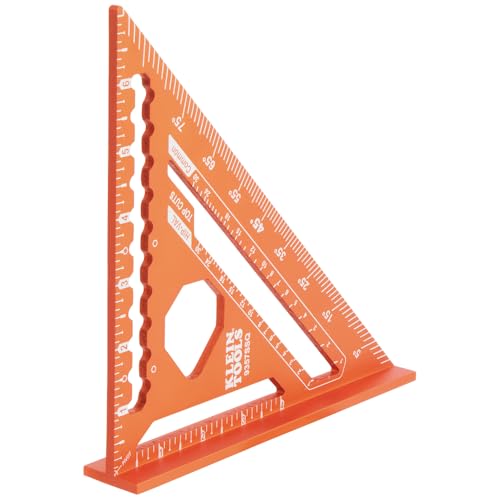
The square that holds your pencil and props your pipe, then reads 0 to 90 degrees without a second tool.
Klein builds this one for the person who is already on the ladder. Scribe notches hold a carpenter pencil at 1/4 inch spacing, so you can pull an even row of marks in one motion. A pipe prop lets you rest metal or plastic pipe for a secure measure and cut. And 0 to 90 degree markings are etched directly onto the aluminum, turning the square into an angle finder on the spot.
Double laser-etched markings are the readability answer — etched into the metal so they stay legible through dust and sun glare. At 7.84 ounces it has enough mass to feel solid in the hand without dragging a belt down. Build quality is what earns it its standing, with functionality and accuracy close behind.
One honest sizing note: the advertised dimensions do not align with what some people expect in hand, so check the 7 inch by 7.25 inch spec against the board widths you cut most. If you are usually on narrower trim, the smaller footprint is an asset. If you are laying out wide stair stringers, you will want more reach.
Standout detail: the pipe prop and scribe notches are features you will not find on most squares in this group.
Worth knowing: the physical size does not match some buyers’ expectations — measure against your typical stock before you commit.
Best for: the working carpenter who marks rafters, curls pipe, and wants pencil guidance built into the tool.
Think twice if: you need a wider span for broad stringers and deck framing.
5. Aluminum 12-inch Rafter Square

A 12-inch span for wide boards, with a lipped edge that locks onto lumber so your marks repeat.
If your work runs to wider boards, this is the reach play. It is 12 inches wide against the Kapro’s 1 inch profile — a huge spread — so it spans stock the compact squares cannot. The high-contrast black scale is laser etched into aluminum alloy, which the maker says resists wear and rust. It works as a protractor from 0 to 90 degrees, a miter square, a saw guide, and a depth scriber. The lipped edge seats on the edge of the lumber so repeatable marks come fast.
Durability and versatility are what carry this one — it is precision-machined from aluminum alloy and finished with a smooth anodized coat that resists glue and paint buildup, which means a quick wipe cleans it. That matters when you are moving between framing and finish work on the same job.
Two things to weigh. First, size gets mixed reactions — some find the 12 inch span exactly right, while others say it is not perfectly square out of the package. Second, accuracy of the marks is a concern for a few. Nothing here means the tool is bad; it means the 12 inch size and the graduations are the specs to check when yours arrives. Run a quick square test against a known straight edge before you trust it on a critical joint.
Reach for this if: wide boards, deck framing, or roofing need a longer straight edge and a lipped fence.
Look elsewhere if: you want a small pocket square, or you need to verify squareness before every job.
6. Swanson S0101TC132 Speed Square
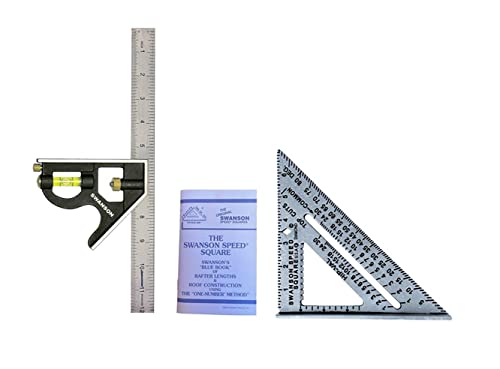
The full Swanson starter kit — speed square, Blue Book, and a 12-inch combination square with a zinc head.
Three pieces here. The 7 inch speed square is CNC machined to a perfect 45 and 90 degree corner, so the marks read true right off the pivot, cut after cut. The body is heavy-gauge die-cast aluminum alloy, which Swanson says is 15 times stronger than standard aluminum construction and holds its 90 degree tolerance under drops, dust, and jobsite abuse. The 12 inch combination square gets a CNC-machined zinc head with precision 45 and 90 degree working faces, an acrylic block vial, and a depth gauge that slides the stainless blade through the head for one-motion measuring.
The detail that identifies a genuine Speed Square is the diamond cutout. That cutout lets you mark a one-motion seat cut on common, hip, and valley rafters. The Blue Book that ships with it covers roof pitch, rafter length, stair stringers, and field measurements — it is the difference between trusting your memory on stair math and checking it.
The acrylic vial on the combination square is a small choice that matters over time. Swanson points out acrylic outperforms tube-type designs that crack on a drop — a stress point you will not think about until the other kind fails. The catch is simply that the kit is three tools, so you are paying for the extra reach versus a bare square.
Why this kit earns its keep
- Three pieces — speed square, Blue Book, and 12 inch combination square
- Diamond cutout enables one-motion seat cuts on common, hip, and valley rafters
- CNC-machined zinc head holds 45 and 90 degree working faces
- Acrylic vial holds up better than tube-type designs on a drop
Where it costs you
- You pay for the full kit if your work only needs a single square
- The combination square adds a second tool to keep track of
Reach for this if: you want one box that covers roof pitch, stair strings, and level checks.
Look elsewhere if: you already own a combination square and only need the speed square.
7. Preciva Carpenter Square Set

A 1/16-inch scale on both squares — the finest graduations on this whole list.
The 12 inch square measures 12 x 12 x 17 inches at 1/16 inch graduations, and the 7 inch square runs 7 x 7 x 10 inches at 1/8 inch graduations. That finer scale is the whole point: the manufacturer notes it gives more precise measurement data than the standard 1/8 inch carpenter square. The scale is laser calibrated and the markings are precise and clear, so the fine steps do not blur together.
With one square you can draw parallel lines, vertical lines, and angle lines, plus locate table saw height and position for drilling. It is made from aluminum alloy with a scratch-resistant finish, so it keeps its accuracy through handling. That range of layout work is what keeps the set in the bag past the first project.
The trade-off to plan for: 1/16 inch graduations are denser, and denser marks take a moment longer to read in low light than the big 1/4 inch ticks on a framing square. If your work is trim, joinery, or anything that needs a tight joint, this is exactly the trade you want. If you are banging out rough framing, the coarse-scale squares earlier on the list will read faster.
What makes it distinct: a 1/16 inch scale across a 12 inch ruler is a rarity at this tier, and it is what buyers here prize.
The trade-off: finer ticks take longer to read outdoors than a coarse framing scale.
For the detail-minded: trim work, joinery, and any layout that closes tight.
Less suited to: rough framing where speed and big tick marks beat fine resolution.
8. Spec Ops Fury 7.5 Rafter Square

A wide-heel square with a built-in level vial and dual-sided rulers — the most feature-stacked tool here.
The heel is the standout. It is 40 percent wider, which the maker says helps it secure to round or damaged edge lumber — the kind of beat-up stock you actually find on a demo job. Dual-sided heel rulers boost measuring and marking versatility. An integrated level vial gives you quick level and plumb checks without reaching for a second tool. Rapid-layout features push layout speed during marking work. The body is stainless steel at 0.25 inches thick and 9.6 ounces, so it feels substantial in hand.
The package rounds out with a digital rafter calculator and guide, integrated compass holes, and laser-etched and stamped markings. The maker backs it with a limited lifetime warranty and notes it donates to Veteran and first responder causes.
Note honestly: this is the newest and least-reviewed tool in the group, so the long-term track record is simply not as thick as the Swanson or Kapro squares above. The feature set is the strongest on the page, and that is your reason to pick it. If proven years of field use matters more to you than a level vial and a digital calculator, the older names have the longer history.
Reach for this if: you want every layout aid in one tool — level, rulers, and a rafter calculator.
Look elsewhere if: you would rather buy a tool with a long field-proven reputation.
Know the Specs
Graduation range
This is how finely the scale is divided. A 1/4 inch range steps in quarter-inch marks — coarse, fast to read, and fine for framing. An 1/8 inch range halves those steps, which suits most layout work. A 1/16 inch range (found on the Preciva set) gives you the finest marks and the tightest joints. The trade-off is always readability versus resolution: finer is more precise but harder to read in poor light.
Material: die-cast versus stamped
Die-cast billet aluminum alloy is poured as a solid piece, so the 45 and 90 degree corners are set at the factory and stay put. Stamped and extruded squares are thinner and can flex. Stainless steel shows up on combination square blades because it resists rust and slides through a head cleanly. If the corner ever bends, the tool is out — which is why the material is the first thing worth checking.
Laser-etched versus printed markings
Laser etching burns the numbers into the metal itself, so they do not fade or wear off. Printed or painted markings can rub away with a thumb over time. On a tool you will use for years, etched markings are the durable choice, and several picks here point to them as a key feature.
Heel width and the lipped edge
The heel is the base that rests against the edge of the board. A wider heel (like the Spec Ops 40 percent wider design) grips round or damaged lumber more securely. A lipped edge, found on the Beslands 12 inch square, locks onto the board edge so repeat marks line up. Both matter most on rough or weathered stock.
Square size and reach
A 7 inch square fits a pouch and handles most rafter and trim work. A 12 inch square spans wider boards and gives a longer saw guide edge. Many carpenters carry both — which is why several value packs here pair the two sizes. Match the size to the widest board you cut routinely.
Extra layout tools
A level vial lets you check plumb and level on the spot. Scribe notches hold a pencil for even lines. A conversion table or digital calculator handles roof pitch and rafter length. None are required, but each one saves a reach — and on a ladder, a saved reach is time.
Common Questions
What is the difference between a speed square and a rafter square?
Will a 7-inch speed square work for stair stringers?
How do I tell if my square is actually 90 degrees?
Do I want 1/4-inch, 1/8-inch, or 1/16-inch graduations?
Is die-cast aluminum better than stamped steel?
What is the Blue Book that comes with some Swanson squares?
Can I use a speed square as a saw guide?
Will laser-etched markings fade over time?
Is a combination square set worth it over a single speed square?
Which square is best for round or damaged lumber?
The Bottom Line
For most people, the top rated speed square winner is the Swanson SW1201K Value Pack — two die-cast aluminum squares and the Blue Book in one pack, with the strongest owner consensus of any tool here. If you want the finest scale, grab the Preciva Carpenter Square Set and its 1/16 inch graduations. And for compact corrosion resistance that clips into a pouch, the Kapro 446 is the one to reach for. One last thought: the tools with the most years behind them — Swanson, Kapro, Klein — are worth the small step up in price over the newer entries, because a square only pays you back by staying true.
How we choose
We do not accept paid placement. Every pick is matched to a real buyer and a real use-case; we do not hands-on test units.
Sources
Specifications: manufacturer listings and product documentation. Review insights: verified customer reviews, as of November 2026. Pricing: not shown on this page (it changes often); check the current price via the retailer link.
As an Amazon Associate, Tactical Gear Guy earns from qualifying purchases. This does not affect which products we feature.