Specs are compiled from manufacturer listings and verified buyer reviews and can change over time — please confirm the key details on the product page before buying.
You want a camera that slips into a jacket pocket and still takes a photo worth keeping. The Xtra Muse squeezes the most out of a small body, with a 1-inch CMOS sensor (a large image sensor for a pocket camera, so it gathers more light) and a built-in 3-axis gimbal (a motorized mount that keeps shots steady) in something you can carry all day. The rest of this list matches each small camera to a job, because a 30x travel zoom and a 24MP APS-C street shooter (a 24-megapixel camera with a larger APS-C sensor) suit completely different days out.
This guide is built by comparing the manufacturers’ published specifications and the patterns across verified customer reviews, so you get each pick’s real strengths and trade-offs instead of marketing spin.
The three things that separate a good small camera from a disappointing one are sensor size, real optical zoom versus digital cropping, and how the thing feels in your hand after an hour. Below you’ll find the honest trade-off on each of these top rated small cameras so you can pick the one that matches how you actually shoot.
Top Picks


How To Choose The Best Top Rated Small Cameras
Buying small means giving something up, and the trick is choosing which thing you can live without. A camera the size of a deck of cards can’t hold a huge lens, so the maker decides for you: big sensor, long zoom, or low price. Decide which of those three you need before you compare specs.
Sensor size beats megapixel count every time
A sensor is the light-catching chip behind the lens, and its physical size decides how much light it gathers. A 1-inch sensor or an APS-C sensor (the larger chip type used in enthusiast cameras) collects far more light than the tiny chip in a budget point-and-shoot. More light means cleaner photos in a dim room or at sunset, even if the smaller camera advertises a bigger megapixel number. If your shooting happens indoors or after dark, weight sensor size heavily.
Optical zoom versus digital zoom is not a small detail
Optical zoom moves glass to magnify a distant subject, so the image stays sharp. Digital zoom simply crops the frame and blows it up, which is why distant shots from cheap cameras look mushy. A 24X optical zoom lens holds detail at the long end. A 20X digital zoom is really just a crop, and it shows. For concerts, wildlife or school sports, insist on optical.
How it feels in a pocket and in your hand
A small camera only earns its place if you actually carry it. Look for a body that slips into a coat pocket or a small bag, and a screen that flips so you can frame yourself for video. A built-in stand or a threaded handle helps when you want a steady shot without a tripod. Grip matters too, since a smooth body gets slippery once your hands are cold or damp.
Battery, stabilization and transfer
A tiny body holds a tiny battery, so expect to charge it more often than a full-size camera. Two included batteries or USB-C charging saves a trip. Stabilization keeps handheld video from wobbling, and WiFi or Bluetooth transfer lets you move clips to your phone without a laptop. Decide which of these you’ll actually use before you fall for a spec sheet.
Side-by-Side Comparison
| Model | Best For | Sensor / Resolution | Zoom | Video | Amazon |
|---|---|---|---|---|---|
| Xtra Muse★ Best Overall | Handheld video and vlogging | 1-inch CMOS | — | 4K at 120fps | Amazon |
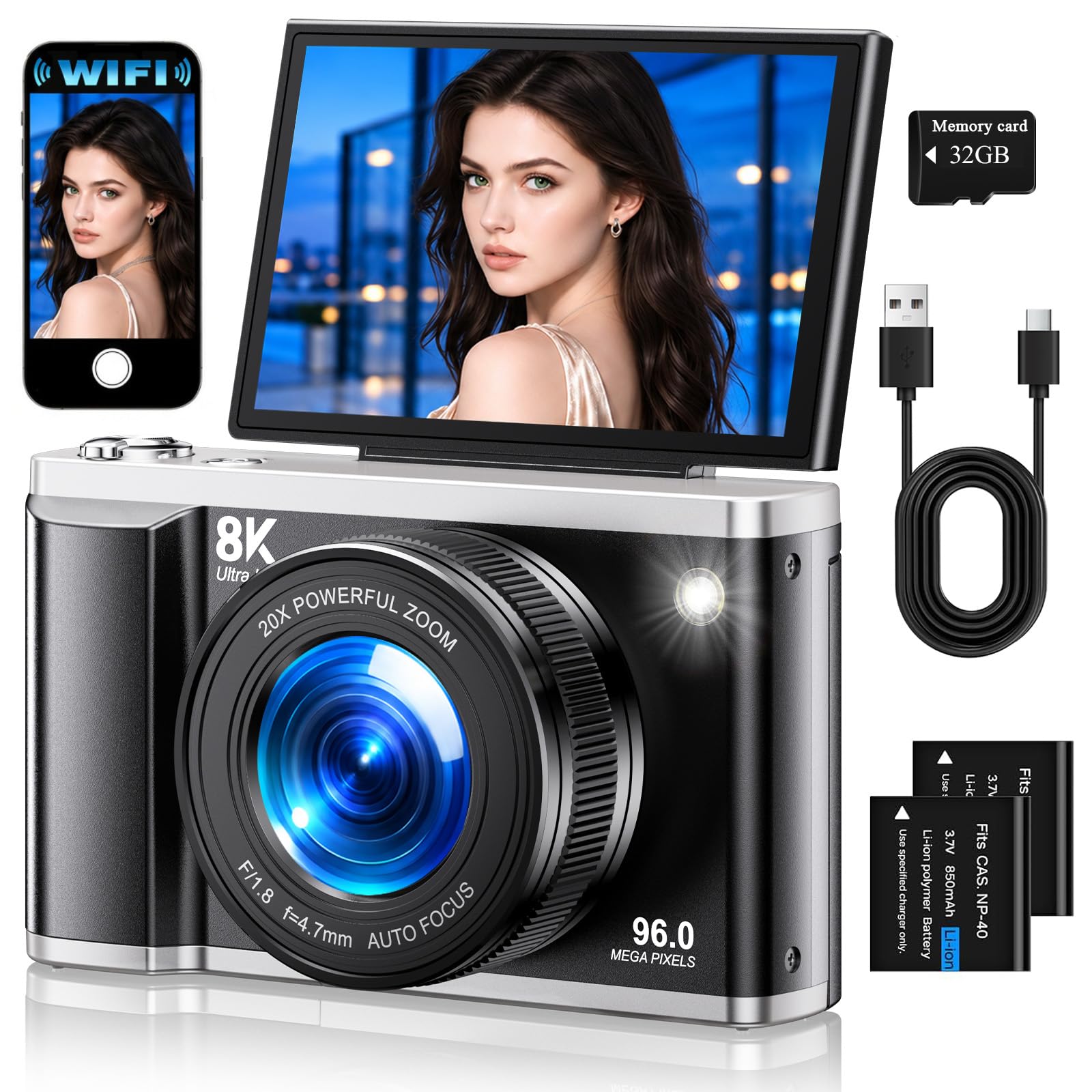
| 8K Digital Camera (AUREAPIX)Budget Champion | Budget creators and students | 96MP stills | 20X digital | 8K | Amazon |
| Gavonde 4K 24XOptical Zoom Pick | Distant subjects on a budget | 88MP | 24X optical | 4K UHD | Amazon |
| KODAK PIXPRO FZ55 | Simple travel snapshots | 16MP | 5X optical | 1080P Full HD | Amazon |
| Canon PowerShot V10 | Vlogging and live streaming | 15.2MP 1-inch CMOS | 3x digital | 4K at 30fps | Amazon |
| FUJIFILM X Half | Film-style creative shooting | 18MP | — | 2-in-1 stills/video | Amazon |
| Panasonic LUMIX ZS99 | Travel and concerts | — | 30x optical (24-720mm) | 4K at 30p | Amazon |
| Panasonic LUMIX ZS300 | Long zoom with a bigger sensor | 1-inch sensor | 15x optical (24-360mm) | 4K | Amazon |
| Sony ZV-1 II | Wide selfie video | 1.0-type sensor | 18-50mm zoom | 4K | Amazon |
| RICOH GR IIIx HDF | Street and portrait work | 24.2MP APS-C | 40mm fixed | — | Amazon |
| Sony RX100 VII | All-round premium travel | 20.1MP 1.0-type | 24-200mm | 4K | Amazon |
Detailed Reviews
1. Xtra Muse Pocket Gimbal Camera
Our pick — 4.5+★ from 500+ verified ratings; the strongest balance of quality and price.
A pocket video camera that steadies itself so your walk-and-talk footage doesn’t wobble.
Most small cameras make you choose between a decent sensor and a body you’ll actually carry. The Xtra Muse refuses that trade: it fits a 1-inch CMOS sensor (a light-catching chip far bigger than the tiny sensors in budget point-and-shoots) into a handheld gimbal you can slip into a bag. That combination is why it heads this list. It shoots 4K video at 120fps, which means you can slow footage down and still keep it sharp.
The 3-axis gimbal is the headline. It physically counter-moves to cancel out your hand shake, so dancing, running or hiking footage looks smooth instead of seasick. A 2-inch touch screen flips your framing questions out of the way, and you can switch between horizontal and vertical shooting without re-rigging. For anyone posting vertical video, that alone saves a step. The 10-bit X-Log color mode is there for people who grade their footage afterward, and the standard bundle adds a carrying bag, wrist strap and a 1/4-inch threaded handle.
Here’s the honest limit: 161 minutes of battery life is the number to plan around, and a gimbal plus a screen in a small body means you’ll want a spare charge for a full day out. This is a video-first tool, not a stills camera with a zoom lens — if your main goal is photographing distant subjects, the Panasonic ZS99 below carries a 30x optical lens that this one simply doesn’t have.
What earns it the top spot
- Built-in 3-axis gimbal keeps handheld video steady without a rig
- 1-inch CMOS sensor for cleaner footage in low light
- 4K at 120fps gives you real slow-motion options
- Switches horizontal to vertical shooting on the fly
- 161 minutes of battery per charge
Where it asks you to compromise
- No optical zoom for distant subjects
- A full shooting day needs a top-up charge
- Built for motion, not for stills-first shooters
Reach for this if: you shoot video on the move and want smooth footage without carrying a separate stabilizer.
Look elsewhere if: your priority is zooming in on far-away subjects — this is a wide, steady video tool.
2. AUREAPIX 8K Digital Camera with WiFi
Two batteries, a flip screen and built-in WiFi for creators on the tightest budget.
If you’re buying your first camera for YouTube or TikTok and don’t want to spend much, the AUREAPIX makes a strong case. It carries a 3.5-inch 180-degree flip screen — the kind that swings round so you can see yourself while recording — and it comes with two batteries so a long shoot doesn’t die halfway through. The 20X zoom is digital, meaning the camera crops and enlarges rather than moving glass, so treat it as a framing convenience rather than a lens.
Its aperture opens to f/1.8, which is a wide opening that lets in more light than the f/2.8 of the KODAK PIXPRO FZ55 below — a real advantage in a dim room or at night. Stills are captured at 96MP, and the built-in flash helps when the light drops. WiFi transfer through the Viipulse app moves clips to your phone, and the camera doubles as a webcam over USB for livestreaming or video calls.
The catch is where budget bodies always compromise: that zoom is digital, and there’s no optical lens movement to hold detail at a distance. If long-range shots matter, the Gavonde 24X below is the better choice for the same money. The high megapixel count is best treated as a specification, not a promise — good lighting is still what makes an image look sharp.
Who it lands for: first-time creators who need a flip screen, a webcam mode and two batteries without stretching the budget.
The honest trade: digital-only zoom means far-away subjects lose detail, so pair its light weight with close-to-mid-range shots.
Suits the starter creator: a flip screen plus two batteries is a sensible first-vlog kit.
Not for the telephoto shooter: the 20X zoom is digital, so don’t expect sharp distant detail.
3. Gavonde 4K Camera with 24X Optical Zoom
Real optical reach — the lens moves, so distant subjects stay crisp instead of smearing.
The number that matters on the Gavonde is 24X optical. That’s a lens that physically magnifies by moving glass, so a bird on a far branch or a kid at the back of a school field stays sharp. Compare it to the KODAK FZ55 below, which tops out at 5X optical — the Gavonde reaches dramatically further, and it’s the single best zoom value in this group of small cameras.
Around that lens sits a practical kit: 88MP stills from a CMOS sensor, 4K UHD video, a built-in flash for dim conditions, and WiFi so you can push photos to your phone. Nine shooting modes cover the usual ground, and the camera also works as a webcam over USB. Macro shooting lets you get close, and the menu keeps buttons small enough for first-timers, kids and older users to follow.
The trade-off worth knowing: that big lens travel means a body that’s less pocket-flat than the fixed-lens picks, and the zoom is where most of the engineering went. And the 10 g battery is a reminder that this is a light-use day camera rather than a week-long expedition tool. Build quality is the strength buyers call out most — 11 owners single it out, well ahead of the 5 who praise the value.
The lens is the story: 24X optical zoom holds detail where digital zoom would blur, so this is the small camera for far-away subjects.
Set expectations on the body: the zoom lens makes it a chunkier carry than a fixed-lens pocket camera.
Pick it for reach: the optical zoom is the reason to choose this over smaller fixed-lens cameras.
Pass if flat is your priority: a long zoom lens means a less pocketable shape.
4. KODAK PIXPRO FZ55 Compact Zoom Camera

A simple, likable pocket camera that gets out of the way and takes the shot.
Some cameras are a project; the KODAK FZ55 is a point-and-shoot in the literal sense. Its 16MP sensor pairs with a 28mm wide-angle lens and 5X optical zoom, so you can frame a group shot or pull in a mid-distance subject by actually moving glass. The result: video is Full HD 1080P, and the 2.7-inch LCD screen keeps composition and playback easy. Its icon is the 5X optical zoom, which is what keeps those travel snaps sharp.
What wins people over is the sheer ease — press the recording button, point, done. It slips into a pocket or a bag, which is why so many buyers treat it as a travel companion. The retro, 2000s-style look gets more affection than you’d expect from a small digital camera, and quality is the thing owners praise most, with 65 buyers singling it out. Value for money follows close behind, cited by 30.
One honest note: at f/2.8 the aperture is narrower than the f/1.8 opening on AUREAPIX above, so the KODAK wants a little more light. That makes an outdoor, daylight-first camera the natural fit. If you need full manual control or a big zoom, look further up this list — but for straightforward snapshots and travel memories, the simplicity is the point.
The charm is the simplicity: 5X optical zoom, a 2.7-inch screen and one recording button make it the least intimidating camera here.
Light matters: the f/2.8 aperture prefers daylight, so plan your dim-room or dusk shots accordingly.
Made for: the casual traveler or family who wants a likable, low-effort pocket camera.
skip it if: you need big zoom reach or full manual control — those live higher up the list.
5. Canon PowerShot V10 Compact Vlogging Camera

A pocket vlog camera with a wide lens and a fold-out stand that poses itself.
If vlogging is the point rather than a bonus feature, the Canon V10 was built for exactly that. It packs a 15.2MP 1-inch back-illuminated CMOS sensor — the big-chip advantage in a body you can fit in a fanny pack — and shoots 4K video at up to 30fps or Full HD at up to 60fps. Fourteen movie color filters let you set a mood straight in camera.
The 19mm wide-angle lens (in 35mm terms) is a deliberate choice: it fits more of a room or a street scene into the frame, so you’re not fighting to get yourself and your surroundings in shot. The stand folds out front or back, letting you prop it up hands-free at odd angles. A front-facing screen flips round for framing, and there’s a micro-HDMI port plus an external mic jack for adding better sound. Three stabilization modes handle handheld wobble.
Two things to weigh up. Battery life lands around 2 hours, and the fixed wide lens has no real zoom to speak of — the Canon is a wide-angle tool, not a telephoto. And note that the image quality here is strong, with 50+ owners rating that as the standout attraction, but the recurring complaint across the page is battery life, so pack a power bank for longer days. It’s a vlog-first camera, and it’s honest about that.
The vlogging case
- 1-inch back-illuminated CMOS for low-light video
- Fold-out stand for hands-free shooting at any angle
- 19mm wide lens gets your surroundings in frame
- External mic jack and micro-HDMI for a fuller setup
- 14 movie color filters built in
What to plan around
- Battery life sits around 2 hours
- No meaningful optical zoom
- Wide-angle focus means distant subjects stay small
Vloggers first: the wide lens, flip screen and fold-out stand are a purpose-built combo for talking to camera.
The trade: around 2 hours of battery per charge — carry power for full days.
6. FUJIFILM X Half Premium Compact Camera

A dial-driven retro camera that’s built to feel like shooting film again.
The X Half isn’t trying to be the sharpest or the most powerful compact — it’s trying to be fun, and that’s the whole reason it belongs here. A film camera-style body with dial-based controls puts settings on your fingertips, and 26 analog-inspired film and filter options let you pick a look before you shoot. It captures 18MP stills in JPEG, with an ISO range from 100-3200 so you can push it in lower light without everything going grainy.
A unique 2-in-1 mode blends stills and video for a more playful, mixed-media style, and you can print straight to a compatible instax printer or share through the dedicated app. Compactness is the other half of its identity — it slips into a coat pocket, which is what makes carrying it around every day feel natural rather than a chore.
Set expectations clearly. There’s no optical zoom here, so this is a shooter’s camera for composing through the lens you’ve got, and the ISO ceiling of 3200 means it prefers decent light to pitch-black. Owners describe it as solidly built, and the 18MP stills hold up in decent light. This one’s for you if the process of taking a photo is part of the pleasure.
Built for the feel: film-style dials, 26 filter options and instax printing make shooting it a tactile, playful experience.
The limit: no zoom and an ISO range that caps at 3200 — a fair trade for the analog character.
For the tactile shooter: dials, film modes and pocket portability reward someone who enjoys the ritual.
Not for the zoom-dependent: a fixed lens and capped ISO put character ahead of reach.
7. Panasonic LUMIX ZS99 Point and Shoot Camera

A 24-720mm lens that turns a pocket camera into a concert and travel workhorse.
For the person who wants one small camera to cover everything from a wide beach shot to a band on a far stage, the ZS99’s 24-720mm LEICA lens with 30x optical zoom is a genuinely broad reach. That’s a bigger zoom range than the 15x optical on the Panasonic ZS300 further down, at the cost of a smaller sensor. It records 4K video at 30p and 4K PHOTO bursts at 30fps, plus HD high-speed video at 120fps for slow-motion clips.
The travel details are thoughtful. A 1,840k-dot tiltable touchscreen lets you shoot from high or low angles, and USB Type-C charging means you can power up from the same cable as your phone. Bluetooth v5.0 with a dedicated Send Image button moves photos and videos to the Panasonic Image App on your smartphone, so sharing isn’t a desk-bound chore. A 19-point hybrid autofocus keeps track of moving subjects.
The honest read from the page: quality is the strongest impression, with 19 owners praising it, and a full set of PASM exposure modes is a real plus for anyone moving beyond auto. The image quality verdict is more mixed, and menu navigation draws some grumbling. So treat it as a flexible travel tool, not a pro sensor — and note the 30x zoom is where the value really sits.
The zoom sells it: 30x optical reach from 24mm to 720mm covers landscapes and distant action in one pocket body.
Mind the sensor: long zoom means a smaller sensor, so low-light stills are a compromise versus the 1-inch alternatives.
Best for the one-camera traveler: 30x optical zoom spans the widest range of scenes on this list.
Know the trade: the smaller sensor behind that long lens is the low-light weak point.
8. Panasonic LUMIX ZS300 Compact Travel Camera
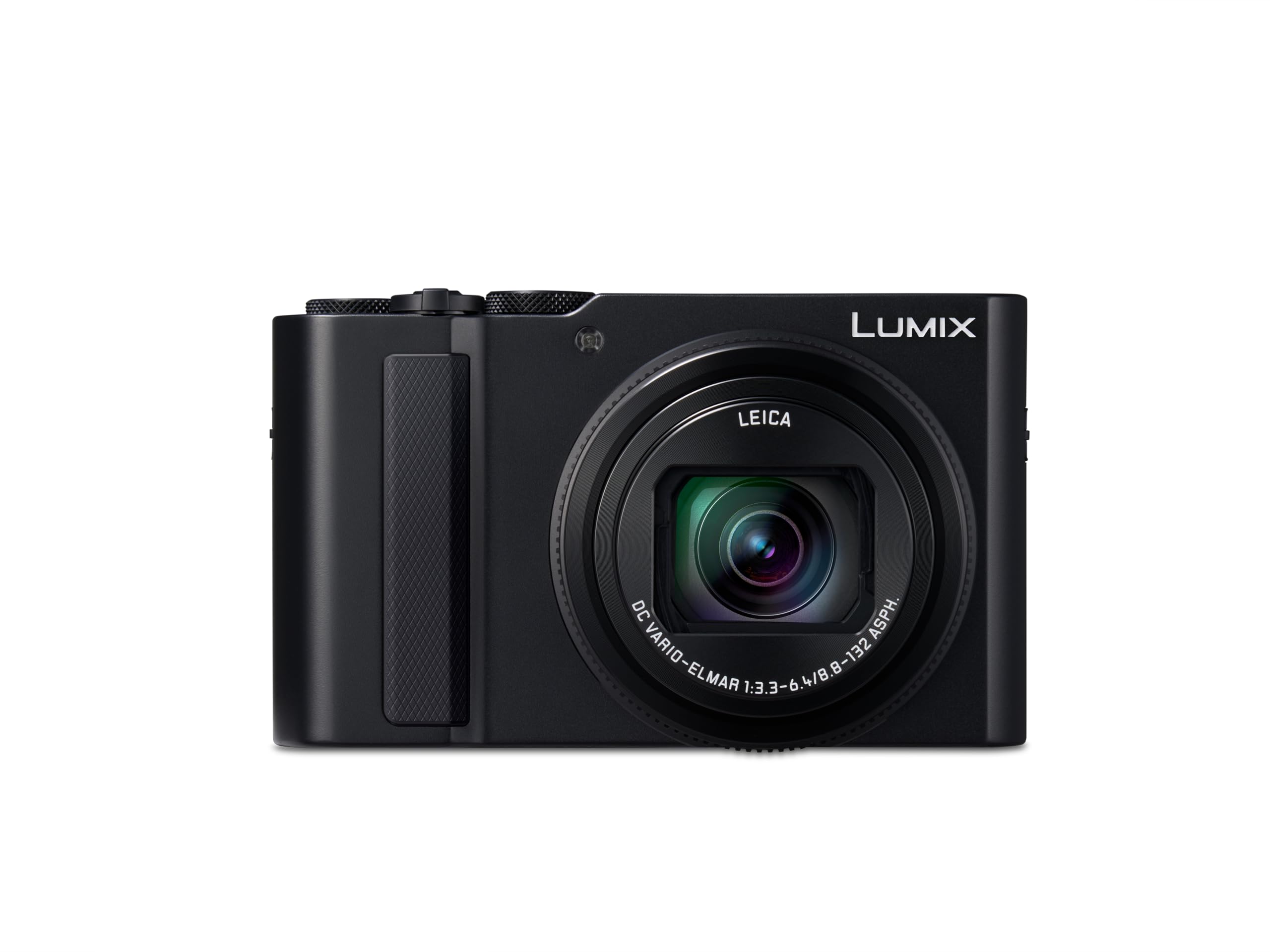
A bigger 1-inch sensor and long zoom — the pairing most pocket cameras force you to choose between.
The tension in small cameras is sensor versus zoom, and the ZS300 tries to have both. It puts a 1-inch sensor — an inherently larger light-catcher than the chips in budget bodies — behind a 15x optical Leica-standard zoom that runs from 24mm to 360mm. That bigger sensor serves low-light work in a way the long-zoom budget cameras can’t. It records 4K video and 4K PHOTO at 30fps, so you can grab a high-resolution still out of fast-moving footage.
Practical touches earn their keep, too. AF macro focuses as close as 1.18 inches at the wide end, which means true close-ups. There are 22 filter effects for playing with looks in-camera, the design is pocket-sized enough to fit in a bag or a large pocket, and the battery is a 1,025 mAh lithium-ion unit. The compact size and zoom range are the two things that stand out for buyers, and it’s the size that gets singled out most, with 9 owners putting it first and 7 more praising the compactness.
Here’s the main question a buyer will have: is the bigger sensor and shorter zoom a better balance than the longer 30x zoom of the ZS99 above? The honest answer depends on your light. Value for money draws mixed opinions, so weigh what matters to you — sharper low light versus maximum reach.
The balance point: a 1-inch sensor behind a 15x zoom is the closest thing here to a have-it-all travel camera.
What you give up: the zoom tops out shorter than the ZS99’s 30x, and the price-value question draws mixed views.
Choose it when light is tight: the 1-inch sensor plus 15x zoom covers low-light travel better than a small-sensor zoom.
Consider the alternative: if maximum zoom distance matters more than sensor size, the ZS99 reaches further.
9. Sony ZV-1 II Premium Compact Camera

The selfie shooter’s compact — an 18-50mm zoom wide enough to hold your whole frame.
For anyone whose camera gets pointed at their own face, the ZV-1 II starts with the right idea: an ultra-wide 18-50mm zoom lens that fits your face and your surroundings in the same shot at arm’s length. Behind it sits a large 1.0-type sensor — a bigger light-catcher than the tiny chips in budget bodies — paired with a wide f/1.8-4.0 aperture that lets you create softly defocused backgrounds rather than flat everything-in-focus frames.
Audio is handled with more care than most small cameras manage: a directional 3-capsule mic plus a wind screen accessory for cutting the roar of the breeze. Real-time autofocus tracking with Eye-AF keeps the subject locked even when moving. That combination is why it suits talking-head clips and walking tours of a city. Quick face detection and a 315-point autofocus array back it up.
Be clear about the trade-offs. Battery life is a recurring dissatisfaction, and the camera has less zoom range than the travel-zoom models above — it’s a wide-angle specialist. Value, reliability and image quality draw more divided opinions than the praise for its core quality does. So it’s the pick for the vlogger who wants a wide, well-built compact, not the one who needs reach.
Wide and steady: the 18-50mm lens handles selfies at arm’s length, and the 3-capsule mic plus wind screen improves audio on the move.
The honest caveat: battery life and limited zoom are the two points to plan around.
Match it to solo video: a wide lens and protected audio make it a natural for talking-head clips.
Look elsewhere for reach: the zoom range is short and battery life is a known compromise.
10. RICOH GR IIIx HDF Premium Compact Camera

A large APS-C sensor in a body small enough to forget you’re carrying an enthusiast camera.
If image quality is the one thing you refuse to compromise, the GR IIIx HDF is the pick. Its 24.2MP APS-C sensor is the largest chip on this list — a real enthusiast-sized light-catcher crammed into a genuinely small body. Behind its 40mm-equivalent f/2.8 lens is a 7-element, 5-group optical system built for high resolution and high contrast. That focal length is close to how your eye sees, which is why portrait and street shots look natural.
The defining feature is the built-in Highlight Diffusion Filter, which softens bright highlights into a dreamier, filmic look for images with depth. The Fn button toggles HDF on and off quickly, and the dark silver shutter button sets this version apart visually. Contrast-detection autofocus with 150 points handles the tracking. Image quality is the second-strongest impression across the page, right behind the overall build quality that 12 owners highlight.
Now the reality of a fixed lens: 40mm does not zoom, so this is a camera for people who like one focal length and get good at it. A 24MP portrait machine rewards moving your feet. And at f/2.8 the aperture is narrower than Sony’s f/1.8 ZV-1 II, though the larger sensor offsets some of that gap in low light — this is the sensor-first choice for stills.
The big chip advantage: a 24.2MP APS-C sensor in a pocket body is the finest detail capture here, backed by a 40mm f/2.8 prime.
The single-lens trade: no zoom means you compose with your feet, and f/2.8 asks for a steadier hand than wider primes.
A stills specialist’s camera: the APS-C sensor and 40mm prime are built for people chasing image quality over zoom.
Not for the zoomer: the fixed lens refuses to reach, so this demands a walk-toward-it shooting style.
11. Sony RX100 VII Premium Compact Camera

The pocket travel camera that tries to do everything — and mostly pulls it off.
The RX100 VII is the premium all-rounder of this list, and its spec sheet reads like it. A 20.1MP 1.0-type stacked CMOS sensor sits behind a Zeiss Vario Sonnar T 24-200mm f/2.8-4.5 zoom lens, so you get a genuine telephoto reach in a body that slips into a purse or a pocket. Its autofocus can lock on in 0.02 seconds, backed by 357-point phase-detection and 425-point contrast-detection AF.
Speed is where it earns its keep. It can shoot up to 20 frames per second blackout-free, and its AI-based real-time tracking keeps a moving subject in focus for both stills and movies, with real-time eye AF for people. Video is 4K with S-Log3 and a microphone jack, plus active-mode image stabilization, so the RX100 VII handles travel, events and family action in one device. Image quality is what buyers praise most — 100+ owners put it at the top, and 41 name the compact size as the next strength.
The honest questions are price and effort. This is one of the pricier picks here, and some owners find the value side of the equation less satisfying. Reliability and ease of use draw more divided views, and a camera this dense takes time to learn. But as a single small camera for travel, its mix of image quality, autofocus speed and pocket size is hard to argue with in a category where you usually have to choose.
Why it tops the all-rounders
- 24-200mm Zeiss zoom in a pocket body
- 0.02-second autofocus with 357-point phase detection
- Up to 20 fps blackout-free shooting
- 4K with S-Log3, a mic jack and stabilization
- 1.0-type stacked CMOS for strong image quality
The fine print
- Value is the weakest area for some buyers
- Reliability and ease of use draw mixed views
- Dense menus take practice to master
For the traveler who wants it all: zoom, autofocus speed and pocket size make it the complete small camera.
Weigh the price: it’s one of the costlier picks here, and value is the one thing buyers push back on.
Know the Specs
Sensor size and megapixels
A sensor is the chip that gathers light, and its size matters more than the megapixel count printed on the box. Larger sensors — like the 1-inch chips on the Xtra Muse and Canon V10, or the APS-C chip in the RICOH GR IIIx — collect more light and give cleaner results in dim conditions. Megapixels only measure how large a photo you can make, so a big number on a tiny chip won’t help you at dusk. For evening and indoor shooting, lead with sensor size.
Optical versus digital zoom
Optical zoom physically moves the lens to magnify a subject, keeping detail intact. Digital zoom crops the image and enlarges the pixels, which blurs the result. A 30x optical zoom like the Panasonic ZS99’s holds real reach, while a digital zoom — such as the 20X on the AUREAPIX — is a framing tool rather than a true lens. When distant subjects matter, always choose optical.
Aperture and low light
Aperture is the size of the opening that lets light in, written as an f-number. A lower number like f/1.8 lets in more light than f/2.8, which is a genuine edge in darker settings. The AUREAPIX opens to f/1.8 while the KODAK FZ55 sits at f/2.8. Pair a wide aperture with a larger sensor and you get the best low-light performance.
Video frame rates and stabilization
Frame rate is how many pictures the camera captures per second. Higher rates let you slow footage down smoothly later — the Xtra Muse records 4K at 120fps, for instance. Stabilization keeps handheld video from shaking; a built-in gimbal like the Xtra Muse’s does this mechanically, while other cameras use in-camera modes. If you shoot video on the move, weigh both frame rate and stabilization together.
Common Questions
Is a 1-inch sensor small camera actually better than a high-megapixel budget camera?
What is the difference between optical and digital zoom on a compact camera?
Can a small pocket camera really replace my phone camera?
Which small cameras on this list are best for vlogging?
Do these compact cameras work as a webcam for streaming?
How long does the battery last on a small camera?
Is optical stabilization better than digital stabilization in a compact camera?
Can I transfer photos from a small camera straight to my phone?
What does a fixed lens like the RICOH GR IIIx’s 40mm mean for my shooting?
Are these cameras easy enough for a beginner, or should I start with an older point-and-shoot?
Do I need a separate SD card to use these compact cameras?
The Bottom Line
Shoot video on the move and the Xtra Muse earns the top spot among these top rated small cameras. It packs a 1-inch CMOS sensor, a built-in 3-axis gimbal and 4K at 120fps (ultra-smooth slow motion) into a body you can carry all day. Chase still image quality instead and the RICOH GR IIIx HDF puts a 24.2MP APS-C sensor in a genuinely small body, so street shots hold fine detail. Want one camera for travel and concerts? The Panasonic LUMIX ZS99 reaches furthest with its 30x optical zoom, so distant stage acts fill the frame. And if you just want an easy, likable pocket camera, the KODAK PIXPRO FZ55 is the simplest place to start.
How we choose
We do not accept paid placement. Every pick is matched to a real buyer and a real use-case; we do not hands-on test units.
Sources
Specifications: manufacturer listings and product documentation. Review insights: verified customer reviews, as of November 2026. Pricing: not shown on this page (it changes often); check the current price via the retailer link.
As an Amazon Associate, Tactical Gear Guy earns from qualifying purchases. This does not affect which products we feature.