Specs are compiled from manufacturer listings and verified buyer reviews and can change over time — please confirm the key details on the product page before buying.
You want a rain gauge you can read from the window and that survives the storms it measures. For most people that means a big, bold-numbered tube (or a floating one) mounted where you can glance at it from inside. The Headwind EZRead 26″ is the safest starting point — 4.5+ stars across 5,700+ owners — because its oversized numbers stay legible from up to 50 feet and its funnel keeps leaves out of the tube. Below, nine gauges grouped by how much precision and durability you actually need.
This guide is built by comparing the manufacturers’ published specifications and the patterns across verified customer reviews, so you get each pick’s real strengths and trade-offs instead of marketing spin.
Some gauges here read to the hundredth of an inch for weather tracking, others just need to survive a freezing winter in your garden bed. My breakdown of the top rated rain gauge picks breaks down readability, capacity, and freeze safety so you buy once.
Top Picks

How To Choose The Best Top Rated Rain Gauge
A rain gauge is simple, but the wrong one wastes your money in two ways: you can’t read it without walking out to it, or it cracks in the first freeze. The buying decision really depends on three things — how far away you need to read it, how much rain you expect between emptyings, and whether your winters drop below freezing.
Readability and the size of the numbers
If you plan to read the gauge from a kitchen window, number size matters more than tube volume. A 26-inch tube with jumbo markings stays legible from up to 50 feet, while a compact 5-inch gauge is really a walk-up-and-look tool. Match the number size to the distance you’ll actually stand from it.
Capacity for real storms
An 11-inch or 13.5-inch capacity means a heavy downpour won’t overflow before you check it. A small 5-inch gauge overflows fast in a storm, so you lose the actual total. If you track storms seriously, buy capacity.
Freeze-proof material
Glass shatters when trapped water freezes; thickened polycarbonate and PS plastic flex instead. Look for the words “freeze proof” or “winter-safe” and a tube that won’t crack. Skip glass if your nights drop below freezing.
Mounting
A bracket or stake keeps the gauge level and off the ground. Most gauges here include either a plastic hanger, a mounting bracket, or a steel stake — check that the mount suits the fence or post you have.
Side-by-Side Comparison
| Model | Best For | Capacity | Readability | Freeze Proof | Amazon |
|---|---|---|---|---|---|
| Headwind EZRead 26″★ Best Overall | Reading from far away | — | Up to 50 ft | Yes | Amazon |
| Rain Gauge Outdoor UpgradedAdjustable Height | Adjustable height | — | Large print, 15 ft | Yes | Amazon |
| 4 Pcs 5″ Acrylic (Blue)Best Multi-Pack | Multi-pack value | Up to 5 inches | Up to 20 ft | Reported cracking | Amazon |
| 36 Inch Hummingbird | Decorative yard piece | 7-inch tube | From a window | Yes | Amazon |
| Professional Precise w/ Bracket | Bird-proof precision | 11 inches | 0.01-inch markings | Yes | Amazon |
| Outdoor Rain Gauge 1/100 Inch | Budget precision | 11 inches | 0.01-inch markings | Yes | Amazon |
| Professional 11-Inch Capacity | Daily weather tracking | 11 inches | 0.01-inch increments | Yes | Amazon |
| WCRG Copper Rain Gauge | Decorative floating gauge | 5.5 inches (140 mm) | Large numbers | Winter-safe | Amazon |
| Tropo Precision CoCoRaHS | Serious weather tracking | ~13.5 inches | 0.01-inch resolution | Yes | Amazon |
Detailed Reviews
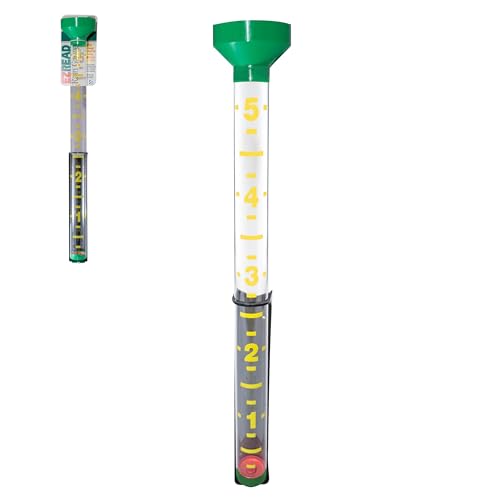
1. Headwind EZRead 26” Giant Professional Outdoor Rain Gauge
Our pick — 4.5+★ from 5,500+ verified ratings; the strongest balance of quality and price.
A 26-inch tower with numbers big enough to read across the yard, no squinting required.
Here’s the number that decides this one: it measures 26 inches tall and can be read from up to 50 feet. That means you can check the catch from inside the house or across a lawn without putting on boots. A high-visibility float rises with the water, and the tube itself magnifies the level so the mark lines up clearly.
The funnel at the top keeps leaves and debris out of the tube — debris that would otherwise clog the collector and throw off your reading. At 5.6 ounces it weighs about as much as a large apple, so mounting it on a garden fence with the included plastic hanger is a one-person job. Owners keep it for years, and the build holds up from Colorado snow to Florida heat.
The catch is sun exposure. Some units reportedly fade or crack after prolonged direct sun, so if your mounting spot bakes all afternoon, that’s the trade-off to weigh.
Why the EZRead leads
- Readable from up to 50 feet — you can check it from the window
- Funnel top keeps leaves and debris from clogging the tube
- High-visibility float plus magnified water level for clean readings
- Weighs 5.6 ounces — simple one-person fence mounting
- Bright color stays visible in cloudy weather
What to plan around
- Long-term sun exposure can fade or crack the plastic on some units
- Costs more than a plain tube gauge
Right call for: anyone who wants to read rainfall from a window and stop scooping leaves out of a collector.
Think twice if: your only mount spot is full-sun all day, where plastic fading is a real risk.
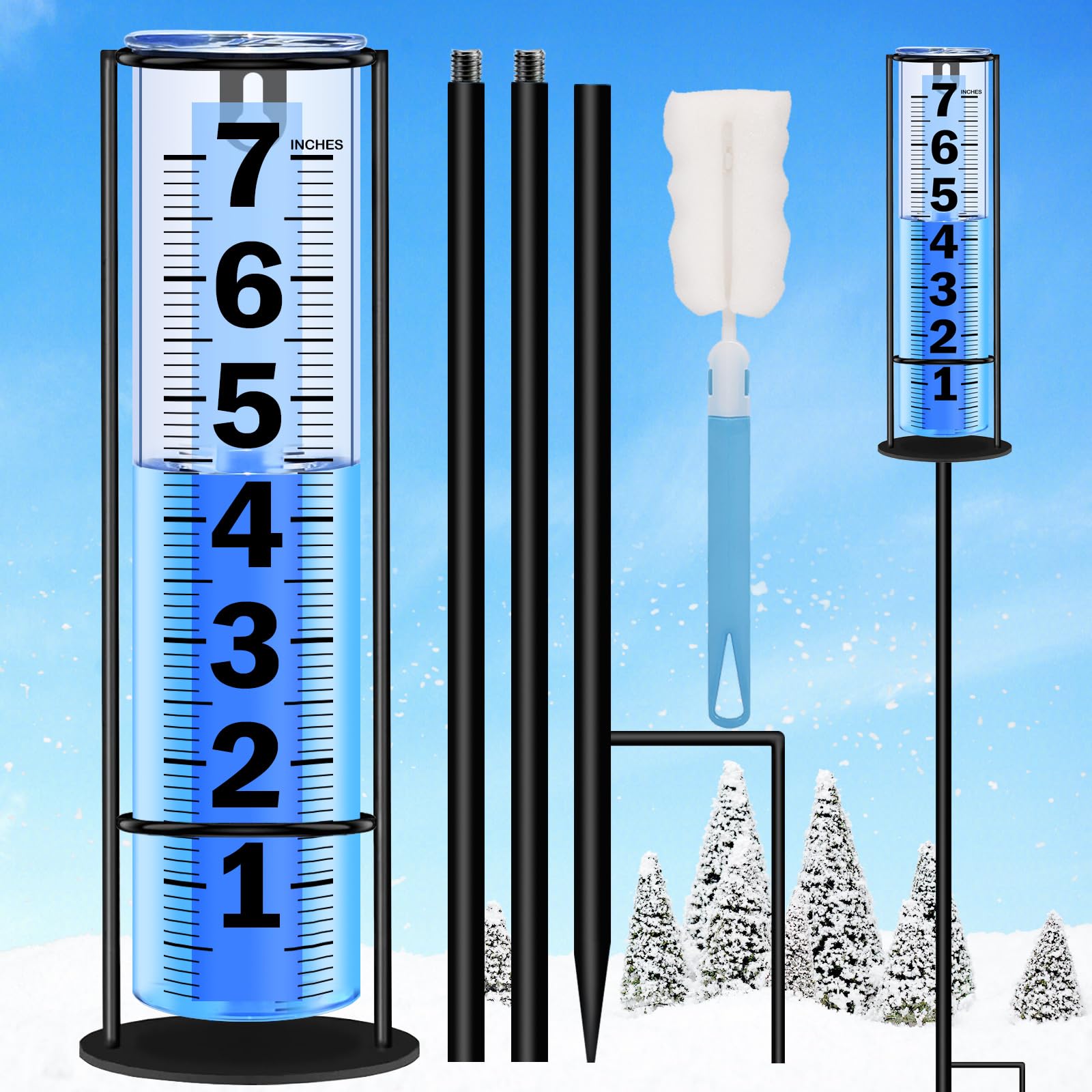
2. Rain Gauge Outdoor Upgraded, Accurate Freeze Proof Thickened
The gauge that grows with your garden, from 18.4 inches up to 36.8 inches tall.
Its four-section steel stand adjusts from 18.4 inches to 36.8 inches, so you can lift the tube above flowers and grass and skip crouching to read it. The scale is the other talking point: 1 inch divided into 10 graduations instead of the usual 8, so each line is a tenth of an inch rather than an awkward 0.125. Bigger type plus that finer split makes it readable from around 15 feet.
Unlike the acrylic multi-pack further down, the tube here is thickened transparent plastic rather than glass, and it’s built to resist freeze-cracking. A blue strip behind the water turns the level blue, which fixes the glare and reflection problems that make clear tubes hard to read. The 11.3-ounce unit is heavier than the 5.6-ounce Headwind — that extra weight comes from the steel holder, which is the sturdy part.
The honest caveat is sturdiness and size expectation. Some buyers find the stand flimsy for the money, and a few say it reads smaller in person than the listing implies. If you need a heavy-duty permanent post mount, look to the bracket models below instead.
Best fit: a gardener who plants tall and wants to raise the tube as the bed grows, with finer tenth-inch graduations for tracking.
Trade-off to know: the steel stand draws mixed feedback on sturdiness, so mount it where wind won’t batter it.
Reach for this if: adjustable height and readable tenth-inch lines matter more to you than a rock-solid stand.
Look elsewhere if: you want a permanently rigid post-mounted precision gauge.
3. 4 Pcs 5” Rain Gauge Outdoor Acrylic, Blue
Four blue gauges in one box, so you can scatter them across beds and share the spares.
You get 4 pieces, each measuring up to 5 inches of rainwater and sized at 12.4 x 2.76 x 1.38 inches. That’s a spare for the shed, one for the vegetable bed, one for the front lawn, and one to hand a neighbor. The PS plastic body is reusable and doesn’t bend easily, and the clear scale magnifies the number when water sits behind it, so you can read it from up to 20 feet.
Installation is as simple as it gets — push the tube into the ground or wire it to a fence, then pull it out to empty and reset. What wins people over here is overall quality for the money across four units, with readability close behind. It’s lighter than the heavier stake-mounted decorative gauges, at 1.06 pounds for the set.
Freezing nights are the real limitation. These are the short acrylic tubes that reportedly crack during the first freeze, so bring them in before a hard frost or accept they’re seasonal. And 5 inches of capacity overflows in a torrential storm, so they suit steady rain, not gully-washers.
Where it shines: multi-spot coverage and a shareable spare at a value price, with 20-foot readability.
Where it stops: short acrylic tubes crack in a freeze and top out at 5 inches of catch.
Good match for: a household that wants several cheap gauges for different beds and mild-winter climates.
Not the pick for: deep-freeze regions or anyone tracking storm totals beyond 5 inches.
4. 36 Inch Hummingbird Rain Gauge
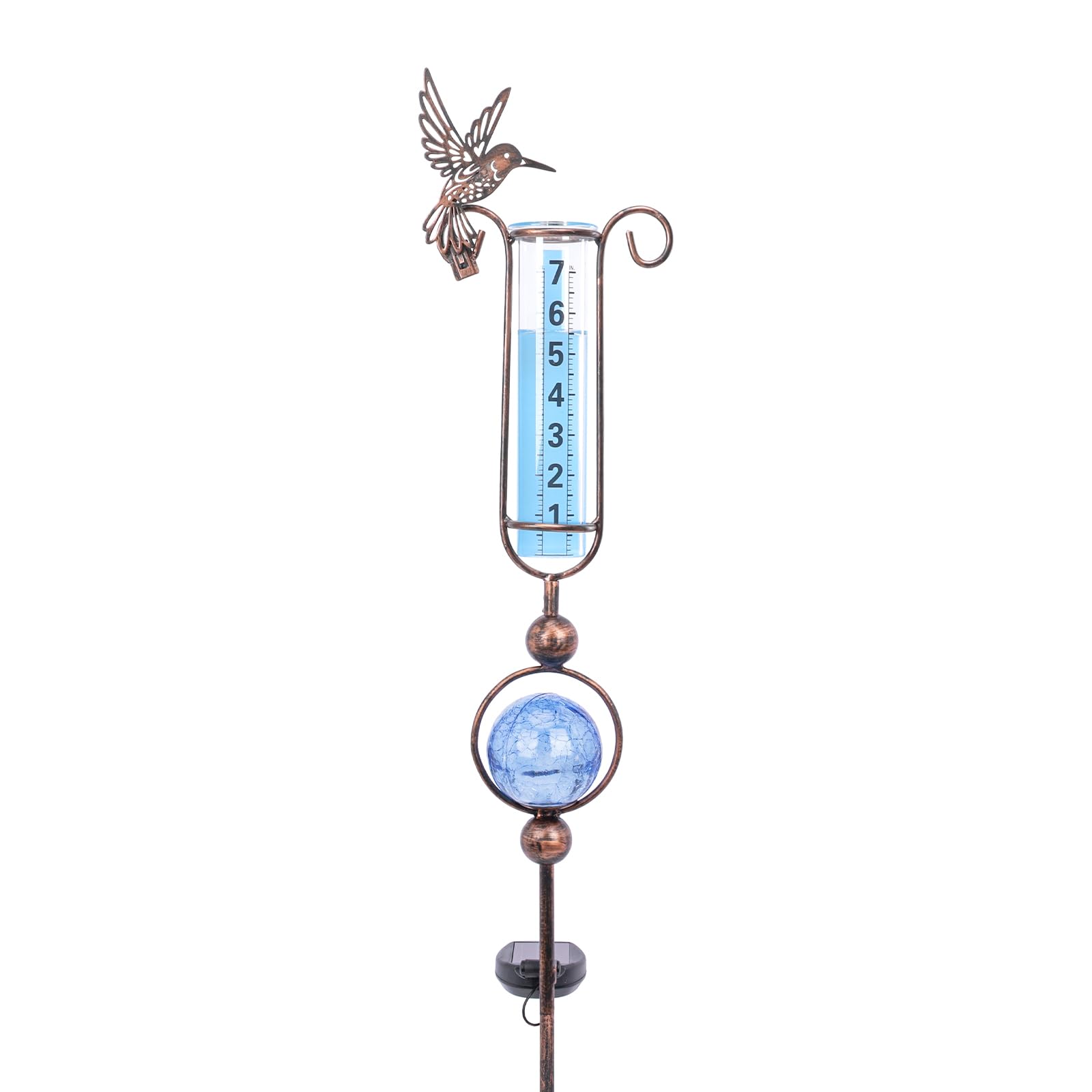
A yard ornament that catches rain by day and glows by night, standing a full 36 inches tall.
The height is the practical half of the pitch: at 36 inches the tube sits above most flowers and grass, so you read it standing up. Black bold font and metal strips behind the tube turn the water blue, letting you take the number from a window. The 7-inch plastic tube is built for big storms and won’t freeze-crack.
Then there’s the part that draws the eye — a solar LED that switches on at dusk and off at dawn once charged. That’s why appearance is the thing buyers love most about it, with the lit-up look at night a close favorite. A sturdy weather-resistant stake keeps it planted through wind. At 2.05 pounds it’s the heaviest of the decorative picks here, and it outweighs the 1.06-pound acrylic set by comparison.
Two real caveats. The glass vessel reportedly shatters in cold temperatures for some owners, and the solar light reportedly quits on some units. Treat it as a good-looking gauge first and a light second, and bring it in for hard freezes if you have glass in yours.
Signature strength: a glowing garden accent that out-shines plain tubes, with 36-inch stand-up height and window readability.
Fair warning: the solar light and the glass vessel both have their limits — the LED can quit and glass can shatter in cold.
Buy it if: you want a decorative, night-lit piece that still catches rain at legible height.
Skip the glass version if: your region sees hard freezes.
5. Rain Gauge Outdoor Professional

Built to stop birds from knocking it over and to log rain down to a hundredth of an inch.
The measure tube reads up to 11 inches, with a 1-inch inner tube accurate to 0.01 inch. That hundredth-inch resolution lets a weather observer record daily totals precisely rather than eyeballing a big line. The clever bit is the bird-proofing: deterrent rods sit around the bottle mouth to keep birds and animals from breaking the tube, and the opening adjusts so you can insert them as needed.
Unlike the acrylic multi-pack, this one is polycarbonate rated UV- and heat-resistant, built for hot sun and freezing weather without fading or corroding. The included mounting bracket secures the tube to a post or pole and lets you pull it off to read and clean. Buyers praise the solid build and professional-quality feel it delivers for tracking moisture, rain or snow.
One instruction matters: don’t let water freeze solid inside the manual tube. It’s freeze-resistant, not indestructible, and trapped ice is what cracks a gauge. Otherwise this is the pick for someone who actually wants the numbers, not just a glance.
The draw: bird-proof rods plus 0.01-inch precision in UV- and heat-resistant polycarbonate.
The caution: empty it before a hard freeze — standing ice is the enemy of any manual tube.
Hands-down pick for: weather hobbyists who want accurate hundredth-inch readings and animals kept off the tube.
Not ideal if: you only want to eyeball a rough total and never fuss with emptying.
6. Outdoor Rain Gauge 1/100 Inch
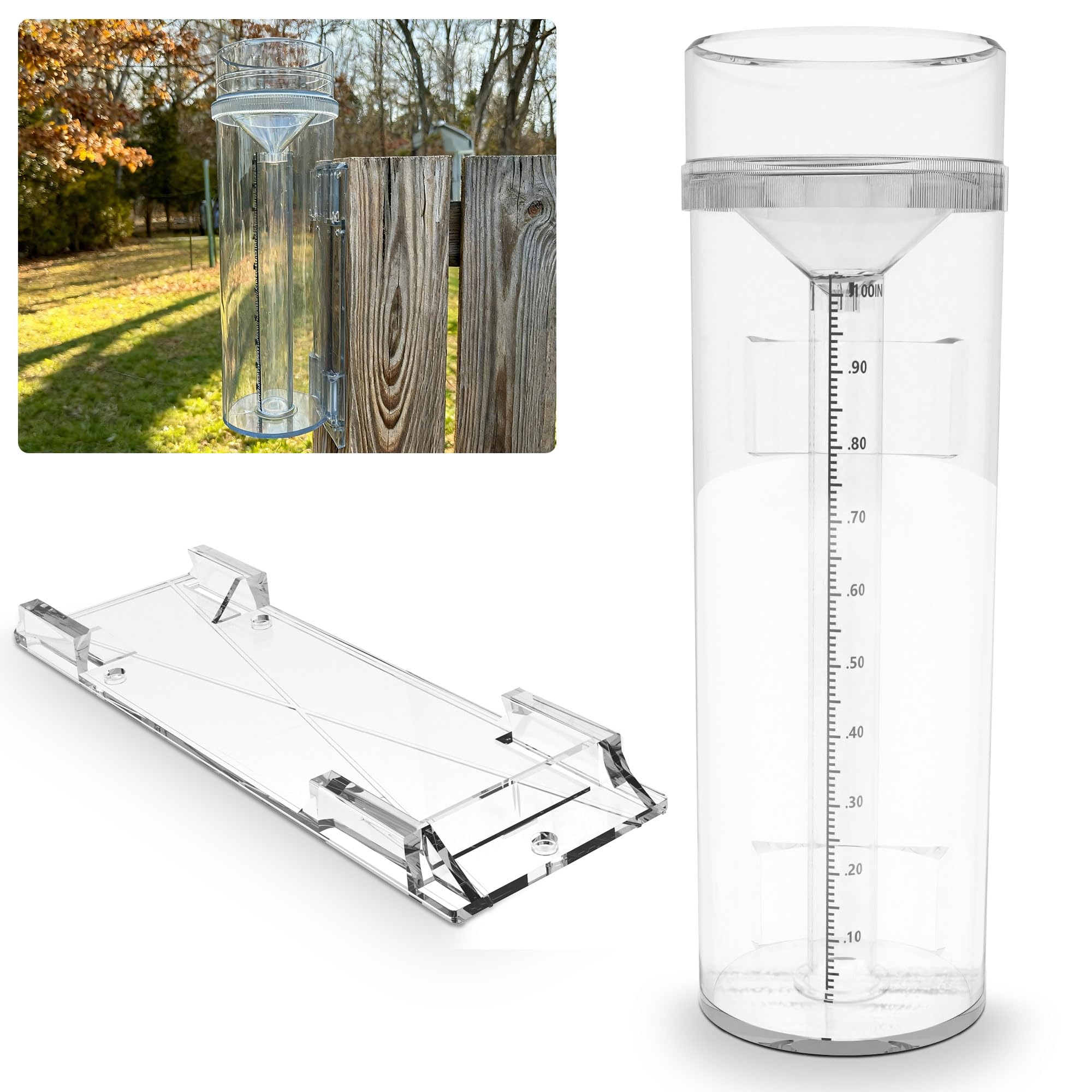
Hundredth-inch precision and an 11-inch tube, sized for garden data without the premium tag.
Accuracy is the point: readings down to 1/100th of an inch and a tube that measures up to 11 inches of rain. That combination suits gardeners and landscapers who want real numbers for irrigation decisions, not just a rough idea it rained. The spacious measuring tube handles heavy downpours without overflowing before you check.
The build is UV- and heat-resistant polycarbonate, so it holds up in harsh sun, heavy rain, and frost without rusting or fading. A quick-connect bracket makes setup and removal simple — pop the gauge off to read and empty, then click it back. At 2.01 pounds it’s heavier than the 1.3-pound copper WCRG, so it feels planted on a post.
Owners consistently pair its hundredth-inch accuracy and readability with strong value for the price. The one thing to watch: it’s a gauge, not a weather station, so rely on the tube itself rather than expecting digital logging.
What earns it a spot: hundredth-inch accuracy, 11-inch capacity, and a quick-connect bracket at a value-minded build.
The reality check: it’s a manual read — you still walk out and look, just with a finer scale.
Strongest for: budget-minded gardeners who want precise hundredth-inch readings and 11-inch headroom.
skip it if: you need a hands-free, remote or logged reading.
7. Professional Rain Gauge 11-Inch

A two-stage tube that measures the first inch close-up and the storm total up to 11 inches.
The design splits the job: the clear inner tube reads the first 1 inch of rain in 0.01-inch increments, and the outer cylinder collects the rest so you can measure storm totals in stages up to 11 inches. That two-part approach means you don’t overflow in a downpour. The accuracy is the star — readings to the 1/100th of an inch, with clear visibility for reading and recording.
It’s polycarbonate that’s UV- and heat-resistant, so the water stays visible and the body holds up in yards, gardens, farms, and backyard weather stations. The included mounting bracket goes vertical on a post or pole, and you remove the gauge to read, empty, and clean before returning it. Owners rate the value and function strongly, and easy installation is a frequent plus.
The durability is the mixed note. Owner reports range from about two years to 4-5 years before the plastic inner tube eventually cracks. It’s a plastic gauge, so plan for replacement down the road, not a lifetime fixture.
Top virtue: staged 11-inch capacity plus 0.01-inch precision for daily precipitation logging.
Wear to expect: the inner tube is plastic and can crack after a few seasons.
Go for this if: you log daily rainfall and want storm-total capacity with close-up precision.
Pass if: you want a one-piece fixture you never have to replace.
8. WCRG Copper Rain Gauge for Yard, Steel Stake
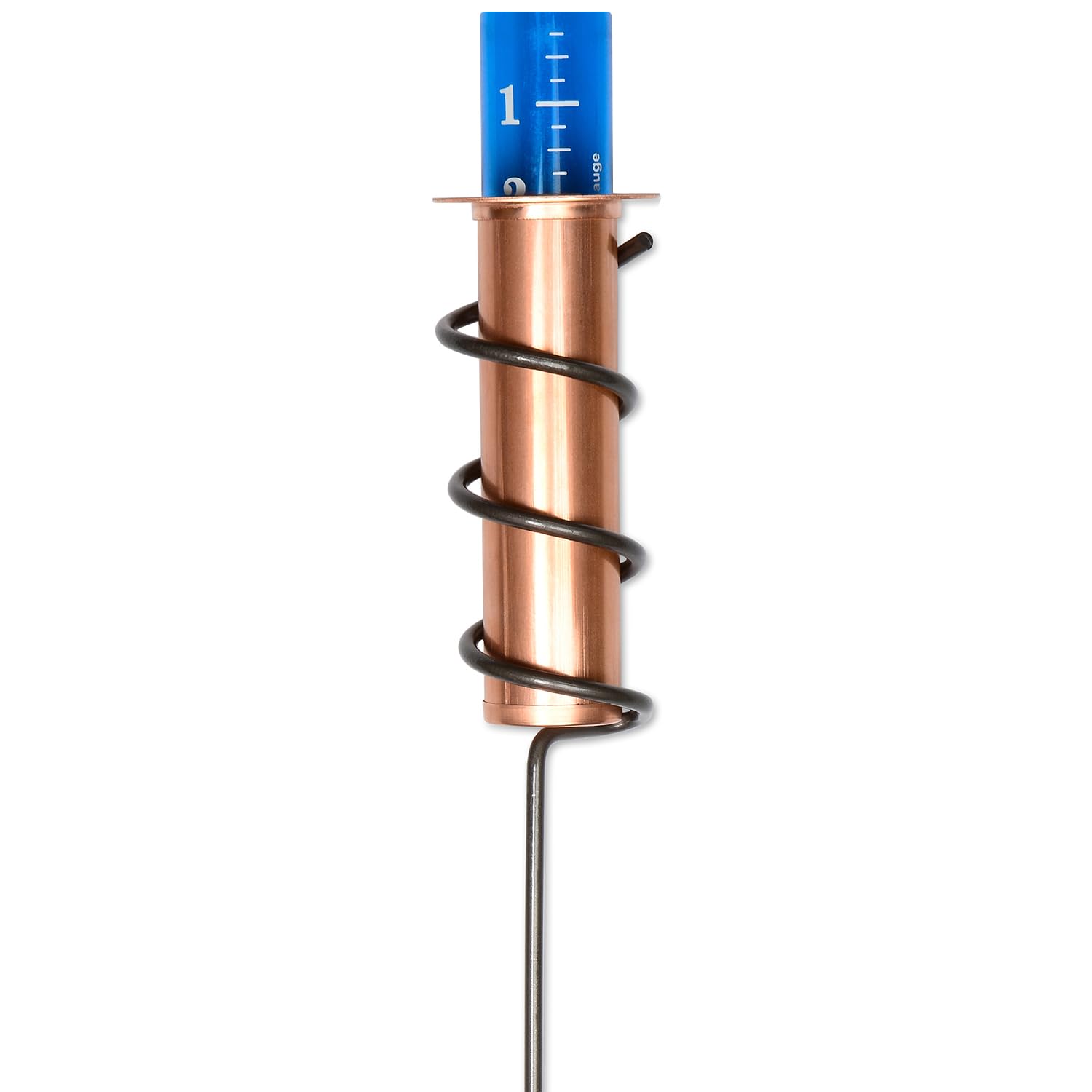
Watch a copper tube float up with the rain — a yard piece people stop and question.
Forget a plain column. The original floating gauge lifts a tube as water collects, measuring up to 5.5 inches (140 mm) in both inches and millimeters, with large numbers for quick reads. A 24-inch powder-coated steel stake plants it solid in the yard or garden, and the solid copper finish ages into a natural patina that looks better as the seasons pass.
There’s no glass to break — the floating tube is shatterproof polycarbonate and the whole thing is built leak-proof and winter-safe, so freezing temperatures won’t crack or break it. Shatterproof polycarbonate and the solid copper finish carry it — the look is why people photograph it. At 1.3 pounds it’s light enough to reposition without tools.
The honest trade-off is accuracy and cost. Some owners find the floating read less precise than a graduated tube, and a few call it an expensive gimmick for a measurement tool. If you want hundredth-inch lab numbers, this isn’t that gauge — it’s the one you enjoy looking at.
Why it charms: a copper floating tube that no glass can shatter, winter-safe and genuinely decorative.
Its limit: floating-tube accuracy splits opinion versus a straight graduated scale.
The one to buy if: you want a durable, gorgeous yard accent that measures rain a different way.
Better served elsewhere if: precision numbers are the whole point for you.
9. Tropo Precision Rain Gauge
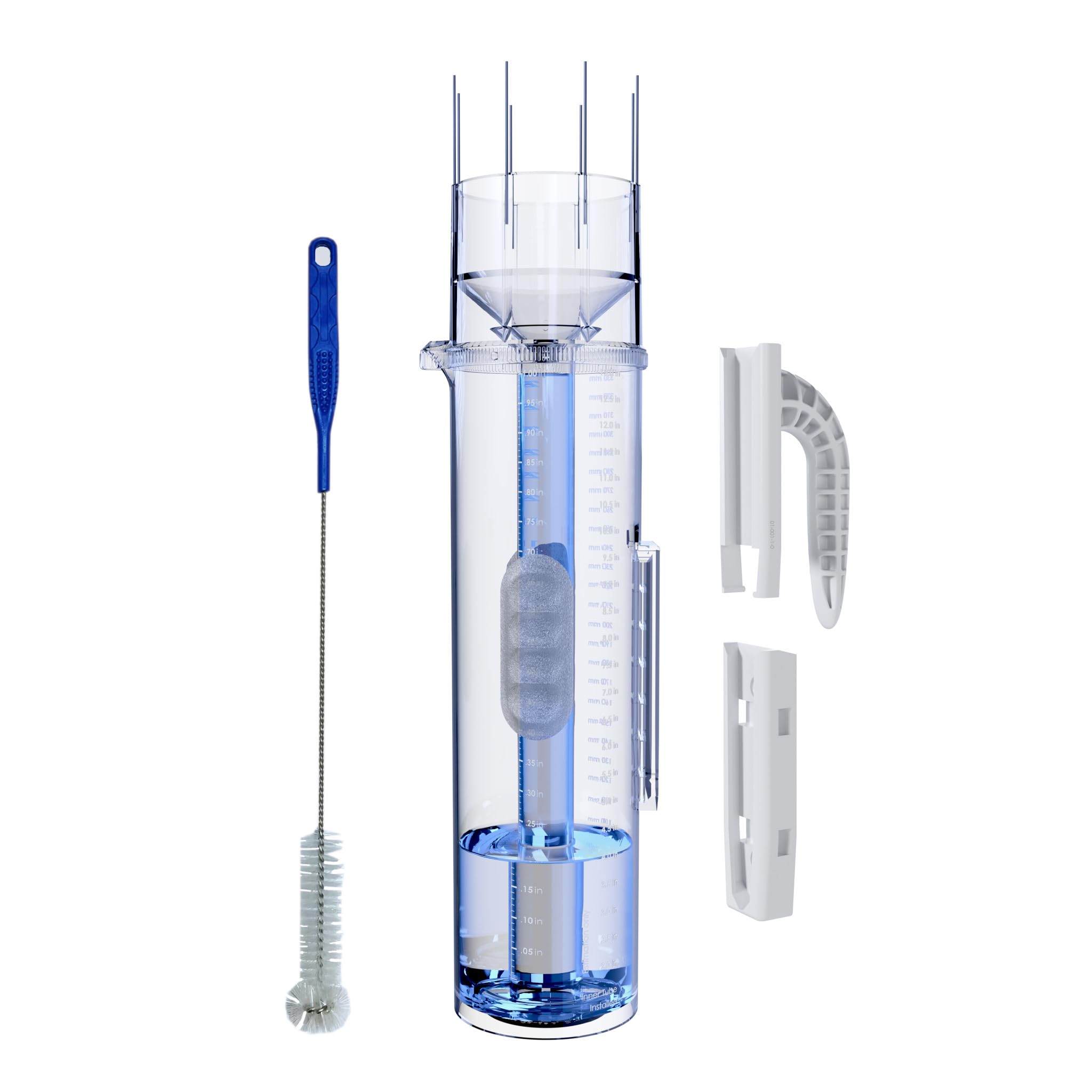
A CoCoRaHS-approved gauge built on the design of the National Weather Service’s 8-inch standard.
This is the serious instrument of the group. It uses the same dual-cylinder design as NOAA’s 8-inch official standard, with a resolution of 0.01 inch (0.25 mm). The inner cylinder holds 1 inch (25 mm), and the extra-large outer cylinder holds another 12.5 inches (317.5 mm) for roughly 13.5 inches of total capacity — the biggest here, well beyond the 11-inch bracket gauges.
The inner cylinder and funnel cap come off so you can catch snowfall or frozen precipitation, then melt or weigh it to get a liquid equivalent in inches or millimeters. It’s polycarbonate, the same material as greenhouses, built to take full sun and freezing temps without fading or hazing. A universal bracket mounts on a pole or post for quick removal even in freezing weather, and there’s a pour spout and handle to empty the outer tube without spills.
Its following comes from CoCoRaHS-approved accuracy — readings that data-collecting organizations will accept. It’s the highest-capacity and priciest pick, so if you just want a glance-and-go gauge, this is more instrument than you need.
Why weather folks rave: CoCoRaHS approval, 0.01-inch resolution, and about 13.5 inches of total capacity.
Consider the jump: it’s the top-tier capacity gauge — overkill if you don’t record data.
Reserve this for: citizen scientists and data collectors who need certified-grade precipitation records.
Not worth it if: a quick glance at the garden rain is all you’re after.
Know the Specs
Measurable Capacity (the overflow limit)
Capacity is how much rain the gauge can hold before it tops out. An 11-inch or 13.5-inch tube swallows a heavy storm; a 5-inch tube overflows and you lose the total. If you track storms, bigger capacity means no lost readings.
Graduation (0.01 vs 0.10 inch)
Graduation is the size of each mark on the scale. A 0.01-inch graduation lets a weather observer log precise daily totals; a 0.10-inch graduation is coarse but easy to read from a distance. Match the line size to how exact you need the number.
Readability distance
This is how far away you can still see the water line. A gauge with jumbo numbers and a magnified level reads from 50 feet; a compact tube needs a walk-up. If you plan to read from a window, buy for distance, not compactness.
Freeze-proof material
Material decides winter survival. Thickened plastic and polycarbonate flex under freezing water; glass shatters. Look for “freeze proof” or “winter-safe” wording, and empty the tube before a hard freeze to protect any manual gauge.
Common Questions
How high should I mount a rain gauge off the ground?
Will an acrylic rain gauge crack in winter?
What does a 0.01-inch graduation actually mean?
How much rain can a gauge hold before it overflows?
Can I read a rain gauge from inside my house?
How do I stop leaves and birds from fouling my rain gauge?
What is CoCoRaHS approval on a rain gauge?
Should I empty my rain gauge before a freeze?
Can a rain gauge also measure snow?
Is a floating rain gauge as accurate as a graduated tube?
The Bottom Line
The top rated rain gauge winner for most people is the Headwind EZRead 26″ — its 50-foot readability and debris-stopping funnel mean you check the rain from the window and skip the leaf scooping. If you want adjustable height with finer tenth-inch lines, the Rain Gauge Outdoor Upgraded is the one; and if you log real weather data, the Tropo Precision CoCoRaHS gauge with its ~13.5-inch capacity is the serious choice. Its 50-foot readability is why it stays the crowd favorite, and it’s the safest first buy here.
How we choose
We do not accept paid placement. Every pick is matched to a real buyer and a real use-case; we do not hands-on test units.
Sources
Specifications: manufacturer listings and product documentation. Review insights: verified customer reviews, as of November 2026. Pricing: not shown on this page (it changes often); check the current price via the retailer link.
As an Amazon Associate, Tactical Gear Guy earns from qualifying purchases. This does not affect which products we feature.