Specs are compiled from manufacturer listings and verified buyer reviews and can change over time — please confirm the key details on the product page before buying.
You do not need the loudest shredder on the shelf — you need the one that finishes the tax boxes without choking. The number that matters most is continuous run time before a forced cool-down, because a shredder that quits after seven minutes leaves you standing over a half-empty bin. Every pick below is judged on real duty cycles, cut security levels, and what happens when you slide in a staple.
This guide is built by comparing the manufacturers’ published specifications and the patterns across verified customer reviews, so you get each pick’s real strengths and trade-offs instead of marketing spin.
Office shredding is a stamina sport, and the stamina lives in the duty cycle. Here is how the reliably rated machines separate once you look past the sheet counts and focus on the motor’s real patience.
The picks below cover every job from a mailbox pile to a decade of file cabinets, and this breakdown of top rated office shredders ranks the crowd favorites by duty cycle.
Top Picks

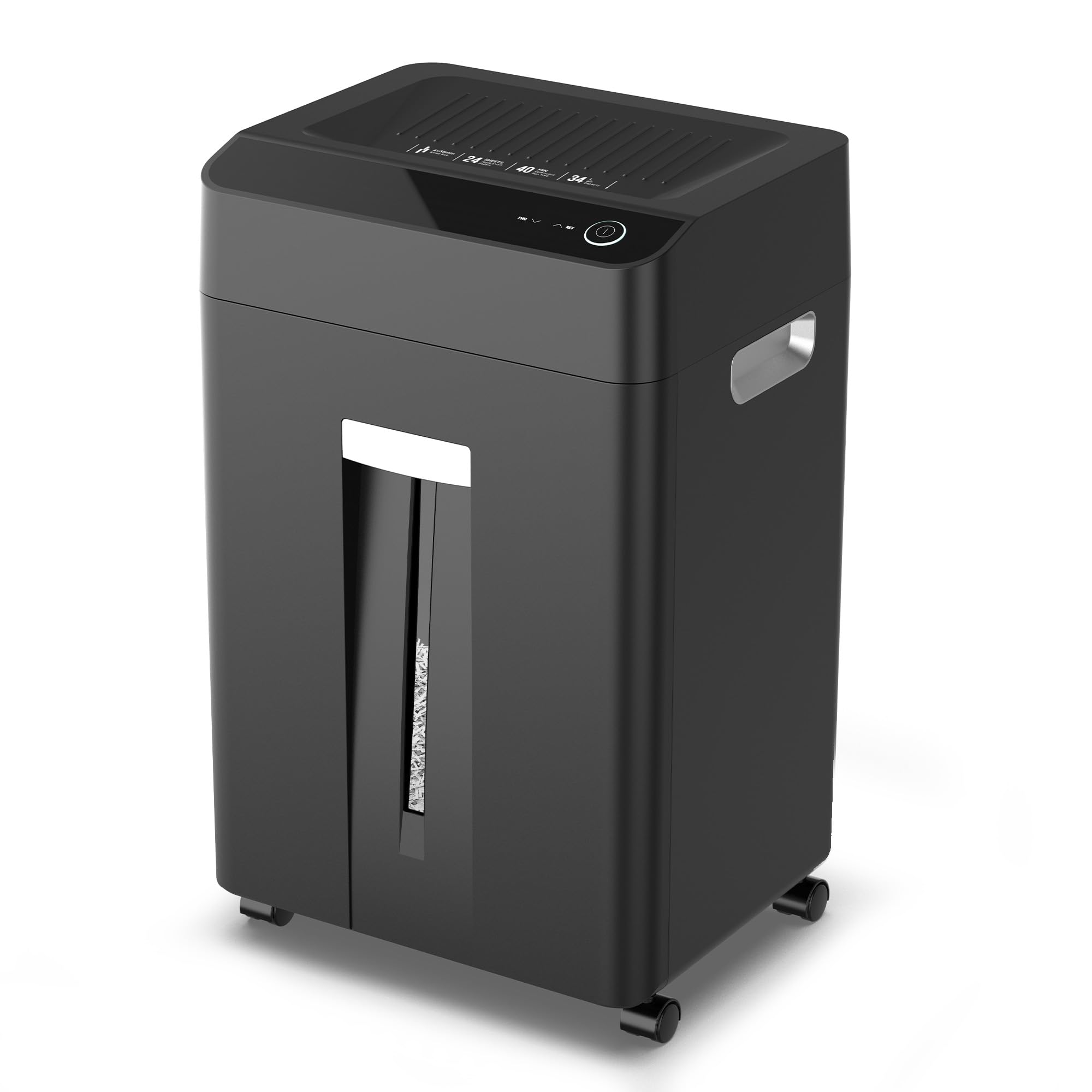

How To Choose The Best Top Rated Office Shredders
Start with the size of your backlog, not the sheet count on the box. If you shred a week of mail at a time, a short-duty machine is fine. If you are clearing a filing cabinet, run time is the number that decides whether the job gets done in one sitting or five.
Run time is the real endurance test
Run time means how long the motor runs before it needs to stop and cool down. The gap is wide across this category — one pick manages 60 minutes of nonstop work, while another lets you run the manual slot for 7 minutes. If your boxes are stacked high, chase the longer figure.
Match the cut to what you are destroying
Cross-cut machines slice paper into small pieces, and micro-cut slices them finer still. A P-4 rating means high security for everyday confidential documents; P-5 pushes the pieces smaller. For bank statements and client records, either one beats a strip-cut machine that leaves readable ribbons.
Auto-feed versus manual slot
An auto-feed tray lets you stack a whole pile and walk away. A manual slot is where credit cards, staples, and clips go. Several picks here carry both, which matters if you deal with mixed office debris and not just loose paper.
Specs can list a bigger load than the machine likes
A stated sheet count is the ceiling, not the comfortable cruise. Owners of one 14-sheet rated pick report the unit is closer to 10 or 12 sheets in real use. Feed at or below the real limit and the motor lasts for years.
Side-by-Side Comparison
| Model | Best For | Run Time | Cut / Security | Bin Capacity | Amazon |
|---|---|---|---|---|---|
| Fellowes Powershred 99Ci★ Best Overall | All-day shared office use | 30 minutes | Cross cut / P-4 | 9 gallons | Amazon |
| Locksworth 24-SheetBest Capacity Value | Small business with big stacks | 40 minutes | Cross cut / P-5 | 9 gallons | Amazon |
| Fellowes AutoMax 100MABest Hands-Free | Hands-free batch shredding | 7 min manual / 10 min auto | Micro cut / P-4 | 4.5 gallons | Amazon |
| Aurora AU2260XA | Long uninterrupted sessions | 60 minutes | Cross cut / P-4 | 7 gallons | Amazon |
| Staples 150-Sheet | Quiet home-office bulk work | Not listed | Micro cut / P-4 | 7.4 gallons | Amazon |
| Amazon Basics 200-Sheet | Mail-in, empty-a-bin household | 60 min auto / 10 min manual | Cross cut / P-4 | 8.5 gallons | Amazon |
| Bonsaii C283-A | Large-volume office destruction | 60 min auto / 30 min manual | Micro cut / P-4 | 8.1 gallons | Amazon |
| BONSEN S3113 | Heavy daily batch shredding | 60 min auto / 30 min manual | Micro cut / P-4 | 8.1 gallons | Amazon |
| Aurora AU200MA | Legal-grade P-5 security | 60 minutes | Micro cut / P-5 | 8.5 gallons | Amazon |
Detailed Reviews
1. Fellowes Powershred 99Ci Crosscut Paper Shredder
Our pick — 4.5+★ from 11,000+ verified ratings; the strongest balance of quality and price.
The quiet workhorse that swallows 18 sheets and a staple without raising its voice.
For a shared office where three or four people take turns at the same machine, this is the one to buy. It takes 18 sheets in a single pass and keeps going through staples, paper clips, credit cards, CDs and junk mail — so nobody has to pick the staple out first.
The security story is a P-4 cross-cut, which turns each sheet into 397 particles at 5/32 by 1-½ inches. Readable ribbons are gone, and the 9-gallon pull-out bin with a bin-full light means you stop less often to empty it. It runs 30 minutes continuously before it needs a rest, which covers a full afternoon of desk cleanup.
You can keep working while it shreds because it runs at 62.1 db (decibels, a measure of sound) — quieter than the Fellowes AutoMax 100MA at 75 db — so your phone call stays workable. SafeSense (a safety sensor that stops the blades) shuts the machine down the moment hands or paws touch the paper opening. At 36.4 pounds it is 4.3 pounds heavier than the Aurora AU2260XA on casters below, so rolling it is the sensible way to move it. Buyers give it 4.5+ stars across 11,000+ ratings, and the recurring gripe is small: the bin door does not always latch shut, which stalls the motor when it swings open.
Where it earns its badge
- Shreds 18 sheets per pass plus staples, clips, cards and discs
- 62.1 db keeps a shared office quiet while it works
- 9-gallon pull-out bin with a bin-full indicator
- SafeSense disables the cutter when hands touch the opening
The honest friction points
- 36.4 pounds means lifting across a room is a chore
- The bin door needs a firm push to stay closed
- The wheels are not the most stable for constant repositioning
Reach for this if: you want one shredder that a whole office can abuse daily and still respect the room’s noise level.
Think twice if: you need long uninterrupted marathon runs — the 60-minute Aurora picks below outlast its 30-minute window.
2. 24-Sheet Cross Cut Paper Shredder
Two dozen sheets a pass and P-5 security — the small-business spec sheet nobody expects at this tier.
Here is the head-to-head that decides it for a growing office: this Locksworth holds 24 sheets against the Fellowes 99Ci’s 18, and it climbs to P-5 security for finer particles than the Fellowes P-4. It also runs 40 minutes continuously against the Fellowes 30. That is more stamina, more security, and a bigger single-pass load in one machine.
The 40-minute window lets it push through a lot of paper in one period, then it rests for 60 minutes to cool. A REV button clears jams and sweeps dust off the blades. The 9-gallon bin holds plenty and has a clear window so you can see the fill line without pulling it out. Safety is handled by a stop switch that cuts the motor the moment the bin is pulled and only resumes once it is seated again.
Reliability is what carries this one in owner hands — it is the most-praised trait on its listing, with the ability to run for days of real work. Compact enough at 15.4 × 12.2 × 23 inches to slide under a desk, and four casters move it between rooms in seconds. The fair caveat: it slows noticeably with a heavy stack in the slot, so treat 24 as a ceiling and feed closer to six or eight for steady speed.
Built for the backlog: P-5 particles at 5/32 by 1-12/32 inches make a shredded document genuinely unreadable, which matters if you handle client files or payroll.
One spec worth noting: the machine ships with a warranty, and the bin-full window saves you from a messy overflow.
Pick this one: a small business that wants top-tier particle security and a long run without paying premium-cabinet money.
Pass it by: you shred months of old mail in one go at full sheet count — this one prefers a lighter, steadier feed.
3. Fellowes AutoMax 100MA Micro-Cut Paper Shredder
Stack 100 sheets in the tray, walk away, and let the machine do the standing.
This is for the office that accumulates paper faster than anyone wants to stand at a slot. The auto-feed tray swallows up to 100 sheets and works through them in 5 minutes, so a full inbox becomes confetti while you do something else. The manual opening handles credit cards, paper clips and staples.
Micro-cut at P-4 means the output is fine enough for confidential documents rather than readable strips. The auto-reverse kicks in to prevent misfeeds, and you can run the auto tray and the manual slot at the same time if you want. The bin is a 4.5-gallon pull-out, and owners note that micro-cut lets you shred quite a bit before it needs emptying.
Buyers keep coming back to how well it works — load it up and it does the job without fuss. The trade-offs are honest: at 75 db (decibels, a measure of sound) it is louder than the 62.1 db Fellowes 99Ci above, and the run time is the shortest on this list at 7 minutes manual and 10 minutes auto, so you cannot camp on it for an afternoon. The bin is 2.5 gallons smaller than the 7-gallon pick below, and a few units give out after a stretch of use — feed it at sensible limits and it holds up.
Set it and leave it: the 100-sheet automatic tray paired with a simultaneous manual slot is the reason to choose this over every single-feed machine here.
Bottom line: the best fit for a home office or small suite where batches of mail pile up and nobody wants to babysit the feed slot.
Ideal when: batch shredding and walking away is the whole point — this one turns a stack into a chore nobody has to mind.
Not for: long uninterrupted sessions, since its 10-minute auto window needs a cool-down well before the marathon picks.
4. Aurora AU2260XA Crosscut Shredder

Sixty minutes nonstop without a cool-down — this one wins the endurance race outright.
When the boxes are stacked ceiling-high, run time is everything. This Aurora goes 60 minutes continuously, while the Fellowes 100MA next to it in this list runs just 7 minutes on manual — that is the widest stamina gap here, and it decides a heavy job in a single sitting.
It cross-cuts 22 sheets at a time and takes CDs, DVDs, credit cards and small paper clips. At 32.1 pounds it is 4.3 pounds lighter than the 36.4-pound Fellowes 99Ci, and the casters make moving it around the office easy. The 7-gallon pull-out bin comes with LED status lights for standby, overheat, bin-full, overload and door-open, so you always know what it wants.
Speed and quiet are what make owners happy — it works fast and stays quiet enough to talk over while it runs. The honest catch is durability: the machine is sturdy for the long haul in most hands, though a few units have failed badly. Buy it for the 60-minute marathon sessions and keep the feed steady.
Why the 60 minutes matters: a full filing cabinet rarely fits into a 30-minute window, and this is one of only two picks here that stretches to an hour of punching.
Keep it movable: casters and a 7-gallon bin mean you clear a job without lifting the machine.
Choose it for: the afternoon you decide to clear out years of paper and do not want to pause every half hour.
Look elsewhere if: you want the most owner-proven durability track record — the Fellowes 99Ci above has the stronger long-term record.
5. Staples 150-Sheet Micro-Cut Paper Shredder
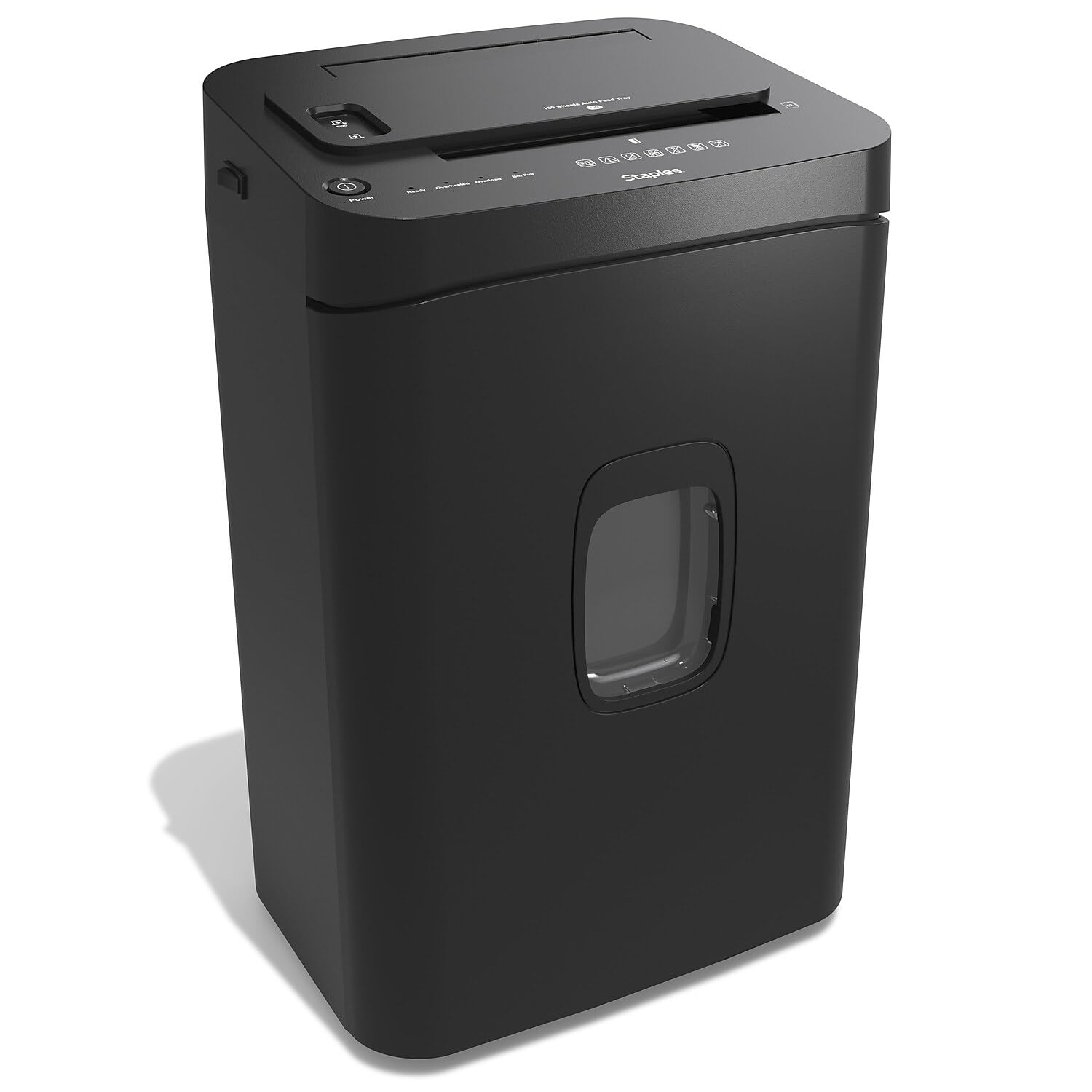
A 150-sheet tray that shreds seven feet of paper a minute at 65 decibels.
The sheet count tells the story: this Staples machine takes a 150-sheet stack in its top-load tray, while the Fellowes 99Ci handles 18 at a time. That is a huge difference for anyone clearing a drawer in one pour. It chews roughly 7 feet of paper per minute, so a decent stack finishes while you’re still pouring coffee.
P-4 micro-cut (a security level that turns each sheet into small pieces) cuts paper to 4.3mm by 12mm, and the manual side takes credit cards, staples and small paper clips. The 7.4-gallon pull-out bin separates it from the 4.5-gallon Fellowes 100MA — you empty less often. At 65 db (decibels, a measure of sound) it stays well below the 75 db float noise figure of the Fellowes 100MA, which is what keeps a home office usable while it runs.
Owners describe it as heavy-duty yet genuinely quiet, and it makes short work of a large stack without overheating. It is also sturdy and simple to assemble. The one honest limit: this is a home-office batch machine, not a continuous industrial runner, so keep the tray loads sensible rather than pre-loading it to the brim every day.
What stands out
- 150-sheet tray clears a big drawer in a single pour
- Shreds about 7 feet of paper per minute
- 65 db keeps the work quiet
- 7.4-gallon bin means fewer emptying breaks
Worth knowing
- Built for home-office batches, not industrial marathons
- At 29.5 pounds it is a two-hand lift to relocate
Made for: a home office that wants a big tray and a quiet room while handling confidential paperwork.
Skip if: your shredding never exceeds a fistful at a time — a lighter-duty machine will do the same work for less.
6. Amazon Basics 200-Sheet Cross-Cut Paper Shredder

Two hundred sheets in the tray and an 8.5-gallon bin — a household shredder built to take stacks.
The big-tray story belongs to this machine: 200 sheets go in the top automatically, and the manual slot takes 10. That auto run lasts 60 minutes before a 45-minute cool-down, while the manual side runs 10 minutes. For a home that opens mail at a bar counter and dumps envelopes straight in, that is plenty of muscle in one shot.
P-4 cross-cut at 5/32 by 25/32 inches keeps documents confidential, and staples come out without any fuss. A 4-mode switch handles Auto/On, Off, Forward and Reverse, and the anti-jam auto-reverse prevents a stall. The 8.5-gallon pull-out bin glows with LED indicators for a feed error, a full bin, an open door, overload and overheat, and an energy-saving sleep mode cuts power when idle.
Here is the fair caveat, sized properly: this is the highest-rated pick on review volume by a wide margin — 4.0+ stars across 80,000+ ratings — but it prefers a gentle feed. Buyers report it can overheat after roughly 20 minutes of heavy volume and can only handle a page or two at a time on the manual side. Feed it steadily and let the 200-sheet auto tray do the work. Do not keep aerosols near it, and do not push metallic credit cards through.
The volume verdict: for shipping mail straight from the counter into the tray, its 200-sheet auto-feed punches far above the small home machines.
One specification note: an 8.5-gallon bin holds more than the 4.5-gallon Fellowes 100MA, so fewer emptying trips.
Right call for: a busy household that needs to shred mail in batches and empty a large bin less often.
Wrong call for: a shared office that expects to camp on the machine for hours — the heavy-volume limit will send it to a cool-down.
7. Bonsaii 240-Sheet Micro Cut Paper Shredder
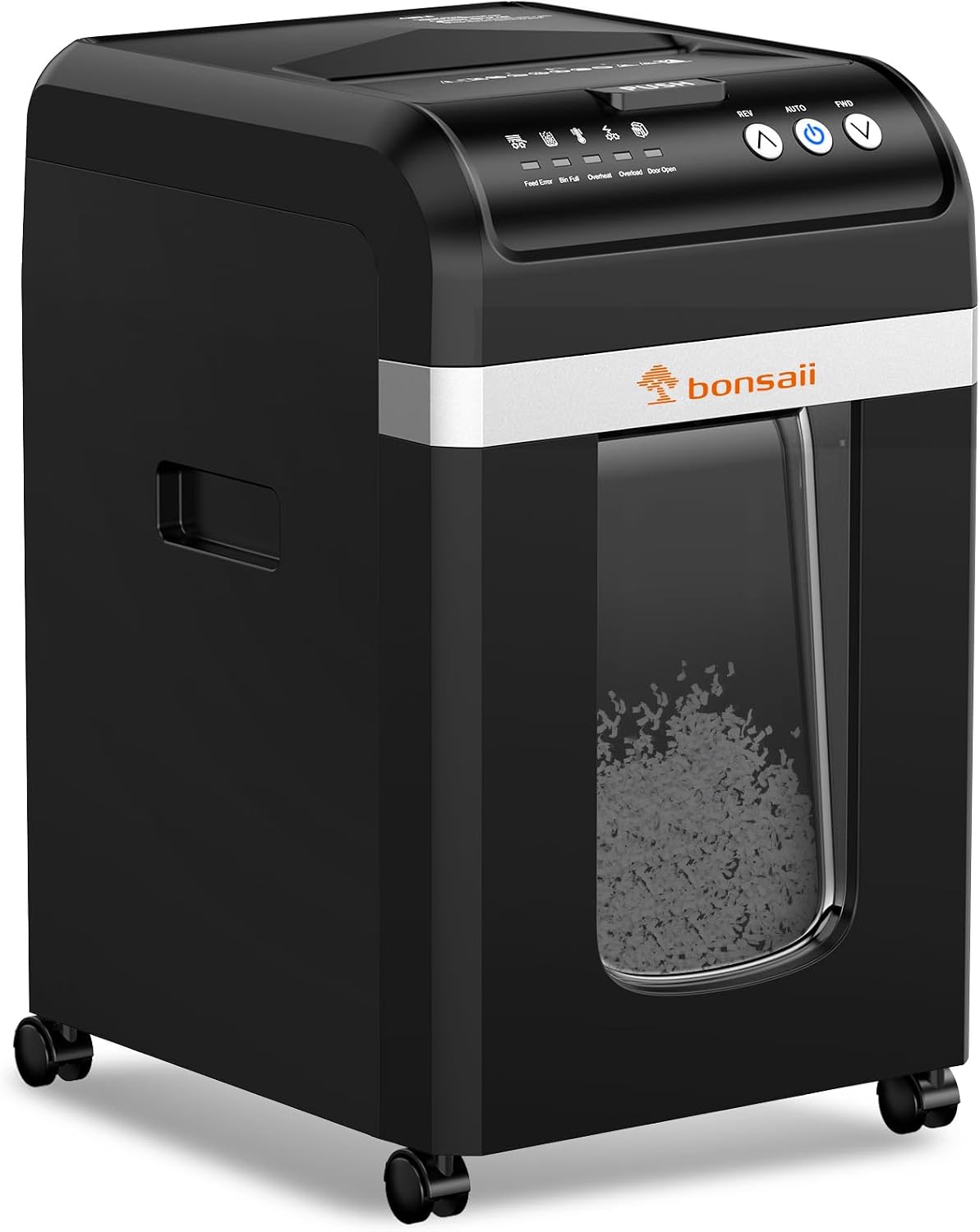
A 240-sheet tray and 60 minutes of quiet running — the large-volume engine of this list.
For a real office with real filing cabinets, this is the machine to beat. Its auto-feed tray takes 240 letter-size sheets in one load and runs 60 minutes continuously. The manual slot adds credit cards, staples and paper clips, plus 12 sheets at a time, with 30 minutes of run on that side. Compare that to the 7-minute manual window of the Fellowes 100MA above and the gap tells you exactly who built for stamina.
The micro-cut output lands at 5/32 by 15/32 inches, finer than the cross-cut Fellowes 99Ci, so confidential contracts and employee files come out unrecognizable. The 8.1-gallon pull-out basket holds roughly 700 sheets before it needs emptying. Four wheels roll it between desks, and the motor runs at ≤58 db so it fades behind office noise. A smart sleep mode kicks in after 10 minutes idle to save power.
Quality is the trait owners land on most — this thing chews through year-old files without overheating. Two fair limits to size: the auto-feed is designed for letter-size paper at 20lb, so mixed envelopes and odd sizes go to the manual slot. And the advertised 12-sheet manual capacity is a ceiling; keep to a smaller stack and the motor stays happy.
Where the value sits: a 240-sheet tray, a 60-minute run and ≤58 db in one cabinet is the strongest overall spec combination here for a working office.
Fed sensibly: the manual slot’s stated capacity runs ahead of real comfort, so load it modestly.
Buy it for: a busy office clearing years of files where quiet running and a huge auto tray are the whole show.
Not worth it if: you shred a few sheets a week — the tray and run time are wasted on a mailpile that small.
8. BONSEN 300-Sheet Micro Cut Paper Shredder
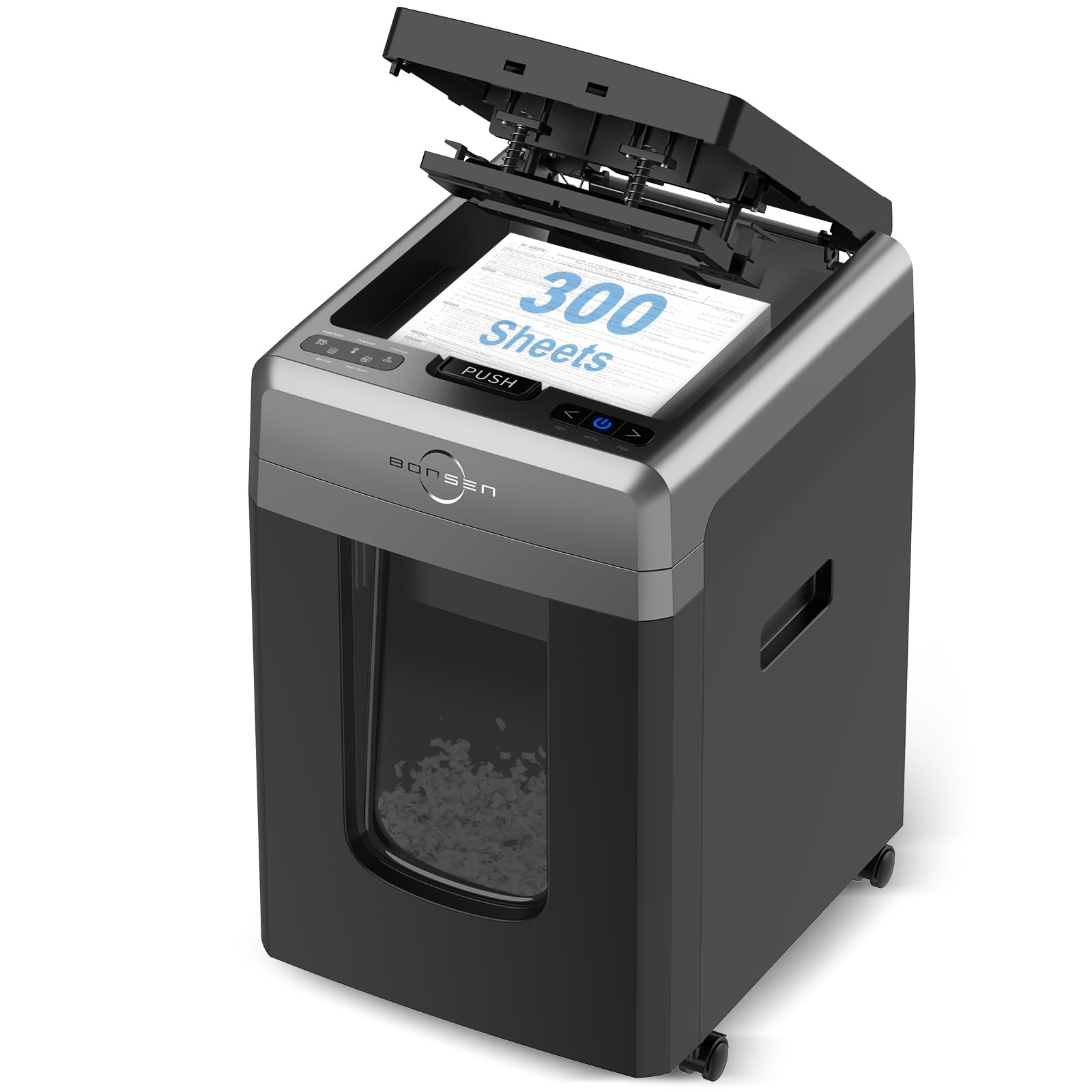
The largest auto tray here — 300 sheets at once, running 60 minutes in auto mode.
If you want the biggest hands-free load on this list, this is it: a 300-sheet auto tray tops the Bonsaii’s 240-sheet drawer and dwarfs the Fellowes 100MA’s 100 sheets. The auto side runs 60 minutes continuously, and the manual slot takes 12 sheets plus credit cards, staples and clips, with 30 minutes on that side.
Micro-cut at P-4 turns documents into 5/32 by 15/32-inch particles, aimed at legal and financial professionals handling high-volume confidential files. An auto-sleep after 10 minutes idle saves power and reduces safety risk. A full spread of LED indicators flags a feed error, full bin, open door, overload and overheat. At 58 db it stays quiet enough for a shared workspace.
Owners describe it as a sturdy, quality machine that shreds continuously for close to half an hour without stopping, and it handles CDs and cards easily. The real caveat: volume work throws off a lot of fine shaving dust, so plan on wiping down the area. It also tends to run slower than the auto-load suggests, so do not expect instant turnover.
Why it tops the tray race
- 300-sheet auto tray, the biggest load here
- 60 minutes continuous in auto mode
- 58 db keeps a shared office calm
- P-4 micro-cut output for sensitive files
What to plan around
- Volume shredding leaves a layer of fine dust to wipe up
- It runs slower than a full 300-sheet load implies
Worth it for: an office that wants the deepest auto tray here and can live with a little cleanup afterward.
Look past it if: you want the fastest processing speed — the spec sheet promises capacity, not quick turnaround.
9. Aurora 200-Sheet Micro-Cut Shredder

Legal-grade P-5 security that turns a sheet into thousands of confetti bits.
For legal, medical or financial paperwork, this is the pick to look at first. Its P-5 micro-cut reduces a document to 5/64 by 15/32-inch particles, roughly 2,592 pieces per letter-size page. That is the finest security level on this list, deeper than the P-4 Fellowes 99Ci or the P-4 Bonsaii — precise enough that a shredded contract stays unreadable.
The auto-feed handles up to 200 sheets at once and the manual slot takes 10, and a 60-minute continuous run means long sessions without a break. Anti-jam auto-reverse clears a feed slip, and an auto power-sleep mode saves energy. The 8.5-gallon pull-out bin carries LEDs for standby, overheat, bin-full, overload and door-open, so you are never guessing what the machine wants.
Performance is what draws people to this model — load 200 sheets, switch it on, and walk away while it turns them into fine cross-cut confetti. Quiet operation helps in an open office. Two real limits to weigh: the bin fills quickly given how finely it cuts, and a few units have given out after light use, so keeping it within stated loads protects the motor. It is also the heaviest machine here at 38.1 pounds, so plan where it lands.
The security case: P-5 particles at 2,592 per page are the deepest peace-of-mind cover in this lineup, which justifies the premium-cabinet placement.
Move it once: at 38.1 pounds it is a set-down-and-keep-it-there machine.
The right tool for: anyone whose documents need the strongest security level here and who wants a 200-sheet auto tray behind it.
Look at the 240-sheet Bonsaii instead if: you want a longer auto run and a bigger tray without demanding P-5.
Know the Specs
Continuous Run Time
Run time is how long the motor works before it must stop and cool. It is the single most useful number for a working office. A short window like 7 minutes on manual suits a few envelopes at a time, while a 60-minute window clears a full filing cabinet in one sitting. Push any machine past its stated run time and the overheat protection simply stops the job for you.
Security Levels P-4 and P-5
P-4 means high security, turning paper into small cross-cut or micro-cut particles. P-5 pushes those particles smaller still — one P-5 pick yields roughly 2,592 pieces per letter-size page. For bank statements, contracts and client files, either level beats a strip-cut machine. The finest cuts cost you bin space because you are producing more volume for the same sheets.
Auto-Feed Trays vs Manual Slots
An auto-feed tray lets you stack a whole pile and walk away, and the load ranges here from 100 sheets up to 300. A manual slot is where cards, staples and clips go. Some machines run both at once. If you shred only loose paper, the tray is enough; if you deal with credit cards and junk mail, make sure the machine has a manual entry.
Bin Capacity and Noise
A bigger bin means fewer trips to empty it — the range here runs from 4.5 gallons up to 9. A micro-cut fills a bin faster than a cross-cut, so pair the cut type with the bin size. Sound levels span 58 db up to 75 db, and in an open office the quieter end keeps the phone and conversation usable while it works.
Common Questions
Will an office shredder handle staples and paper clips without breaking?
What is the difference between P-4 and P-5 security levels?
How long can these shredders run before they need to cool down?
Can an auto-feed tray shred envelopes and folded paper?
Do I need to oil a micro-cut shredder, and how often?
How often will I have to empty the bin?
Will shredding credit cards damage the machine?
Is a louder shredder always more powerful?
What happens when the machine overheats or the bin is full?
Can one shredder serve a whole small office?
The Bottom Line
For most offices, the strongest top rated office shredders pick is the Fellowes Powershred 99Ci — it shreds 18 sheets a pass, runs 30 minutes straight, and stays at 62.1 db while it works through staples and cards. If your backlog is a filing cabinet and not a desk, grab the Bonsaii C283-A with its 240-sheet tray and 60-minute run. And when confidential documents need the smallest particles here, the Aurora AU200MA and its P-5 cut is the one to reach for.
How we choose
We do not accept paid placement. Every pick is matched to a real buyer and a real use-case; we do not hands-on test units.
Sources
Specifications: manufacturer listings and product documentation. Review insights: verified customer reviews, as of November 2026. Pricing: not shown on this page (it changes often); check the current price via the retailer link.
As an Amazon Associate, Tactical Gear Guy earns from qualifying purchases. This does not affect which products we feature.