Specs are compiled from manufacturer listings and verified buyer reviews and can change over time — please confirm the key details on the product page before buying.
You want to know how cold it is on the porch without opening the door. That is the whole job of an indoor outdoor thermometer — one screen inside, one sensor outside, a number you can trust at a glance. The trick is that the screen has to be readable from across the room and the outdoor sensor has to survive rain, frost, and direct sun. This guide covers nine units that read both indoor and outdoor temperature, from wired designs to multi-sensor wireless setups, and tells you plainly which one fits your kitchen window, your barn, or your greenhouse.
This guide is built by comparing the manufacturers’ published specifications and the patterns across verified customer reviews, so you get each pick’s real strengths and trade-offs instead of marketing spin.
Every pick below is judged on the same three things: how far the outdoor signal carries, how clearly you can read the numbers, and how long the sensor keeps reporting. That is what separates a top rated indoor outdoor thermometer from one that quits on the first cold snap.
Top Picks

How To Choose The Best Top Rated Indoor Outdoor Thermometer
Most people buy the first thermometer they see, mount the sensor on a sunny fence post, and then wonder why the outside number runs hot all afternoon. Getting a good one is less about the brand and more about matching three specs to your actual house — range, accuracy, and how the screen gets its power.
Transmission range sets how far the sensor can sit from the screen
The range figure is the maximum distance the outdoor sensor can talk to the indoor display, measured in open air with no walls in between. A 1000-foot rating is the longest in this group, while a 200-foot unit is fine when the sensor is just outside the kitchen window. Remember that walls, foil-backed insulation, and metal siding all cut that number down, so buy more range than you think you need.
Accuracy tells you how close the reading is to the real temperature
Accuracy is written as a plus-or-minus figure, like ±1.8°F, which means the display can sit that far above or below the true temperature. Tighter numbers matter for a greenhouse or a wine cellar where a couple of degrees changes what you do. For a quick glance before you leave the house, a wider tolerance is usually fine — just mount the sensor out of direct sun so the sun itself does not fake a higher reading.
Wired versus wireless changes where you can put the sensor
A wired unit runs a cable from the display straight to the outdoor probe, which means no batteries to swap on the sensor side and no signal to drop. The cost is that your sensor has to live within the cable’s reach. Wireless frees you to put the sensor across a yard or in a barn, but you are now feeding batteries into two devices and trusting a radio link.
Backlight and power mode decide whether you can read it at night
Many screens light up only for a few seconds on battery power, then go dark to save energy. Plug one in over USB and the backlight can often stay on all night, which matters if the display sits on a nightstand. Check whether the unit includes the USB cable or the wall adapter, because several in this group ship with one and not the other.
Side-by-Side Comparison
| Model | Best For | Signal Type | Range | Sensors Included | Amazon |
|---|---|---|---|---|---|
| AcuRite 00754w4★ Best Overall | Everyday kitchen or hallway use | 433 MHz wireless | — | 1 outdoor | Amazon |
| AcuRite 00888A3Best Budget Wired | Budget window-ledge placement | Wired 10-foot cable | 10 ft cable | 1 wired probe | Amazon |
| OBET B0DD339L3MMost Sensors Included | Monitoring several rooms at once | Wireless | 500 ft | 3 outdoor | Amazon |
| TempPro TempAir 1000 FT | Long-distance signal reach | 915 MHz wireless | 1000 ft | 1 outdoor | Amazon |
| Geevon 24190 | Whole-home sensor network | 433 MHz wireless | 200 ft | 3 outdoor | Amazon |
| Geevon 238665 | Forecast, barometer, and clock | Radio frequency wireless | 200 ft | 1 outdoor | Amazon |
| OBET B66-Multi | Big color screen across a room | Wireless | 500 ft | 3 outdoor | Amazon |
| La Crosse 308-1415 | Cold-climate outdoor readings | Wireless | — | 1 outdoor | Amazon |
Detailed Reviews
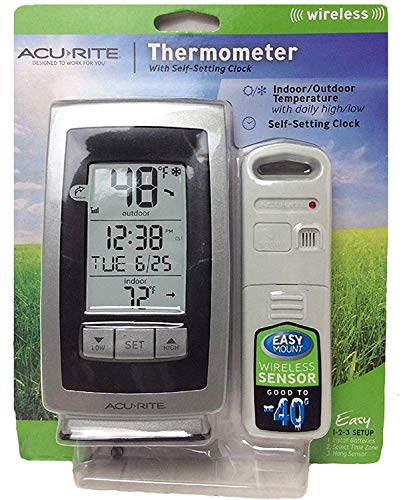
1. Acurite 00754w4 Digital Thermometer
Our pick — 4.0+★ from 850+ verified ratings; the strongest balance of quality and price.
The plain black display that sets its own clock and never asks you to touch it again.
The 00754w4 does the two things a kitchen thermometer should do without drama. It shows indoor and outdoor temperature in °F or °C on a tabletop-or-wall LCD, and it adds a daily high and low so you can see how cold the night actually got. The Intelli-Time clock and calendar set themselves, which means no blinking 12:00 after a power blip. Owners describe setup as flipping it on and letting it lock onto the sensor.
Where this one earns its keep is the moment you are walking out the door. A glance tells you the current outside number plus the day’s low, so you know whether the car will be frosted. The 433 MHz signal is the same band most wireless sensors in this price range use, and it holds up through ordinary walls at ordinary house distances. Pair it with a lithium battery in the sensor for cold winters and it keeps reporting.
The catch is the one thing you would not guess from a spec sheet: the outdoor sensor has a track record of quitting after roughly seven months in some homes, and the display gets hard to read from across a large room. That is a fair trade for a unit this simple, but buy it as an indoor-friendly thermometer rather than a decade-long outdoor instrument.
What makes it the top pick
- Shows both indoor and outdoor temperature in °F or °C on one LCD
- Self-setting clock and calendar, so no manual time entry
- Daily high and low recorded, so you see the overnight drop
- Sits on a table or hangs on a wall
Where it gives ground
- Outdoor sensor can fail within about seven months
- Numbers get harder to read at a distance across a big room
- No humidity readout or backlight mentioned
Reach for this if: you want one quiet, self-managing thermometer for a hallway or kitchen wall.
Think twice if: you need the outdoor sensor to survive many seasons without a swap.
2. AcuRite 00888A3 Digital Thermometer
No radio signal to lose and no sensor batteries to feed — just a cable and a number.
The 00888A3 skips wireless entirely. A weather-resistant 10-foot cable runs from the display to the outdoor probe, so the sensor draws its power through the wire and never needs a battery of its own. That is a real advantage in a cold climate, where wireless sensors burn through cells fast. Buyers report the wired probe working well for years, with no sensor batteries to replace.
At 6.25 inches long it is small enough to sit on a window ledge, which is exactly where you want a wired probe’s indoor half. That length is actually the better part of an inch longer than the TempPro TempAir, so it takes a little more sill space but still tucks into a corner. The display is digital with a push-button backlight, and you can read minimum and maximum temperatures in Fahrenheit or Celsius.
Accuracy is the honest weak spot, and the pattern is consistent enough to plan around. Some owners find it within a degree or two of the official reading; others report it running 8-12 degrees higher than the actual outdoor temperature. If precise numbers matter, mount the probe in shade and out of direct afternoon sun, and treat this as a trend thermometer rather than a reference instrument.
Best fit for a window sill: a wired probe removes the two biggest failure points of a wireless unit — dead sensor batteries and a dropped signal. For a renter or a small apartment, that simplicity is worth more than range.
The accuracy caveat: the mixed accuracy feedback is the one thing to weigh before you buy. Position the probe carefully and it behaves; leave it baking in the sun and the number climbs.
Pick it when: your outdoor probe only needs to sit a few feet from the display.
Pass when: you need the outside sensor across a yard or through thick walls.
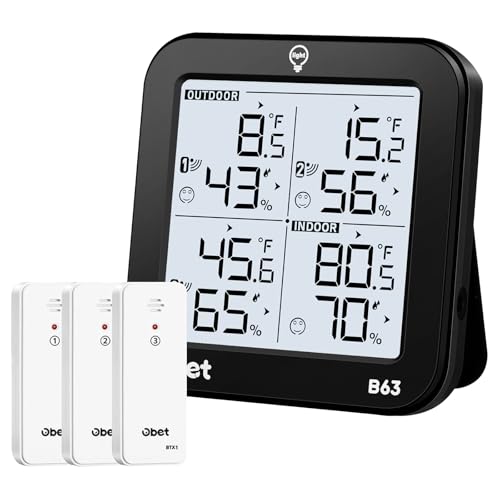
3. OBET Thermometer Humidity Monitor
Three sensors, one screen, and a backlight you can leave on all night over USB.
Three outdoor sensors ship in the box, which is the whole reason to look at this unit. You can park one in the garage, one in the greenhouse, and one in the RV and see all of them on one 3.8-by-3.8-inch black display. The outdoor temperature range reaches down to -50°F and up to 158°F, which covers a hard winter night as easily as a summer afternoon. Humidity is tracked too, with a wide 20% to 95% range.
The 500-foot line-of-sight range is generous and sits comfortably ahead of the Geevon 24190’s 200 feet. Accuracy is rated at ±1.8°F for temperature and ±5% for humidity, tight enough to make a greenhouse or incubator decision with. Plug it into USB and the adjustable backlight can stay on at high, low, or off; run it on batteries and the light switches itself off after 10 seconds to save power.
The thing to plan for is that batteries are not included, and the battery-only mode means a dark screen unless you press a button. If you want that backlight on demand through the evening, keep a USB cable on it. It also carries a one-year warranty and a 30-day return window, which is a reasonable cushion for a multi-sensor device.
Why three sensors change the job
- Three sensors included, so you cover three locations at once
- 500 ft range reaches across a big yard or between buildings
- ±1.8°F temperature and ±5% humidity accuracy
- USB power keeps the backlight on continuously, adjustable high, low, or off
- Air comfort indicators and min/max trend data on one screen
Before you order
- Batteries not included
- On battery power only, the backlight turns off after 10 seconds
- Home-use return window rather than an on-device display of comfort accuracy tested
Buy it when: you have three separate places to watch and want them on one screen.
Skip it when: a single sensor covers your needs and you would rather not manage three.
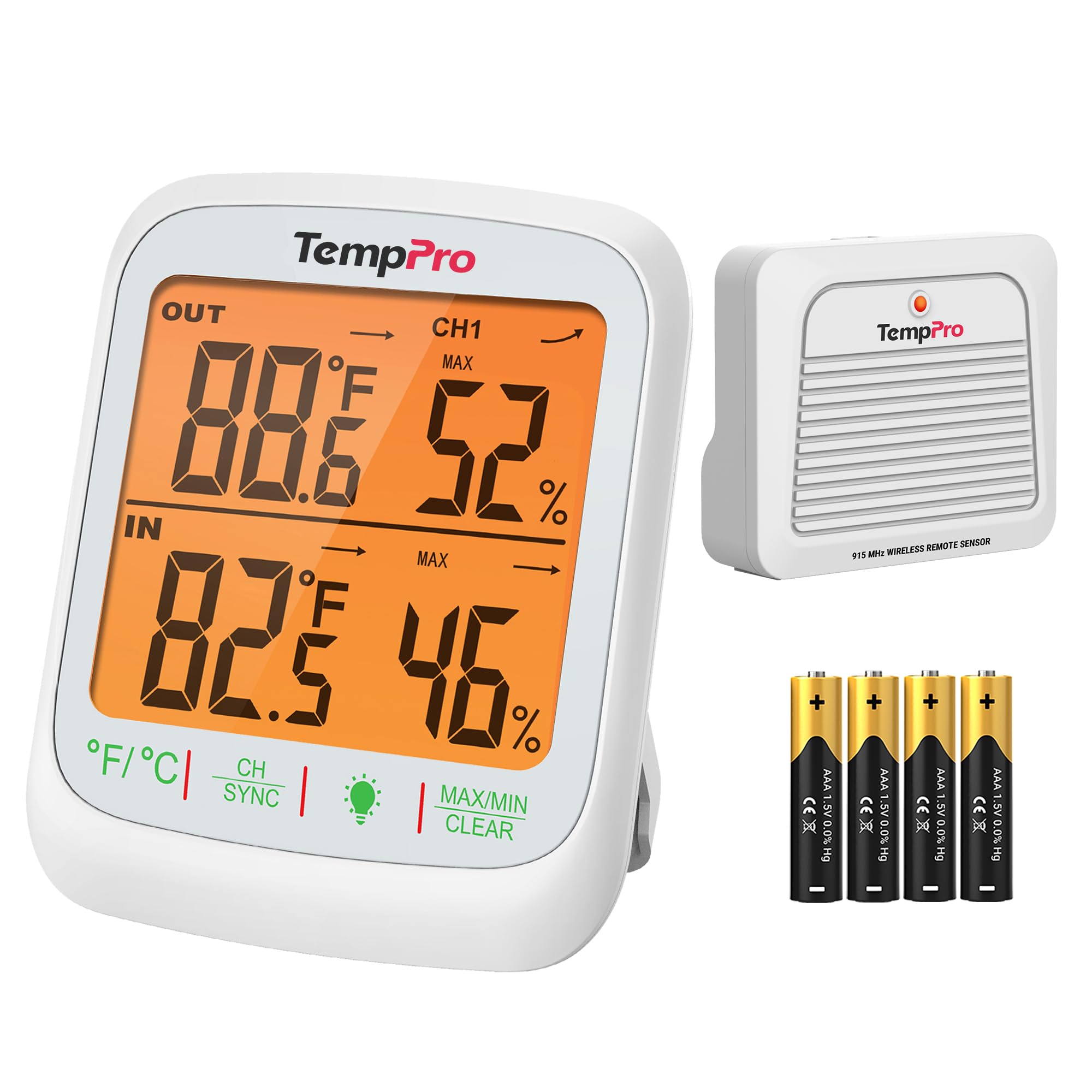
4. TempPro TempAir Thermometer
The one that reaches a thousand feet and still tells you the temperature within half a degree.
Range is the headline and it is not close. The TempAir is rated to 1000 feet with a clear line of sight, five times the 200-foot reach of the Geevon 24190. That matters if your sensor lives in a field, on a dock, or on the far side of a big shop. Inside, a 915 MHz wireless link and a tabletop-stand, wall-mount, or built-in magnet give you placement options in every room it lands in.
The accuracy is the sharpest number in the group. It reads to ±0.5°F and ±2-3% relative humidity, with trend arrows and high/low records right beside the number. Owners back that up, reporting it holds within a degree of NIST-traceable instruments. Four AAA batteries come included, and there is a re-sync trick for the sensor if you swap only its batteries: hold the CH/SYNC button on the receiver for three seconds.
The trade-off is that the 1000-foot figure is an open-air number. Walls, trees, and metal roofing cut into it, so mount the sensor high and clear to get the most from it. At 5.19 inches it is slightly more compact than the AcuRite 00888A3 at 6.25 inches, so it fits a tighter spot on a shelf.
The standout spec: 1000 feet of range plus ±0.5°F accuracy is a pairing no other unit in this group matches. For a homestead with a distant sensor, that is the whole argument.
The honest limit: the long reach is a best case in open air; plan for real obstacles and give the antenna clearance.
Go with this if: your outdoor sensor sits far from the house and you want an accurate number anyway.
Look elsewhere if: a sensor ten feet out the window is all you need.
5. Geevon Thermometer 3 Remote Sensors

Four channels, three sensors, and an audible alarm that rings before the greenhouse overheats.
This Geevon supports readings from four separate places at once, with three remote sensors in the box. The 5-inch LCD shows black, bold numbers you can read without leaning in, and the USB-powered backlight can stay on for night checks as long as the current stays under 500mA. Past 24 hours of max and min records tell you whether the basement stayed dry overnight, and comfort indicators label the air wet, comfortable, or dry.
The temperature and humidity alert function is the useful extra here. You set a high and low threshold by hand, and the unit rings when the reading crosses either line — handy in a grow tent or a wine cellar where a swing matters. The sensors are rated IPX4 splash-proof, so they shrug off a little rain but still want shelter from direct sun and persistent downpour. That is an honest boundary to plan around.
The measuring rates are solid: indoor range 50°F to 140°F, outdoor from -58°F to 158°F, humidity 20% to 95%, all with ±2°F accuracy. Owners find it reliable once the sensors and display are on the same channel. Where it gives ground is against the longer-range units — 200 feet is the shortest reach in this group, so keep the sensors closer to the display.
Best for a multi-room watch: three sensors plus customizable high/low alarms make this the pick for anyone tracking several spaces that cannot be allowed to drift.
The range reality: 200 feet is fine within a house or a small yard, but it is the one real limitation to size your layout against.
Worth it for: a grow tent, cellar, or greenhouse setup where an alarm matters more than range.
Hold off if: you need to reach a sensor across a large property.
6. Geevon Weather Stations VA Display

A weather station that turns the thermometer into a full dashboard of forecast, pressure, and moon phase.
If you want more than two numbers, this is the pick. The 7.5-inch color VA display layers inside and outside temperature and humidity with tendency arrows, max and min values, a next 12-24 hour forecast, comfort indicator, barometric pressure, moon phases, and an alarm clock with snooze. Owners like the variety of information, and the color coding keeps the readouts distinct at a glance.
Power options are flexible. Plug in the included AC adapter and the backlight stays lit with three brightness levels; run it on batteries alone and the light drops after 10 seconds. There is also a spare USB charging port for a phone or tablet, and a built-in stand or hanging hole let it sit on a desk or mount to the living room wall. The unit itself is rated for a 6-month battery figure.
Two things to know going in. Only one sensor is included, though the display connects to three within the 200-foot range, so multi-location monitoring costs extra. And the brightness and reliability feedback runs mixed — some find the screen bright and accurate, others say it is dimmer than expected or the temperature readings stall. It is a strong information display, not the most bulletproof outdoor sensor in the lineup.
What you get on screen: forecast, barometer, moon phase, calendar, and clock on one 7.5-inch panel — by far the most information per glance here.
Read before buying: the single-sensor box and the mixed notes on screen brightness. Add sensors if you need a second location.
Made for: the person who wants forecast and pressure context, not just a temperature number.
Not the one for: anyone needing outdoor sensors at multiple distant spots from the start.
7. OBET Weather Station Thermometer

A 7.68-inch color panel that fills a room and flashes a frost icon before the car ices over.
The screen is the reason this one stands out — a 7.68-inch color LCD that lays out indoor and outdoor temperature, humidity, max and min records, the 12-hour forecast, trends, and barometric pressure together. From across the room the big, bright numerals stay legible, which is the thing owners keep coming back to. Setup is quick; it works from the start and locks onto the sensors with little fuss.
Three sensors deliver readings from up to three spots with a 500 ft/150 m wireless range, covering an RV, a fridge, a garage, and a garden off one display. Temperature accuracy is ±1.8°F and humidity ±5%, and the forecast works off barometric pressure with a frost alert that flashes a snowflake icon between 33.8°F and 30.2°F, then holds it below 30.2°F.
Two practical notes. The USB plug is not included, so if you want the backlight adjustable at high, low, or off without a 10-second auto-off, plan for your own cable. And the sensors want to sit vertically, clear of sun, rain, and the ground, to read accurately. Set them up that way and the numbers hold true.
The living-room pick: this is the largest color display in the group at 7.68 inches, and the frost alert makes it genuinely useful on a cold morning.
The small print: no USB plug in the box and it needs a USB source to keep the backlight on continuously.
Right for: a kitchen or living room where you want the forecast and a frost warning readable from the couch.
Wrong for: someone who wants the backlight on from the start with no extra cable.
8. La Crosse Technology 308-1415 Wireless Thermometer, Black

The thermometer that keeps reading down to -40°F if you feed it the right batteries.
The 308-1415 is the cold-weather specialist. Its outdoor sensor measures -20°F using alkaline batteries, and drops to a -40°F floor once you switch to lithium cells. For a northern climate where a wireless sensor normally dies in January, that change alone is the reason to pick this unit. Indoor temperature gets its own trend arrows and daily high and low records, so the inside half of the picture is covered too.
The multi-color LCD is the other draw. Owners say the multi-color LCD is readable from 15 feet away. An adjustable backlight runs at high, low, or off, and a 5.0V AC adapter is included — though batteries are not, so plan on four AA cells. The whole unit weighs 7.2 ounces and sits freestanding, so it goes wherever you set it down.
Accuracy is where the honest caveat sits. Indoor and outdoor readings tend to hold well, but owners mention the outdoor figure running 7-9 degrees higher than the true temperature. That is a consistent pattern, not a one-off, so mount the sensor well away from sun and heat sources and expect to correct for a slight offset. Treat the cold-climate range as the selling point and the accuracy as something to verify.
The cold-climate case: a -40°F lithium-battery floor and a screen readable from 15 feet make this the strongest pick for a hard winter.
What to check: the outdoor reading tends high by 7-9 degrees, so shade the sensor and compare it against a known reference.
Best for: a cold-weather household that wants the sensor to keep reporting through a deep freeze.
Pass if: precise outdoor accuracy matters more than the low-temperature range.
Know the Specs
Transmission Range
Range is the furthest distance the outdoor sensor can send to the indoor display, measured in open air with nothing in the way. A 1000-foot unit can reach a distant field; a 200-foot unit is built for the same house or a small yard. Walls, insulation, and metal siding all reduce that figure, so if your sensor is going through a wall, you want the longer-rated unit.
Accuracy Rating
Accuracy is the plus-or-minus figure after the temperature reading, like ±1.8°F or ±0.5°F. It means the screen can sit that far off the true temperature in either direction. A tighter number means a more precise reading, which matters for a greenhouse or cellar; a wider one is fine for a coat-off-the-hanger check. Mount the sensor out of direct sun so the sun itself does not skew the reading.
Number of Sensors
A sensor count tells you how many places the display can watch at once. A single-sensor unit covers inside and one outside spot. A three-sensor unit lets you monitor a garage, a greenhouse, and a basement on one screen, provided the display has the channels for it. More sensors means more coverage, but also more batteries to keep track of.
Power and Backlight Mode
These units run on batteries, on USB or AC power, or both. On batteries alone, most screens light up for a few seconds and then go dark to save energy. Plug in to a wall source and the backlight can usually stay lit all night at an adjustable brightness. Check the box for whether the USB cable or the wall adapter is included, since several here ship with one and not the other.
Common Questions
How far can an outdoor sensor be from the indoor display?
Do these thermometers read humidity as well as temperature?
Why does my outdoor reading run higher than the real temperature?
Will a wireless sensor survive a freezing winter?
What is the difference between a wired and a wireless thermometer?
Can I leave the backlight on all night?
Can one display monitor more than one outdoor location?
Do I need batteries if I plug the thermometer in?
How accurate are these thermometers compared with a weather service reading?
The Bottom Line
For a top rated indoor outdoor thermometer that simply works, the winner is the AcuRite 00754w4 — it sets its own clock, shows both temperatures with a daily high and low, and asks nothing of you after setup. If your sensor needs to reach a distant field or barn, go with the TempPro TempAir, whose 1000-foot range and ±0.5°F accuracy lead the group. And if you want to watch three locations at once, the OBET three-sensor monitor puts all three on one screen with an adjustable backlight. Match the range and accuracy to where your sensor will actually live, and any of these will tell you what to wear before you open the door.
How we choose
We do not accept paid placement. Every pick is matched to a real buyer and a real use-case; we do not hands-on test units.
Sources
Specifications: manufacturer listings and product documentation. Review insights: verified customer reviews, as of November 2026. Pricing: not shown on this page (it changes often); check the current price via the retailer link.
As an Amazon Associate, Tactical Gear Guy earns from qualifying purchases. This does not affect which products we feature.