Specs are compiled from manufacturer listings and verified buyer reviews and can change over time — please confirm the key details on the product page before buying.
Most people shopping for a camera think “more megapixels” is the answer. It is not. At this budget, the thing that decides whether you come home with sharp photos or soft ones is the sensor size, the zoom reach, and whether the autofocus can actually lock onto a moving face. Get those three right and your photos come home sharp instead of soft. Get them wrong and you will be fighting missed focus and grainy low-light shots.
This guide is built by comparing the manufacturers’ published specifications and the patterns across verified customer reviews, so you get each pick’s real strengths and trade-offs instead of marketing spin.
Below you will find the specs that actually change your photos, the honest trade-offs behind each model, and a plain answer to which body suits a first-time buyer. The short version: pick a camera that fits how you shoot, and this breakdown of Top Rated Digital Cameras Under $500 shows you which specs to weigh.
Top Picks


How To Choose The Best Top Rated Digital Cameras Under $500
The right camera for this budget is the one whose sensor, zoom, and autofocus match what you actually photograph. Before you compare models, decide what you will photograph most. A bird on a far fence and a friend at a dinner table demand completely different lenses, and one camera rarely does both well.
Sensor size matters more than the megapixel number
The sensor is the light-gathering chip inside the camera, and its physical size sets how much light it captures. A 1-inch sensor (like the one in a compact built for video) collects more light than a small 1/2.3-inch sensor, so it handles dim rooms and evening shots with less grain. A large APS-C sensor inside a DSLR or mirrorless body pushes that further and gives you softly blurred backgrounds that make a portrait subject pop. Megapixels only decide how much you can crop or print large; they do not fix a dark photo.
Optical zoom versus digital zoom
Optical zoom moves glass to magnify a distant subject while keeping full resolution. Digital zoom simply crops the frame and stretches it, which is why those shots look soft. If you plan to shoot wildlife, athletes, or anything across a field, prioritize a real optical range. If your subjects are close and you shoot wide, a modest zoom and a wide-angle lens are more useful than a huge number.
Autofocus is where cheap cameras fall apart
Autofocus points are the spots the camera can measure focus against. More points, and smarter face or eye detection, mean the camera locks onto a moving child or a pet instead of the wall behind them. For portraits and video, eye-detection autofocus is the difference between a sharp face and a soft one. For sports, burst speed in frames per second (fps) lets you rattle off a sequence and keep the best frame.
Video, connectivity, and what you can grow into
Full HD 1080p is plenty for family clips and social posts, while 4K gives you more detail to crop and looks sharper on a big screen. Built-in Wi-Fi lets you beam photos to your phone without a card reader. And if you want to add lenses later, choose a body with an interchangeable lens mount rather than a fixed lens — that is the single biggest factor in how far the camera can grow with you.
Side-by-Side Comparison
| Model | Best For | Sensor | Optical Zoom | Video | Amazon |
|---|---|---|---|---|---|
| KODAK PIXPRO FZ55 Bundle★ Best Overall | First-timers who want everything in the box | 16MP | 5x | 1080p Full HD | Amazon |
| Canon EOS Rebel T7Also Great | Best overall DSLR for beginners | 24.1MP APS-C CMOS | Kit lens (18-55mm) | Full HD | Amazon |
| KODAK PIXPRO AZ528Most Zoom Reach | Long-range zoom on a budget | 16MP BSI CMOS | 52x | 1080p Full HD | Amazon |
| Nikon D3100 (Renewed) | Learning DSLR fundamentals cheaply | 14.2MP CMOS | Kit lens (18-55mm) | 1080p HD | Amazon |
| Nikon D7000 (Renewed) | Action shooters on a tight budget | 16.2MP DX-format CMOS | Body only | 1080p HD | Amazon |
| Canon PowerShot IXY 650 Bundle | Travelers who want zoom and a bundle | 20.2MP 1/2.3″ CMOS | 12x | 1080p at 30 fps | Amazon |
| Panasonic Point and Shoot 4K | Zoom plus electronic viewfinder | — | 60x (POWER O.I.S.) | 4K | Amazon |
| Canon EOS R100 | Growing into mirrorless and 4K | 24.1MP APS-C CMOS | Kit lens (18-45mm) | 4K | Amazon |
| Sony ZV-1F | Vloggers and solo creators | 1-inch sensor | Fixed 20mm wide lens | 4K | Amazon |
Detailed Reviews
1. KODAK PIXPRO FZ55 Compact Zoom Digital Camera
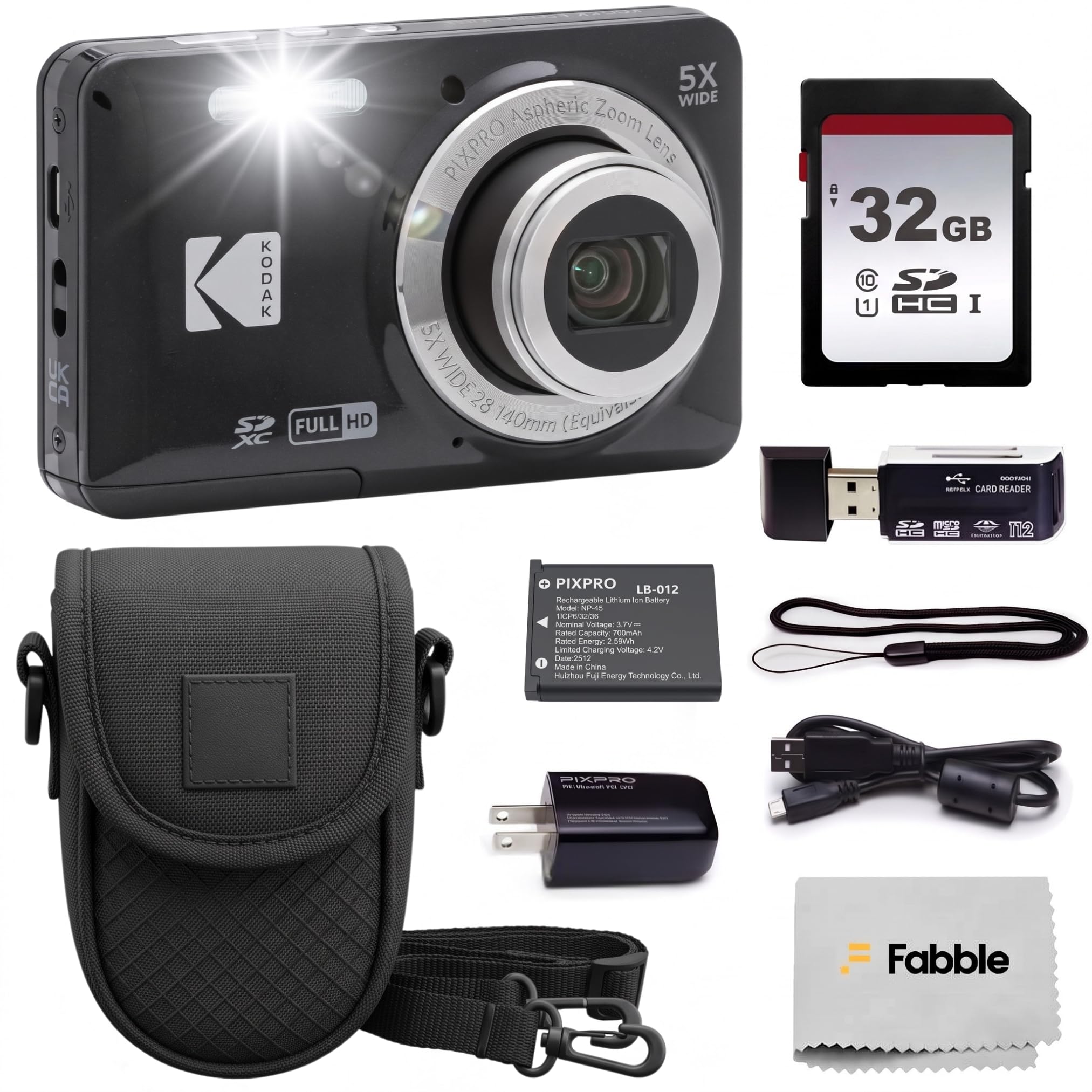
A pocket camera that arrives with the card, case, and reader already in the box.
Not everyone wants to shop for accessories. This bundle hands you the FZ55, a 32GB SD card, a protective case, a USB card reader, and a cleaning cloth in one go — so you can start snapping the moment it lands. The camera itself is a 16MP point-and-shoot with a 5x optical zoom and a 28mm wide-angle lens, which is plenty for trips, parties, and everyday snaps.
The 2.7-inch LCD makes framing and reviewing simple, and it records 1080p Full HD video for clips. There are 179 autofocus points for locking onto subjects around the frame, and dual digital-and-optical image stabilization helps steady handheld shots. A 12-bit depth and a built-in flash round out a friendly, no-fuss kit. What draws people in is the image quality for the price — it outperforms its price tag in most everyday scenes, and its compact size makes it a natural travel companion.
The honest caveat is the 2.7-inch screen: that is smaller than the 3.0-inch display on the PowerShot IXY 650, so reviewing shots takes a slightly closer squint. The 5x zoom is also modest next to the AZ528, so this is a close-subject camera, not a long-reach one.
The value story: card, case, and reader bundled in means zero extra shopping and a lower total outlay than buying pieces separately.
Fair warning: the smaller screen and modest zoom make it a close-range everyday camera, not a telephoto tool.
Go for it if: you want a complete, ready-to-shoot starter kit with nothing left to buy.
Skip the bundle if: you already own cards and cases and would rather put money into zoom reach.
2. Canon EOS Rebel T7 DSLR Camera Lens Kit
The beginner DSLR that gives you a real 24.1MP APS-C sensor and a lens in one box.
The headline number is 24.1 megapixels on an APS-C CMOS sensor. That larger sensor, compared to the tiny chips in most point-and-shoots, is why your portraits get that soft, blurry background and your indoor shots stay cleaner. It sits at the top of this list on real evidence: 4.5+ stars across 5,000+ ratings, which is the strongest buyer record of any camera here.
You get a standard 18-55mm zoom lens in the kit, so you can shoot wide landscapes or step in for a closer portrait without buying anything extra. The 9-point autofocus and AI Servo mode follow a moving subject, which keeps a walking toddler or a pet in focus. Sensitivity runs from ISO 100 to 6400, with an expanded setting at H:12800, meaning the camera can brighten dim scenes when you cannot add light. And 14-bit depth — the amount of color and tone detail it records per shot — gives you more room to edit a raw file later.
What wins people over is how quickly a first-timer can learn the dials and manual controls. Students learning DSLR basics pick up the dials fast, and the kit lens alone turns out photos that look far more expensive than the camera. The trade-off is size and weight: a DSLR with a lens slung on is a real bag commitment, not a pocket camera. Battery life and a purist’s lens path are the other things to weigh if you shoot all day.
Where it earns its keep
- 24.1MP APS-C sensor delivers clean detail and blurred backgrounds
- Kit 18-55mm lens included, so it shoots the day it arrives
- 9-point AF with AI Servo tracks moving subjects
- Built-in Wi-Fi and NFC for phone transfers
What to weigh first
- Bulky compared with a compact point-and-shoot
- Heavier to carry on a full day out
- ISO ceiling of 6400 is modest in very low light
Best for: a first DSLR you plan to learn on and grow with, especially for portraits and everyday family shots.
Think twice if: you want something that slips into a jacket pocket.
3. KODAK PIXPRO AZ528 Digital Camera
A 52x optical zoom that pulls distant birds and athletes right up to your eye.
If your subjects live far away, this is the reach champion. The AZ528 spans a 24mm wide angle out to a genuine 52x optical zoom — that is over ten times the reach of the 5x FZ55, and it uses real glass rather than a digital crop, so the image stays sharp. A 16MP backside-illuminated CMOS sensor (a design that gathers more light) helps in dim conditions, and built-in optical image stabilization keeps handheld telephoto shots from turning to mush.
The 6fps burst mode rattles off fast sequences for wildlife and sports, and a 3-inch LCD lets you review and keep the sharpest frame. Wi-Fi means you can send shots straight to your phone in the field, and the rechargeable lithium-ion battery keeps a full day of shooting going. It accepts Class 10 SD, SDHC, or SDXC cards up to 1.5TB, enough for thousands of photos.
Here is the honest part: the picture quality draws a genuinely mixed reaction. In good light and at moderate zoom it pleases, but fine results thin out at the far telephoto end, and autofocus is the weak point owners flag. Treat it as a reach-first tool rather than a portrait machine, and give it steady light and a firm hand.
Reach that actually delivers: for birders, sideline parents, and anyone shooting across a field, the 52x optical lens plus stabilization is the reason to buy it.
The trade-off: autofocus and far-zoom sharpness are the recurring gripes, so it rewards patience and bright conditions over fast indoor grabs.
Reach for this if: your photos are mostly of far-away subjects and you want real optical magnification.
Look elsewhere if: you mostly shoot close-ups indoors where autofocus speed matters most.
4. Nikon D7000 DSLR (Body Only) (Renewed)

A renewed body with 39 autofocus points and 6 fps for catching fast action.
The number that matters here is 39: that is the autofocus point count, and it is more than four times the 9 points on the Rebel T7. For sports, birds, and running kids, more points mean the camera tracks a moving subject across more of the frame. Pair that with 6fps continuous shooting — up to 100 shots in a burst — and you can fire a sequence and pick the sharpest moment.
Inside is a 16.2MP DX-format CMOS sensor, and it records Full 1080p HD video with full-time autofocus, so the camera keeps a face sharp even while recording. This is a body-only listing, meaning you bring your own Nikon F-mount lens — great if you already own glass, a deal-breaker if you do not. As a renewed unit it is professionally inspected and backed by a 90-day warranty.
The size of the kit is the catch. Because you supply the lens, your total cost and total weight depend entirely on what glass you add, and a DSLR body with a zoom is a bag you carry rather than pocket. For the photographer with lenses already on the shelf, though, this is a lot of focusing capability for the outlay.
Built for speed: 39 autofocus points and 6 fps give it the tracking and burst an action shooter needs, well beyond the 9 points on the beginner DSLR above.
Know before you buy: body-only means no lens included, so factor in the glass you already own or will need to buy.
Suits you if: you already own Nikon F-mount lenses and want more autofocus reach for active shooting.
Not for you if: you are starting from scratch and need a lens in the box.
5. Nikon D3100 DSLR Camera

A no-frills renewed DSLR that gets a beginner into interchangeable lenses cheaply.
This is the lowest-cost way here to step into a real DSLR with a lens attached. You get a 14.2MP CMOS sensor paired with the EXPEED 2 image processor, a combo that keeps noise down and colors faithful. The kit includes the 18-55mm VR zoom lens with Vibration Reduction, so handheld shots stay steadier without a tripod.
ISO runs up to 3200, expandable to Hi 2 (ISO 12800 equivalent) for dim evenings and indoor shooting. The 3-inch 230,000-dot monitor is fine for framing, and the 11 autofocus points cover the basics. It records 1080p HD movies with a full-time autofocus mode, and continuous shooting runs at 3fps. For a student who wants to learn aperture and shutter control on a genuine DSLR, this covers the fundamentals.
Two things to keep in mind. At 14.2 megapixels, it trails the 24.1MP Rebel T7 by a wide margin, so you have less room to crop. And as an older renewed model, availability and condition vary, which is the nature of buying refurbished. Reliability reports are mixed, so inspect the copy you receive.
The entry point
- Lowest-cost route to a lens-included DSLR
- Kit ships with an 18-55mm VR stabilized lens
- ISO up to 3200, expandable to ISO 12800 equivalent
- Full 1080p HD movie recording with full-time AF
Set expectations
- 14.2MP trails the 24.1MP competition
- Renewed condition varies unit to unit
- 3fps burst is slower than action-focused bodies
Right fit for: a student or first-timer wanting a real DSLR to learn on with minimal spend.
Reconsider if: you need high-resolution files for cropping or large prints.
6. Canon PowerShot IXY 650 HS Digital Camera
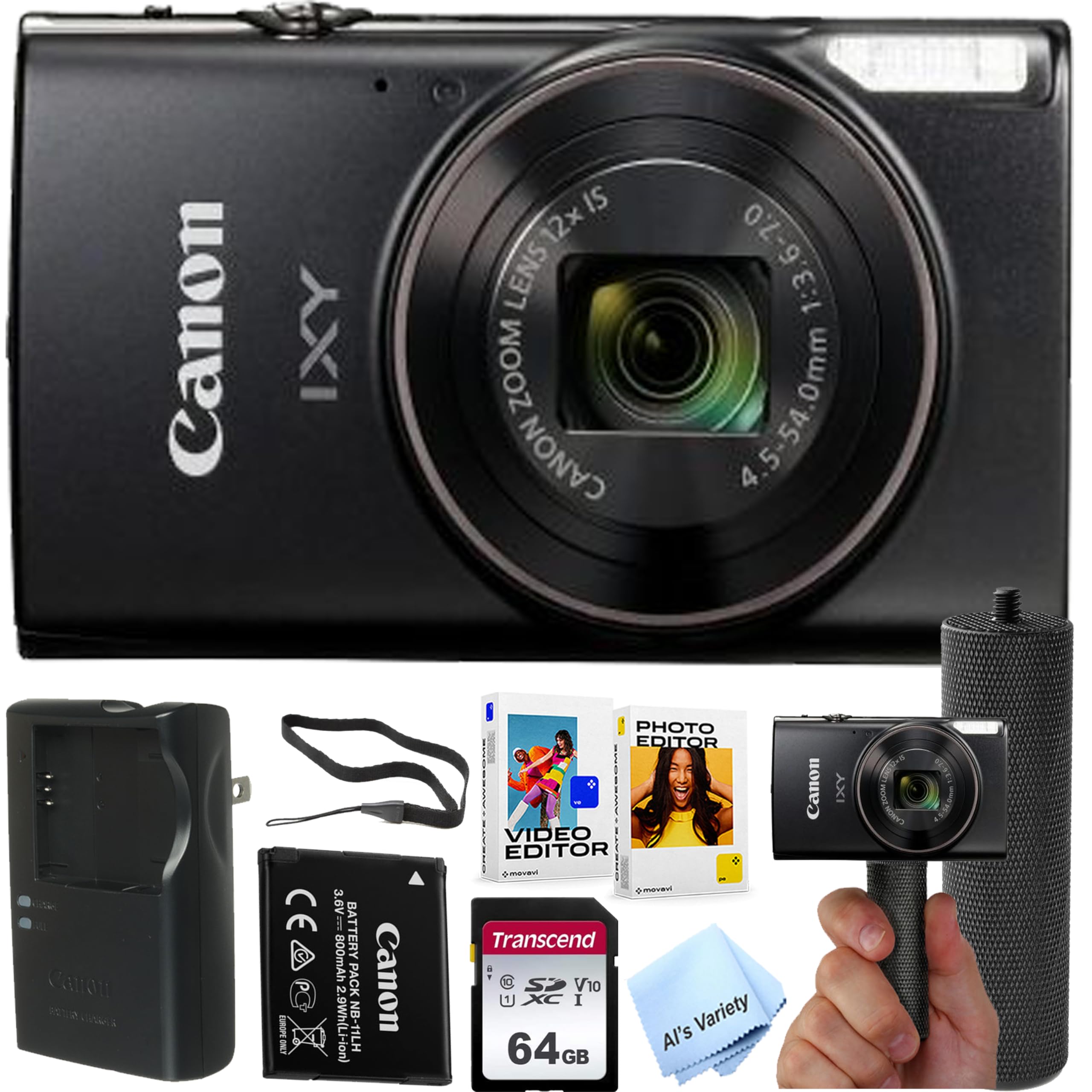
A slim travel camera with a 12x zoom that reaches from wide streets to distant rooftops.
For a camera you can slip into a bag on a trip, the 12x optical zoom is the draw. Its 25-300mm equivalent range starts wide for architecture and group shots, then reaches far for detail across a plaza. A 20.2MP 1/2.3-inch CMOS sensor pairs with the DIGIC 4+ processor to keep noise down, with sensitivity up to ISO 3200 and continuous shooting up to 7.2 fps.
The 3.0-inch 461k-dot LCD is larger than the 2.7-inch screen on the FZ55 bundle, so reviewing shots is easier. Intelligent IS image stabilization steadies both stills and video, and it records Full HD 1080p at 30 fps. Built-in Wi-Fi with NFC and a dedicated Wi-Fi button make sending to a phone quick. The bundle adds a 64GB card, a stabilizing grip, and a Movavi editing software kit for Windows and Mac, so you can shoot and cut clips without extra purchases.
The honest limitation: this is a renewed unit and a compact sensor, so it favors convenience over big-sensor image depth. You will not get the blurred backgrounds of the APS-C DSLRs, but for compact travel zoom, the reach and bundle are the point.
Travel convenience: 12x zoom in a slim body plus a 3.0-inch screen and a bundle with card and editing software, all suited to a trip.
Real limitation: the small 1/2.3-inch sensor keeps it a convenience camera, not a shallow-depth portrait machine.
Choose this if: you want big zoom reach in a pocket-sized travel camera with extras included.
Pass if: blurred-background portraits and large-sensor depth are your priority.
7. Panasonic Point and Shoot Digital Camera 4K

A 4K travel camera whose electronic viewfinder stays clear even in harsh sunlight.
Sunlight is the enemy of a rear screen, and this Panasonic answers it with a 2,360K-dot Large LVF electronic viewfinder at 0.74x (35mm equivalent). That means you frame through an eyepiece glare cannot wash out, a real advantage outdoors. The zoom reaches 60x, and POWER O.I.S. optical stabilization holds the telephoto end steady so distant shots stay sharp in hand.
Video is the other strength. It shoots 4K, which records up to four times the resolution of Full HD, giving you room to crop in editing. The 4K Photo mode lets you pull an 8-megapixel still out of a 4K clip, so a missed moment is recoverable. The Post Focus feature lets you choose the in-focus area after the shot. What owners praise most is the image quality and the 60x zoom range, with the 20mm wide end getting a nod.
Fair expectations matter here. Image quality draws a mixed reaction: some shots come out crisp, but clarity can fade at high zoom, and a few units have stopped working. Give it good light, lean on the stabilizer for the long end, and it delivers the reach and 4K flexibility it promises.
Outdoor framing: the 2,360K-dot LVF viewfinder plus 60x stabilized zoom makes far subjects visible and steady in bright light.
The honest caveat: sharpness softens at extreme zoom and reliability is mixed, so treat the long end with care.
Fits you if: you shoot outdoors in bright light and want a viewfinder plus serious zoom and 4K.
Look past it if: you need guaranteed consistency at the maximum telephoto setting.
8. Canon EOS R100 Mirrorless Camera with 18-45mm Lens

A compact mirrorless body that pairs a 24.1MP APS-C sensor with 4K video and 143-zone autofocus.
Modern autofocus is the story: Dual Pixel CMOS AF covers up to 143 zones with human face and eye detection, plus animal and vehicle tracking. That is a huge jump over the 9-point systems on the beginner DSLRs, and it means the camera finds and holds a face even when your subject moves. It also captures up to 6.5 shots per second in One-Shot AF for bursts.
The 24.1MP APS-C CMOS sensor delivers the detail and natural bokeh you want from an interchangeable-lens body, and the DIGIC 8 processor adds 4K video capability. This is the smallest and lightest body in the EOS R series, built for mobility — the kind of camera you actually carry. The 18-45mm lens and a bundled Canon shoulder bag plus a Lexar 64GB UHS-I SD card round out a grab-and-go kit.
The realistic note is lens-mount lock-in: it uses the Canon RF mount, so your future lenses are RF lenses, not the EF glass that fits the Rebel T7. That is a different upgrade path, not a flaw. If you are starting fresh and want a modern mirrorless system, it is a smart entry.
The modern edge
- 143-zone Dual Pixel AF with face, eye, animal, and vehicle detect
- 24.1MP APS-C sensor with natural bokeh
- 4K video from the DIGIC 8 processor
- Smallest, lightest EOS R body for carrying
The fine print
- Uses RF mount, not EF lenses
- New system means new glass over time
- Kit lens is a slower f/4.5–f/6.3 aperture
Best match for: a beginner who wants a light, modern mirrorless system with smart autofocus and 4K.
Not the one if: you already own a bag of Canon EF lenses and want to reuse them.
9. Sony ZV-1F Compact Digital Camera 4K Video Black

A 20mm wide lens and 1-inch sensor built to keep a solo creator in frame and in focus.
Solo filming is where this camera makes sense. The ultra-wide 20mm lens pulls in your surroundings even when the camera is held at arm’s length, so you and the room fit in one shot. A large 1-inch sensor teams with an F2 lens to shoot in low light and blur backgrounds, and 425 autofocus points with Eye-AF and tracking keep your face sharp as you move.
The side-articulating touchscreen flips for selfies, and Clear Voice uses a directional 3-capsule mic with a wind screen accessory to capture your voice cleanly outdoors. It records clean 4K, and the compact size and ease of use make it a favorite for beginners and younger creators — as owners put it, it is “super user-friendly for solo filming.” Connectivity spans Wi-Fi, Bluetooth, USB, and micro HDMI.
Two things to know: there is no built-in flash, so indoor stills need available light, and battery life is the most-flagged weak spot — the most-discussed category in its reviews, so plan on a spare or a power bank for long shoots. For video-first creators, though, the framing and audio are the reasons it earns a place.
Made for talking to camera: the 20mm wide lens, 1-inch F2 sensor, Eye-AF, and directional mic combine to keep you framed, in focus, and clearly heard.
Budget for it: no built-in flash and the shortest battery endurance here mean extra light and a spare cell for full days.
Grab this if: you create solo video, vlog, or shoot social clips and want clean 4K with strong autofocus and audio.
Not your camera if: you shoot stills indoors in low light without a flash or carry no spare battery.
Know the Specs
Sensor Size and Type
The sensor is the chip that captures light, and its physical size decides low-light quality and background blur. A 1-inch sensor gathers more light than a small 1/2.3-inch chip, and a larger APS-C sensor goes further. Backside-illuminated (BSI) designs and stacked processors like DIGIC or EXPEED help manage noise. Bigger sensors tend to mean cleaner dim shots and softer, more pleasing backgrounds.
Optical Versus Digital Zoom
Optical zoom physically moves glass to magnify a subject at full resolution. Digital zoom just crops and enlarges, which softens detail. A 52x optical zoom reaches far sharper than any digital crop, and image stabilization (O.I.S. or Vibration Reduction) keeps that long reach steady in hand. For distant subjects, real optical range plus stabilization is what counts.
Autofocus Points and Burst Speed
Autofocus points are the spots the camera measures focus against. More points, plus face or eye detection, mean the camera holds a moving subject instead of the background. Burst speed in frames per second lets you fire a sequence and pick the sharpest frame. Faster bursts and denser point coverage tend to suit action and portraits better.
Video, Bit Depth, and Connectivity
Full HD 1080p covers everyday clips, while 4K records much more detail you can crop. Bit depth is the color and tonal detail stored per shot; higher depth gives more editing headroom. Built-in Wi-Fi, NFC, or Bluetooth lets you send photos to a phone without a card reader. These features decide how easily the camera fits your phone-based workflow.
Common Questions
Is a DSLR or a compact point-and-shoot better for a beginner?
Will a camera with a large APS-C sensor take better photos than a point-and-shoot?
What does optical zoom mean versus digital zoom?
Do I need 4K video or is 1080p enough?
Can these cameras send photos straight to my phone?
Is a renewed or refurbished camera a safe buy?
What memory card do these cameras take?
How many autofocus points do I need for moving subjects?
Can I add different lenses later?
The Bottom Line
For most people, the top rated digital cameras under $500 winner is the Canon EOS Rebel T7 because its 24.1MP APS-C sensor, included 18-55mm lens, and 9-point autofocus give a beginner a complete, capable DSLR that shoots well from day one. If your subjects live far away, reach for the KODAK PIXPRO AZ528 with its 52x optical zoom. And if you create video for a living, the Sony ZV-1F is the one to pick up for its 20mm wide lens, 1-inch sensor, and clean 4K. Whichever body you choose, match its sensor size, zoom reach, and autofocus to your subjects.
How we choose
We do not accept paid placement. Every pick is matched to a real buyer and a real use-case; we do not hands-on test units.
Sources
Specifications: manufacturer listings and product documentation. Review insights: verified customer reviews, as of November 2026. Pricing: not shown on this page (it changes often); check the current price via the retailer link.
As an Amazon Associate, Tactical Gear Guy earns from qualifying purchases. This does not affect which products we feature.