Specs are compiled from manufacturer listings and verified buyer reviews and can change over time — please confirm the key details on the product page before buying.
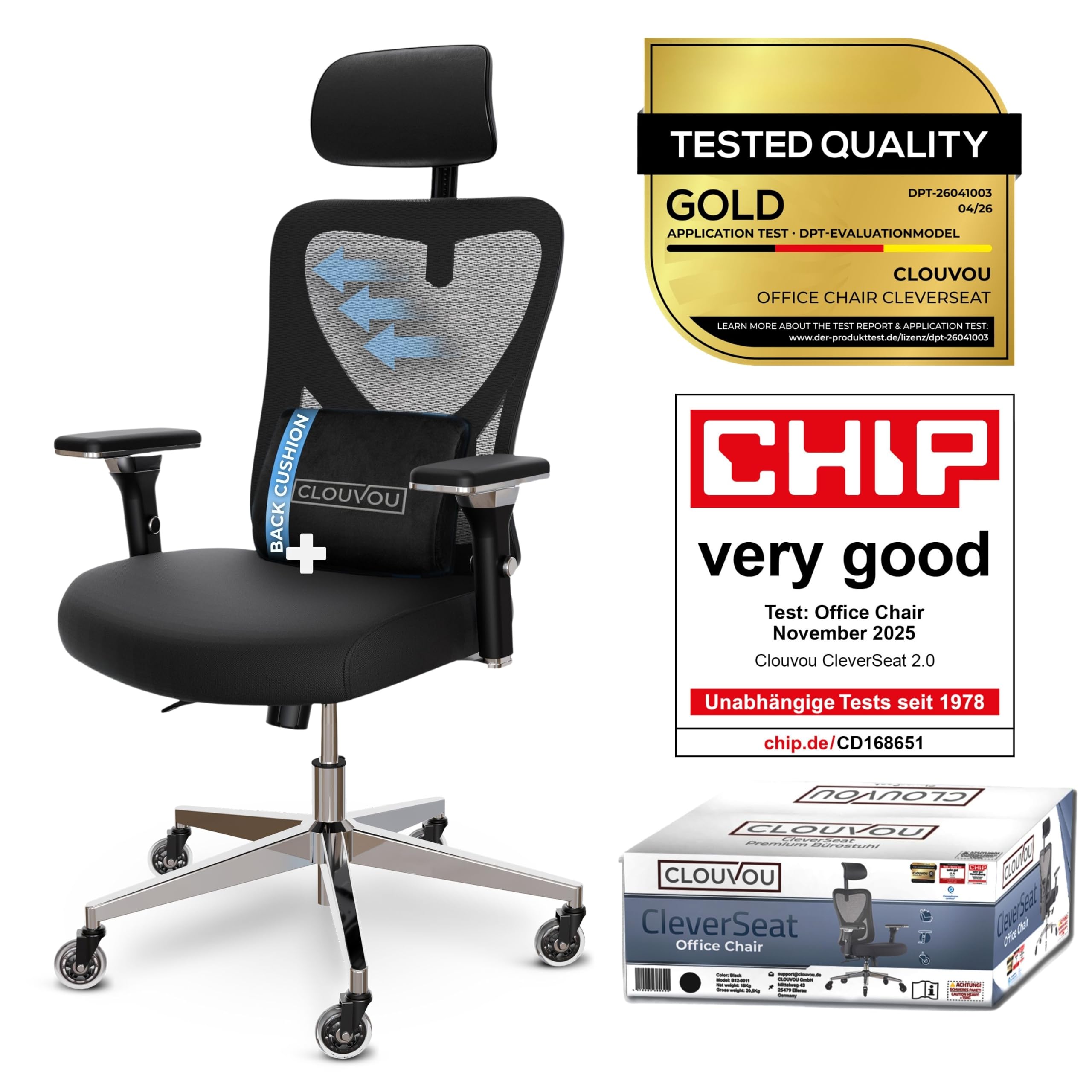
The chair you sit in for eight hours decides how your back feels at 6 p.m., and most desk chairs lose their cushioning and lumbar shape within a year. The shortlist below is built around the specs that actually keep you comfortable: weight rating, lumbar adjustment range, seat cushion thickness, and warranty length. If you want the quick answer, the CleverSeat Ergonomic Office Chair is the crowd favorite at 4.5+ stars across 2,900+ owners, and it stays quiet on hard floors thanks to its ultra-quiet wheels. Everything else here fills a specific gap — big-and-tall builds, short frames, tight budgets, and people who want to nap at their desk.
This guide is built by comparing the manufacturers’ published specifications and the patterns across verified customer reviews, so you get each pick’s real strengths and trade-offs instead of marketing spin.
You will see which chairs fit which body type, what a 5-year warranty (a promise to repair or replace the chair for five years) really costs you in confidence, and where a sliding seat depth (a seat that moves forward or back to fit your legs) beats a thicker cushion. Here is the honest breakdown of top rated desk chairs.
Top Picks
How To Choose The Best Top Rated Desk Chairs
A desk chair is one of the few purchases you will sit in for most of your waking hours. That is why three practical questions matter more than the specs on the box: how much weight the chair is rated to hold, whether the lumbar support (the part that supports your lower back) moves to meet your back, and whether the seat depth keeps your thighs supported without cutting off circulation behind the knee.
Start With Your Height And Weight, Not The Color
Chair makers publish a recommended height range because a backrest that hits a 5’4″ frame in the wrong spot hits a 6’2″ frame in an entirely different place. The SIHOO M18 is built for people 5’6″ to 6’2″ tall. The ProtoArc EC200 is calibrated for users 5’4″–6’0″ and under 220 lbs. If you fall outside a chair’s stated range, the lumbar curve will sit too high or too low and the headrest will land on your neck instead of under your skull. Read that range first, before anything else.
Understand What A Weight Rating Really Tells You
A weight rating is the maximum load the frame, base, and gas cylinder are engineered to carry. A 500 lbs rating (the Cloomey and the DUMOS both carry that figure) means a heavier metal base and a sturdier cylinder than a 275 lbs chair. That extra capacity is not just for bigger bodies — a heavier base is also more stable when you recline. If you are under 200 lbs, a 300 lbs rating still gives you a comfortable safety margin on a daily-use chair.
Lumbar Support: Movable Beats Fixed
Lumbar support is the curve that presses into the gap between your lower back and the seat back. A fixed pillow pushes in one spot. An adjustable lumbar pad moves up and down or in and out so you can place it exactly on your lower back curve. The Cloomey goes further with an inflatable airbag you pump up to change how firm the support feels. Fixed lumbar can work well if the chair’s height range already matches your body — but on a chair built for a wide height range, adjustable lumbar is the feature that makes the fit work.
Seat Depth And Cushion Thickness Change How Long You Can Sit
Seat depth is the distance from the front edge of the seat pan to the backrest. If it is too short, your thighs dangle. If it is too long, the front edge digs into the back of your knees. A sliding seat depth adjustment (the ProtoArc offers 5 positions with 1.97″ of travel) lets you change that distance without changing chairs. Cushion thickness matters too — the DUMOS lists a 4.33″ thick cushion, and the HYLONE lists a 5″ thick seat. Thicker foam means less pressure on your sit bones after hour six.
Side-by-Side Comparison
| Model | Best For | Weight Rating | Height Range | Backrest Width | Amazon |
|---|---|---|---|---|---|
| CleverSeat Ergonomic Office Chair★ Best Overall | All-day work with quiet rolling | — | Up to 6.5 ft | — | Amazon |
| Black Ergonomic Office Chair with Headrest & LumbarTop Warranty | Short to mid-height users wanting a 5-year warranty | 330 lbs | 4.9–6.2 ft | 18.9 inches | Amazon |
| HYLONE 400lb Big and Tall Office ChairTall Frame Pick | Taller frames needing a thick seat | 400 lbs | About 5’5″–6’2″ | — | Amazon |
| SIHOO M18 Ergonomic Office Chair | Long workdays with a wide backrest | 150 kg (up to 330 lbs) | 5’6″–6’2″ | 20.47 inches | Amazon |
| Cloomey 500lbs Big and Tall Office Chair | Bigger bodies wanting inflatable lumbar | 500 lbs | — | — | Amazon |
| Staples Dexley Ergonomic Mesh Task Chair | Office-standard ergonomics with tilt lock | 275 lbs | Seat 17.4″–21″ high | 19.17 inches | Amazon |
| YFO Home Office Desk Chair | Leather look with smooth rubber casters | — | — | 15.8 inches | Amazon |
| DUMOS Big and Tall Office Desk Chair | Heavy-duty mesh with a 4.33″ cushion | 500 lbs | — | 18.5 inches | Amazon |
| ProtoArc EC200 Ergonomic Office Chair | Sliding seat depth for tailored fit | Under 220 lbs (user range) | 5’4″–6’0″ | 17 inches | Amazon |
| GABRYLLY Ergonomic Office Chair with Footrest | Reclining and napping at the desk | 300 lbs | 5’3″–6’0″ | — | Amazon |
| MOLENTS Ergonomic Office Chair | Wide seat with 3D armrests | — | Seat 19.5″–23.3″ high | 19.7 inches | Amazon |
Detailed Reviews
1. CleverSeat Ergonomic Office Chair
Our pick — 4.5+★ from 2,500+ verified ratings; the strongest balance of quality and price.
The chair that rolls silent on wooden floors and still holds a 6.5 ft frame.
What wins people over on the CleverSeat is the build. The frame is a sturdy polymer base wrapped in elastic nylon mesh, and the foam fill gives you a seat that does not flatten out by mid-afternoon. The wheels are the sleeper feature — ultra-quiet casters that glide without the plastic clatter most desk chairs make on a hard floor. If you take calls in the same room you work in, that quiet roll is worth more than any armrest gadget.
Back support is where the design earns its keep. The backrest tilts up to 135°, so you can lean back between meetings without standing up. The lumbar support is built in and targeted, and the armrests adjust so your elbows sit at desk height instead of floating. It is rated for users up to 6.5 ft, which covers the tall end of the market that most chairs ignore. Assembly is reported as straightforward — the screw kit and wrench come in the box.
The honest catch is adjustability. The lumbar and headrest adjustments work well for many owners, but the headrest does not always lock into position on every unit. Sizing leans large, too — a 6’5″ owner with a heavier build called it a good fit while suggesting a petite person look elsewhere. If you are small-framed, measure your seated height before you commit. The seat cushion is firm by design, and one tall rider wanted the back to slouch further forward than it does.
What Earns The Top Spot
- Ultra-quiet wheels roll silently on hard floors — no clatter on calls
- Backrest tilts up to 135° so you can lean back between tasks
- Rated for users up to 6.5 ft, covering taller frames most chairs skip
- Built-in lumbar support and adjustable armrests at desk height
Where It Gives You Pause
- Headrest does not always lock into position on every unit
- Firm cushion and large sizing suit bigger riders better than petite ones
- Back slouch does not come as far forward as some tall users want
Best for: Anyone who works long hours at a desk and wants a quiet roll plus a real recline to 135°.
Measure first if: You are petite or small-framed — the sizing runs large and the firm cushion is built for bigger riders.
2. Black Ergonomic Office Chair with Headrest & Lumbar
Five years of coverage on a chair built for the 4.9 to 6.2 ft crowd.
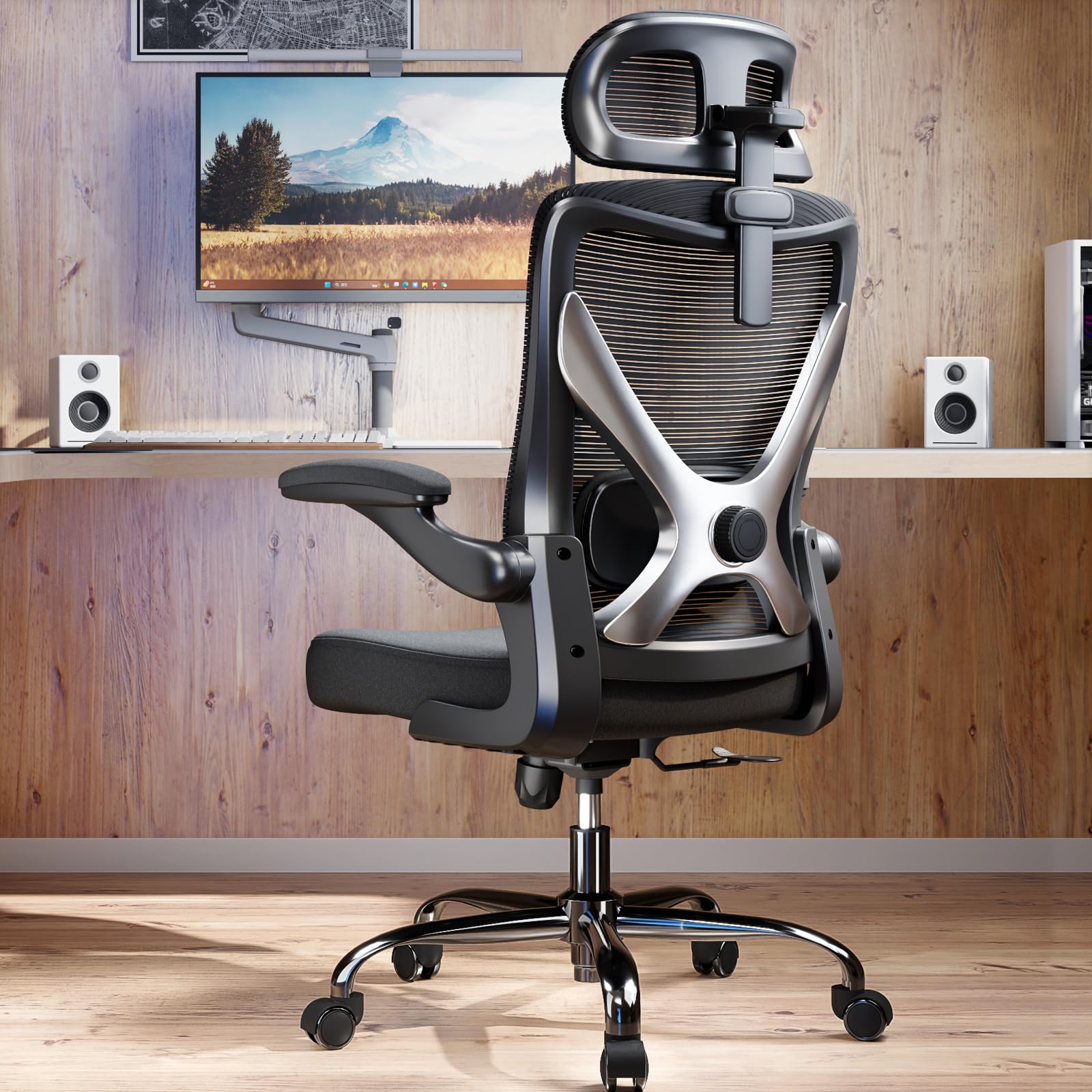
The number that matters most here is the warranty: five years, against the three years you get on the SIHOO M18. That is a 67% longer coverage window, and on a chair you sit in daily, that gap is real money if a gas cylinder or a caster gives out. The Ergalithic frame is metal with a 330 lbs capacity, and the backrest comes in at 18.9 inches wide — narrower than the SIHOO’s 20.47 inches, which suits a slimmer body.
The adjustable lumbar pillow moves 1.8″ up and down and 1″ in and out, so you can slide it onto your lower back curve instead of hoping it lands right. The 3D headrest and 90° flip-up armrests let you push the arms out of the way when you want to sit cross-legged or slide the chair under a low desk. The backrest rocks between 90° and 120° and locks firm at 90° for focused work. The mesh back keeps airflow moving so you do not bake in the afternoon.
What buyers consistently report is a chair that feels more expensive than its position on the shelf. There is no creak in the base, the wheels are dead quiet, and assembly takes one person with the included manual and video. The trade-off is sturdiness perception — some owners find the frame less tank-like than a heavier metal chair. It is also a chair for a specific height band, not a universal fit.
The warranty argument: Five years of parts coverage beats the SIHOO M18’s three years, and the movable lumbar pillow (1.8″ up/down, 1″ in/out) is more flexible than a fixed pad.
The honest limit: The frame reads as lighter than a heavy-duty metal chair, and the 330 lbs rating sits below the Cloomey’s 500 lbs. It is a fit-first chair, not a load-first one.
Reach for this if: You fall inside 4.9–6.2 ft, want a headrest that adjusts in three directions, and value a long warranty over raw weight capacity.
Look elsewhere if: You need a chair rated for well over 330 lbs — the Cloomey or DUMOS carry that load.
3. HYLONE 400lb Big and Tall Office Chair
A 5-inch seat cushion and a 28-inch base built for people who run tall.
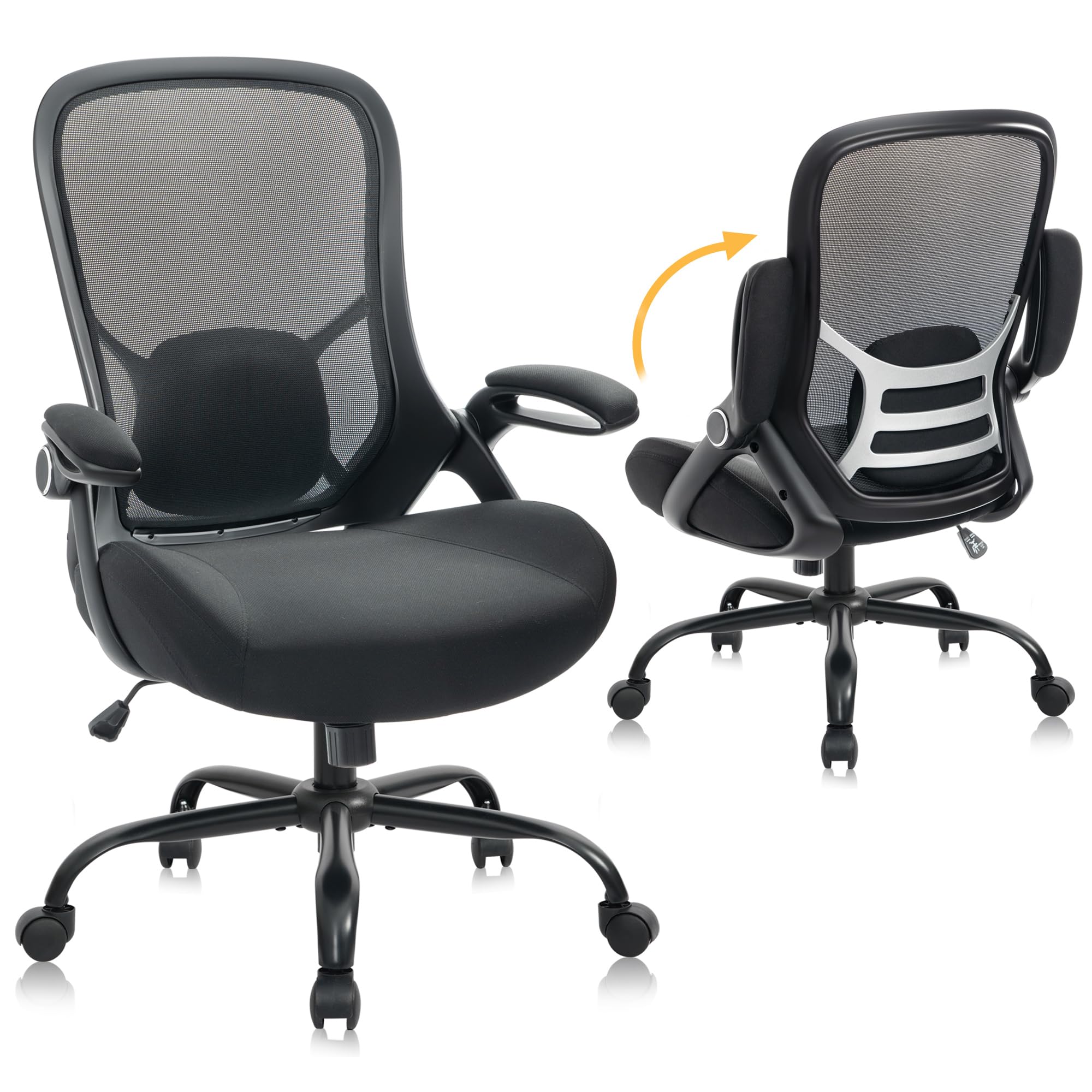
If you are 6’2″ or taller, most chairs push your knees above your hips and leave you slouching. The HYLONE is designed around a 5’5″ to 6’2″ range with a seat that adjusts from 18.1 to 22 inches high — a wide enough window to actually get your feet flat on the floor. The seat cushion is 5″ thick, layered sponge over a wood frame, and the nylon mesh back keeps air moving in a warm room. The base is a 28″ five-star spread that stays planted even at full height.
The flip-up arms are the practical detail. They rotate out of the way so you can roll the chair straight under a desk or a kitchen counter without dropping the seat. The chair is rated for 400 lbs, and the frame is FSC-certified wood under the seat board. One thing buyers mention again and again: this chair works for really tall people where others do not. A 6’7″ owner called the fit great. A 6’0″, 210 lbs rider said it was a dream.
Assembly takes about 30 minutes with clear instructions, and most people report no trouble. The recurring gripe is the wheels — they are the first thing owners want to swap. The cushioning also drew mixed feedback: one rider found the seat padding thin after a while, and a petite buyer warned short women to measure carefully before buying. If you are under 5’4″, this is not your chair.
Built for: Taller riders between 5’5″ and 6’2″ who want a thick 5″ cushion and a 28″ base that stays stable.
Skip if: You are petite or very short — the sizing is tuned for taller frames, and the wheels are the first upgrade most owners want.
4. SIHOO M18 Ergonomic Office Chair
The widest backrest on the list, backed by years of owner experience.
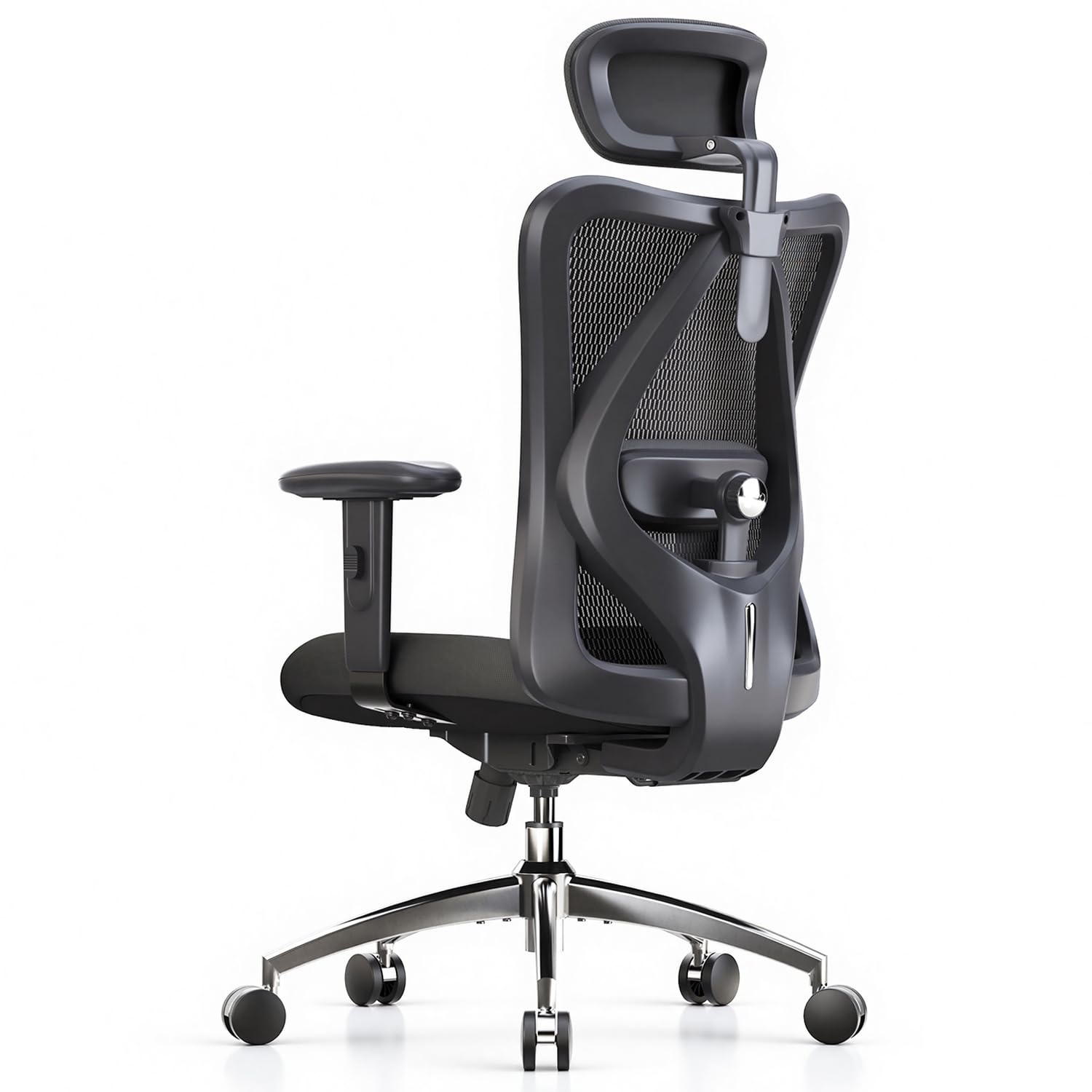
At 20.47 inches wide, the SIHOO M18 backrest is broader than the Black Ergonomic Office Chair’s 18.9 inches — that extra width matters if you have broad shoulders and keep rolling off a narrow back. The design puts support in four places: head, back, hips, and hands. The stainless steel frame is built for 150 kg and the chair passed the BIFMA test plus a 1136 kg static pressure test. It fits people from 5’6″ to 6’2″ tall, and assembly is eight steps with the included manual.
What buyers report after months of use is a chair that holds up. As owners put it, some can work eight or nine hours without pain, and the flexible mesh back keeps you cool while you do it. The lumbar support is removable if you want it gone, and the headrest is shaped to sit under your neck rather than behind it. The steel frame and extra screws in the box signal a chair built with some margin.
The honest trade-off is firmness. The seat runs hard, and some owners want more padding or a slightly deeper seat. The armrest cushion can peel after a few months of daily use — treat the arms gently and it holds longer. This is a chair for someone who prioritizes support and longevity over a plush initial feel.
Why it earns the placement: The 20.47″ backrest is the widest in this lineup, and the stainless steel frame paired with the BIFMA and static pressure testing points to a chair built to last past the one-year mark.
The cushion reality: The seat is firm by design. If you want plush, look at the DUMOS with its 4.33″ cushion instead.
Go with this if: You want a wide backrest, a steel frame, and a chair with a long track record of holding up under daily work.
Think again if: You like a soft, deep seat — the firm cushion and armrest peeling are the two things owners bring up.
5. Cloomey 500lbs Big and Tall Office Chair
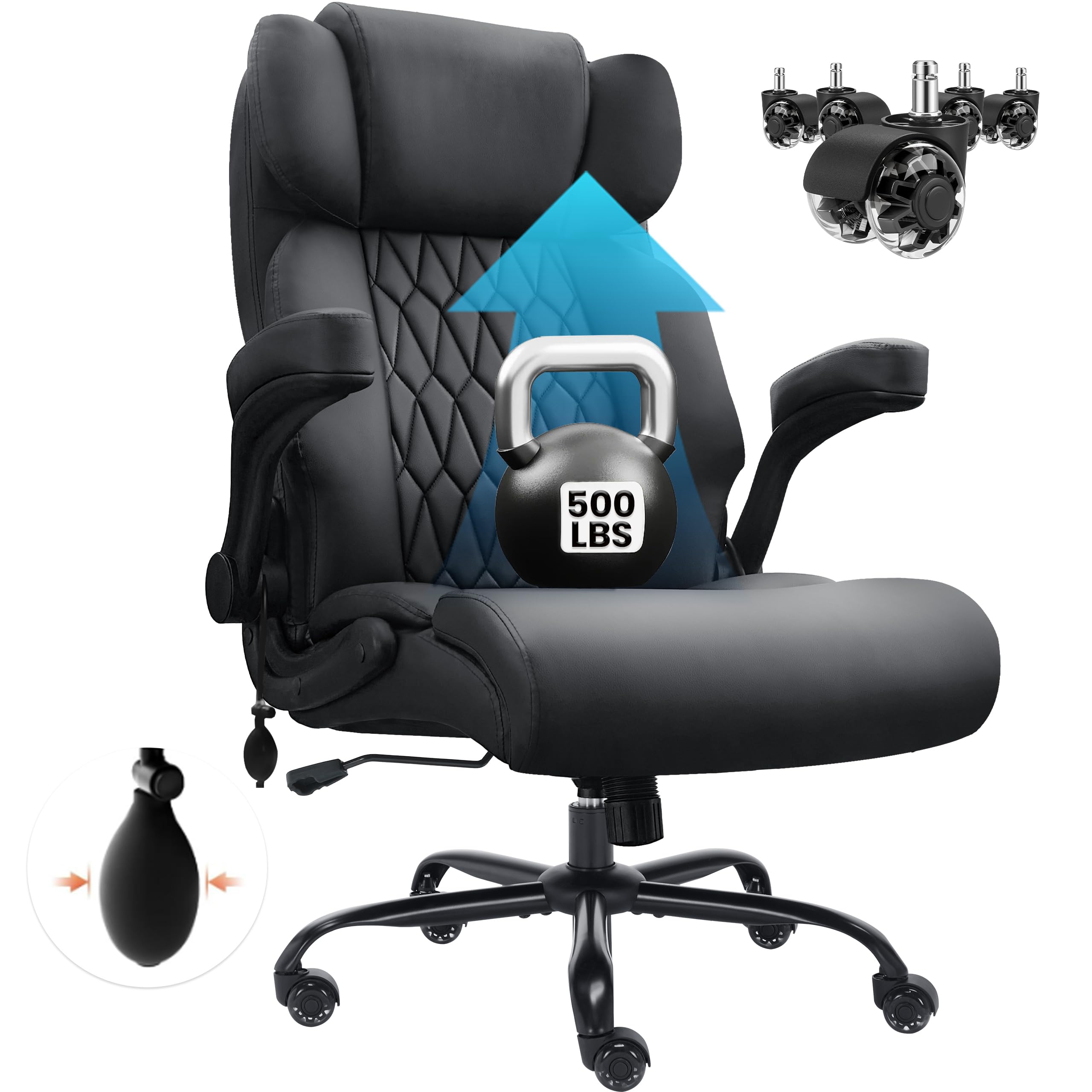
An air pump for your lower back and a 500 lbs base under it.
Most lumbar support is a fixed pad. This one is an airbag you inflate by hand until it pushes exactly where you want it. That is the feature people talk about most — you pump it up for firm support in the morning and let some air out when you want to lean back. The chair is rated for 500 lbs, with a heavy-duty metal base, and the SGS-certified grade 3 gas cylinder and base were tested past 100,000 cycles. The casters use soft nylon rubber with a polyurethane outer layer, so they roll without scuffing hardwood, laminate, tile, or vinyl.
The seat is built for a wider body. Multi-layer thick cushioning follows the body’s outer contour, and the backrest runs tall enough that a 6’1″ owner called the fit perfect. Owners who are larger than average say the extra room is exactly what they needed, and the wide seat is roomy enough to sit cross-legged in. The armrests are pillow-top padded, and assembly is quick with the included instructions.
The catch is the arms. A few owners find the armrests sit slightly uneven, which is a fit-and-finish note rather than a structural worry. The chair is also bulky — depth runs 30.3 inches. Measure your space before you order if you work in a small room.
Where It Wins
- Inflatable lumbar airbag lets you dial support in by feel
- 500 lbs rating with an SGS-certified grade 3 gas cylinder tested past 100,000 cycles
- Polyurethane-wheeled casters roll without marking hardwood, tile, or vinyl
- Wide, multi-layer cushion roomy enough to sit cross-legged
What To Weigh
- Armrests can arrive slightly uneven — a fit-and-finish detail
- 30.3″ depth needs floor space a compact room may not have
- Covers one year of warranty, shorter than the Black Ergonomic’s five years
Made for: Bigger and taller riders who want a 500 lbs rating and want to control lumbar firmness with a pump.
Room check: The chair is 30.3″ deep — measure before you buy if your desk sits in a tight corner.
6. Staples Dexley Ergonomic Mesh Task Chair
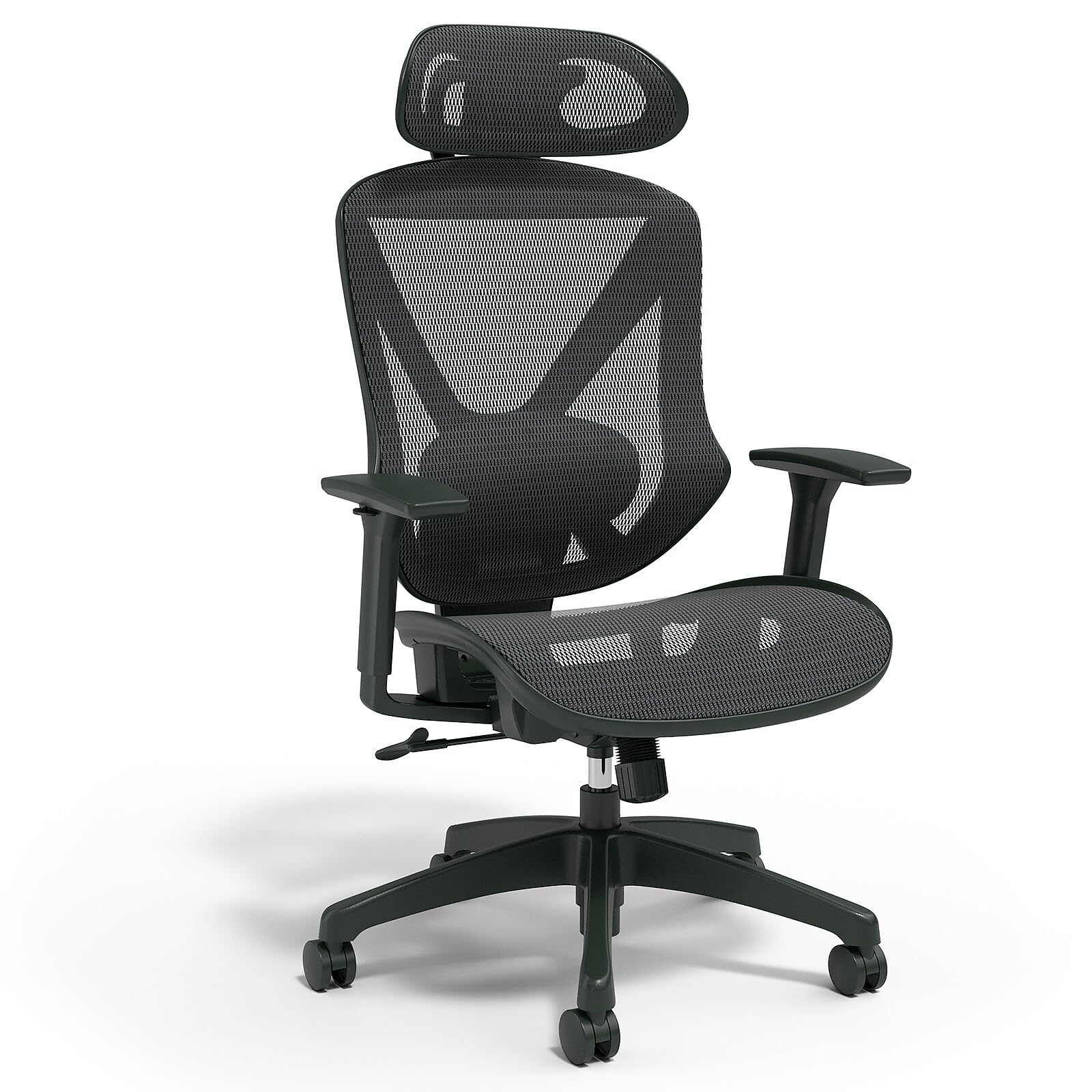
The office chair your workplace probably already owns, with a tension knob you can tune.
This is the chair that shows up in offices because it meets ANSI/BIFMA standards and carries a 275 lbs rating based on a 5–10 hour workday. The tilt mechanism is the real differentiator: a swivel-tilt system with a 3-position tilt lock and a tension knob that changes how hard it is to lean back. If you have ever leaned back and felt the chair drop away, the tension knob is the fix. The arms adjust in height, and the headrest adjusts in both height and angle.
The mesh back and mesh seat keep airflow moving through both surfaces, not just the back. The seat runs 17.4″ to 21″ high, which suits a wide range of desk setups, and the 19.17″ backrest width is closer to the SIHOO’s wide back than the narrower YFO. Owners who have had lumbar surgery call it the most supportive chair they have used. A tall owner said the lumbar support is top-notch where most chairs fail him.
The trade-off is noise. The chair has a reputation for squeaks and creaks as the moving parts wear in, and greasing the joints is the usual remedy. Durable-feeling is one thing; silent is another. If you work in a quiet room with a microphone on, test it before you settle in.
The tuning edge: A 3-position tilt lock plus a tension knob gives you a recline you can actually control — rare at this tier.
The noise caveat: Squeaks and creaks are the recurring gripe. Grease the moving parts and it quiets down, but a sound-sensitive workspace should know that going in.
The right buy when: You want office-grade standards, a tunable recline, and a chair rated for a 5–10 hour workday.
Check the room acoustics first: If a creak under your seat would drive you up the wall, this one may not suit you.
7. YFO Home Office Desk Chair

Brown leather that looks like a car interior, on wheels that roll like roller blades.
The YFO is the chair you buy when the desk sits in a living room and you want it to look like furniture. The brown leather finish is stitched to a standard owners compare to a custom high-end car. Under the leather, the seat packs a wooden board, soft sponge, and a spring pack that keeps the cushion springy through a long day. The seat is 22 inches wide and 20 inches deep, so there is real room to spread out.
The wheels are the second thing people notice. Rubber casters roll on wood, carpet, and marble without the scuffing a hard plastic wheel leaves behind. The armrests are optional — install them for desk work, leave them off and you have a cross-legged chair. That flexibility is rare, and it lets one chair cover two use modes. A 5’2″ owner found it a little low at a desk, so if you are short, check your desk height against the seat height before you order.
The back is where the compromises show. It is not adjustable, and one taller owner felt it gave little back support. The lumbar support is built into the cushion style rather than a movable pad, so it is a fixed curve. If lower-back support is your main reason for buying, a chair with adjustable lumbar will serve you better.
Looks that carry the room: The brown leather and stitched finish read like a custom car interior, and the 22″ wide by 20″ deep seat gives you room to spread out.
The support trade-off: The backrest is fixed. If you need adjustable lumbar, this is not the chair — look at the ProtoArc or the Cloomey instead.
Choose it for: A home office where the chair is seen as much as used, and you like the idea of optional armrests.
Pass if: Your lower back is the priority — a fixed backrest cannot match adjustability.
8. DUMOS Big and Tall Office Desk Chair
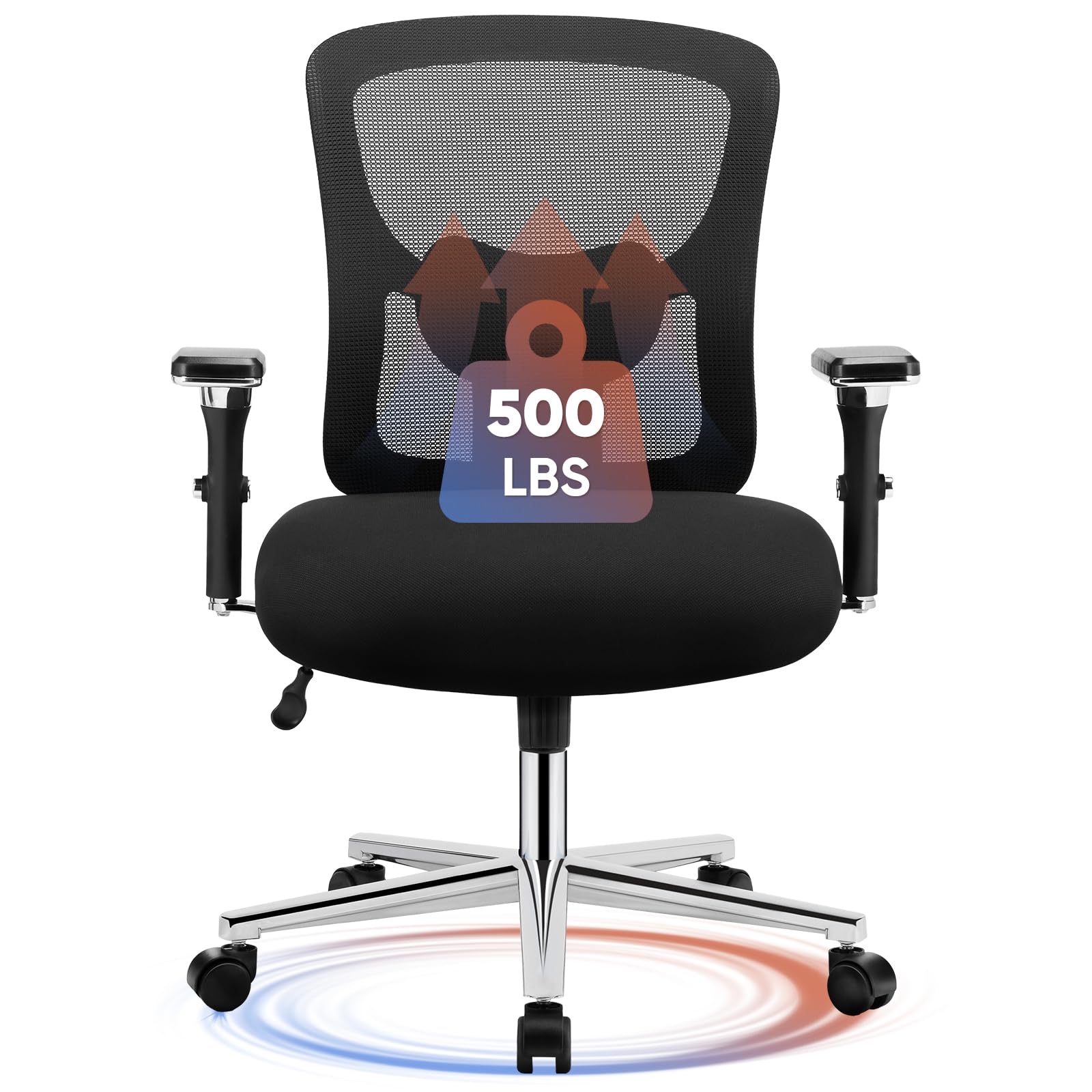
A 4.33-inch cushion on a 500 lbs frame, sized for larger desk setups.
Start with the cushion, because it is the number most chairs hide: 4.33 inches of high-resilience sponge, with a waterfall front edge that eases pressure on the back of your calves. The chair is rated for 500 lbs, with a 3-stage gas cylinder and a metal base built for smooth motion under load. If you have ever felt a chair sink after a few months, that three-stage cylinder is the part that prevents it.
The lumbar support adjusts back and forth to sit against your vertebra. The armrests are 4D — they move in depth, height, width, and rotation — so you can set them for typing, gaming, or reading without shoulder strain. The breathable mesh back keeps airflow moving, and the tilt tension knob under the seat lets you set how easily the backrest leans. It is built for use at a small desk, and owners mention it rolls well even on carpet.
The honest limit is adjustability. The backrest does not adjust in angle the way some pricier chairs do, and the armrests sit slightly forward of where a few owners want them. It is a sturdy, straightforward chair rather than an ergonomic transformer — one that survives a tumble better than most. If that sounds like overkill, remember the 500 lbs base is doing the work.
Reach for it if: You want a 4.33″ cushion, a 500 lbs rating, and 4D armrests that adjust in every direction.
Know before you buy: The backrest angle does not adjust, so this is a support-first chair, not a recline-heavy one.
9. ProtoArc EC200 Ergonomic Office Chair
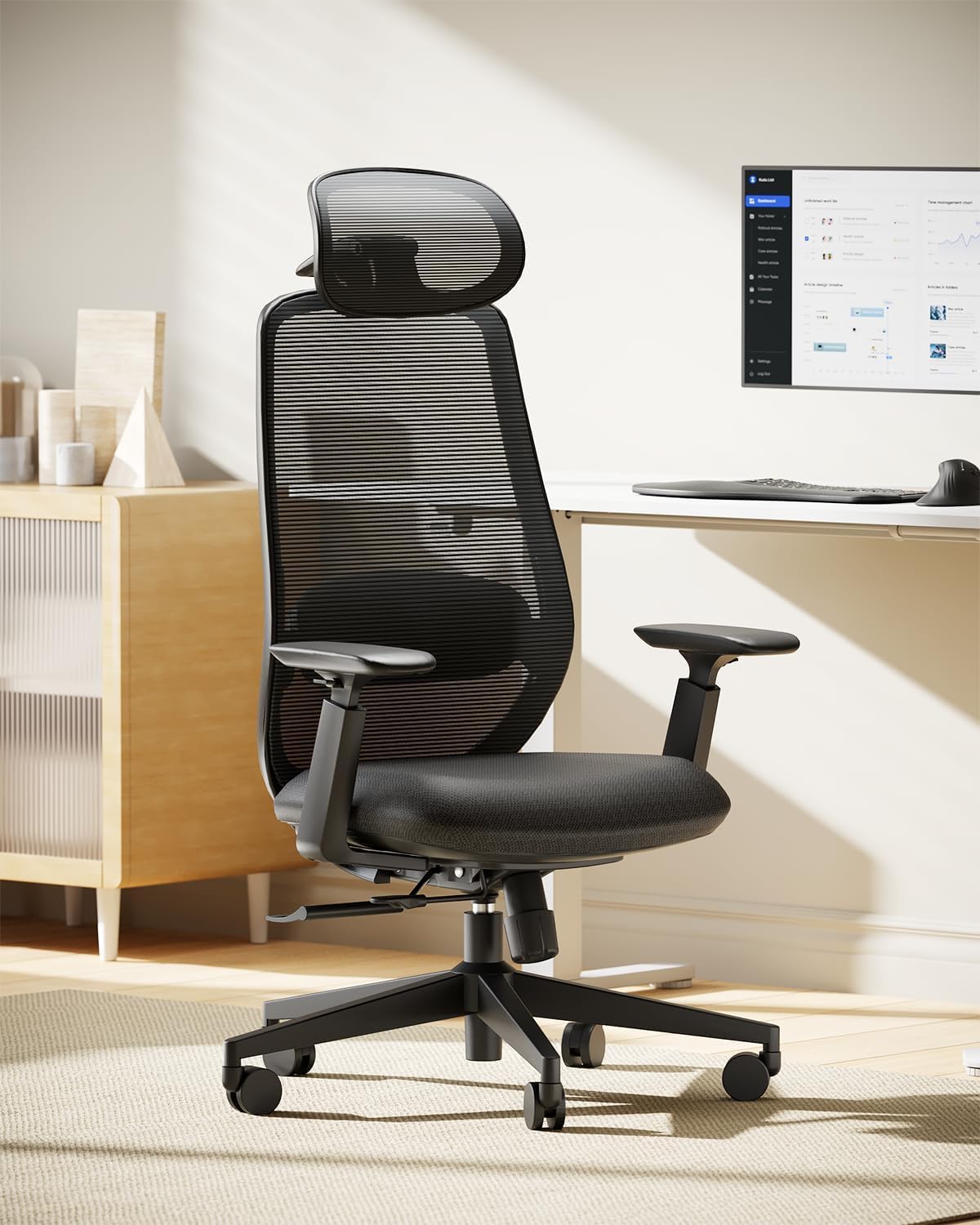
Five seat-depth positions for people whose thighs never quite fit the chair.
A sliding seat depth is the feature you did not know you needed until your legs dangle. This chair offers 5 positions with 1.97″ of travel, so you can push the seat forward to support your thighs while your back stays against the lumbar pad. That is a rare feature at this tier. The seat foam is 55D high-density, built to resist sagging through years of daily use, and the gas lift is TÜV-tested Class 4 with BS EN 1335 and BIFMA X5.1 backing the frame.
The chair is calibrated for users 5’4″–6’0″ and under 220 lbs, with a 17″ wide backrest and 2D armrests. The lumbar support adjusts 2.36″ in height and 0.8″ in depth, so it fills the lower back curve rather than sitting behind it. The recline locks in four positions — 90° for work, 105° for reading, 120° for calls, and 130° for relaxing. Assembly takes about 20 minutes with the included tools and visual guide, and it fits into bedroom corners and studio apartments where a full executive chair will not.
The honest caveat is fit for taller riders. The lumbar support does not go low enough for some people in the 5’10” range, and the raised rim around the seat pinches thighs for a few owners. The headrest is firm — one buyer describes it as extremely hard. Great for a short-to-average frame, not for a tall one.
The rare feature: 5 seat-depth positions with 1.97″ of travel is a real upgrade — it keeps your thighs supported while your back stays on the lumbar.
The height ceiling: Calibrated for 5’4″–6’0″ under 220 lbs. Taller riders will find the lumbar sits too low and the seat rim pinches.
Best pick for: Short-to-average frames who want a seat depth that actually fits their legs.
Not the one if: You are tall or wide — the chair’s height and weight calibration is narrow by design.
10. GABRYLLY Ergonomic Office Chair with Footrest
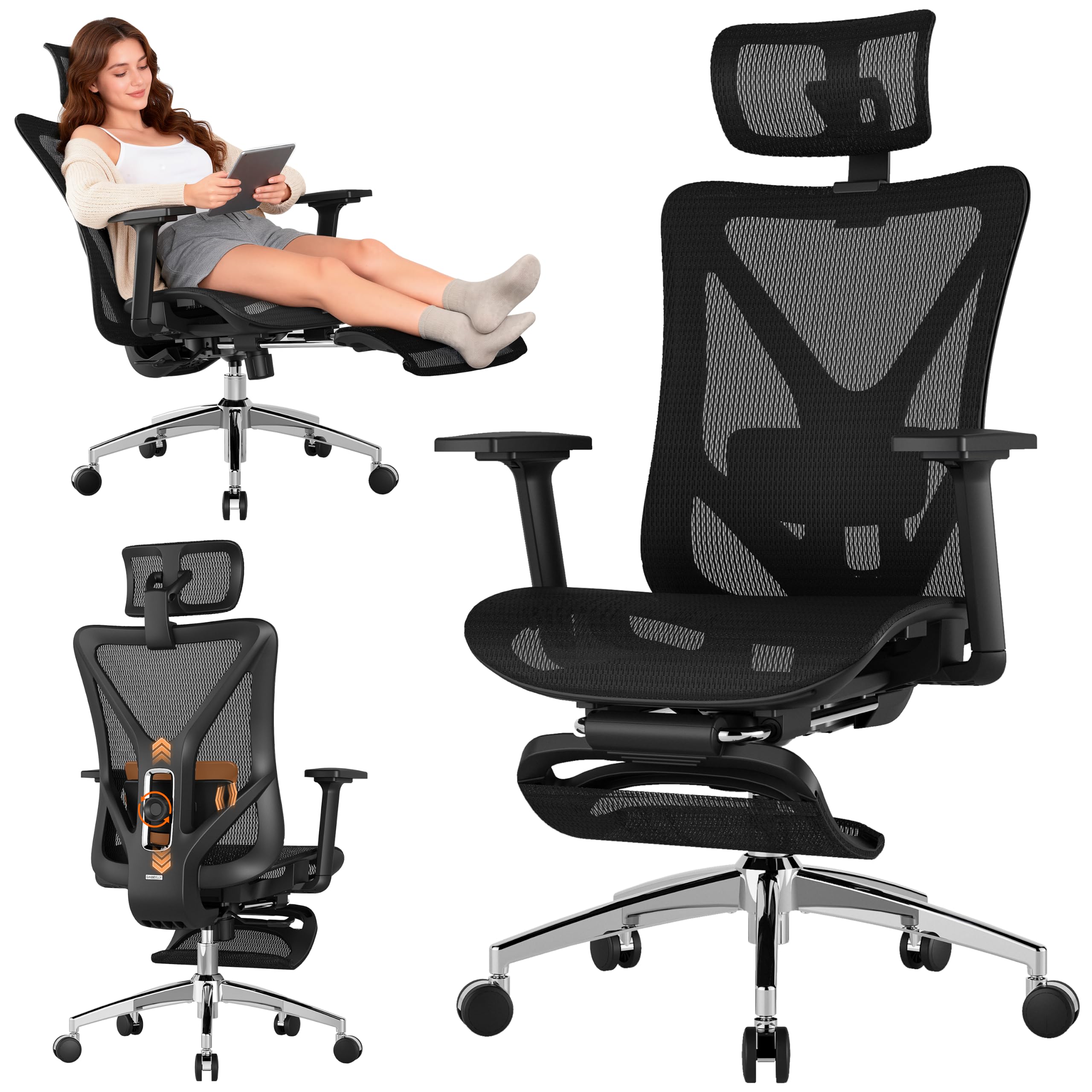
The chair that turns your work desk into a napping station.
A retractable steel footrest that extends to 18.1 inches is the headline here. Combined with a 135° recline that locks in three positions (90°, 110°, 135°), it lets you stretch out fully between calls instead of sitting bolt upright all day. The lumbar support adjusts 3″ vertically and 1.6″ horizontally to follow your lower back, and the chair is rated for 300 lbs with SGS and BIFMA testing behind it. The base is a 27.5″ steel spread with silent wheels, stable enough to lean back into without tipping.
The 3D armrests move up and down, front and back, and in and out, so you can find the right typing position or fold them out of the way. The mesh headrest adjusts in height, angle, and bracket so it sits under your skull, not against your neck. The all-mesh design keeps air moving in a warm room. The chair is designed for users between 5’3″ and 6’0″ tall, and it comes with an Allen wrench and screw kit for a 15–25 minute assembly.
The catch is the wheels. A few customers note the casters do not roll smoothly, and the adjustability — while broad — can be fiddly to dial in the first time. The chair also sits at the bulky end, so it needs a bit of room behind you to recline. If you have that space and want a footrest, this is the one that delivers.
The Recline Advantage
- Retractable steel footrest extends to 18.1″ for full leg support
- 135° recline locks in three positions for work-to-nap transitions
- 27.5″ steel base with a 300 lbs rating and silent wheels
- 3D armrests and a 3-way adjustable headrest
The Friction Points
- Some casters do not roll smoothly from the start
- Broad adjustability takes time to dial in the first time
- Needs floor space behind the chair to recline fully
Made for: Anyone who wants a footrest, a 135° recline, and a chair that doubles as a break-time lounge.
Worth knowing: The casters and the adjustability both take some breaking in — if you need silent wheels from day one, look elsewhere.
11. MOLENTS Ergonomic Office Chair

A wide 19.8-inch seat with 3D arms that slide and rotate wherever you need them.
The MOLENTS is built for a frame that needs room. The seat runs 19.8 inches wide and 18.9 inches deep, the overall chair width is 27.6 inches, and it is BIFMA X5.1 certified — the same standard office furniture buyers check for durability and safety. The seat height adjusts from 19.5 to 23.3 inches, which lets you sit high at a workbench or lower at a standard desk. The mesh back is skin-friendly and high-elastic, keeping airflow moving all day.
The 3D armrests slide forward and back, move up and down, and rotate left and right. The armrest panels rotate, so you can angle them under your forearms instead of resting on a flat pad. The lumbar support adjusts up and down and in and out to deliver a lower-back curve that fits your body. The backrest tilts in three positions from 90° to 120°, letting you shift from work mode to rest mode. The whole chair assembles in about 15 minutes with the included manual and tools.
One owner found the armrests annoying because they can slide rather than stay fixed. If you prefer a locked panel, the armrest rotation is the thing to note. The chair is also a wide build — 27.6 inches overall — so measure your under-desk clearance if your desk has a tight kneehole.
Room to spread out: A 19.8″ wide seat and 27.6″ overall width give bigger frames somewhere to land, and BIFMA X5.1 certification backs the build.
The armrest quirk: The panels slide and rotate by design. If you want a fixed armrest, that movement will feel loose rather than helpful.
The one to get if: You want a wide seat, adjustable lumbar, and armrests that move in every direction under a 15-minute assembly.
Check your desk: The chair is 27.6″ wide overall — confirm it clears your kneehole before it ships.
Know the Specs
Weight Rating (lbs or kg)
A weight rating is the maximum load the frame, base, and gas cylinder are engineered to carry. A 500 lbs chair uses a heavier metal base and a sturdier cylinder than a 275 lbs chair, which is why the heavier build also feels more stable when you lean back. If your body weight sits well under the rating, you get a margin of safety and less wear on the mechanism over years of daily sitting.
Height Range (feet and inches)
The stated height range is the body height the chair’s lumbar curve and headrest were shaped to fit. A chair calibrated for 5’4″–6’0″ will put the lumbar pad in the wrong spot on a 6’4″ rider. Match your own height to the range before you buy, and if you sit at the edge of the range, check the seat height adjustment window to make sure your feet still reach the floor.
Lumbar Support Adjustment
Lumbar support presses into the gap between your lower back and the seat back. A movable pad that adjusts up and down or in and out lets you place iton your lower back curve. A fixed pillow pushes in one spot, which works if the chair’s height range already matches your body. The inflatable design on the Cloomey adds firmness control on top of position adjustment.
Seat Depth and Cushion Thickness
Seat depth is the distance from the front edge of the seat to the backrest. Too short and your thighs dangle; too long and the edge digs behind your knees. A sliding seat depth lets you change that distance without changing chairs — the ProtoArc offers 5 positions with 1.97″ of travel. Cushion thickness is the other half: a 4.33″ or 5″ thick seat spreads pressure better over a long day than a thin pad.
Mesh Versus Leather or Fabric
A mesh back is a woven fabric stretched over a frame that lets air pass through, so your back stays cool in a warm room. Leather and fabric backs hold more warmth but give a plusher surface. If you run warm or work in a room without strong airflow, mesh is the safer pick. If the chair sits in a visible living space and you want a furniture look, leather earns its place.
Warranty Length and What It Covers
A warranty tells you how long the maker will replace parts like the gas cylinder, casters, or frame. The Black Ergonomic Office Chair offers a 5-year warranty, against the 3 years on the SIHOO M18. A longer window matters most on the parts that fail first: the cylinder that lifts the seat and the casters that roll. Check whether the coverage includes free replacement parts or only the frame.
Common Questions
How do I know if a desk chair will fit my height before it arrives?
Is a 500 lbs weight rating worth it if I weigh much less?
What is the difference between fixed and adjustable lumbar support?
Do mesh chairs stay cooler than leather chairs?
How long does assembly usually take on these chairs?
Will the wheels scratch my hardwood floor?
Why does a seat depth adjustment matter on a desk chair?
How much floor space should I leave behind the chair for reclining?
What does BIFMA or ANSI certification actually mean?
Can a heavy-duty chair still be comfortable for a smaller person?
The Bottom Line
If you want one dependable pick, the top rated desk chairs winner is the CleverSeat Ergonomic Office Chair because it pairs ultra-quiet wheels with a 135° backrest tilt (the back leans back 135 degrees) and a build rated for users up to 6.5 ft — a combination that suits long workdays and tall frames at once. If you want the longest warranty and a movable lumbar pillow, grab the Black Ergonomic Office Chair. And for bigger bodies who want an inflatable lumbar (a cushion you pump up to support your lower back) and a 500 lbs rating, the Cloomey Big and Tall Office Chair is the one to reach for.
The honest nudge: if your body falls inside a chair’s stated height range and the lumbar support moves to meet your back, that fit is what keeps you comfortable past hour eight — and the CleverSeat holds the highest score of the group at 4.5+ stars, backed by a deep pool of owners who keep buying it.
How we choose
We do not accept paid placement. Every pick is matched to a real buyer and a real use-case; we do not hands-on test units.
Sources
Specifications: manufacturer listings and product documentation. Review insights: verified customer reviews, as of November 2026. Pricing: not shown on this page (it changes often); check the current price via the retailer link.
As an Amazon Associate, Tactical Gear Guy earns from qualifying purchases. This does not affect which products we feature.