Specs are compiled from manufacturer listings and verified buyer reviews and can change over time — please confirm the key details on the product page before buying.
If you are buying a dash cam, the only question that matters is whether the footage is readable when you actually need it — after a bump in a parking lot, a disputed lane change, or a hit-and-run. A camera that records a blurry smear of headlights is worthless. So the short answer: pick a unit with a wide aperture (the size of the lens opening that lets light in), a proper night-vision sensor, and a memory card already in the box. Everything below is built around that.
This guide is built by comparing the manufacturers’ published specifications and the patterns across verified customer reviews, so you get each pick’s real strengths and trade-offs instead of marketing spin.
You will see dual-channel and three-channel setups side by side, plus which ones lock footage automatically and which need extra hardware for parking watch. The picks below cover every budget tier, and each one is here because its footage holds up under real conditions — a genuine list of top rated dash cam options you can actually trust.
Top Picks
How To Choose The Best Top Rated Dash Cam
The trap most first-time buyers fall into is chasing the biggest resolution number on the box. A 4K label tells you how many pixels the sensor records — it tells you nothing about whether those pixels are usable at 9 p.m. in the rain. Read the four things below in this order and you will pick a camera that produces evidence, not decoration.
Start with the lens opening, then the sensor
Aperture is written as an f-number, and a smaller number means a bigger opening. An F1.55 lens (like the one on the 70mai A800SE) pulls in more light than an F1.7, which matters most for reading a plate at night. Pair a wide aperture with a STARVIS 2 sensor — Sony’s low-light imaging chip — and you get footage that stays sharp when headlights flare across your windshield.
Decide how many angles you need
A single front camera covers what happens ahead. A dual setup adds a rear lens for tailgaters and rear-end impacts. A three-channel camera adds a cabin lens pointed at the people inside — useful if you drive for rideshare or carry passengers. More channels means more footage to store, so budget your memory card accordingly.
Check what comes in the box
Some cameras ship with a memory card pre-installed and some ship with an empty slot. A dash cam without a card is a paperweight on day one. Also check whether parking mode needs a separate hardwire kit — several of these units only watch your car overnight if you buy that extra cable.
Look for a supercapacitor, not a battery
A supercapacitor stores power without the fire risk of a lithium battery and keeps working through extreme heat and cold. If your car sits in direct summer sun all day, this single component choice matters more than the brand name on the front.
Side-by-Side Comparison
| Model | Best For | Channels | Max Card Support | Field of View | Amazon |
|---|---|---|---|---|---|
| TERUNSOUl 4K 3-Channel★ Best Overall | Total coverage on a mid-range budget | 3 (Front / Rear / Cabin) | 512 GB | 170° front | Amazon |
| 70mai A800SEBest Night Vision | Plate reading after dark | 2 (Front / Rear) | 512 GB | 140° | Amazon |
| BOTSLAB G300H PlusSlimmest Mount | Heat tolerance and slim mounting | 2 (Front / Rear) | 256 GB | 170° | Amazon |
| REDTIGER 4K Dual | Fast phone downloads | 2 (Front / Rear) | — | 170° | Amazon |
| 70mai T800E | Rideshare cabin coverage | 3 (Front / Inside / Rear) | 512 GB | Not stated | Amazon |
| ROVE R2-4K Dual PRO | Long trips and big storage | 2 (Front / Rear) | 1 TB | 150° front | Amazon |
| VIOFO A229 Plus | Total darkness cabin recording | 3 (Front / Inside / Rear) | — | 140° | Amazon |
| REDTIGER F17 Elite | Color night footage | 3 (Front / Rear / Cabin) | 512 GB | Not stated | Amazon |
| VIOFO A329S | Fleet-grade storage and fisheye cabin | 3 (Front / Cabin / Rear) | 512 GB | 210° cabin | Amazon |
Detailed Reviews
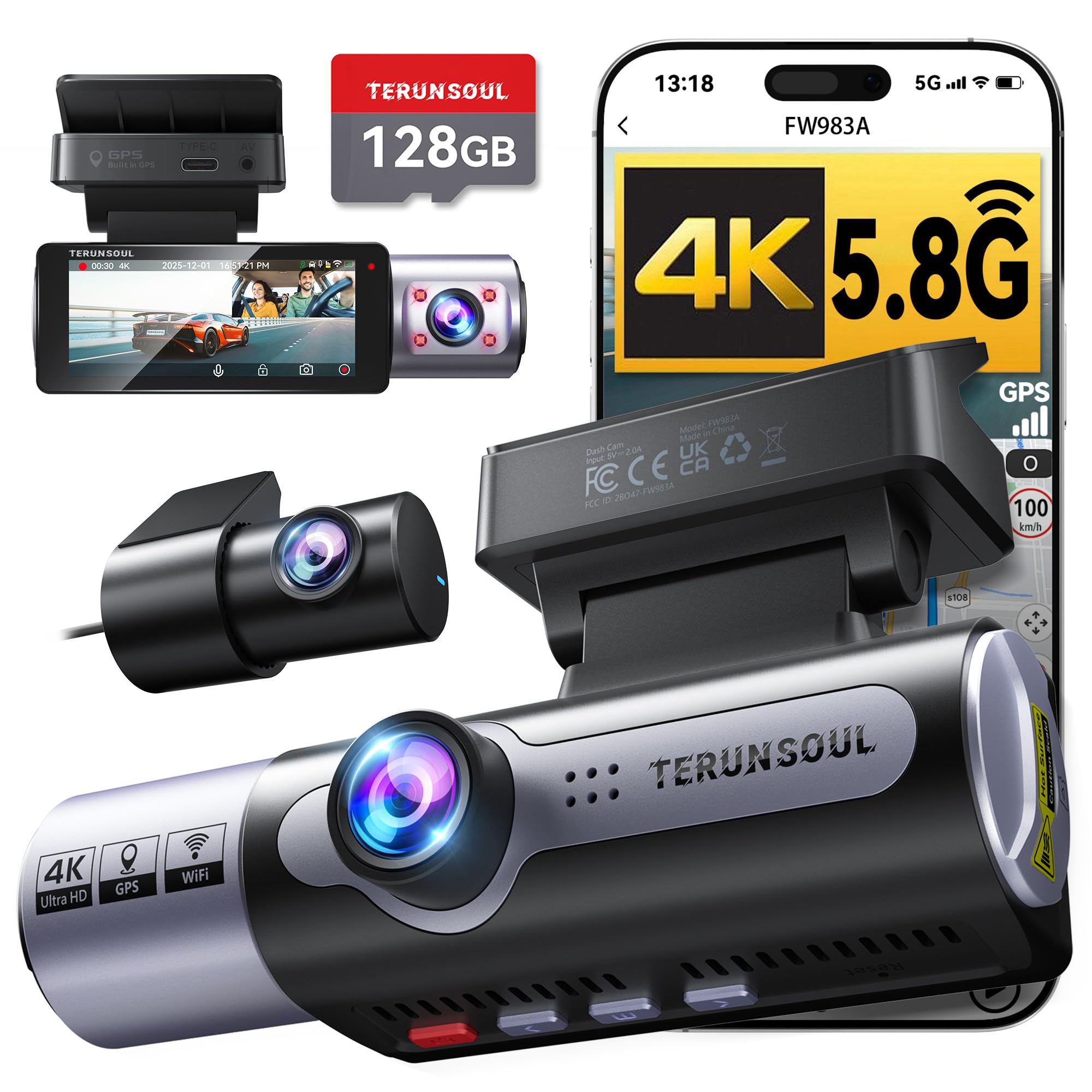
1. TERUNSOUl 4K 3-Channel Dash Cam with 128GB Card
Our pick — 4.5+★ from 450+ verified ratings; the strongest balance of quality and price.
Three cameras, one card already inside, and no extra purchase to start recording today.
Three angles from a single unit is the reason this one sits at the top. You get a 4K front lens plus two 1080P lenses — one facing the back window and one pointed at the cabin — so a rear-end bump and a passenger dispute are both on file. The front lens covers a 170° ultra-wide angle, and the rear and cabin lenses each cover 165°, which adds up to near 360° of coverage around the car.
Setup is genuinely plug-and-play. The 128GB memory card is pre-installed, so the camera is recording on the drive home rather than waiting on a separate order. When the card fills, loop recording overwrites the oldest clips automatically; when the collision sensor feels a hard impact, that clip gets locked so it survives the overwrite. GPS is built in and stamps your speed, route, and timestamp straight onto the video, which is the detail an insurer actually wants to see.
Night footage holds together thanks to a starlight-grade five-layer lens and an F1.6 aperture (a fairly wide lens opening), with HDR balancing the bright and dark halves of the frame. The 3.16-inch IPS screen is big enough to review a clip at the roadside without pulling out your phone. Owners repeatedly call the footage clear and the setup straightforward, with reviews describing it as capturing “clear footage with good detail.”
three-channel coverage
- Front, rear, and cabin lenses record at the same time for near-360° coverage
- 128GB card ships inside the box, so there is nothing else to buy to start
- Built-in GPS embeds speed and location into every clip
- 5.8GHz and 2.4GHz Wi-Fi for phone previews and clip sharing
suction mount wobble
- Parking mode needs a separate hardwire kit that is not included
- Three channels of footage means the card fills faster than a front-only setup
fleet owners: you want front, cabin, and rear coverage in one box with zero extra shopping.
hardwire needed: the hardwire kit for overnight parking surveillance.
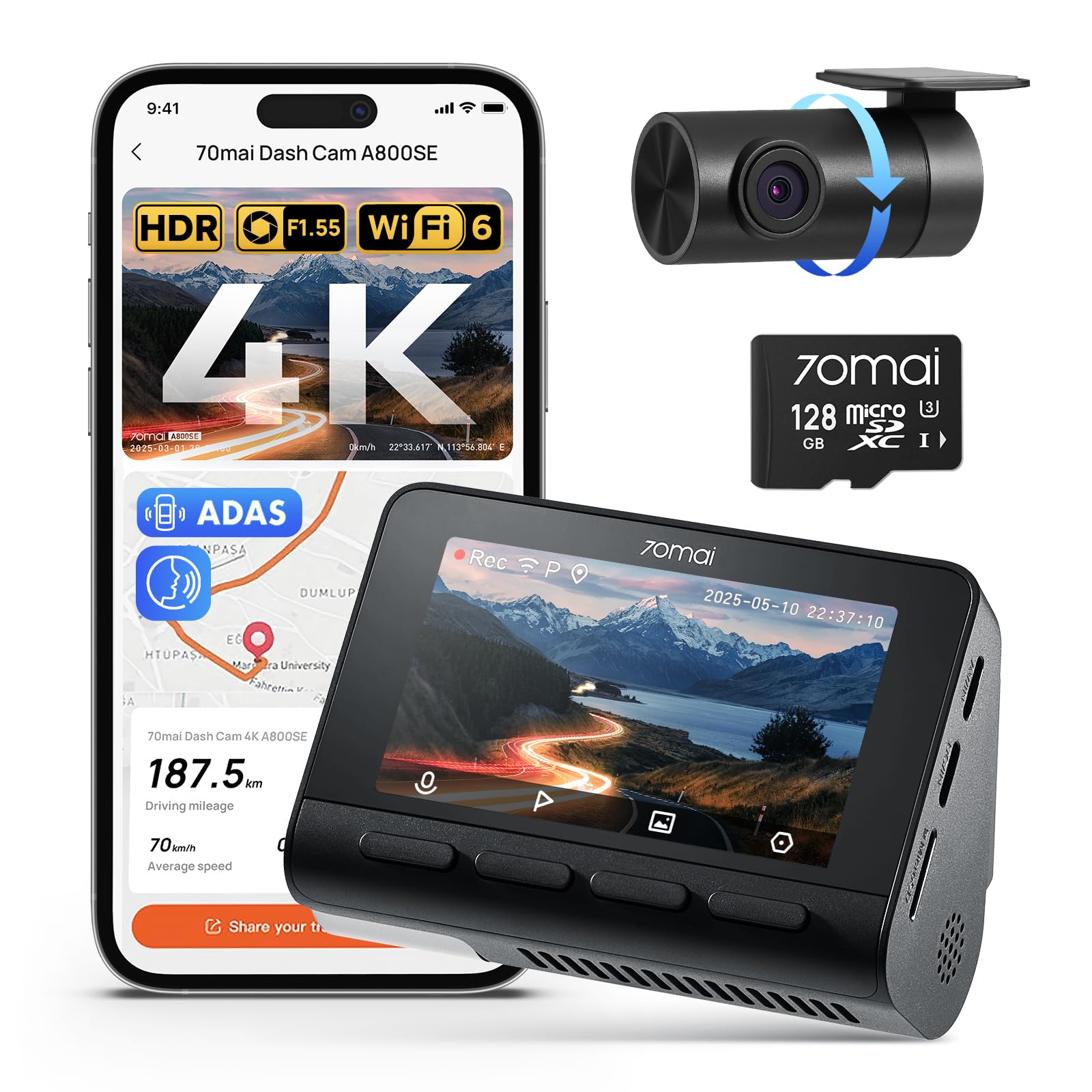
2. 70mai A800SE 4K Front and Rear Dash Cam
The F1.55 lens here is the single widest aperture on this list — and that is what wins at night.
Light gathering is where most dash cams quietly give up after sunset. The A800SE fights back with a 7-layer glass lens, an F1.55 aperture, and dual HDR processing that evens out exposure in tunnels, rain, and glare. Practically, that means the plate on the car in front of you still has readable characters at 10 p.m. instead of a glowing white rectangle.
The rear camera is worth a note because its lens adjusts. It can record inside the cabin or turn to face out the back window, so you choose your second angle rather than living with whatever the factory picked. Resolution is 4K up front and 1080P at the rear, and the included 128GB card holds a decent stretch of driving before loop recording starts overwriting. Wi-Fi 6 is the other upgrade that matters day to day — 70mai rates it up to five times faster than older Wi-Fi for pulling clips onto your phone. Buyers report about 45 minutes to mount it and describe the companion app as easy to navigate.
front-rear clarity: the night footage and the app experience. Plate detail after dark is the recurring theme in owner feedback, and the phone interface gets out of your way when you need a clip fast.
app setup fuss: the 140° front lens is narrower than the 170° units on this list. That is a deliberate trade — a tighter view means less edge distortion and denser pixels per plate, so it reads clearer but covers less of the shoulder. Parking surveillance also needs the optional hardwire kit, so budget for that separately.
Pick this when night driving is your main worry: the F1.55 aperture is the brightest lens here.
daily commuters your car sits in a garage and never needs overnight eyes.
3. BOTSLAB G300H Plus 4K Dual Dash Cam
A 0.45-inch-thick body that tucks against the glass and survives a baking dashboard.
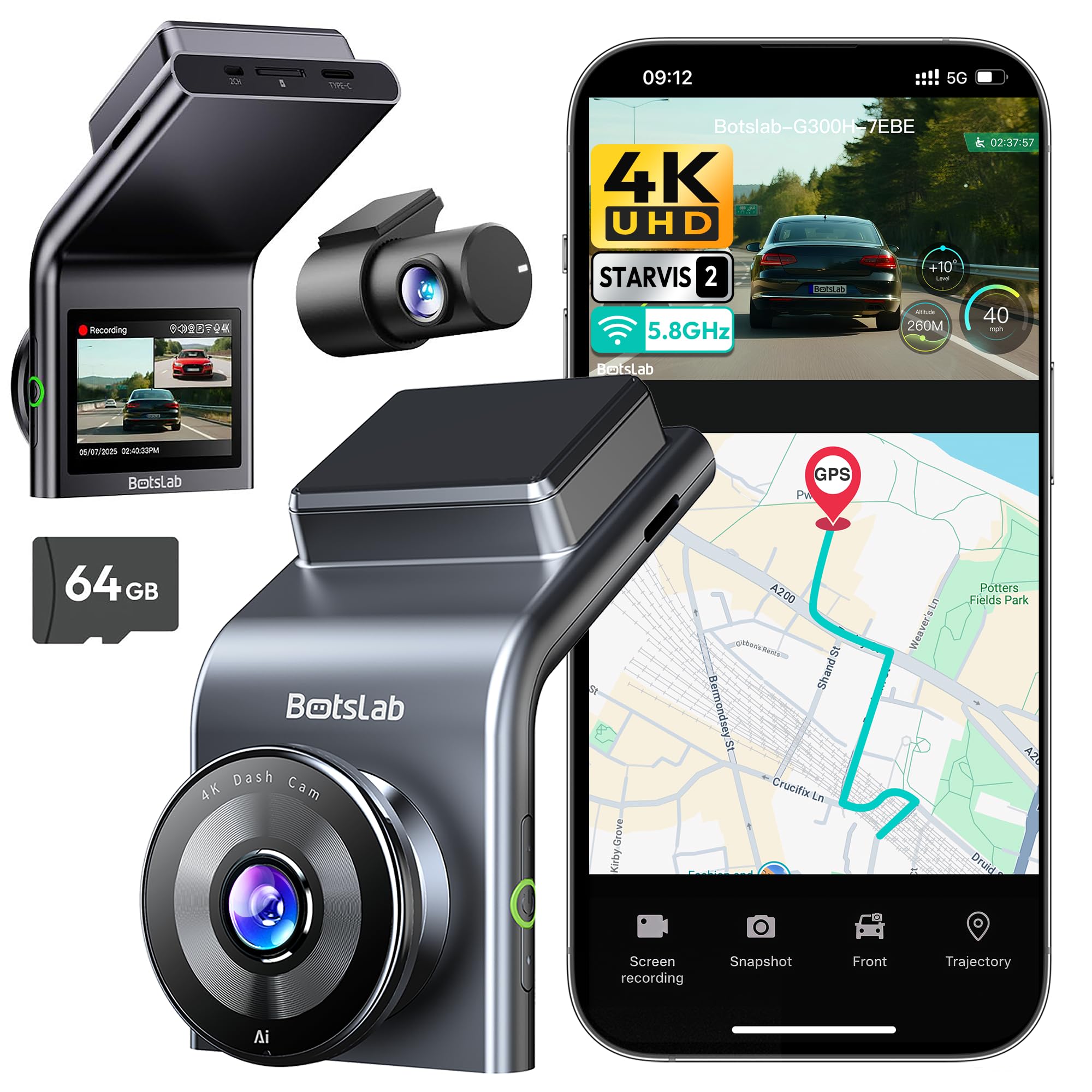
Mounting a camera behind your mirror usually means a bulky brick blocking part of your view. This one measures 2.28 inches deep by 4.13 inches wide by 0.45 inches tall — the flattest body on this list, and slim enough to hide in the mirror shadow. Meanwhile the TERUNSOUl three-channel unit measures 1.69 by 5.07 by 3.07 inches, so this is the easier fit if cabin space is tight.
The sensor is a STARVIS 2, which Botslab rates at twice the low-light sensitivity of a generic sensor, and the front lens opens to F1.5. Its 170° front view is wider than the 140° lens on the 70mai A800SE, so you capture more lanes at the cost of some edge softness. The built-in supercapacitor is the durability story: it keeps working from -20℃ to 70℃, which is exactly the range a windshield-mounted gadget faces in a real summer and a real winter.
Owners most often praise simple functionality, with build quality a close second. The included 64GB card gets you started, and the slot takes up to 256GB. Voice commands handle “take photo” and “video start” so your hands stay on the wheel. One quirk worth flagging up front: an iPhone can only hold one Wi-Fi connection at a time, so you cannot run CarPlay and the dash cam app together.
small windshields: hot-climate drivers who want a low-profile camera that will not cook in the sun.
limited support: the CarPlay Wi-Fi conflict and the smaller 64GB starter card.
4. REDTIGER 4K Front and 1080P Rear Dash Cam
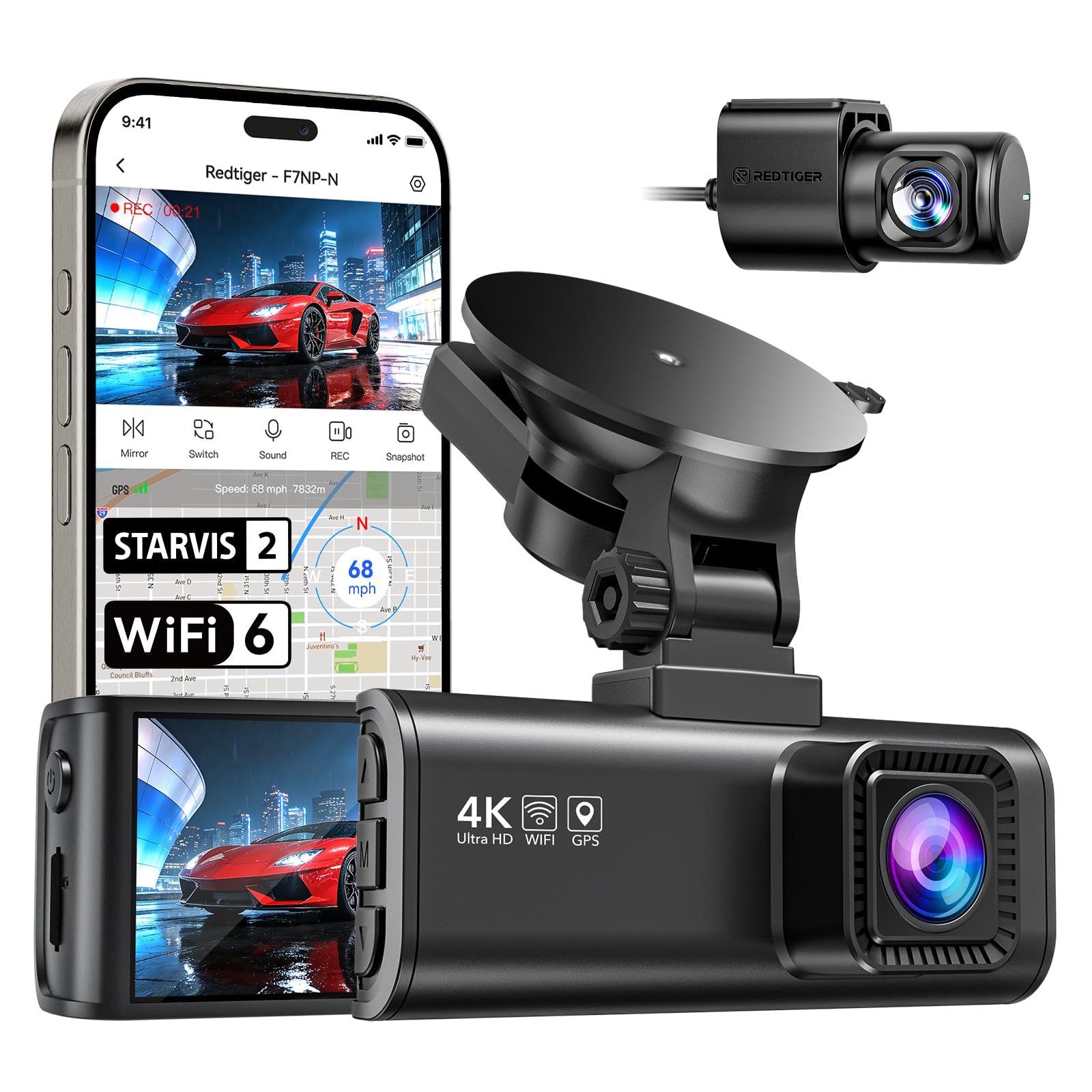
Twenty megabytes a second over Wi-Fi — you are pulling clips off your windshield in seconds.
The download speed is the headline here. Built-in 5.8GHz Wi-Fi pushes video to the Redtiger Cam app at up to 20MB/s, so a clip is on your phone before you have finished finding your insurance card. You can preview live footage, replay saved files, check GPS route and speed data, and run firmware updates without ever pulling the card out of the camera.
Footage comes from a STARVIS 2 sensor on the front lens paired with a 1080P rear, and both lenses run wide. HDR and WDR work together to balance a blown-out sky against a dark road, which is the classic scenario where plates vanish. The unit uses a supercapacitor instead of a battery, so heat and long parked hours are less of a worry. Owners praise video quality above all else, repeatedly citing sharp plate detail in both daylight and low light.
Two things to sort before you buy. The SD card is not included, so add a high-endurance microSD card to your order or the camera has nothing to record onto. And parking mode needs the hardwire kit, sold separately — the time-lapse and impact-triggered modes only activate with it. Reliability is the one area where feedback splits, so treat this as a camera that performs well for most but warrants keeping your receipt.
first-time buyers: you want clips on your phone fast and plan to add your own high-capacity card.
weak night rear: you want a card in the box on delivery day.
5. 70mai T800E 4K 3-Channel Dash Cam
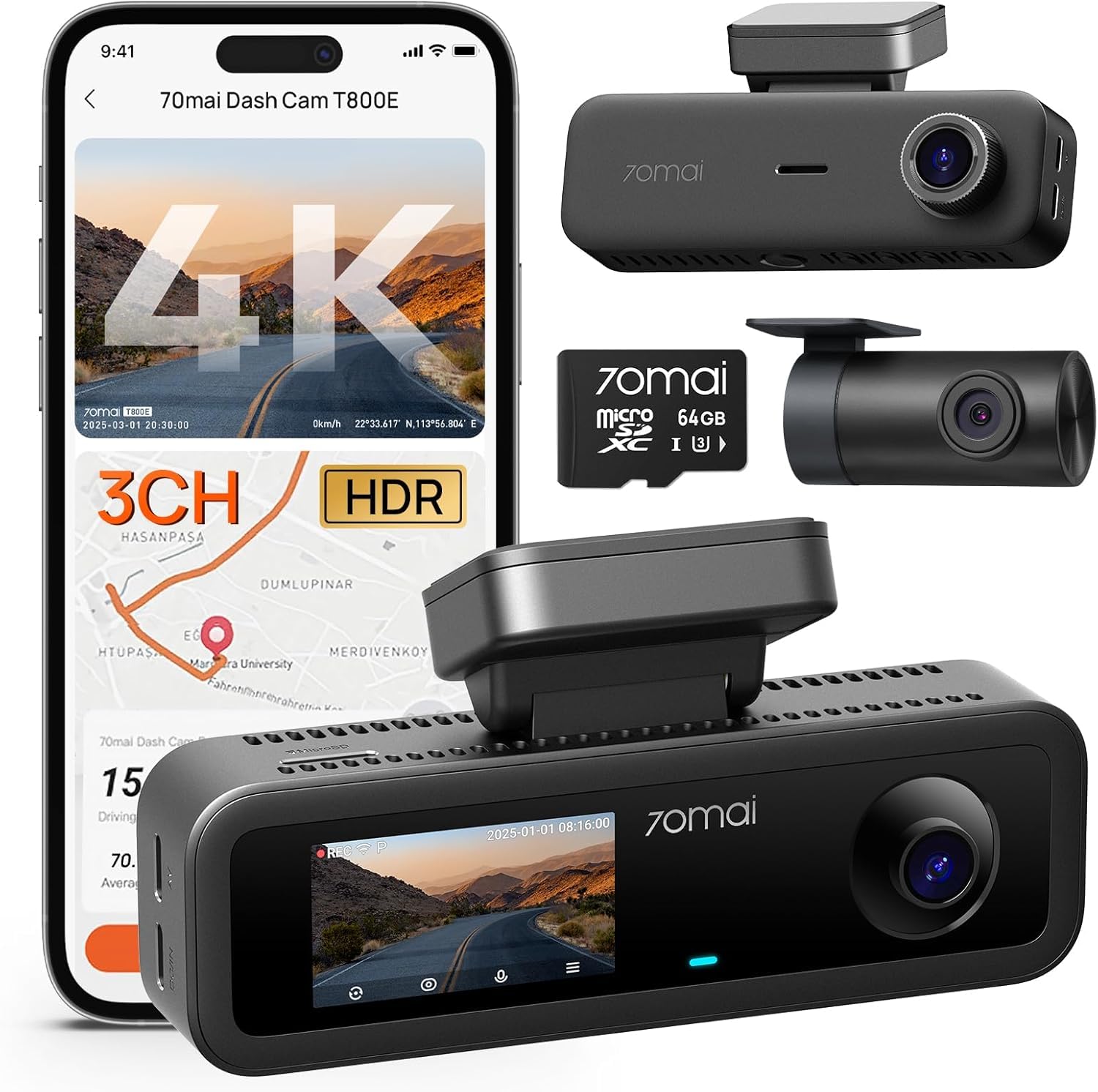
A cabin lens with switchable infrared — your passengers are visible even with the interior lights off.
If you drive for Uber or Lyft, the cabin angle is the one that settles disputes. This 70mai records 4K up front, 1080P at the interior, and 1080P out the rear, all at once. The interior lens has a trick the others do not: switchable infrared, so you can turn on IR for clear night footage of the cabin or switch it off when you do not need it. Advanced HDR and 3D noise reduction keep plates and road detail readable after dark, and the F1.55 aperture matches the brighter lens on the A800SE.
Wi-Fi 6 gets files onto the 70mai app at speeds up to 10 MB/s, so you are not sitting in the car waiting on a transfer. Built-in five-mode GPS logs your location, speed, and route onto the footage. Voice control handles photos, recording start, and locking important clips without your hands leaving the wheel. A 64GB card ships inside and the slot takes up to 512GB if you want weeks of footage before anything overwrites.
The supercapacitor is rated from 14°F to 140°F, which covers a cold Minnesota morning and a Phoenix dashboard in the same unit. One limitation to know: 4G connectivity is not supported, so this is a local-storage camera, not a cloud-streaming one. Owners describe the 4K front footage as sharp and note that the camera does not block their line of sight.
rideshare cabin lens
- Switchable IR lets the cabin lens see in total darkness
- Front, interior, and rear record simultaneously at 4K/1080P/1080P
- Supercapacitor rated from 14°F to 140°F
- 64GB card included, expandable to 512GB
bulky three-cam rig
- No 4G support — you cannot stream footage remotely
- Parking surveillance requires the separate hardwire kit (UP06 or UP03)
taxi drivers: rideshare and family drivers who need the cabin on record.
casual drivers: anyone expecting a cloud-connected camera.
6. ROVE R2-4K Dual PRO Dash Cam
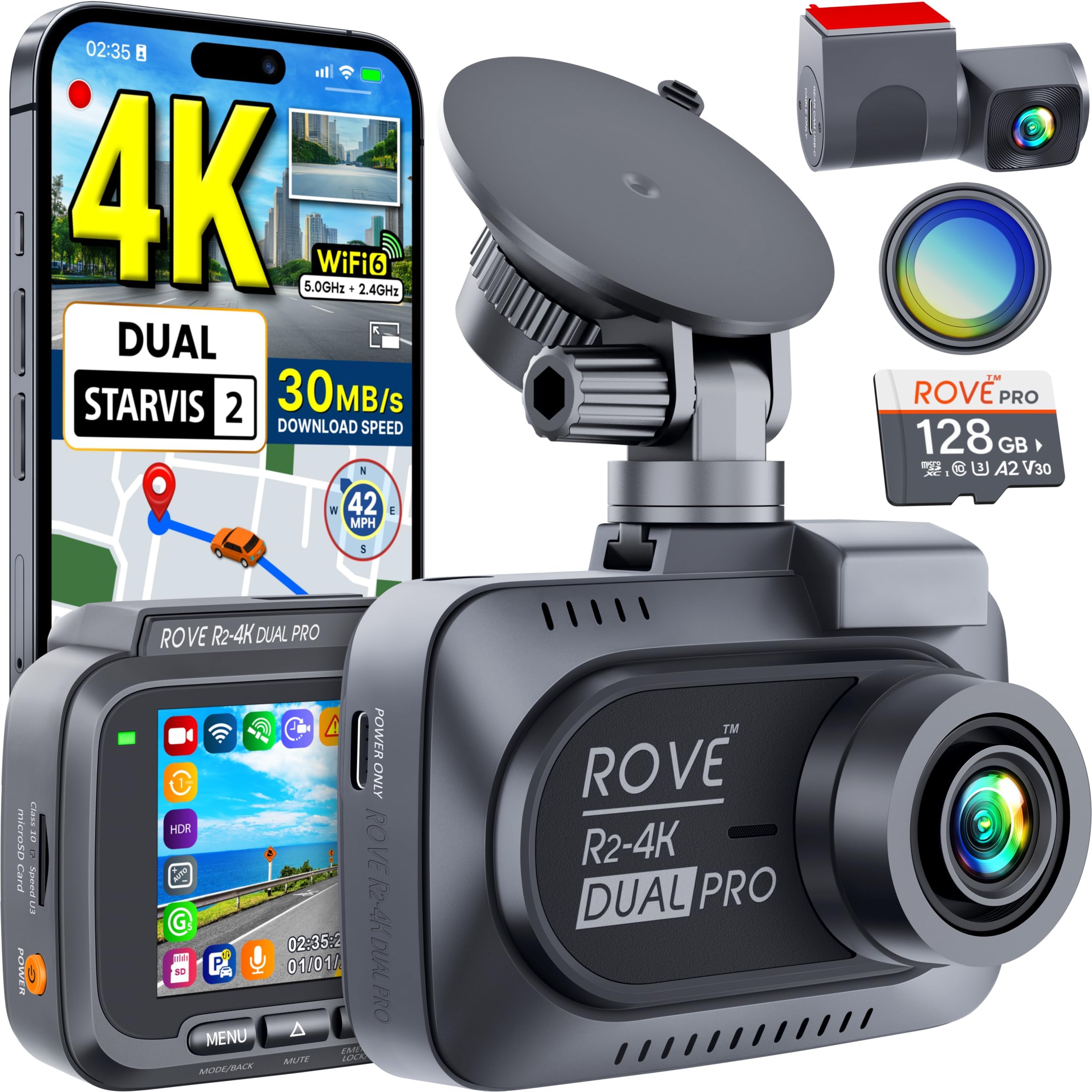
Two STARVIS 2 sensors, a 1TB card ceiling, and a polarizing filter already in the box.
Rear-resolution is where this one separates from the pack. The front records 3840x2160P at 30fps and the rear records 2560x1440P at 30fps — a 2K rear lens instead of the 1080P you get on most dual setups here. Both use Sony STARVIS 2 sensors, the IMX678 up front at 8MP and the IMX675 at the rear at 5MP, with F1.7 and F1.55 apertures respectively. The front view spans 150° and the rear 140°.
The max card ceiling is the other big number: 1TB, which is double the 512GB ceiling on the 70mai A800SE. A high-performance 128GB ROVE PRO card ships inside, tested for 4K recording without dropped frames, and a CPL filter (a circular polarizer that cuts windshield glare) is included rather than sold separately. Dual-band Wi-Fi 6 moves files at up to 30MB/s, the fastest transfer speed on this list. Quad-mode GPS pulls from four satellite systems — GPS, BEIDOU, GALILEO, and GLONASS — and stamps live speed and location onto every clip.
Parking mode gives you three choices: 1FPS time-lapse, motion detection, or collision detection, each producing a one-minute event clip in a locked folder with a voice alert on your next start-up. The caveat is honest and common to the category: the hardwire kit is sold separately. Feedback on reliability splits between units that run perfectly and a front camera that quits, so this is a pick to buy with warranty coverage in mind rather than one to gamble on.
long-haul trips: the 2K rear lens and the 1TB ceiling — ideal for long-haul and road-trip driving.
no rear cam: the separate hardwire kit for the parking modes.
7. VIOFO A229 Plus 3-Channel Dash Cam
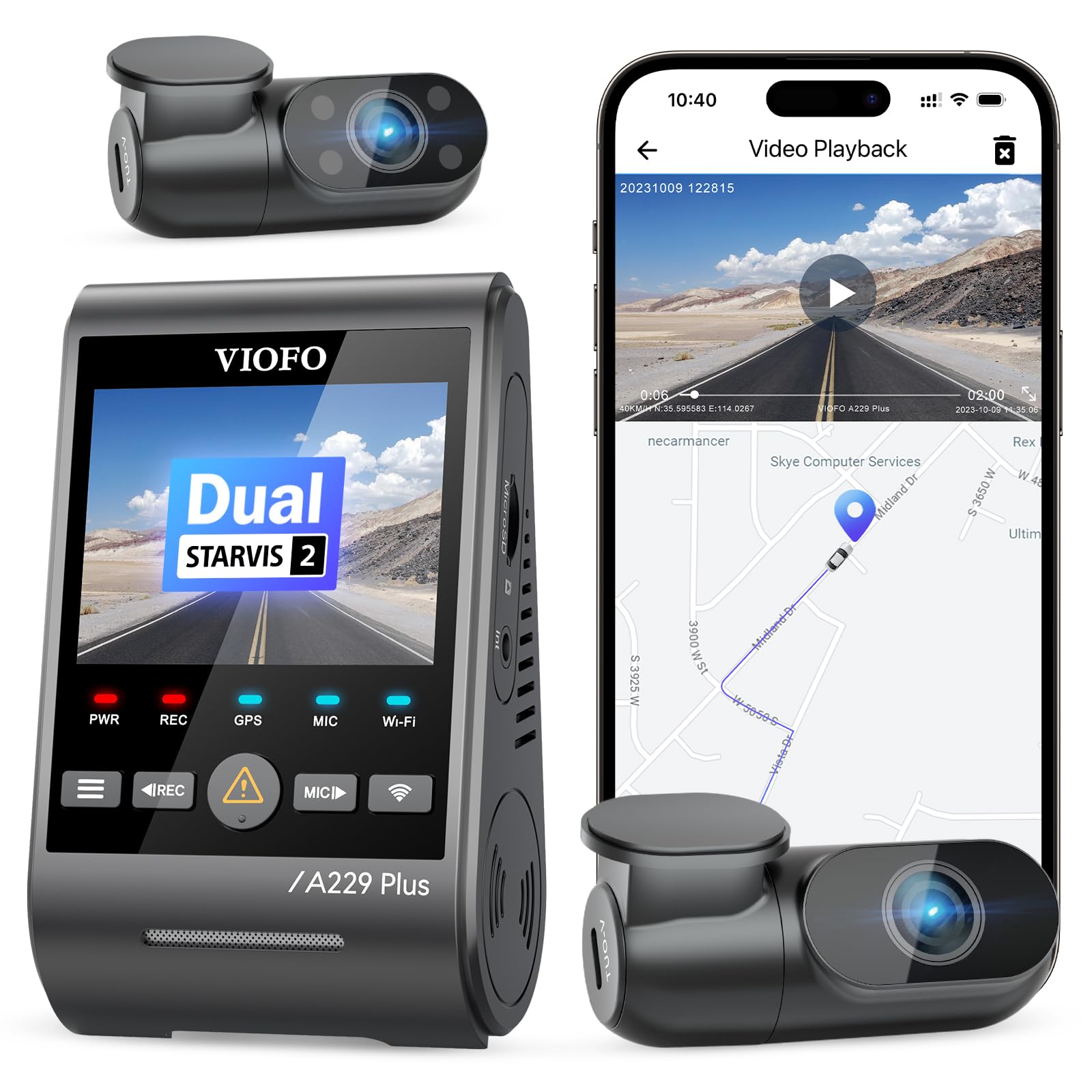
Four infrared LEDs fire automatically when the cabin goes dark — no light, still a clear picture.
This is the camera for recording a pitch-black interior. The cabin lens carries a built-in IR sensor and four infrared LEDs that switch on the moment light drops, producing sharp black-and-white detail of the whole cabin. The front and rear both record at 1440P while the cabin handles 1080P, and all three channels support HDR for balanced exposure across the frame.
Two Sony STARVIS 2 IMX675 sensors sit in the front and rear cameras — VIOFO rates the dynamic range and light sensitivity at 2.5 times that of the older STARVIS generation, which shows up as less noise and less motion blur on night recordings. Twelve voice commands cover photos, video locking, Wi-Fi toggling, and camera switching, so you never reach for a button in traffic. The Quad-Mode GPS module pulls from GPS, BEIDOU, GALILEO, and GLONASS for precise location and speed data on playback.
Owners praise video quality first, reliability second, and installation third. The compact interior and rear cameras make routing cables easier than a full-size unit. Connectivity is where the gripes live — Wi-Fi disconnections and app issues come up — so plan on pulling the card for long transfers rather than relying on wireless every time.
parking watch: taxi and rideshare drivers who need the cabin on file after dark.
simple setups: wireless transfers can be flaky, so keep a card reader handy.
8. REDTIGER F17 Elite 4K 3-Channel Dash Cam
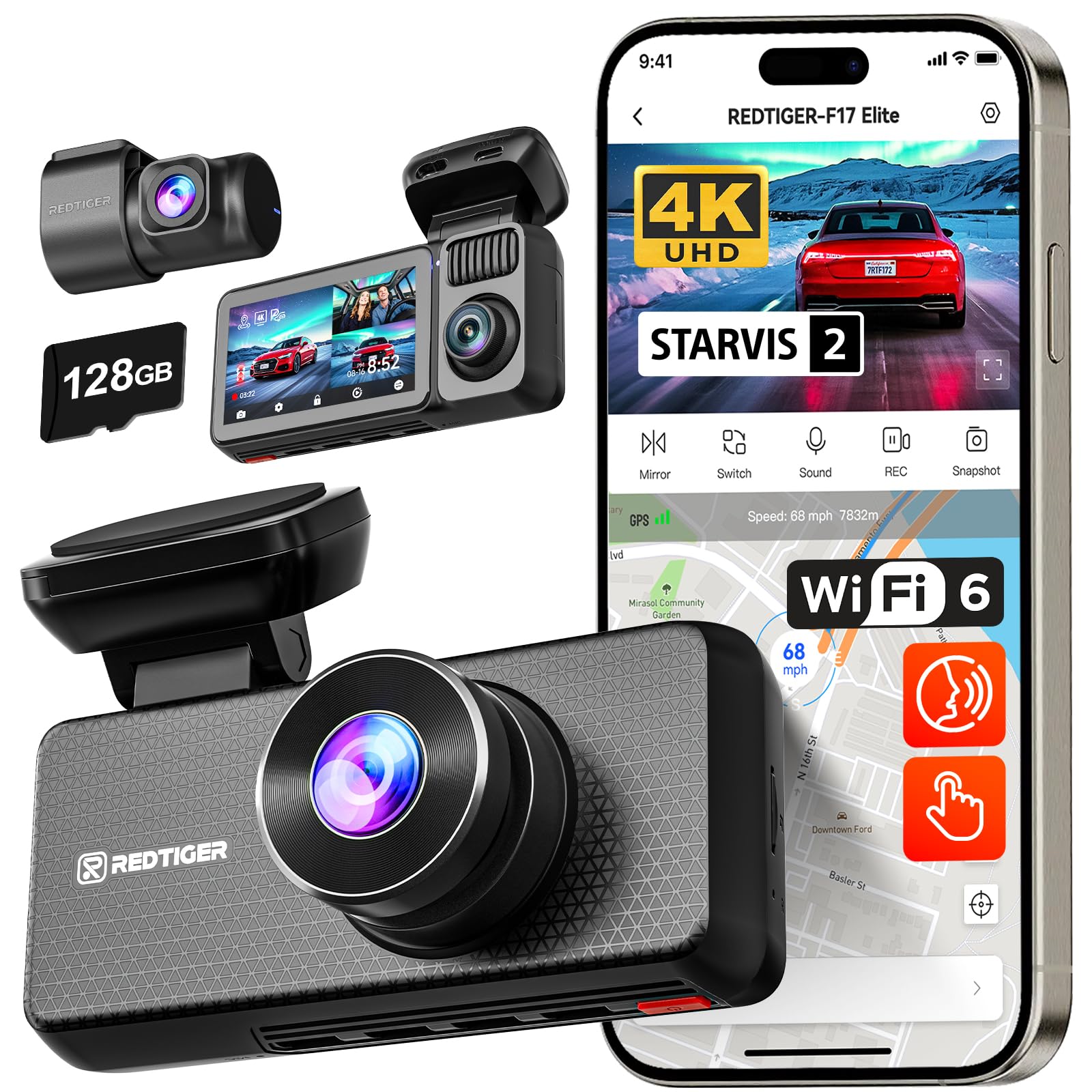
Full-color night vision on both the front and cabin lenses, where most cameras drop to grey infrared.
Traditional night footage goes black and white once the light fades. This F17 Elite keeps color on the front and cabin cameras, so a suspicious figure in a parking garage still has a jacket color, not just a silhouette. The front lens is the 8MP IMX678 sensor capturing true 4K, the rear is the 4MP IMX675 at 2.5K, and the cabin records 1080P — three sensors, three channels, one unit. HDR cuts glare and evens out the contrast between a bright oncoming headlight and a dark road.
Owners praise the sharpness of the 4K front footage most, followed closely by ease of use — saving and retrieving a clip is described as simple. A 128GB microSD card is pre-installed, loop recording overwrites the oldest files automatically, and the G-sensor locks event clips so they survive the overwrite. The slot takes up to 512GB. Wi-Fi 6 at 5.8GHz pushes downloads up to 30MB/s, GPS stamps location and speed onto every video, and voice commands plus a touchscreen cover control.
One recurring note is worth hearing: some units stop working when they get too hot in direct sun. A supercapacitor is inside and rated for extreme temperatures, but a windshield in a heat wave is still the hardest place on earth for any camera. Mount it in the mirror shadow where you can, and keep the 18-month warranty in your records.
premium builds: drivers who want color detail in the cabin and behind the car, not grey infrared.
tight budgets: heat — park in shade where possible and keep the warranty paperwork.
9. VIOFO A329S 4K+2K+2K Dash Cam

A 210-degree fisheye cabin lens that leaves no seat out of frame.
Most cabin cameras see the front seats and miss the back row. This one uses a 210° ultra-wide fisheye lens on the interior, which is the widest angle on this list by a wide margin and enough to cover the full cabin of a van or rideshare. The front records 4K at 30fps, the cabin 2K, and the rear 2K, with STARVIS 2 sensors on all three channels — the IMX678 up front and IMX675 sensors for the cabin and rear.
Storage is where the A329S goes beyond anything else here. It accepts an external SSD up to 4TB or a microSD card up to 512GB, which covers long recording sessions without constant overwriting. Wi-Fi 6 in the 5GHz band reaches up to 30MB/s, enough to move a one-minute 4K clip in under 10 seconds. The dual slim coaxial cables are built to resist electromagnetic and radio-frequency interference, so your camera cabling will not interfere with other electronics in the car. A CPL filter is included and pre-mounted on the front lens to cut reflections.
The honest downsides are price and setup. It sits at the premium end of this list, no card or SSD is included in the box, and the hardwire kit for parking mode is also sold separately. App connectivity gets mixed feedback — some find it works well, others run into connection trouble — so a card reader is a smart companion.
detail chasers: fleet drivers and heavy-mileage operators who want a 4TB storage path and a 210° cabin lens.
low-storage cards: a card or SSD and the hardwire kit — none of them ship inside.
Know the Specs
Aperture (the F-number)
Aperture is the size of the lens opening, written as an f-number. A smaller number is a bigger opening, which lets in more light and keeps plates readable after dark. An F1.55 lens pulls in more light than an F1.7, and both beat a typical F2.0 lens on a budget unit.
Field of View (the degrees number)
This is how wide the lens sees, measured in degrees. A 170° front lens covers more lanes and shoulder than a 140° lens, but the wider view spreads the same sensor pixels across more area. A tighter lens often reads a plate more cleanly at distance.
Channel Count
One channel is front only. Two channels add a rear lens. Three channels add a cabin lens pointed at the passengers. Each extra channel multiplies the footage stored, so size your memory card for the number of channels you run.
Memory Card Support
This is the largest microSD card the camera will recognize. Higher ceilings mean longer before loop recording starts overwriting. Check whether a card ships in the box — a camera with an empty slot needs a card ordered on day one.
Common Questions
Will a dash cam drain my car battery when parked?
Do I need a special memory card for a dash cam?
Can a dash cam record at night through a tinted windshield?
How long does the footage last before it gets overwritten?
Is a three-channel dash cam worth it over a front-and-rear setup?
What temperature can a dash cam handle on a hot dashboard?
Will my phone connect to the dash cam and CarPlay at the same time?
Do I need to buy a separate hardwire kit for parking mode?
Is GPS worth having on a dash cam?
Can I install a dash cam myself or do I need a professional?
The Bottom Line
The most complete setup here is the TERUNSOUl 4K 3-Channel, and it is the one I would hand to most buyers. Three channels of simultaneous recording, a 128GB card already inside, and GPS stamped onto every clip means you are covered front, back, and inside without buying a single accessory on day one. It also carries the strongest owner rating here — 4.5+ stars across 450+ reviews — and it is the only three-channel pick that ships with a memory card.
If night footage is your worry rather than channel count, the 70mai A800SE has the widest aperture on this list at F1.55 and an adjustable rear lens that can face the cabin or the road behind you. Rideshare drivers should jump to the 70mai T800E for its switchable infrared cabin lens. And if you run a fleet or need serious storage headroom, the VIOFO A329S handles an external SSD up to 4TB with a 210° fisheye cabin view.
How we choose
We do not accept paid placement. Every pick is matched to a real buyer and a real use-case; we do not hands-on test units.
Sources
Specifications: manufacturer listings and product documentation. Review insights: verified customer reviews, as of November 2026. Pricing: not shown on this page (it changes often); check the current price via the retailer link.
As an Amazon Associate, Tactical Gear Guy earns from qualifying purchases. This does not affect which products we feature.