Specs are compiled from manufacturer listings and verified buyer reviews and can change over time — please confirm the key details on the product page before buying.
Most compact binoculars fail for one boring reason: they gather so little light that the picture goes dim and grainy the moment the sun drops. The fix is not the biggest glass you can find. It is to match three numbers — magnification, objective lens size, and eye relief — to what you actually do with them. The picks below cover all of it, from a close-focus specialist that shows you a butterfly’s wing at arm’s length to pocket models built for a rucksack.
This guide is built by comparing the manufacturers’ published specifications and the patterns across verified customer reviews, so you get each pick’s real strengths and trade-offs instead of marketing spin.
A compact pair should disappear into a jacket pocket and still hold a sharp, steady image. This guide ranks the top rated compact binoculars by their strongest real-world use. top rated compact binoculars are the ones that earn their place in your pack.
Top Picks


How To Choose The Best Top Rated Compact Binoculars
The first thing to settle is what you point them at. A bird on a far fence line and a beetle on a leaf demand completely different glass. Answer that first and the spec sheet narrows itself.
Match magnification to steady hands
Magnification is the “X” number — 8x makes the subject look eight times closer. Higher magnification shrinks your field of view and amplifies every hand tremor. A 6.5x or 8x model holds steadier in the field, which is why youth and travel designs lean low.
Objective lens and light gathering
The second number is the objective lens diameter in millimeters — the front glass that collects light. A 25mm lens keeps the barrel pocket-sized. A 32mm or 42mm lens pulls in more light for dawn and dusk, at the cost of bulk.
Eye relief for glasses wearers
Eye relief is the gap between the eyepiece and your eye where the full picture appears. Around 15mm works for most people. If you wear glasses, look for longer relief and twist-up eyecups so your lenses do not fight the binocular.
Waterproofing and armor
Nitrogen purging and O-ring seals keep internal fog out when the temperature swings. Rubber armor protects against knocks on a rock or a truck bed. For anything beyond fair-weather use, treat both as required rather than optional.
Side-by-Side Comparison
| Model | Best For | Magnification | Objective Lens | Eye Relief | Amazon |
|---|---|---|---|---|---|
| Pentax Papilio II 6.5×21★ Best Overall | Close-up nature and all-round viewing | 6.5x | 21 mm | 15 mm | Amazon |
| Bushnell PowerView 10×42Best Value | Budget all-purpose glassing | 10x | 42 mm | — | Amazon |
| Vortex Bantam HD 6.5×32Best for Young Eyes | Kids and petite adults | 6.5x | 32 mm | 18.7 mm | Amazon |
| Nikon Trailblazer II 8×25 | Packing light on trips | 8x | 25 mm | 10 mm | Amazon |
| Leupold BX-1 Rogue 10×25 | Field carry while hunting | 10x | 25 mm | 15 mm | Amazon |
| Nikon PROSTAFF P3 10×30 | Birding and day hikes | 10x | 30 mm | 15.4 mm | Amazon |
| Nocs Provisions Standard Issue 10×25 | Travel and everyday carry | 10x | 25 mm | 10 mm | Amazon |
| Vortex Vanquish 10×26 | Backpack hunting and events | 10x | 26 mm | 16 mm | Amazon |
| Pentax AD 8×25 WP | Mountaineering and travel | 8x | 25 mm | 21 mm | Amazon |
Detailed Reviews
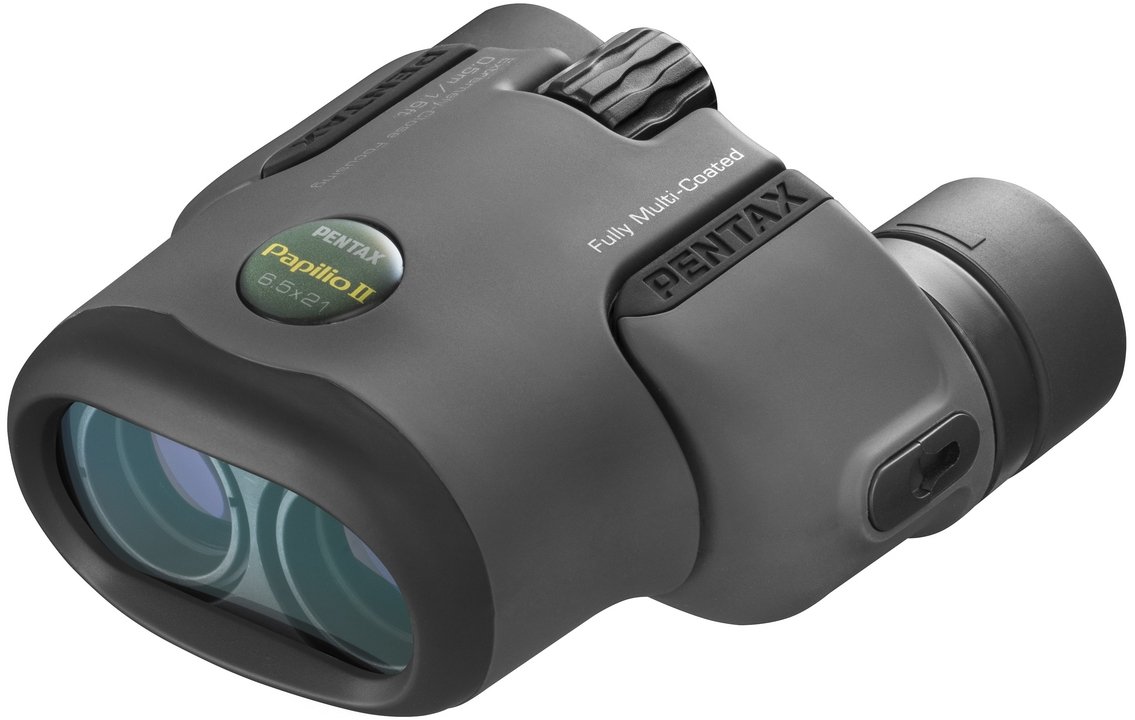
1. Pentax Papilio II 6.5×21 Binoculars
Our pick — 4.5+★ from 800+ verified ratings; the strongest balance of quality and price.
Pentax’s close-focus oddity is the most versatile compact here.
The headline here is a close-focus figure you will not find on most compact glass: Pentax rates the Papilio II to focus at 50 centimeters, roughly an arm’s length. That one number changes what the binocular is for. Point it at a flower, a beetle, or a painting and it delivers a magnified image instead of a blur. Owners treat that trick as the reason they bought it.
The rest of the spec sheet backs up the party piece. A 6.5x magnification keeps the picture steady enough to study tiny detail without the jitter a higher power would add. Fully multi-coated optics and a Bak 4 prism carry bright, color-true light through to your eye, and aspherical lens elements keep the corners of the view as sharp as the middle. The 393-foot field of view is the tighter of the two compared here — the Nikon Trailblazer II reaches 435 feet — so you trade a sliver of width for that close-up range.
Where it earns daily carry: a rubber-coated body shrugs off knocks, the helicoid eyecups let you dial eye relief to taste, and a +/-5 diopter range means two different prescriptions in one pair of eyes can each be corrected on its own lens. Neoprene strap, case, and lens cover all come in the box. Think of it as one binocular a curious kid and a curious adult can share.
Why people keep them
- 50 cm close focus turns insects, flowers, and artwork into a viewing subject
- 6.5x power holds steady, so small detail stays readable
- Independent +/-5 diopter adjustment for mismatched eyes
- Fully multi-coated Bak 4 optics with aspherical elements for edge-to-edge sharpness
Where it gives ground
- 393-foot field of view is narrower than the Nikon Trailblazer II’s 435 feet
- The 21 mm objective lens is the smallest here, so low-light reach has limits
Reach for this if: you want to study the world up close and at distance with one pair, and steady hands matter more than raw power.
Look elsewhere if: you need every bit of width for sweeping a wide field at dusk.
2. Bushnell PowerView 10×42 Compact Roof Prism Binoculars
A 42 mm front lens on a pair you can still call compact.
If light gathering is your worry, start with the glass: this Bushnell carries a 42 mm objective lens, the largest objective in this lineup and exactly double the Pentax Papilio II’s 21 mm. Bigger front glass means more light reaches your eye, so a distant bird stays bright rather than turning into a gray smudge. Multi-coated lenses and BK-7 prism glass do the rest of that work.
The trade-off for that lens is size — a 42 mm barrel is chunkier than a 25 mm pocket model. Bushnell answers with a non-slip rubber armor shell, a diamond-cut texture down the sides for grip, and a roof prism layout that keeps the shape slimmer than an old-school porro. The 10x magnification pulls subjects in tight, and the center focus ring is smooth enough to track a moving animal. A neck strap, carry pouch, cleaning cloth, and lens caps ship in the box.
What wins owners over is how it feels in the hand for the tier — the review pages read like people surprised to find high-end heft and finish on a mainstream price. Two things to know before you buy. Some eyes want the eyecups set at exactly the right height, because a small drift off-center blanks the image. And the eyecup is the part that occasionally fails, so treat it kindly when you fold it down.
The value read: the biggest objective lens on the list paired with a proven roof-prism body, aimed squarely at birders and weekend glassers.
Fair warning: the eyecups reward a gentle touch, and the eye position has to be set right for the full picture.
Suits: anyone who wants maximum light for the money and does not mind carrying a slightly larger barrel.
Not for: a jacket-pocket carry where 25 mm glass is the only thing that fits.
3. Vortex Bantam HD 6.5×32 Youth Binoculars
Built for small faces, but plenty of grown-ups quietly claim them.
The specs read forgiving for beginners. A 6.5x magnification is low enough that a child can hold the view still without a tremble ruining it. The 32 mm objective lens gathers more light than a 25 mm pocket model without turning into a brick. And the eye relief runs a generous 18.7 millimeters — nearly double the Nikon Trailblazer II’s 10 mm — so glasses wearers and small faces both get a full picture without mashing their eye into the glass.
The HD optical system uses select glass elements to sharpen resolution and hold color true, and XR lens coatings on every air-to-glass surface push light transmission for duller conditions. The 7.6-degree field is wide enough to catch movement quickly. Rubber armor, a nitrogen purge, and water-and-fog-proof sealing mean a dropped pair survives the trail. Add Vortex’s unlimited lifetime VIP warranty and you have a pair backed well past the age a kid outgrows it.
One honest catch: this is not a featherweight. It runs larger and heavier than a tiny pocket pair, and a child around ten or under may find it too much to hold steady for long. For everyone else — parents, petite adults, hunters scanning open ground — it is the value pick that keeps the framing stable.
The fit that sells it: wide eye relief and a low power that steadies the image, aimed at young shooters and short faces.
The honest caveat: for very small children it is on the heavy side, so save it for older kids.
Buy it for: a starter pair that will outlive the phase, with a warranty behind it.
Skip it for: a toddler who needs the lightest possible glass.
4. Nikon Trailblazer II 8×25
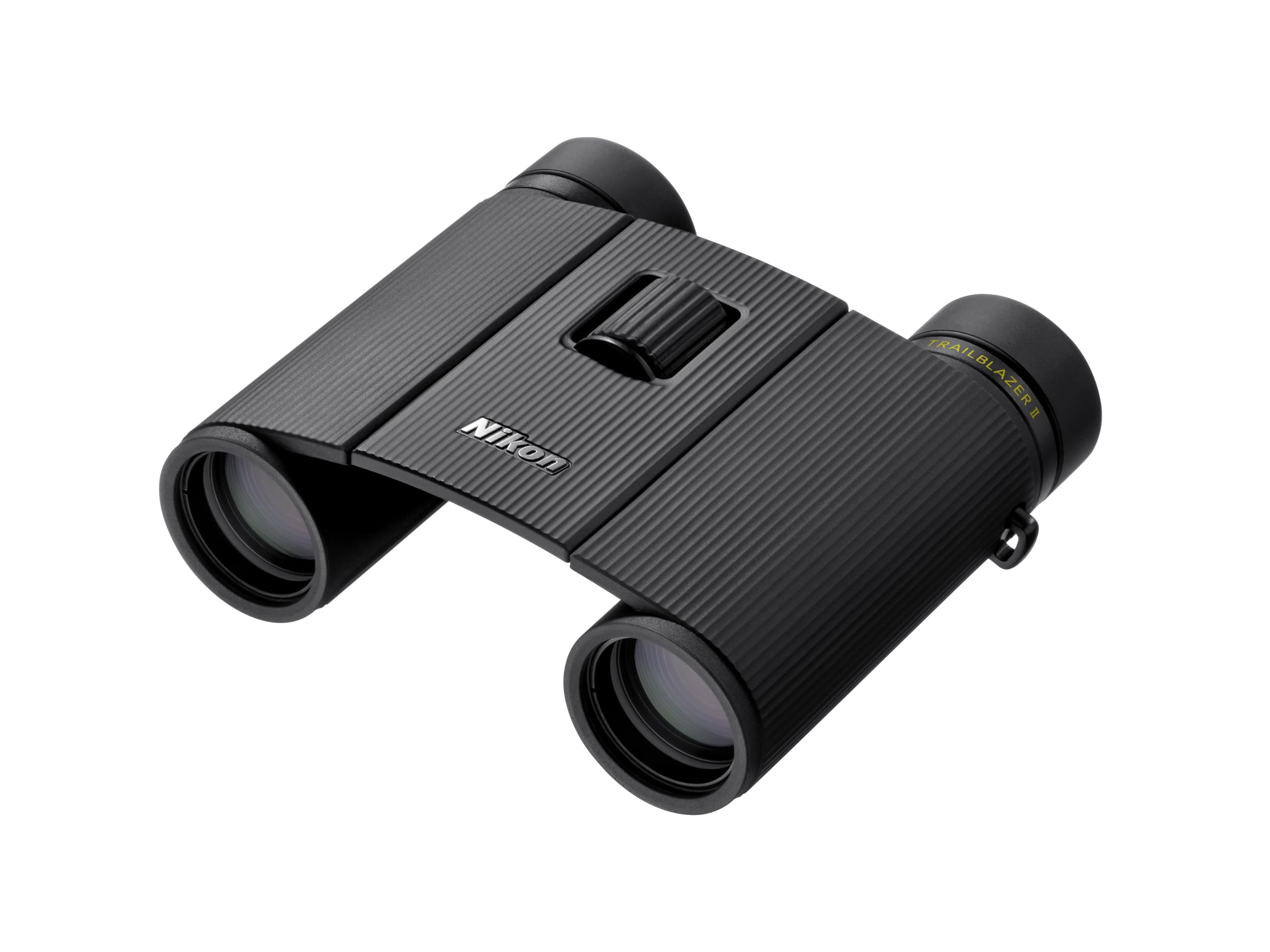
An 8×25 that slides into a hip-belt pocket and disappears.
Trail weight drives this design. Its 435-foot field is the widest here, so a moving bird stays in view on a bouncy hike.
Multi-layer-coated lenses with a large objective hold brightness up, and the rubber-armored body takes shock and grip in stride. Turn-and-slide eyecups with multi-click stops let you set the eye distance without fiddling. It is built to shrug off rain and rapid temperature swings, so a wet mountain pass is not a problem.
Two things stack up against it. The eye relief is just 10 millimeters — the tightest here — which means glasses wearers will struggle to see the full circle. And the protective lens caps are the design gripe; they feel like an afterthought compared with the glass. For a hiker-biker-traveler who values small and light above all, the rest of the package is genuinely compelling.
Where it shines: the widest field of view in the group, so scanning open terrain feels quick.
The honest caveat: that 10 mm eye relief is unforgiving for people who wear glasses.
Your match if: portability comes first and you rarely glass with spectacles on.
Think twice if: your glasses stay on for every look.
5. Leupold BX-1 Rogue 10x25mm

A field-hunting pair that hides on your harness until you need it.
This is the extreme one for magnification. A 10x power puts the subject close and is the highest number seen next to the Pentax Papilio II’s 6.5x — 54% more reach on paper. The cost is an exit pupil of 2.5 millimeters, the smallest here, so the image wants good light. During the day and into early evening it is sharp and clean; deep dusk is where it starts to work harder.
Leupold’s inverted porro prism layout tucks the whole thing into a genuinely small, light shell without giving up optical performance. A fully multi-coated system reduces glare in harsh light for long glassing sessions. The aluminum body wears a rubber armor coat that grips in wet conditions, and it is built waterproof and fog proof. A central focus wheel handles the adjustment, and +/-5 diopters let each eye be set separately.
What you will notice first is the optics — clear enough that owners compare them to larger Leupold glass. The one thing to watch is durability of the strap attachment; the shoulder-strap holder is the piece that lets the team down if you are hard on your gear. Pair that with the small exit pupil and this is a fair-weather, daylight field tool rather than a dedicated night binocular.
What earns its keep
- 10x power delivers the longest reach in the lineup
- Inverted porro prism keeps the body compact and light
- Fully multi-coated optics tame glare in harsh sun
- Rubber armor and a waterproof build take field abuse
The fine print
- 2.5 mm exit pupil keeps it a daylight-first tool
- The shoulder-strap holder is the weak point for heavy handling
Go for it if: you want maximum power in a small hunting companion and shoot in good light.
Consider another: if your glassing hours run deep into twilight.
6. Nikon PROSTAFF P3 10×30

The balance point between a pocket pair and a full-size binocular.
A 30 mm objective lens sits right between the tiny 25 mm pocket models and the chunky 42 mm glass, and that is the whole idea. You get a 10x pull for distant birds and a barrel still compact enough to drop in a backpack. The 346-foot field of view is middle of the road, but the eye relief at 15.4 millimeters keeps a full picture available both with and without glasses.
The optics lean on multilayer coatings to cut reflections and boost contrast, plus a silver-alloy prism coating for true-to-life color. O-ring seals and nitrogen gas purging keep fog and water out through rain, snow, and sharp temperature changes. The fiberglass-reinforced polycarbonate frame wears rubber armor for grip, and turn-and-slide eyecups adjust for daily use.
It earns its spot on versatility more than on any single showpiece number. Owners routinely toss it in a ruck for a day hike and come back happy with the clarity. The compromise is nothing dramatic — a 3 mm exit pupil means it favors daylight, and you are paying above the entry tier for the middle-size formula. For most people who want one pair that does a bit of everything, that is a fair deal.
The case for it: the 30 mm middle size walks the line between pocketable and light-gathering.
Where it holds back: the 3 mm exit pupil prefers daylight, so twilight views are not its reason to exist.
The right call if: you want a single pair that handles birding, hiking, and sports without a second thought.
Look elsewhere if: you glass deep into evening and need a bigger exit pupil.
7. Nocs Provisions Standard Issue 10×25

A 10x roof-prism pocket pair that actually likes getting wet.
The waterproof rating is the standout line. This pair is rated IPX7, which means it can survive a dunking in up to three feet of water for 30 minutes — far beyond what a fair-weather pocket model handles. A medical-grade O-ring assembly and injected nitrogen gas stop internal fog, and the scratch-proof body keeps up with the abuse. If you see it as a travel companion, that rating alone earns the spot.
The optics use fully multi-coated glass with a Swiss-designed Bak 4 prism, and the 315-foot field of view is the tightest in the group. The 10x power pulls subjects close, but that field of view and a 2.4 mm exit pupil mean it wants decent light. A central focus system and a multi-stop twist-up eyecup with three positions help fine-tune the view for glasses or bare eyes. Nocs rates the weight at 11.85 ounces.
What people rave about is the look and the grip — the Rugged Wave Grip pattern keeps it from slipping in a wet palm, and the colorways are a step away from all-black utility. A “No-Matter-What” lifetime warranty backs it. The catch is the narrow field of view compared with the Nikon Trailblazer II; for sweeping wide areas you notice it. For a beach day, a bird feeder, or stargazing off a deck, it is a lot of binocular for the money.
The standout: IPX7 protection at three feet for thirty minutes is the real story here.
The trade: that 315-foot field of view is the narrowest here, so you scan a little slower.
Great for: the traveler who ends up near water and wants a pair that shrugs it off.
Not the pick if: wide-field scanning is your main use.
8. Vortex Vanquish 10×26 Reverse Porro Prism

A 10×26 backpack hunt companion with a warranty that outlasts the trail.
The build says field tool. A 10x magnification with a 26 mm objective makes this one of Vortex’s smallest, lightest, most compact binoculars, and it wears full rubber armor for grip and durability. Fully multi-coated lenses push light and resolution through so the image stays clean and crisp. Nitrogen purging and O-ring sealing keep it waterproof and fog proof. Twist-and-lock eyecups adjust to your face, and the eye relief at 16 millimeters helps glasses wearers find the view.
Owners lean on this as a mid-price hunting pair, and it holds up for checking 100-yard targets and backpack hunts. A 294-foot field of view is the narrowest in the group, and the exit pupil at 2.6 mm means it is best in daylight. Pair that with a central focus wheel and the trade is clear — a sharp, precise image that asks for decent light.
Where Vortex charges a premium is behind the glass: the unlimited, unconditional, lifetime VIP warranty is fully transferable and covers repair or replacement of a damaged unit. That is the kind of protection you keep long after the hunt. The one spot to size up is the narrow field of view versus the wide Nikon above; if you want to sweep a huge area, this is not the tool. For a compact backpack pair that stays close and takes a beating, it is an easy recommendation.
The warranty story: an unlimited, unconditional, transferable lifetime VIP warranty is the real reason to buy this one.
The narrow trade: 294 feet of view is the smallest here, so wide scanning runs slower.
Worth it for: hunters and hikers who want a compact 10x backed for life.
Step back if: a wide field matters more than warranty depth.
9. Pentax AD 8×25 WP

Long eye relief and a waterproof shell built for a coat pocket.
Sharp eyes behind a pair of glasses get the longest gap to the eyepiece here — 21 millimeters of eye relief, which beats the Nikon Trailblazer II’s 10 mm outright. That gap is the space where the full picture sits, so you can keep your spectacles on and still see the whole circle. An 8x magnification with a 25 mm objective lens keeps the barrel small enough to stash in a coat pocket for a hike or a live event.
Multi-layer coatings push light through a lightweight, fiber-reinforced polycarbonate chassis for bright, true-to-life images across a range of conditions. The body is waterproof and nitrogen-filled to JIS Class 6, which rates it submersible to a meter — real protection in extreme weather, not just a drizzle. The reinforced frame stays rigid but light enough to carry all day.
Two small quirks come with the design. The hinge feel is a touch looser on newer units and the eye cups want to stay in the “in” position for the right picture. Neither is a deal-changer. For the glasses wearer who wants one compact waterproof pair for travel and mountaineering, this is the model to reach for.
The pick of the pack: at 21 mm of eye relief it is the most glasses-friendly glass in the lineup.
The adjust time: a slightly looser hinge and a specific eyecup position take some settling in.
The one to choose if: glasses are non-negotiable and you want a waterproof 8x for the trail.
Look on if: you demand a rock-solid hinge feel from day one.
Know the Specs
Magnification and Objective Lens (the X and the mm)
Every compact binocular is listed as two numbers, like 8×25. The first is the magnification — how many times closer the subject looks. The second is the front lens diameter in millimeters, which sets how much light the glass gathers. A bigger objective gives a brighter picture but a chunkier barrel. A lower magnification holds steadier in the hands and widens your view.
Exit Pupil and Brightness
The exit pupil is the small circle of light that reaches your eye, and it tends to shrink as the objective lens shrinks. A larger exit pupil can feel brighter at dusk; a smaller one keeps the body slim. Divide the objective by the magnification to compare them on paper, then weigh that against how much bulk you will carry.
Eye Relief for Glasses Wearers
Eye relief is the distance from the eyepiece where your eye sees the full field of view. Around 15 mm suits most bare-eyed users. If you wear glasses, you generally want a longer figure and twist-up eyecups so the lenses do not crowd the view. A short eye relief of 10 mm can force glasses wearers to peek around the edges.
Waterproof and Fog Proof Ratings
Nitrogen purging pushes moisture out of the barrel so internal fog does not form when the temperature drops. O-ring seals keep water from getting in. An IPX7 rating means a dunk in shallow water is survivable. If you plan to use the glass in weather, treat waterproof and fog proof as essentials, not luxuries.
Common Questions
Are 10×25 compact binoculars good for bird watching?
What does eye relief mean if I wear glasses with binoculars?
Is 8x or 10x better for compact binoculars?
Can compact binoculars focus close enough to see insects?
Do I need waterproof binoculars for hiking?
How long does the lens coating last on compact binoculars?
Are compact binoculars strong enough for stargazing?
What is the difference between roof prism and porro prism binoculars?
Can kids use an adult compact binocular?
Should I carry a compact binocular or a spotting scope?
The Bottom Line
For most people, the pick that justifies the whole list is the Pentax Papilio II 6.5×21, because its 50 centimeter close focus turns a compact pair into something you point at the world up close and far away. If you want the widest view in the smallest pocket, the Nikon Trailblazer II 8×25 gives you 435 feet of field in a barrel you forget you are carrying. And for glasses wearers who need a waterproof trail companion, the Pentax AD 8×25 WP and its 21 mm eye relief is the one to reach for.
How we choose
We do not accept paid placement. Every pick is matched to a real buyer and a real use-case; we do not hands-on test units.
Sources
Specifications: manufacturer listings and product documentation. Review insights: verified customer reviews, as of November 2026. Pricing: not shown on this page (it changes often); check the current price via the retailer link.
As an Amazon Associate, Tactical Gear Guy earns from qualifying purchases. This does not affect which products we feature.